Pew Research Center

FOR RELEASE JUNE 15, 2024

Most Black Americans Believe U.S. Institutions Were Designed To Hold Black People Back

Those who experienced racial discrimination are more likely to say these institutions intentionally or negligently harm Black people.

BY Kiana Cox

FOR MEDIA OR OTHER INQUIRIES:

Communications Department
202.419.4372
www.pewresearch.org

RECOMMENDED CITATION

Pew Research Center, June 2024, "Most Black Americans Believe U.S. Institutions Were Designed To Hold Black People Back"

About Pew Research Center

Pew Research Center is a nonpartisan, nonadvocacy fact tank that informs the public about the issues, attitudes and trends shaping the world. It does not take policy positions. The Center conducts public opinion polling, demographic research, computational social science research and other data-driven research. It studies politics and policy; news habits and media; the internet and technology; religion; race and ethnicity; international affairs; social, demographic and economic trends; science; research methodology and data science; and immigration and migration. Pew Research Center is a subsidiary of The Pew Charitable Trusts, its primary funder.

© Pew Research Center 2026

Table of contents

  • About Pew Research Center
  • Most Black Americans Believe U.S. Institutions Were Designed To Hold Black People Back
  • 1. Racial discrimination shapes how Black Americans view their progress and U.S. institutions
  • 2. Black Americans’ mistrust of the criminal justice system  
  • 3. Black Americans’ mistrust of the U.S. political system  
  • 4. Black Americans’ mistrust of the U.S. economic system and big businesses
  • 5. Black Americans’ mistrust of the U.S. news media 
  • 6. Black Americans and mistrust of the U.S. health care system and medical research
  • 7. Black Americans’ mistrust of U.S. government policies on family and reproductive health
  • Acknowledgments
  • Methodology

Most Black Americans Believe U.S. Institutions Were Designed To Hold Black People Back

Those who experienced racial discrimination are more likely to say these institutions intentionally or negligently harm Black people.

Editorial note to readers

A version of this study was originally published on June 10. We previously used the term “racial conspiracy theories” as an editorial shorthand to describe a complex and mixed set of findings. By using these words, our reporting distorted rather than clarified the point of the study. Changes to this version include: an updated headline, new “explainer” paragraphs, some additional context and direct quotes from focus group participants.

Claudia Deane, Mark Hugo Lopez and Neha Sahgal contributed to the revision of this report.

(Illustration by JDawnInk via Getty Images)
How we did this

Pew Research Center conducted this study to explore how Black Americans think about the factors that contribute to or hinder their success in the United States. An early 2024 report explored the success factors, and this current report focuses on the hindrances. Based on their real personal and collective historical experiences with racial discrimination, Black Americans might be suspicious of the actions of U.S. institutions.

These suspicions often circulate in Black spaces as ideas about the intentional or negligent harm that hinders Black people from thriving. For this report, Black adults were asked in a survey how familiar they are with these ideas. Then, regardless of their familiarity, they were asked if they thought these things were restricted to the past or could also be happening today. Detailed examples of these ideas and corresponding survey results are discussed at length in Chapters 2-7.

We surveyed 4,736 U.S. adults who identify as Black and non-Hispanic, multiracial Black and non-Hispanic, or Black and Hispanic. The survey was conducted from Sept. 12 to 24, 2023, and includes 1,755 Black adults on the Center’s American Trends Panel (ATP) and 2,981 Black adults on Ipsos’ KnowledgePanel.

Respondents on both panels are recruited through national, random sampling of residential addresses. Recruiting panelists by mail ensures that nearly all U.S. Black adults have a chance of selection. This gives us confidence that any sample can represent the whole population (see our Methods 101 explainer on random sampling). For more information on this survey, refer to its methodology and topline questionnaire.

This study also included seven focus groups with Black adults of various ages, income levels, political affiliations, and geographic locations. Conducted online from May 23 to June 1, 2023, these groups gave Black adults the opportunity to describe how they defined success and accounted for hindrances to their success. For more information, read the focus group methodology.

Terminology

The terms Black Americans, Black adults and Black people are used interchangeably throughout this report to refer to U.S. adults who self-identify as Black, either alone or in combination with other races or Hispanic identity.

Throughout this report, Black non-Hispanic respondents are those who identify as single-race Black and say they have no Hispanic background. Black Hispanic respondents are those who identify as Black and say they have a Hispanic background. We use the terms Black Hispanic and Hispanic Black interchangeably. Multiracial respondents are those who indicate two or more racial backgrounds (one of which is Black) and say they are not Hispanic.

In this report, immigrant refers to persons born outside of the 50 U.S. states or the District of Columbia, Puerto Rico or other U.S. territories.

To create the upper-, middle- and lower-income tiers, respondents’ 2021 family incomes were adjusted for differences in purchasing power by geographic region and household size. Respondents were then placed into income tiers: Middle income is defined as two-thirds to double the median annual income for the entire survey sample. Lower income falls below that range, and upper income lies above it.

Throughout this report, Black adults with upper incomes are those who have family incomes in the upper-income tier. Black adults with middle incomes and Black adults with lower incomes have family incomes in the middle- and lower-income tier, respectively. For more information about how the income tiers were created, read the methodology.

Throughout this report, Democrats are respondents who identify politically with the Democratic Party or those who are independent or identify with some other party but lean toward the Democratic Party. Similarly, Republicans are those who identify politically with the Republican Party and those who are independent or identify with some other party but lean toward the Republican Party.

A bar chart showing that Majorities of Black adults say U.S. institutions were designed to hold Black people back

While many Black Americans view themselves as at least somewhat successful and are optimistic about their financial future, previous work by Pew Research Center also finds most believe U.S. institutions fall short when it comes to treating Black people fairly.

A new analysis suggests that many Black Americans believe the racial bias in U.S. institutions is not merely a matter of passive negligence; it is the result of intentional design. Specifically, large majorities describe the prison (74%), political (67%) and economic (65%) systems in the U.S., among others, as having been designed to hold Black people back, either a great deal or a fair amount.

Black Americans’ mistrust of U.S. institutions is informed by history, from slavery to the implementation of Jim Crow laws in the South, to the rise of mass incarceration and more.

Several studies show that racial disparities in income, wealth, education, imprisonment and health outcomes persist to this day.

A bar chart showing that Many Black Americans see ongoing and intentional bias in U.S. institutions

The goal of the current study is to explore how Black Americans think about U.S. institutions and the impact they have on their success.

Specifically, we examine the extent to which Black Americans believe U.S. institutions intentionally or negligently harm Black people and how personal experiences of racial discrimination factor into these beliefs.

The beliefs and narratives that Black Americans have about institutional harm have long been studied by scholars in the health and social sciences and the humanities. Narratives about how institutions were designed to hold Black people back also surfaced in several of the online focus groups Pew Research Center conducted with this study last year. (Selected quotes from our focus group discussions can be found in an accompanying text box.)

To measure the prevalence of these narratives of mistrust, we conducted a survey of 4,736 Black adults in the U.S. from Sept. 12 to 24, 2023.

First, respondents were asked if they had ever heard a series of statements about how U.S. institutions might intentionally or negligently harm Black people. Respondents were then asked if they thought these harms were also happening to Black people today. Here are some key findings about Black Americans’ beliefs in institutional mistrust.

  • 76% of Black adults say Black public officials today are singled out to be discredited in a way that doesn’t happen to White public officials.
  • 76% say police today do very little to stop guns and drugs from flooding Black communities.
  • 74% say Black people are more likely than White people to be incarcerated because prisons want to make money on the backs of Black people today.
  • 67% of Black Americans say businesses today target marketing of luxury products to Black people in order to put them into debt.
  • 55% of Black adults say secret and nonconsensual medical experiments (like the Tuskegee study) are happening to Black people today.
  • 55% of Black adults say the government today encourages single motherhood and the elimination of Black men from Black families. 
  • 51% of Black adults say the government promotes birth control and abortion to reduce the size of the Black population, and this is happening today.

The report also finds that Black Americans who have experienced racial discrimination are more likely to believe U.S. institutions intentionally or negligently harm Black people.

There are also modest differences among Black Americans by gender, education, family income and political affiliation. Still, majorities across many Black demographic subgroups are familiar with these statements about the intentions of many U.S. institutions and say these things are happening to Black people today.

In their own words: Quotes from our 2023 focus groups of Black Americans

To understand how Black Americans view success and setbacks in the U.S., in May and June 2023, we conducted seven online focus groups nationally among Black people of varying income, age and ideological backgrounds. For details on how groups were defined and recruited, refer to the focus group methodology.

One theme that emerged: Some participants felt they are up against a system deliberately designed to hold them back. The following are some illustrative quotes:

“I believe there are … strategic works, behind the scenes, that are being done to sabotage a Black person’s effort. … You could be on the road to success with nothing stopping you. But then, all it takes is one incident that was planned and plotted against you to destroy your life.”
– Woman, low-income group, early 50s

“As Black people we are always fighting some type of fight. … We always get to some type of height of success. And then there’s always something that takes us down. …There is always something in the way.”
– Woman, young adult group, late 20s

“Well, there’s institutionalized stuff that is invisible. …There are institutionalized things that are in place that one has always suspected, but because they are seemingly benign, you can’t really call them out on it. …There are things like that which I think are purposely built into society or industries or whatever to keep certain numbers down because of access to financial gain.”
– Man, high-income group, late 30s

“I trust the government to an extent, but when it comes to certain things, I don’t. For example, take the pandemic. They had all this help out there for people, but there were certain people that applied for help that just couldn’t get it and they were literally just struggling to just get by. … I feel like us Black people are helped the least because we’ve always had the short end of the stick.”
– Woman, Republican group, late 20s

“This is a capitalistic society. And I feel as though Black men just have to be the ones at the bottom in order for this system to succeed. … I think that a few hands may be part of this. I don’t want to speculate, but it just still seems to be a system set in place where Black people, especially Black men, have not been successful for a while. We can even go back to Black Wall Street where we were starting to have a little bit of success, and then that was taken down by the powers to be. So whatever system it is, it’s a pretty good system that doesn’t reveal itself so easily.”
– Man, Republican group, late 30s

1. Racial discrimination shapes how Black Americans view their progress and U.S. institutions

Editorial note to readers

A version of this study was originally published on June 10. We previously used the term “racial conspiracy theories” as an editorial shorthand to describe a complex and mixed set of findings. By using these words, our reporting distorted rather than clarified the point of the study. Changes to this version include: an updated headline, new “explainer” paragraphs, some additional context and direct quotes from focus group participants.

Claudia Deane, Mark Hugo Lopez and Neha Sahgal contributed to the revision of this report.

A pie chart showing that The majority of Black adults say they have experienced racial discrimination

Most Black adults say they have experienced racial discrimination (75%), either regularly (13%) or from time to time (62%). They say these experiences make them feel like the system is set up for their failure. Many also say Black people must work harder than everyone else to achieve success.

Most Black adults say they experience racial discrimination

Three-quarters of Black Americans say they have experienced racial discrimination, either regularly (13%) or from time to time (62%). Fewer say they have not been discriminated against because of their race (23%). Black adults differ slightly on this question by age, education, family income and where they live.

By age

Eight-in-ten Black Americans ages 65 and older say they experience racial discrimination, compared with smaller shares of Black adults under 30 (71%), ages 30 to 49 (76%) and 50 to 64 (75%). Black men 50 and older (82%) were most likely to say they experience racial discrimination when compared with men under 50 (73%) and Black women of any age (75%).

By education and family income

Most Black adults with at least a bachelor’s degree (82%) say they experience racial discrimination. Fewer of those with some college (77%) or a high school diploma or less education (70%) say the same. Black adults with upper incomes (80%) are more likely than those with lower incomes (74%) to say this.1

By region

Black adults who live in Western states (81%) are more likely than those who live in the Northeast (72%) and the South (74%) to say they experience racial discrimination. In the Midwest, 78% of Black adults experience this.

Black adults feel angry or undermined in the face of discrimination 

A bar chart showing Most Black adults say discrimination makes them feel like the system was designed to keep them down

Black Americans who experience racial discrimination have a range of reactions to this treatment. Large majorities say their experiences with racial discrimination made them feel angry (76%) and like the system was designed to keep them down (73%).

Smaller shares say they felt nervous or anxious (59%), negative about the future (56%), scared for their personal safety (53%), isolated (52%) or depressed (41%), or had trouble sleeping (25%).

By gender and age

There are a few key differences among Black adults in their reactions to racial discrimination. Black women under 50 (80%) are more likely than Black men under 50 (73%) and women 50 and older (75%) to say racial discrimination made them feel angry.

Most Black adults also say experiencing racial discrimination made them feel like the system was designed to hold them down (73%). Black men 50 and older (75%) are more likely than Black women in this age group (69%) to say this.

By birthplace, education and party

Black adults born in the U.S. (77%) are more likely than Black immigrants (65%) to say experiencing racial discrimination made them feel angry. And Black adults who went to college (80%), regardless of their degree level, are more likely than those with a high school diploma or less (70%) to say the same. 

Black Democrats and Democratic-leaning independents (76%) are more likely than Black Republicans and Republican leaners (63%) to say their personal experiences with racial discrimination made them feel like the system was designed to hold them down. Still, majorities of both groups say racial discrimination makes them feel like the system was designed to hold them down.

Black adults say they must work more than everyone else to get ahead 

A bar chart showing that Three-quarters of Black adults say they must work more than everyone else to achieve success

Regardless of whether they feel systems are designed to hold them back, Black Americans generally view their road to success as more difficult than others’. Three-quarters of Black adults say they must work more than everyone else to achieve success. Far fewer say Black people must work the same as everyone else (19%) or less than everyone else (4%) to be successful.

By discrimination experience

Discrimination is still a key factor in how Black Americans think about their progress. Black adults who have experienced racial discrimination (79%) are more likely than those who haven’t (63%) to say Black people must work more than everyone else to be successful, though majorities of both groups share this view.

By ethnicity and age

Ethnicity and age also play a role. Non-Hispanic Black adults (76%) and multiracial Black adults (74%) are more likely than Hispanic Black adults (50%) to say Black people must work more than everyone else to achieve success. And the oldest Black adults, those ages 65 and older (82%), are more likely than those younger than 30 (69%) to say this.

By education, family income and party

Over eight-in-ten Black adults with a bachelor’s degree (84%) say Black people have to work more than everyone else to achieve success. Fewer of those with some college experience (77%) or a high school diploma or less education (68%) say the same. And Black adults with upper incomes (84%) are the most likely among income groups to say Black people must work harder than everyone else to be successful.

Political affiliation is also a factor in how Black Americans think about their progress. Black Democrats (79%) are more likely than Black Republicans (58%) to say Black people must work more than others to achieve success (though majorities of both groups say this).

2. Black Americans’ mistrust of the criminal justice system  

Editorial note to readers

A version of this study was originally published on June 10. We previously used the term “racial conspiracy theories” as an editorial shorthand to describe a complex and mixed set of findings. By using these words, our reporting distorted rather than clarified the point of the study. Changes to this version include: an updated headline, new “explainer” paragraphs, some additional context and direct quotes from focus group participants.

Claudia Deane, Mark Hugo Lopez and Neha Sahgal contributed to the revision of this report.

Views about the intentions of the U.S. criminal justice system have their roots in key events in the 20th century.

In the convict-leasing and chain gang systems of the early 1900s, Black men were forced to build roads, bridges and ditches as part of their incarceration. This new infrastructure improved the business prospects of rural planters throughout the South.

And in the 1990s, the CIA released a report about its role in the inner-city cocaine epidemic of the 1980s and early ’90s. While the agency denied that it was directly involved, it admitted that addressing drug activity in their Central American operations was not among its priorities.

These events provide some context for Black Americans’ beliefs about the intentions of the nation’s criminal justice system.

Black Americans believe the criminal justice system was designed to hold them back

A bar chart showing that Black Democrats more likely than Republicans to say the criminal justice system holds Black people back

About three-quarters (74%) of Black adults say the prison system was designed to hold Black people back a great deal or a fair amount. Similar shares say the same about the courts and judicial process (70%) and policing (68%). While many Black adults say the criminal justice system was designed to hold Black people back, there are some group differences.

By discrimination experience and ethnicity

Racial discrimination continues to be a significant factor in how Black Americans assess their progress, or lack of it. Those who have experienced racial discrimination are more likely than those who haven’t to say the prison system (79% vs. 62%), judicial process (74% vs. 61%) and policing (73% vs. 55%) each was designed to hold Black people back.

When it comes to ethnicity, the majority of non-Hispanic (75%) and multiracial (72%) Black adults say the prison system and the judicial process were designed to hold Black people back. Fewer Hispanic Black adults say the same (60%).

By education, family income and party

Black Americans’ views also differ by education. About three-quarters or more of Black adults who have been to college, regardless of their degree status, say the prison system, the judicial process and policing were designed to hold Black people back. Those with a high school diploma or less education are less likely to agree. Likewise, Black adults with high family incomes are more likely than those with lower family incomes to say the same about prisons and policing.2

Political affiliation also plays a role in what Black adults believe about the criminal justice system. Black Democrats are more likely than Black Republicans, including those who lean to each party, to say the prison system (78% vs. 59%), judicial process (74% vs. 55%) and policing (72% vs. 54%) were intentionally designed to hold Black people back, though majorities of both groups say the systems were designed this way.

Black adults and mistrust about policing and prisons 

A bar chart showing that most Black Americans mistrust the criminal justice system

In addition to believing the criminal justice system was designed to hold Black people back, most Black Americans mistrust the criminal justice system.

Some 83% of Black adults say they have heard of the idea that police do very little to prevent guns and drugs from flooding Black communities. And 82% have heard the idea that Black people are incarcerated more than White people to create profit for prisons. Only about 15% of Black Americans say they are unfamiliar with these narratives.

Beliefs about policing in Black communities

About three-quarters of Black adults say the police’s failure to prevent the flow of guns and drugs in Black communities is something that happens today (76%). By comparison, 10% say this happened in the past but no longer happens today, and 8% say this has never happened.

By discrimination experience and community type

Black adults who have experienced racial discrimination (80%) are more likely than those who haven’t (68%) to say the failure of police to prevent the flow of guns and drugs is something that happens today. And Black adults who live in urban areas (80%) are slightly more likely than those in suburbs (76%) or rural areas (72%) to say this.

By education and party

Black adults also differ on this question by education and political party. Those with a bachelor’s degree (78%) are more likely than those with a high school diploma or less (72%) to say that police are failing to prevent the flow of guns and drugs into Black communities. A larger share of Black Democrats (79%) believe this than among Black Republicans (66%), though majorities of both groups say this.

Beliefs about prisons and profits

A bar chart showing that About 3 in 4 Black adults say Black people are disproportionately jailed to make money for prisons

About three-in-four Black adults (74%) say that Black people are being incarcerated more than White people so that prisons can make profits off them. Smaller shares say this happened in the past but no longer happens today (11%) or say this has never happened (8%).

Black adults who have experienced discrimination and those who are Democrats are more likely than their counterparts to say Black people are used for profit in the prison industry today.

3. Black Americans’ mistrust of the U.S. political system  

Editorial note to readers

A version of this study was originally published on June 10. We previously used the term “racial conspiracy theories” as an editorial shorthand to describe a complex and mixed set of findings. By using these words, our reporting distorted rather than clarified the point of the study. Changes to this version include: an updated headline, new “explainer” paragraphs, some additional context and direct quotes from focus group participants.

Claudia Deane, Mark Hugo Lopez and Neha Sahgal contributed to the revision of this report.

Black Americans’ suspicions about politics and the treatment of Black politicians have their roots in well-known events involving Black political leaders.

Declassified memos show how Martin Luther King Jr. was viewed by the FBI as an “effective” and “dangerous” leader who should be “neutralized.” And a letter attributed to a former New York City police officer suggests there were federal and local conspiracies to discredit Malcolm X and his organization.

This history of surveillance of Black leaders provides context for how Black Americans mistrust U.S. politics today.

Many Black Americans believe the U.S. political system was designed to hold them back

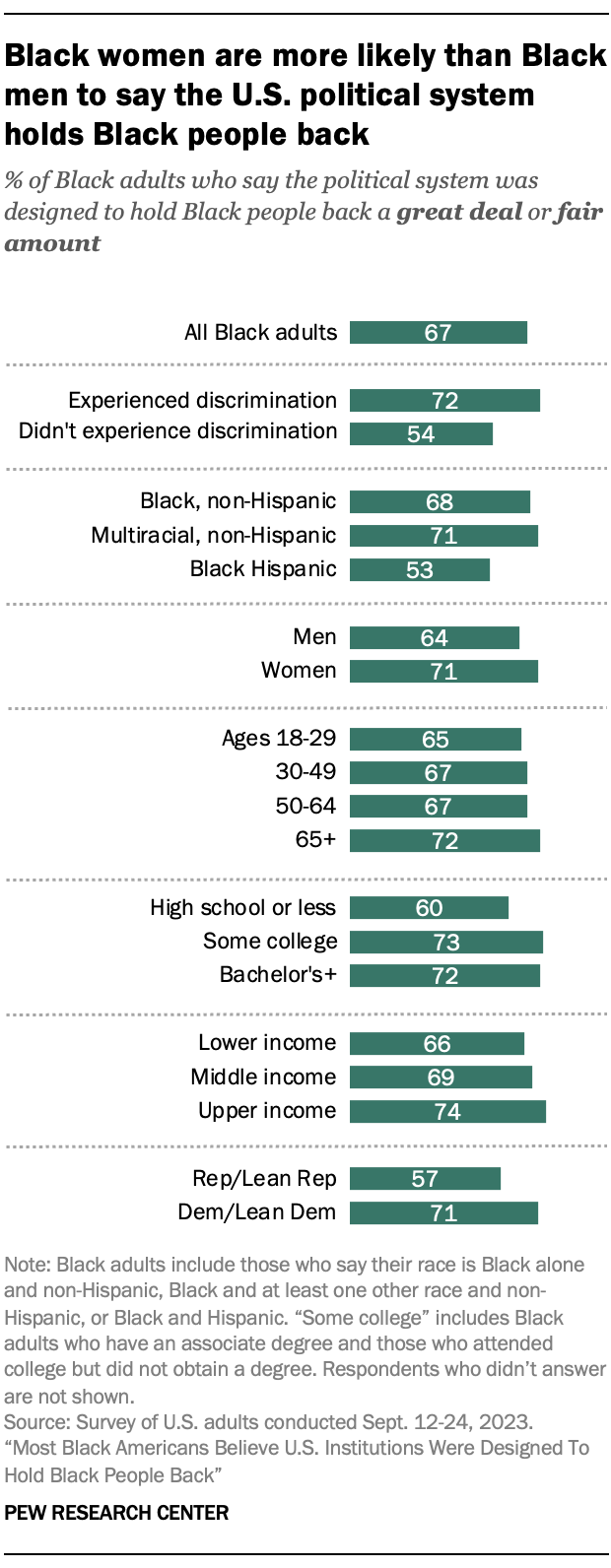
A bar chart showing that Black women are more likely than Black men to say the U.S. political system holds Black people back

Two-thirds of Black Americans (67%) say the country’s political system was designed to hold Black people back a great deal or fair amount. Smaller shares say it only holds Black people back somewhat (20%) or does not hold them back much, if at all (11%).

Black adults who have experienced racial discrimination (72%) are more likely than those who haven’t (54%) to say the political system was designed to significantly hold Black people back. And while about seven-in-ten Black adults who are non-Hispanic or multiracial say the same, fewer Hispanic Black adults agree (53%).

By gender

Black women (71%) are more likely than Black men (64%) to say the U.S. political system was designed to significantly hold Black people back. However, age also factors into this. Black women under 50 (73%) are more likely than Black men of the same age group (60%) to say this. They are also slightly more likely than Black women 50 and older to agree (68%). Still, large majorities of Black men and women across all age groups hold this view about the U.S. political system.

By education, family income and party

Education and income also play a role in how Black Americans think about the nation’s political system. About seven-in-ten Black adults with a bachelor’s degree (72%) say the political system was designed to hold Black people back a great deal or fair amount. Black adults with a high school diploma or less education (60%) are less likely to say the same. And Black adults with upper incomes (74%) are the most likely among the income groups to say the political system intentionally holds Black people back. Black Democrats (71%) and Republicans (57%) also differ significantly on this question.

Black Americans, Black political leaders and mistrust of the U.S. political system

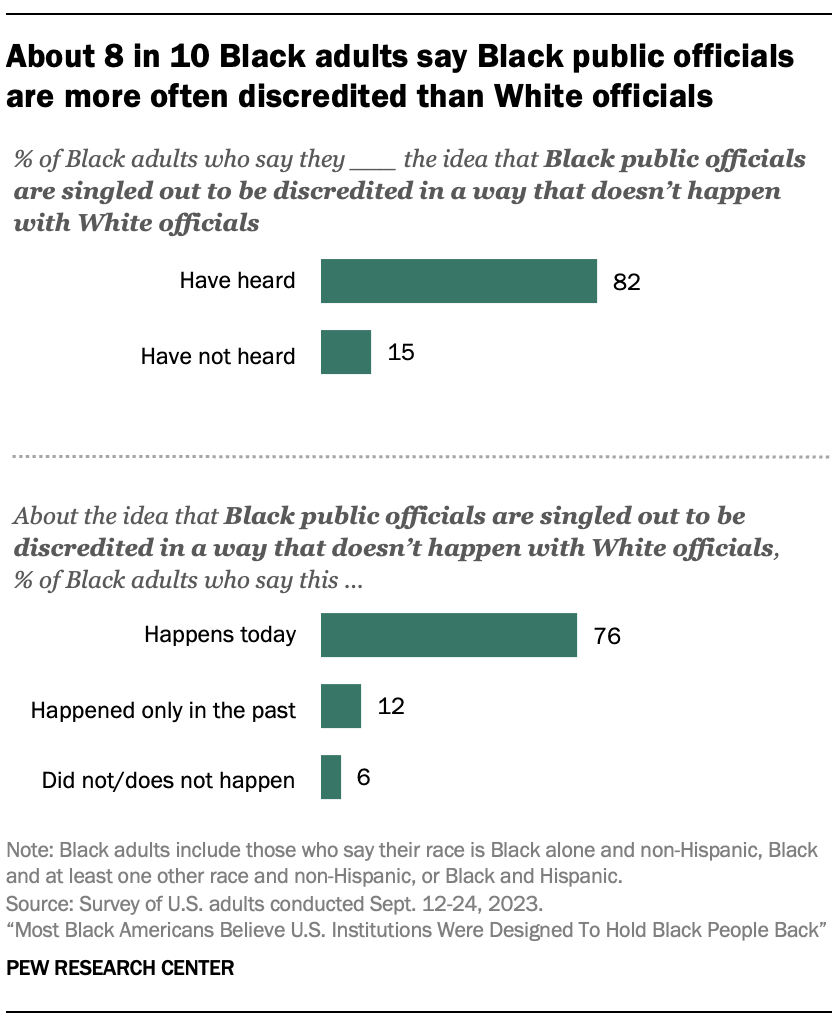
A bar chart showing that About 8 in 10 Black adults say Black public officials are more often discredited than White officials

About eight-in-ten Black adults (82%) say they have heard the idea that Black public officials are singled out and discredited in a way that doesn’t happen with White public officials. Only 15% of Black Americans say they have not heard of this idea at all.

By age and ethnicity

Some groups of Black Americans are more familiar with these ideas than others. Black adults ages 65 and older (85%) are slightly more like than those 50 to 64 (81%) to have heard that Black officials are singled out more than White officials. And the share of non-Hispanic Black adults (84%) who have heard of this idea outpaces that of both multiracial (75%) and Hispanic Black adults (71%).

Belief that Black political leaders are singled out to be discredited

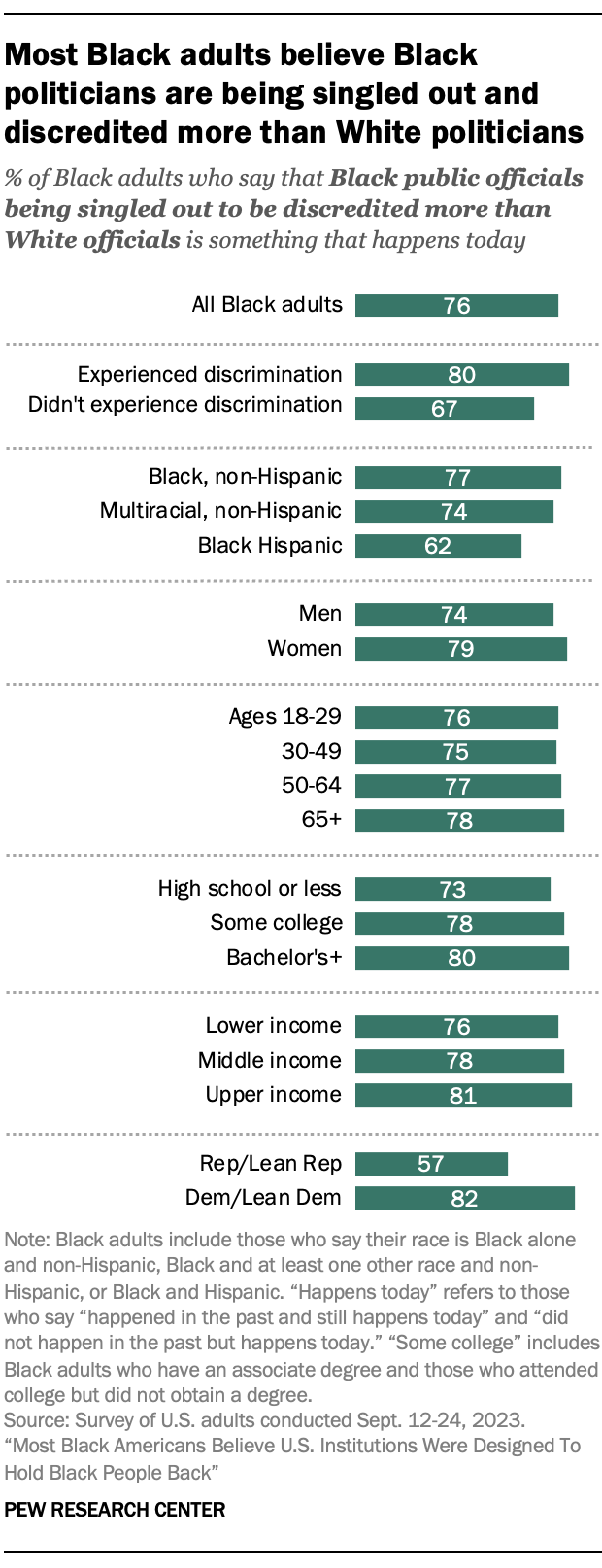
A bar chart showing that Most Black adults believe Black politicians are being singled out and discredited more than White politicians

About three-quarters of Black Americans (76%) believe that Black officials are singled out and discredited more than White officials and that this is happening today. Much smaller shares say this is something that happened in the past but doesn’t happen today (12%) or that it has never happened (6%).

By discrimination experience and ethnicity

Eight-in-ten Black adults who have experienced racial discrimination say Black officials are singled out more than White officials. The share is smaller among those who haven’t experienced discrimination (67%). And about 75% of non-Hispanic and multiracial Black adults also believe this racial disparity in how leaders are treated is happening today. Fewer Hispanic Black adults say the same (62%).

By gender, party and education

Overall, Black women (79%) are slightly more likely than Black men (74%) to say Black leaders are singled out unfairly today. More specifically, Black men under 50 (72%) are less likely than women of any age to say this.

Black Democrats (82%) are significantly more likely than Black Republicans (57%) to say Black leaders are treated unfairly today. And Black adults with a bachelor’s degree (80%) outpace those with a high school diploma (73%) on this question.

4. Black Americans’ mistrust of the U.S. economic system and big businesses

Editorial note to readers

A version of this study was originally published on June 10. We previously used the term “racial conspiracy theories” as an editorial shorthand to describe a complex and mixed set of findings. By using these words, our reporting distorted rather than clarified the point of the study. Changes to this version include: an updated headline, new “explainer” paragraphs, some additional context and direct quotes from focus group participants.

Claudia Deane, Mark Hugo Lopez and Neha Sahgal contributed to the revision of this report.

Social scientists have long debated the causes of economic inequality among Black Americans. The conversation among Black people reached a notable inflection point in 2004, when comedian Bill Cosby linked persistent poverty in some Black families with the purchase of luxury items.

There is some evidence that poverty and expensive purchases are related in complex ways for Black people – namely, that race and residential segregation impact how people signal wealth. However, this broad conversation about the causes of persistent economic inequality provides some context for Black adults’ beliefs about the economic system.

Black Americans believe the economic system was designed to hold them back

A bar chart showing that Black college graduates are most likely to say the U.S. economic system holds Black people back

About two-thirds of Black Americans (65%) say the U.S. economic system was designed to hold Black people back, either a great deal (39%) or fair amount (26%). Roughly a quarter (23%) say it was designed to hold Black people back somewhat, and 11% say it was not designed to hold Black people back much or at all.

By education and family income

Roughly 70% of Black adults who have been to college say the economic system was designed to hold Black people back. Fewer Black adults with a high school diploma or less education say the same (58%). And about two-thirds of Black adults at each income level say the economic system intentionally holds Black people back.

By gender and community type

Black adults also differ by gender on this question. Black women (67%) are slightly more likely than Black men (62%) to say the nation’s economic system was designed to hold Black people back. Black women under 50 (69%) are particularly more likely than Black men (61%) of their same age group to say this.

Black adults who live in urban areas (67%) are slightly more likely than those in rural areas (61%) to say the economic system significantly holds Black people back. Two-thirds (66%) of those in suburbs agree.

Mistrust of big businesses

A bar chart showing that Two-thirds of Black adults believe big businesses’ marketing practices target Black people today

Many Black Americans are familiar with narratives that suggest large corporations have unspoken motives behind their marketing practices. Indeed, 70% of Black adults have heard, either a lot or a little, the idea that big businesses market luxury items to Black people to keep them in debt. About a quarter of Black adults (27%) have not heard this idea at all.

Whether Black Americans are familiar with this idea is associated with their age. Black adults ages 30 to 49 (72%) are slightly more likely than those 50 to 64 and 65 and older (67% each) to say they have heard that big businesses market luxury items to Black people to keep them in debt. Still, 60% or more across all age groups are familiar with this idea.

Many Black adults have not only heard of this idea, they also think malicious marketing of luxury items to Black people is something that happens today (67%). Only 10% say this happened in the past but does not happen today, and 17% say this has never happened.

Once again, age makes a difference. Black adults ages 30 to 49 (70%) are more likely than those 65 and older (63%) to believe targeted marketing of luxury items to Black people happens today.

Black adults who live in urban areas (71%) are slightly more likely than those in the suburbs (65%) to say they believe malicious marketing targeting Black people happens today.

5. Black Americans’ mistrust of the U.S. news media 

Editorial note to readers

A version of this study was originally published on June 10. We previously used the term “racial conspiracy theories” as an editorial shorthand to describe a complex and mixed set of findings. By using these words, our reporting distorted rather than clarified the point of the study. Changes to this version include: an updated headline, new “explainer” paragraphs, some additional context and direct quotes from focus group participants.

Claudia Deane, Mark Hugo Lopez and Neha Sahgal contributed to the revision of this report.

Some of the most enduring stereotypes about Black people have their roots in images created during and immediately after slavery. From the docile Mammy and Uncle Tom characters that appeared in newspaper ads and on food containers to the threatening Mandingo in the film “Birth of a Nation” and the more recent controversy about whether television character Olivia Pope was a modern-day Jezebel, Black Americans’ relationship with media has been contentious at best.

Black Americans have also said the news media specifically characterizes them as disproportionately poor, welfare-dependent and criminal. This history of stereotypical imagery provides some context for Black Americans’ beliefs about the media in the U.S.

A Pew Research Center survey from early 2023 shows that 63% of Black Americans say the news about Black people is often more negative than news about other racial and ethnic groups. Over half (57%) say the news only covers certain segments of Black communities, and 43% say the coverage significantly stereotypes Black people.

In the current survey, nearly nine-in-ten Black Americans (88%) say they at least sometimes come across news and information about Black people they think is inaccurate. This includes 42% who say they come across this often or extremely often and 46% who say they see these inaccuracies sometimes.

And when they come across these errors, Black Americans are more likely to fact-check stories for themselves (85%) than they are to reduce the amount of news they take in overall (52%), from social media (66%), or from friends and family (44%).

About half of Black Americans believe U.S. news media was designed to hold them back 

A bar chart showing that Black women are more likely than Black men to say the news media was designed to hold Black people back

Roughly half of Black Americans (52%) say the news media in the U.S. was designed to hold Black people back a great deal or a fair amount. Fewer say the media was designed to hold Black people back somewhat (30%) or not much, if at all (16%).

Black adults differ significantly on this question by gender. Black women (56%) are more likely than Black men (47%) to say the news media was designed to hold Black people back. Younger Black women are especially likely to agree. Six-in-ten Black women under 50 say this (61%), compared with smaller shares of Black men under 50 (47%) and Black women and men 50 and older (51% and 47%, respectively).

Roughly 55% of Black adults who have been to college say the news media was designed to hold Black people back. This is larger than the share of Black adults with a high school diploma or less education who say the same (48%).

And Black adults who have experienced racial discrimination (56%) are more likely than those who haven’t (40%) to say the news media was designed to hold Black people back.

Most Black adults say they encounter inaccurate news about Black people

About nine-in-ten Black Americans (88%) say they come across inaccurate news and information about Black people at least sometimes. And among those who do, 73% say those inaccuracies were created on purpose. Substantially fewer say they are the result of normal human error (24%).

Black adults who have been discriminated against (74%) are more likely than those who haven’t (68%) to say media inaccuracies about Black people are created on purpose.

Black adults with a bachelor’s degree (81%) are more likely than those with some college (74%) or a high school diploma or less education (66%) to say media inaccuracies about Black people are created on purpose. And the share of Black adults with high (80%) and middle (77%) family incomes outpace the share of Black adults with lower incomes (68%) who agree.

6. Black Americans and mistrust of the U.S. health care system and medical research

Editorial note to readers

A version of this study was originally published on June 10. We previously used the term “racial conspiracy theories” as an editorial shorthand to describe a complex and mixed set of findings. By using these words, our reporting distorted rather than clarified the point of the study. Changes to this version include: an updated headline, new “explainer” paragraphs, some additional context and direct quotes from focus group participants.

Claudia Deane, Mark Hugo Lopez and Neha Sahgal contributed to the revision of this report.

Although the Tuskegee Syphilis Study is one of the best-known examples of race-based medical malpractice, there are others.

Throughout the 20th century, many Black women were subject to eugenics laws that forcibly sterilized them. In 1951, Henrietta Lacks’ cervical cells were harvested and studied without her knowledge or consent.

Today, some Black women specifically seek out Black obstetricians to avoid racial discrimination in medical care and improve their health outcomes. This history of mistrust provides the context for Black Americans’ beliefs about the health care system and medical research.

Some Black Americans believe the health care system was designed to hold them back

A bar chart showing that Black women are more likely than Black men to say the health care system holds Black people back

A 2022 Pew Research Center report found mixed results in how Black adults assessed their experiences with health care. While nearly half (47%) said health outcomes for Black people have improved over the last 20 years, sizable minorities said they have stayed the same (31%) or gotten worse (20%).

And the majority of Black Americans (55%) said they have had negative experiences with doctors, including having to speak up to get proper care and feeling like the pain they were experiencing was not taken seriously.

In the current survey, 51% of Black Americans say the U.S. health care system was designed to hold Black people back a great deal or fair amount. Another 28% say it was designed to hold Black people back some, and 19% say not too much or not at all.

Black adults differ significantly on this question by gender. Indeed, Black women (58%) are more likely than Black men (44%) to say the health care system was designed to hold Black people back. But Black women under 50 (61%) are much more likely to say this than older Black women (54%) and all men regardless of age (44%). These patterns are like those in the 2022 study, which found that Black women (particularly those under 50) were significantly more likely than Black men to report negative experiences in health care. This includes not having their women’s health concerns taken seriously.

Mistrust about medical research

A bar chart showing that While many Black adults say the U.S. health care system was designed to hold Black people back, 78% say they have heard the idea that medical researchers experiment on Black people without their knowledge or consent

While many Black adults say the U.S. health care system was designed to hold Black people back (51%), 78% say they have heard the idea that medical researchers experiment on Black people without their knowledge or consent. Only 19% say they have not heard about this at all.

A bar chart showing that Many Black adults say medical researchers experiment on Black people without their knowledge or consent

When it comes to medical research, 55% of Black Americans believe nonconsensual experiments are being conducted on Black people today. Fewer say this is a thing of the past (30%) or that it never happened (10%).

Like their general belief that the U.S. health care system was designed to hold Black people back, Black women (57%) are slightly more likely than Black men (52%) to believe medical experimentation on Black people without their knowledge or consent is something that is happening today.

Black adults with some college (58%) or a high school diploma (55%) are more likely than those with a bachelor’s degree or higher (49%) to say medical experimentation on Black people without their knowledge or consent happens today.

Likewise, Black adults with lower incomes (60%) are the most likely among the income groups to agree. Black adults who live in the Midwest (60%) are more likely than those in the Northeast (52%) to say medical experimentation against Black people happens today. About half of Black adults in the South (54%) and the West (53%) say the same. Black adults in urban areas (59%) are more likely than those in the suburbs (51%) to say these types of experiments happen today, while 57% of those in rural areas agree.

7. Black Americans’ mistrust of U.S. government policies on family and reproductive health

Editorial note to readers

A version of this study was originally published on June 10. We previously used the term “racial conspiracy theories” as an editorial shorthand to describe a complex and mixed set of findings. By using these words, our reporting distorted rather than clarified the point of the study. Changes to this version include: an updated headline, new “explainer” paragraphs, some additional context and direct quotes from focus group participants.

Claudia Deane, Mark Hugo Lopez and Neha Sahgal contributed to the revision of this report.

Aside from their beliefs about health and medicine in general, many Black adults believe the government intervenes in their decisions about partners and family planning.

Since the introduction of social welfare programs in the mid-20th century, ideas about “man in the house” rules have circulated among the public. That is, various states required that women who received welfare payments not live or have sexual relationships with able-bodied men, which dissuaded women from having or pursuing relationships with men while receiving benefits. If men were found in the home during a welfare home visit, the women would be accused of welfare fraud and their payments would end.

These rules were struck down by the Supreme Court in 1968, but the association between poverty, welfare and government incentives for absent Black fathers remained.

At the same time, the idea that birth control and abortion are genocidal efforts aimed at Black families and communities has a long history. Some Black political figures like Herman Cain and Ben Carson have controversially connected Planned Parenthood and its founder, Margaret Sanger, with efforts to eliminate the Black population through birth control and abortion. And some contemporary Black anti-abortion activists make similar claims.

Mistrust of family-related government policy  

A bar chart showing that About 6 in 10 Black adults say the U.S. government intervenes in Black families and reproductive health

About six-in-ten Black Americans (62%) have heard the idea that the government encourages single motherhood among Black women to eliminate the need for Black men in Black families, while 35% have not heard this idea at all.

By gender

Black men (65%) are more likely than Black women (59%) to have heard the idea that the government encourages Black women to be single mothers to eliminate the need for Black men.

Younger Black men are particularly more likely to say they have heard this. Seven-in-ten Black men under 50 are familiar with this idea, compared with smaller shares of both Black men and Black women 50 and older (58% and 50%, respectively).

By age and party

In general, younger Black adults are more familiar than older adults with the idea that the government encourages single motherhood. Those ages 18 to 29 (66%) and 30 to 49 (69%) are more likely than those 50 to 64 (56%) and 65 and older (50%) to have heard this.

Black Republicans (72%) are the most likely to say they have heard that the government encourages single motherhood among Black women to eliminate the need for Black men. While still a majority, Black Democrats (60%) are less likely to say they have heard this.

Many Black Americans believe the government has encouraged single motherhood among Black mothers

A bar chart showing that Black Republicans are more likely than Democrats to say the government today encourages Black single motherhood

While 62% of Black Americans are familiar with narratives about single motherhood and Black men, fewer say the government-supported elimination of Black men from Black families is happening today. Still, more than half (55%) of Black adults say the government encouraging single motherhood among Black women to eliminate the need for Black men is something that is happening today. Smaller shares say this happened in the past but does not happen today (15%) or say this has never happened (23%).

By age and gender

Black adults ages 30 to 49 (59%) are more likely than those 50 to 64 (52%) and 65 and older (48%) to say the idea of the government encouraging single motherhood to eliminate the need for Black men is happening today. Black women under 50 (62%) are significantly more likely than Black women 50 and older (50%) and all Black men to say this.

By education, family income and party

Black adults with the most education and highest incomes are among the least likely to believe government encouragement of single motherhood happens today. About half (49%) of Black adults with a bachelor’s degree say this, compared with 56% of those with less formal education. And 47% of Black adults with higher incomes say this, compared with larger shares of those with middle (54%) and lower family incomes (58%).

Black Republicans (62%) are more likely than Black Democrats (54%) to say that the government encouraging single motherhood among Black women is something that happens today.

Mistrust of government reproductive health policy

A bar chart showing that Lower-income Black adults are most likely to say government promotes birth control to control U.S. Black population

About six-in-ten Black Americans (58%) have heard the idea that the government promotes birth control and abortion to keep the Black population small, while 39% have not heard this idea at all.

By gender

Although Black men (60%) and women (57%) don’t differ on this question in the broad view, younger Black men stand out. Specifically, Black men under 50 (63%) are more likely than both Black men (55%) and Black women (53%) 50 and older to say they have heard the idea that the government promotes birth control and abortion to manage the size of the Black population.

By family income and party

About six-in-ten Black adults with lower incomes (61%) say they have heard the idea that the government promotes birth control and abortion to keep the Black population small. This is larger than the share of Black adults with high incomes (52%) who say the same.

And like their familiarity with ideas about single Black mothers, Black Republicans (71%) are more likely than Black Democrats (56%) to have heard ideas about reproductive techniques being used to keep the Black population small.

About half of Black Americans believe the government uses abortion and birth control policy today to keep the Black population small

About half of Black Americans (51%) say the government promoting birth control and abortion to keep the Black population small is something that happens today. Smaller shares say this happened in the past but no longer happens today, or that it never happened at all (21% each).

By gender

Some 57% of Black women under 50 say government promotion of birth control and abortion to manage the size of the Black population is happening today. This is more than the share of Black men and women 50 and older (48% each) who say the same. Half of Black men under 50 say this happens today.

By education and family income

Only 44% of Black adults with a bachelor’s degree or higher say the government today is promoting birth control and abortion to manage the size of the Black population. Larger shares of Black adults with some college or a high school diploma or less education say the same (53% each). And Black adults with lower incomes (58%) are most likely among income groups to say that the government promotes reproductive health techniques to control the Black population today.

By region, community type and party

Black Americans living in the Midwest (57%) are more likely than those in every other region of the U.S. to say that the government is now promoting birth control and abortion to manage the size of the Black population. Black adults who live in rural (56%) and urban (54%) areas are more likely than those in the suburbs (46%) to say the same.

Black Republicans (63%) are more likely than Black Democrats (49%) to say that government promotion of birth control and abortion to manage the Black population is something that happens today.

Acknowledgments

This report was written by Kiana Cox, senior researcher.

Editorial guidance was provided by Mark Hugo Lopez, director, race and ethnicity research; Sahana Mukherjee, associate director, race and ethnicity research; Khadijah Edwards, research associate, race and ethnicity research; Neha Sahgal, vice president, research; and Claudia Deane, executive vice president.

Methodological guidance was provided by Courtney Kennedy, vice president, methods and data and innovation, and Dorene Asare-Marfo, panel manager. Guidance on the communications strategy and outreach was provided by Tanya Arditi, senior communications manager.

The report was number-checked by Mohamad Moslimani, Gracie Martinez and Carolyne Im, research assistants; and Edwards and Luis Noe-Bustamante, research associates. Sara Atske, digital producer, produced the report. David Kent, senior copy editor, copy edited the report. Charts were designed by Cox and John Carlo Mandapat, information graphics designer. Find related reports online at our topic page on Black Americans.

Methodology

Note:

An earlier version of the report used the phrase “racial conspiracy theories” to describe a complex and sensitive set of findings. We previously defined racial conspiracy theories as the suspicions that Black adults might have about the actions of U.S. institutions based on their personal and collective historical experiences with racial discrimination. For editorial reasons, we have chosen not to use this phrasing in the updated report. The data remains unchanged.

The American Trends Panel survey methodology

Overview

The American Trends Panel (ATP), created by Pew Research Center, is a nationally representative panel of randomly selected U.S. adults. Panelists participate via self-administered web surveys. Panelists who do not have internet access at home are provided with a tablet and wireless internet connection. Interviews are conducted in both English and Spanish. The panel is being managed by Ipsos.

Data in this report is drawn from ATP Wave 134, conducted from Sept. 12 to Sept. 24, 2023. A total of 7,470 panelists responded out of 10,219 who were sampled, for a response rate of 74% (AAPOR RR3). This includes 4,489 respondents from the ATP and an oversample of 2,981 Black Americans from Ipsos’ KnowledgePanel. The cumulative response rate accounting for nonresponse to the recruitment surveys and attrition is 2%. The break-off rate among panelists who logged on to the survey and completed at least one item is 3%. The margin of sampling error for the full sample of 7,470 respondents is plus or minus 1.9 percentage points.

Panel recruitment

A table showing American Trends Panel recruitment surveys

The ATP was created in 2014, with the first cohort of panelists invited to join the panel at the end of a large, national, landline and cellphone random-digit-dial survey that was conducted in both English and Spanish. Two additional recruitments were conducted using the same method in 2015 and 2017, respectively. Across these three surveys, a total of 19,718 adults were invited to join the ATP, of whom 9,942 (50%) agreed to participate.

In August 2018, the ATP switched from telephone to address-based sampling (ABS) recruitment. A study cover letter and a pre-incentive are mailed to a stratified, random sample of households selected from the U.S. Postal Service’s Delivery Sequence File. This Postal Service file has been estimated to cover as much as 98% of the population, although some studies suggest that the coverage could be in the low 90% range.3 Within each sampled household, the adult with the next birthday is asked to participate. Other details of the ABS recruitment protocol have changed over time but are available upon request.4

We have recruited a national sample of U.S. adults to the ATP approximately once per year since 2014. In some years, the recruitment has included additional effort (known as an “oversample”) to boost sample size with underrepresented groups. For example, Hispanic adults, Black adults and Asian adults were oversampled in 2019, 2022 and 2023, respectively.

Across the six address-based recruitments, a total of 23,862 adults were invited to join the ATP, of whom 20,917 agreed to join the panel and completed an initial profile survey. Of the 30,859 individuals who have ever joined the ATP, 11,944 remained active panelists and continued to receive survey invitations at the time this survey was conducted.

The American Trends Panel never uses breakout routers or chains that direct respondents to additional surveys.

Sample design

The overall target population for this survey was noninstitutionalized persons ages 18 and older living in the U.S., including Alaska and Hawaii. It featured a stratified random sample from the ATP in which Black adults were selected with certainty. The remaining panelists were sampled at rates designed to ensure that the share of respondents in each stratum is proportional to its share of the U.S. adult population to the greatest extent possible. Respondent weights are adjusted to account for differential probabilities of selection as described in the Weighting section below.

The ATP was supplemented with an oversample from the KnowledgePanel in which all panelists who had previously identified as Black or African American (including those who identify as Hispanic or Black in combination with another race) were selected with certainty.

Questionnaire development and testing

The questionnaire was developed by Pew Research Center in consultation with Ipsos. The web program was rigorously tested on both PC and mobile devices by the Ipsos project management team and Pew Research Center researchers. The Ipsos project management team also populated test data that was analyzed in SPSS to ensure the logic and randomizations were working as intended before launching the survey.

Incentives

All respondents were offered a post-paid incentive for their participation. Respondents could choose to receive the post-paid incentive in the form of a check or a gift code to Amazon.com or could choose to decline the incentive. Incentive amounts ranged from $5 to $20 depending on whether the respondent belongs to a part of the population that is harder or easier to reach. Differential incentive amounts were designed to increase panel survey participation among groups that traditionally have low survey response propensities.

Data collection protocol

The data collection field period for this survey was Sept. 12 to Sept. 24, 2023. Postcard notifications were mailed to all ATP panelists with a known residential address on Sept. 11. 

A table showing Invitation and reminder dates for ATP Wave 134

Invitations were sent out in two separate launches: soft launch and full launch. Eighty ATP panelists and 484 KnowledgePanel panelists were included in the soft launch, which began with an initial invitation sent on Sept. 12, 2023. The ATP panelists chosen for the initial soft launch were known responders who had completed previous ATP surveys within one day of receiving their invitation. All remaining English- and Spanish-speaking sampled panelists were included in the full launch and were sent an invitation on Sept. 13.

All panelists with an email address received an email invitation and up to four email reminders if they did not respond to the survey. All ATP panelists who consented to SMS messages received an SMS invitation and up to four SMS reminders.

Data quality checks

To ensure high-quality data, the Center’s researchers performed data quality checks to identify any respondents showing clear patterns of satisficing. This includes checking for very high rates of leaving questions blank, as well as always selecting the first or last answer presented. As a result of this checking, six ATP and 11 KnowledgePanel respondents were removed from the survey dataset prior to weighting and analysis.

Weighting

A table showing American Trends Panel weighting dimensions

The data is weighted in a multistep process that accounts for multiple stages of sampling and nonresponse that occur at different points in the survey process. First, each panelist begins with a base weight that reflects their probability of selection for their initial recruitment survey. That weight is then adjusted to account for nonresponse to the recruitment surveys and panel attrition. Next, respondents are divided into three groups, which are ATP Black respondents, ATP non-Black respondents, and KnowledgePanel Black respondents. The base weights for each group are separately scaled to be proportional to their effective sample size before being recombined and calibrated so that the proportion of Black (alone or in combination) respondents matches the American Community Survey benchmark.

This weight is further calibrated again to align with the population benchmarks identified in the accompanying table and trimmed at the 1st and 99th percentiles separately for Black and non-Black respondents to reduce the loss in precision stemming from variance in the weights. Sampling errors and tests of statistical significance take into account the effect of weighting.

The following table shows the unweighted sample sizes and the error attributable to sampling that would be expected at the 95% level of confidence for different groups in the survey.

A table showing Sample sizes and margins of error for ATP Wave 134

Sample sizes and sampling errors for other subgroups are available upon request. In addition to sampling error, one should bear in mind that question wording and practical difficulties in conducting surveys can introduce error or bias into the findings of opinion polls.

Dispositions and response rates

A table showing Final dispositions for ATP Wave 134
A table showing Cumulative response rate as of ATP Wave 134

How family income tiers are calculated

Family income data reported in this study is adjusted for household size and cost-of-living differences by geography. Panelists then are assigned to income tiers that are based on the median adjusted family income of all American Trends Panel members. The process uses the following steps:

  1. First, panelists are assigned to the midpoint of the income range they selected in a family income question that was measured on either the most recent annual profile survey or, for newly recruited panelists, their recruitment survey. This provides an approximate income value that can be used in calculations for the adjustment.
  2. Next, these income values are adjusted for the cost of living in the geographic area where the panelist lives. This is calculated using price indexes published by the U.S. Bureau of Economic Analysis. These indexes, known as Regional Price Parities (RPP), compare the prices of goods and services across all U.S. metropolitan statistical areas as well as non-metro areas with the national average prices for the same goods and services. The most recent available data at the time of the annual profile survey is from 2021. Those who fall outside of metropolitan statistical areas are assigned the overall RPP for their state’s non-metropolitan area.
  3. Family incomes are further adjusted for the number of people in a household using the methodology from Pew Research Center’s previous work on the American middle class. This is done because a four-person household with an income of say, $50,000, faces a tighter budget constraint than a two-person household with the same income.
  4. Panelists are then assigned an income tier. “Middle-income” adults are in families with adjusted family incomes that are between two-thirds and double the median adjusted family income for the full ATP at the time of the most recent annual profile survey. The median adjusted family income for the panel is roughly $71,700. Using this median income, the middle-income range is about $47,800 to $143,400. Lower-income families have adjusted incomes less than $47,800 and upper-income families have adjusted incomes greater than $143,400 (all figures expressed in 2022 dollars and scaled to a household size of three). If a panelist did not provide their income and/or their household size, they are assigned “no answer” in the income tier variable.

Two examples of how a given area’s cost-of-living adjustment was calculated are as follows: The Anniston-Oxford metropolitan area in Alabama is a relatively inexpensive area, with a price level that is 16.2% less than the national average. The San Francisco-Oakland-Berkeley metropolitan area in California is one of the most expensive areas, with a price level that is 19.8% higher than the national average. Income in the sample is adjusted to make up for this difference. As a result, a family with an income of $41,900 in the Anniston-Oxford area is as well off financially as a family of the same size with an income of $59,900 in San Francisco. 

The respondents from the KnowledgePanel oversample answered the same family income and household size questions, and their incomes were adjusted using the procedures detailed above. They were then assigned an income tier based on the median adjusted family income for the full ATP at the time of the most recent annual profile survey.

Focus group methodology

Pew Research Center worked with PSB Insights to conduct seven focus groups with a total of 34 Black adults. The focus groups were conducted online from May 23 to June 1, 2023. 

The focus groups included at least one group for each of the following categories of Black adults: young adults ages 18 to 29; adults with household incomes less than $30,ooo (low income); adults with household incomes greater than or equal to $100,000 (high income); adults born outside of the U.S.; Black men; and adults who align with or lean toward the Republican Party.

Each group included four or five participants, lasted for 90 minutes, and was led by an experienced moderator using a discussion guide developed by Pew Research Center. The focus groups were conducted over a secure, online research platform with video and audio capabilities.

Recruitment efforts included targeted email outreach among a panel of qualified candidates and social media outreach, followed by a screening phone call with those who expressed interest over email or social media to ensure they were eligible for the study.

Participants had to meet four criteria to be eligible. First, potential participants had to be living in the United States and be at least 18 years old. Second, they were screened to confirm that their race was Black or African American. Third, they had to have access to the internet and a device with a working webcam. And finally, participants had to be willing to attend the online focus group on a particular date and time.

In order to ensure a diverse mix of participants among all who qualified, the research team also collected demographic information such as region, age, gender, household income, and political affiliation. The demographic breakdown of the participants was as follows:

A table showing Demographic characteristics of focus group participants

The findings are not statistically representative and cannot be extrapolated to wider populations.


© Pew Research Center, 2024