Pew Research Center

FOR RELEASE FEBRUARY 16, 2023

Black Americans Firmly Support Gender Equality but Are Split on Transgender and Nonbinary Issues   

Nearly six-in-ten want organizations working for Black progress to address the distinct challenges facing Black LGBTQ people

BY Kiana Cox

FOR MEDIA OR OTHER INQUIRIES:

Communications Department
202.419.4372
www.pewresearch.org

RECOMMENDED CITATION

Pew Research Center, February 2023, "Black Americans Firmly Support Gender Equality but Are Split on Transgender and Nonbinary Issues   "

About Pew Research Center

Pew Research Center is a nonpartisan, nonadvocacy fact tank that informs the public about the issues, attitudes and trends shaping the world. It does not take policy positions. The Center conducts public opinion polling, demographic research, computational social science research and other data-driven research. It studies politics and policy; news habits and media; the internet and technology; religion; race and ethnicity; international affairs; social, demographic and economic trends; science; research methodology and data science; and immigration and migration. Pew Research Center is a subsidiary of The Pew Charitable Trusts, its primary funder.

© Pew Research Center 2026

Table of contents

  • About Pew Research Center
  • Black Americans Firmly Support Gender Equality but Are Split on Transgender and Nonbinary Issues   
  • 1. Black Americans’ views of gender equality in society and gender roles in families
  • 2. Black Americans and their views on feminism
  • 3. Black Americans’ views on transgender and nonbinary issues
  • Acknowledgments
  • Methodologies

Black Americans Firmly Support Gender Equality but Are Split on Transgender and Nonbinary Issues   

Nearly six-in-ten want organizations working for Black progress to address the distinct challenges facing Black LGBTQ people

How we did this

In recent years, Pew Research Center has conducted multiple studies that focus on gender and gender identity. This analysis of Black Americans’ views on gender equality, gender roles, feminism, and transgender and nonbinary issues relies on data from four of these focused surveys.

The first was conducted among 8,660 Black adults (ages 18 and older) from Nov. 19, 2019, to June 3, 2020. It contains data from four sources: Pew Research Center’s American Trends Panel (conducted online), NORC’s AmeriSpeak panel (conducted online or by phone), Ipsos’ KnowledgePanel (conducted online) and a national cross-sectional survey by the Center (conducted online and by mail). This survey provided the data on Black adults’ views on gender, faith and family discussed in this report. For more information on this study, see its methodology and questionnaire.  

The second was conducted online among 3,143 U.S. adults (ages 18 and older) from March 18 to April 1, 2020, on Ipsos’ KnowledgePanel. There were 705 Black adults in the sample. This survey provided the data on the public’s views of gender equality and feminism discussed in this report. For more information on this study, see its methodology and questionnaire.

The third survey was conducted online among 3,912 Black adults (ages 18 and older) from Oct. 4 to 17, 2021. The survey includes 1,025 Black adults on the Center’s American Trends Panel and 2,887 Black adults on Ipsos’ KnowledgePanel. This survey provided the data on Black adults’ views of intersectional issues and their concerns about discrimination against LGBTQ people. For more information on this study, see its methodology and questionnaire.

The fourth survey was conducted online among 10,188 U.S. adults (ages 18 and older) from May 16 to 22, 2022, using the Center’s American Trends Panel. There were 799 Black adults in the sample. This survey provided the data on the public’s views of transgender and nonbinary issues discussed in this report. For more information on this study, see its methodology and questionnaire. Read more on how we measured the share of the U.S. population that is transgender or nonbinary.

Respondents in each study were recruited through national, random sampling of residential addresses. Recruiting panelists by mail ensures that nearly all U.S. adults have a chance of selection. This gives us confidence that any sample can represent the whole population (see our Methods 101 explainer on random sampling).

Terminology

The terms “Black Americans,” “Black adults” and “Black people” are used interchangeably throughout this report to refer to U.S. adults who self-identify as Black. These terms refer to Black adults who are single-race Black and say they have no Hispanic background, unless otherwise noted.

Throughout this report, educational descriptors are shortened to denote the following: “High school or less” indicates Black adults who have obtained a high school diploma or lower level of education, and “some college experience” or “with college experience” indicate Black adults who either attended college and obtained an associate degree but not a bachelor’s degree, or who attended college without obtaining any degree.   

The acronym “LGBTQ” collectively refers to people who are lesbian, gay, bisexual, transgender or queer.

The term “transgender” is used here to refer to people whose gender is different from the sex they were assigned at birth. This includes, but is not limited to, transgender men (that is, men who were assigned female at birth) and transgender women (women who were assigned male at birth).

The term “nonbinary” refers to people who are neither a man nor a woman or who aren’t strictly one or the other. Some, but not all, nonbinary participants also consider themselves to be transgender. Read more on how we measured the share of the U.S. population that is transgender or nonbinary.

The phrase “gender equality” is used throughout this report to refer to the extent to which women and men have equal rights, opportunities and access to resources in the United States.
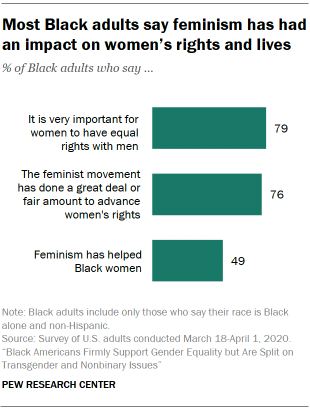
Bar chart showing most Black adults say feminism has had an impact on women’s rights and lives

Discussions about gender equality and feminism have a long history among Black Americans. Some hallmarks of this history are Maria Miller Stewart publicly affirming the place of Black women as abolitionist leaders in Boston in 1832; the Combahee River Collective’s formative statement on the intersection of race, gender, class and sexuality in 1977; Anita Hill’s sexual harassment allegations against then-Supreme Court nominee Clarence Thomas in 1991; and the ongoing discussions about how women are represented in rap music, both as subjects and performers of songs. These often-contentious debates raise questions about the relative importance of gender and other inequalities among Black Americans, given the long history of racial inequality in the United States.

To be sure, about six-in-ten non-Hispanic Black adults1 (62%) say Black people should prioritize the struggle against racism over other inequalities, according to a 2021 Pew Research Center survey of Black adults. Meanwhile, three-in-ten Black adults say the opposite: that racism should not be prioritized over other inequalities. Among the 30% who say racism should not be prioritized, most say this is because racism is just as important as other inequalities or that racism is interconnected with other inequalities. 

Although most Black Americans view the fight against racism as their primary struggle for progress, they also support women’s equality and think feminism has been a positive force for women overall and for Black women specifically, according to a 2020 Pew Research Center survey of U.S. adults.  

About eight-in-ten non-Hispanic Black adults say it is very important for women to have equal rights with men (79%). The majority of Black adults (76%) also say the feminist movement has done a great deal or a fair amount to advance women’s rights. And about half of Black adults say feminism has helped Black women (49%).

These findings stand in stark contrast to the contentious history that Black Americans have had with the feminist movement. Black women were relegated to the back of feminist marches in the 19th century, if not completely excluded. Black women redefined their approach to women’s equality, and even renamed it “womanism” to make it more inclusive of their needs and to reject the exclusion they had experienced in feminist organizations. 

This history provides context for the findings of the 2020 survey, which indicate that about two-thirds (68%) of Black adults view feminism as empowering, but nearly half (48%) would not use the term “feminist” to describe themselves. 

Black adults are split over how much society should accept transgender people

According to the Williams Institute, at least 1 million Black adults in the U.S. are lesbian, gay, bisexual or transgender (LGBT), making up 12% of the nation’s LGBT population. LGBT Black Americans are younger than non-LGBT Black adults, with nearly 60% under age 35 compared with 34% of non-LGBT Black adults. Women comprise a larger share of LGBT Black adults than of non-LGBT Black adults, and LGBT Black adults are slightly less likely to live in the South than the rest of the Black population.

Black LGBT and non-LGBT adults do not differ in their sense of belonging to their own race. Nearly half of both groups say they feel connected to Black communities. And 62% of Black lesbian, gay or bisexual adults and 29% of Black transgender adults say they feel a part of the larger LGBT community, the Williams Institute has found.
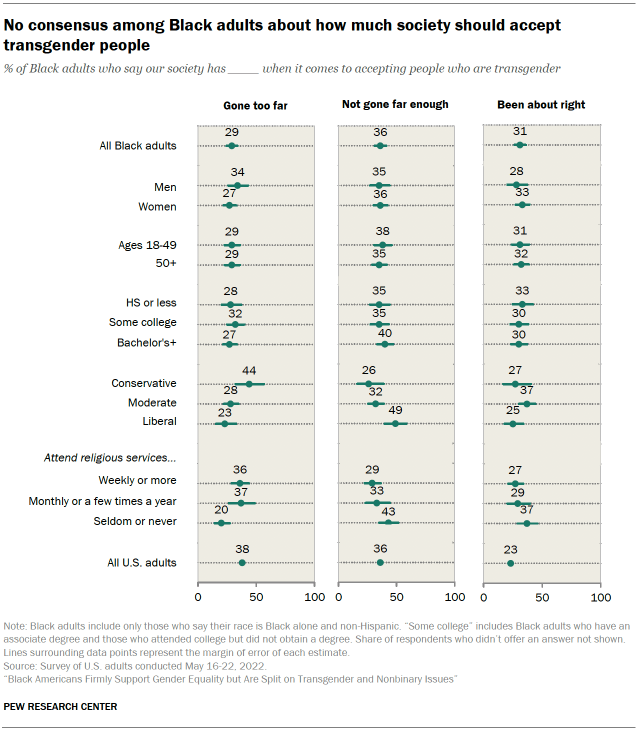
Bar chart showing Black adults are split in their views on transgender issues

Still, over half of Black LGBT adults (55%) say the city or area they live in is not a good place for transgender people, and 39% say their areas are not safe for lesbian, gay or bisexual people. In fact, the majority of Black LGBT people say they have experienced verbal insults or abuse (79%) or have been threatened with violence (60%).

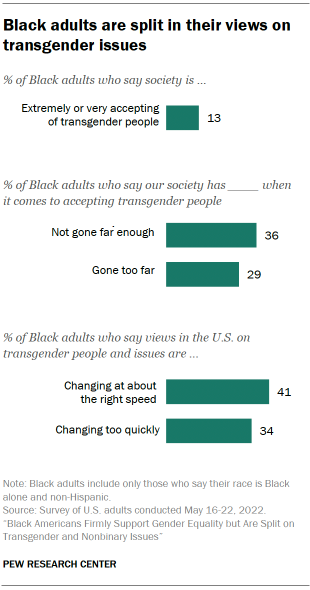
The social difficulties that Black LGBT people experience are reflected in Black Americans’ views on gender identity issues, according to a 2022 Pew Research Center survey of U.S. adults. Only 13% of non-Hispanic Black adults say that U.S. society is extremely or very accepting of transgender people.

However, Black adults are split in their views on how accepting society should be. While 36% say society has not gone far enough in accepting people who are transgender, 31% say the level of acceptance in society has been about right and 29% say it has gone too far. And while about four-in-ten Black adults (41%) say views about transgender people and issues are changing at the right speed, roughly a third (34%) say they are changing too quickly. 

These divergent points of view exist alongside each other, demonstrating that Black Americans’ views on gender identity issues show much less consensus than their views on gender equality.

The findings in this report emerge from four Pew Research Center surveys of U.S. adults conducted from 2019 to 2022. Using multiple Center surveys provides a unique opportunity to summarize Black Americans’ views on gender equality and gender identity in the United States in the broadest scope. The report provides context for Black Americans’ views on and experiences with current issues of national importance, such as their majority disapproval of the overturning of Roe v. Wade (67%) and the disproportionate number of Black transgender and nonbinary people who experience fatal violence.  

Here are other findings presented in this report:  

Black Americans are critical of the progress of women’s equality in the U.S. About seven-in-ten Black adults (69%) say that the U.S. has not gone far enough in giving women equal rights with men. And among those who say this, a quarter say it’s not too or not at all likely that there will be equal rights between women and men in the future. 

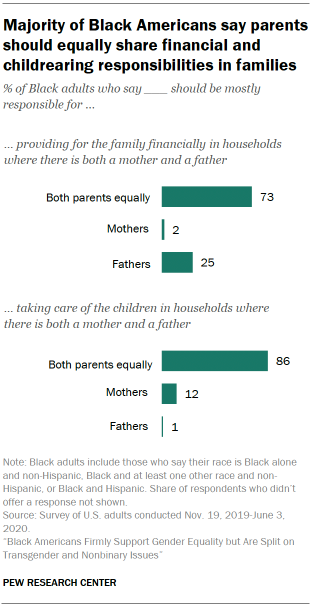
Black Americans are more likely to have egalitarian views about gender roles than their houses of worship. Black adults believe that mothers and fathers who live in the same household should share parenting (86%) and financial responsibilities (73%). However, the majority of Black Americans who attend religious services at least a few times a year say their congregations are more likely to emphasize men’s financial role in the family and involvement in Black communities as role models than women’s family and community roles.  

Black Americans are more likely to know someone who is transgender or nonbinary than to identify as such themselves. About 1.4% of Black adults are transgender or nonbinary. However, 35% of Black adults say they know someone who is transgender. And among those who have heard at least a little about people who do not identify as a man or woman, 26% say they know someone who identifies this way. 

CORRECTION (Feb. 27, 2023): In Chapter 3, the chart “Nearly six-in-ten Black adults say Black organizations should address the challenges Black LGBTQ people face,” the rows for women and men have been edited to correct an inversion in the percentages of Black women and Black men who think organizations should address challenges that Black gay and lesbian people face. These figures are 62% and 51%, respectively. These numbers were referenced correctly in the body of the report, and the changes did not affect the report’s substantive findings.
1. Black Americans’ views of gender equality in society and gender roles in families

Black Americans are largely in support of gender equality between women and men and are critical of society’s lack of progress in the United States.

For many Black adults, their support of gender equality aligns with their spiritual or moral beliefs. Large majorities say opposing gender discrimination is essential to what those beliefs mean to them.

However, those who attend religious services at least a few times a year say their congregations often do not share their egalitarian views. Whereas Black adults think men and women should share financial responsibilities for their families equally, their congregations emphasize this role for men more than they do for women.

Findings in this chapter are drawn from two Pew Research Center surveys of U.S. adults conducted in 2019 and 2020.

Black adults differ by gender and education in their views on the progress of gender equality

The majority of Black adults say it is very important for women to have equal rights with men in the U.S. (79%), according to a Center survey conducted March 18 to April 1, 2020.2 Only 18% say it is somewhat important, while 3% say it is not too or not at all important.  

Three-quarters or more of Black men (76%) and Black women (82%) say it very important for women to have equal rights with men, as do 81% of Black adults 18 to 49 and 77% of those 50 and older.

Black Americans’ views on gender equality vary by educational attainment. About nine-in-ten Black adults with a bachelor’s degree or higher level of education (89%) say that women having equal rights with men is very important. Though still a majority, Black adults with some college experience (78%) and those with a high school diploma or less (75%) are less likely to say this.

Bar chart showing 69% of Black adults say the U.S. has not gone far enough in giving women equal rights with men

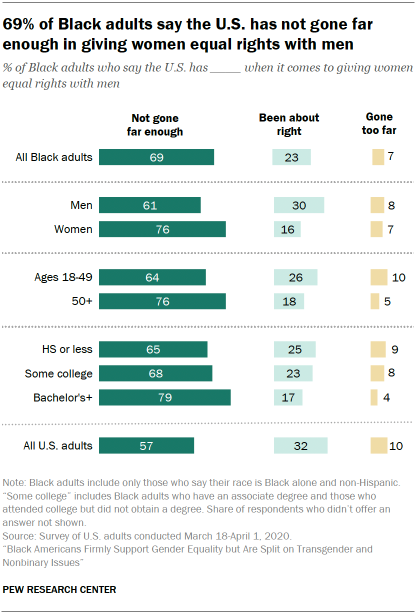
While most Black adults favor gender equality, they are also critical of the lack of progress toward it in the United States. About seven-in-ten Black adults (69%) say the U.S. has not gone far enough when it comes to giving women equal rights with men. Much smaller shares say the speed of this progress has been about right (23%) or has gone too far (7%). Black adults’ views on this question differ by gender, age and education.  

About three-quarters of Black women (76%) and Black adults 50 and older (76%) say the U.S. has not gone far enough when it comes to gender equality, compared with 61% of Black men and 64% of Black adults under 50.

About eight-in-ten Black adults with a bachelor’s degree (79%) say the country has not gone far enough in giving women equal rights with men, as compared with 68% of Black adults with some college experience and 65% with a high school diploma or less.

Overall, Black adults (69%) are more likely than all U.S. adults (57%) to say the U.S. has not gone far enough when it comes to gender equality.

Among Black adults who say the U.S. has not gone far enough in giving women equal rights with men, three-quarters say it is at least somewhat likely that women in the U.S. will eventually have those rights (75%). However, only 24% say it is very likely, similar to the share that says it is not too or not at all likely (25%).

Black women who say the country has not gone far enough in giving women equal rights are more pessimistic about the prospect of achieving gender equality in the U.S. than Black men. About three-in-ten Black women say it is not too or not at all likely that women will eventually have equal rights with men (31%). Only 17% of Black men say the same. 

Bar chart showing about three-quarters of Black adults say the gains women have made in society have not come at the expense of men

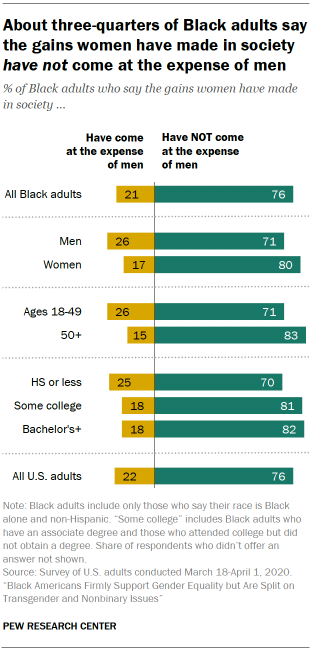
Black women and men not only differ in their views on the progress of gender equality in the country, they also differ on the costs. About a quarter of Black men say the gains women have made in society have come at the expense of men (26%). Smaller shares of Black women (17%) say the same. Still, most Black men (71%) say these gains have not come at the expense of men.  

Although majorities of Black adults across age and education groups say the gains that women have made have not come at the expense of men, Black adults 50 and older and those with college experience (both with and without bachelor’s degrees) are the most likely to say this.

Bar chart showing Black adults are more likely to have a conversation about gender equality with family or friends than post about it on social media or attend a protest

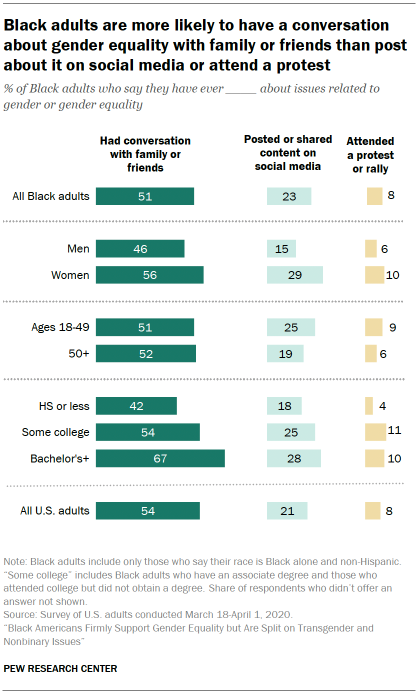
When it comes to sharing their views about gender and gender equality, Black adults are more likely to do so in conversations with family or friends (51%) than to post or share content on social networking sites (23%), contribute money to an organization working on gender issues (13%), contact a public official to express their opinion (9%) or attend a protest or rally (8%), according to the 2020 survey.    

Some 56% of Black women say they have conversations about gender or gender equality with family and friends, and 46% of Black men say they do the same. Black women (29%) are more likely than Black men (15%) to post about gender issues on social media.

Black adults who have a bachelor’s degree (67%) are more likely than those with a high school diploma or less (42%) to have conversations about gender and gender equality with relatives and friends.

And Black adults ages 18 to 49 (51%) are about as likely as those 50 and older (52%) to have conversations about gender and gender equality with their family or friends.

Gender, faith and family

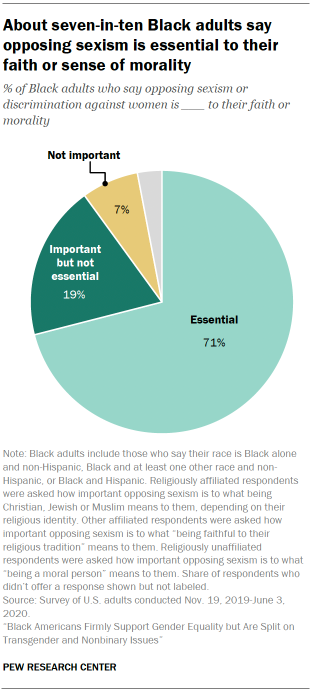
Pie chart showing about seven-in-ten Black adults say opposing sexism is essential to their faith or sense of morality

Many Black Americans see their views on gender equality as a core part of their religion or sense of morality, according to a Center survey of U.S. adults, with a large sample of Black adults, conducted Nov. 19, 2019, through June 3, 2020.3

Two-thirds of Black adults are Protestant Christians (66%), while others are Catholic (6%), members of other Christian faiths such as Jehovah’s Witnesses (3%), members of non-Christian faiths such as Islam (3%), or unaffiliated with a religion (21%).

About seven-in-ten Black adults, regardless of their religious affiliation, say opposing sexism or discrimination against women is essential to their faith or sense of morality (71%). Much smaller shares of Black adults say opposing sexism is important but not essential to their faith or sense of morality (19%) or not important at all (7%).

Roughly seven-in-ten Black adults across genders and age groups say opposing sexism is essential to their faith or sense of morality. However, Black adults with a high school diploma or less (64%) are less likely than those with a bachelor’s degree (76%) or those who have some college experience (73%) to say this.

Although the majority of Black adults say opposing sexism is essential to their faith or sense of morality, only about three-in-ten Black adults who attend religious services at least a few times a year (28%) say they heard a sermon on sexism in the year prior to the survey.4

Bar chart showing majority of Black Americans say parents should equally share financial and childrearing responsibilities in families

Black Americans’ broad acceptance of gender equality carries over to their views of gender roles in their families. The majority say mothers and fathers should be equally responsible for family finances in households where both are present (73%), while a quarter say that fathers should take the lead. 

Black women (76%) are somewhat more likely than Black men (69%) to say mothers and fathers should share financial responsibilities equally. Though still a majority, Black adults ages 18 to 49 (75%) are slightly more likely to say this than those 50 and older (70%). And about three-quarters of Black adults across all education levels say that mothers and fathers should share family financial responsibilities equally.

An even larger majority of Black Americans believe that mothers and fathers should split child care responsibilities in households where both parents are present (86%). Most demographic subgroups of Black adults share this view, with few differences among them.

Although Black adults take these egalitarian stances on gender roles in their personal lives, many of them belong to congregations with different views. Roughly 60% of Black adults attend religious services at least annually. This includes 33% who attend weekly or more. And among those who attend annually, 60% go to houses of worship where the majority of the congregation and the clergy is Black – meaning that Black adults are hearing these gendered messages about Black families from Black religious leaders in predominantly Black religious spaces.

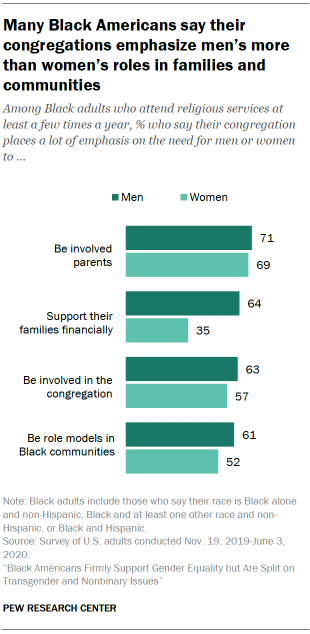
Bar chart showing many Black Americans say their congregations emphasize men’s more than women’s roles in families and communities

About seven-in-ten Black adults who attend religious services at least a few times a year say their congregations place a lot of emphasis on the need for both men (71%) and women (69%) to be involved parents.

But when it comes to being involved in congregations and being role models in Black communities, somewhat fewer hear these messages emphasized for women than men. For instance, 61% of Black congregants say their houses of worship strongly emphasize the need for men to be good role models, and 52% hear this emphasized for women.  

There is an especially large gap on the issue of financial support within families: Only about a third of Black adults who attend religious services at least a few times a year (35%) say that their congregations stress that women should support their families financially, compared with 64% who say their congregations emphasize this for men.

2. Black Americans and their views on feminism

The relationship between Black Americans and the U.S. feminist movement has been contentious since the 19th century. Feminist activists such as Susan B. Anthony and Alice Paul racially stereotyped Black men during Reconstruction and kept Black women suffragists at the back of women’s marches in the early 20th century.

In the 1970s, Black women criticized the feminist movement for being narrowly focused on the issues of middle-class White women. Many White feminist activists expressed a desire to work outside the home, one that many Black feminist activists did not share because Black women had historically been a part of the labor force as enslaved workers, farmers and maids. And in an era that saw the codifying of Roe v. Wade, Black women’s fight for reproductive rights extended beyond abortion to advocacy against forced sterilizations.

Since the 1990s, Black Americans’ feminist tensions have often revolved around questions of intraracial harm and betrayal. Anita Hill’s sexual harassment allegation against Clarence Thomas, the women who have made sexual assault claims against hip-hop stars such as R. Kelly and Russell Simmons, and Meredith Watson’s sexual assault claim against former Virginia Lt. Gov. Justin Fairfax are all examples of Black women being positioned as race traitors who are “trying to bring a good brother down.” Indeed, Black Americans’ relationship with feminism is fraught from both external and internal challenges to the movement’s legitimacy.

This chapter draws data on Black adult’s views of feminism from a Pew Research Center survey of U.S. adults conducted in March and April of 2020.5

Black adults say feminism has had a significant impact on women’s rights

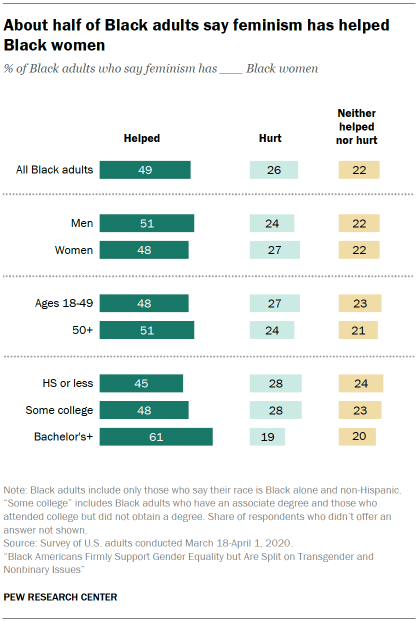
Chart shows About half of Black adults say feminism has helped Black women

Despite this history of tension, about three-quarters of Black adults (76%) say the feminist movement has done a lot to advance women’s rights in the U.S. This includes 28% who say the feminist movement has done a great deal to advance these rights and 48% who say it has done a fair amount. Much smaller shares say the feminist movement hasn’t done much (17%) or anything at all (6%) to advance women’s rights.   

While Black adults view feminism as impactful overall, they have different views on the extent to which the movement has helped various groups of women. About half of Black adults (49%) say feminism has helped Black women, either a little (33%) or a lot (16%). About a quarter of Black adults say feminism has hurt Black women (26%), either a little (10%) or a lot (15%). At the same time, 22% of Black adults say feminism has neither helped nor hurt Black women.

Black adults differ on this question primarily by education. Those with a bachelor’s degree (61%) are more likely than those with a high school diploma or less (45%) to say feminism has helped Black women. In contrast, about three-in-ten Black adults with a high school diploma or less or some college education (28% each) say feminism has hurt Black women, while 19% of Black adults with a bachelor’s degree say the same. And Black adults with a high school diploma or less (19%) are more likely than those with a bachelor’s degree (8%) to say feminism has hurt Black women a lot.

Reflecting some of the historical tension described above, Black adults are more likely to say that feminism has had a significant positive impact on White women than on Black women. While 42% of Black adults say feminism has helped White women a lot, a much smaller share say the same about Black women (16%).

When asked specifically about the impact of feminism on their personal lives, about a third of Black women (36%) say feminism has helped them personally, either a little (29%) or a lot (7%). Smaller shares say that feminism has hurt them (13%), either a little or a lot (7% respectively). And half of Black women say feminism has neither helped nor hurt them personally (49%).

How Black Americans describe feminism

Chart shows nearly seven-in-ten Black adults describe feminism in the U.S. as empowering

When asked how they would describe feminism in the U.S. today, the majority of Black adults say it is “empowering” (68%). This is higher than the shares who describe it as “inclusive” (45%), “polarizing” (34%) or “outdated” (24%).

About seven-in-ten Black women (71%) and 65% of Black men describe feminism as empowering, as do 70% of Black adults 18 to 49 and 65% of Black adults 50 and older.

However, Black adults differ by education on this question. While three-quarters of Black adults with a bachelor’s degree (75%) describe feminism as empowering, a smaller share of Black adults with a high school diploma or less share this view (63%).

Differences by education also appear in other descriptors of feminism. A majority of Black adults with a bachelor’s degree (57%) characterize feminism as inclusive. The same is true of only 39% of Black adults with a high school diploma or less and 44% of those with some college experience. While 41% of Black bachelor’s degree holders describe feminism as polarizing, only 30% of those with a high school diploma or less say the same. And roughly one-in-five Black bachelor’s degree holders (18%) describe feminism as outdated, while about a quarter of Black adults with a high school diploma or less (25%) or some college experience (26%) share this view.

And while Black adults (68%) and the general public (64%) are both most likely to view feminism as empowering, Black adults are less likely than Americans overall to characterize feminism as polarizing (34% vs. 45%) or outdated (24% vs. 30%).

Aside from their descriptions about feminism in the U.S. overall, Black adults were also asked about how well the term describes them personally. About half of Black adults say “feminist” does not describe them (48%), saying it applies either not too well (25%) or not well at all (24%). Roughly a third of Black adults say “feminist” describes them somewhat well (36%). And only 16% say it describes them very well.

Black men (63%) are much more likely than Black women (36%) to say “feminist” does not describe them well. Meanwhile, Black women are more likely than Black men to say that feminism describes them somewhat well (44% vs. 27%) or very well (20% vs. 10%).

And 54% of Black adults with a high school diploma or less say “feminist” does not describe them well, compared with 43% of those with a bachelor’s degree and 44% of those with college experience and no bachelor’s degree.

3. Black Americans’ views on transgender and nonbinary issues

The intersection of race with gender identity and sexuality presents a unique set of challenges for Black Americans. Although most Black adults say they experience discrimination because of their race (79%), many scholars and activists say the nature of discrimination changes when people have multiple identities. This compounded nature of inequality was termed “intersectionality” in 1989 by legal scholar Kimberlé Crenshaw.

Intersectionality was originally put forward to examine blind spots in discrimination law that caused Black women’s claims of unequal treatment to be routinely misinterpreted by courts. Black women were left to either bring suits based on race, in which their experiences were compared with Black men’s, or to bring suits as women and have their claims be compared to those of White women. They often lost both types of cases. If they tried to claim they were discriminated against specifically as “Black women,” they were accused of opening a “Pandora’s box” by seeking to create a new legally protected class.

Beyond its legal beginnings, the more popular usage of intersectionality focuses on how different mixtures of identities produce different, and often worse, experiences of inequality. For example, while about one-in-three LGBTQ Americans report that they have experienced discrimination in the year prior to being surveyed, LGBTQ people of color are more likely to report discrimination of any kind than White LGBTQ people, a 2020 Center for American Progress-NORC survey found. These intersectional differences are particularly dire when it comes to transgender and nonbinary people specifically. Since 2013, over 300 transgender and nonbinary people have been victims of fatal violence, according to the Human Rights Campaign Foundation. Two-thirds (63%) of those victims have been Black transgender women.

This chapter draws on data from two Pew Research Center surveys. The first was of U.S. adults with a large oversample of Black adults and was conducted in October 2021. The second was of U.S. adults and conducted in May 2022.6

Black Americans prioritize race but still think other inequalities should be addressed

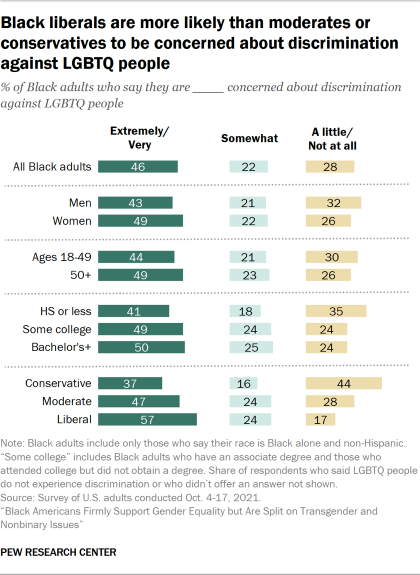
A bar chart showing that Black liberals are more likely than moderates or conservatives to be concerned about discrimination against LGBTQ people

About six-in-ten Black adults (62%) say Black people should prioritize the struggle against racism over other inequalities, according to a 2021 survey of U.S. adults. At the same time, three-in-ten Black adults (30%) say the opposite: that racism should not be prioritized over other inequalities.

Among those who say racism should not be prioritized, most say this is because racism is equally as important as other inequalities (43%) or that racism is interconnected with other inequalities (36%).

Although many Black Americans view the fight against racism as their primary struggle for progress, they also view discrimination against LGBTQ people as problematic.

Nearly half of Black adults say they are extremely or very concerned about discrimination against LGBTQ people (46%). About one-in-five Black adults say they are somewhat concerned about it (22%), and 28% of Black adults say they are a little or not at all concerned. 

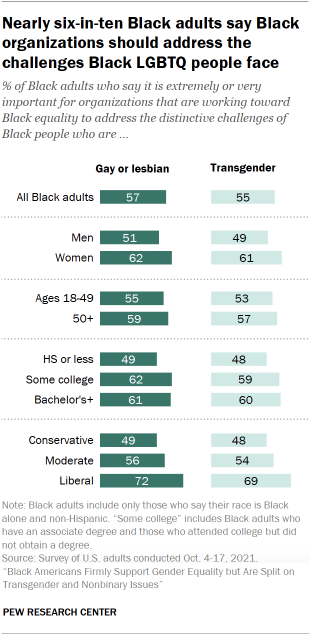
A bar chart showing that nearly six-in-ten Black adults say Black organizations should address the challenges Black LGBTQ people face

When it comes to education, half of Black adults with a bachelor’s degree (50%) and some college experience but no bachelor’s degree (49%) say they are extremely or very concerned about discrimination against LGBTQ people, compared with 41% of those with a high school diploma or less.   

The shares of Black liberals (57%) and moderates (47%) who are extremely or very concerned outpace the share of Black conservatives who say this (37%).

When it comes to social action on intersectional issues, nearly six-in-ten Black adults say it is extremely or very important for organizations that are working toward Black equality to address the distinctive challenges of Black people who are gay or lesbian (57%) or transgender (55%).  

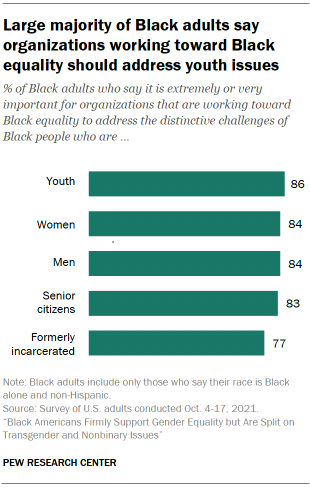
A bar chart showing that a large majority of Black adults say organizations working toward Black equality should address youth issues

Survey respondents were asked the same question about how important it is for organizations working toward Black equality to address the distinct challenges of other groups of Black people. For these other groups, larger shares say the organizations should address the distinctive challenges of Black youth (86%), Black men and women (84% respectively), Black senior citizens (83%) and formerly incarcerated Black people (77%). 

When it comes to their views on organizations working toward equality for Black gay, lesbian or transgender people, Black adults differ by gender, education and political ideology. Black women are more likely than Black men to say it is extremely or very important for organizations that work toward Black equality to address the distinctive challenges of Black people who are gay or lesbian (62% vs. 51%). There is a similar split between Black women (61%) and Black men (49%) when it comes to addressing the issues that Black transgender people face.

About six-in-ten Black adults with a bachelor’s degree (61%) and those with college experience but no bachelor’s degree (62%) say organizations working toward Black equality should address the unique issues of Black people who are gay or lesbian. A smaller share of Black adults with a high school diploma or less say the same (49%). This pattern repeats when it comes to the issues that Black transgender people face.

Black liberals are more likely than their moderate and conservative peers to say that organizations working toward Black equality should address the distinctive challenges faced by Black gay and lesbian (72%) or transgender (69%) people.

CORRECTION (Feb. 27, 2023): In the chart “Nearly six-in-ten Black adults say Black organizations should address the challenges Black LGBTQ people face,” the rows for women and men have been edited to correct an inversion in the percentages of Black women and Black men who think organizations should address challenges that Black gay and lesbian people face. These figures are 62% and 51%, respectively. These numbers were referenced correctly in the body of the report, and the changes did not affect the report’s substantive findings.
Personal connections to people who are transgender and nonbinary

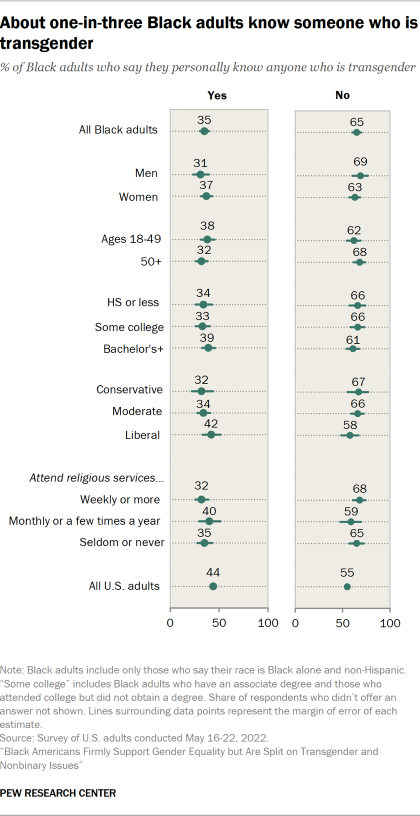
A chart showing that about one-in-three Black adults know someone who is transgender

About 1.4% of Black adults are transgender or nonbinary – that is, their gender is something other than the sex they were assigned at birth.

Although few are transgender themselves, 35% of Black adults know someone who is transgender. This is smaller than the share of the general public who say they know a transgender person (44%).

Among Black adults who know someone who is transgender, that person is more likely to be a friend (63%) than a relative (31%) or co-worker (29%).

The majority of Black adults (64%) say they have heard about people who are nonbinary – that is, those who do not identify as a man or woman. This includes 19% who have heard a lot and 45% who have heard a little.

About a third of Black adults (36%) say they have heard nothing at all about nonbinary people. Among Black adults who have heard at least a little, 26% say they know someone personally who is nonbinary.

Most Black adults say gender is determined by the sex assigned at birth

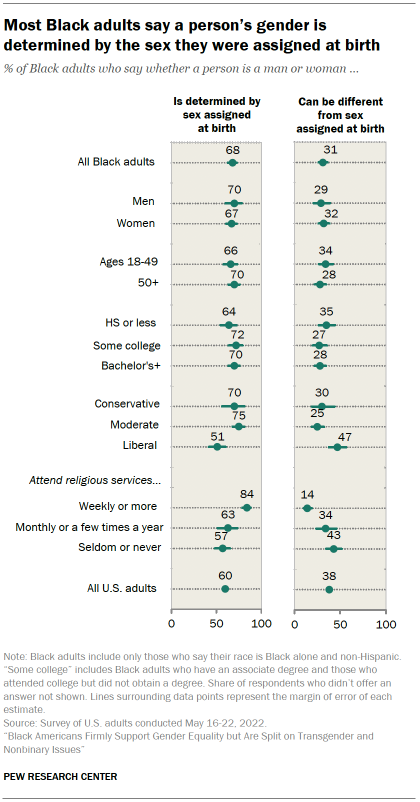
A chart showing that most Black adults say a person’s gender is determined by the sex they were assigned at birth

About two-thirds of Black adults (68%) say that whether a person is a man or a woman is determined by the sex they were assigned at birth. A smaller share say the opposite: that someone can be a man or woman even if this differs from the sex they were assigned at birth (31%).

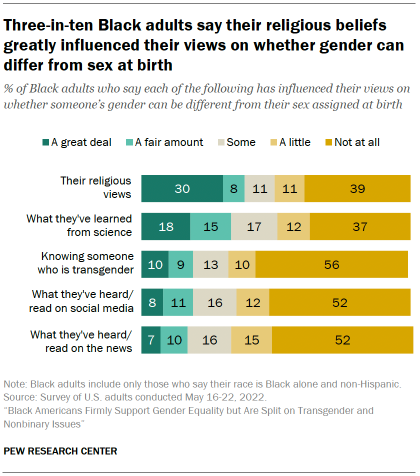
A bar chart showing that three-in-ten Black adults say their religious beliefs greatly influenced their views on whether gender can differ from sex at birth

Black adults (68%) are slightly more likely than the general public (60%) to say that gender is determined by sex at birth.

About two-thirds or more of Black men and women, as well as of those of various ages and educational levels, say that gender is based on sex assignment at birth. However, there are differences by political ideology and religious service attendance.

Black moderates (75%) are more likely than liberals (51%) to say that whether a person is a man or woman is determined by their sex assigned at birth.

And about eight-in-ten Black adults who attend religious services at least once a week (84%) say gender is based on sex assignment at birth. This is higher than the shares among those who attend monthly or a few times a year (63%) or who seldom or never attend (57%).

Black adults’ views on whether someone’s gender can differ from the sex they were assigned at birth are influenced by different sources. Some 37% of Black adults say their views are influenced a great deal or fair amount by their religious beliefs, while 33% say their views are influenced by what they learned from science.

About one-in-five say their views on sex assignment at birth are influenced by knowing someone who is transgender (20%), what they have heard or read on social media (19%) or what they have heard or read on the news (17%). Black adults differ in the influences they cite by religious service attendance and political ideology. 

Black adults who attend religious services weekly (54%) are more likely than those who rarely or never attend (22%) to say their religious beliefs influenced their views on sex assignment at birth a great deal or a fair amount.

About a third of Black liberals (32%) say their views on whether gender is determined by sex assignment at birth are influenced a great deal or fair amount by knowing someone who is transgender. Smaller shares of Black moderates (15%) and conservatives (13%) say the same.

Black adults are split on how accepting society should be of transgender people

Six-in-ten Black adults (60%) say there is a great deal or fair amount of discrimination against transgender people in the U.S. today, according to a 2022 Pew Research Center survey of U.S. adults.7 And 40% say society is a little or not at all accepting of transgender people.

Despite these views, there is no consensus among Black adults about how accepting society should be of transgender people. Roughly a third of Black adults say society has not gone far enough when it comes to accepting people who are transgender (36%), 31% say acceptance of transgender people has been about right and 29% say it has gone too far. Black adults differ on this question by political ideology and religious service attendance.

About half of Black liberals (49%) say society has not gone far enough in accepting transgender people, while smaller shares of moderates (32%) and conservatives (26%) say the same. Meanwhile, Black adults who attend religious services monthly (37%) or weekly (36%) are more likely than those who seldom or never attend (20%) to say society has gone too far in accepting transgender people. 

There is also no clear consensus among Black adults on how quickly views on transgender and nonbinary issues in society are changing. Some 41% say views are changing at the right speed, 34% say views are changing too quickly and about one-in-five Black adults (22%) say they are not changing quickly enough.

Like many of the views stated above, Black adults differ on the speed of change by religious service attendance and political ideology. Those who attend religious services weekly (44%) are more likely than those who rarely or never attend (27%) to say views on transgender and nonbinary issues in society are changing too quickly. And about one-third of Black liberals (33%) say views are not changing quickly enough, compared with 18% of moderates and 14% of conservatives.

While there are no clear majority opinions on these issues among Black adults, they are less likely than the general public to say our society has gone too far in accepting people who are transgender (29% vs. 38%).

A chart showing that there is no consensus among Black adults about how much society should accept transgender people

Acknowledgments

This report was written by Kiana Cox, research associate.

Editorial guidance was provided by Mark Hugo Lopez, director, race and ethnicity research and Juliana Menasce Horowitz, associate director, social and demographic trends research.

Guidance on the communications strategy and outreach was provided by Tanya Arditi, communications manager.    

The report was number checked by Carolyne Im, research assistant. Shannon Greenwood, digital producer, produced the report. David Kent, senior copy editor, copy edited the report. Charts were designed by Cox with editorial guidance provided by Peter Bell, design director.   

Pew Research Center is grateful to a panel of expert advisers who gave advice on all stages of the four studies covered in this report.

Study 1 (questions on gender, faith, and family): R. Khari Brown, associate professor of sociology at Wayne State University; Ryon J. Cobb, assistant professor of sociology at the University of Georgia; Yolanda Pierce, professor and dean at Howard University School of Divinity; Tia Noelle Pratt, president and director of research at TNPratt & Associates LLC; Dr. W. Franklyn Richardson, chairman of the Conference of National Black Churches; Josef Sorett, professor of religion and African American and African diaspora studies and chair of the religion department at Columbia University; and Eric Williams, curator of religion for the Smithsonian National Museum of African American History and Culture.

Study 2 (questions on gender equality and feminism): Carrie Lukas, president, Independent Women’s Forum; Dana R. Fisher, professor of sociology at the University of Maryland; Kristin Goss, Kevin D. Gorter professor of public policy and political science, Duke University; and Corrine McConnaughy, research scholar, department of politics, Princeton University.

Study 3 (questions on intersectional issues and Black adults’ concern about discrimination against LGBTQ people): Michael C. Dawson, John D. MacArthur professor of political science and the College at the University of Chicago; Leah Wright Rigueur, SNF Agora Institute associate professor of history at Johns Hopkins University; C. Riley Snorton, professor of English language and literature and the Center for Gender and Sexuality Studies at the University of Chicago; Mosi Adesina Ifatunji, assistant professor of Afro-American studies and sociology at the University of Wisconsin at Madison; and Charlene A. Carruthers, founding national director of Black Youth Project 100.

Study 4 (questions on transgender and nonbinary issues): Erica Anderson, clinical psychologist at Anderson Health Strategies LLC; Leonardo Kattari, LEO lecturer at University of Michigan; Shanna Kattari, assistant professor of social work and assistant professor of women’s studies at University of Michigan; Lain Mathers, assistant professor of sociology at Indiana State University; C. Riley Snorton, professor of English language and literature at the University of Chicago; and Ben Vincent, research coordinator at the Trans Learning Partnership.

Find related reports online at https://alpha.pewresearch.org/pewresearch-org/topic/race-ethnicity/racial-ethnic-groups/black-americans/.

Methodologies

This report draws on four surveys conducted by Pew Research Center between 2019 and 2022 using the American Trends Panel and supplemented by samples from the Ipsos KnowledgePanel and NORC’s AmeriSpeak panel. Brief descriptions of and links to the methodologies for these previously released surveys are included below.

The four studies

Study 1: Black Americans’ views on faith and religion 

The first survey that this report draws on was conducted among 8,660 Black adults (ages 18 and older) from Nov. 19, 2019, to June 3, 2020, and contains data from four sources: Pew Research Center’s American Trends Panel (conducted online), NORC’s AmeriSpeak panel (conducted online or by phone), Ipsos’ KnowledgePanel (conducted online) and a national cross-sectional survey by the Center (conducted online and by mail). In this survey, Black adults include those who say they are Black and non-Hispanic, Black and at least one other race and non-Hispanic, or Black and Hispanic. This survey provided the questions on gender, faith and family discussed in Chapter 1 of this report. To learn more, read the detailed methodology and the report based on this survey. 

Study 2: U.S. adults’ views on gender equality and feminism

The second was conducted online among 3,143 U.S. adults (ages 18 and older) from March 18 to April 1, 2020, on Ipsos’ KnowledgePanel. There were 705 non-Hispanic Black adults in the sample. In this survey, Black adults only include those who say they are single-race Black and non-Hispanic. This survey provided the questions on gender equality and feminism discussed in Chapters 1 and 2 of this report. To learn more, read the detailed methodology and the report based on this survey.

Study 3: Black Americans’ views on racial identity and racial inequality

The third survey was conducted online among 3,912 Black adults (ages 18 and older) from Oct. 4 to 17, 2021. The survey includes 1,025 Black adults on the Center’s American Trends Panel and 2,887 Black adults on Ipsos’ KnowledgePanel. In this survey, Black adults include those who say they are Black and non-Hispanic, Black and at least one other race and non-Hispanic, or Black and Hispanic. There were 3,416 Black and non-Hispanic adults in the sample. This survey provided the questions on intersectionality and Black adults’ concern about discrimination against LGBTQ people in Chapter 3 of this report. To learn more, read the detailed methodology and two reports based on this survey covering Black Americans’ racial identity and political views. 

Study 4: U.S. adults’ views on transgender and nonbinary issues

The fourth survey was conducted online among 10,188 U.S. adults (ages 18 and older) from May 16 to 22, 2022, using the Center’s American Trends Panel. There were 799 Black adults in the sample. In this survey, Black adults only include those who say they are Black and non-Hispanic. This survey provided the questions on transgender and nonbinary issues discussed in Chapter 3 of this report. To learn more, read the detailed methodology and two reports based on this survey covering transgender and nonbinary adults in the United States and Americans’ views on gender identity and transgender issues. Learn more about how we measured the share of the U.S. population that is transgender or nonbinary.