
Pew Research Center

FOR RELEASE DECEMBER 19, 2022

In Their Own Words: Asian Immigrants’ Experiences Navigating Language Barriers in the United States

Across 49 focus groups with Asian immigrants, daily challenges related to speaking English emerged as a common theme. Participants also shared frustration, stress and at times sadness in dealing with cultural and language barriers, and described support they received from others.

BY Luis Noé-Bustamante, Lauren Mora and Neil G. Ruiz

FOR MEDIA OR OTHER INQUIRIES:

Communications Department
202.419.4372
www.pewresearch.org

RECOMMENDED CITATION

Pew Research Center, December 2022, "In Their Own Words: Asian Immigrants’ Experiences Navigating Language Barriers in the United States"

About Pew Research Center

Pew Research Center is a nonpartisan, nonadvocacy fact tank that informs the public about the issues, attitudes and trends shaping the world. It does not take policy positions. The Center conducts public opinion polling, demographic research, computational social science research and other data-driven research. It studies politics and policy; news habits and media; the internet and technology; religion; race and ethnicity; international affairs; social, demographic and economic trends; science; research methodology and data science; and immigration and migration. Pew Research Center is a subsidiary of The Pew Charitable Trusts, its primary funder.

© Pew Research Center 2026

Table of contents

  • About Pew Research Center
  • In Their Own Words: Asian Immigrants’ Experiences Navigating Language Barriers in the United States
  • 1. Where Asian immigrants face language challenges: Navigating daily life and communicating in English
  • 2. How Asian immigrants learn English
  • 3. How Asian immigrants receive help while navigating language barriers
  • Acknowledgments

In Their Own Words: Asian Immigrants’ Experiences Navigating Language Barriers in the United States

Across 49 focus groups with Asian immigrants, daily challenges related to speaking English emerged as a common theme. Participants also shared frustration, stress and at times sadness in dealing with cultural and language barriers, and described support they received from others.

How we did this

This report focuses on how immigrant members of the ethnically diverse Asian population navigate through challenges related to language and culture in the United States. The analysis is based on a Pew Research Center analysis of the U.S. Census Bureau’s 2021 American Community Survey and 49 focus groups of participants from across the U.S. that we conducted virtually in the fall of 2021 in 17 non-English languages. This is part of a broader focus group project that explored the identity, economic mobility, representation, and experiences of immigration and discrimination among the Asian population in the United States.

The discussions in these groups may or may not resonate with other Asians living in the United States, as participants were recounting their personal experiences. All quotes in this report were translated from 17 non-English languages into English and have been lightly edited for readability, and punctuation.

By including participants of different languages, immigration or refugee experiences, educational backgrounds, and income levels, this focus group study aimed to capture, in people’s own words, what it means to be Asian in America. More information about the groups and analysis can be found in this methodology page.

Terminology

The terms “Asian” and “Asian American” are used interchangeably throughout this report to refer to U.S. adults who self-identify as Asian, either alone or in combination with other races or Hispanic identity.

“The United States” and “the U.S.” are used interchangeably with “America” for variations in the writing.

U.S. born refers to people born in the 50 U.S. states or the District of Columbia, Puerto Rico or other U.S. territories.

Immigrant refers to people who were not U.S. citizens at birth – in other words, those born outside the U.S., Puerto Rico or other U.S. territories to parents who were not U.S. citizens. The terms “immigrant” and “foreign born” are used interchangeably in this report. 

New immigrant arrivals to the United States face many challenges and obstacles when navigating their daily lives. For Asian immigrants, these include language and cultural obstacles that impact those who arrive with little to no proficiency in English. But navigating life in America also impacts English-speaking immigrants as they adjust to life in a new country with its own unique linguistic and cultural quirks.

A little over half of Asian Americans (54%) were born outside the United States, including about seven-in-ten Asian American adults (68%). While many Asian immigrants arrived in the United States in recent years, a majority arrived in the U.S. over 10 years ago. The story of Asian immigration to the U.S. is over a century old, and today’s Asian immigrants arrived in the country at different times and through different pathways. They also trace their roots, culture and language to more than 20 countries in Asia, including the Indian subcontinent.  

In 2021, Pew Research Center conducted 49 focus groups with Asian immigrants to understand the challenges they faced, if any, after arriving in the country. The focus groups consisted of 18 distinct Asian origins and were conducted in 17 Asian languages. (For more, see the methodology.)

Across the focus groups, daily challenges related to speaking English emerged as a common theme. These include experiences getting medical care, accessing government services, learning in school and finding employment along with speaking English and understanding U.S. culture. Participants also shared frustration, stress and at times sadness because of the cultural and language barriers they encountered. Some participants also told us about their challenges learning English, as well as the times they received support from others to deal with or overcome these language barriers.

Among Asian immigrants, recent arrivals report lower English proficiency levels than long-term residents

Focus group findings about learning English and challenges navigating life in the U.S. are reflected in government data about English proficiency among Asian immigrants. For example, about half (53%) of Asian immigrants ages 5 and older who have been in the U.S. for five years or less say they speak English proficiently, according to a Pew Research Center analysis of Census Bureau data. By contrast, 60% of Asian immigrants who have been in the U.S. for more than a decade say they speak English proficiently, a higher share than recent arrivals.  
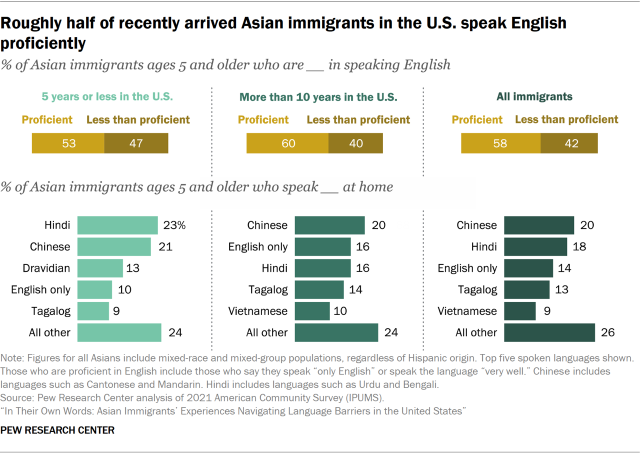
Chart showing roughly half of recently arrived Asian immigrants in the U.S. speak English proficiently

Among Asian Americans ages 5 and older, 58% of immigrants speak English proficiently, compared with nearly all of the U.S. born who say the same (94%).

There is language diversity among Asian immigrants living in the U.S. The vast majority (86%) of Asian immigrants 5 and older say they speak a language other than English at home, while 14% say they speak only English in their homes. The most spoken non-English language among Asian immigrants is Chinese, including Mandarin and Cantonese (20%). Hindi (18%) is the second most commonly spoken non-English language among Asian immigrants (this figure includes Urdu, Bengali and other Indo-Iranian and Indo-European languages), followed by Tagalog and other Filipino languages (13%) and Vietnamese (9%). This reflects the languages of the four largest Asian origin groups (Chinese, Indian, Filipino and Vietnamese) living in the U.S. But overall, many other languages are spoken at home by Asian immigrants.

The following chapters explore three broad themes from the focus group discussions: the challenges Asian immigrants have faced in navigating daily life and communicating in English; tools and strategies they used to learn the language; and types of help they received from others in adapting to English-speaking settings. The experiences discussed may not resonate with all Asian U.S. immigrants, but the study sought to capture a wide range of views by including participants of different languages, immigration or refugee experiences, educational backgrounds and income levels.
1. Where Asian immigrants face language challenges: Navigating daily life and communicating in English

Many focus group participants described how difficulties speaking English impacted their ability to carry out daily tasks like shopping, going to the doctor or visiting a government office, highlighting the many ways in which not being able to communicate can make daily life challenging. For example, simple activities such as visiting stores or purchasing food were difficult to complete.

“I came here when I was in college. I couldn’t speak English at all … I couldn’t speak in English at the post office or the grocery store.”1

–Immigrant woman of Japanese origin in mid-30s

“I didn’t know a single word [of English] when I first came here. … The language is very different. I didn’t know how to order food when dining out.”

–Immigrant woman of Vietnamese origin in early 40s

Some participants mentioned that when they struggled to speak in English, they noticed frustration from people they were interacting with. A Taiwanese woman described her experience at stores:

“Because my English isn’t that good, I often feel slighted by shopkeepers … some lose their patience with me.”

–Immigrant woman of Taiwanese origin in late 30s

Using public transportation also presents barriers. A Burmese woman recalled her initial challenges with a local bus system due to not being able to ask for help in English:

“I didn’t know where the bus stops were. I didn’t know how to ask so I walked … I couldn’t speak the language.”

–Immigrant woman of Burmese origin in early 50s

Visiting medical offices was highlighted as another place where newly arrived immigrants faced challenges, including not being able to accurately describe ailments.

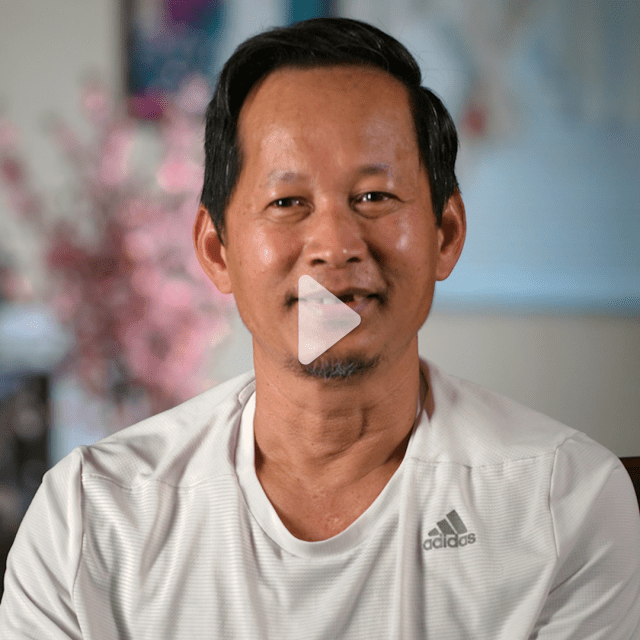
“When I came to the emergency room, I went alone. There were not any interpreters. But I know if the doctor asks me to sit on the bed, I need to sit on the bed.”

BUNTHA, documentary participant
(translated from KHMER)
    MORE SHORT VIDEOS OF THE ASIAN AMERICAN EXPERIENCE >

“There are a lot of obstacles … we can’t communicate … it is difficult … particularly [when] going to see a doctor. Sometimes we want to talk about our conditions or our health conditions, but we don’t know the words in English, especially my parents … sometimes, I have to go with them and don’t know how to explain things to the doctor.”

–Immigrant woman of Cambodian origin in mid-20s

Another Cambodian woman shared her language challenges while visiting the doctors during her pregnancy:

“I had hardships once I arrived in the [United States]. Yes, it was very difficult. … I didn’t know the [English] language yet … especially [when] I was pregnant. … Every time I went to see doctors … there were no interpreters. So it was difficult to talk to them.”

–Immigrant woman of Cambodian origin in mid-40s

Meanwhile, some participants had difficulties with English during their visits to government offices, including while filling out paperwork. 

“When I just came here and had to go to government offices for various procedures, it was easier to understand if there was a Japanese person who could explain in Japanese, but if they explained in English, I didn’t understand English and had absolutely no idea what I was supposed to do.”

–Immigrant woman of Japanese origin in mid-40s

“When I go to places like the DMV and other place to do some paperwork, I have a hard time when the documents are all in English.”

–Immigrant woman of Japanese origin in mid-30s

English proficiency challenges at school and college

Many participants mentioned their educational experiences in the U.S. and the communication obstacles they faced. For some, this happened when they were school-age children or teenagers, newly arrived in the U.S. For others it happened when they arrived in the country to begin their university studies. 

Other participants shared that they had learned English in their places of origin prior to arriving in the U.S. Yet, they found themselves facing challenges as they transitioned into predominantly English-speaking environments. Some attribute these challenges to their lack of fluency and comfort in English despite understanding what others were saying to them. Some participants also indicated that their accents led to confusion when communicating with English speakers.

“When I first arrived, I was only 10 years old, and with poor English language skills. Then, I found myself in a class full of other Chinese students. It was difficult to learn English that way as everybody could speak Chinese, so you would not talk to them in English. [My] progress was very slow.”

–Immigrant woman of Chinese origin in early 30s

There were participants who recalled feelings of fear at school, not only because they did not know the language but because they did not understand how American society and schools functioned. One immigrant woman of Vietnamese origin recalled not knowing whom to ask for help because no one in her family understood American culture.  

“When I came to the U.S. … I went to high school immediately … my parents went to work to earn money, so I had to go to school. … But at that time, I felt very scared. I didn’t understand what people talked [about] in school at all. It was not only English, but also culture and other things, everything was different in school. Coming home, I didn’t know who to ask; no one in my family knew. Because my family came here under the sponsorship. … There were many things I didn’t understand about the culture here. I didn’t know; I didn’t dare to ask.”

–Immigrant woman of Vietnamese origin in early 40s

A portion of focus groups participants came to the United States in their teenage years. These participants recalled challenging situations at school regarding their English skills. Some participants knew no English and reported having to take hours of English as a second language (ESL) classes, which left them behind in other classes in high school.

“I was already old when I first came because I was 14. I attended ninth grade but failed. I moved down to seventh grade because I could not do it. In seventh and eighth grade, it was challenging because I could not keep up with others in any of the classes in high school. I moved to ESL to learn the English language. I attended two, three hours and then I joined others again. It was a waste.”

–Immigrant woman of Laotian origin in early 50s

Several participants immigrated to the United States to study at a college or university and reported challenges speaking English and navigating U.S. culture. This included feeling insecure in their language abilities as well as other students not being able to understand them. 

“As a university student, the language barrier was a problem for me. Even though I started out from a language school and acquired a certain level of English, I was still embarrassed to speak English at the university, could not participate in discussions at all, and I was also embarrassed and frustrated when I had to speak. I knew my classmates stared at me like ‘I can’t understand what she’s saying at all.’ It felt really tough to attend classes. It’s also about the language barrier and it was a struggle at first.”

–Immigrant woman of Japanese origin in mid-30s

Several top schools in the United States require the Test of English as a Foreign Language, or TOEFL, to determine the language abilities of non-native English-speaking applicants. Some participants reported that despite passing this test and obtaining a top score, they experienced challenges keeping up in college-level courses in the U.S. Even in non-academic social settings, some recalled not fully understanding what native English speakers were saying due to their use of slang and frequent pop culture references.

“I remember when I began my university, almost 50% of the classes were incomprehensible. You thought you had already got a very good TOEFL score, right? I took a score above 100 or 110, and it was the ceiling, and it turned out that you really didn’t understand the instruction. When I was in college, I remember many times when I made friends, they might be the native English speaker. When I couldn’t understand, I quietly remembered that word and then went back to look it up in the dictionary. … People often say it, but it is not used in academics. Later, I found that my English improved a bit. When you really interact more with local people, you will slowly get used to the pop culture and those words. Then you need to have something appealing when you communicate, you further your learning by watching more American TV shows.”

–Immigrant woman of Chinese origin in late 20s

“At first, I came here to study for a master’s degree as an international student, but I couldn’t speak a single word of English when I first met the head of the department. I only took the TOEFL and GRE tests. The head of the department said, ‘You don’t seem to be ready for classes. Then take only one class and register for the language training.’ So I started taking language training for six months and moved my school to another place.”

–Immigrant man of Korean origin in early 40s

English proficiency and the workplace

Many participants pointed to their difficulties speaking in English as a major reason they struggled to find employment. One Taiwanese man mentioned: 

“I wanted a job all along, but there were obstacles. I started sending out my resume … but it wasn’t successful. I think it was mainly due to my poor communication skills. There were usually four stages in an interview, starting with a phone interview. I never got to stage four, as I usually would fail at stage one.”

–Immigrant man of Taiwanese origin in early 40s

A Taiwanese women described the challenges of finding a job:

“The hardest thing was to find a job. Due to poor language ability, I could not express myself well during interviews, and this was the biggest challenge.”

–Immigrant woman of Taiwanese origin in late 40s

Some participants shared that once employed, language barriers slowed their professional success and advancement. A Chinese woman described how language challenges emerged when she changed industries. 

“I just changed jobs, and this job was very different from what I did before, so the terminology used at work now is completely different from the previous work environment. It is like relearning the language of a new field, that is, I do not have the breadth that the native English speakers have, because I did not get exposed to all the words they use.”

–Immigrant woman of Chinese origin in early 30s

A Japanese woman shared her belief that her lack of proficiency speaking English negatively affected her ability to get customers as a hairdresser.

“I had been working as a hairdresser in Japan for quite a long time, so I thought I could do well in the U.S. as well, but the language barrier made it difficult to get customers … for the first year.”

–Immigrant woman of Japanese origin in mid-40s

Some participants noted their accents affected how they were treated at work.      

“When starting to work … many times on the phone, I had to make phone calls to customers, then they heard my accent; they were obviously talking to my co-workers in different ways than they talked with me. Their attitude was totally different.”

–Immigrant woman of Vietnamese origin in early 40s

“I was working as an office administrator. Actually, I was also an operator, but since I have an accent with my English, then I wasn’t allowed to pick up the phone. Because they don’t want the company’s credibility to go down.”

–Immigrant woman of Indonesian origin in late 30s

2. How Asian immigrants learn English

Focus group moderators asked participants if they were in the process of learning English, and what challenges they faced trying to learn the language. Participants shared various ways they learned or improved their English skills.

Taking English classes

Many participants shared that during their childhood they were enrolled in English as a second language (ESL) courses as part of their school program. Others who arrived in the country as adults mentioned that they were able to join English courses offered by organizations in their communities or cities.

“When I came [to the U.S.], I studied English. I joined an ESL class for about six months. After six months, I got direct college entry. And then I finished school. Finished school. Now I also work as an interpreter.”

–Immigrant woman of Burmese origin in early 50s

“My wife thought I should first familiarize myself with the environment, so I first went to ESL courses. The main thing was to develop my listening and speaking skills. And also to build up my experience in communicating with others.”

–Immigrant man of Taiwanese origin in early 40s

“Even though I have lived in the United States for more than 10 years, it always felt like that being fluent in English remained a question. Now that my children have grown up, I have a lot of time. That’s why I’m enrolled in an adult school to take an ESL course. … Online adult school and ESL programs are well-organized because of COVID-19.”

–Immigrant woman of Korean origin in early 40s

Meanwhile, other participants shared their experiences of learning English prior to coming to the U.S. yet still facing language barriers related to their accents because they learned English from British teachers.

“Before I left Vietnam, I studied English. I learned British English accent in Vietnam. I had a problem with my accent here.”

–Immigrant man of Vietnamese origin in late 40s

“While I studied in Nepal, I studied in an English medium school and they taught us British language, and here, American English is used. … I felt that the tone of my speech is different, the way of speaking is different than the native speakers … words were different and even meanings were different.”

–Immigrant woman of Nepalese origin in late 20s

Connecting with English speakers

Many participants shared how they learned English simply by trying to talk to native speakers as much as possible, from new friends to co-workers to other people in everyday life. While many made this a casual everyday practice, some mentioned attending meet-ups and language exchanges in their new home cities.

“I go to meet-ups every weekend. There are Americans who want to learn Korean and Koreans who want to learn English, and I go there for the purpose of language exchange. Everyone really likes Korean culture and they welcome me just because I am Korean, so I feel very close to them. After the meet-up, we eat together and hang out, so I often attend those meetings.”

–Immigrant woman of Korean origin in late 20s

Some participants recalled their decision to purposely live in a place without other immigrants from their own ethnic group. This allowed them to immerse themselves in American culture, including English language, and offered an opportunity to practice speaking with native speakers.

“In my case, I came to live here permanently and wanted to get accustomed to local society, so, it might sound weird, but I have avoided seeing Japanese people as much as possible. If I got a chance to talk with a Japanese person at a Japanese supermarket, of course I would have a friendly conversation, but as for where I would live, I intentionally chose an area with few Japanese people so that I could speak English like a native speaker as quickly as possible and live here permanently.”

–Immigrant woman of Japanese descent in mid-40s

“At first, I moved to stay away from the Vietnamese people to avoid coming in contact with them, so that I could have more opportunities to interact with the native Americans. I wanted to speak English so I could practice my English. After I feel that my English is [strong] enough to communicate and study this and that, I want to return to the Vietnamese area.”

–Immigrant man of Vietnamese origin in early 20s

Consuming more English-language media

American pop culture and media served as an important tool in many immigrants’ English-learning journey. Focus group participants shared how watching American television, listening to radio and podcasts, and reading publications in English helped them improve their comprehension, speaking and writing skills.

Watching, hearing and reading media in English was a particularly useful strategy for those who said they were busy with school, work or taking care of kids. One Korean male in his early 40s said, “I’m busy and I don’t have time as I have to take care of my kids, so my only English study is to listen to American broadcasts in my car for an hour of commuting. That was the only time I had to study English.” Absorbing American media was important in different ways to others as well.

“I would increase reading. I started reading American newspapers, then books, and now watching TV, movies, these streaming platforms were all in English. And then I switched everything into English on mobile phones, computers, etc.”

–Immigrant woman of Chinese origin in early 30s

“I would keep my podcast on all the time. And when I was free, I would keep it on as background sound. It was to see if I could absorb any new knowledge.”

–Immigrant woman of Taiwanese origin in mid-20s

“[I learned by] watching all English programs on TV with subtitles. When I talked to my boss about this, he suggested that I should watch English programs I like, but should use subtitles. He told me if I don’t understand, then I should go back and see after rewinding what has been said. In this way you will catch the slang of this place. … He used to suggest that I may watch as many Hindi programs as I like but I should make sure to watch English movies. … For better understanding, we used to replay everything that was not understood, by rewinding. In this way, my English got better to some extent.”

–Immigrant woman of Indian origin in early 50s

3. How Asian immigrants receive help while navigating language barriers

Across the focus groups, participants also shared personal stories of help they received from others while navigating different situations and settings in which they faced language barriers.

“Medical words used at hospitals are too difficult and unfamiliar. It’s so nice to be able to talk about my symptoms freely when I see second-generation Korean doctors who can speak Korean even a little bit.”

–Immigrant woman of Korean origin in early 40s

“Language was indeed a great obstacle when I first came. I was living largely in Brooklyn in the beginning … there were many other Chinese people around. If there was any problem, I could always find someone to ask, so it was easier.”

–Immigrant man of Chinese origin in mid-50s

“I got in a car accident. … I didn’t know English … I didn’t know how to call the insurance … until I found a Cambodian person who knew English and helped me call.”

–Immigrant woman of Cambodian origin in mid-40s

“Yes, I had knowledge [of English] but we were not used to speaking it. My instruction for education was in English, but we were not using it for conversation with each other. We talk with our friends and family members in Hindi in India. … [My boss] taught me many things. I used to make a list of 10 things every day that I had learned from my boss. He was living here for so many years.”

–Immigrant woman of Indian origin in early 50s

Other participants described the support they received while learning or improving their English after arriving in the country.

“After we came, we participated in a lot of the English learning classes sponsored by the U.S. government.”

–Immigrant man of Chinese origin in late 50s

“I really admired and appreciated [ESL] teachers … because they knew we were refugees, and that English was our second language. … The teacher tried to help us.”

–Immigrant woman of Cambodian origin in mid-40s

“My husband taught me [English] because I couldn’t speak English. It was so hard. When I got a call, I didn’t pick up. My husband kept teaching me. … In New York, [Koreans] need an interpreter when they have a car accident or get a checkup at a hospital. So now that’s what I’m doing.”

–Immigrant woman of Korean origin in early 50s

“I used to search in Google for places where free [English] language courses were provided. The first was Columbia University and the next was a church that was providing free language classes to immigrants on the basis of a lottery system.”

–Immigrant man of Nepalese origin in late 30s

When asked how he improved his English fluency and accent, an Indian man mentioned how he leaned to practice on other international students in his college:

“I knew that if I wanted to do better, I had to step out of my comfort zone … I got an on-campus job. Many people from other countries were working on-campus jobs, so I received a lot of help [with my accent] from them.”

–Immigrant man of Indian origin in early 30s

Acknowledgments

Pew Research Center is a subsidiary of The Pew Charitable Trusts, its primary funder. This study was funded by The Pew Charitable Trusts, with generous support from the Chan Zuckerberg Initiative DAF, an advised fund of the Silicon Valley Community Foundation; the Robert Wood Johnson Foundation; the Henry Luce Foundation; The Wallace H. Coulter Foundation; The Dirk and Charlene Kabcenell Foundation; The Long Family Foundation; Lu-Hebert Fund; Gee Family Foundation; Joseph Cotchett; the Julian Abdey and Sabrina Moyle Charitable Fund; and Nanci Nishimura.

The accompanying video clip was made possible by The Pew Charitable Trusts, with generous support from The Sobrato Family Foundation and The Long Family Foundation.

We would also like to thank the Leaders Forum for its thought leadership and valuable assistance in helping make this study possible.

This report was written by Luis Noe-Bustamante, Research Associate, Lauren Mora, Research Assistant, and Neil G. Ruiz, Associate Director of Race and Ethnicity Research.

Many individuals contributed to this study’s data collection and methodology. The authors are grateful to Sono Shah, Computational Social Scientist of the Center’s Data Labs; Laura Silver, Senior Researcher; Mohamad Moslimani, Research Assistant; Carolyne Im, Research Assistant; and Sunny Shao, former Research Associate, for tirelessly observing focus groups, coding the transcripts and helping in analyzing the results. Pew Research Center is also grateful to Andre Sanabia, Collen McCauley, Shawnna Mullenax and Valerie Ojeda-Avitia from PSB Insights and to Grace Chiu and Patrick Cahill from GC Global for their many contributions to this project.

The report and the accompanying video clip were produced by Shannon Greenwood, Digital Producer. The communications and outreach strategy for the report, as well as editorial advice on all accompanying research products, was provided by Hannah Klein, Communications Manager, and Gar Meng Leong, Communications Associate.

Editorial guidance was provided by Mark Hugo Lopez, Director, Race and Ethnicity Research. The report was number checked by Mohamad Moslimani, Research Assistant. David Kent, Senior Copy Editor, copy edited the report.

Pew Research Center is grateful to a panel of expert advisers who provided guidance at all stages of this report: Yến Lê Espiritu, Distinguished Professor of Ethnic Studies at University of California, San Diego; Devesh Kapur, Starr Foundation Professor of South Asian Studies at Johns Hopkins School of Advanced International Studies; Anthony Christian Ocampo, Professor of Sociology at California State Polytechnic University, Pomona; Karthick Ramakrishnan, Professor of Public Policy at the University of California, Riverside; Janelle Wong, Professor of American Studies and Asian American Studies at the University of Maryland; and Yang Sao Xiong, Assistant Professor of Social Work and Asian American Studies at University of Wisconsin-Madison.

Find related reports online at https://alpha.pewresearch.org/pewresearch-org/topic/race-ethnicity/racial-ethnic-groups/asian-americans/