Pew Research Center

FOR RELEASE AUGUST 30, 2022

Black Americans Have a Clear Vision for Reducing Racism but Little Hope It Will Happen

Many say key U.S. institutions should be rebuilt to ensure fair treatment

BY Kiana Cox and Khadijah Edwards

FOR MEDIA OR OTHER INQUIRIES:

Communications Department
202.419.4372
www.pewresearch.org

RECOMMENDED CITATION

Pew Research Center, August 2022, "Black Americans Have a Clear Vision for Reducing Racism but Little Hope It Will Happen"

About Pew Research Center

Pew Research Center is a nonpartisan, nonadvocacy fact tank that informs the public about the issues, attitudes and trends shaping the world. It does not take policy positions. The Center conducts public opinion polling, demographic research, computational social science research and other data-driven research. It studies politics and policy; news habits and media; the internet and technology; religion; race and ethnicity; international affairs; social, demographic and economic trends; science; research methodology and data science; and immigration and migration. Pew Research Center is a subsidiary of The Pew Charitable Trusts, its primary funder.

© Pew Research Center 2026

Table of contents

  • About Pew Research Center
  • Black Americans Have a Clear Vision for Reducing Racism but Little Hope It Will Happen
  • 1. Black Americans are pessimistic about their position in U.S. society
  • 2. Black Americans’ views on political strategies, leadership and allyship for achieving equality
  • 3. Reparations for slavery
  • 4. Black Americans’ views on systemic change
  • Acknowledgments
  • Appendix: Supplemental tables
  • Methodology

Black Americans Have a Clear Vision for Reducing Racism but Little Hope It Will Happen

Many say key U.S. institutions should be rebuilt to ensure fair treatment

How we did this

Pew Research Center conducted this analysis to understand the nuances among Black people on issues of racial inequality and social change in the United States. This in-depth survey explores differences among Black Americans in their views on the social status of the Black population in the U.S.; their assessments of racial inequality; their visions for institutional and social change; and their outlook on the chances that these improvements will be made. The analysis is the latest in the Center’s series of in-depth surveys of public opinion among Black Americans (read the first, “Faith Among Black Americans” and “Race Is Central to Identity for Black Americans and Affects How They Connect With Each Other”).

The online survey of 3,912 Black U.S. adults was conducted Oct. 4-17, 2021. Black U.S. adults include those who are single-race, non-Hispanic Black Americans; multiracial non-Hispanic Black Americans; and adults who indicate they are Black and Hispanic. The survey includes 1,025 Black adults on Pew Research Center’s American Trends Panel (ATP) and 2,887 Black adults on Ipsos’ KnowledgePanel. Respondents on both panels are recruited through national, random sampling of residential addresses.

Recruiting panelists by phone or mail ensures that nearly all U.S. Black adults have a chance of selection. This gives us confidence that any sample can represent the whole population (see our Methods 101 explainer on random sampling). Here are the questions used for the survey of Black adults, along with its responses and methodology.

Terminology

The terms “Black Americans,” “Black people” and “Black adults” are used interchangeably throughout this report to refer to U.S. adults who self-identify as Black, either alone or in combination with other races or Hispanic identity.

Throughout this report, “Black, non-Hispanic” respondents are those who identify as single-race Black and say they have no Hispanic background. “Black Hispanic” respondents are those who identify as Black and say they have Hispanic background. We use the terms “Black Hispanic” and “Hispanic Black” interchangeably. “Multiracial” respondents are those who indicate two or more racial backgrounds (one of which is Black) and say they are not Hispanic.

Respondents were asked a question about how important being Black was to how they think about themselves. In this report, we use the term “being Black” when referencing responses to this question.

In this report, “immigrant” refers to people who were not U.S. citizens at birth – in other words, those born outside the U.S., Puerto Rico or other U.S. territories to parents who were not U.S. citizens. We use the terms “immigrant,” “born abroad” and “foreign-born” interchangeably.

Throughout this report, “Democrats and Democratic leaners” and just “Democrats” both refer to respondents who identify politically with the Democratic Party or who are independent or some other party but lean toward the Democratic Party. “Republicans and Republican leaners” and just “Republicans” both refer to respondents who identify politically with the Republican Party or are independent or some other party but lean toward the Republican Party.

Respondents were asked a question about their voter registration status. In this report, respondents are considered registered to vote if they self-report being absolutely certain they are registered at their current address. Respondents are considered not registered to vote if they report not being registered or express uncertainty about their registration.

To create the upper-, middle- and lower-income tiers, respondents’ 2020 family incomes were adjusted for differences in purchasing power by geographic region and household size. Respondents were then placed into income tiers: “Middle income” is defined as two-thirds to double the median annual income for the entire survey sample. “Lower income” falls below that range, and “upper income” lies above it. For more information about how the income tiers were created, read the methodology.
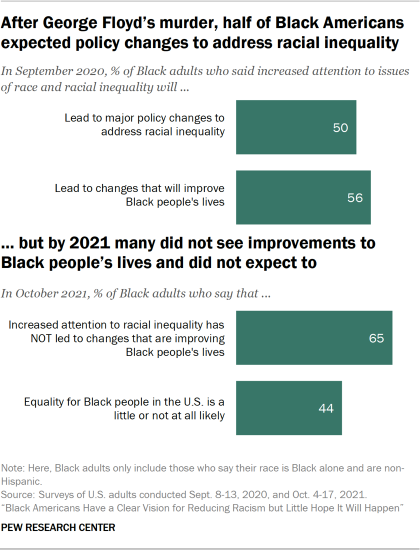
Bar chart showing after George Floyd’s murder, half of Black Americans expected policy changes to address racial inequality, After George Floyd’s murder, half of Black Americans expected policy changes to address racial inequality

More than a year after the murder of George Floyd and the national protests, debate and political promises that ensued, 65% of Black Americans say the increased national attention on racial inequality has not led to changes that improved their lives.1 And 44% say equality for Black people in the United States is not likely to be achieved, according to newly released findings from an October 2021 survey of Black Americans by Pew Research Center.

This is somewhat of a reversal in views from September 2020, when half of Black adults said the increased national focus on issues of race would lead to major policy changes to address racial inequality in the country and 56% expected changes that would make their lives better.

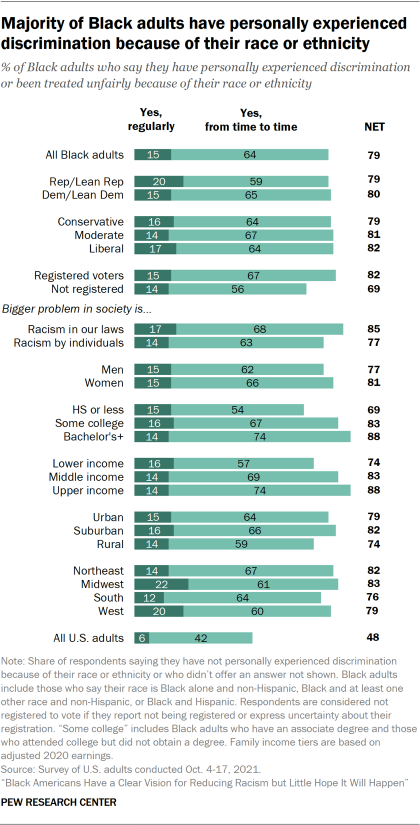
At the same time, many Black Americans are concerned about racial discrimination and its impact. Roughly eight-in-ten say they have personally experienced discrimination because of their race or ethnicity (79%), and most also say discrimination is the main reason many Black people cannot get ahead (68%).  

Even so, Black Americans have a clear vision for how to achieve change when it comes to racial inequality. This includes support for significant reforms to or complete overhauls of several U.S. institutions to ensure fair treatment, particularly the criminal justice system; political engagement, primarily in the form of voting; support for Black businesses to advance Black communities; and reparations in the forms of educational, business and homeownership assistance. Yet alongside their assessments of inequality and ideas about progress exists pessimism about whether U.S. society and its institutions will change in ways that would reduce racism.

These findings emerge from an extensive Pew Research Center survey of 3,912 Black Americans conducted online Oct. 4-17, 2021. The survey explores how Black Americans assess their position in U.S. society and their ideas about social change. Overall, Black Americans are clear on what they think the problems are facing the country and how to remedy them. However, they are skeptical that meaningful changes will take place in their lifetime.

Black Americans see racism in our laws as a big problem and discrimination as a roadblock to progress
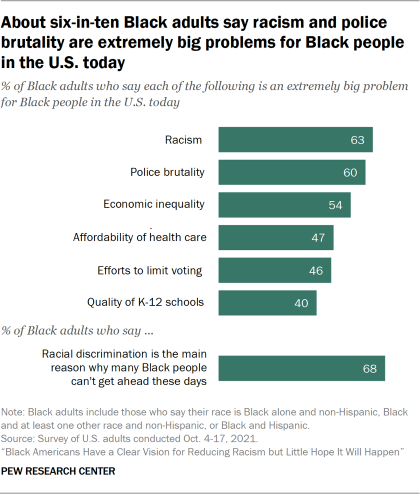
Bar chart showing about six-in-ten Black adults say racism and police brutality are extremely big problems for Black people in the U.S. today

Black adults were asked in the survey to assess the current nature of racism in the United States and whether structural or individual sources of this racism are a bigger problem for Black people. About half of Black adults (52%) say racism in our laws is a bigger problem than racism by individual people, while four-in-ten (43%) say acts of racism committed by individual people is the bigger problem. Only 3% of Black adults say that Black people do not experience discrimination in the U.S. today.

In assessing the magnitude of problems that they face, the majority of Black Americans say racism (63%), police brutality (60%) and economic inequality (54%) are extremely or very big problems for Black people living in the U.S. Slightly smaller shares say the same about the affordability of health care (47%), limitations on voting (46%), and the quality of K-12 schools (40%).

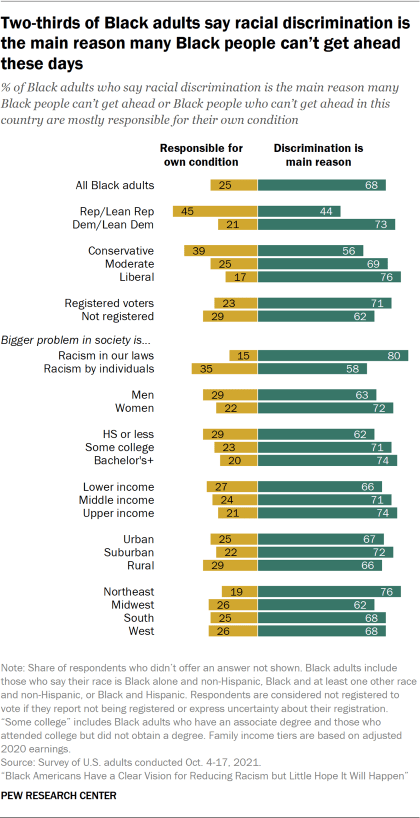
Aside from their critiques of U.S. institutions, Black adults also feel the impact of racial inequality personally. Most Black adults say they occasionally or frequently experience unfair treatment because of their race or ethnicity (79%), and two-thirds (68%) cite racial discrimination as the main reason many Black people cannot get ahead today.

Black Americans’ views on reducing racial inequality

Bar chart showing many Black adults say institutional overhauls are necessary to ensure fair treatment

Black Americans are clear on the challenges they face because of racism. They are also clear on the solutions. These range from overhauls of policing practices and the criminal justice system to civic engagement and reparations to descendants of people enslaved in the United States.

Changing U.S. institutions such as policing, courts and prison systems

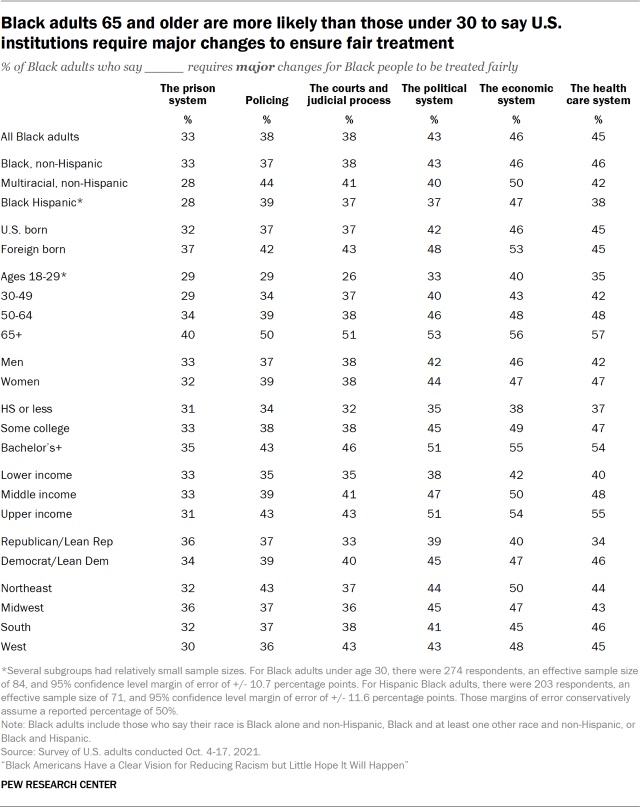
About nine-in-ten Black adults say multiple aspects of the criminal justice system need some kind of change (minor, major or a complete overhaul) to ensure fair treatment, with nearly all saying so about policing (95%), the courts and judicial process (95%), and the prison system (94%).

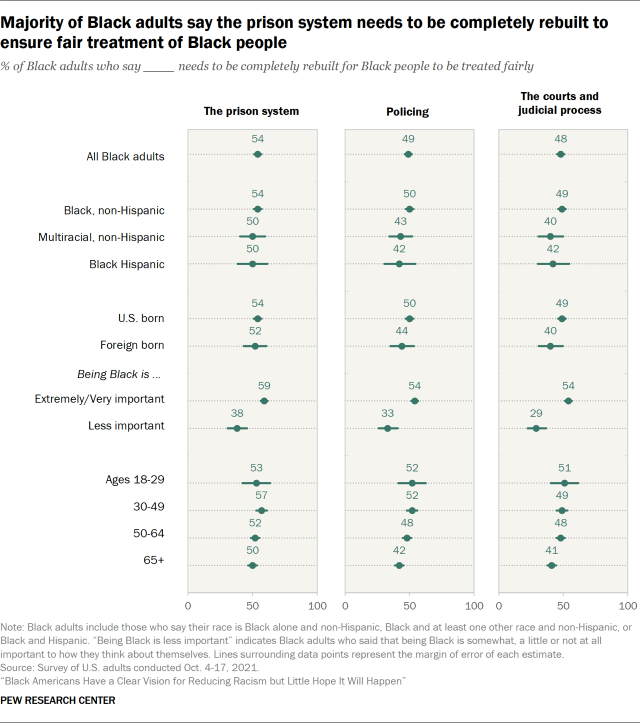
Roughly half of Black adults say policing (49%), the courts and judicial process (48%), and the prison system (54%) need to be completely rebuilt for Black people to be treated fairly. Smaller shares say the same about the political system (42%), the economic system (37%) and the health care system (34%), according to the October survey.

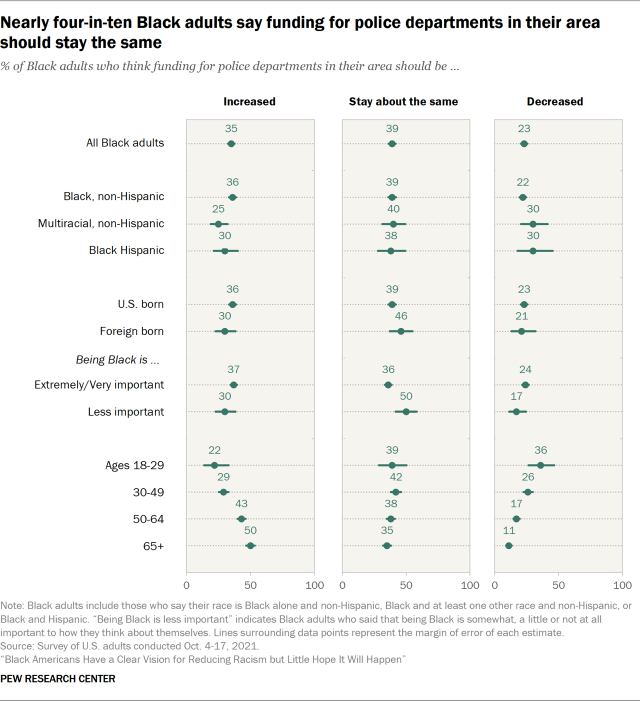
While Black Americans are in favor of significant changes to policing, most want spending on police departments in their communities to stay the same (39%) or increase (35%). A little more than one-in-five (23%) think spending on police departments in their area should be decreased.

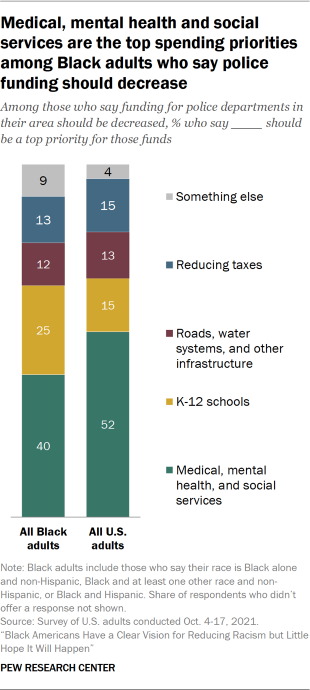
Black adults who favor decreases in police spending are most likely to name medical, mental health and social services (40%) as the top priority for those reappropriated funds. Smaller shares say K-12 schools (25%), roads, water systems and other infrastructure (12%), and reducing taxes (13%) should be the top priority.

Voting and ‘buying Black’ viewed as important strategies for Black community advancement

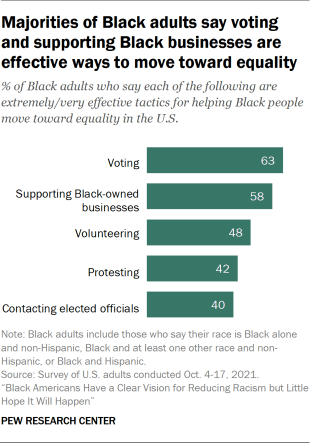
Black Americans also have clear views on the types of political and civic engagement they believe will move Black communities forward. About six-in-ten Black adults say voting (63%) and supporting Black businesses or “buying Black” (58%) are extremely or very effective strategies for moving Black people toward equality in the U.S. Smaller though still significant shares say the same about volunteering with organizations dedicated to Black equality (48%), protesting (42%) and contacting elected officials (40%).

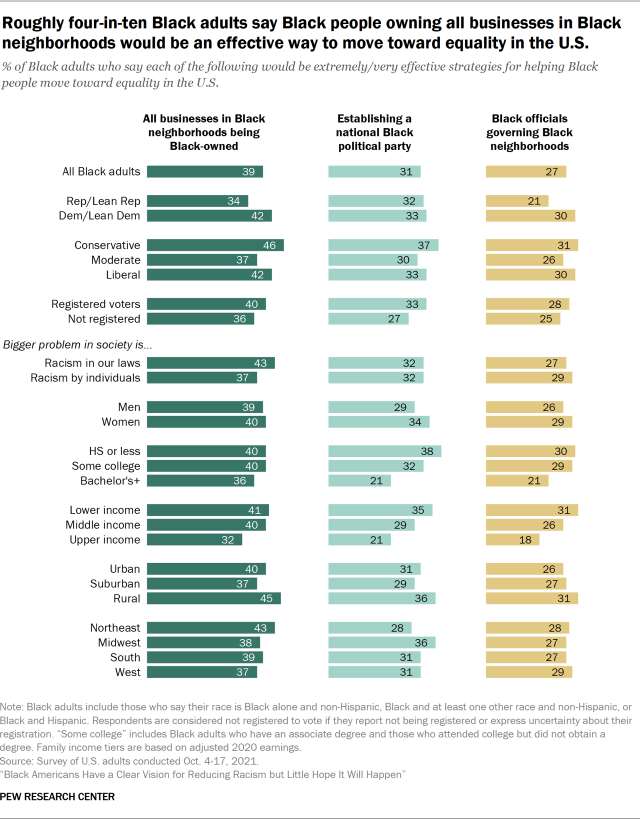
Black adults were also asked about the effectiveness of Black economic and political independence in moving them toward equality. About four-in-ten (39%) say Black ownership of all businesses in Black neighborhoods would be an extremely or very effective strategy for moving toward racial equality, while roughly three-in-ten (31%) say the same about establishing a national Black political party. And about a quarter of Black adults (27%) say having Black neighborhoods governed entirely by Black elected officials would be extremely or very effective in moving Black people toward equality.

Most Black Americans support repayment for slavery

Discussions about atonement for slavery predate the founding of the United States. As early as 1672, Quaker abolitionists advocated for enslaved people to be paid for their labor once they were free. And in recent years, some U.S. cities and institutions have implemented reparations policies to do just that.

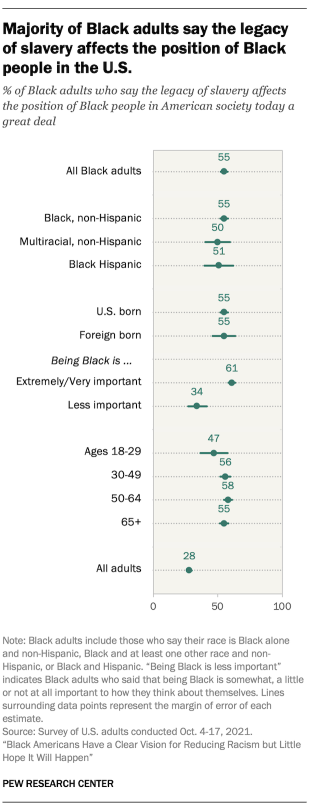
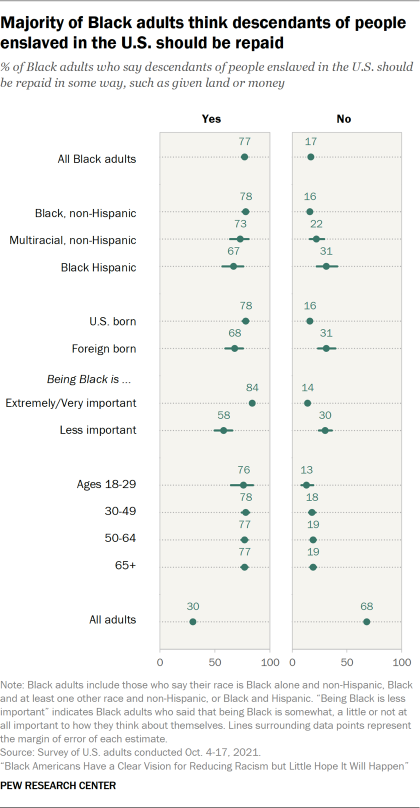
Most Black Americans say the legacy of slavery affects the position of Black people in the U.S. either a great deal (55%) or a fair amount (30%), according to the survey. And roughly three-quarters (77%) say descendants of people enslaved in the U.S. should be repaid in some way.

Black adults who say descendants of the enslaved should be repaid support doing so in different ways. About eight-in-ten say repayment in the forms of educational scholarships (80%), financial assistance for starting or improving a business (77%), and financial assistance for buying or remodeling a home (76%) would be extremely or very helpful. A slightly smaller share (69%) say cash payments would be extremely or very helpful forms of repayment for the descendants of enslaved people.

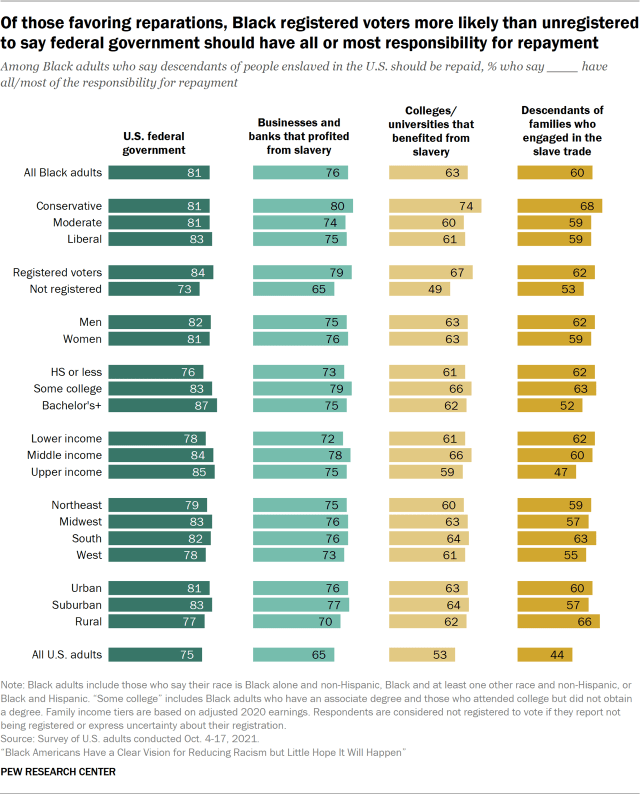
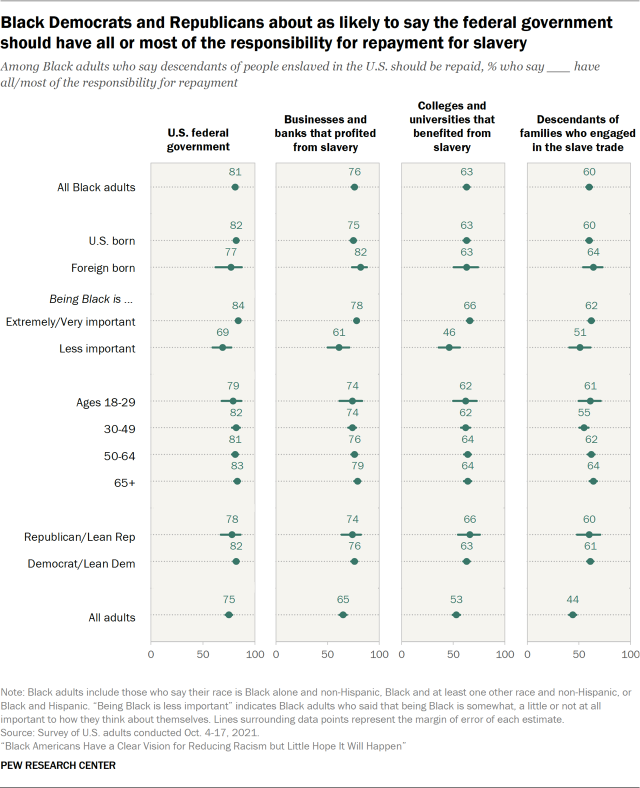
Where the responsibility for repayment lies is also clear for Black Americans. Among those who say the descendants of enslaved people should be repaid, 81% say the U.S. federal government should have all or most of the responsibility for repayment. About three-quarters (76%) say businesses and banks that profited from slavery should bear all or most of the responsibility for repayment. And roughly six-in-ten say the same about colleges and universities that benefited from slavery (63%) and descendants of families who engaged in the slave trade (60%).

Black Americans are skeptical change will happen
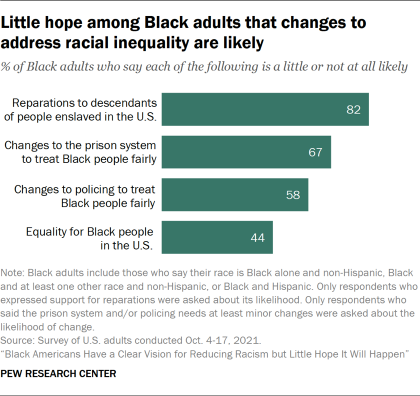
Bar chart showing little hope among Black adults that changes to address racial inequality are likely

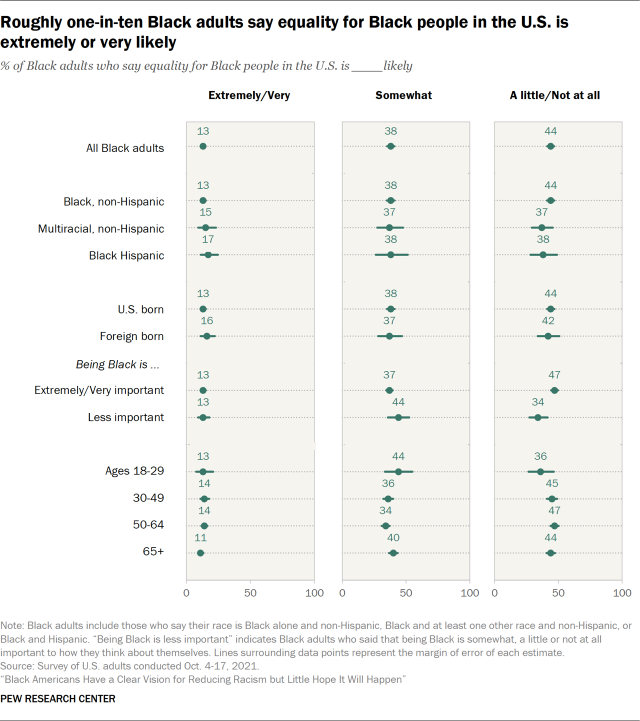
Even though Black Americans’ visions for social change are clear, very few expect them to be implemented. Overall, 44% of Black adults say equality for Black people in the U.S. is a little or not at all likely. A little over a third (38%) say it is somewhat likely and only 13% say it is extremely or very likely.

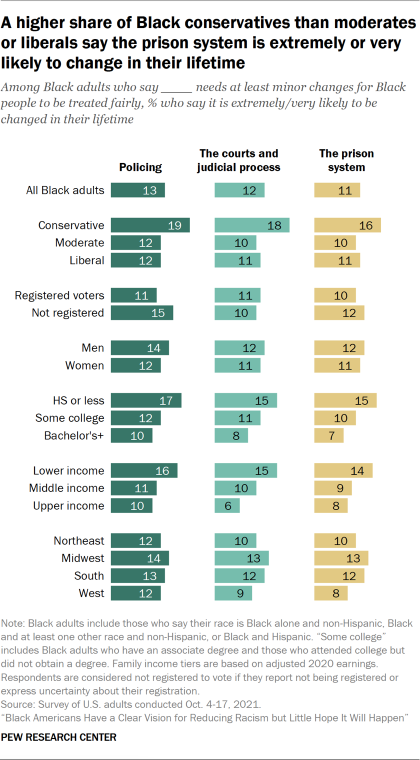
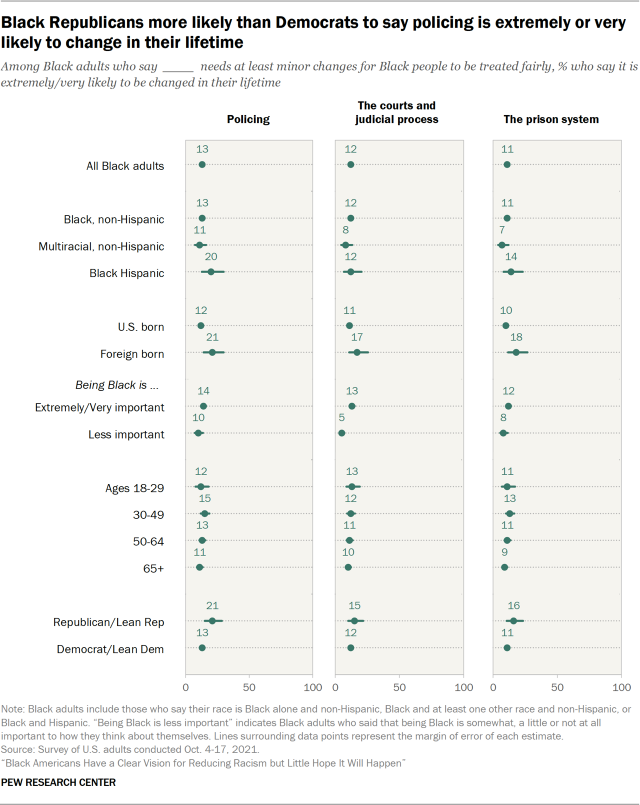
They also do not think specific institutions will change. Two-thirds of Black adults say changes to the prison system (67%) and the courts and judicial process (65%) that would ensure fair treatment for Black people are a little or not at all likely in their lifetime. About six-in-ten (58%) say the same about policing. Only about one-in-ten say changes to policing (13%), the courts and judicial process (12%), and the prison system (11%) are extremely or very likely.

This pessimism is not only about the criminal justice system. The majority of Black adults say the political (63%), economic (62%) and health care (51%) systems are also unlikely to change in their lifetime.

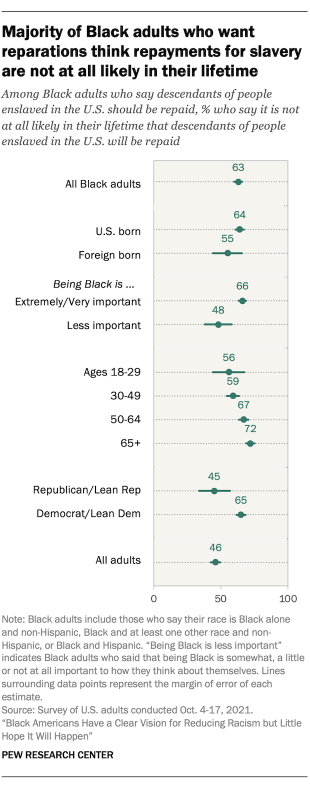
Black Americans’ vision for social change includes reparations. However, much like their pessimism about institutional change, very few think they will see reparations in their lifetime. Among Black adults who say the descendants of people enslaved in the U.S. should be repaid, 82% say reparations for slavery are unlikely to occur in their lifetime. About one-in-ten (11%) say repayment is somewhat likely, while only 7% say repayment is extremely or very likely to happen in their lifetime.

Black Democrats, Republicans differ on assessments of inequality and visions for social change
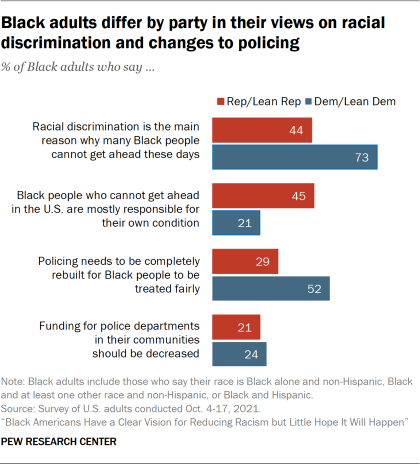
Bar chart showing Black adults differ by party in their views on racial discrimination and changes to policing

Party affiliation is one key point of difference among Black Americans in their assessments of racial inequality and their visions for social change. Black Republicans and Republican leaners are more likely than Black Democrats and Democratic leaners to focus on the acts of individuals. For example, when summarizing the nature of racism against Black people in the U.S., the majority of Black Republicans (59%) say racist acts committed by individual people is a bigger problem for Black people than racism in our laws. Black Democrats (41%) are less likely to hold this view.

Black Republicans (45%) are also more likely than Black Democrats (21%) to say that Black people who cannot get ahead in the U.S. are mostly responsible for their own condition. And while similar shares of Black Republicans (79%) and Democrats (80%) say they experience racial discrimination on a regular basis, Republicans (64%) are more likely than Democrats (36%) to say that most Black people who want to get ahead can make it if they are willing to work hard.

On the other hand, Black Democrats are more likely than Black Republicans to focus on the impact that racial inequality has on Black Americans. Seven-in-ten Black Democrats (73%) say racial discrimination is the main reason many Black people cannot get ahead in the U.S, while about four-in-ten Black Republicans (44%) say the same. And Black Democrats are more likely than Black Republicans to say racism (67% vs. 46%) and police brutality (65% vs. 44%) are extremely big problems for Black people today.

Black Democrats are also more critical of U.S. institutions than Black Republicans are. For example, Black Democrats are more likely than Black Republicans to say the prison system (57% vs. 35%), policing (52% vs. 29%) and the courts and judicial process (50% vs. 35%) should be completely rebuilt for Black people to be treated fairly.

While the share of Black Democrats who want to see large-scale changes to the criminal justice system exceeds that of Black Republicans, they share similar views on police funding. Four-in-ten each of Black Democrats and Black Republicans say funding for police departments in their communities should remain the same, while around a third of each partisan coalition (36% and 37%, respectively) says funding should increase. Only about one-in-four Black Democrats (24%) and one-in-five Black Republicans (21%) say funding for police departments in their communities should decrease.

Among the survey’s other findings:

Black adults differ by age in their views on political strategies. Black adults ages 65 and older (77%) are most likely to say voting is an extremely or very effective strategy for moving Black people toward equality. They are significantly more likely than Black adults ages 18 to 29 (48%) and 30 to 49 (60%) to say this. Black adults 65 and older (48%) are also more likely than those ages 30 to 49 (38%) and 50 to 64 (42%) to say protesting is an extremely or very effective strategy. Roughly four-in-ten Black adults ages 18 to 29 say this (44%).

Gender plays a role in how Black adults view policing. Though majorities of Black women (65%) and men (56%) say police brutality is an extremely big problem for Black people living in the U.S. today, Black women are more likely than Black men to hold this view. When it comes to criminal justice, Black women (56%) and men (51%) are about equally likely to share the view that the prison system should be completely rebuilt to ensure fair treatment of Black people. However, Black women (52%) are slightly more likely than Black men (45%) to say this about policing. On the matter of police funding, Black women (39%) are slightly more likely than Black men (31%) to say police funding in their communities should be increased. On the other hand, Black men are more likely than Black women to prefer that funding stay the same (44% vs. 36%). Smaller shares of both Black men (23%) and women (22%) would like to see police funding decreased.

Income impacts Black adults’ views on reparations. Roughly eight-in-ten Black adults with lower (78%), middle (77%) and upper incomes (79%) say the descendants of people enslaved in the U.S. should receive reparations. Among those who support reparations, Black adults with upper and middle incomes (both 84%) are more likely than those with lower incomes (75%) to say educational scholarships would be an extremely or very helpful form of repayment. However, of those who support reparations, Black adults with lower (72%) and middle incomes (68%) are more likely than those with higher incomes (57%) to say cash payments would be an extremely or very helpful form of repayment for slavery.
1. Black Americans are pessimistic about their position in U.S. society

During the national reckoning sparked by George Floyd’s murder in 2020, a significant share of Black Americans expected the increased focus on issues of racial inequality to lead to changes that would improve the lives of Black people. Roughly a year and a half later, nearly two-thirds (64%) of all Black adults, including those who are multiracial or Hispanic, say the increased attention did not lead to such changes, and few (13%) expect Black people will achieve equality in the United States, according to the October 2021 survey.

Instead, Black adults cite racism as a top issue for Black people living in the U.S. today (82%), and most say racial discrimination (68%) is the main reason why many Black people can’t get ahead these days. Yet while the overwhelming majority (79%) of Black adults say they have personally experienced discrimination because of their race or ethnicity, they are also more likely to say racism in our laws is a bigger problem than to cite racism by individual people (52% vs. 43%).

Black Americans see little improvement in their lives despite increased national attention to racial issues

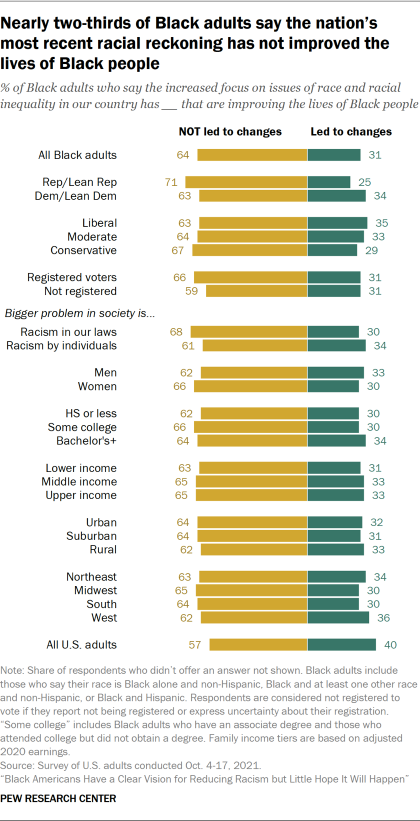
Bar chart showing nearly two-thirds of Black adults say the nation’s most recent racial reckoning has not improved the lives of Black people

More than a year after national demonstrations following the murder of George Floyd and the subsequent racial reckoning, 64% of Black Americans say the increased focus on issues of race and racial inequality in our country has not led to changes that are improving the lives of Black people. These findings vary little, with majorities of Black adults across demographic subgroups holding this view. Even so, some subgroups are more likely than others to say such changes have not occurred.

Roughly seven-in-ten Black adults who identify with or lean toward the Republican Party (71%) say the increased focus on race and racial inequality has not led to changes that are improving the lives of Black people, compared with 63% of Black Democrats and Democratic leaners who say the same.

Meanwhile, there is little variation across the ideological spectrum, with nearly two-thirds of Black adults who describe their political views as liberal (63%), moderate (64%) and conservative (67%) all saying this.

Similar shares of Black men (62%) and Black women (66%) say the increased focus on racial inequality has not led to changes. Likewise, there are no significant differences by educational attainment or income levels, with majorities of Black adults across education groups and income tiers all agreeing that the increased focus on race has not led to any changes.

When it comes to ethnicity, non-Hispanic Black adults (65%) are slightly more likely than Black Hispanic adults (51%) to say the increased attention has not improved the lives of Black people, while Black multiracial adults are about as likely as both groups to say this (56%).

Black adults who say being Black is extremely or very important to them (66%) are not much more likely than those for whom being Black is less important (58%) to say this. There are no significant differences on this measure by age, with majorities of Black adults across age groups saying the racial reckoning has not led to changes.

Black adults born in the United States (65%) are not much more likely than those born abroad (55%) to say changes have not occurred despite the national reckoning on race.

While majorities of Black adults across a variety of demographic subgroups say the nation’s racial reckoning has not improved the lives of Black people, a smaller share of U.S. adults overall (57%) say the same. Instead, Black adults in the U.S. are less likely than U.S. adults overall to say that the increased focus on race and racial issues has led to changes that are improving the lives of Black people (31% vs. 40%).

Few Black adults expect equality for Black people in the U.S.

Bar chart showing just 13% of Black adults say equality for Black people in the U.S. is extremely or very likely

Only a small minority of Black adults (13%) say achieving equality for Black people in the U.S. is extremely or very likely. Instead, nearly four-in-ten say equality is somewhat likely (38%) while 44% say equality is only a little or not at all likely. These findings are consistent across most demographic subgroups of Black Americans, though there is some notable variation.

A larger share of Black Democrats (45%) than Black Republicans (39%) say equality for Black people in the U.S. is only a little or not at all likely. Among both groups, few say it is extremely or very likely equality for Black people will be achieved – 13% and 16% respectively.

While roughly four-in-ten Black conservatives (38%) say equality for Black people is only a little or not at all likely, nearly half of Black moderates (45%) and Black liberals (46%) agree. Likewise, nearly half (46%) of Black registered voters say this, compared with roughly four-in-ten Black adults who are not registered to vote and say the same (38%).

Black adults who say racism in our laws is a bigger problem for Black Americans than racism by individual people (52%) are more likely than those who say racism by individuals is the bigger problem (37%) to believe equality is unlikely for Black people in the United States.

Along gender lines, Black women are more likely than Black men to say equality is a little or not at all likely for Black people in the U.S. (48% vs. 40%).

Black adults with a bachelor’s degree (50%) are more likely than those with some college experience but no four-year degree (44%) or those with a high school diploma or less (39%) to say this. Likewise, Black adults with middle and upper incomes (49% each) are more likely than those with lower incomes (39%) to say equality for Black people in the United States is either a little or not at all likely. 

Similar shares of non-Hispanic Black adults (44%), Black multiracial adults (37%) and Black Hispanic adults (38%) say equality is a little or not at all likely for Black people in the U.S.

When accounting for the importance of racial identity, nearly half (47%) of those who say being Black is extremely or very important to them say equality is unlikely, compared with about one-third (34%) of those for whom being Black is less important. Notably, both groups are just as likely to say achieving equality for Black Americans is extremely or very likely – 13% each.

Chart showing roughly one-in-ten Black adults say equality for Black people in the U.S. is extremely or very likely

Black adults say racism and police brutality are extremely big problems for Black people in the U.S.

Bar chart showing majority of Black adults say racism  and police brutality are extremely big problems

The new survey asked Black adults to rate how much of a problem each of the following issues are for Black people living in the U.S. today: racism, efforts to limit voting, economic inequality, quality of K-12 schools, police brutality and the affordability of health care. While the majority of Black adults say all of these issues are extremely or very big problems, racism and police brutality rank highest.

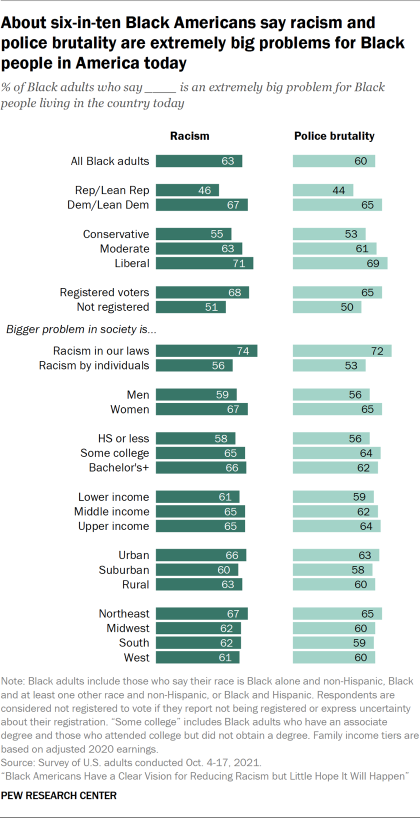
About six-in-ten Black adults say racism (63%) and police brutality (60%) are extremely big problems for Black people living in the country today. While assessments vary, majorities across many of the subgroups rate both as extremely big problems.

Black Democrats are more likely than Black Republicans to rate each of these issues as an extremely big problem. Roughly two-thirds of Black Democrats say racism (67%) and police brutality (65%) are extremely big problems. By contrast, nearly half of Black Republicans say the same (46% and 44%, respectively). 

About seven-in-ten Black liberals say racism (71%) and police brutality (69%) are extremely big problems. Shares drop to roughly six-in-ten (63% and 61%) among Black moderates, and roughly half (55% and 53%) among Black conservatives on both issues.

Bar chart showing about six-in-ten Black Americans say racism and police brutality are extremely big problems for Black people in America today

Black registered voters are more likely (68%) than those who are not registered to vote (51%) to say racism is an extremely big problem for Black people in the U.S. Likewise, nearly two-thirds of Black registered voters (65%) say police brutality is an extremely big problem, compared with half of Black adults who are not registered to vote who say the same.

While majorities of both groups say racism and police brutality are extremely big problems, Black women are more likely to say this than Black men. For example, 65% of Black women say police brutality is an extremely big problem for Black people living in the country today, while 56% of Black men say the same.

Notably, there are few significant differences among Black Americans by income level, urbanicity or across regions of the country. 

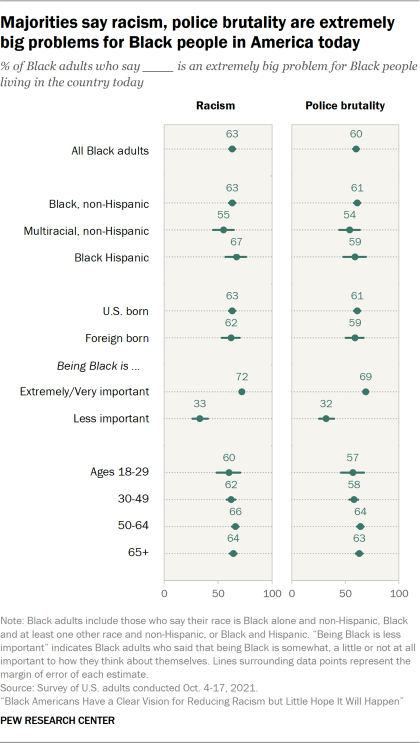
Chart showing majorities say racism, police brutality are extremely big problems for Black people in America today

When it comes to ethnicity, roughly six-in-ten non-Hispanic Black adults say racism (63%) and police brutality (61%) are extremely big problems for Black people in the United States. By comparison, roughly half of Black multiracial adults say racism (55%) and police brutality (54%) are extremely big problems. Meanwhile, nearly seven-in-ten (67%) Black Hispanic adults say racism is an extremely big problem, and 59% say the same for police brutality.

Black adults who say being Black is extremely or very important to how they think of themselves (72%) are more likely than those for whom being Black is less important (33%) to say racism is an extremely big problem. Likewise, 72% of Black adults who say being Black is extremely or very important to them also say police brutality is an extremely big problem. By comparison, 32% of Black adults for whom being Black is less important say the same.

Fewer see other national issues, such as economic inequality or K-12 education, as extremely big problems for Black Americans

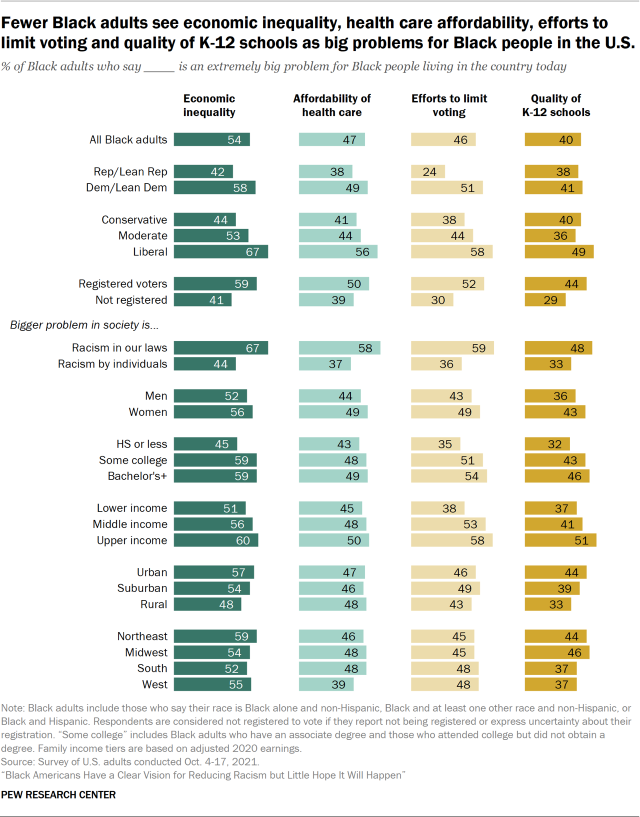
Smaller shares of Black adults see economic inequality (54%), affordability of health care (47%), efforts to limit voting (46%) and quality of K-12 schools (40%) as extremely big problems for Black people in the U.S. today.

Black Democrats are more likely than Black Republicans to say some of these issues are extremely big problems for Black people in America today. For example, Black Democrats (58%) are more likely than Black Republicans (42%) to say economic inequality is an extremely big problem. Black Democrats (51%) are also more likely than Black Republicans (24%) to say efforts to limit voting are an extremely big problem for Black people living in the country today.

Registered voters are more likely than those who are not registered to vote to see some of these national issues as being extremely big problems for Black people. While nearly six-in-ten Black registered voters (59%) say economic inequality is an extremely big problem, roughly four-in-ten Black adults who are not registered to vote (41%) say the same.

Black adults who believe racism in our laws is a bigger problem than racism by individual people are more likely to see each of these national issues as an extremely big problem for Black people living in the country today. Roughly six-in-ten Black adults who say racism in our laws is a bigger problem (59%) also say efforts to limit voting are an extremely big problem. By comparison, roughly one-third (36%) of Black adults who believe racism by individuals is a bigger problem say this.

Smaller shares of Black adults with lower incomes cite economic inequality, health care affordability, efforts to limit voting and the quality of K-12 schools as extremely big issues compared with those with middle or upper incomes. While 51% of Black adults with lower incomes say economic inequality is an extremely big problem, roughly six-in-ten Black adults with middle incomes (56%) and upper incomes (60%) say the same. And about four-in-ten Black adults with lower incomes (38%) say efforts to limit voting are an extremely big problem, compared with roughly half (53%) of those with middle incomes and nearly six-in-ten (58%) with upper incomes.

A similar pattern exists among education groups. Smaller shares of those with a high school diploma or less education say various national issues are extremely big problems compared with those with higher levels of educational attainment. For example, 45% of Black adults with a high school education or less say economic inequality is an extremely big problem. By contrast, 59% each of those with some college education but no bachelor’s degree and those with at least a bachelor’s degree say the same. Likewise, about one-third (32%) of Black adults with a high school education or less say the quality of K-12 schools is an extremely big problem, compared with roughly four-in-ten of those with some college but no bachelor’s degree (43%) and just under half (46%) of Black adults with a four-year degree or higher.

When it comes to ethnicity, similar shares of non-Hispanic Black adults (54%), Black multiracial adults (46%) and Black Hispanic adults (52%) say economic inequality is an extremely big problem for Black people living in the country today. However, non-Hispanic Black adults (47%) are more likely than Black multiracial adults (35%) to say affordability of health care is an extremely big problem. Additionally, non-Hispanic Black adults (47%) are slightly more likely than Black Hispanic adults (35%) to say efforts to limit voting are an extremely big problem. Roughly four-in-ten Black multiracial adults say this as well (39%).

Overall, Black adults who say being Black is extremely or very important to them are generally more likely than Black adults for whom being Black is less important to say these national issues are extremely big problems for Black people living in the country today. For example, roughly half of Black adults who say being Black is extremely or very important also say affordability of health care (52%) or efforts to limit voting (53%) are extremely big problems. By contrast, a smaller share of Black adults for whom being Black is less important say the same (29% and 23%, respectively).

Similar shares of Black adults across age groups say economic inequality, affordability of health care and quality of K-12 schools are extremely big problems for Black people living in the country today. However, Black adults ages 65 and older (61%) are the most likely age group to say efforts to limit voting are an extremely big problem. This share drops to roughly half (52%) among Black adults ages 50 to 64, roughly four-in-ten (42%) among those 30 to 49 and about one-third (32%) among those 18 to 29.

Bar chart showing fewer Black adults see economic inequality, health care affordability, efforts to limit voting and quality of K-12 schools as big problems for Black people in the U.S.
Chart showing Black adults ages 65 and older are more likely than younger Black adults to say efforts to limit voting are an extremely big problem

Personal experiences with discrimination are widespread among Black Americans

Bar chart showing majority of Black adults have personally experienced discrimination because of their race or ethnicity

Nearly eight-in-ten Black adults (79%) say they have personally experienced discrimination or been treated unfairly either regularly or from time to time because of their race or ethnicity. These findings vary little, with majorities of Black adults across all demographic subgroups saying this.

There are no significant differences by partisanship on this measure, with similar shares of Black Republicans (79%) and Black Democrats (80%) saying they have personally experienced discrimination or been treated unfairly. Likewise, there’s little variation across the ideological spectrum, with similar shares of Black liberals (82%), Black moderates (81%) and Black conservatives (79%) saying the same.

Roughly eight-in-ten Black registered voters (82%) say they’ve personally experienced discrimination. This share drops to 69% among Black adults who are not registered to vote.

There are no significant differences by gender on this measure, with roughly equal shares of Black men (77%) and Black women (81%) saying they’ve personally experienced discrimination because of their race or ethnicity.

When it comes to education, nearly seven-in-ten Black adults with a high school diploma or less education say they’ve experienced discrimination regularly or from time to time. This share increases to 83% among those with some college experience but no bachelor’s degree and 88% among those with a bachelor’s degree or higher.

Similarly, about three-quarters (74%) of Black adults with lower incomes say they’ve experienced discrimination or been treated unfairly because of their race or ethnicity. This share increases to 83% among those with middle incomes and 88% among those with upper incomes.

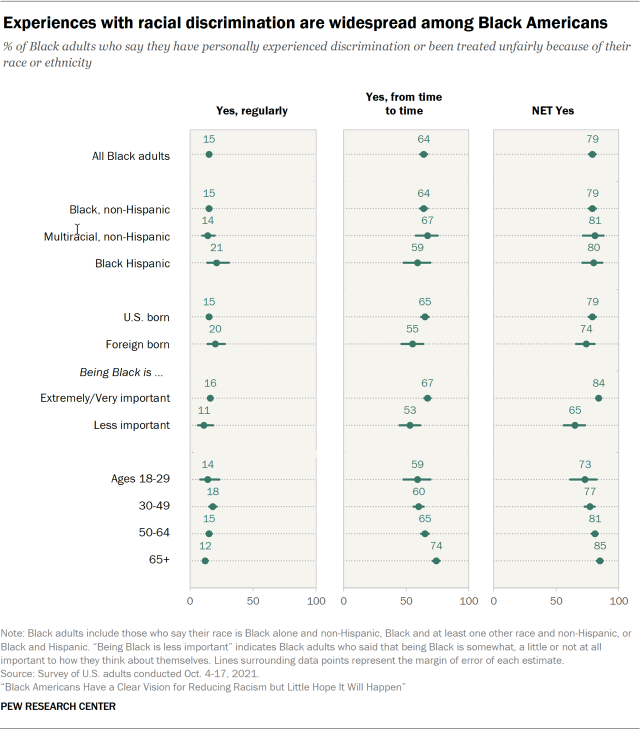
Similar shares of non-Hispanic Black adults (79%), Black multiracial adults (81%) and Black Hispanic adults (80%) say they’ve personally experienced discrimination or unfair treatment because of their race or ethnicity. And Black adults who say being Black is extremely or very important to them are more likely (84%) than those for whom being Black is less important (65%) to say the same.

Among age groups, Black adults 65 and older are most likely to say they’ve personally experienced discrimination or unfair treatment because of their race or ethnicity: 85% in this age group say this has happened to them regularly or from time to time. By comparison, roughly seven-in-ten Black adults ages 18 to 29 (73%) and nearly eight-in-ten of those 30 to 49 (77%) and 50 to 64 (81%) say they have experienced discrimination at least from time to time.

While majorities of Black adults across demographic subgroups say they have personally experienced discrimination or been treated unfairly because of their race or ethnicity, fewer than half (48%) of U.S. adults overall say the same.

Chart showing experiences with racial discrimination are widespread among Black Americans

Black adults say racism in our laws is a bigger problem than racism by individual people

Although the majority of Black adults say they have personally experienced discrimination or been treated unfairly because of their race or ethnicity, Black adults are still more likely to say racism in our laws is a bigger problem (52%) than racism by individual people (43%).

Black Democrats are more likely to say racism in our laws is the bigger problem (56%) than racism by individual people (41%). By contrast, about one-third (34%) of Black Republicans say racism in our laws is the bigger problem while more than half (59%) say it is racism by individual people that matters more when it comes to racism against Black people.

Black liberals (59%) are more likely than Black conservatives (42%) to say racism in our laws is the bigger problem, while Black moderates are about as likely (53%) as Black liberals to say this. By contrast, roughly half of Black conservatives (52%) say racism by individual people is the bigger problem, compared with roughly four-in-ten Black moderates (44%) and Black liberals (38%) who say the same.

Black registered voters (55%) are more likely than Black adults who are not registered to vote (44%) to say racism in our laws is the bigger problem, while similar shares of both groups (42% and 45%, respectively) say racism by individual people is the bigger problem.

Among Black adults, the share saying racism in our laws is the bigger problem is higher among those with more education and higher incomes. Black adults with at least a bachelor’s degree (61%) are more likely than those with some college education but no bachelor’s degree (53%) or a high school education or less (44%) to say racism in our laws is the bigger problem. Instead, Black adults with a high school education or less (47%) are more likely than those with at least a four-year degree (37%) to say racism by individual people is the bigger problem.

Likewise, Black adults with lower incomes are the least likely to say racism in our laws is the bigger problem (46%), compared with about six-in-ten with middle (56%) and upper incomes (61%) who say the same. Instead, 46% of Black adults with lower incomes say racism by individuals is the bigger problem, while 41% with middle incomes and 36% with upper incomes say this. 

Bar chart showing about half of Black adults say racism in our laws is  a bigger problem than racism by individual people

Among Black adults, there is little variation across ethnic groups when it comes to determining which form of racism is a bigger problem for Black people living in the United States. Roughly half of non-Hispanic Black adults (52%) and Black Hispanic adults (49%) say racism in our laws is the bigger problem. Meanwhile, 44% of Black multiracial adults say the same.

Black adults who say being Black is extremely or very important to them (58%) are more likely than those for whom being Black is less important (33%) to say racism in our laws is the bigger problem when it comes to racism against Black people today.

By contrast, those for whom being Black is less important (53%) are more likely than those who say being Black is extremely or very important to them (40%) to say racism by individual people is the bigger problem.

Notably, 10% of Black adults for whom being Black is less important say there is no discrimination against Black people, compared with only 1% of those for whom being Black is extremely or very important.

Roughly four-in-ten Black adults ages 18 to 29 (42%) say racism in our laws is the bigger problem, compared with about half of Black adults ages 30 to 49 (54%) and 50 to 64 (52%). Nearly six-in-ten Black adults 65 and older (58%) agree that racism in our laws is the bigger problem. On the other hand, nearly half (47%) of Black adults ages 18 to 29 say racism by individuals is the bigger problem, compared with roughly four-in-ten Black adults ages 30 to 39 (42%), 50 to 64 (43%) and 65 and older (40%).

Notably, Black adults (52%) are significantly more likely than U.S. adults overall (23%) to say racism in our laws is a bigger problem than racism by individuals when it comes to racism against Black people in the U.S. today. While fewer than half (43%) of Black adults say racism by individual people is the bigger problem, nearly two-thirds (65%) of U.S. adults overall say the same.

Chart showing among Black adults, racism in our laws is seen as a bigger problem than racism by individual people

Black adults see racial discrimination as the primary obstacle to success for Black people in America

Bar chart showing two-thirds of Black adults say racial discrimination is the main reason many Black people can’t get ahead these days

More than two-thirds of Black adults (68%) say racial discrimination is the main reason many Black people can’t get ahead these days, while one-quarter say Black people who can’t get ahead are mostly responsible for their own condition. This finding is unchanged from 2020, when 70% of Black adults cited discrimination as the primary obstacle to success for Black people and 26% said Black people are mostly responsible for their own condition.

According to the new survey, Black Democrats (73%) are far more likely than Black Republicans (44%) to say racial discrimination is the main reason Black people in the U.S. can’t get ahead. Notably, Black Republicans (45%) are more likely than most other demographic subgroups to say Black people who can’t get ahead in the U.S. are mostly responsible for their own condition. Just 21% of Black Democrats hold the same view.

Roughly three-quarters (76%) of Black liberals say racial discrimination is the main reason Black people can’t get ahead, compared with 69% of Black moderates and 56% of Black conservatives. While nearly four-in-ten Black conservatives (39%) say Black people who can’t get ahead are mostly responsible for their own condition, smaller shares of Black moderates (25%) and Black liberals (17%) say the same.

About seven-in-ten Black registered voters (71%) say discrimination is the primary obstacle for Black people in the U.S., while roughly two-in-ten (23%) say Black people who can’t get ahead are mostly responsible for their own condition. Black adults who are not registered to vote are similarly divided on this measure, with roughly six-in-ten (62%) saying discrimination is the main reason Black people can’t get ahead and about three-in-ten (29%) saying those who can’t get ahead are responsible for their own condition.

Black women are more likely (72%) than Black men (63%) to cite racial discrimination as the primary obstacle to getting ahead. Meanwhile, Black men (29%) are more likely than Black women (22%) to say Black people who can’t get ahead are mostly responsible for their own condition.

When it comes to education, about six-in-ten (62%) Black adults with a high school education or less say racial discrimination is the main reason many Black people can’t get ahead. By comparison, 71% of those with some college but no bachelor’s degree and 74% of those with at least a bachelor’s degree say the same. Likewise, Black adults with middle and upper incomes (71% and 74%, respectively) are more likely than Black adults with lower incomes (66%) to point to racial discrimination as the main reason many Black people can’t get ahead these days.

Chart showing across most demographic subgroups, Black adults say racial discrimination is the main reason many Black people can’t get ahead these days

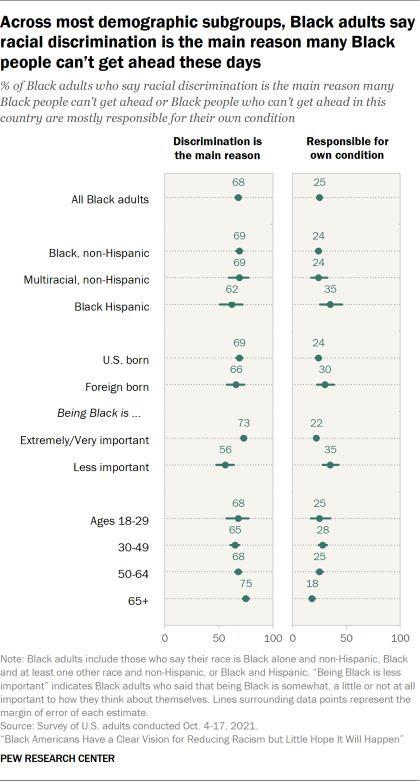
Nearly seven-in-ten non-Hispanic Black adults and Black multiracial adults (69% each) say racial discrimination is the main reason Black people can’t get ahead, a view shared by 62% of Black Hispanic adults. Among Black adults who say being Black is extremely or very important to them, 73% say racial discrimination is the main reason Black people can’t get ahead. This share decreases to 56% among those who say being Black is less important.

These findings are fairly consistent across most age groups, though three-quarters of Black adults 65 and older say racial discrimination is the main reason many Black people can’t get ahead, while about two-thirds of Black adults ages 18 to 29 (68%), 30 to 49 (65%) and 50 to 64 (68%) say the same. By comparison, roughly one-quarter of Black adults under 65 say Black adults who can’t get ahead are mostly responsible for their own condition. Just 18% of Black adults 65 and older say the same.

2. Black Americans’ views on political strategies, leadership and allyship for achieving equality

Protests for racial equality emerged throughout the nation in 2020 in response to George Floyd’s murder. The subsequent racial reckoning led to public condemnations of systemic racism by politicians, corporations and organizations. Similar to the 1960s civil rights movement, the events of 2020 captured the nation’s attention, with Americans from all backgrounds joining Black Americans in the fight for racial equality. While many leaders used these events to encourage Black Americans to vote their way to racial equality, others argued that many of the nation’s institutions were beyond reform and needed to be rebuilt in order to be truly equitable.

Given the wide variety of possible political strategies to pursue racial equality, the October 2021 survey asked Black adults to rate the effectiveness of strategies such as protesting, voting, contacting elected officials and supporting Black businesses. The survey also sought to understand how Black adults see Black leaders and organizations and to determine if race matters when it comes to political allyship.

Overall, Black adults overwhelmingly say voting is the most effective strategy for helping Black people move toward equality in the United States, but the survey reveals there is support for other strategies, too. When it comes to individual leaders and organizations, Black Americans rank former President Barack Obama as the most important Black leader in the U.S. today. And in comparison with other organizations or entities, a plurality says Black Lives Matter has done the most to help Black people in recent years.

Black adults see voting as the most effective strategy for moving toward equality in the U.S.

Bar chart showing majorities of Black adults say voting and supporting Black businesses are effective ways to move toward equality

In the national survey, Black adults were asked how effective voting, protesting, contacting elected officials, volunteering with organizations dedicated to Black equality, and supporting Black businesses (“buying Black”) are as strategies for helping Black people move toward equality in the United States.

Out of the five tactics, Black adults were most likely to say voting is extremely or very effective for helping Black people move toward equality in the U.S. Even so, significant shares indicated the other strategies can also be effective.

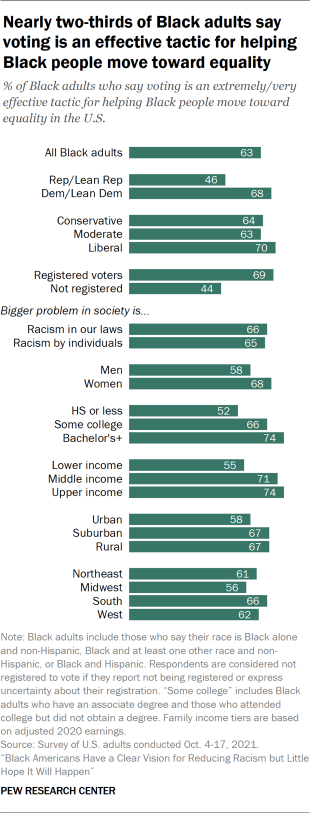
Although most Black adults see voting as the most effective strategy for helping Black people move forward, there are notable differences across demographic subgroups of the Black population.

Bar chart showing nearly two-thirds of Black adults say voting is an effective tactic for helping Black people move toward equality

Black Democrats and those who lean toward the Democratic Party (68%) are more likely than Black Republicans and Republican leaners (46%) to say voting is an extremely or very effective tactic for helping Black people move toward equality in the U.S. Notably, nearly one-third (31%) of Black Republicans say voting is either a little or not at all effective for helping Black people move toward equality in the U.S., while just 10% of Black Democrats say the same.

Seven-in-ten Black adults who describe their political views as liberal say voting is extremely or very effective for Black equality. This share decreases to roughly six-in-ten among those who identify as moderate (63%) or conservative (64%). And Black registered voters (69%) are significantly more likely than those who are not registered to vote (44%) to say this.

Nearly seven-in-ten Black women (68%) say voting is extremely or very effective for Black equality, compared with fewer than six-in-ten (58%) Black men. When it comes to education, Black adults with at least a bachelor’s degree (74%) are more likely to say this than those with some college education but no bachelor’s degree (66%) or those with a high school diploma or less (52%). Roughly three-quarters of Black adults with upper (74%) and middle incomes (71%) say voting is extremely or very effective for helping Black people move toward equality in the U.S. By comparison, roughly half (55%) of Black adults with lower incomes say the same.

Chart showing Black adults under 30 are among the least likely to say voting is an extremely or very effective path toward equality

There are no differences by ethnicity when it comes to the share of Black adults who say voting is an extremely or very effective tactic. Similar shares of non-Hispanic Black adults (63%), Black multiracial adults (60%) and Black Hispanic adults (61%) say this.

However, when accounting for the importance of their racial identity, Black adults who say being Black is extremely or very important to them are significantly more likely than those for whom being Black is less important (70% vs. 42%) to say voting is extremely or very effective for helping Black people move toward equality in the U.S.

Black adults under 30 are among the least likely age group to say this. While about half (48%) of Black adults under 30 say voting is an extremely or very effective tactic, this share increases to 59% among those ages 30 to 49, 68% among those 50 to 64 and 77% among those 65 and older.

Instead, roughly one-quarter (23%) of Black adults ages 18 to 29 say voting is either a little or not at all effective, and this share decreases to about one-in-eight among those ages 30 to 49 and 50 to 64 (13% each); only 7% of Black adults 65 and older say the same.

Black adults see other forms of civic engagement as less effective than voting for achieving Black equality

Compared with voting as a strategy, fewer Black adults see supporting Black businesses (58%), volunteering (48%), protesting (42%) and contacting elected officials (40%) as extremely or very effective for helping Black people move toward equality in the U.S.

Black Democrats are more likely than Black Republicans to say each of these strategies is extremely or very effective for moving Black people toward equality in the U.S. For example, Black Democrats (63%) are more likely than Black Republicans (41%) to say supporting Black businesses is an extremely or very effective tactic. And while roughly half (52%) of Black Democrats say volunteering with organizations is extremely or very effective, only about three-in-ten Black Republicans say the same (29%). Gaps between Black Democrats and Black Republicans are narrower when it comes to the perceived effectiveness of protesting and contacting elected officials.

While more than half of Black liberals (57%) say volunteering with organizations is an extremely or very effective tactic, smaller shares of moderates (45%) and conservatives (53%) say the same. This is also true when it comes to the perceived effectiveness of protesting. Black liberals (57%) are more likely than moderates (41%) or conservatives (37%) to say protesting is extremely or very effective for helping Black people move toward equality in the U.S.

Likewise, Black registered voters are more likely than those who are not registered to vote to say each of these measures is an extremely or very effective strategy for helping Black people move toward equality in the U.S. About six-in-ten (62%) of registered voters say supporting Black businesses is an extremely or very effective tactic, compared with about half (47%) of Black adults who are not registered to vote. And while roughly half (51%) of Black registered voters say volunteering is an extremely or very effective strategy for Black equality, 37% of Black adults who are not registered say this. 

Bar chart showing Black adults see supporting Black-owned businesses as very effective at promoting equality for Black people
Chart showing most Black adults say supporting Black businesses is an extremely or very effective tactic toward equality

Views on which tactics are effective at helping Black people move toward equality in the U.S. do not vary significantly across Black ethnic groups. Nearly six-in-ten non-Hispanic Black adults (58%) see buying from Black businesses as an extremely or very effective strategy for helping Black people move toward equality. By comparison, half of Black multiracial non-Hispanic adults say this, as do 65% of Black Hispanic adults. Likewise, nearly half of non-Hispanic Black adults (48%) say volunteering is an extremely or very effective strategy, compared with 42% of Black multiracial adults and 51% of Black Hispanic adults.

Black adults who say being Black is extremely or very important to them are more likely than those for whom being Black is less important to say each of these measures is extremely or very effective for helping Black people move toward equality in the U.S. For example, Black adults who say being Black is important to them (67%) are more likely than those for whom being Black is less important (30%) to say buying Black is an effective strategy for moving Black people toward equality. Likewise, Black adults who say being Black is important to them (55%) are more likely than those for whom being Black is less important (26%) to view volunteering as an extremely or very effective strategy.

Similar shares of Black adults born in the U.S. and those born abroad say these strategies are extremely or very effective. The only significant difference is in the perceived effectiveness of protesting. U.S.-born Black adults are less likely (41%) than Black adults born abroad (54%) to say protesting is an extremely or very effective strategy for achieving Black equality.

While nearly half (45%) of Black adults 65 and older say contacting elected officials is an extremely or very effective tactic, smaller shares of Black adults ages 30 to 49 (39%), 50 to 64 (39%) and 18 to 29 (37%) say the same. Instead, roughly three-in-ten Black adults ages 18 to 29 (30%), 30 to 49 (26%) and 50 to 64 (28%) say contacting elected officials is only a little or not at all effective, compared with 19% of Black adults 65 and older who say the same.

Some Black adults see Black businesses and communities as effective remedies for inequality

Black adults were also asked how effective the following hypothetical strategies would be for helping Black people move toward equality in the United States: Black people owning all businesses in Black neighborhoods (39%), establishing a national Black political party (31%), and all elected officials governing Black neighborhoods being Black (27%).While fewer than half of Black adults say these strategies are likely to be extremely or very effective, the strategies are not written off entirely, with few Black adults saying these strategies would not be effective at all.

As with other issues, opinions among Black adults vary across demographic subgroups.

Black adults by party affiliation

Larger shares of Black Democrats than Black Republicans say these strategies would be extremely or very effective for helping Black people move toward equality in the U.S., though fewer than half of both groups say this. For example, roughly four-in-ten Black Democrats (42%) say having all businesses owned by Black people in Black neighborhoods would be extremely or very effective at helping Black people move toward equality. By comparison, roughly one-third (34%) of Black Republicans say the same. Instead, 42% of Black Republicans say this strategy would be a little or not at all effective, compared with roughly one-quarter (26%) of Black Democrats.

And while three-in-ten Black Democrats say having Black elected officials governing Black neighborhoods would be extremely or very effective, this share drops to roughly two-in-ten (21%) among Black Republicans.

Notably, similar shares of Black Democrats (33%) and Black Republicans (32%) say establishing a national Black political party would be extremely or very effective for helping Black people move toward equality.

Bar chart showing roughly four-in-ten Black adults say Black people owning all businesses in Black neighborhoods would be an effective way to move toward equality in the U.S.
Black adults by political ideology

When it comes to political ideology, slightly higher shares of Black conservatives than Black moderates or liberals say these strategies would be extremely or very effective. Nearly half (46%) of Black conservatives say having all businesses in Black neighborhoods be Black owned would be extremely or very effective for helping Black people move toward equality in the U.S. By comparison, roughly four-in-ten Black moderates (37%) and Black liberals (42%) say the same. Likewise, while nearly four-in-ten Black conservatives (37%) say establishing a national Black political party would be extremely or very effective, roughly three-in-ten moderates (30%) and liberals (33%) say the same.

Black adults by educational attainment

Across levels of formal education, similar shares of Black adults say having only Black-owned businesses in Black neighborhoods would be extremely or very effective at helping Black people move toward equality in the country. However, Black adults with at least a bachelor’s degree are least likely to say establishing a national Black political party would be an extremely or very effective tactic. While roughly two-in-ten college graduates say this (21%), roughly one-third of those with some college education but no bachelor’s degree (32%) and nearly four-in-ten Black adults with a high school diploma or less (38%) say the same. Instead, nearly six-in-ten college graduates (55%) say this strategy would be a little or not at all effective, compared with about four-in-ten Black adults with some college but no bachelor’s degree (37%) and fewer than one-third (29%) of Black adults with a high school education or less.

Black adults with at least a bachelor’s degree are also less likely to say all elected officials governing Black neighborhoods being Black would be extremely or very effective at helping Black people move toward equality. While roughly three-in-ten Black adults with a high school education or less (30%) and those with some college but no bachelor’s degree (29%) say this, just 21% of Black adults with at least a bachelor’s degree say the same. By contrast, nearly half (47%) of Black college graduates say this strategy would be a little or not at all effective, compared with 37% of those with some college but no bachelor’s degree and 28% of those with a high school education or less.

Black adults by income tiers

A similar pattern exists across income groups as well. Black adults with upper incomes (32%) are also less likely than Black adults with middle incomes (40%) or lower incomes (41%) to say Black people owning all businesses in Black neighborhoods would be extremely or very effective for helping Black people move toward equality.

When it comes to the potential efficacy of establishing a national Black political party, Black adults with lower incomes (35%) are more likely than those with middle (29%) or upper incomes (21%) to say establishing a national Black political party would be an extremely or very effective strategy. By contrast, Black adults with upper incomes are the most likely income group to say establishing a national Black political party would not be effective, with 56% saying so. The share drops to less than half (46%) among Black adults with middle incomes and 29% among Black adults with lower incomes.

Black adults with upper incomes (18%) are also less likely than those with middle (26%) or lower incomes (31%) to say having Black elected officials govern Black neighborhoods would be an extremely or very effective tactic for helping Black people move toward equality. At the same time, nearly half of Black adults with upper incomes (49%) say this would be a little or not at all effective, compared with 43% of those with middle incomes and 29% of those with lower incomes.

Black adults by ethnicity

When it comes to ethnicity, four-in-ten non-Hispanic Black adults say Black people owning all businesses in Black neighborhoods would be an extremely or very effective tactic for achieving Black equality in the U.S. By comparison, roughly one-third (34%) of Black multiracial adults and some 38% of Black Hispanic adults hold the same view.

There are also no significant differences by ethnicity when it comes to the perceived effectiveness of establishing a national Black political party. Nearly three-in-ten non-Hispanic Black adults (32%), Black multiracial adults (25%) and Black Hispanic adults (26%) say establishing a national political party would be extremely or very effective.

Black adults who say being Black is extremely or very important to how they view themselves are more likely than Black adults for whom being Black is less important to view each of these strategies as being extremely or very effective for helping Black people move toward equality. For example, nearly half (46%) of Black adults who say being Black is extremely or very important to them also say Black people owing all businesses in Black neighborhoods would be an extremely or very effective strategy. By comparison, just 17% of Black adults for whom being Black is less important hold the same view.

Likewise, Black adults who say being Black is very or extremely important to their identity (36%) are also more likely than Black adults for whom being Black is less important (14%) to say establishing a national Black political party would be extremely or very effective for helping Black people move toward equality in the U.S. Additionally, Black adults who say being Black is very or extremely important to how they view themselves (32%) are more likely than Black adults for whom being Black is less important (12%) to say having all elected officials governing Black neighborhoods be Black would be an effective strategy.

Black adults by age groups

Roughly four-in-ten Black adults ages 18 to 29 (40%), 30 to 49 (44%) and 50 to 64 (39%) say Black people owning all businesses in Black neighborhoods would be an extremely or very effective strategy for helping Black people move toward equality in the U.S. By comparison, three-in-ten Black adults 65 and older agree. Instead, Black adults 65 and older are most likely to say this strategy would be a little or not at all effective (37%), compared with 30% among Black adults ages 50 to 64 and nearly one-quarter of Black adults 18 to 29 and 30 to 49 (24% each).

Roughly one-third of Black adults ages 18 to 29 (33%), 30 to 49 (34%) and 50 to 64 (31%) say establishing a national Black political party would be extremely or very effective, while about one-quarter (24%) of Black adults 65 and older agree. Instead, Black adults 65 and older are most likely to say this would be little or not at all effective (47%), compared with 41% of Black adults ages 50 to 64 and roughly one-third of Black adults ages 18 to 29 (36%) and 30 to 49 (33%).

Finally, younger Black adults ages 18 to 29 (32%), 30 to 49 (32%) and 50 to 64 (23%) are more likely than Black adults 65 and older (18%) to say having Black elected officials govern Black neighborhoods would be an extremely or very effective way for helping Black people move toward equality in the country. By contrast, Black adults 65 and older (48%) are most likely to say this would be little or not at all effective, compared with 41% of those 50 to 64, 34% of those 30 to 49 and 25% of those ages 18 to 29.

Chart showing younger Black adults are slightly more likely to say Black-controlled community institutions would be effective in helping Black people move toward equality

Obama ranked as the most important Black leader in the U.S. today

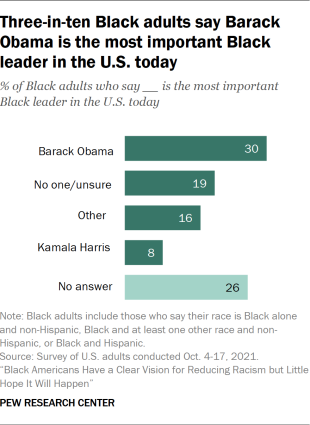
Bar chart showing three-in-ten Black adults say Barack Obama is the most important Black leader in the U.S. today

When asked in an open-ended question to name the most important Black leader in the U.S. today, three-in-ten Black adults wrote in former President Barack Obama. Current Vice President Kamala Harris ranked second for most mentions, with 8% naming her. Another 19% of Black adults say there is no Black leader in the U.S. today or indicated they weren’t sure, while 16% named someone else.

The pattern of responses varies little by demographic subgroups with exception to partisanship and political ideology. Roughly one-third (35%) of Black Democrats cited Obama as the nation’s most important Black leader, compared with one-in-six Black Republicans (16%). Black Republicans (33%) were more likely than Black Democrats (18%) to say they were unsure who the most important Black leader is in the U.S. today. Across ideological groups, Black liberals were most likely to pick Obama (40%) as the most important Black leader in the U.S. today, compared with 30% of Black moderates and 23% of Black conservatives.  

Black Lives Matter seen as the most helpful organization for Black people in America in recent years

Bar chart showing nearly four-in-ten Black adults say Black Lives Matter has done the most  to help Black people in recent years

When asked to pick which of the following organizations or entities has done the most to help Black people in the U.S. in recent years, nearly four-in-ten Black adults (39%) say it is Black Lives Matter. Smaller shares chose the NAACP (17%), Black churches or other religious organizations (13%), the Congressional Black Caucus (6%) and the National Urban League (3%). Across all demographic subgroups, Black Lives Matter ranks highest as the organization that has done the most to help Black people in recent years.

Black Democrats are more likely (44%) than Black Republicans (26%) to say Black Lives Matter has done the most to help Black people in recent years. Pluralities across the ideological spectrum point to Black Lives Matter, with nearly half (47%) of Black liberals, roughly four-in-ten Black moderates (41%) and roughly three-in-ten Black conservatives (32%) doing so. Higher shares of Black registered voters (42%) than of Black adults not registered to vote (33%) agree that Black Lives Matter has done the most for Black people in the U.S. in recent years.

Black adults with at least a college degree (44%) are more likely than Black adults with some college education but no bachelor’s degree or Black adults with a high school diploma or less (37% each) to say Black Lives Matter has done the most. Across income groups, similar shares of Black adults with lower (40%), middle (40%) and upper incomes (42%) agree that Black Lives Matter has done the most.

Similar shares of Black adults across ethnicities also say Black Lives Matter has done the most to help Black people in the U.S. in recent years. Roughly four-in-ten non-Hispanic Black adults (39%), Black multiracial non-Hispanic adults (41%) and Black Hispanic adults (37%) say this. Likewise, roughly four-in-ten Black adults across age groups say Black Lives Matter has done the most in recent years. 

Black Americans say race matters little when choosing political allies

The majority of Black adults say White, Latino and Asian Americans would make good political allies for Black people. However, opinions vary across Black demographic subgroups and by whether or not these racial groups need to experience the same hardships that Black Americans face to be good allies. Nevertheless, few Black adults overall say either of these groups would not make good political allies.

White people as political allies

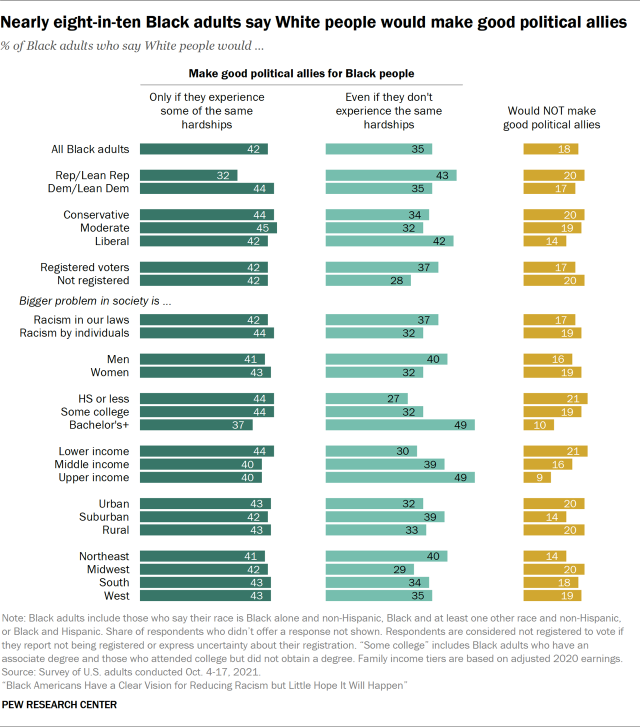
Roughly three-quarters (77%) of Black adults say White people would make good political allies for Black people, with about four-in-ten (42%) saying this is true only if White people experience the same hardships as Black people. Roughly one-third (35%) say White people would make good political allies even if they don’t experience the same hardships. About one-in-five Black adults (18%) say White people would not make good political allies.

Although similar shares of both groups say White people would make good political allies, Black Democrats (44%) are more likely than Black Republicans (32%) to say this is true only if White people experience some of the hardships Black people face. At the same time, 43% of Black Republicans and 35% of Black Democrats say White people would make good political allies even if they don’t experience the same hardships Black people face.

Roughly eight-in-ten Black liberals (84%) say White people would make good political allies, with 42% saying this applies only if White people experience the same hardships and another 42% saying experiencing these hardships is not necessary. However, the views of Black moderates and Black conservatives are more aligned, with similar shares of both groups saying white people can be good political allies whether they experience the same hardships or not.

Nearly nine-in-ten Black adults with a bachelor’s degree or higher (86%) say White people would make good political allies, with roughly four-in-ten (37%) saying so only if White people experience the same hardships and nearly half (49%) saying this applies even if they don’t.

While the majority of Black adults with less education still agree White people would make good political allies, roughly four-in-ten Black adults with either some college education but no bachelor’s degree or with a high school education or less (44% each) say White people would make good political allies only if they experience some of the hardships Black people face. Likewise, roughly three-in-ten Black adults with some college but no bachelor’s degree (32%) and a high school education or less (27%) say White people would make good political allies even if they don’t experience the same hardships.

Black adults with upper incomes (89%) are most likely to say White people would make good political allies whether or not they experience the same hardships as Black people. Smaller but still significant majorities of Black adults with middle (79%) and lower incomes (74%) also say this. 

Majorities across ethnic groups say White people would make good political allies, but higher shares of Black multiracial adults and Black Hispanic adults (83% each) say this than non-Hispanic Black adults (76%).

Roughly eight-in-ten Black adults born in the U.S. (77%) and those born abroad (82%) say White people would make good political allies for Black people. However, Black immigrants are more likely than U.S.-born Black adults to say White people would be good political allies even if they don’t experience the same hardships (46% vs. 34%).

Bar chart showing nearly eight-in-ten Black adults say White people would make good political allies
Chart showing majorities of Black adults say White people would make good political allies
Latinos as political allies

Roughly three-quarters (77%) of Black adults say Latinos would make good political allies whether or not they experience the same hardships that Black people face.

Black liberals (87%) are more likely than Black moderates and Black conservatives (76% each) to say Latinos would make good political allies whether or not the experience the same hardships as Black people. In fact, nearly half (48%) of Black liberals say Latinos would make good political allies even without sharing the same experiences as Black people, while smaller shares of Black moderates (39%) and Black conservatives (35%) say the same.

Majorities of Black adults across education levels say Latinos would make good political allies for Black people, but Black adults with at least a bachelor’s degree (86%) are more likely than those with some college education but no bachelor’s degree (77%) and a high school education or less (70%) to say this. More than half (54%) of Black adults with a college degree say experiencing the same hardships does not matter, while smaller shares of those with some college but no bachelor’s degree (40%) and a high school education or less (30%) say the same.

Likewise, Black adults with upper incomes are most likely (87%) to say Latinos would make good political allies regardless of whether they experience the same hardships that Black people face. By comparison, 79% of Black adults with middle incomes and 74% with lower incomes say the same. While about half (53%) of Black adults with upper incomes say it doesn’t matter if Latinos experience the same hardships, smaller shares of those with middle (45%) and lower incomes (35%) say this. 

Three-quarters (75%) of non-Hispanic Black adults say Latinos would make good political allies whether or not they experience the same hardships as Black people. By comparison, 81% of Black multiracial non-Hispanic adults and 92% of Black Hispanic adults say this. While nearly half of Black multiracial non-Hispanic adults and Black Hispanic adults (49% each) say it doesn’t matter if Latinos experience the same hardships, roughly four-in-ten non-Hispanic Black adults say the same (39%).

Roughly eight-in-ten Black immigrants (82%) and Black adults born in the U.S. (77%) say Latinos would make good political allies. While U.S.-born Black adults are evenly divided over whether Latinos need to experience the same hardships (38%) or not (39%), Black immigrants are less divided, with roughly one-third (34%) saying Latinos need to experience the same hardships and nearly half (49%) saying shared hardships do not matter when it comes to political allyship.

Bar chart showing nearly eight-in-ten Black adults say Latinos would make good political allies
Chart showing majorities of Black adults say Latinos would make good political allies
Asian Americans as political allies

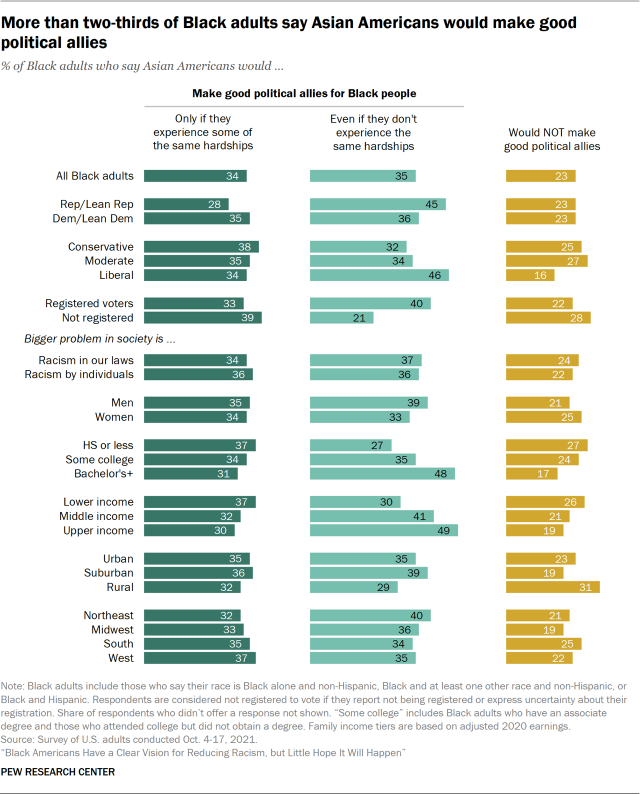
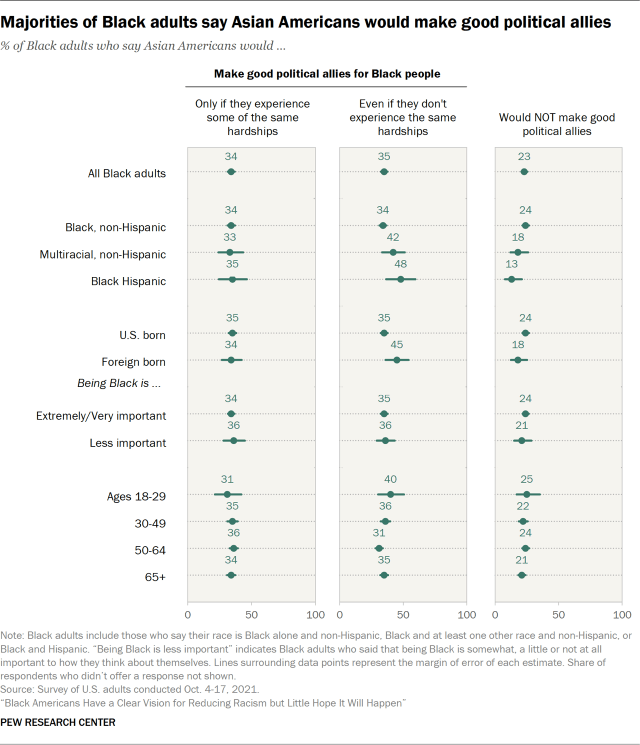
Seven-in-ten Black adults say Asian Americans would make good political allies, with roughly one-third (34%) saying this is true only if Asian Americans experience some of the hardships that Black people face and another one-third (35%) saying Asian Americans would make good political allies even if they do not experience the same hardships. Roughly one-quarter (23%) of Black adults say Asian Americans would not make good political allies for Black people.

Similar shares of Black Republicans (73%) and Black Democrats (72%) say Asian Americans would make good political allies whether or not they experience the same hardships that Black people face. However, Black Republicans (45%) are more likely than Black Democrats (36%) to say Asian Americans would make good political allies even if they don’t experience the same hardships.

Black liberals (80%) are more likely than Black moderates (69%) and conservatives (70%) to say Asian Americans would make good political allies. Roughly half (46%) of Black liberals say Asian Americans would make good political allies even if they don’t experience the same hardships that Black people face. By comparison, roughly one-third of Black moderates (34%) and Black conservatives (32%) say the same.

Majorities across education levels say Asian Americans would make good political allies for Black people, but Black adults with at least a bachelor’s degree (79%) are more likely than those with some college education but no bachelor’s degree (69%) and high school or less (64%) to say this. Nearly half (48%) of Black adults with a college degree say experiencing the same hardships is not required for political allyship, while smaller shares of those with some college but no bachelor’s degree (35%) and a high school education or less (27%) say the same.

Likewise, Black adults with upper incomes are among the most likely (79%) to say Asian Americans would make good political allies regardless if they experience the same hardships that Black people face. By comparison, 73% of Black adults with middle incomes and 67% with lower incomes say this. While roughly half (49%) of Black adults with upper incomes say it doesn’t matter for political allyship if Asian Americans experience the same hardships, smaller shares of those with middle (41%) and lower incomes (30%) say the same. 

Roughly two-thirds (69%) of non-Hispanic Black adults say Asian Americans would make good political allies regardless of whether they experience the same hardships Black people face. By comparison, three-quarters of Black multiracial non-Hispanic adults and roughly eight-in-ten (83%) Black Hispanic adults say the same. While nearly half (48%) of Black Hispanic adults say it doesn’t matter if Asian Americans experience the same hardships, this share drops to 42% among Black multiracial non-Hispanic adults and 34% among non-Hispanic Black adults.

Nearly eight-in-ten Black immigrants (79%) say Asian Americans would make good political allies, compared with seven-in-ten Black adults born in the U.S. While Black adults born in the U.S. are evenly divided over whether Asian Americans must experience the same hardships (35%) or not (35%). Meanwhile, 34% of Black immigrants say Asian Americans must experience the same hardships, and nearly half (45%) say shared hardships don’t matter.

Bar chart showing more than two-thirds of Black adults say Asian Americans would make good political allies
Chart showing majorities of Black adults say Asian Americans would make good political allies

3. Reparations for slavery

Discussions about atonement for the enslavement of Black Americans has a long history in the United States. Most famously, General William T. Sherman drafted Special Field Order 15 in 1865. The order stipulated that Confederate land seized in Georgia and South Carolina would be split among formerly enslaved Black people in those states, no more than 40 acres per family.

Black Americans commonly refer to this measure as “40 acres and mule,” and it has become a long-standing symbol for both the promise of and pessimism about repayment for slavery, or reparations.

Efforts toward reparations have continued into the 21st century. In 2021, Evanston, Illinois, became the first U.S. city to create a reparations plan for its Black residents. And in 2022, Harvard University created a $100 million fund for Black students who are descendants of enslaved people.

Given this enduring history, the survey asked Black Americans to share their views on the impact of slavery on their position in the United States; whether the descendants of enslaved Black people should be repaid for the labor of their ancestors; the forms of repayment that would be most helpful; the institutions or individuals who bear responsibility for repayment; and the likelihood that repayment would occur in their lifetime.

The legacy of slavery affects Black Americans today

Chart showing majority of Black adults say the legacy of slavery affects the position of Black people in the U.S.

Nearly six-in-ten Black adults (57%) say their ancestors were enslaved. This includes 41% who report their ancestors were enslaved in the U.S. and 5% who say they were enslaved outside the U.S., as well as another 11% who say their ancestors were enslaved both in the U.S. and in another country. However, not all Black Americans are certain whether their ancestors were enslaved, and some indicate their ancestors were not enslaved at all. About one-third (34%) say they are unsure if their ancestors were enslaved, while 8% say their ancestors were not enslaved.

Despite differences in their personal knowledge about the enslavement of their ancestors, a large majority of Black adults (85%) say the legacy of slavery affects the position of Black people in the U.S. today. This includes 55% who say the legacy of slavery affects Black people a great deal and 30% who say it affects them a fair amount. Much smaller shares of Black adults say the legacy of slavery does not have much (9%) or any effect (4%) on the position of Black people in the U.S. today.

Among Black Americans, political party affiliation, educational attainment and income are important points of difference in views on this question. The share of Black Democrats and Democratic leaners (57%) who say the legacy of slavery affects Black people a great deal outpaces the share of Black Republicans and Republican leaners (39%) who say the same.

Black adults who identify as politically liberal (64%) are more likely than those who identify as moderate (51%) or conservative (54%) to say the legacy of slavery affects the position of Black people a great deal. And Black adults who say they are registered to vote (58%) are more likely than those who say they are not registered (45%) to say the same.

Black adults with a bachelor’s degree or higher level of education (61%) are more likely than those with a high school diploma or less (48%) and those with some college education but no bachelor’s degree (56%) to say that the legacy of slavery affects the position of Black people a great deal. And Black adults with upper (61%) and middle incomes (57%) are more likely than those with lower incomes (51%) to say this.

There are also regional differences among Black adults on this question. Those who live in the Northeastern U.S. (62%) are more likely than those in the South (53%) or the Midwest (51%) to say the legacy of slavery affects Black people a great deal. But no matter which region of the country they are in, at least seven-in-ten Black adults say slavery’s legacy affects Black people in the U.S. today at least a fair amount.

Black adults do not differ by ethnicity or immigrant status on this issue. Non-Hispanic Black adults (55%) are about as likely as multiracial (50%) and Hispanic (51%) Black adults to say that the legacy of slavery affects Black people a great deal. Likewise, U.S.-born Black adults (55%) are about as likely as Black immigrants (55%) to say this.

Among the general public, only 28% say the legacy of slavery affects the position of Black people in the U.S. today a great deal. Four-in-ten U.S. adults (40%) say the legacy of slavery has little to no effect on the position of Black Americans in the country today.

Most Black adults agree the descendants of enslaved people should be repaid

Bar chart showing Black Democrats more likely than Republicans to think descendants of the enslaved should be repaid

A large majority of Black adults (77%) think the descendants of people enslaved in the U.S. should be repaid in some way, a view widely shared across many demographic subgroups of Black Americans. Black adults’ differences on this question fall primarily along the lines of political affiliation.

Although the majority of Black adults in both partisan coalitions think descendants of those enslaved in the U.S. should be repaid, Democrats (81%) are more likely to hold this view than Republicans (64%).

Black liberals (84%) and moderates (79%) are more likely than conservatives (71%) to say that descendants of the enslaved should be repaid. And Black adults who say they are registered to vote (80%) are more likely than those who report they are unregistered (72%) to support reparations for slavery.

Notably, large majorities of almost all these groups support reparations for the descendants of those enslaved in the U.S.

Black adults’ support for reparations also differs based on their views of identity and society. In the survey, Black adults were asked how important being Black was to how they think about themselves and also whether racist laws or racist individuals are a bigger problem for Black people in the U.S. today.

Chart showing majority of Black adults think descendants of people enslaved in the U.S. should be repaid

Black adults who say that being Black is extremely or very important to their personal identity (84%) are more likely to support reparations for slavery than those who say that being Black is somewhat, a little or not at all important to them (58%).

And Black adults who say racist laws are a bigger problem for Black people (87%) are more likely than those who say racist individuals are the bigger problem (72%) to support reparations, though large majorities of both groups still agree.

While nearly three-quarters or more of Black adults across education and income levels support reparations, about one-in-five Black adults with a bachelor’s degree (21%) as well as Black adults with middle (21%) or upper incomes (20%) do not think descendants of enslaved people should be repaid.

The pattern of wide support for reparations among Black adults is reversed when it comes to the general public. Just 30% of all U.S. adults say descendants of enslaved people should be repaid in some way, a much lower share than the 77% of Black adults who say the same. In fact, nearly seven-in-ten among the public overall (68%) say descendants of people enslaved in the U.S. should not be repaid, compared with 17% of Black adults who say the same.

The types of repayment Black adults think would be most helpful

Black adults who say descendants of enslaved people should be repaid were asked how helpful the following forms of repayment would be: educational scholarships, financial assistance for starting or improving a business, financial assistance for buying or remodeling a home, and cash payments.

Overall, about three-quarters or more of Black adults who support reparations say scholarships (80%) and financial assistance for businesses (77%) and for homes (76%) would be extremely or very helpful for descendants of enslaved people. Fewer say the same about cash payments (69%). Although majorities across most Black demographic groups say each of these forms of repayment would be extremely or very helpful, a few differences by age, education and income stand out.

Of those who support reparations, Black adults ages 65 and older (85%) are slightly more likely than those 30 to 49 (78%) to say that educational scholarships would be extremely or very helpful. Black adults with a bachelor’s degree or higher level of education (83%) and those with some college education but no bachelor’s degree (82%) are more likely than those with a high school diploma or less (75%) to say that scholarships would be extremely or very helpful. And Black adults with upper and middle incomes (both 84%) are more likely than those with lower incomes (75%) to say this.

Meanwhile, some Black adults were more likely than others to say cash payments would be extremely or very helpful. Black adults with a high school diploma or less (70%) as well as those with some college but no four-year degree (73%) are more likely than those with a bachelor’s degree (62%) to say cash payments would be extremely or very helpful. And the shares of Black adults with lower (72%) and middle incomes (68%) who say that cash payments would be extremely or very helpful are larger than the share of upper-income Black adults (57%) who say the same.

Bar chart shwoing Black adults who want reparations differ by education and income on helpfulness of cash payments
Chart showing Majority of Black adults who want reparations think educational and business assistance would be extremely or very helpful forms of repayment for slavery

Responsibility for reparations and the likelihood repayment will occur

Black adults who say descendants of enslaved people should be repaid were also asked about the institutions and individuals who bear responsibility for repayment and whether repayment, of any type or from any source, would happen in their lifetime. Overall, Black adults are pessimistic about the likelihood of reparations, but a large majority say the U.S. federal government should have all or most of the responsibility for repayment.

Black registered voters most likely to point to the federal government and businesses for repayment

Among Black adults who support reparations, about eight-in-ten (81%) say the U.S. federal government should have all or most of the responsibility for repaying descendants of people enslaved in the U.S. A similar share (76%) says the same about businesses and banks that profited from slavery. Slightly smaller shares say that college and universities that benefited from slavery (63%) and the descendants of families who engaged in the slave trade (60%) should have all or most of the responsibility for reparations.

Black adults differ slightly on this question by voter status, education and income. Black adults who are registered to vote (84%) are more likely than those who are unregistered (73%) to say the federal government should bear all or most of the responsibility for repaying the descendants of enslaved people. Black registered voters are also more likely than those who are unregistered to say that business and banks that profited from slavery as well as colleges and universities that benefited from slavery should have all or most of the responsibility for repayment.

However, Black registered voters are not more likely than those who are unregistered to say that descendants of families who engaged in the slave trade should bear all or most of the responsibility for repayment.

Bar chart showing of those favoring reparations, Black registered voters more likely than unregistered to say federal government should have all or most responsibility for repayment

Black adults with a bachelor’s degree (87%) and those who have attended college but did not obtain a bachelor’s degree (83%) are more likely than those with a high school diploma or less education (76%) to say that the U.S. federal government should bear all or most of the responsibility for reparations. And Black adults with upper (85%) and middle incomes (84%) are also more likely than those with lower incomes (78%) to say this.

Although Black adults do not differ much by education or income on whether businesses or colleges should have all or most of the responsibility for repayment, they have differences on whether descendants of families who engaged in the slave trade should. Black adults with a high school education (62%) and those with some college but no bachelor’s degree (63%) are more likely than those with a bachelor’s degree (52%) to say that descendants of families that engaged in the slave trade should have all or most of the responsibility for repayment. Those with lower and middle incomes (62% and 60%, respectively) are more likely than upper-income Black adults (47%) to say this.

Black adults differ by political ideology on two of the sources for repayment. Black conservatives (74%) are more likely than moderates (60%) or liberals (61%) to say that colleges and universities should have all or most of the responsibility for repaying the descendants of people enslaved in the U.S. Black conservatives (68%) are again more likely than moderates or liberals (59% each) to say that descendants of families that engaged in the slave trade should have all or most of the responsibility.
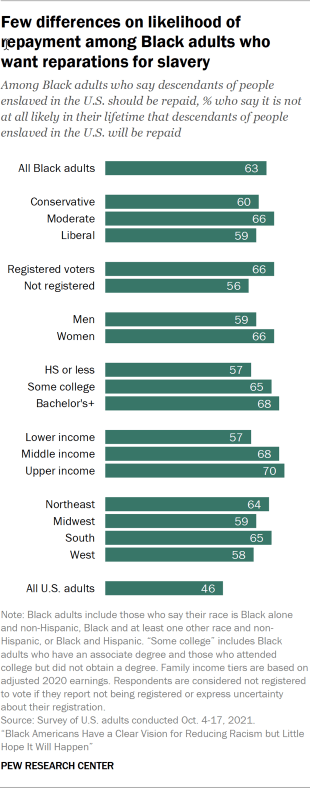
Chart showing Black Democrats and Republicans about as likely to say the federal government should have all or most of the responsibility for repayment for slavery

Most Black adults say repayment for slavery will not occur in their lifetime

Chart showing majority of Black adults who want reparations think repayments for slavery are not at all likely in their lifetime

Although most Black adults say descendants of slavery should be repaid, very few of those who want reparations say that such repayment is likely in their lifetime. Only 7% of Black adults who support reparations say it is extremely or very likely that descendants of people enslaved in the U.S. will be repaid in their lifetime, and only about one-in-ten (11%) say it is somewhat likely. Roughly eight-in-ten Black adults (82%) say repayment is a little or not at all likely. In fact, a majority of Black adults who support reparations (63%) say repayment for slavery is not at all likely to happen in their lifetime.
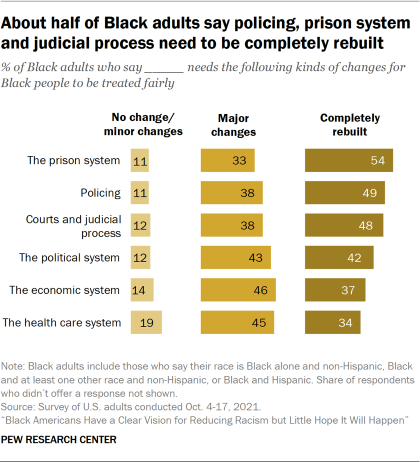
Age, education, income and party are key points of difference in Black adults’ views on the likelihood of reparations. Black adults ages 65 and older (72%) are the most likely to say reparations would not be paid in their lifetime, compared with 67% of those ages 50 to 64, 59% of those 30 to 49 and 56% under 30.

Bar chart showing few differences on likelihood of repayment among Black adults who want reparations for slavery

Black adults with a bachelor’s degree (68%) and those who attended college but do not have a bachelor’s degree (65%) are more likely than those with a high school education (57%) to say that repayment for slavery will not occur in their lifetime. And Black adults with upper (70%) and middle incomes (68%) are more likely than those with lower incomes (57%) to say this.

Among Black partisans who support reparations, Democrats (65%) are more likely than Republicans (45%) to say reparations would not occur in their lifetime.

Conversely, Black Republicans who support reparations (17%) are more likely to say repayment in their lifetime is extremely or very likely than Black Democrats who support reparations (6%). And among Black registered voters, 66% who support reparations say repayment will not occur in their life, compared with 56% of Black adults who are unregistered.

4. Black Americans’ views on systemic change

When it comes to how Black people are treated in the United States, most Black adults think several major U.S. institutions need large-scale changes to ensure fairness. They are particularly critical of various aspects of the criminal justice system, including policing, prisons and the courts. Despite this criticism, the majority of Black adults want funding for police departments in their communities to stay the same or increase. The survey also shows that while Black adults want these systems to change for the better, few think such improvements are likely.

Black adults say the criminal justice system needs to be completely rebuilt

Bar chart showing about half of Black adults say policing, prison system and judicial process need to be completely rebuilt

Nearly nine-in-ten Black adults say policing (87%), the courts and judicial process (86%), and the prison system (86%) require major changes or need to be completely rebuilt for Black people to be treated fairly. Only around one-in-ten Black adults say that each system requires minor changes or no changes at all. Black adults differ by age, education, income, party, voter status and their views about racism on the kinds of changes they would like to see.

Policing

Nearly nine-in-ten Black adults (87%) say policing needs large-scale changes for Black people to be treated fairly: 38% say it needs major changes, and about half (49%) of Black adults say that policing needs to be completely rebuilt. Only 11% say policing needs few or no changes for Black people to be treated fairly. (For details, see supplemental tables.)

The oldest Black adults (50%) are more likely than their younger peers to say policing needs major changes to treat Black people fairly. However, Black adults ages 30 to 49 (52%) and 50 to 64 (48%) are slightly more likely than those 65 and older (42%) to say policing needs to be completely rebuilt to ensure fair treatment.

Black adults also differ by education and income on policing. Black adults with a bachelor’s degree or higher level of education (43%) are more likely than those who attended college but do not have a bachelor’s degree (38%) and those who have a high school diploma or less education (34%) to say policing needs major changes for Black people to be treated fairly. However, Black adults with a high school education or less (17%) are more likely than those with a bachelor’s degree (7%) or those with some college but no four-year degree (7%) to say policing requires few, if any, changes to treat Black people fairly.

Black adults differ modestly by income on this question. Those with upper incomes (43%) are more likely than those with lower incomes (35%) to say policing requires major changes. Meanwhile, about one-in-ten Black adults with lower incomes (11%) say policing only requires minor changes for Black people to be treated fairly.

Black adults also differ by political party in their views on policing and fair treatment. Black Democrats (52%) are more likely than Black Republicans (29%) to say policing needs to be completely rebuilt for Black people to be treated fairly. Conversely, one-in-three Black Republicans (33%) say policing requires no changes or only minor changes to ensure fair treatment. Only 8% of Black Democrats say the same. 

Black adults who view racist laws as a bigger problem for Black people in society than racist individuals (59%) are more likely than those who view racist individuals as the bigger problem (41%) to say policing needs to be completely rebuilt for Black people to be treated fairly.

Bar chart showing majority of Black registered voters say the prison system needs to be completely rebuilt for Black people to be treated fairly

The courts and judicial process

A large majority of Black adults (86%) say the courts and judicial process in the United States require major changes or needs to be completely rebuilt for Black people to be treated fairly. This includes 38% who say this system needs major changes and 48% who say it needs to be completely rebuilt. Only 12% of Black adults say the judicial process needs no changes or only minor changes for Black people to be treated fairly.

Black adults 65 and older (51%) are more likely than their younger counterparts to say the judicial process needs major changes. However, Black adults ages 30 to 49 (49%) and 50 to 64 (48%) are slightly more likely than those 65 and older (41%) to say the judicial process needs to be completely rebuilt.

Black adults with a bachelor’s degree (46%) are more likely than those who attended college but do not have a four-year degree (38%) and those who have a high school diploma or less education (32%) to say the judicial process needs major changes. And Black adults with upper incomes (43%) are more likely than those with lower incomes (35%) to say this.

Black Democrats (50%) are more likely than Republicans (35%) to say the judicial process needs to be rebuilt for Black people to be treated fairly. However, nearly one-third of Black Republicans (31%) say the judicial process needs only minor changes or no changes at all.

Black adults differ on this question based on their views about racism in society. Those who say that racist laws are a bigger problem for Black people than racist individuals (60%) are more likely to say the judicial process needs to be completely rebuilt than those who say racist individuals are the bigger problem (37%). Those who say racist individuals are a bigger problem (45%) are more likely to say the judicial process needs major changes but does not need to be rebuilt.

Chart showing majority of Black adults say the prison system needs to be completely rebuilt to ensure fair treatment of Black people

Prisons

The majority of Black adults (86%) say the prison system needs to change for Black people to be treated fairly; this includes 33% who say that the prison system needs major changes and 54% who say it needs to be completely rebuilt. Only 11% of Black adults say the prison system needs minor changes or none at all to ensure fair treatment.

Black adults ages 65 and older (40%) are slightly more likely than all other age groups to say the prison system requires major changes for Black people to be treated fairly. However, Black adults ages 30 to 49 (57%) are slightly more likely than those 50 to 64 (52%) or 65 and older (50%) to say the prison system needs to be completely rebuilt.

Black Democrats (57%) are more likely than Black Republicans (35%) to say the prison system needs to be completely rebuilt for Black people to be treated fairly. Among Democrats, those who identify as liberal (63%) are more likely than those who identify as moderate (54%) to say the prison system needs to be completely rebuilt. Black Republicans (27%) are more likely than Democrats (9%) to say that prisons require either minor changes or no changes at all to treat Black people fairly.

Black adults who say racist laws are a bigger problem for Black people than racist individuals (67%) are more likely than those who say racist individuals are the bigger problem (42%) to think that the prison system needs to be completely rebuilt to ensure that Black people are treated fairly.

Black Americans who want improvements are skeptical about the likelihood of change in the criminal justice system

Bar chart showing a higher share of Black conservatives than moderates or liberals say the prison system is extremely or very likely to change in their lifetime

In addition to asking how much change Black adults thought was necessary to fix each system, the survey also asked those who said a system needed change how likely this change was.

Among Black Americans who say the criminal justice system needs at least minor changes, only about one-in-ten say policing (13%), the courts and judicial process (12%) or the prison system (11%) are extremely or very likely to change in their lifetime.

Black Americans who want these systems to change vary in saying that these systems are only somewhat likely to change, from 28% for policing to 21% for the prison system. However, the majority of Black Americans who want these systems to change say the prison system (67%), the judicial process (65%) and policing (58%) are a little or not at all likely to change in their lifetime.

Although few Black Americans say the criminal justice system is likely to change, some demographic groups are more optimistic about change than others. About one-in-six Black adults with a high school diploma say policing (17%), the prison system (15%) and the judicial process (15%) are extremely or very likely to change; this makes them more likely than Black adults with a bachelor’s degree to say this. Black adults with lower incomes are also slightly more likely than those with middle and upper incomes to say that policing (16%), the judicial process (15%) and the prison system (14%) are extremely or very likely to change in their lifetime.

Black Republicans (21%) are more likely than Black Democrats (13%) to say policing is extremely or very likely to change in their lifetime. However, there are no partisan differences on the likelihood that the prison system (16% vs. 11%) or the judicial process (15% vs. 12%) will change. And about one-in-six Black adults who say racist individuals are a bigger problem for Black people in society than racist laws say policing (16%), the judicial process (15%) and the prison system (14%) are extremely or very likely to change. Black adults who say that racist laws are a bigger problem than racist individuals are less likely to think that any of these systems will change in their lifetime.

Chart showing Black Republicans more likely than Democrats to say policing is extremely or very likely to change in their lifetime

Black adults say political, economic and health care systems need major changes to ensure fair treatment

Black adults are not only critical of the criminal justice system when it comes to race and fair treatment. They also say other major U.S. institutions need significant improvements to ensure Black people are treated fairly. Roughly eight-in-ten Black adults say the political system (85%), economic system (83%) and health care system (79%) require major changes or need to be completely rebuilt for Black people to be treated fairly. Much like their views on the criminal justice system, Black adults differ by age, education, income and party on the kinds of changes they would like to see. Black adults who are younger, have more formal education, have lower incomes or are Democratic are more in favor of drastic systemic change than their older, more educated, higher-income and Republican counterparts.

Black adults 65 and older are more likely than their younger counterparts to say that the political system (53%), economic system (56%) and health care system (57%) need major changes for Black people to be treated fairly. However, Black adults under 30 are slightly more likely than those 65 and older to say the health and political systems need to be completely rebuilt.

Roughly half of Black adults with a bachelor’s degree say the political (51%), economic (55%) and health care (54%) systems need major changes – more than the shares among those without a bachelor’s degree who say each.

However, Black adults who attended college but did not obtain a bachelor’s degree (44%) are more likely than those with a bachelor’s degree (38%) to say the political system needs to be rebuilt. Black adults with a high school diploma or less education (37%) are more likely than those with a four-year degree (30%) to say the health care system needs to be completely rebuilt.

About half of Black adults with middle and upper incomes say that the political, economic and health care systems require major changes for Black people to be treated fairly; fewer Black adults with lower incomes say the same. Meanwhile, about four-in-ten Black adults with lower incomes say these systems need to be completely rebuilt to ensure fair treatment, higher than the share of Black adults with upper incomes who say this. And Black Democrats are more likely than Black Republicans to say the political (43% vs. 31%), economic (39% vs. 26%) and health care (36% vs. 26%) systems need to be completely rebuilt for Black people to be treated fairly.

Black conservatives, those with lower levels of education and income most likely to say that systemic change will occur in their lifetime

Bar chart showing Black adults differ by education and income in saying that the political, economic and health care systems are extremely or very likely to change in their lifetime

Among Black Americans who say that each of these systems needs at least minor changes, very few think that these changes are likely. While 16% of Black adults who want change think changes to the health care system are extremely or very likely in their lifetime, only about one-in-ten say the same about the economic system (12%) and the political system (11%).

In fact, about half (51%) of Black adults who say the health care system needs to change for Black people to be treated fairly say that such change is a little or not at all likely in their lifetime. About six-in-ten say the same about the political system (63%) and the economic system (62%).

Among Black adults who want change, those with a high school diploma or less are more likely than those with at least a bachelor’s degree to say that changes to the health care (22% vs. 11%), economic (16% vs. 8%) or political (15% vs. 7%) systems are extremely or very likely to occur in their lifetime. And Black adults with lower incomes are more likely than those with middle and upper incomes to say the same about the health care and political systems.

Black adults who identify as politically conservative (28%) are more likely than moderates (14%) or liberals (14%) to say that the health care system is extremely or very likely to change in their lifetime. Likewise, Black conservatives are more likely than Black moderates and liberals to say the economic (21%) and political (18%) systems are extremely or very likely to change in their lifetime.

Most Black adults say funding for police departments should stay the same or increase

Bar chart showing Black women more likely than Black men to say police department funding in their area should increase

Aside from questions on the fair treatment of Black Americans in various systems, Black adults were asked specifically about funding for police departments in their communities and if those funds should increase, decrease or stay the same. Those who said funds should decrease shared their views on where that money should go.

About four-in-ten Black adults (39%) say that when thinking about police departments in their area, spending on policing should stay the same, while 35% say it should increase. And 23% of Black adults say funding should be decreased. Black adults differ across demographic groups on what should happen to police funding.

Black adults do not differ by party on this question. Similar shares of Black Democrats and Republicans say that funding should increase (36% and 37%, respectively), stay the same (40% each) or decrease (24% and 21%).

Black adults who identify as politically conservative (49%) are more likely than those who identify as moderate (35%) or liberal (32%) to say spending on policing should increase. Meanwhile, Black adults who identify as liberal (35%) are more likely than moderates (19%) or conservatives (16%) to say funding should be decreased.     

Non-Hispanic Black adults (36%) are more likely than multiracial Black adults (25%) to say funding for police should increase, though roughly four-in-ten non-Hispanic (39%), multiracial (40%) and Hispanic (38%) Black adults say funding should remain the same.

Black adults ages 65 and older (50%) are more likely than their younger counterparts to say funding for police in their communities should increase. However, Black adults ages 18 to 29 (36%) and those 30 to 49 (26%) are more likely than those 50 to 64 (17%) and 65 and older (11%) to say funding should be decreased.

Chart showing nearly four-in-ten Black adults say funding for police departments in their area should stay the same
Bar chart showing medical, mental health and social services are the top spending priorities among Black adults who say police funding should decrease

Overall, Black adults (35%) are less likely than the general U.S. public (48%) to say funding for police in their communities should be increased. And Black adults (23%) are more likely than the general public (13%) to say funding should be decreased.

Adults who say funding for police should decrease were asked which of the following should be the top priority for the reappropriated funds in their communities: medical, mental health, and social services; K-12 schools; roads, water systems and other infrastructure; reducing local taxes; or something else.

Both Black adults (40%) and the general public (52%) were most likely to say the reappropriated funds should go to medical, mental health and social services in their area. However, Black adults (25%) were slightly more likely than the general public (15%) to say that reappropriated funds should go to K-12 schools.

Acknowledgments

This report was written by Kiana Cox, research associate, and Khadijah Edwards, research associate.

Editorial guidance was provided by Mark Hugo Lopez, director, race and ethnicity research.

Methodological guidance was provided by Courtney Kennedy, vice president, methods and innovation, and Ashley Amaya, senior survey research methodologist. Guidance on the communications strategy and outreach was provided by Tanya Arditi, communications manager.

The report was number checked by Mohamad Moslimani, research assistant; Carolyne Im, research assistant; and Anusha Natarajan, research intern. Shannon Greenwood, digital producer, produced the report. David Kent, senior copy editor, copy edited the report. Charts were designed by Cox, Edwards, Im and Natarajan with guidance from Peter Bell, design director.

Pew Research Center is grateful to a panel of expert advisers who gave advice on all stages of the research process: Michael C. Dawson, John D. MacArthur Professor of Political Science and the College at the University of Chicago; Leah Wright Rigueur, SNF Agora Institute Associate Professor of History at Johns Hopkins University; C. Riley Snorton, Professor of English Language and Literature and the Center for Gender and Sexuality Studies at the University of Chicago; Mosi Adesina Ifatunji, Assistant Professor of Afro-American Studies and Sociology at the University of Wisconsin at Madison; and Charlene A. Carruthers, Founding National Director of Black Youth Project 100. 

Find related reports online at https://alpha.pewresearch.org/pewresearch-org/topic/race-ethnicity/racial-ethnic-groups/black-americans/.

Appendix: Supplemental tables

Table showing Black adults 65 and older are more likely than those under 30 to say U.S. institutions require major changes to ensure fair treatment

Methodology

The American Trends Panel survey methodology

Overview

The American Trends Panel (ATP), created by Pew Research Center, is a nationally representative panel of randomly selected U.S. adults. Panelists participate via self-administered web surveys. Panelists who do not have internet access at home are provided with a tablet and wireless internet connection. Interviews are conducted in both English and Spanish. The panel is being managed by Ipsos.

Data in this report is drawn from the panel wave conducted from Oct. 4 to Oct. 17, 2021. A total of 6,513 panelists responded out of 9,738 who were sampled, for a response rate of 68% (AAPOR RR3). This includes 3,626 respondents from the ATP and an oversample of 2,887 Black Americans from Ipsos’ KnowledgePanel (KP). The cumulative response rate accounting for nonresponse to the recruitment surveys and attrition is 2%. The break-off rate among panelists who logged on to the survey and completed at least one item is 3%. The margin of sampling error for the full sample of 6,513 respondents is plus or minus 2.2 percentage points.

Panel recruitment

Table showing American Trends Panel recruitment surveys

In August 2018, the ATP switched from telephone to address-based recruitment. Invitations were sent to a stratified, random sample of households selected from the U.S. Postal Service’s Delivery Sequence File. Sampled households receive mailings asking a randomly selected adult to complete a survey online. A question at the end of the survey asks if the respondent is willing to join the ATP. Starting in 2020 another stage was added to the recruitment. Households that do not respond to the online survey are sent a paper version of the questionnaire, $5 and a postage-paid return envelope. A subset of the adults returning the paper version of the survey are invited to join the ATP. This subset of adults receive a follow-up mailing with a $10 pre-incentive and invitation to join the ATP.

Across the four address-based recruitments, a total of 19,578 adults were invited to join the ATP, of whom 17,257 agreed to join the panel and completed an initial profile survey. In each household, the adult with the next birthday was asked to go online to complete a survey, at the end of which they were invited to join the panel. Of the 27,199 individuals who have ever joined the ATP, 11,498 remained active panelists and continued to receive survey invitations at the time this survey was conducted. The U.S. Postal Service’s Delivery Sequence File has been estimated to cover as much as 98% of the population, although some studies suggest that the coverage could be in the low 90% range.2 The American Trends Panel never uses breakout routers or chains that direct respondents to additional surveys.

About the Ipsos KnowledgePanel

The Ipsos KnowledgePanel is an online probability-based panel representative of the U.S. adult population. Households without internet connection are provided with a web-enabled device and free internet service. KnowledgePanel’s recruitment process was originally based on a national RDD sampling methodology. In 2009, the panel switched to using an address-based sample (ABS) methodology. Additional information about the recruitment, sampling and weighting procedures for the Ipsos KnowledgePanel are available here.

Sample design

The overall target population for this survey was non-institutionalized persons ages 18 and older, living in the U.S., including Alaska and Hawaii. It featured a stratified random sample from the ATP in which panelists were assigned to the first matching stratum in the following order: Black Americans (including those who identify as Hispanic or Black in combination with another race), tablet households, foreign-born Hispanics, U.S.-born Hispanics, people not registered to vote, people with a high school education or less, foreign-born Asians, people ages 18 to 34, people who use the internet weekly or less, non-volunteers and a final stratum comprised of any remaining panelists not assigned to any of the above. Black ATP members were selected with certainty.  The remaining strata were sampled at rates designed to ensure that the share of respondents in each stratum is proportional to its share of the U.S. adult population to the greatest extent possible. Respondent weights are adjusted to account for differential probabilities of selection as described in the Weighting section below.

The ATP was supplemented with an oversample from the KnowledgePanel in which all panelists who had previously identified as Black or African American (including those who identify as Hispanic or Black in combination with another race) were selected with certainty.

Questionnaire development and testing

The questionnaire was developed by Pew Research Center in consultation with Ipsos. The web program was rigorously tested on both PC and mobile devices by the Ipsos project management team and Pew Research Center researchers. The Ipsos project management team also populated test data that was analyzed in SPSS to ensure the logic and randomizations were working as intended before launching the survey.

Incentives

All respondents were offered a post-paid incentive for their participation. Respondents could choose to receive the post-paid incentive in the form of a check or a gift code to Amazon.com or could choose to decline the incentive. Incentive amounts ranged from $5 to $20 depending on whether the respondent belongs to a part of the population that is harder or easier to reach. Differential incentive amounts were designed to increase panel survey participation among groups that traditionally have low survey response propensities.

Ipsos operates an ongoing modest incentive program for KnowledgePanel to encourage participation and create member loyalty. The incentive program includes special raffles and sweepstakes with both cash rewards and other prizes to be won. Typically, panel members are assigned no more than one survey per week. On average, panel members complete two to three surveys per month with durations of 10 to 15 minutes per survey. An additional incentive is usually provided for longer surveys. For this survey, KnowledgePanel members were offered 10,000 points (equivalent to $10) in addition to the regular incentive program on Oct. 16, 2021, at 4:30 p.m. Eastern to those who hadn’t responded yet in an attempt to boost the number of responses from KnowledgePanel members.

Data collection protocol

The data collection field period for this survey was Oct. 4 to Oct. 17, 2021. Postcard notifications were mailed to all ATP panelists with a known residential address on Oct. 4. 

Invitations were sent out in two separate launches: Soft Launch and Full Launch. Sixty ATP panelists and 229 KnowledgePanel panelists were included in the soft launch, which began with an initial invitation sent on Oct. 4, 2021. The ATP panelists chosen for the initial soft launch were known responders who had completed previous ATP surveys within one day of receiving their invitation. All remaining English- and Spanish-speaking panelists were included in the full launch and were sent an invitation on Oct. 5.

All panelists with an email address received an email invitation and up to four email reminders if they did not respond to the survey. All ATP panelists that consented to SMS messages received an SMS invitation and up to four SMS reminders. The third and final reminders were sent to all KP sample and only to ATP sample that had previously identified as Black in the panel profile survey.

Table showing Invitation and reminder dates

Data quality checks

To ensure high-quality data, the Center’s researchers performed data quality checks to identify any respondents showing clear patterns of satisficing. This includes checking for very high rates of leaving questions blank, as well as always selecting the first or last answer presented. As a result of this checking, three ATP and four KP respondents were removed from the survey dataset prior to weighting and analysis.

Weighting

Table showing weighting dimensions

The data was weighted in a multistep process that accounts for multiple stages of sampling and nonresponse that occur at different points in the survey process. First, each panelist begins with a base weight that reflects their probability of selection for their initial recruitment survey. These weights were then adjusted to account for each panelist’s probability of being sampled to participate in this wave.

Next, respondents were placed into one of three groups: 1) Black ATP respondents, 2) Black KnowledgePanel respondents, and 3) all remaining ATP respondents. Within each group, the weights for each respondent were scaled to be proportional to that group’s effective sample size. The groups were then recombined and the weights were poststratified so that the weighted proportion of Black adults matches that of the U.S. adult population.

The weights were then further calibrated to align with the population benchmarks identified in the accompanying table and trimmed at the 1st and 99th percentiles to reduce the loss in precision stemming from variance in the weights. In a final step, the trimmed weights were again poststratified to ensure that the share of Black adults exactly matches the U.S. population. Sampling errors and test of statistical significance take into account the effect of weighting.

Some of the population benchmarks used for weighting come from surveys conducted prior to the coronavirus outbreak that began in February 2020. However, the weighting variables for ATP members recruited in 2021 were measured at the time they were recruited to the panel. Likewise, the profile variables for existing panelists were updated from panel surveys conducted in July or August 2021. For KnowledgePanel respondents, many of the weighting variables were measured on this wave.

This does not pose a problem for most of the variables used in the weighting, which are quite stable at both the population and individual levels. However, volunteerism may have changed over the intervening period in ways that make their 2021 measurements incompatible with the available (pre-pandemic) benchmarks. To address this, volunteerism is weighted to an estimated benchmark that attempts to account for possible changes in behavior.

The weighting parameter is estimated using the volunteerism profile variable that was measured on the full American Trends Panel in 2021 but weighted using the profile variable that was measured in 2020. For all other weighting dimensions, the more recent panelist measurements were used. For ATP panelists recruited in 2021, the 2020 volunteerism measure was imputed using data from existing panelists with similar characteristics.

The following table shows the unweighted sample sizes and the error attributable to sampling that would be expected at the 95% level of confidence for each group in the survey.

Table showing the unweighted sample sizes and the error attributable to sampling that would be expected at the 95% level of confidence for each group in the survey.

Sample sizes and sampling errors for other subgroups are available upon request. In addition to sampling error, one should bear in mind that question wording and practical difficulties in conducting surveys can introduce error or bias into the findings of opinion polls.

Dispositions and response rates

Table showing final dispositions
Table showing cumulative response rate

Adjusting income and defining income tiers

To create upper-, middle- and lower-income tiers, respondents’ 2020 family incomes were adjusted for differences in purchasing power by geographic region and household size. “Middle-income” adults live in families with annual incomes that are two-thirds to double the median family income in the panel (after incomes have been adjusted for the local cost of living and household size). The middle-income range for the American Trends Panel is about $42,000 to $125,900 annually for an average family of three. Lower-income families have incomes less than roughly $42,000, and upper-income families have incomes greater than roughly $125,900 (all figures expressed in 2020 dollars).

Based on these adjustments, 46% of Black respondents are lower income, 39% are middle income and 9% fall into the upper-income tier. An additional 5% either didn’t offer a response to the income question or the household size question. Among all U.S adults, 29% are lower income, 47% are middle income and 18% fall into the upper-income tier. An additional 6% either didn’t offer a response to the income question or the household size question.

For more information about how the income tiers were determined, please see here.