Pew Research Center

FOR RELEASE NOVEMBER 4, 2021

Majority of Latinos Say Skin Color Impacts Opportunity in America and Shapes Daily Life

Latinos with darker skin color report more discrimination experiences than Latinos with lighter skin color

BY Luis Noé-Bustamante, Ana Gonzalez-Barrera, Khadijah Edwards, Lauren Mora and Mark Hugo Lopez

FOR MEDIA OR OTHER INQUIRIES:

Communications Department
202.419.4372
www.pewresearch.org

RECOMMENDED CITATION

Pew Research Center, November 2021, "Majority of Latinos Say Skin Color Impacts Opportunity in America and Shapes Daily Life"

About Pew Research Center

Pew Research Center is a nonpartisan, nonadvocacy fact tank that informs the public about the issues, attitudes and trends shaping the world. It does not take policy positions. The Center conducts public opinion polling, demographic research, computational social science research and other data-driven research. It studies politics and policy; news habits and media; the internet and technology; religion; race and ethnicity; international affairs; social, demographic and economic trends; science; research methodology and data science; and immigration and migration. Pew Research Center is a subsidiary of The Pew Charitable Trusts, its primary funder.

© Pew Research Center 2026

Table of contents

  • About Pew Research Center
  • Majority of Latinos Say Skin Color Impacts Opportunity in America and Shapes Daily Life
  • 1. Half of U.S Latinos experienced some form of discrimination during the first year of the pandemic
  • 2. For many Latinos, skin color shapes their daily life and affects opportunity in America
  • 3. Latinos divided on whether race gets too much or too little attention in the U.S. today
  • 4. Measuring the racial identity of Latinos
  • Acknowledgments
  • Methodology
  • Appendix: Additional tables

Majority of Latinos Say Skin Color Impacts Opportunity in America and Shapes Daily Life

Latinos with darker skin color report more discrimination experiences than Latinos with lighter skin color

How we did this

Pew Research Center conducted this study to understand the role of skin color in the life experiences of Latino adults. It also measures attitudes of Latinos about race and race relations and their personal experiences with discrimination. In addition, the study explores four different ways to measure racial identity, including an assessment of skin color.

For this analysis we surveyed 3,375 U.S. Hispanic adults in March 2021. This includes 1,900 Hispanic adults on Pew Research Center’s American Trends Panel (ATP) and 1,475 Hispanic adults on Ipsos’ KnowledgePanel. Respondents on both panels are recruited through national, random sampling of residential addresses. Recruiting panelists by phone or mail ensures that nearly all U.S. adults have a chance of selection. This gives us confidence that any sample can represent the whole population (see our Methods 101 explainer on random sampling), or in this case the whole U.S. Hispanic population.

To further ensure the survey reflects a balanced cross-section of the nation’s Hispanic adults, the data is weighted to match the U.S. Hispanic adult population by age, gender, education, nativity, Hispanic origin group and other categories. Read more about the ATP’s methodology. Here are the questions used for our survey of Hispanic adults, along with responses, and its methodology.

Terminology

The terms Hispanic and Latino are used interchangeably in this report.

Skin color is self-assessed based on a 10-step scale, ranging from lightest (1) to darkest (10). Latinos with lighter skin color or Latinos with lighter skin selected 1-4 on the scale while Latinos with darker skin color or Latinos with darker skin selected 5-10.

U.S. born refers to persons born in the United States and those born in other countries to parents at least one of whom was a U.S. citizen.

Foreign born refers to persons born outside of the United States to parents neither of whom was a U.S. citizen. The terms foreign born and immigrant are used interchangeably in this report. For the purposes of this report, foreign born also refers to those born in Puerto Rico. Although individuals born in Puerto Rico are U.S. citizens by birth, they are included among the foreign born because they are born into a Spanish-dominant culture and because on many points their attitudes, views and beliefs are much closer to Hispanics born abroad than to Hispanics born in the 50 states or the District of Columbia, even those who identify themselves as being of Puerto Rican origin.

First generation refers to foreign-born people. The terms “foreign born,” “first generation” and “immigrant” are used interchangeably in this report.

Second generation refers to people born in the 50 states or the District of Columbia, with at least one first-generation, or immigrant, parent.

Third or higher generation refers to people born in the 50 states or the District of Columbia, with both parents born in the 50 states or the District of Columbia.

Language dominance is a composite measure based on self-described assessments of speaking and reading abilities. Spanish-dominant people are more proficient in Spanish than in English (i.e., they speak and read Spanish “very well” or “pretty well” but rate their English-speaking and reading ability lower). Bilingual refers to people who are proficient in both English and Spanish. English-dominant people are more proficient in English than in Spanish.

The perceived impact of skin color in the lives of U.S. Latinos is broad. From impacting their ability to get ahead in the country to shaping their daily life experiences to dealing with discrimination, skin color is seen by Latinos as an important factor affecting their lives and life chances.
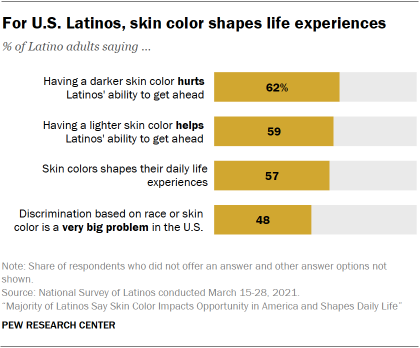
For U.S. Latinos, skin color shapes life experiences

A majority (62%) of Hispanic adults say having a darker skin color hurts Hispanics’ ability to get ahead in the United States today at least a little. A similar share (59%) say having a lighter skin color helps Hispanics get ahead. And 57% say skin color shapes their daily life experiences a lot or some, with about half saying discrimination based on race or skin color is a “very big problem” in the U.S. today, according to Pew Research Center’s National Survey of Latinos, a bilingual, national survey of 3,375 Hispanic U.S. adults conducted in March 2021.

Colorism is a form of discrimination based on skin color, usually, though not always, favoring lighter skin color over darker skin color within a racial or ethnic group. While it can be tied to racism, it is not necessarily the same. (Racism is prejudice directed at members of a racial or ethnic group because of their origin.) For example, Hispanics in the U.S. may face discrimination because they are Hispanic (a form of racism), but the degree of discrimination may vary based on skin color, with those of darker shades experiencing more incidents (a form of colorism). And because of colorism’s deep roots in the histories of Latin America and the United States, discrimination based on skin color can occur among Hispanics just as much as it can be directed at Hispanics by non-Hispanics.

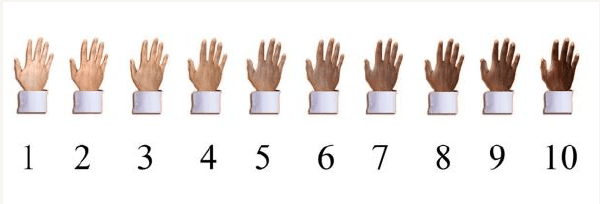
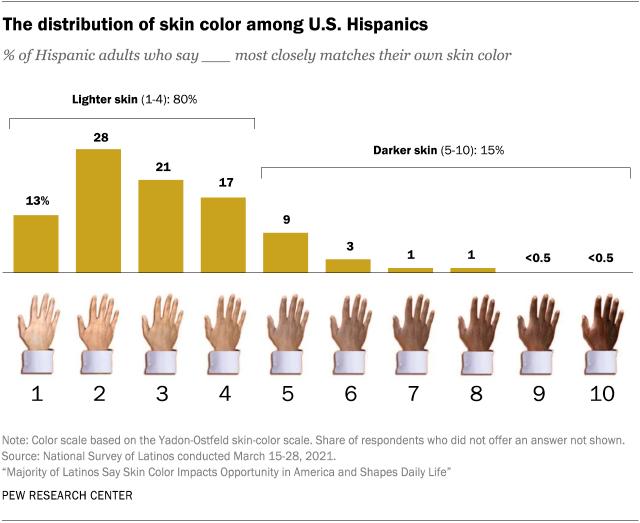
To measure this dimension of Latino identity in the United States, the survey asked respondents to identify the skin color that best resembled their own using a version of the Yadon-Ostfeld skin-color scale. Respondents were shown ten skin colors that ranged from fair to dark (see text box below for the images and scale used). Fully 80% of Latino adults selected a color between one and four, or lighter skin colors, while 15% selected a color between five and ten on the scale, or darker skin colors.1

Discrimination and skin color

Colorism in the Americas

Discrimination based on skin color has deep historical roots in Latin America and the Caribbean. Centuries ago, a hierarchical or caste system was established in the Americas, tying privilege, individual worth and access to opportunities to one’s skin color, race and birthplace. This was further shaped by the arrival of slaves from Africa across the region and the mixing of Indigenous, European and African populations.

Today, skin color remains an important determinant of outcomes across the region. Individuals with darker skin achieve lower levels of educational attainment or have less access to health care, for example. And those of lighter skin color experience less discrimination than those of darker skin color.

Colorism is present in the U.S. as well and has similarly impacted the lives of Hispanics, Black Americans and Asian Americans, existing alongside racial discrimination. And it is similarly linked to a number of outcomes. For example, racism may impact both Hispanics of lighter skin and darker skin color, but Hispanics with darker skin may experience more discrimination.

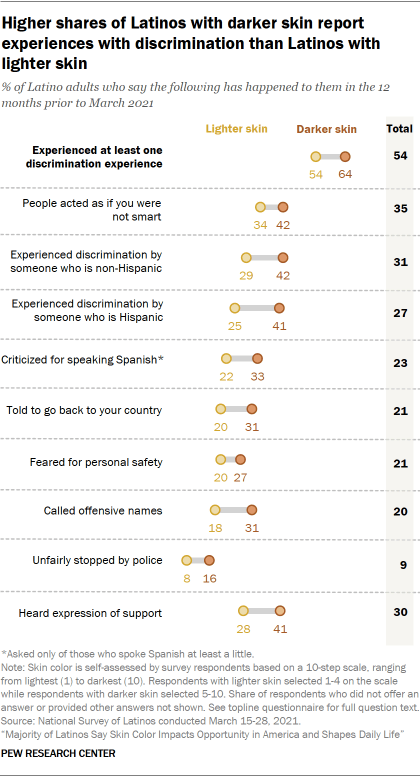
Overall, about half (54%) of Hispanic adults experienced at least one of the eight discrimination incidents asked about in the survey, reflecting broader and ongoing experiences with discrimination among U.S. Hispanics no matter their skin color. However, the new survey finds Hispanics with darker skin color are more likely to have experienced at least one discrimination incident than Hispanics with lighter skin color. Nearly two-thirds (64%) of Hispanics with darker skin say they personally experienced at least one of the eight discrimination incidents during the year previous to the survey, while 54% of Hispanics with lighter skin color say the same.  

Among the discrimination experiences included in the survey, being treated as if they were not smart is the most reported. Some 42% of Latinos with darker skin say this happened to them, as do 34% of Latinos with lighter skin.

The next most common discrimination experiences were those directed at Hispanics by non-Hispanics and Hispanics alike, with the chances of these incidents happening linked to skin color. Some 42% of Hispanics with darker skin personally experienced discrimination or were treated unfairly by someone who is not Hispanic, while 29% of those with lighter skin say the same happened to them. And 41% of Hispanics with darker skin say they personally experienced discrimination or were treated unfairly by someone who is Hispanic, while 25% of those who have a lighter skin color say they too experienced discrimination by someone who is Hispanic.

Hispanics with darker skin more likely to experience discrimination incidents than those with lighter skin

Still, no matter their skin color and despite the notable gap, Latinos are experiencing discrimination. About one-third (32%) of Latinos with darker skin say someone told them to go back to their country, for example, as did 20% 0f those with lighter skin. Some 33% of Latinos with darker skin say someone criticized them for speaking Spanish in public, as did 22% of those with lighter skin. And 27% of Latinos with darker skin say they feared for their personal safety while 20% of those with lighter skin say the same.

While Latinos’ skin color is linked to discrimination experiences, those with darker skin and lighter skin alike say skin color affects opportunity and life experiences in America. For example, majorities of both groups say skin color shapes their daily life experiences – 62% among Latinos with darker skin and 57% among Latinos with lighter skin. And both groups are just as likely to say darker skin color “hurts” Latinos’ ability to get ahead in the U.S. (63% and 64% respectively). About half (49%) of Latinos with lighter skin say discrimination based on race or skin color is a very big problem, as do 41% of those with darker skin.

Impact of race, skin color is a topic of conversation with relatives and friends for Hispanics
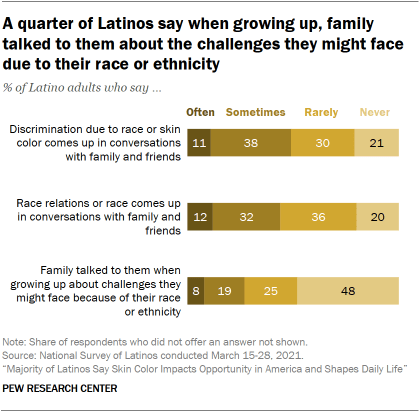
A quarter of Latinos say when growing up, family talked to them about the challenges they might face due to their race or ethnicity

Race, skin color and the state of race relations sometimes come up in conversations Latinos have with family and friends. Roughly half (48%) say discrimination based on race or skin color is a topic in conversations at least sometimes with friends and relatives. But these conversations are not happening frequently among all Latinos. About half (51%) say these conversations with relatives and friends happen rarely (30%) or never (21%).

Conversations about racial or skin color discrimination are happening more often among Hispanics with darker skin than those with lighter skin. Six-in-ten Hispanics with darker skin color (60%) say they often or sometimes talk with family and friends about discrimination based on race or skin color, a share that falls to 46% among Hispanics with lighter skin.

And 44% say the topic of U.S. race relations often or sometimes comes up when talking with family and friends. About half (52%) of Hispanics with darker skin say this, as do 43% of Hispanics with lighter skin.

Racial identity and experiences with racism have been a part of some Latinos’ experiences growing up as well. About one-in-four Latinos (27%) say their family talked to them at least sometimes about the challenges they might face due to their race or ethnicity when they were growing up. This is more common among Latinos who indicate they have darker skin (41%) than among those who indicate they have lighter skin (25%).

Capturing skin color among U.S. Hispanics

A self-assessed measure of skin color was included in the survey as one of four measures of racial identity. The survey used a version of the Yadon-Ostfeld 10-point skin color scale, where one represents the lightest skin color and 10 the darkest. (The scale used in the survey is reproduced below.) Survey respondents were asked to select the color that most closely matches their own, even if none of them were exactly right.

Responses were distributed mostly toward lighter skin colors. Eight-in-ten Hispanics selected one of the four lightest skin colors, with the second-lightest ranking on top (28%), followed by the third (21%) and fourth lightest colors (17%). By contrast, 15% of Latino respondents selected one of the six darker skin colors, with only 3% in total selecting one of the four darkest skin colors (7-10). For this report, those who indicated their skin color is between one and four are identified as of a lighter skin color, while those who indicated their skin color is between five and 10 are identified as of a darker skin color.
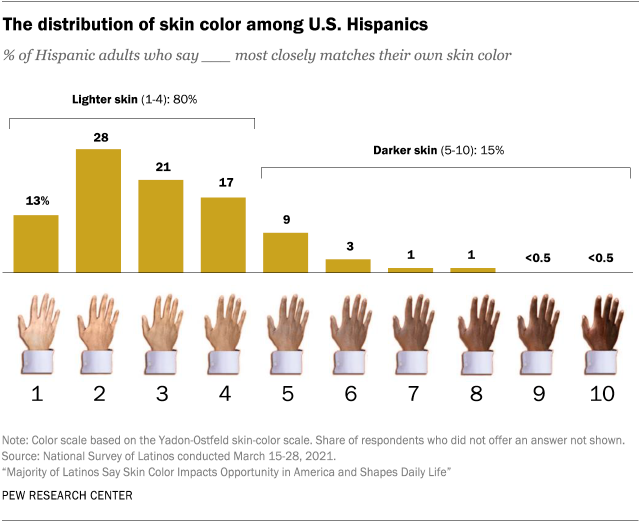
The distribution of skin color among U.S. Hispanics

Half of Latinos say there is too little national attention on racial issues concerning Latino people

After nearly a year of national engagement over issues of race following the killing of George Floyd in May of 2020 and subsequent nationwide racial justice protests, Latinos are split over whether there is too much or too little attention paid to race and racial issues in the country today. Overall, 37% say that too little attention is paid to these issues, while 36% say there is too much attention and 25% say the amount of attention given to race and racial issues is about the right amount.

Since 2019, fewer Hispanics say too little attention is paid to race and racial issues nationally. Though about half say too little attention is paid to race and racial issues concerning Hispanics

The views of Latinos on this have shifted as the share saying too little attention is paid to race relations has dipped compared with 2019 and 2020, when 50% and 46% of Latinos respectively said the same. At the same time, a growing share say there is too much attention paid to race and racial issues nationally. Some 36% say this today, up from 27% who said the same in 2019.

Even before recent events, Latinos were downbeat about race relations in the U.S. In another 2019 Pew Research Center survey, six-in-ten Latinos (60%) said race relations in the country then were generally bad and getting worse. In the same survey, more Latinos said people not seeing racism where it really does exist was a bigger problem in the country than people seeing racial discrimination where it really does not exist. 

Yet, when it comes to how much attention is paid to race and racial issues concerning Hispanic people, about half of all Hispanics (51%) say too little attention is paid to them today. Among Hispanics with darker skin, 57% say too little attention is paid to racial issues concerning Hispanic people, a higher share than the 50% of those with lighter skin color who say the same.

About as many Hispanics hold this view about the level of national attention paid to race and racial issues concerning Asian people. Over half (55%) of Hispanics say too little attention is paid to race issues concerning Asian people in the country today. Meanwhile, 29% of Hispanics say the amount of national attention paid to race issues concerning Asian people is about right and 14% say too much attention is paid to these issues. (The survey was fielded just as the number of hate and violence incidents focused on Asian Americans drew wide national attention.)

At the same time, 30% of Hispanics say too little attention is paid to race and racial issues related to Black people today, while 45% say too much attention is paid to them and 23% say the right amount of attention is paid to these issues.

Hispanics often hear other Hispanics make racially insensitive comments and jokes about Hispanics and non-Hispanics alike
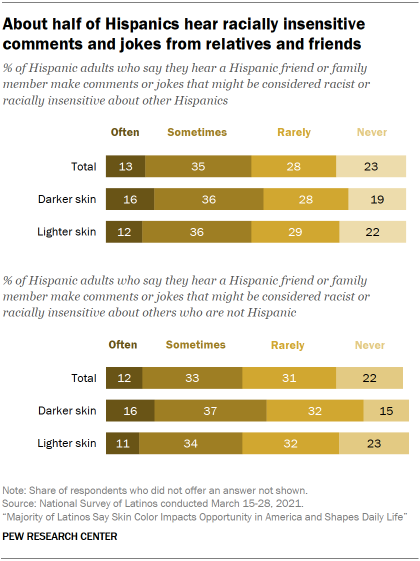
About half of Hispanics hear racially insensitive comments and jokes from relatives and friends

Hispanics are hearing racially insensitive comments and jokes coming from other Hispanics, according to the survey. Nearly half (48%) of Hispanic adults say they have often or sometimes heard a Hispanic friend or family member make comments or jokes about other Hispanics that might be considered racist or racially insensitive. Similar shares of Hispanics who identify with a lighter skin color (48%) or darker skin color (52%) say they have heard these types of comments or jokes from friends or family at least sometimes.

And 45% of Hispanic adults say the same about hearing a Hispanic friend or family member make racist or racially insensitive comments or jokes about others who are not Hispanic often or at least sometimes. Among Hispanics with darker skin color, 53% say this, a higher share than among Hispanics with lighter skin color (44%).

This is little changed from 2019, when a similar share of Hispanics (47%) said they heard a Hispanic friend or family member make what might be considered a racist comment about people who are not Hispanic. In the same 2019 survey, half of those who heard these comments or jokes from people close to them said they confronted a friend or family member about it.

While Hispanics say skin color affects their ability to get ahead in America, other factors are seen as important as well
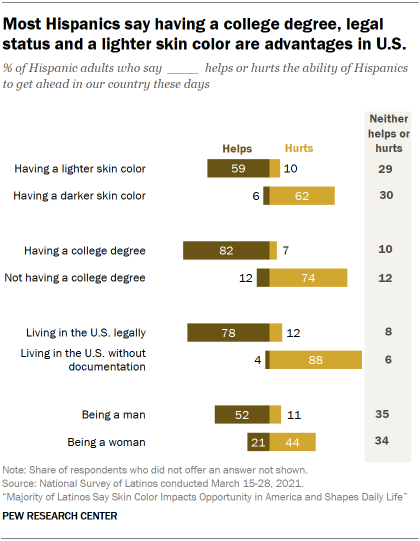
Most Hispanics say having a college degree, legal status and a lighter skin color are advantages in U.S.

While a majority of Latinos say skin color impacts Latinos’ opportunity in the U.S. today, education and immigration status are viewed by more as having an impact on the ability to get ahead.

About eight-in-ten Hispanics (82%) say having a college degree helps the ability of Hispanics to get ahead in the U.S. these days. And 78% say the same about living in the U.S. legally. Both are higher than the 59% saying a lighter skin color helps Hispanics get ahead in America and the 62% saying a darker skin color hurts Hispanics.

When asked if gender affects Hispanics’ ability to get ahead in the U.S. today, about half (52%) of Hispanics say being a man helps, while 21% say the same about being a woman. Roughly one-in-three say that being a Hispanic man or woman is neither an advantage nor disadvantage in America today.

For Latinos, discrimination experiences and views about skin color and race are linked
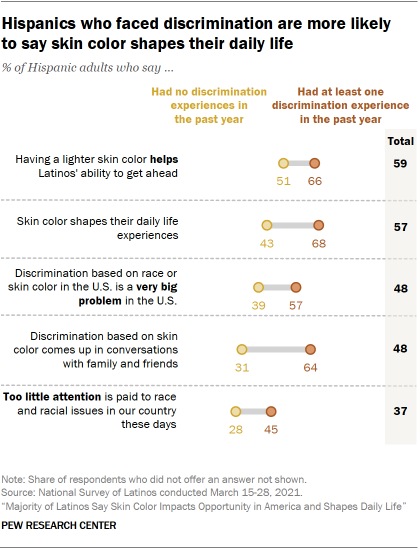
Hispanics who faced discrimination are more likely to say skin color shapes their daily life

Latinos’ views on topics related to race or skin color differ by their own experiences with discrimination. Those who reported experiencing at least one of eight specific forms of discrimination asked about in the survey were more likely than those who did not report one to say having a lighter skin color helps at least a little in the ability of Hispanics to get ahead – 66% vs. 51% respectively.2

About two-thirds (68%) of Latinos who had a discrimination experience in the past year say skin color shapes their daily life experiences a lot or some, compared with 43% of those who had no discrimination experiences that say the same.

In addition, those who had at least one discrimination experience in the past year were more likely than those who did not have such experiences to say discrimination based on race or skin color is a “very big problem” in the U.S., that discrimination based on skin color comes up often or sometimes in conversations with family and friends and that too little attention is paid to race and racial issues in the U.S. these days.
1. Half of U.S Latinos experienced some form of discrimination during the first year of the pandemic

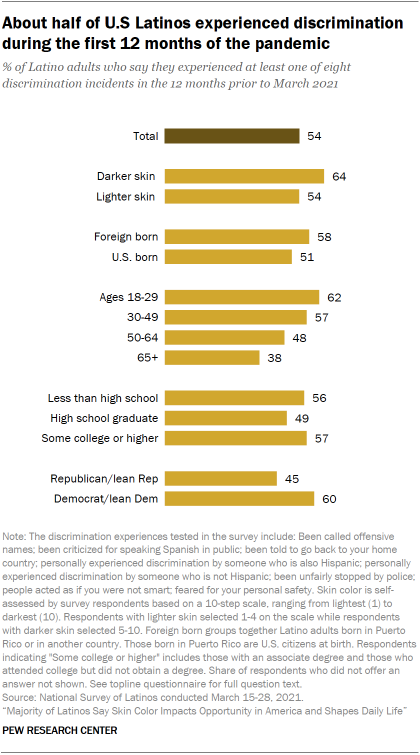
During the first 12 months of the COVID-19 pandemic, more than half (54%) of Latinos say they experienced at least one of eight specific forms of discrimination, according to the March 2021 survey of Latino adults. However, experiences with discrimination vary notably by skin color, age and partisanship.

About half of U.S Latinos experienced discrimination during the first 12 months of the pandemic

In the national survey, respondents were asked whether or not they have been called offensive names because they are Hispanic; been criticized for speaking Spanish in public; heard a remark from someone that they should go back to their home country; personally experienced discrimination or been treated unfairly because of their background, by someone who is Hispanic and by someone who is not Hispanic; been unfairly stopped by police; people acted as if they thought they were not smart; and feared for their personal safety. Survey respondents were also asked if someone expressed support for them because they are Hispanic. (This is not an exhaustive list of possible discrimination experiences. Some Hispanics who said “no” to all these may still have experienced some form of discrimination not captured by the survey. Meanwhile, some respondents might have experienced more than one type of discrimination reported here.)

Experience with discrimination in the year prior to the survey is linked to skin color. Nearly two-thirds (64%) of Latinos with darker skin say they experienced at least one of the eight discrimination events compared with 54% of Latinos with lighter skin. Even so, at least half of each group experienced some form of discrimination in the first year of the pandemic.

Other demographic characteristics are also linked with discrimination experiences. Latinos under 50 were more likely to report experiencing discrimination than Latinos over 50. Roughly six-in-ten Latinos ages 18 to 29 (62%) and 30 to 49 (57%) experienced at least one form of discrimination in the 12 months prior to the survey. By comparison, roughly half (48%) of Latinos ages 50 to 64 experienced discrimination, and about four-in-ten Latinos (38%) ages 65 and older experienced discrimination.

Additionally, six-in-ten Hispanic Democrats (60%) experienced discrimination, compared with 45% of Hispanic Republicans who say the same.

Hispanics experienced discrimination from non-Hispanics and Hispanics alike

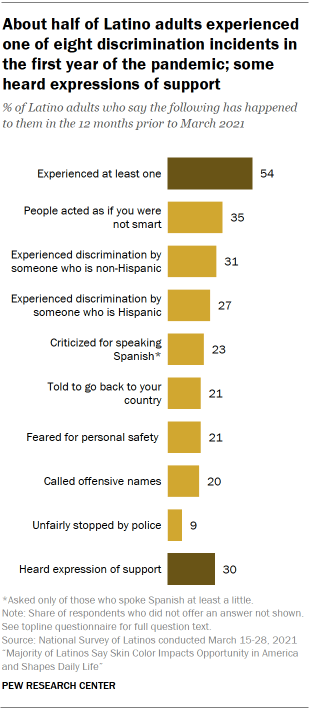
About half of Latino adults experienced one of eight discrimination incidents in the first year of the pandemic; some heard expressions of support

Among the eight discrimination experiences asked about in the survey, the most common experience reported by Latino adults was people acting as if they are not smart. More than one-third of Latinos (35%) say this happened to them in the 12 months prior to the survey. Latinos who are bilingual are more likely to say they’ve been treated this way (41%) than those who are dominant Spanish speakers (32%) and those who are dominant English speakers (29%).

The second most common discrimination experiences were those coming from other people. But notably, Hispanics say they personally experience discrimination from Hispanics and non-Hispanics alike. About three-in-ten Hispanics (31%) say they personally experienced discrimination or were treated unfairly because of their Hispanic background by someone who is not Hispanic, while some 27% say they personally experienced discrimination or were treated unfairly by someone who is Hispanic.

However, this gap is wider for some Latino demographic subgroups than others. For example, among Latinos with college experience, 35% say they experienced discrimination by someone who is not Hispanic, while 26% say they experienced discrimination by someone who is Hispanic – a 9 percentage point gap. By comparison, among Latinos with less than a high school diploma, 28% experienced discrimination by someone who is not Hispanic, while 32% say they experienced discrimination by someone who is Hispanic – a 4-point gap in the other direction.

Among other discrimination experiences tested in the survey, about one-in-five Hispanics say they were told to go back to their home country (21%), were criticized for speaking Spanish in public (23%) or were called offensive names (20%). All three of these are little changed from a 2019 survey of Hispanic adults conducted before the pandemic. The current survey also found that 21% say they feared for their personal safety and that 9% say they were unfairly stopped by the police.

Despite these experiences with discrimination, three-in-ten Latinos say someone expressed support for them because of their Latino background, a finding that remains unchanged from 2019, when 30% said the same.

Latinos with darker skin experience more discrimination than Latinos with lighter skin

Younger Latinos are more likely than older Latinos to report experiencing discrimination

Skin color is connected to discrimination experiences for Latinos, according to the survey. While 54% of Latinos with lighter skin experienced at least one of the eight incidents measured in this survey, nearly two-thirds (64%) of Latinos with darker skin experienced the same.

This gap in experiences by skin color extends across all discrimination experiences asked about in the survey. For example, while about three-in-ten of Hispanics with lighter skin color (29%) personally experienced discrimination because of their background from someone who is not Hispanic, 42% of Hispanics with darker skin color personally experienced the same. Similarly, a quarter (25%) of Hispanics with lighter skin color report personally experiencing discrimination by someone who is also Hispanic, while 41% of Hispanics with darker skin color report experiencing the same.

Although Latinos with darker skin are more likely than Latinos with lighter skin to experience each of the eight incidents, they are also more likely than Latinos with lighter skin color to say someone expressed support for them. Some 41% of Latinos with darker skin say they have heard expressions of support in the year prior to the survey, while 28% of Latinos with lighter skin say they heard the same.

Experiences with discrimination are more common among younger Latinos

Higher shares of Latinos with darker skin report experiences with discrimination than Latinos with lighter skin

Younger Latinos are more likely to say they experienced discrimination than older Latinos, according to the survey. For each of the eight measures of discrimination, Latinos under 50 are more likely than Latinos who are 50 and older to say these things happened to them. For some of the measures there is a gradual decrease as age increases. For example, about four-in-ten Latinos ages 18 to 29 (40%) and 30 to 49 (38%) say people acted as if they were not smart. This share drops to 31% for Latinos ages 50 to 64, while only 19% of Latinos 65 and older say people acted as if they were not smart.

Part of the reason for the difference in experiences may be related to skin color. Younger Hispanics are more likely to say they have darker skin than older Hispanics. Some 18% of Hispanics ages 18 to 29 and 17% of those ages 30 to 49 indicate they have darker skin. By comparison, 11% of Hispanics ages 50 to 64 and 10% of Hispanics 65 and older indicate the same about their skin color. Yet, even controlling for skin color, younger Hispanics are still more likely to report one of the eight discrimination experiences happened to them in the 12 months prior to the survey than older Hispanics.

2. For many Latinos, skin color shapes their daily life and affects opportunity in America

The social and personal impact of race and skin color is on the minds of many U.S. Hispanics today. Most view skin color as an important influence in their daily lives and say having a lighter skin color is an advantage for getting ahead today. And while about a quarter say that during their upbringing they had at least occasional conversations with family about potential challenges they might face due to race, about half say discrimination due to race and skin color is sometimes a topic of conversations with family and friends today. Still, there are differences in views about the impact of skin color among Latinos, depending on how they describe their own skin color or if they have had a discrimination experience due to race or skin color in the past year.

Skin color shapes the life experiences of many Latinos

More than half of Latinos say skin color shapes their daily experiences

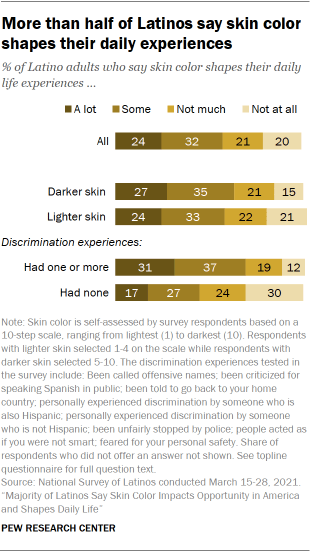
Over half of Latino adults (57%) say skin color affects their daily life experiences a lot (24%) or some (32%), while about one-in-five (21%) say skin color does not have much effect in their daily life or no influence at all (21% and 20% respectively).  

More than half of Latinos say skin color affects their daily experiences regardless of their self-identified skin color, according to the survey. About one-in-four with darker skin (27%) and a similar share of those with lighter skin (24%) say skin color shapes their daily life “a lot,” while about a third of each group says it has some effect (35% and 33%).

Latino Democrats more likely than Latino Republicans to say skin color shapes their daily life

Among Hispanics who reported experiencing at least one of eight specific forms of discrimination in the year before the survey, about two-thirds (68%) say skin color shapes their daily life at least some, while 43% of Hispanics who reported experiencing none of the discrimination experiences included in the survey say the same.3

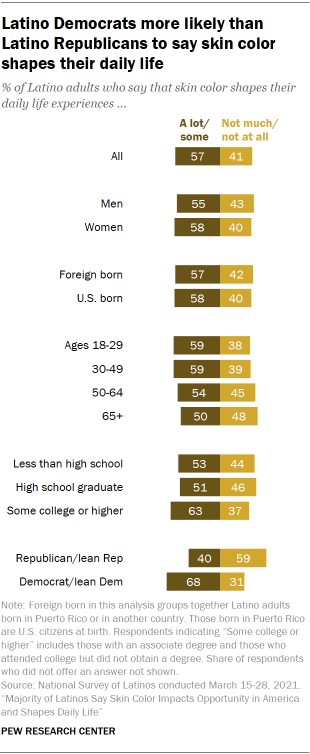
While similar shares of Hispanic adults say skin color affects their daily experiences across many demographic subgroups, there are differences in the shares who say this by education and political party affiliation.

About six-in-ten Hispanics with at least some college experience (63%) say that skin color shapes their daily experience, a higher share than among those who are high school graduates (51%) or do not have a high school diploma (53%).

When it comes to party affiliation, roughly seven-in-ten Latinos (68%) who identify as Democrats or lean toward the Democratic Party say skin color affects their daily experiences, compared with four-in-ten (40%) who identify as or lean Republican, the largest difference among the main subgroups of the Latino population. Only among Latino Republicans do a majority (59%) say skin color shapes their daily life experiences not much or not at all.

When growing up, Hispanics with darker skin talked with family about likely challenges due to race or ethnicity more than those with lighter skin

Latinos with darker skin more likely than Latinos with lighter skin to talk with family about challenges due to race or ethnicity

When asked about conversations with family during their upbringing, about one-in-four Latinos (27%) say their family talked to them often (8%) or sometimes (19%) about the potential challenges they might face due to their race or ethnicity. Meanwhile, 25% say they rarely had these conversations when growing up and 48% say they never did. Still, there are differences by skin color in how often Latinos say they had these conversations when growing up.

About four-in-ten Hispanics with darker skin (41%) say that when growing up their family talked to them often (11%) or sometimes (30%) about potential challenges because of their race or ethnicity. By contrast, one-in-four Hispanics with lighter skin color (25%) say they had these conversations often (8%) or sometimes (17%) when growing up.

The survey also finds Latinos who have experienced discrimination in the year prior to the survey were more likely than those who had no discrimination experiences to say that during their upbringing, their family talked to them at least sometimes about potential challenges due to their race or skin color (37% vs. 14%).

One-in-four Latinos say while growing up, family talked to them about challenges related to race or ethnicity

The share of Latinos who say they had these conversations when growing up varies among some demographic subgroups.

Latinos born in the U.S. are more likely to say they had these conversations when they were growing up than those born in another country (34% compared with 20%).

Hispanics with at least some college experience (31%) were more likely than high school graduates (24%) or those who have not completed high school (23%) to say their families talked to them often or sometimes about potential challenges related to race or ethnicity. Meanwhile, Hispanics who identify as Democrats (31%) were more likely than Hispanic Republicans (22%) to say they had these conversations often or sometimes during their upbringing.

When it comes to racial identity, Latinos who say their race is White, whether self-described or not, are less likely to say that when growing up their family talked to them about challenges they would face because of their race or ethnicity. For example, Latinos who say they would be described as White by most people who walked by them on the street were less likely (18%) than those who think they would be described as Hispanic or Latino (28%), or mixed race or another race (37%), to say their family talked to them about potential challenges due to their race or ethnicity. Similarly, in an open-end question that asked about race or origin, those who identified as White (15%) were less likely than those who identified as Hispanic or Latino (23%) or with another race (27%) to say they had conversations with family about potential challenges due to their race or ethnicity in the future.

Half of Latinos today talk about discrimination based on race or skin color with their family and friends

Discrimination based on race or skin color are topics of conversations with family and friends for half of Hispanics

About half of Hispanics (48%) say that in current conversations with family and friends, discrimination based on race or skin color comes up often (11%) or sometimes (38%). Meanwhile, 30% say it rarely comes up and 21% say it never does.

Similar shares say race and race relations are topics of conversation. Some 44% of Latinos say it comes up often (12%) or sometimes (32%) in their conversations with friends and family.

Roughly half of Latinos report hearing racially insensitive comments or jokes from Latino family and friends

Half of Hispanics say Hispanic family and friends make what might be considered racist or racially insensitive comments or jokes

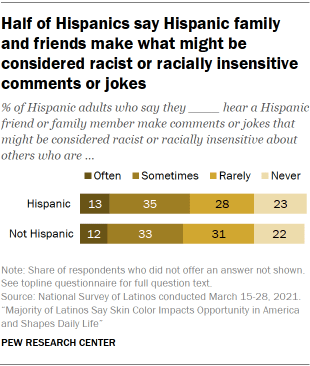
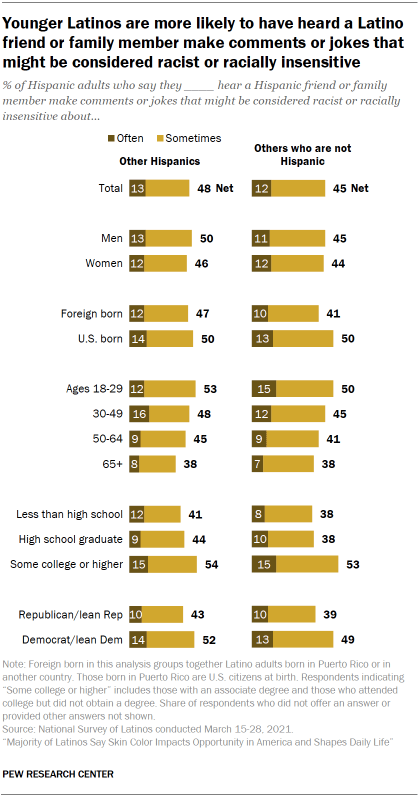
About half of Hispanics say they at least sometimes hear a Hispanic friend or family member make comments or jokes that might be considered racist or racially insensitive. Sometimes these comments or jokes are about other Hispanics: Roughly half (48%) say they have heard racist or racially insensitive comments or jokes often (13%) or sometimes (35%) from Hispanic friends and family when talking about other Hispanics. Sometimes these comments or jokes are about others who are not Hispanic: 45% of Hispanic adults say they often (12%) or sometimes (33%) hear these comments or jokes from Hispanic friends and family in reference to people who are not Hispanic.

Younger Hispanics are more likely to have heard a Hispanic friend or family member make comments or jokes that might be considered racist or racially insensitive

Regardless of whether jokes or comments reference Hispanics or non-Hispanics, younger adults are more likely than those who are older to say they often or sometimes hear Hispanic friends or family members make comments or jokes that might be considered racist or racially insensitive. About half of Hispanics ages 18 to 29 say they hear racist or racially insensitive comments or jokes about other Hispanics (53%) or others who are not Hispanic (50%) from their Hispanic friends and family. By contrast, 38% of Hispanics ages 65 and older say they hear the same type of comments or jokes from Hispanic friends or family in reference to other Hispanics or people who are not Hispanic. Hispanics with at least some college experience are more likely than those with no college experience to say they hear racist or racially insensitive comments from Hispanic friends or family, and those who identify as Democrats are more likely than Republicans to say the same.

Having a lighter skin color seen as an advantage for getting ahead

Hispanics view skin color as a driver of advantage when it comes to getting ahead in the U.S.

A majority of Hispanics say having lighter skin color is an advantage in the country

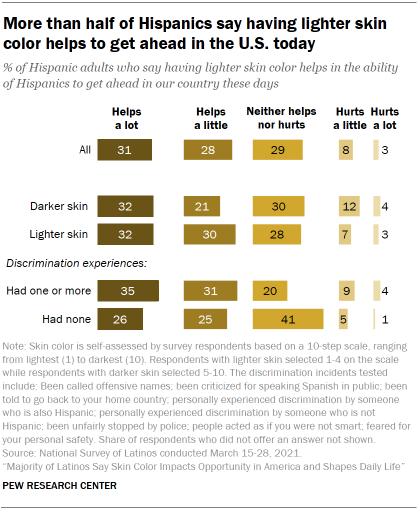
About six-in-ten Latinos (59%) say that having a lighter skin color helps at least a little in the ability of Latinos to get ahead in the country these days, while 29% say it neither helps nor hurts and 10% say it hurts. By contrast, roughly six-in-ten Latinos (62%) say having a darker skin color hurts the ability to get ahead, more than the 30% who say it neither helps nor hurts or the 6% who say it helps.

In a related 2019 survey, 61% of Latinos said that being White helps at least a little in a person’s ability to get ahead in the country, a similar share to the 59% of the U.S. general population who said the same.

Even so, while many Latinos say skin color can help or hurt one’s chances of getting ahead in the country today, other factors such as education and legal status are seen as bigger factors for success. For example, 82% of Latino adults say having a college degree helps when it comes to Latinos getting ahead in the U.S. today. And 88% say living in the U.S. without documentation hurts Latinos’ chances of getting ahead.  

More than half of Hispanics say having lighter skin color helps to get ahead in the U.S. today

About six-in-ten Latinos who self-identified as having lighter skin color (62%) also say that having lighter skin color helps at least a little in their ability to get ahead in the country, while a lower share (53%) of Latinos who say they have darker skin color say the same. And two-thirds (66%) of those who reported at least one discrimination experience say having lighter skin helps to get ahead, compared with 51% among those who reported none.

Hispanic Democrats, more than Republicans, say lighter skin color  is an advantage for getting ahead

Across many major demographic groups, half or more say that having a lighter skin color helps in their ability to get ahead – with the exception of Republicans.

Latino Democrats (70%) are considerably more likely than Republicans (43%) to say having lighter skin color is an advantage.

Meanwhile, Hispanics with at least some college experience (69%) are more likely than those with no college experience to say that lighter skin color helps at least a little in the ability to get ahead in the country (51% among high school graduates and 50% among those who have not graduated high school). 

Other measures of racial identity show a connection to views about skin color and advancement in the U.S. For example, about seven-in-ten Latinos who say they would be described as White (68%) by most people who walked by them on the street say that having a lighter skin color helps in the ability to get ahead, a higher share than among those who think they would be described as Hispanic or Latino by a passerby (58%).

In addition, a slightly higher share of U.S.-born Latinos (64%) than those who are foreign born (56%) say having a lighter skin color is an advantage for Latinos when it comes to getting ahead in the U.S. today.

3. Latinos divided on whether race gets too much or too little attention in the U.S. today

Over the last decade, the United States has been deeply engaged in a national conversation surrounding race and racial discrimination, from the Black Lives Matter movement to growing attention about racial inequality and structural racism in America to concern about the rise in violence against Asian Americans. For U.S. Latinos, the survey finds divided views on how much attention is paid to race and racial issues in the country today.

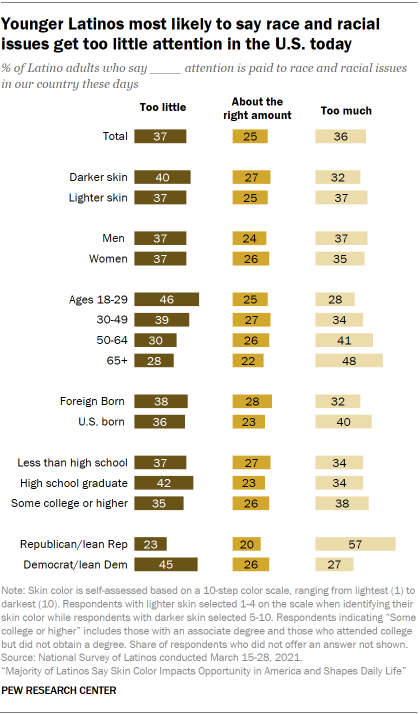
Younger Latinos most likely to say race and racial issues get too little attention in the U.S. today

A little over a third (37%) of Latino adults say there’s not enough attention paid to race and racial issues in our country these days; roughly the same share (36%) say there’s too much attention, and a quarter say the level of attention is about right.

Views are similarly split across Latinos with darker skin and Latinos with lighter skin. Among Latinos with darker skin, 32% say there is too much attention paid to race and racial issues in the country today, while 40% say there is too little attention paid and 27% say the amount of attention is about right. Latinos with lighter skin color are similarly split.

While almost equal shares across all Hispanic subgroups say the amount of attention paid to race and racial issues in the country today is right, there are differences in views of whether too much or too little attention is paid to race and race relations.

Opinions vary sharply across party lines: Over half (57%) of Republican and Republican-leaning Latinos think there’s too much attention paid to race and racial issues, compared with a little over a quarter (27%) of Democrats and Democratic leaners. By comparison, twice as many Democrats (45%) as Republicans (23%) say there’s too little attention to these issues in the country today.

The view that there is too much focus on race and racial issues in the country today is also more common among Latinos ages 65 and older (48%). By contrast, 28% of young adults, ages 18 to 29, say the same. The sentiment that there is not enough attention on racial issues is more commonly held by young adults (46%) than it is by those 65 and older (28%).

Similarly, Latinos born in the United States are more likely than those born in Puerto Rico or another country to say there is too much attention paid to race and racial issues today (40% vs. 32%).

Views about how much attention is paid to race and racial issues in the nation today are correlated with how Latinos describe their racial identity. Latinos who say most people would describe them as Hispanic or Latino on the street are more likely than those who say they would be described as White to say too little attention is paid to race and racial issues these days, 40% and 30% respectively.

Similarly, attitudes about how much attention is paid to race in the country vary by how Hispanics describe their racial and ethnic identity in an open-ended question. About half (51%) who described their racial-ethnic origin as American say there’s too much attention paid to race and racial issues in the country today, while 37% of those who described themselves as Latino or Hispanic or as having an origin in a Spanish-speaking country say the same.

Half of Hispanics say racial issues concerning Hispanics in the U.S get too little attention

While Hispanics are generally split on how much attention is paid to race and racial issues generally in the country today, when it comes to race and racial issues concerning Hispanic people, about half (51%) say too little attention is paid to them today. Meanwhile, 29% say the right amount of attention is paid to race and racial issues concerning Hispanic people and 19% say too much attention is paid to them.

Notably, the largest differences in views are along political party lines. Hispanic Democrats are more likely, at 59%, to say that race and racial issues concerning Hispanics get too little attention in the country today, while 38% of Hispanic Republicans say the same.

At the same time, Hispanics under the age of 50 are more likely than those 50 and older to say there is too little attention paid to race and racial issues concerning Hispanics in the country today. Some 57% of Hispanics ages 18 to 29 and 54% of those ages 30 to 49 say this, both higher shares than those ages 50 to 64 and 65 and older (41% and 47% respectively).

Similarly, those with at least some college experience are more likely than other Hispanics to say there is too little attention given to race and racial issues concerning Hispanic people nationally. More than half (56%) of Hispanics with some college experience say this, compared with 49% of high school graduates and 44% of those with less than a high school diploma. Still, significant shares of all three groups say too little attention is paid to race and racial issues among Hispanics in the country today.

There are also differences among Hispanics depending on their self-reported skin tone and their racial and ethnic identity. Half of Hispanics with lighter skin (50%) say race and racial issues concerning Hispanics get too little attention in the country today, while 57% of Hispanics with darker skin share this sentiment. About one-in-six Hispanics (59%) who described their origin, in an open-ended question, as being from a Hispanic country or region also say this. This is significantly higher than among Hispanics who identified their origin as American or White (47% and 46% respectively), though large shares of all groups agree that too little national attention is paid to race and racial issues concerning Hispanic people.

More than half of Hispanics say too little attention nationally is paid to racial issues concerning Asian people

While about half (51%) of Latino adults say race and racial issues related to Latino people get too little attention in the country today, views about the attention paid to racial and race issues concerning Asian people and Black people differ.

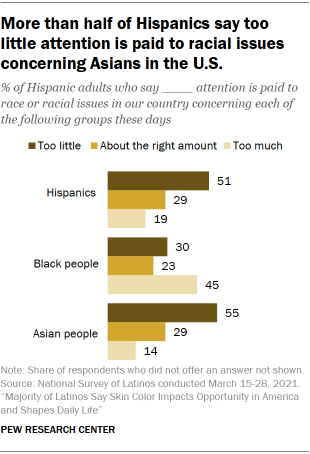
More than half of Hispanics say too  little attention is paid to racial issues concerning Asians in the U.S.

According to the survey, 55% of Latino adults say too little attention is paid to race issues concerning Asian people in the country today, 29% say about the right amount of attention is paid, and 14% say too much attention is paid to these issues. (The survey was fielded around the time that several hate crimes and violent incidents aimed at Asian Americans received broad coverage in the news.)

By contrast, a lower share of Latinos (30%) say too little attention nationally is paid to race and racial issues concerning Black people today, while 23% say the amount of attention paid is about right and 45% say too much attention is paid to these issues.

Among Latinos, roughly six-in-ten adults ages 18 to 29 (62%), individuals with some college experience or higher (60%) and U.S.-born Hispanics (58%) say too little attention is paid to race or racial issues concerning Asian people. Hispanics who described their racial origins as White in an open-ended question were the least likely to say Asian racial issues get too little attention, though 50% still agreed.

This story is different when it comes to national attention paid to racial issues concerning Black people today. Hispanic Republicans by far have the highest share among Hispanics who say these issues get too much attention today – roughly two-thirds (68%) of Hispanic Republicans say this. By contrast, Hispanic Democrats are most likely to say racial issues concerning Black people get too little attention (39%). Men and those 65 and older are among the demographic groups with the highest share who say that too much attention is paid to race and racial issues concerning Black people nationally (48% and 49% respectively).

About a half of Latinos say discrimination based on race or skin color is a big problem in our country today

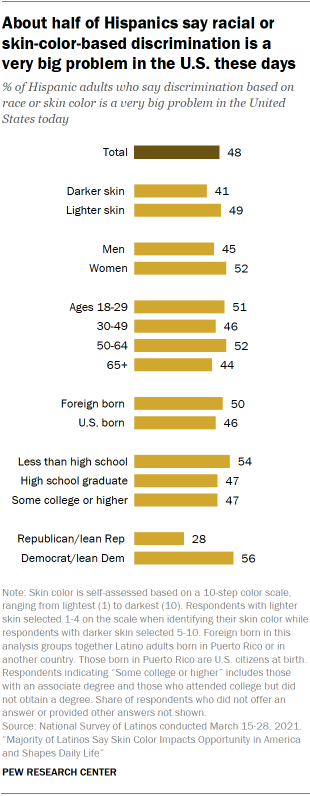
About half of Hispanics say racial or skin-color-based discrimination is a  very big problem in the U.S. these days

Discrimination based on race or skin color is seen as a very big problem in the U.S. today by 48% of Latino adults. An additional 32% say it is a moderately big problem.

Views of racial and skin color discrimination do not vary much across many demographic subgroups, except when comparing across party affiliation and gender. Republican and Republican-leaning Hispanics are among the least likely to agree that racial discrimination is a very big problem these days (28%); by comparison, a majority (56%) of Democrats and Democratic leaners say this. Additionally, a larger share of women than men say racial discrimination is a very big problem (52% vs. 45%).

Latinos with lighter skin are more likely than Latinos with darker skin to say discrimination based on race or skin color in the U.S. is a very big problem (49% vs. 41%).

Views of racial discrimination outside the 50 U.S. states and D.C.

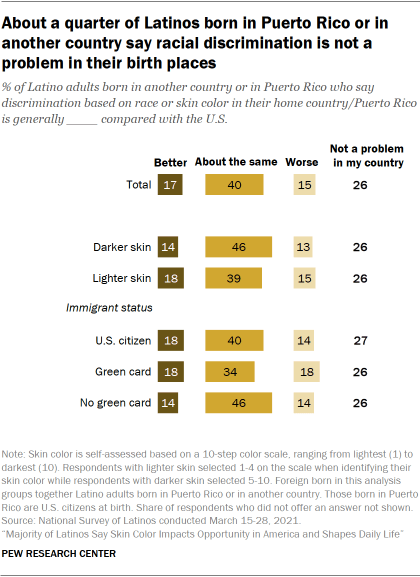
About a quarter of Latinos born in Puerto Rico or in another country say racial discrimination is not a problem in their birth places

Latinos born in another country and those born in Puerto Rico were asked how discrimination based on race or skin color in their home country or Puerto Rico compares with that in the United States.4

Among Latinos born in another country or Puerto Rico, four-in-ten (40%) say discrimination based on race or skin color is about the same in both the place of their birth and in the U.S., while 17% say things are better in the place of their birth than in the U.S. and 15% say things are worse in the place of their birth than in the U.S. About a quarter (26%), though, say discrimination based on race or skin color is not a problem in the place of their birth.

Among those born in Puerto Rico or in another country, similar shares of Latinos with darker skin color and lighter skin say discrimination based on race or skin color is about the same in both the places of their birth and in the U.S. – 46% and 39% respectively. But otherwise, views about racial discrimination in both places is about the same. For example, 26% of both Latinos with darker skin and those with lighter skin say discrimination based on race or skin color is not an issue in the places of their birth (Puerto Rico or another country).

4. Measuring the racial identity of Latinos

How we measured racial identity among Hispanics

The survey used the following four questions to assess the racial identity of Latinos:

What is your race or origin?

  • White
  • Black or African American
  • Asian or Asian American
  • Two or more races
  • Some other race or origin

How would most people describe you, if, for example, they walked past you on the street? Would they say you are …

  • White
  • Hispanic or Latino
  • Black or African American
  • Asian or Asian American
  • Native American or Indigenous (the native peoples of the Americas such as Mayan, Quechua or Taino)
  • Native Hawaiian or other Pacific Islander
  • Mixed race or multiracial
  • Other ____

In your own words, if you could describe your race or origin in any way you wanted, how would you describe yourself?

Which of these most closely matches your own skin color, even if none of them is exactly right? (If this question makes you uncomfortable, you may skip it.)

The most widely employed method to measure racial and ethnic identity is from the U.S. Census Bureau. It is a two-part question, first asking about Hispanic identity and then asking about racial identity and is the standard method used to measure racial and ethnic identity in decennial censuses and in surveys conducted by the bureau. It is also the standard often used by polling organizations, marketers, local governments and many others.

Alternative measures can capture other dimensions of racial and ethnic identity not necessarily captured by the Census Bureau’s format. For example, one’s skin color can shape opportunities and can be at the heart of discrimination experiences no matter what race one identifies with. In addition, how others see you, such as when passing each other on the street, can shape one’s life experiences. And sometimes directly asking one to describe their racial identity can reveal a personal view of identity unencumbered by the framing of survey questions.

Pew Research Center’s 2021 National Survey of Latinos explored four approaches to measuring racial identity – the Census Bureau’s two-question method; an assessment of how respondents believe others see them when passing them on the street (street race); an open-ended question asking respondents to describe their race and origin in their own words; and self-assessed skin color. Responses across all these measures do not necessarily align – a respondent may indicate their race is White in the Census Bureau’s method but also indicate their street race is Latino (and not White). These differences in responses reflect the nuances of racial identity, contextual factors and the experiences associated with them. This chapter explores these four alternative measures and the responses of Latino adults.

The Census Bureau’s standard method for measuring race and ethnicity

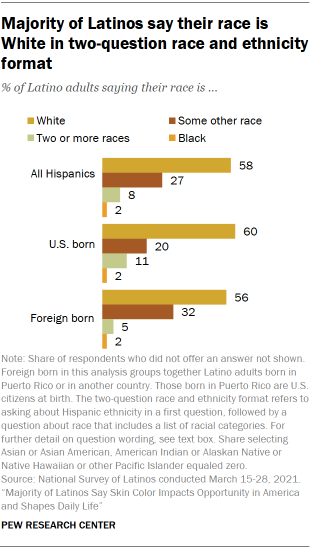
Majority of Latinos say their race is White in two-question race and ethnicity format

In current Census Bureau data collections like the 2020 decennial census and surveys like the American Community Survey, racial and ethnic identity is asked about in a two-part question. First, respondents are asked if they are Hispanic or Latino and then in a second question are asked their race. Currently, the Hispanic category is described in census forms and surveys as an ethnic origin and not a race with respondents given explicit instructions indicating so.

The Pew Research Center survey replicated the Census Bureau’s format, asking about race separately from Hispanic ethnicity. Asked about their race in this way, more than half of Hispanics in the survey identified their race as White (58%), with the next largest share selecting the “some other race” category (27%), 8% selecting two or more races, and 2% selecting Black or African American. Foreign-born Hispanics were more likely than their U.S.-born counterparts to select the “some other race” category, while U.S.-born Hispanics were more likely than foreign-born Hispanics to select multiple races. For both groups, though, more than half say their race is White.

These findings echo those of earlier Pew Research Center surveys of Hispanic adults, as well as Census Bureau findings from the 2010 decennial census and other surveys. Yet, the findings from this survey by the Center, conducted in March 2021, differ from those revealed by the Census Bureau from the 2020 decennial census. The wording of the 2020 Census race question differed markedly from the Center’s question and from previous decennial censuses surveys, which could account for why results varied greatly. In the 2020 census, for the first time respondents were prompted to write in origins or ethnicities for all racial groups; this was not offered to the Center’s survey respondents. According to the bureau, about four-in-ten Hispanics (42%) marked their race as “some other race” in the 2020 census without marking any other response, the single largest set of responses among the nation’s 62.1 million Hispanics—an analysis of the 2010 decennial census results showed that most responses coded as “some other race” were write-ins of Hispanic ancestries or ethnicities. This was followed by one-third (33%) who selected two or more racial groups, and 20% that selected White as their race. A separate Pew Research Center  survey from 2020 found Hispanic adults were more likely than White or Black adults to say the 2020 decennial census two-part race and ethnicity questions do not reflect their identity well: 23% of Hispanic adults say census race and ethnicity questions reflect how they see their race and origin either “not too well” (17%) or “not at all well” (5%). This compares with 15% of White adults and 16% of Black adults who said the same.
Latinos’ skin color reflects the diversity within the group

For Latinos and non-Latinos alike, skin color is an important dimension of identity that can affect their daily lives. To measure this dimension of race, the survey asked Latino respondents to identify the skin color that best resembled their own using a version of the Yadon-Ostfeld scale. Respondents were shown 10 skin colors that ranged from fair to dark (see graphic below for images used). Eight-in-ten Latinos selected one of the four lightest skin colors, with the second-lightest ranking most common (28%), followed by the third (21%) and fourth lightest colors (17%). By contrast, only 3% of Latino respondents in total selected one of the four darkest skin colors.

For purposes of the analysis in this report, Hispanics are grouped into two categories. The “lighter skin” color group consisted of those who chose the four lightest skin colors (80%), while the “darker skin” color group included those who chose the six darker skin colors (15%). (Another 5% of respondents did not indicate their skin color.) While there were enough Hispanics who chose each of the lightest four skin colors to analyze separately, there were no significant differences in the opinions or experiences of discrimination among them due to their skin color. (The number of Hispanics who chose the five darkest skin tones was too small to analyze each separately.)

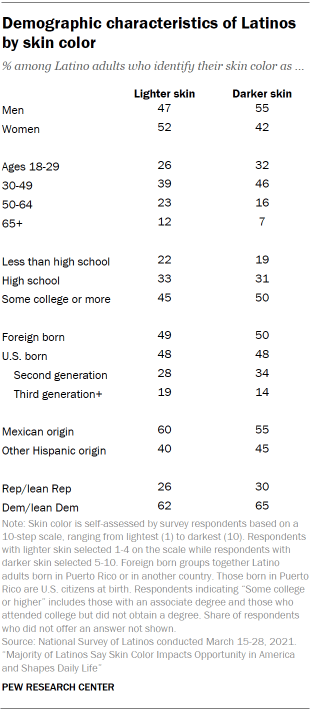
Among Latinos, those who rated their skin as lighter were more likely to be older than 50 (35%) than those who rated their skin as darker (23%). Latinos with lighter skin were also more likely to be women (52%) than Latinos with darker skin (42%).

The distribution of skin color among U.S. Hispanics

Most Latinos say others would describe them as Latino when walking past them on the street

How others would describe Latinos when walking down the street

Similar to skin color, the way others perceive Latinos when interacting with them is another manner in how racial identity can be shaped. In the survey, respondents were asked how most people would describe them if they walked past them on the street.

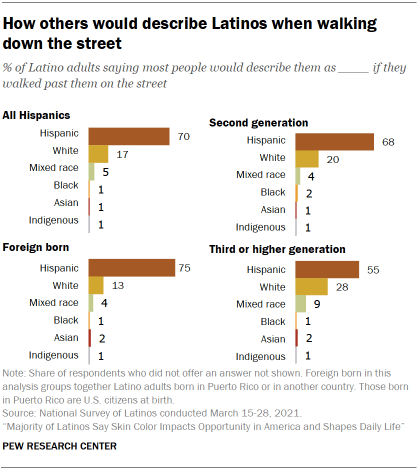
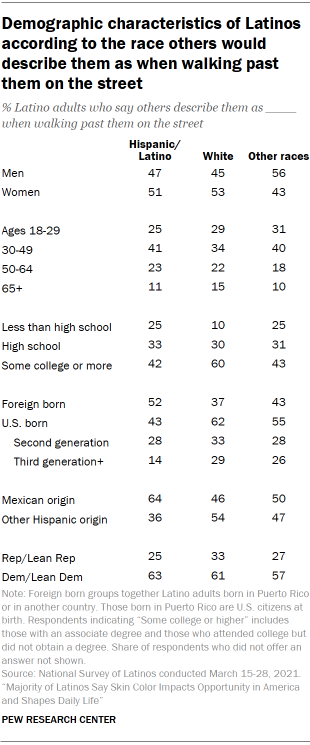
Seven-in-ten Hispanic adults said that most people would describe them as Hispanic when walking past them on the street, with the foreign born the most likely to say this (75%) compared with those of the second generation (68%) or third or higher generation (55%).

Fewer than two-in-ten Latinos (17%) say others would view them as White when walking past them, with those born in the U.S. being more likely to say this (28% of at least third-generation Latinos and 20% of second-generation Latinos) than Latino immigrants (13%).

A smaller share (12%) say others view them as belonging to another racial group such as Asian, Black or Indigenous.

Asked to describe their race or origin, most Latinos say they are Hispanic or Latino or give their country of origin

In open-ended question, most Hispanics identify their race as Hispanic or link it to their country or region of origin

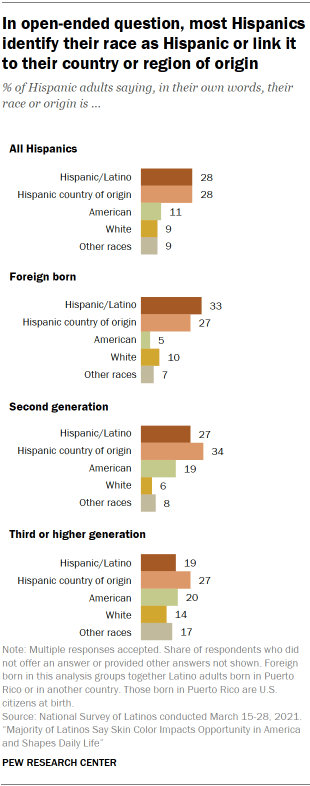
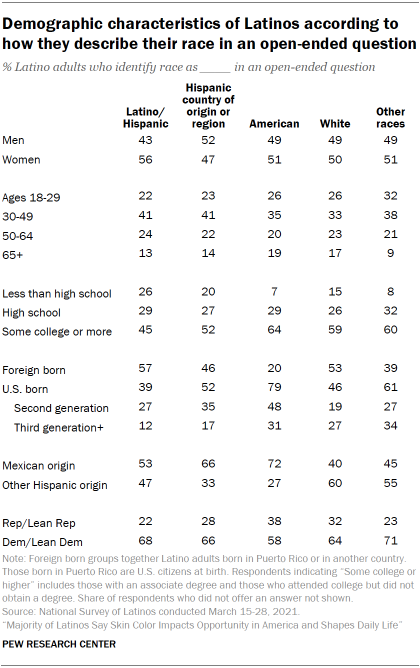
As a fourth measure of racial identity, the survey asked Latinos how they would describe their race or origin in their own words. The most common responses for Latinos regarding their race in this open-end format were the pan-ethnic terms Hispanic, Latino or Latinx (28%) or responses that linked their racial origin to the country or region of their ancestors (28%). A smaller share also chose to identify their race or origin as American, either as a single answer or in combination with another response (11%), 9% identified their race as White, and 9% mentioned another racial group such as Asian, Black or Indigenous.

There were some differences in the way Hispanics identified their race depending on their immigrant roots. Fully one-third of the foreign born (33%) used the pan-ethnic terms Hispanic, Latino or Latinx to identify their race, while 23% of the U.S. born did so. Among the U.S. born, those with at least one immigrant parent – second generation Hispanics – were also more likely than those without any immigrant parents – third or higher generation – to use the pan-ethnic terms to describe their race (27% vs. 19% respectively).

Conversely, those born in the U.S., regardless of the place of birth of their parents, were more likely to describe their race or origin as American or having been born in the U.S. (19% of the U.S. born vs. 5% of the foreign born).

Those in the third or higher generation were more likely than those from the second generation to describe their race as White (14% vs. 6%). In addition, third or higher generation Hispanics were more likely than Hispanic immigrants or those with at least one immigrant parent to mention another racial group such as Black or Asian in their response (17% compared with 7% of foreign born and 8% of second generation).

How the four racial identity measures correlate with each other

There is some overlap in the responses to the four racial identity questions, particularly when looking at just two of the four measures. For example, nearly all respondents who say most people see them as White when passing them on the street (95%) chose one of the four lightest skin colors (1-4). By comparison, 79% of those who say they would be viewed as Latino by passersby selected one of the four lightest skin colors and 69% who say they would be perceived as belonging to another racial group did the same.

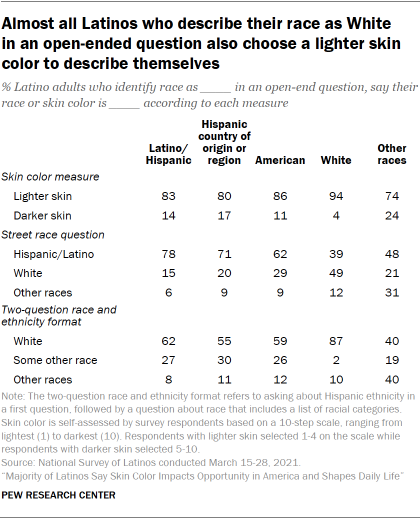
Similarly, 94% of those who said their race was White in the open-ended question chose one of the four lightest skin colors. About eight-in-ten (83%) of those who say they are Hispanic in the open-ended question or included a Hispanic country of origin or region (80%) also chose one of the four lightest skin colors. Meanwhile, 74% Hispanics who mentioned another racial group like Black or Asian selected one of the lighter skin colors.

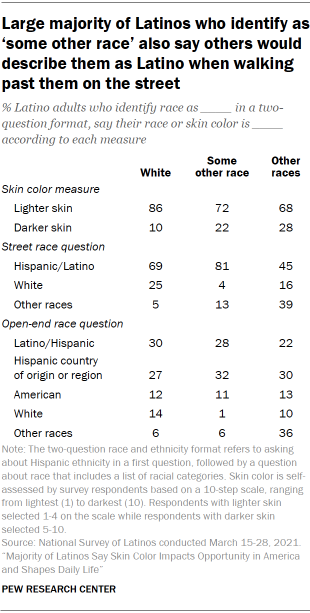
Among Hispanics who characterized their race as White in the Census Bureau’s standard two-part question, 86% selected one of the four lightest skin colors. By comparison, about seven-in-ten of those who identified their race as “some other race” (72%) or chose another race group (68%) selected one of the four lightest skin colors.

There were other similarities across the ways respondents characterized their race across the four different questions included in the survey, but the overlap between similar categories across the four measures was considerably less. For example, among those who mark their race as White in a standard two-part race question, only 25% say others would describe them as such walking down the street, and only 14% describe their race as White in an open-ended question. In both measures, respondents who had selected their race as White in the Census Bureau’s standard two-part question were more likely to select Hispanic as the way others view them (69%) or use a pan-ethnic term (30%) or a country or Hispanic origin as their race (27%) when asked to describe their race in their own words.

Most common combination of answers to the four racial identity measures

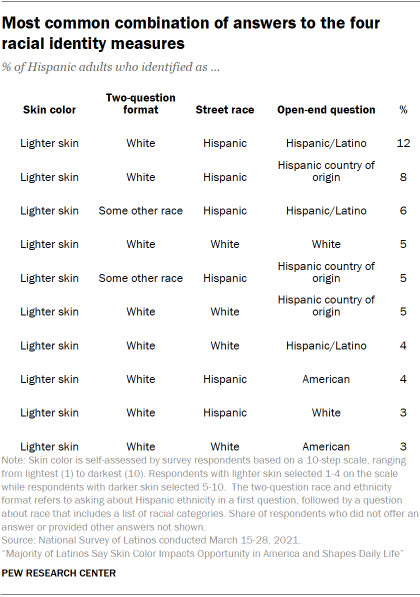
The table shows the degree to which responses to the four different ways we asked about race correlate with each other. As can be seen, there is not much overlap across the four measures in the most common responses for these measures. When looking at the overlap across the four measures, only 5% of Hispanics identified their race as Hispanic or Latino in the open-ended question, said others viewed them as Hispanic when walking past them, selected the “some other race” option in a standard two-way format question and selected one of the four lighter skin colors of the 10 given. Similarly, only 4% of Hispanics described their race as White in an open-ended question, said others viewed them as White when walking past them, selected White in a standard two-way format question and selected one of the four lighter skin colors.

Acknowledgments

This report was written by Luis Noe-Bustamante, Research Analyst; Ana Gonzalez-Barrera, Senior Researcher; Khadijah Edwards, Research Associate; Lauren Mora, Research Assistant; and Mark Hugo Lopez, Director, Race and Ethnicity research.

Editorial guidance was provided by Lopez; Tanya Arditi, Communications Manager; Kiana Cox, Research Associate, Jens Manuel Krogstad, Senior Writer/Editor; and Neil G. Ruiz, Associate Director, Race and Ethnicity research.

The report was number checked by Edwards, Gonzalez-Barrera, Mohamad Moslimani, Research Assistant, Mora, and Noe-Bustamante. Shannon Greenwood, Digital Producer, produced the report. David Kent, Senior Copy Editor, copy edited the report. Charts were designed by Noe-Bustamante, Gonzalez-Barrera, Edwards and Mora.

Find related reports online at pewresearch.org/topic/race-ethnicity.

Methodology

The American Trends Panel survey methodology

Overview

The American Trends Panel (ATP), created by Pew Research Center, is a nationally representative panel of randomly selected U.S. adults. Panelists participate via self-administered web surveys. Panelists who do not have internet access at home are provided with a tablet and wireless internet connection. Interviews are conducted in both English and Spanish. The panel is being managed by Ipsos.

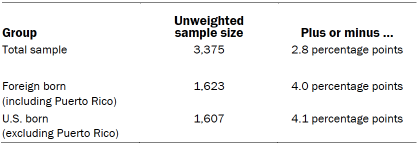
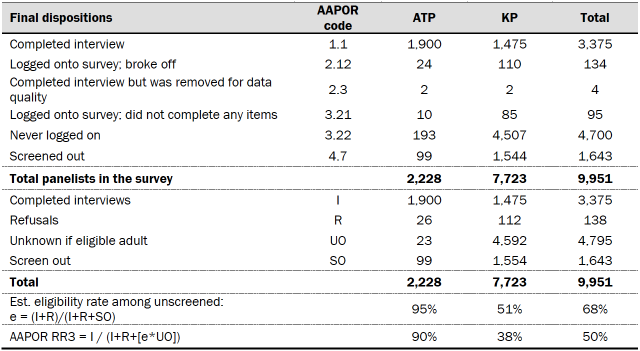
Data in this report is drawn from the panel wave conducted March 15 to March 28, 2021, among self-identified Hispanics from the ATP and Ipsos’ KnowledgePanel. A total of 3,375 panelists responded out of 9,951 who were sampled, for a response rate of 50% (AAPOR RR3). This includes 1,900 from the ATP and 1,475 respondents from the KnowledgePanel. This does not include four panelists who were removed from the data due to extremely high rates of refusal or straightlining. The cumulative response rate accounting for nonresponse to the recruitment surveys and attrition is 1%. The break-off rate among panelists who logged on to the survey and completed at least one item is 4%. The margin of sampling error for the full sample of 3,375 respondents is plus or minus 2.8 percentage points.

Panel recruitment

American Trends Panel recruitment surveys

The ATP was created in 2014, with the first cohort of panelists invited to join the panel at the end of a large, national, landline and cellphone random-digit-dial survey that was conducted in both English and Spanish. Two additional recruitments were conducted using the same method in 2015 and 2017, respectively. Across these three surveys, a total of 19,718 adults were invited to join the ATP, of whom 9,942 (50%) agreed to participate.

In August 2018, the ATP switched from telephone to address-based recruitment. Invitations were sent to a random, address-based sample of households selected from the U.S. Postal Service’s Delivery Sequence File. Two additional recruitments were conducted using the same method in 2019 and 2020, respectively. Across these three address-based recruitments, a total of 17,161 adults were invited to join the ATP, of whom 15,134 (88%) agreed to join the panel and completed an initial profile survey. In each household, the adult with the next birthday was asked to go online to complete a survey, at the end of which they were invited to join the panel. Of the 25,076 individuals who have ever joined the ATP, 13,538 remained active panelists and continued to receive survey invitations at the time this survey was conducted.

The U.S. Postal Service’s Delivery Sequence File has been estimated to cover as much as 98% of the population, although some studies suggest that the coverage could be in the low 90% range.5 The American Trends Panel never uses breakout routers or chains that direct respondents to additional surveys.

About the Ipsos KnowledgePanel

The Ipsos KnowledgePanel is an online probability-based panel representative of the U.S. adult population. Households without internet connection are provided with a web-enabled device and free internet service. KnowledgePanel’s recruitment process was originally based on a national RDD sampling methodology. In 2009, the panel switched to using an ABS methodology. Additional information about the recruitment, sampling and weighting procedures for the Ipsos KnowledgePanel are available here.

Sample design

The overall target population for this survey was non-institutionalized self-identifying people of Hispanic origin ages 18 and older, living in the U.S., including Alaska and Hawaii. The ATP sample consisted of all current panel members that previously identified as being Hispanic. The KnowledgePanel sample included oversamples of Hispanics who were of Mexican or Central American ancestry or had no more than a high school education.

Questionnaire development and testing

The questionnaire was developed by Pew Research Center in consultation with Ipsos. The web program was rigorously tested on both PC and mobile devices by the Ipsos project management team and Pew Research Center researchers. The Ipsos project management team also populated test data which was analyzed in SPSS to ensure the logic and randomizations were working as intended before launching the survey.

Incentives

All respondents were offered a post-paid incentive for their participation. ATP respondents could choose to receive the post-paid incentive in the form of a check or a gift code to Amazon.com or could choose to decline the incentive. Incentive amounts ranged from $10 to $20 depending on whether the respondent belongs to a part of the population that is harder or easier to reach. Differential incentive amounts were designed to increase panel survey participation among groups that traditionally have low survey response propensities.

Ipsos operates an ongoing modest incentive program for KnowledgePanel to encourage participation and create member loyalty. The incentive program includes special raffles and sweepstakes with both cash rewards and other prizes to be won. Typically, panel members are assigned no more than one survey per week. On average, panel members complete two to three surveys per month with durations of 10 to 15 minutes per survey. An additional incentive is usually provided for longer surveys. For this survey, KnowledgePanel members were offered 10,000 points (equivalent to $10) in addition to the regular incentive program during the last few days of data collection to those who hadn’t responded yet in an attempt to boost the number of responses from panel members of Central American ancestry.

Data collection protocol

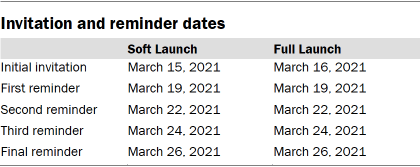
The data collection field period for this survey was March 15 to March 28, 2021. Postcard notifications were mailed to all ATP panelists with a known residential address on March 15, 2021. 

On March 15 and March 16, invitations were sent out in two separate launches: Soft Launch and Full Launch. Sixty ATP panelists and 182 KnowledgePanel panelists were included in the soft launch, which began with an initial invitation sent on March 15, 2021. The ATP panelists chosen for the initial soft launch were known responders who had completed previous ATP surveys within one day of receiving their invitation. All remaining English- and Spanish-speaking panelists were included in the full launch and were sent an invitation on March 16, 2021.

All panelists with an email address received an email invitation and up to four email reminders if they did not respond to the survey. All ATP panelists that consented to SMS messages received an SMS invitation and up to four SMS reminders.

Invitation and reminder dates

Data quality checks

To ensure high-quality data, the Center’s researchers performed data quality checks to identify any respondents showing clear patterns of satisficing. This includes checking for very high rates of leaving questions blank, as well as always selecting the first or last answer presented. As a result of this checking, two ATP and two KnowledgePanel respondents were removed from the survey dataset prior to weighting and analysis.

Weighting

The data was weighted in a multistep process that accounts for multiple stages of sampling and nonresponse that occur at different points in the survey process. First, each respondent begins with a base weight that reflects their probability of selection for their initial recruitment survey. For the KnowledgePanel respondents, the base weight also reflects their probability of being selected to participate in this survey. To combine the base weights for the ATP and KnowledgePanel, respondents were grouped into one of six cells depending on whether they had no more than a high school education and whether they were of Mexican, Central American or another Hispanic ancestry. The base weights for ATP and KnowledgePanel respondents were then standardized proportionately to their effective sample size within each cell and combined. This combined base weight was then poststratified so that the combined sample in each cell matched its share of the larger population of Hispanic adults.

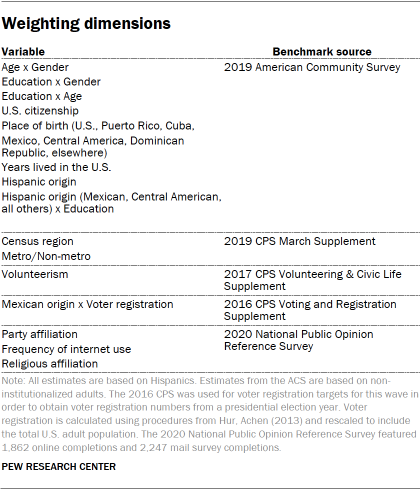
Weighting dimensions

In the final weighting step, the combined weights were calibrated to match the population benchmarks specified in the accompanying table and trimmed at 1st and 99th percentiles to reduce the loss in precision stemming from variance in the weights. Sampling errors and test of statistical significance take into account the effect of weighting.

Unweighted sample sizes and error attributable to sampling

The following table shows the unweighted sample sizes and the error attributable to sampling that would be expected at the 95% level of confidence for different groups in the survey.

Dispositions and response rates

Final dispositions
Cumulative response rate

Appendix: Additional tables

Almost all Latinos who say others would describe them as White choose a lighter skin color to describe themselves
Large majority of Latinos who identify as ‘some other race’ also say others would describe them as Latino when walking past them on the street
Almost all Latinos who describe their race as White  in an open-ended question also choose a lighter skin color to describe themselves
Demographic characteristics of Latinos by skin color
Demographic characteristics of Latinos according to the race others would describe them as when walking past them on the street
Demographic characteristics of  Latinos according to their race in a  two-question format
Demographic characteristics of Latinos according to how they describe their race in an open-ended question