Pew Research Center

FOR RELEASE AUGUST 11, 2020

About One-in-Four U.S. Hispanics Have Heard of Latinx, but Just 3% Use It

Young Hispanic women among the most likely to use the term

BY Luis Noé-Bustamante, Lauren Mora and Mark Hugo Lopez

FOR MEDIA OR OTHER INQUIRIES:

Communications Department
202.419.4372
www.pewresearch.org

RECOMMENDED CITATION

Pew Research Center, August 2020, "About One-in-Four U.S. Hispanics Have Heard of Latinx, but Just 3% Use It"

About Pew Research Center

Pew Research Center is a nonpartisan, nonadvocacy fact tank that informs the public about the issues, attitudes and trends shaping the world. It does not take policy positions. The Center conducts public opinion polling, demographic research, computational social science research and other data-driven research. It studies politics and policy; news habits and media; the internet and technology; religion; race and ethnicity; international affairs; social, demographic and economic trends; science; research methodology and data science; and immigration and migration. Pew Research Center is a subsidiary of The Pew Charitable Trusts, its primary funder.

© Pew Research Center 2026

Table of contents

  • About Pew Research Center
  • About One-in-Four U.S. Hispanics Have Heard of Latinx, but Just 3% Use It
  • 1. How widespread is awareness of Latinx?
  • 2. Who uses Latinx?
  • 3. Views on Latinx as a pan-ethnic term for U.S. Hispanics
  • Acknowledgments
  • Methodology

About One-in-Four U.S. Hispanics Have Heard of Latinx, but Just 3% Use It

Young Hispanic women among the most likely to use the term

Note: For the Center’s 2024 report on Latinx and other pan-ethnic terms, read “Latinx Awareness Has Doubled Among U.S. Hispanics Since 2019, but Only 4% Use It.”  

How we did this

For this analysis we surveyed 3,030 U.S. Hispanic adults in December 2019 as part of the 2019 National Survey of Latinos. We asked survey respondents about their awareness of the term Latinx and their views of the term. The sample includes 2,094 Hispanic adults who were members of Pew Research Center’s American Trends Panel (ATP), an online survey panel that is recruited through national, random sampling of residential addresses. It also includes an oversample of 936 respondents sampled from Ipsos’ KnowledgePanel, another online survey panel also recruited through national, random sampling of residential addresses. For the purposes of this report, references to foreign-born Hispanics include those born in Puerto Rico. Individuals born in Puerto Rico are U.S. citizens by birth. The survey was conducted in both English and Spanish.

See the Methodology section of this report for more details.

Terminology

The terms Hispanic and Latino are used interchangeably in this report.

Latinx is a term used to describe people who are of or relate to Latin American origin or descent. It is a gender-neutral or nonbinary alternative to Latino or Latina.

U.S. born refers to persons born in the United States and those born in other countries to parents at least one of whom was a U.S. citizen.

Foreign born refers to persons born outside of the United States to parents neither of whom was a U.S. citizen. The terms foreign born and immigrant are used interchangeably in this report. For the purposes of this report, foreign born also includes those born in Puerto Rico. Although individuals born in Puerto Rico are U.S. citizens by birth, they are included among the foreign born for this report because they are born into a Spanish-dominant culture and because on many points their attitudes, views and beliefs are much closer to Hispanics born abroad than to Hispanics born in the 50 states or the District of Columbia, even those who identify themselves as being of Puerto Rican origin.

Second generation refers to people born in the 50 states or the District of Columbia with at least one first-generation, or immigrant, parent.

Third and higher generation refers to people born in the 50 states or the District of Columbia with both parents born in the 50 states or the District of Columbia.

Language dominance is a composite measure based on self-described assessments of speaking and reading abilities. Spanish-dominant people are more proficient in Spanish than in English (i.e., they speak and read Spanish “very well” or “pretty well” but rate their English-speaking and reading ability lower). Bilingual refers to people who are proficient in both English and Spanish. English-dominant people are more proficient in English than in Spanish.

Pan-ethnic labels describing the U.S. population of people tracing their roots to Latin America and Spain have been introduced over the decades, rising and falling in popularity. Today, the two dominant labels in use are Hispanic and Latino, with origins in the 1970s and 1990s respectively.

A chart showing most Latino adults have not heard of the term Latinx; few use it

More recently, a new, gender-neutral, pan-ethnic label, Latinx, has emerged as an alternative that is used by some news and entertainment outlets, corporations, local governments and universities to describe the nation’s Hispanic population.

However, for the population it is meant to describe, only 23% of U.S. adults who self-identify as Hispanic or Latino have heard of the term Latinx, and just 3% say they use it to describe themselves, according to a nationally representative, bilingual survey of U.S. Hispanic adults conducted in December 2019 by Pew Research Center.

The emergence of Latinx coincides with a global movement to introduce gender-neutral nouns and pronouns into many languages whose grammar has traditionally used male or female constructions. In the United States, the first uses of Latinx appeared more than a decade ago. It was added to a widely used English dictionary in 2018, reflecting its greater use.

Yet the use of Latinx is not common practice, and the term’s emergence has generated debate about its appropriateness in a gendered language like Spanish. Some critics point to its origins among U.S. English speakers, saying it ignores the Spanish language and its gendered form.1 Still, there are examples of the term’s use in Spanish in the U.S. and abroad.2 Meanwhile, others see Latinx as a gender- and LGBTQ-inclusive term, reflecting a broader movement within the U.S. around gender identity.
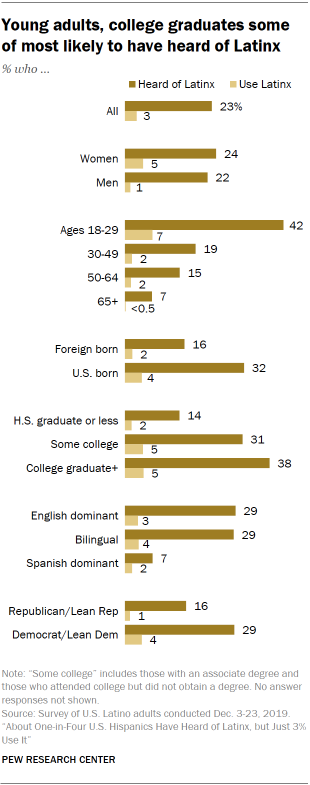
Young adults, college graduates some of most likely to have heard of Latinx

While only about a quarter of U.S. Hispanics say they have heard the term Latinx, awareness and use vary across different subgroups. Young Hispanics, ages 18 to 29, are among the most likely to have heard of the term – 42% say they have heard of it, compared with 7% of those ages 65 or older. Hispanics with college experience are more likely to be aware of Latinx than those without college experience; about four-in-ten Hispanic college graduates (38%) say they have heard of Latinx, as do 31% of those with some college experience. By comparison, just 14% of those with a high school diploma or less are aware of the term.

In addition, the U.S. born are more likely than the foreign born to have heard the term (32% vs. 16%), and Hispanics who are predominantly English speakers or bilingual are more likely than those who mainly speak Spanish to say the same (29% for both vs. 7%).

Hispanics who identify with or lean toward the Democratic Party are more likely to have heard of Latinx than those who identify with or lean toward the Republican Party (29% vs. 16%).

Awareness of the term Latinx does not necessarily translate into use. Across many demographic subgroups, the share of Hispanics who say they use Latinx to describe their own identity is significantly lower than the share who say they have heard it. Use is among the highest for Hispanic women ages 18 to 29 – 14% say they use it, a considerably higher share than the 1% of Hispanic men in the same age group who say they use it.

The emergence of Hispanic, Latino and Latinx

Throughout the last half-century in the U.S., different pan-ethnic terms have arisen to describe Americans who trace their roots to Latin America and Spain.

The term Hispanic was first used by the U.S. government in the 1970s after Mexican American and other Hispanic organizations lobbied the federal government to collect data on the population. Subsequently, the U.S Congress passed Public Law 94-311 in 1976, mandating the collection of information about U.S. residents of Mexican, Puerto Rican, Cuban, Central American, South American and other Spanish-speaking country origins. The law called for the U.S. Census Bureau to create a broader category that encompassed all people who identified having roots from these countries. The term Hispanic was first used in a full census in 1980.

The 1990s brought resistance to the term Hispanic, as it embraced a strong connection with Spain, and an alternative term emerged: Latino. By 1997, the U.S. Office of Management and Budget issued a directive adding the term Latino to government publications. The two terms are used interchangeably, with Latino first appearing on the U.S. census in 2000, alongside Hispanic.

More recently, Latinx has emerged as an alternative to Hispanic and Latino. Online searches for the term among the general U.S. population appeared online in the early 2000s. But the first substantial rise in searches (relative to all online searches) appeared in June 2016 following a shooting at Pulse nightclub, an LGBTQ dance club in Orlando, Florida, that was hosting its Latin Night on the date of the attack. In subsequent years, the term’s use on social media by celebrities, politicians and grassroots organizations has grown. In addition, some academic centers at community colleges, public universities and Ivy League universities are replacing Latino program names that were established in previous decades with new Latinx-focused names.

In more than 15 years of polling by Pew Research Center, half of Americans who trace their roots to Spanish-speaking Latin America and Spain have consistently said they have no preference for either Hispanic or Latino as a term to describe the group. And when one term is chosen over another, the term Hispanic has been preferred to Latino. Importantly, the same surveys show, country of origin labels (such as Mexican or Cuban or Ecuadorian) are preferred to these pan-ethnic terms among the population they are meant to describe.

Google searches for Latinx rising in U.S., but trail far behind Latina, Latino and Hispanic

The relative popularity of Latinx in online searches in the U.S. has increased since 2016, according to a Pew Research Center analysis of Google Trends data.3 While its earliest Google searches extend back to the early 2000s, the highest monthly relative number of searches for Latinx occurred in June 2020, surpassing a previous peak in October 2019.4
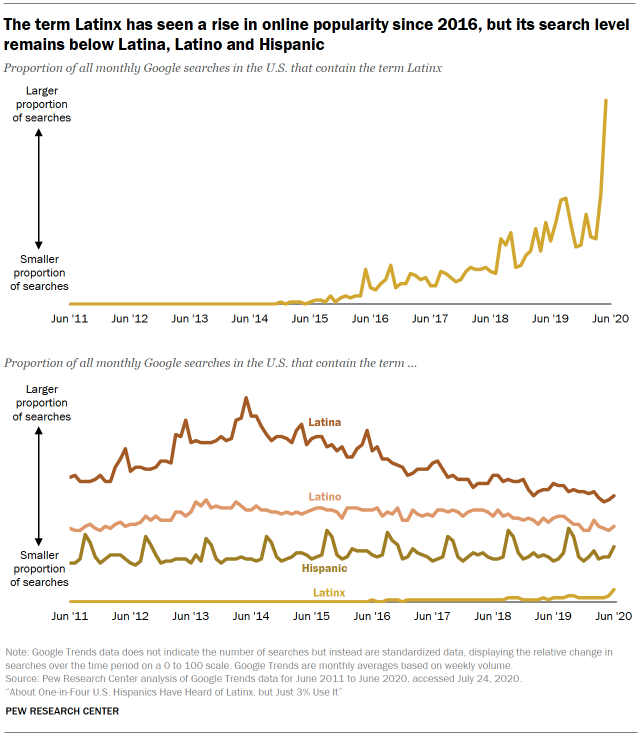
A chart showing that the term Latinx has seen a rise in online popularity since 2016, but its search level remains below Latina, Latino and Hispanic

Compared with June 2020, monthly Google searches for Latinx rose substantially for the first time in June 2016, following the Pulse nightclub shooting in Orlando, Florida.5

Despite its increase in popularity, Google searches for Latinx remain below those for Latina, Latino and Hispanic over the past decade. Among these terms, Latina has shown the highest popularity, though its share of searches has been falling relative to its peak in June 2014.6

Should Latinx be adopted as a pan-ethnic term for U.S. Hispanics?

A chart showing that one-third who have heard of the term Latinx say it should be used to describe the U.S. Hispanic or Latino population, but among

Among those aware of Latinx, one-in-three say it should be used to describe the nation’s Hispanic or Latino population.

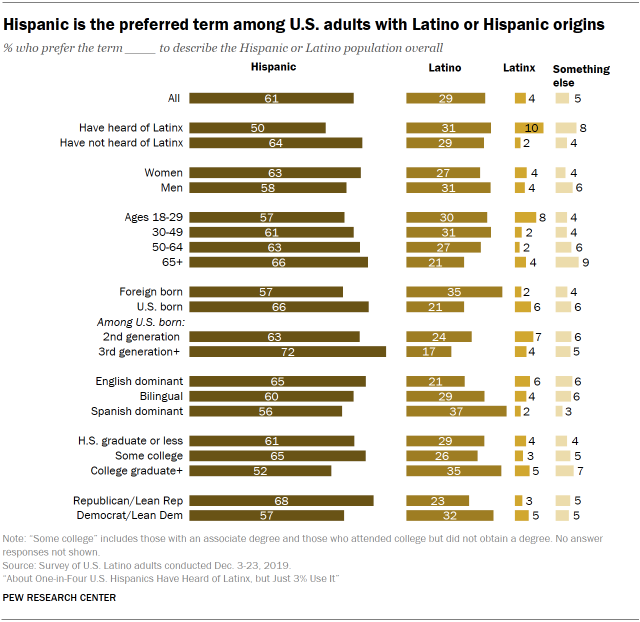
While some Hispanics say Latinx should be used as a pan-ethnic term, few say they prefer it over others. A majority (61%) say they prefer Hispanic to describe the Hispanic or Latino population in the U.S., and 29% say they prefer Latino. Meanwhile, just 4% say they prefer Latinx to describe the Hispanic or Latino population.

Preference for Latinx as a pan-ethnic term is higher among those who are aware of it – 10% in this group say they prefer Latinx. Yet even among those aware of Latinx, the terms Hispanic (50%) and Latino (31%) are preferred.

In their own words: What does Latinx mean to Hispanics?

When asked in an open-ended question what Latinx means in their own words, 42% of those who have heard the term describe it as a gender-neutral one. As one 21-year-old woman said, “Latinx is a more inclusive term to use for those who do not choose to identify with a certain gender. The terms Latino and Latina are very limiting for certain people.”

Other responses from the open-ended question offer other descriptions of Latinx and reactions to it. For example, 12% of respondents who had heard of Latinx express disagreement or dislike of the term. Some described the term as an “anglicism” of the Spanish language, while others say the term is “not representative of the larger Latino community.”

Among other responses, 12% say Latinx is a term about being Hispanic or Latino, while 9% of those aware of Latinx say it is an LGBTQ community inclusive term. And 6% of respondents who have heard of Latinx say it is a new, alternative or replacement term for Latino.
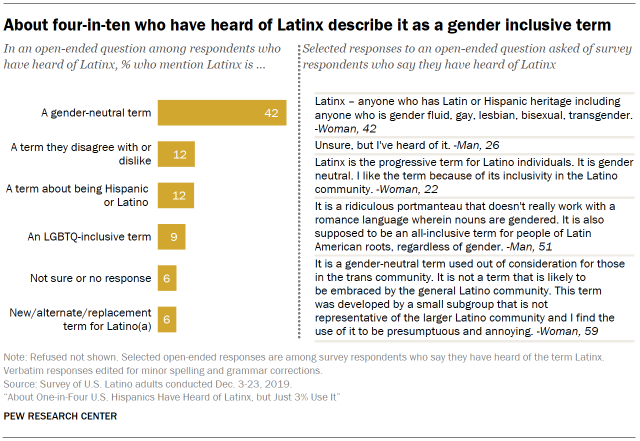
A chart that shows about four-in-ten who have heard of Latinx describe it as a gender inclusive term

1. How widespread is awareness of Latinx?

Note: For the Center’s 2024 report on Latinx and other pan-ethnic terms, read “Latinx Awareness Has Doubled Among U.S. Hispanics Since 2019, but Only 4% Use It.”  

Overall, about a quarter of Latino adults (23%) have heard of Latinx, though familiarity with the term varies widely across demographic subgroups.

Awareness among the youngest Latinos is considerably higher than among older adults. About four-in-ten (42%) of those ages 18 to 29 have heard of the term Latinx. That share falls to 19% among those ages 30 to 49, while those 65 and older are the least likely to have heard of Latinx (7%).

Familiarity with Latinx also differs by nativity and language use. U.S.-born Latinos (32%) are twice as likely to have heard of the term as immigrant Latinos (16%). Among those who are predominantly English speakers or bilingual Latinos, 29% have heard the term, a significantly higher share than the 7% of predominantly Spanish speakers who say the same.

Latinos with college experience are more likely to have heard of the term Latinx than those without college experience. Some 38% of Latino college graduates have heard of Latinx, as have 31% of those with some college experience, while only 14% of Latinos who are high school graduates or less have heard of the term.

The share of Latinos who have heard of Latinx also varies by political party affiliation. Democrats and those who lean to the Democratic Party (29%) are more likely to say they have heard of the term than Republicans and Republican leaners (16%).

Demographics and Latinx awareness

A table showing the profile of Hispanics who have heard and not heard the term Latinx

There are many demographic differences between Hispanics who have heard of the term Latinx and those who have not. Those who have heard the term are more likely than those who haven’t to be younger, U.S. born, primarily English speakers or bilingual, have been to college and identify as Democrats.

Age

The median age of those who have heard of Latinx is 29 years, compared with 43 years for those who have not heard it.

Half of Latinos (50%) who have heard the term are ages 18 to 29. By comparison, 21% of those who have not heard the term are the same age. (In 2018, 18- to 29-year-olds made up 28% of the Latino adult population, according to Pew Research Center analysis of U.S. Census Bureau data.)

Nativity

Among Latinos familiar with Latinx, 64% are U.S. born while 35% are immigrants. By contrast, among those not familiar with the term, fewer than half (42%) are U.S. born while 56% are immigrants.

Education

Most Latinos who have heard of Latinx have some college experience (38%) or are college graduates (27%). Meanwhile, among those who have not heard the term, less than half have at least some college experience.

Language use

Hispanics who have heard of Latinx are more likely to mainly be English speakers (35%) or bilingual (57%) than those who have not heard it (25% and 42%). On the other hand, the share of Spanish speakers is higher among those who have not heard of Latinx (33%) compared with those who have heard the term (9%).

Party affiliation

About three-in-four Latinos (74%) who have heard of the term Latinx identify as Democrats or Democratic-leaning independents, a significantly higher share than among those who have not heard the term (54%).

2. Who uses Latinx?

Note: For the Center’s 2024 report on Latinx and other pan-ethnic terms, read “Latinx Awareness Has Doubled Among U.S. Hispanics Since 2019, but Only 4% Use It.”  

While about one-in-four Latinos are aware of the term Latinx, just 3% say they use it to describe themselves, a share that is similar across all major demographic subgroups.

Latinx use is greater among younger Latinos than older Latinos. Some 7% of those ages 18 to 29 say they have used Latinx, while 2% or fewer among those ages 30 and older say the same.

About 5% of college graduates or those have some college experience say they have used Latinx, compared with 2% of those who have a high school degree or less.

Meanwhile, 4% of Democrats and Democratic-leaning independents say they have used Latinx, compared with 1% of Republicans and Republican leaners.

In addition, those who have heard of the term Latinx are more likely to use it to describe themselves than adults overall. Among those who say they have heard the term, 14% say they have used it.

A chart showing young Hispanic women stand out among Latinx users

Hispanic women (5%) are slightly more likely than Hispanic men (1%) to say they use Latinx. The share rises to 14% among Hispanic women ages 18 to 29, a substantially higher share than other Hispanic women or men. In all adult age and gender groups other than women ages 18 to 29, the share who say they use Latinx to describe themselves is 2% or lower.

3. Views on Latinx as a pan-ethnic term for U.S. Hispanics

Note: For the Center’s 2024 report on Latinx and other pan-ethnic terms, read “Latinx Awareness Has Doubled Among U.S. Hispanics Since 2019, but Only 4% Use It.”  

Latinx has emerged in recent years as a new pan-ethnic term to describe the nation’s diverse Hispanic population. However, the new survey shows most (65%) who have heard the term say it should not be used to describe the Hispanic or Latino population, while one-third say it should be used.

Among those who have heard the term Latinx, Hispanic women are more likely than men to say the term should be used to describe the Hispanic or Latino population. Some 42% of women say this compared with 23% of Hispanic men.

Hispanic is the preferred term to describe the Hispanic or Latino population overall

When asked about their preferred pan-ethnic term to describe the Hispanic or Latino population, a vast majority of adults say they prefer other terms over Latinx. Only 4%, according to the new survey, prefer Latinx to describe the Hispanic or Latino population. Meanwhile, 61% say they prefer the term Hispanic, followed by 29% who prefer the term Latino and 5% who say something else.

Though few say they prefer Latinx, those who have heard the term are more likely to prefer it as a pan-ethnic term than those who have not heard it. One-in-ten (10%) who have heard the term Latinx prefer it to describe the Hispanic or Latino population, significantly higher than the share among those who have not heard the term (2%) and the share among all Latino adults (4%).

There are some differences by age and nativity in pan-ethnic term preferences. Among those ages 18 to 29, 8% say they prefer Latinx over other terms, slightly higher than the share among older adults. In addition, 6% of those who are U.S. born say they prefer Latinx, compared with 2% among immigrants.

A chart showing Hispanic is the preferred term among U.S. adults with Latino or Hispanic origins

Across demographic subgroups, the term Hispanic is preferred by about half or more of respondents. Those who are third generation or higher (72%) are among the most likely to prefer Hispanic. Even among those who have heard the term Latinx, 50% say they prefer Hispanic to describe the nation’s Hispanic or Latino population.

Meanwhile, immigrants, college graduates and predominantly those who speak mainly Spanish are among the most likely to prefer the term Latino.

Acknowledgments

This report was written by Luis Noe-Bustamante, Research Analyst; Lauren Mora, Administrative Coordinator; and Mark Hugo Lopez, Director of Global Migration and Demography Research.

Editorial guidance was provided by Neil G. Ruiz, Associate Director of Global Migration and Demography Research; D’Vera Cohn, Senior Writer and Editor; Jeffrey S. Passel, Senior Demographer; Ana Gonzalez-Barrera, Senior Researcher; Tanya Arditi, Communications Manager; Jens Manuel Krogstad, Senior Writer and Editor; James Bell, Vice President of Global Strategy; Courtney Kennedy, Director, Survey Research; Nick Bertoni, Senior Panel Manager; Sono Shah, Computational Social Scientist; Katerina Eva Matsa, Associate Director of Research; and Galen Stocking, Senior Data Scientist.

The report was number-checked by Abby Budiman, Research Analyst. Shannon Greenwood, Digital Producer, produced the report. David Kent copy edited the report. Charts were designed by Luis Noe-Bustamante.

Find related reports online at https://alpha.pewresearch.org/pewresearch-org/hispanic/

Methodology

The American Trends Panel survey methodology

The American Trends Panel (ATP), created by Pew Research Center, is a nationally representative panel of randomly selected U.S. adults. Panelists participate via self-administered web surveys. Panelists who do not have internet access at home are provided with a tablet and wireless internet connection. The panel is being managed by Ipsos.

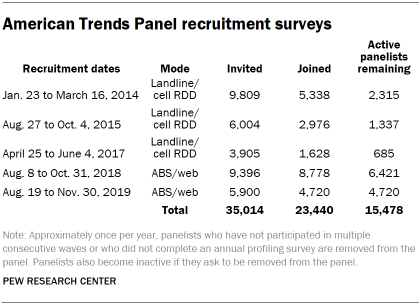
American Trends Panel recruitment surveys

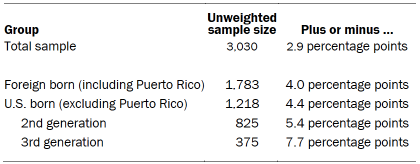
Data in this report are drawn from the panel wave conducted December 3 to December 23, 2019. A total of 3,030 panelists responded out of 5,395 who were sampled, for a response rate of 56%. This includes 2,094 from the ATP and an oversample of 936 respondents sampled from Ipsos’ KnowledgePanel. The cumulative response rate accounting for nonresponse to the recruitment surveys and attrition is 2.4%. The break-off rate among panelists who logged onto the survey and completed at least one item is 0.4%. The margin of sampling error for the full sample of 3,030 respondents is plus or minus 2.9 percentage points.

The ATP sample consisted of all current panel members who previously identified as being Hispanic. For the KnowledgePanel sample, Hispanics who were either born in Mexico or had no more than a high school education were oversampled relative to those who had more than a high school education and were born outside of Mexico.

The ATP was created in 2014, with the first cohort of panelists invited to join the panel at the end of a large, national, landline and cellphone random-digit-dial survey that was conducted in both English and Spanish. Two additional recruitments were conducted using the same method in 2015 and 2017, respectively. Across these three surveys, a total of 19,718 adults were invited to join the ATP, of which 9,942 agreed to participate.

In August 2018, the ATP switched from telephone to address-based recruitment. Invitations were sent to a random, address-based sample (ABS) of households selected from the U.S. Postal Service’s Delivery Sequence File. In each household, the adult with the next birthday was asked to go online to complete a survey, at the end of which they were invited to join the panel. For a random half-sample of invitations, households without internet access were instructed to return a postcard. These households were contacted by telephone and sent a tablet if they agreed to participate. A total of 9,396 were invited to join the panel, and 8,778 agreed to join the panel and completed an initial profile survey. The same recruitment procedure was carried out on August 19, 2019, from which a total of 5,900 were invited to join the panel and 4,720 agreed to join the panel and completed an initial profile survey. Of the 23,440 individuals who have ever joined the ATP, 15,478 remained active panelists and continued to receive survey invitations at the time this survey was conducted.

The USPS Delivery Sequence File has been estimated to cover as much as 98% of the population, although some studies suggest that the coverage could be in the low 90% range.7

Weighting

Weighting dimensions

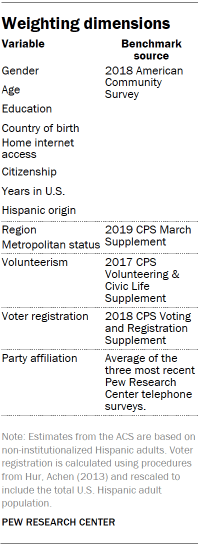
The ATP data was weighted in a multistep process that begins by calibrating the entire panel so that it aligns with the population benchmarks identified in the accompanying table to create a full-panel weight. For ATP waves in which only a subsample of panelists are invited to participate, a wave-specific base weight is created by adjusting the full-panel weights for subsampled panelists to account for any differential probabilities of selection for the particular panel wave. The next step in the weighting uses an iterative technique that aligns the sample to population benchmarks on the dimensions listed in the accompanying table. For this wave, additional weighting parameters were added to adjust for citizenship, years in the U.S., country of birth and Hispanic origin.

Sampling errors and test of statistical significance take into account the effect of weighting. Interviews are conducted in both English and Spanish.

In addition to sampling error, one should bear in mind that question wording and practical difficulties in conducting surveys can introduce error or bias into the findings of opinion polls.

The following table shows the unweighted sample sizes and the error attributable to sampling that would be expected at the 95% level of confidence for different groups in the survey:

Unweighted sample sizes and the error attributable to sampling

For the purposes of this report, references to foreign-born Hispanics include those born in Puerto Rico. Individuals born in Puerto Rico are U.S. citizens by birth. Sample sizes and sampling errors for other subgroups are available upon request.

Online search data

Trends in online search data volume used in this report are based on data from Google Trends, a publicly available web-based tool that measures search volume of a specific search term across time, in specific languages and in specific countries. In this report, search term data are for the terms for “Latinx,” “Latina,” “Latino” and “Hispanic” among searches conducted in the U.S. Monthly data were downloaded for the period of Jan. 1, 2004, through June 30, 2020.8

Google standardizes online searches on a 0 to 100 scale for the time period selected by the user, with 100 representing the peak level of searches given a region and time period. Internet search data analysis like that available from Google Trends has limitations. Internet search data is an indicator of interest in a topic, not attitudes toward it. Actual motivation for searches or behavior related to searches cannot be authenticated using Google Trends alone.

CORRECTION. (September 2020): A previous version of this methodology statement contained an incorrect description of the base weighting for this survey. None of the study findings or conclusions are affected.