
Pew Research Center

FOR RELEASE FEBRUARY 23, 2017

Latinos and the New Trump Administration

Growing share say situation of U.S. Hispanics is worsening

BY Pew Research Center Staff

FOR MEDIA OR OTHER INQUIRIES:

Communications Department
202.419.4372
www.pewresearch.org

RECOMMENDED CITATION

Pew Research Center, February 2017, "Latinos and the New Trump Administration"

About Pew Research Center

Pew Research Center is a nonpartisan, nonadvocacy fact tank that informs the public about the issues, attitudes and trends shaping the world. It does not take policy positions. The Center conducts public opinion polling, demographic research, computational social science research and other data-driven research. It studies politics and policy; news habits and media; the internet and technology; religion; race and ethnicity; international affairs; social, demographic and economic trends; science; research methodology and data science; and immigration and migration. Pew Research Center is a subsidiary of The Pew Charitable Trusts, its primary funder.

© Pew Research Center 2026

Table of contents

  • About Pew Research Center
  • Latinos and the New Trump Administration
  • 1. Latino priorities for the Trump administration and Congress in 2017
  • 2. Looking forward: Hispanics’ expectations of Trump as president
  • 3. Looking back: The Obama administration
  • 4. Hispanics and their view of the nation’s direction
  • 5. State of Hispanics in the U.S. today
  • Acknowledgements
  • Methodology
  • Appendix A: References

Latinos and the New Trump Administration

Growing share say situation of U.S. Hispanics is worsening

Hispanics are divided about what a Donald Trump presidency means for their place in America, according to a Pew Research Center survey of Hispanic adults taken before his inauguration. The survey also finds that a rising share believes the situation of U.S. Hispanics is worsening and that about half of Hispanics are worried about the deportation of someone they know.

About half (54%) of Hispanics say they are confident about their place in America after Trump’s election while four-in-ten Hispanics (41%) say they have serious concerns about their place in America.
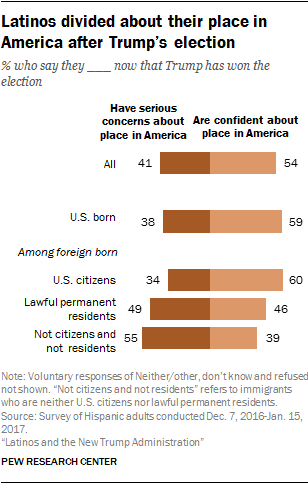
Latinos divided about their place in America after Trump’s election

Hispanics who do not hold U.S. citizenship and do not hold a green card – a group likely to be in the country without authorization – are more likely than the U.S. born and other immigrants to express concern.1 Among likely unauthorized immigrants, 55% say they have serious concerns about their place in the country after Trump’s election. Meanwhile, 38% of U.S.-born Hispanics and 34% of Hispanic immigrants who are U.S. citizens say they have serious concerns about their place in America. And among Hispanic immigrants who are lawful permanent residents, 49% say the same.

When it comes to progress for Hispanics as a group in the U.S., Hispanics are divided. Half (49%) say the situation of U.S. Hispanics today is about the same as it was a year ago, while 32% say it has worsened and 16% say their group’s situation has improved.
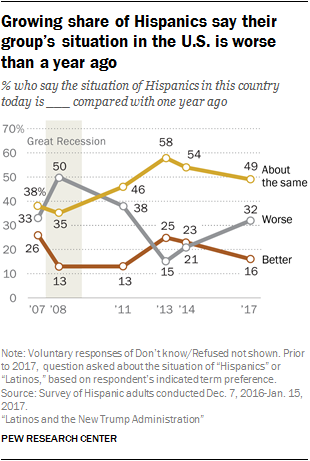
Growing share of Hispanics say their group’s situation in the U.S. is worse than a year ago

But the share of Hispanics that see the state of U.S. Hispanics worsening has grown in recent years. For example, the share today that says the group’s situation has worsened is about double the share that said the same in 2013 (15%). At the same time, the share that says the situation of U.S. Hispanics is about the same compared with a year ago is down from 58% in 2013. And the share that says the group’s situation is better than a year ago is down from 25% in 2013.

Among Hispanics, a growing share of many key subgroups say that the state of U.S. Hispanics has deteriorated. For example, 42% of Hispanic immigrants who do not hold U.S. citizenship and do not hold a green card today say that the situation of U.S. Hispanics has worsened in the past year, up from 24% who said the same in 2014. Some 38% of Hispanic immigrants who hold U.S. citizenship say this today, up from 21% who said the same in 2014. And 29% of U.S.-born Hispanics say that Hispanics are worse off today than one year ago, up from 17% in 2014. By comparison, Hispanic immigrants who are lawful permanent residents are as likely today (26%) as in 2014 (24%) to say the group’s situation in the U.S. has worsened.

These findings emerge from a new, nationally representative bilingual telephone survey of 1,001 Hispanic adults conducted from Dec. 7, 2016, through Jan. 15, 2017, on landline and cellular telephones by SSRS for Pew Research Center. The survey’s margin of error for the full sample is plus or minus 3.6 percentage points at the 95% confidence level.

The U.S. Hispanic population stood at 57 million in 2015 and is among the nation’s fastest growing groups. It is also a largely U.S.-born population – 66% were born here. Among Hispanics who were born in another country, roughly three-in-ten are lawful permanent residents and about four-in-ten are unauthorized immigrants. (Unauthorized immigrants from Latin America make up 78% of all unauthorized immigrants as well.) At the same time, the group’s population growth has slowed in recent years and is now driven more by births in the U.S. than the arrival of new immigrants, driving down the group’s foreign-born share in recent years.

Deportation worries
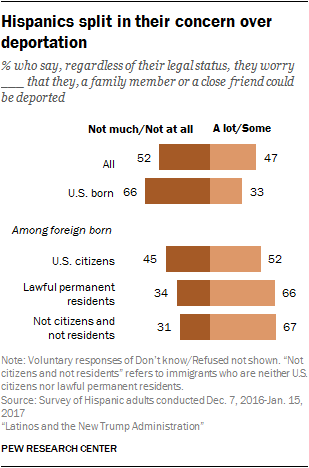
Hispanics split in their concern over deportation

The U.S. Department of Homeland Security this week issued new immigration enforcement policies that widen the pool of unauthorized immigrants prioritized for deportation to include those who have committed an act that will result in criminal charges, those charged with a crime but not convicted, and those convicted of a criminal offense regardless of severity, among other things.2 In recent weeks, immigrants around the nation have grown concerned about stepped-up deporations under the new administration.

According to the new survey, which was taken before Trump’s inauguration and the reported rise in deportration concerns, Hispanics are split in their concern about deportation. About half (47%) of Hispanic adults, regardless of their immigration status, say they worry “a lot” or “some” that they themselves, a family member or a close friend, could be deported, while 52% say they are worried “not at all” or “not much.”

Worries about deportation among immigrants are greatest for those who do not hold U.S. citizenship and do not hold a green card: 67% say they worry a lot (45%) or some (22%) about the deportation of themselves or someone close to them. And among immigrants who are lawful permanent residents, 66% say they are worried about deportation of themselves or someone close to them. Both of these groups are potentially subject to deportation. By comparison, one-third (33%) of U.S.-born Hispanics say they are worried about deportation of someone they know, while 55% say they worry not much or not at all about deportation.

Deportation concerns among Hispanics are little changed from 2013, when 46% of Hispanics said they worried, and is down from 52% in 2010. Overall, all major subgroups of Hispanics have seen a decline in their worry about deportation or no change in recent years. For example, in 2010, 84% of Hispanic immigrants who were not U.S. citizens and not lawful permanent residents said they worried a lot or some that they or someone close to them could be deported, about 17 percentage points higher than today. Meantime, the share of U.S.-born Hispanics who said the same in 2010 was 32%, similar to today’s 33%.

Top priorities for the new administration and Congress in 2017
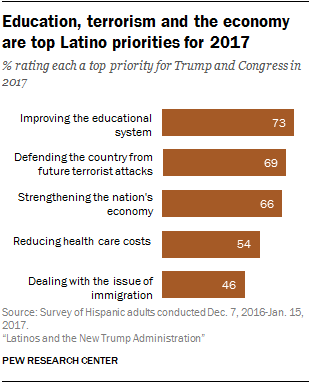
Education, terrorism and the economy are top Latino priorities for 2017

Despite the prominence of immigration issues in last year’s presidential campaign, U.S. Hispanics do not rate them a top issue for the new administration or Congress, a pattern similar to that found in previous years of polling by Pew Research Center. According to the new survey, 46% say dealing with the issue of immigration should be a top priority for the new administration and Congress in 2017, ranking last among the five priorities tested in the new survey.

Instead, Hispanics identify education as a top priority issue for the new Trump administration and for the new Congress among those tested. Fully 73% say improving the educational system should be a top priority in 2017. Other top priorities include defending the country from future terrorist attacks (69%) and strengthening the nation’s economy (66%). Following these three issues is reducing health care costs (54%).

This rating of issue priorities among Latinos is similar to that of the U.S. general public, though there are some differences. According to a recent Pew Research Center survey of U.S. adults, defending the country from terrorism (76%), strengthening the nation’s economy (73%) and improving the educational system (69%) are rated as the top three prirorities of more than 20 tested. On terrorism and the economy, the share of U.S. adults who rate these as top issues is higher than the share of Latinos who say the same. On reducing health care costs, 66% rate the issue as a top priority for Trump and Congress, again a higher share than among Latinos. Meanwhile, on immigration, 43% of U.S. adults say immigration is a top priority, a share similar to that of Latinos.

More broadly, this pattern for top issues among U.S. Latinos has been fairly consistent for a number of years in Pew Research Center surveys. In fall 2016, the top issues for Latinos were education, the economy and health care. And in December 2008, as President-elect Barack Obama prepared to take office for the first time, Latinos cited the economy, education, health care and national security as top issues for the new administration.3

Partisan differences in views of Trump and Obama
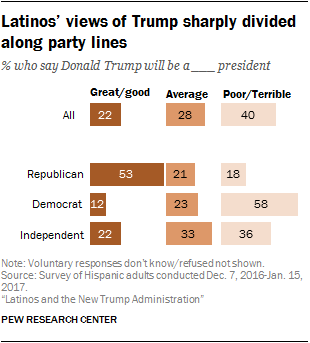
Latinos’ views of Trump sharply divided along party lines

Latino views about the kind of president Trump will be and how former President Obama’s administration will be viewed splits along party lines.
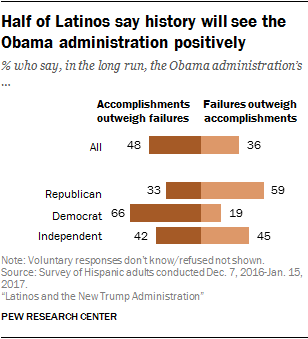
Half of Latinos say history will see the Obama administration positively

Overall, 40% of Hispanic adults think Trump will be a poor or terrible president while 28% say he will be an average president and 22% say he will be a good or great president. But there are sharp divides by political party. About half (53%) of Hispanic Republicans say Trump will be a good or great president. By comparison, Hispanic Democrats hold the opposite view: 58% say Trump will be a poor or terrible president.4

Divisions along party lines also exist in Latinos’ views about the Obama administration. Two-thirds (66%) of Latino Democrats say his administration’s accomplishments will be better remembered than its failures. By contrast, 59% of Latino Republicans say the failures will outweigh accomplishments. Overall, half of Latinos (48%) say the Obama administration’s accomplishments will outweigh its failures, while 36% say the opposite.

Terminology

The terms “Latino” and “Hispanic” are used interchangeably in this report.

“U.S. born” refers to people who say they were born in the 50 states or the District of Columbia, Puerto Rico or other U.S. territories, and those born elsewhere to at least one parent who is a U.S. citizen.

“Foreign born” refers to people who say they were born outside of the United States or other U.S. territories to parents who were not U.S. citizens.

The terms “foreign born” and “immigrant” are used interchangeably.

The following terms are used to describe immigrants and their status in the U.S. In some cases, they differ from official government definitions because of limitations in the available survey data.

  • “Foreign-born U.S. citizens” refers to persons who indicate they are “foreign born” and who indicate they are U.S. citizens. The terms “foreign-born U.S. citizens” and “naturalized U.S. citizens” are used interchangeably in this report.
  • “Foreign-born lawful permanent residents” refers to persons who indicate they are foreign born and who say they have a green card or have been approved for one.
  • “Foreign born who are not lawful permanent residents and not U.S. citizens” refers to persons who indicate they are foreign born and who say they do not have a green card and have not been approved for one.

1. Latino priorities for the Trump administration and Congress in 2017

Latinos generally agree that improving the educational system, defending the country from future terrorist attacks and strengthening the U.S. economy should be top priorities for the Trump administration and Congress in 2017. A smaller share of Latinos say dealing with health care costs and the issue of immigration should be a top priority, though views on immigration as a priority vary by legal status and party affiliation.

Latinos, U.S. general public share some top priorities

Roughly three-quarters of Latinos (73%) say improving the educational system should be a top priority for Trump and Congress in 2017. Other top priorities include defending the country from future terrorist attacks (69%) and strengthening the nation’s economy (66%).

A smaller share of Latinos say reducing health care costs (54%) should be a top priority for Trump and Congress. Dealing with the issue of immigration is the lowest-rated issue for Latinos among those tested in the survey, with about half (46%) saying it should be a top priority.

Immigration was not a top issue among Latinos in past Pew Research Center surveys, either.5 In fall 2016, 87% of Latinos rated education as “very important” to their vote, followed by the economy (81%), health care (80%), immigration (72%), terrorism (71%), how Hispanics are treated (71%) and gun policy (59%). As Barack Obama was taking office as president in 2009, 57% of Latinos said the economy was an “extremely important” issue facing the incoming administration, followed by education (51%), health care (45%), national security (43%), the environment (33%), immigration (31%) and energy policy (20%).

Among the U.S. general public, a Pew Research Center survey from January found that 76% say defending the country from future terrorist attacks should be a top priority for Trump and Congress in 2017 and 73% say the same of strengthening the nation’s economy. Other top priorities include improving the educational system (69%), improving the job situation (68%) and reducing health care costs (66%). Dealing with the issue of immigration is rated lower, with 43% saying it should be a top priority for Trump and Congress in 2017 – similar to the share of Hispanics with this view.

Priorities for Trump and Congress among U.S.-born Latinos and immigrant Latinos

Overall, the ranking of issue priorities is similar among U.S.-born Latinos and immigrant Latinos. Education is seen as a top priority by both groups, for example, as are the economy and terrorism.

Among U.S.-born Latinos, 77% say improving the education system should be a top priority for Trump and Congress in 2017, followed by strengthening the nation’s economy (71%) and defending the country from future terrorist attacks (70%). Lower priorities among those tested include reducing health care costs (57%) and dealing with the issue of immigration (39%).

Among foreign-born Latinos, top priorities for Trump and Congress include improving the educational system (69%), defending the country from future terrorist attacks (68%), strengthening the nation’s economy (62%), dealing with the issue of immigration (52%) and reducing health care costs (51%).

While U.S.-born and immigrant Latinos share a similar set of issue priorities, there are differences among immigrant Latinos that are linked to their legal status. The top three priorities of Latino immigrants who are U.S. citizens and Latino immigrants who are lawful permanent residents are similar to those of U.S.-born Latinos, though the groups rank these priorities differently. Among Latino immigrants who are U.S. citizens, 74% say improving the education system should be a top priority for Trump and Congress; other top priorities include defending the country from future terrorist attacks (70%) and strengthening the nation’s economy (69%), followed by reducing health care costs (58%) and dealing with the issue of immigration (48%).

Similarly, top priorities for Latino immigrants who are lawful permanent residents include defending the country from future terrorist attacks (74%), improving the educational system (72%) and strengthening the nation’s economy (67%), followed by dealing with the issue of immigration (47%) and reducing health care costs (43%).

Among Latinos who are likely unauthorized immigrants – i.e. those who are neither U.S. citizens nor lawful permanent residents –improving the educational system (61%), dealing with the issue of immigration (61%) and defending the country from future terrorist attacks (60%) are among the highest-rated priorities. Other priorities include reducing health care costs (52%) and strengthening the nation’s economy (49%).

Latino issue priorities by political party affiliation

While there are no partisan differences among Hispanics when it comes to the relative importance of health care, immigration and education as national priorities, Republican, Democratic and independent Latinos do place differing degrees of emphasis on national security and the economy. About eight-in-ten Latino Republicans (82%) say defending the nation against future terrorist attacks should be a top priority for Trump and Congress in 2017, compared with 70% of Latino Democrats and 65% of Latino independents who say the same.

When asked about strengthening the nation’s economy, 83% of Latino Republicans say it should be a top priority, followed by 70% of Latino Democrats and 61% of Latino independents.

On improving the educational system, about three-fourths of Latino Republicans (74%),  Democrats (75%) and  independents (73%) say it should be a top priority.

Regardless of political party affiliation, Latinos place a lower emphasis on immigration than on some other issues. About half of Latino Republicans (53%) say dealing with the issue of immigration should be a top priority for Trump and Congress, as do 45% of Latino Democrats and 46% of Latino independents.

The importance of immigration as a priority for Trump, Congress in 2017

Latinos generally rank the issue of immigration as a lower priority than other top issues for Trump and Congress in 2017. However, the percentage of Latinos who say immigration should be a top priority varies across some demographic subgroups.

Among Latinos born in the U.S., 39% say dealing with the issue of immigration should be a top priority, compared with 52% of foreign-born Latinos who say the same. Among foreign-born Latinos, 48% of those who are U.S. citizens say immigration should be a top priority, as do 47% of lawful permanent residents and 61% of those who are neither U.S. citizens nor lawful permanent residents.

Among Latino Republicans, 53% say immigration should be a top priority, compared with 45% of Latino Democrats and 46% of Latino independents.


2. Looking forward: Hispanics’ expectations of Trump as president

As the new administration begins, a plurality of Hispanics have pessimistic expectations of the job Donald Trump will do as president, though Hispanics are divided by party and, to a lesser extent, by gender on this issue. Among Hispanics, Democrats and women generally have negative expectations for Trump’s presidency, while men and Republicans have more positive expectations.

Overall, 40% of Hispanics say they think Trump will be a terrible (24%) or poor (15%) president, while about a fifth (22%) say he will be a good (16%) or great (6%) president. About three-in-ten Hispanics (28%) say Trump will be an average president.

The general public is just as negative in its outlook on Trump’s presidency as Hispanics, with 38% of all Americans saying that Trump will be either a terrible (25%) or poor (13%) president. By contrast, 35% of Americans say Trump will be a good (22%) or great (14%) president, a more positive assessment than that among Hispanics. Meanwhile, the general public (18%) is less likely than Hispanics (28%) to say they expect Trump to be an average president.

Among Hispanics, about three-in-ten (28%) men think Trump will be a great (9%) or good (19%) president; Hispanic women are about half as likely (16%) to say Trump will be a great (3%) or good (13%) president. About the same share of men (31%) and women (25%) think Trump will be an average president. Meanwhile, a higher share of women (47%) think Trump will be a poor (17%) or terrible (30%) president, compared with the 32% of men who expect him to be a poor (13%) or terrible (19%) president.

There are few differences in expectations for Trump’s presidency by age among Latinos. However, expectations for Trump are more polarized among Latinos ages 65 and older than among other groups of Latinos. For example, just 13% of those 65 and older expect Trump to be an average president, yet 30% say he will be a great or good president and another 44% say he will be a poor or terrible president. By contrast, among Latinos ages 18 to 29, 36% say he will be an average president, 20% say he will be good or great and 40% say he will be a poor or terrible. Similar patterns emerge among other age groups of Latinos.

There are no major differences between immigrant Hispanics and U.S.-born Hispanics in their expectations of Trump as president. Among U.S.-born Hispanics, 43% say Trump will be a poor or terrible president and 22% say he will be a good or great president. Among Hispanic immigrants these views are similar, with 37% rating Trump negatively and 22% saying he will be a good or great president. Both groups are about twice as likely to say that Trump will be a poor or terrible president as to say he will be a good or great president. About three-in-ten in each group think Trump will be an average president.

However, there are differences between groups of Hispanic immigrants in their expectations of the new president. Among Hispanic immigrants who are lawful permanent residents, 21% say Trump will be a good or great president, 34% say he will be an average president and 34% say he will be a poor or terrible president. Hispanic immigrants who are not U.S. citizens and who are not lawful permanent residents have similar views. By contrast, among Hispanic immigrants who are U.S. citizens, 26% say Trump will be a good or great president, 18% say he will be average and 41% say he will be poor or terrible.

There are sharp divides in how Hispanic Republicans, Democrats and independents expect Trump will do as president. About half (53%) of Hispanic Republicans say Trump will be a great (22%) or good (31%) president – the highest share among all major Hispanic demographic subgroups. By contrast, about one-in-ten Hispanic Democrats (12%) and two-in-ten independents (22%) think positively of Trump as president. Among major partisan groups, Hispanic independents are the most likely (33%) to say that Trump will be an average president. At the same time, a majority (58%) of Democrats expect Trump to be a poor (20%) or terrible (38%) president, three times the share of Republicans who say the same. Roughly a third (36%) of independents think Trump will be a terrible (20%) or poor (16%) president.

3. Looking back: The Obama administration

Latinos offer mixed views on Barack Obama’s tenure as president. Roughly half (48%) of Latino adults say the administration’s accomplishments will outweigh its failures, while 36% say its failures will outweigh its accomplishments. Latinos’ views of the Obama administration are generally in line with those of the U.S. general public, half (49%) of whom say they expect the administration’s accomplishments to outweigh its failures, compared with 44% who say the opposite.

Hispanics’ views of the Obama administration today are more positive than they were about the George W. Bush administration in 2008. Then, just 19% of Hispanics said the Bush administration’s accomplishments would outweigh its failures. At the same time, 54% of Hispanics in 2008 said the Bush administration’s failures would outweigh its accomplishments. The general public in 2009 held similar views about the Bush administration. Almost a quarter (24%) said that administration would be remembered for its accomplishments more than its failures, while 64% said failures would outweigh successes.

While 52% of U.S.-born Hispanics believe that the Obama administration’s accomplishments will outweigh its failures, a smaller share (45%) of immigrant Hispanics hold the same view.

Views of the Obama administration’s accomplishments also vary among Hispanic immigrants depending on their legal status. For example, half (50%) of Hispanic immigrants who are U.S. citizens and 49% of Hispanic lawful permanent residents believe that the Obama administration’s accomplishments will outweigh its failures. Almost four-in-ten Hispanic immigrants who do not hold U.S. citizenship and do not hold a green card (37%) say the administration’s accomplishments will outweigh its failures, with an equal share saying the opposite (and 25% saying they don’t know). It is this latter group of Hispanics that Obama targeted with an expanded Deferred Action for Childhood Arrivals program that would have extended deportation relief to about 4 million of all the nation’s unauthorized immigrants.6 However, the proposal never took effect after an appeals court sided with several states that brought a lawsuit that sought to block the programs, a decision affirmed by the U.S. Supreme Court.

About the same share of Latino men (47%) and women (50%) say they expect the Obama administration’s accomplishments to outweigh its failures. But the survey also finds that men are more likely than women to say the administration’s failures will outweigh its accomplishments – 41% compared with 31%.

Six-in-ten Latinos with at least some college education agree that Obama’s administration will be remembered more for its accomplishments than its failures. This is a higher share than among those who have not completed high school (38%) and those with only a high school diploma (43%).

The sharpest differences in views of the Obama administration among Hispanics are by political party identification, with Democrats giving a more positive assessment, while Republicans offer a strongly negative assessment. Two-thirds (66%) of Hispanic Democrats say the administration will be remembered more for its accomplishments than its failures, while just 19% say the opposite. By comparison, only one-third (33%) of Hispanic Republicans have a positive view of the Obama administration’s accomplishments, while almost six-in-ten (59%) say the administration’s failures will outweigh its accomplishments. Meanwhile, Hispanic independents are split in their assessment of the Obama administration: 42% say its accomplishments will outweigh its failures, while 45% say its failures will outweigh its accomplishments.

4. Hispanics and their view of the nation’s direction

As the new Trump administration begins, Latinos are split in their views of the nation’s direction. Half of Latinos say they are dissatisfied with the way things are going in the nation today while 45% say they are satisfied, according to a new Latino post-election survey conducted by Pew Research Center. These views have changed somewhat since 2012, but are markedly improved since 2008, the first year of the Great Recession, when 70% of Latinos were dissatisfied with the country’s direction.

Compared with the U.S. general public, Latinos express greater satisfaction with the country’s direction today. While 45% of Latinos say they are satisfied with the country’s direction, only 30% of the general public says the same (65% of U.S. adults say they are dissatisfied with the nation’s direction). Since 2008, the U.S. general public’s views on the country’s direction has improved.

The new survey also shows that views of the nation’s direction vary across Hispanic demographic subgroups. Overall, Hispanic men are more satisfied with the way things are going in the country today compared with Hispanic women – 49% compared with 41%. More than half (54%) of Hispanic women are dissatisfied with the way the country is going.

Generationally, Hispanics ages 50 to 64 are more optimistic than other age groups about how things are going in the country today. Half (50%) say they are satisfied with the nation’s direction while 46% say they are dissatisfied. By comparison, the least optimistic are Hispanics ages 65 and older. Just 38% of this group say they are satisfied with the direction of the country today and more than half (55%) say they are dissatisfied. U.S.-born Hispanics are more dissatisfied with the country’s direction than foreign-born Hispanics. More than half (55%) of Hispanic immigrants say they are satisfied with the country’s direction, while 40% say they are dissatisfied. By comparison, only 34% of Hispanics born in the U.S. say they are satisfied with the country’s direction, while 61% say they are dissatisfied.

U.S.-born Hispanics are more dissatisfied with the country’s direction than foreign-born Hispanics. More than half (55%) of Hispanic immigrants say they are satisfied with the country’s direction, while 40% say they are dissatisfied. By comparison, only 34% of Hispanics born in the U.S. say they are satisfied with the country’s direction, while 61% say they are dissatisfied.

Latinos who are lawful permanent residents are more likely than other groups of Latino immigrants to say they are satisfied with the way things are going in the U.S. today. More than two-thirds (68%) of them say they are satisfied while 30% say they are dissatisfied. By comparison, 52% of Latino immigrants who are neither U.S. citizens nor lawful permanent residents say they are satisfied with the nation’s direction, while 43% say they are dissatisfied. Views are more divided among Latino immigrants who are U.S. citizens. About half (49%) say they are satisfied with the country’s direction while 44% say they are not.

Hispanic Republicans and Hispanic Democrats share similar views on the country’s direction. Just 38% of each group say they are satisfied with the nation’s direction and about six-in-ten of each say they are dissatisfied. By contrast, Hispanics who identify as independents are more optimistic, but remain split in their views. Half (50%) say they are satisfied with the country’s direction while 46% say they are not.

5. State of Hispanics in the U.S. today

Hispanics are divided in their assessment of how they as a group are doing in the country today compared with a year ago. An increasing share of Hispanics say their standing in the U.S. has worsened since 2013, even as half say it is unchanged. Hispanics are also split in their concerns about deportation: About half (47%) say they worry “a lot” or “some” that they, a family member or close friend could be deported, a level of worry that is little changed from four years ago. Finally, the new survey finds Hispanics are relatively divided over their place in America after Donald Trump’s presidential election win. A significant share – 41% – says they have serious concerns about their place in America, but a majority says they are not concerned.

The situation of Latinos in the U.S. today

Latinos are divided in their views about the situation of their group today. Half (49%) say the situation of Hispanics is about the same as a year ago, while 16% say the situation has improved, according to the new survey. About a third (32%) of Latinos say their group’s situation in the U.S. is worse today than a year ago.

Views of how U.S. Latinos are faring have worsened over the past four years. In 2013, just 15% of Latinos said their community was worse off compared with the year before, while 25% said it had improved and 58% said it was about the same.

Pessimism over the status of U.S. Hispanics peaked around the onset of the Great Recession.7 In 2008, half (50%) of Hispanics said the situation of the community was worse than a year earlier, while just 13% said the situation of Hispanics was better and 35% said the situation of Hispanics was about the same.

In the new survey, 29% of U.S.-born Latinos say their situation as a group is worse today than a year ago, while 15% say it is better and 54% say it is about the same. By comparison, 36% of Latino immigrants who say the situation of the community is worse today than a year ago, while 17% say it is better and 44% say it is about the same.

Among Latino immigrants, 38% who are U.S. citizens say the situation of the Latino community is worse today than a year ago, while just 12% say it is better and 46% say it is about the same. By comparison, among Latino immigrants who are lawful permanent residents, a similar share say the situation of the community is worse than a year ago (26%) as say it is better (27%), while 45% say it is about the same. Among Latino immigrants who are neither U.S. citizens nor lawful permanent residents, 42% say the situation of U.S. Latinos is worse than a year ago, 15% say the situation is improved, 41% say it is about the same.

Hispanics and deportation worry

Latinos are also split in their concern about deportation. About half (47%) say they worry a lot (29%) or some (18%) that they, a family member or a close friend could be deported regardless of their own legal status, according to the new survey, which was conducted before Trump’s inauguration. But 52% say they worry not at all (40%) or not much (12%) about deportation of someone they know. These shares are relatively unchanged from 2013, when Latinos held similar views on the issue. However, these figures have changed since 2010, when 52% of Latinos said they worried a lot (34%) or some (18%) about deportation. (In 2010, immigration enforcement became a point of national debate in part due to an Arizona law – SB 1070 – that gave police increased powers to stop and detain people they suspected of being in the country illegally.)

The decline in the share of Latinos who worry about deportation coincided with a series of policy changes by the Obama administration that protected some immigrants from deportation. For example, in 2012 President Obama signed an executive action that allowed some unauthorized immigrants who arrived in the U.S. before age 16 to receive work permits and relief from deportation under the Deferred Action for Childhood Arrivals program. Also in 2012, the Department of Homeland Security announced new deportation priorities that focused enforcement on those convicted of crimes.

During the 2016 presidential campaign, Trump made provocative comments about Mexican immigrants, building a wall along the U.S.-Mexico border and the deportation of millions who are in the country illegally (new Department of Homeland Security removal policies were announced earlier this week). Immigrants from Latin America made up about 78% of all unauthorized immigrants in the U.S. in 2014, with a majority (52.5%) from Mexico, though the share from Mexico has declined over the past decade.

In the new survey, there are significant differences in deportation worry among some demographic subgroups of Hispanics. Among Latino immigrants, about two-thirds of those who are neither U.S. citizens nor lawful permanent residents (and likely unauthorized immigrants) say they worry a lot (45%) or some (22%) about deportation. Similarly, 66% of Latino lawful permanent residents say they worry a lot (47%) or some (19%) about deportation. These two groups expressed some of the greatest amount of worry of any demographic subgroup of Latinos.

Latinos who belong to these two groups are not U.S. citizens and are eligible for deportation if they are in the U.S. without authorization, commit certain crimes or violate the condition of their admission to the U.S. in some other way. Meanwhile, among Latino immigrants who are U.S. citizens, 52% worry a lot (33%) or some (19%) about deportation.

A third of U.S.-born Hispanics say they worry a lot (17%) or some (16%) that they, a family member or a close friend could be deported, while two-thirds (66%) say they worry not much (11%) or not at all (55%) about deportation.

At the same time, six-in-ten Hispanics who have not completed high school (60%) say they worry a lot or some that they, a family member or a close friend could be deported, while 37% say they worry not much or don’t worry at all about deportation. Among Hispanics who are high school graduates, about half (47%) say they worry a lot or some about deportation, while a similar share (53%) say they worry not much or don’t worry at all about deportation. Meanwhile, 37% of Hispanics with at least some college education say they worry a lot or some about deportation, while 62% say they worry not much or don’t worry at all about deportation.

The survey also finds that roughly half (54%) of Hispanic women say they worry a lot or some that they, a family member or a close friend could be deported, while 45% say they worry not much or don’t worry at all about deportation. By comparison, men are less likely to worry – 40% of Hispanic men say they worry a lot or some that they or someone close to them could be deported, while 58% say they worry not much or don’t worry at all about deportation.

There are also significant differences on this measure by political party. About half (53%) of Latino Democrats say they worry a lot or some that they, a family member or a close friend could be deported. Latinos who identify as political independents reported similar levels of worry about deportation – 47% say they worry a lot or some that someone they know may be deported. By comparison, just 28% of Latino Republicans say the same.

Trump’s election and Hispanic concerns about their place in America

After Trump’s presidential election win, 41% of Latinos say they have serious concerns about their place in America, compared with 54% who say they are confident about their place in America.

The survey finds that 45% of Hispanic immigrants and 38% of U.S.-born Hispanics to say they have serious concerns about their place in America. And among Hispanic immigrants, views of their place in America after Trump’s election are linked to their legal status. Some 55% of those who are not citizens and not residents (and likely unauthorized immigrants) and 49% of those who are lawful permanent residents have serious concerns about their place in America. By comparison, only 34% of Hispanic immigrants who are U.S. citizens say they are concerned about their place in America, a share similar to that of U.S.-born Hispanics.

At the same time, 45% of Latinos who have not completed high school say they have serious concerns about their place in America after Trump’s election. Some 36% of Latinos who have finished high school have serious concerns about their place in America, as do 42% of Latinos with at least some college education.

There are other differences among Hispanics on this measure. Some 46% of Hispanic women say they have serious concerns about their place in America after Trump’s election, a larger share than the 37% of Hispanic men who say the same.

There are wide gaps on this measure by political party identification. About half (53%) of Hispanic Democrats say they have serious concerns about their place in America after Trump’s election, as do 42% of Hispanics who identify as independent. By comparison, just 21% of Hispanic Republicans say they have serious concerns about their place in America, while 78% say they are confident about their place in America.

Acknowledgements

This report was written by Mark Hugo Lopez, director of Hispanic research; Jens Manuel Krogstad, writer/editor; Gustavo López, Jynnah Radford and Antonio Flores, research assistants. Ana Gonzalez-Barrera, senior researcher, and López led development of the survey questionnaire. D’Vera Cohn, senior writer/editor and James Bell, vice president for global strategy, provided editorial guidance. Flores, Radford and López created charts and tables. López, Flores, and Radford number-checked the report and its graphics. Radford number-checked the survey topline. Travis Mitchell, digital producer, assisted with formatting and production. David Kent copy edited the report.

Methodology

Results for this study are based on telephone interviews conducted by SSRS, an independent research company, for Pew Research Center, among a nationally representative sample of 1,001 Hispanic respondents ages 18 and older. The interviews were conducted on cellular and landline telephones from Dec. 7, 2016, through Jan. 15, 2017.

For the full sample, a total of 545 respondents were U.S born (including Puerto Rico), and 456 were foreign born (excluding Puerto Rico). For results based on the total 1,001 sample, one can say with 95% confidence level that the error attributable to sampling is plus or minus 3.6 percentage points.

For this survey, SSRS used their Omnibus Survey (OS) – a dual-frame survey offered in English and Spanish which they conduct on a weekly basis. Every week, the OS produces a nationally representative sample of adults ages 18 and older.

During the field period, whenever a respondent on the OS was determined to be Hispanic and 18 years of age or older, that respondent was administered the module of questions which are analyzed in this report. The analytical sample is comprised of all of the respondents who were compiled over multiple weeks of the OS.

For the OS, SSRS used a staff of bilingual interviewers who, when contacting a household, were able to offer respondents the option of completing the survey in Spanish or English. A total of 302 respondents (30%) were surveyed in Spanish, and 699 respondents (70%) were interviewed in English. Any person ages 18 or older who said they were of Hispanic origin or descent was eligible to complete the survey.

The OS employs a dual-frame bilingual landline/cellular telephone survey design. It includes a fully replicated, single-stage, random-digit dialing sample of landline telephone households, as well as randomly generated cell numbers. The landline sampling frame yielded 212 completed Hispanic interviews, and the cellphone sampling frame yielded 789 interviews.1

  • An adjustment was made for all persons found to possess both a landline and a cell phone, as they were more likely to be sampled than were respondents who possessed only one phone type. This adjustment also took into account the different sampling rate in the landline and cellphone samples.
  • An additional adjustment was made to account for the number of phones within the household that are actually answered by the respondent or another member of the household.
  • The sample was corrected for within-household selection in landline interviews, which depended upon the number of Hispanic adults living in the household.
  • The data were put through a post-stratification sample balancing routine. The post-stratification weighting utilized estimates of the U.S. adult population based on the U.S. Census Bureau’s 2015 American Community Survey, on gender by age, gender by Census region, education, race/ethnicity, Hispanic nativity and marital status. The data were also weighted by population density from the 2010 census and phone usage estimates (i.e., cellphone only, landline only, both) from the January to June 2015 Center for Disease Control’s National Health Interview Survey.

Pew Research Center undertakes all polling activity, including calls to mobile telephone numbers, in compliance with the Telephone Consumer Protection Act and other applicable laws.

Appendix A: References

Archibold, Randal C. 2010. “Arizona Enacts Stringent Law on Immigration.” New York City, N.Y.: The New York Times, April.

Blumberg, Stephen J. and Julian V. Luke. 2016. “Wireless Substitution: Early Release of Estimates From the National Health Interview Survey, January-June 2016.” Washington, D.C.: National Center for Health Statistics. June.

Cohn, D’Vera and Jeffrey S. Passel. 2016. “Overall Number of U.S. Unauthorized Immigrants Holds Steady Since 2009.” Washington, D.C.: Pew Research Center, September.

Kelly, John. 2017. “Enforcement of the Immigration Laws to Serve the National Interest.” Washington, D.C.: U.S. Department of Homeland Security. February.

Krogstad, Jens Manuel. 2014. “Top issue for Hispanics? Hint: It’s not immigration.” Washington, D.C.: Pew Research Center, June.

Krogstad, Jens Manuel. 2017. “Unauthorized immigrants covered by DACA face uncertain future.” Washington, D.C.: Pew Research Center, January.

Krogstad, Jens Manuel and Jeffrey S. Passel. 2014. “Those from Mexico will benefit most from Obama’s executive action.” Washington, D.C.: Pew Research Center, November.

Krogstad, Jens Manuel and Mark Hugo Lopez. 2014. “Hispanic Nativity Shift.” Washington, D.C.: Pew Research Center, April.

Krogstad, Jens Manuel and Mark Hugo Lopez. 2016. “Hillary Clinton won Latino vote but fell below 2012 support for Obama.” Washington, D.C.: Pew Research Center, November.

Legal Information Institute . 2012. “8 U.S. Code § 1227 – Deportable aliens.” Ithaca, NY: Cornell University Law School, January.Liptak, Adam and Michael D. Shear. 2016. “Supreme Court Tie Blocks Obama Immigration Plan.” New York City, NY: The New York Times, June.

Livingston, Gretchen. 2009. “Hispanics, Health Insurance and Health Care Access.” Washington, D.C.: Pew Research Center, September.

Lopez, Mark Hugo, Ana Gonzalez-Barrera, Jens Manuel Krogstad,  and Gustavo López. 2016. “Democrats Maintain Edge as Party ‘More Concerned’ for Latinos, but Views Similar to 2012.” Washington, D.C.: Pew Research Center, October.

López, Gustavo and Eileen Patten. 2015. “The Impact of Slowing Immigration: Foreign-Born Share Falls Among 14 Largest U.S. Hispanic Origin Groups.” Washington, D.C.: Pew Research Center, September.

Lopez, Mark Hugo and Gretchen Livingston. 2009. “Hispanics and the New Administration.” Washington, D.C.: Pew Research Center, January.

Lopez, Mark Hugo, Paul Taylor, Cary Funk, and Ana Gonzalez-Barrera. 2013. “On Immigration Policy, Deportation Relief Seen As More Important Than Citizenship.” Washington, D.C.: Pew Research Center, December.

Lopez, Mark Hugo, and Susan Minushkin. 2008. “2008 National Survey of Latinos: Hispanic Voter Attitudes.” Washington, D.C.: Pew Research Center, July.

National Bureau of Economic Research. 2010. “US Business Cycle Expansions and Contractions.” Cambridge, MA: National Bureau of Economic Research, September.

Nakamura, David. 2017. “Trump administration issues new immigration enforcement policies, says goal is not ‘mass deportation.’” Washington, D.C.: The Washington Post, February.

Passel, Jeffrey S. and D’Vera and Cohn. 2016. “Overall Number of U.S. Unauthorized Immigrants Holds Steady Since 2009.” Washington, D.C.: Pew Research Center, September.

Pew Research Center. 2016. “National Satisfaction.” Washington, D.C.: Pew Research Center, October.

Pew Research Center. 2016. “Low Approval of Trump’s Transition but Outlook for His Presidency Improves.” Washington, D.C.: Pew Research Center, December.

Pew Research Center. 2016. “Obama Leaves Office on High Note, But Public Has Mixed Views of Accomplishments.” Washington, D.C.: Pew Research Center, December.

Pew Research Center. 2017. “After Seismic Political Shift, Modest Changes in Public’s Policy Agenda.” Washington, D.C.: Pew Research Center, January.

Pew Research Center. 2017. “In First Month, Views of Trump Are Already Strongly Felt, Deeply Polarized.” Washington, D.C.: Pew Research Center, February.

Ross, Janell, Aaron C. Davis, and Joel Achenbach. 2017. “Immigrant community on high alert, fearing Trump’s ‘deportation force’.” Washington, D.C: The Washington Post, February.

Stepler, Renee and Mark Hugo Lopez. 2016. “U.S. Latino Population Growth and Dispersion Has Slowed Since Onset of the Great Recession.” Washington, D.C.: Pew Research Center, September.

U.S. Census Bureau. 2016. “Sumter Country, Fla., is Nation’s Oldest, Census Bureau Reports.” Washington, D.C. June.