Pew Research Center

FOR RELEASE JULY 20, 2016

Digital Divide Narrows for Latinos as More Spanish Speakers and Immigrants Go Online

Broadband use little changed in recent years among Hispanics

BY Anna Brown, Gustavo López and Mark Hugo Lopez

FOR MEDIA OR OTHER INQUIRIES:

Communications Department
202.419.4372
www.pewresearch.org

RECOMMENDED CITATION

Pew Research Center, July 2016, "Digital Divide Narrows for Latinos as More Spanish Speakers and Immigrants Go Online"

About Pew Research Center

Pew Research Center is a nonpartisan, nonadvocacy fact tank that informs the public about the issues, attitudes and trends shaping the world. It does not take policy positions. The Center conducts public opinion polling, demographic research, computational social science research and other data-driven research. It studies politics and policy; news habits and media; the internet and technology; religion; race and ethnicity; international affairs; social, demographic and economic trends; science; research methodology and data science; and immigration and migration. Pew Research Center is a subsidiary of The Pew Charitable Trusts, its primary funder.

© Pew Research Center 2026

Table of contents

  • About Pew Research Center
  • Digital Divide Narrows for Latinos as More Spanish Speakers and Immigrants Go Online
  • 1. Internet use among Hispanics
  • 2. Broadband subscriptions among Latinos little changed since 2010
  • 3. Hispanics and mobile access to the internet
  • Acknowledgments
  • Methodology
  • Appendix A: References
  • Appendix B: Additional table

Digital Divide Narrows for Latinos as More Spanish Speakers and Immigrants Go Online

Broadband use little changed in recent years among Hispanics

The long-standing digital divide in internet use between Latinos and whites is now at its narrowest point since 2009 as immigrant Latinos and Spanish-dominant Latinos make big strides in going online, according to newly released results from Pew Research Center’s 2015 National Survey of Latinos. Meanwhile, broadband use among Latinos is little changed since 2010.

The story of technological adoption among Latinos has long been a unique one. While Latinos have lagged other groups in accessing the internet and having broadband at home, they have been among the most likely to own a smartphone, to live in a household without a landline phone where only a cellphone is available 1 and to access the internet from a mobile device.
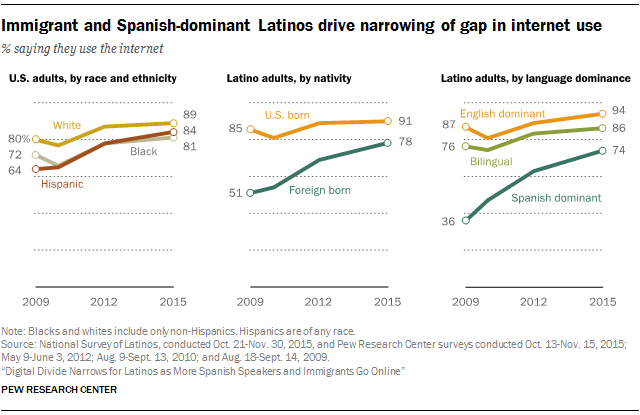
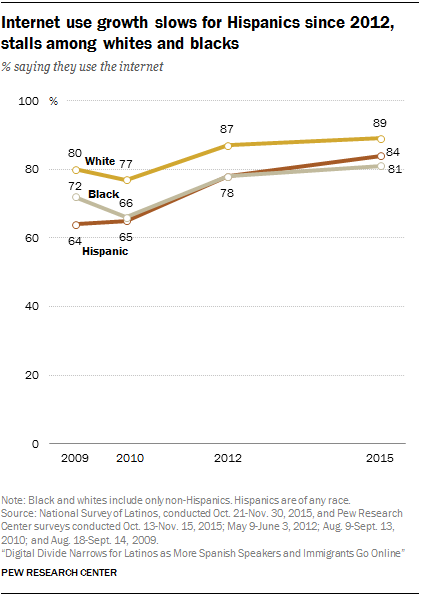
Since 2009, the share of Latino adults who report using the internet increased 20 percentage points, up from 64% then to 84% in 2015. Over the same period, internet use among whites grew too, though at a slower rate, moving from 80% to 89%. As a result, the gap in internet use between Latinos and whites declined from 16 percentage points in 2009 to 5 percentage points in 2015.

Big gains in internet use made by immigrant Hispanics and Spanish-dominant Hispanics, two closely linked groups, 2 have been the main drivers in closing this gap. Both groups have long had among the lowest internet use rates among Hispanics – and that is still the case today. Even so, between 2009 and 2015, the share of immigrant Hispanics who use the internet grew from 51% to 78%. And over the same period, the share of Spanish-dominant Hispanics who use the internet about doubled, from 36% to 74%. As a result, the digital divide among Hispanics has also diminished.
As internet use has grown more common among Latinos, the demographic profile of Latino internet users has also changed and is now more representative of the Hispanic adult population. In 2015, immigrant Latinos made up about half (52%) of all adult Latino internet users, up from 44% in 2009. And Spanish-dominant Latinos made up 32% of all Latino internet users in 2015, up from 20% in 2009. In both cases, these shares closely match each group’s share among the adult Latino population overall. (Immigrant Latinos make up 49% of the adult Latino population, and those who are Spanish dominant make up 38% of Latino adults.) Still, the 16% of Hispanics who do not access the internet remain largely foreign born (77%) and Spanish dominant (58%).

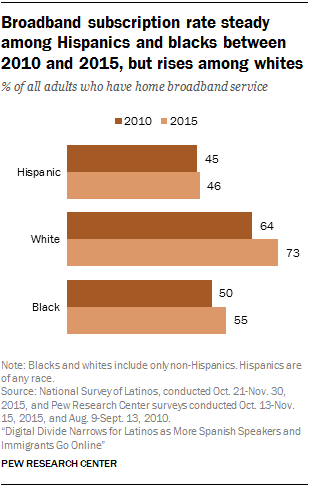
Meanwhile, the share of all Hispanic adults who access the internet through a home broadband connection is little changed since 2010. Then, 45% said they accessed the internet through a broadband home connection. Today that share is 46%. Among blacks too there was little change in the share of adults who have broadband access at home – 50% in 2010 and 55% in 2015. Over the same period, that share among whites grew from 64% to 73%.

The Latino survey also shows that among Latino adults, 80% access the internet from a mobile device, similar to the shares among whites (76%) and blacks (77%) in 2015.

More than 55 million Hispanics live in the U.S. today. The nation’s Hispanic population is also one of the country’s fastest growing groups. It is also among the nation’s youngest – nearly half are under the age of 18.

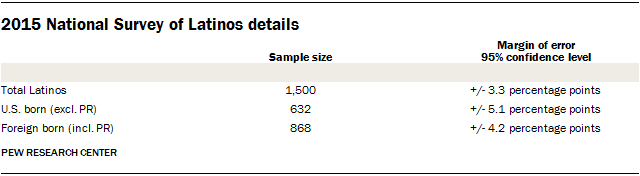
These findings on internet use emerge from the 2015 National Survey of Latinos by Pew Research Center. The survey was conducted in English and Spanish on landline and cellular telephones among a randomly selected, nationally representative sample of 1,500 Latino adults in all 50 states and the District of Columbia. The survey was fielded from Oct. 21 to Nov. 30, 2015, and has a margin of error of plus or minus 3.3 percentage points at the 95% confidence level.

Terminology

The terms “Latino” and “Hispanic” are used interchangeably in this report.

The terms “whites” and “blacks” are used to refer to single-race, non-Hispanic components of their populations.

“U.S. born” refers to persons who say they were born in the 50 states or the District of Columbia.

“Foreign born” refers to persons who say they were born outside of the United States. Foreign born also refers to those born in Puerto Rico. Although individuals born in Puerto Rico are U.S. citizens by birth, they are included among the foreign born because they are born into a Spanish-dominant culture and because on many points their attitudes, views and beliefs are much closer to Hispanics born abroad than to Hispanics born in the 50 states or the District of Columbia. The terms “foreign born” and “immigrant” are used interchangeably.

Language dominance is a composite measure based on self-described assessments of speaking and reading abilities. “Spanish-dominant” persons are more proficient in Spanish than in English, i.e., they speak and read Spanish “very well” or “pretty well” but rate their ability to speak and read English lower. “Bilingual” refers to persons who are proficient in both English and Spanish. “English-dominant” persons are more proficient in English than in Spanish.

In 2015, an “internet user” is someone who says they use the internet or email at least occasionally and/or says they access the internet on a cellphone, tablet or other mobile handheld device at least occasionally. Prior to 2012, internet users were defined as those who answered “yes” to “Do you use the internet, at least occasionally?” and/or “Do you send or receive email, at least occasionally?” See Methodology for details.

A person is considered to have “home internet” or a “home internet subscription” if they are an internet user and report that they currently subscribe to internet service at home.

A person is considered to have “broadband access” or a “broadband subscription” if they say they currently subscribe to internet service at home and confirm that they subscribe to a higher-speed broadband service. Question wording has changed since 2010; see Topline for details.

A person is considered “smartphone dependent” if they do not have broadband internet access at home but do use a mobile device to access the internet.
1. Internet use among Hispanics

In 2015, wide gaps in internet use existed by demographic group among Hispanics, just as there are among all Americans. But in recent years, some of the largest gains in internet use have been among immigrant Hispanics and those who are Spanish dominant. As a result, internet use among Hispanic adults continues to grow, though at a slowing rate, as the internet use rate approaches 90% for Americans overall.

Among Latinos, who goes online?

One of the sharpest divides in internet access among Hispanics is by age. Internet use is over 90% among Hispanics younger than 50, but it drops to 67% among those ages 50 to 64 and only 42% among those ages 65 and older.

There are other differences in internet use among Hispanic demographic subgroups. For example, those with more education and those with higher household incomes are also more likely to report using the internet. Two-thirds (67%) of Hispanics who have less than a high school education were online in 2015, compared with 95% of those with at least some college experience.

On a similar note, 79% of Hispanics who had an annual family income of less than $30,000 use the internet, while nearly all (97%) of those who make $50,000 or more do.

U.S.-born Latinos are somewhat more likely than foreign-born Latinos to report using the internet (91% vs. 78%), but among U.S.-born Latinos, there is no significant difference between second- or third-generation or higher Latinos when looking only at the U.S. born.

Those who speak primarily English are more likely to be online (94%), compared with those who are bilingual (86%) or who speak primarily Spanish (74%).

There is no significant difference between Hispanic men and Hispanic women on the share who use the internet.

Similar demographic patterns emerge when looking at all adults, though the differences are less pronounced since a larger share of older and less-educated U.S. adults use the internet.

Rise in internet use has slowed among Hispanics, stalled among blacks and whites

While growth in the rate of internet use among the major racial groups in the U.S. has slowed, it continues to rise among Hispanics. Between 2012 and 2015, internet use among Hispanic adults rose from 78% to 84%. Meanwhile, there was no statistically significant change in the share of white and black adults who report they use the internet. 3

Just about all of the change in Hispanics’ internet since 2012 took place among the foreign born. While internet use among the U.S. born was steady from 2012 to 2015, the share of foreign-born Hispanics who say they use the internet increased from 69% to 78% over this period.

Similarly, those who are Spanish dominant saw the greatest increase in internet use, rising from 63% in 2012 to 74% in 2015 – an 11-percentage-point increase. By contrast, internet use rose slightly among English-dominant Hispanics and stayed about the same for bilingual Hispanics.

2. Broadband subscriptions among Latinos little changed since 2010

Overall, 59% of Hispanic adults report that they currently subscribe to internet service of any kind at home, but the demographic divides in home internet subscription rates among Hispanics are wide. For example, among Hispanic adults with less than a high school education, just one-third say they have a home internet subscription. Meanwhile, 80% of those with at least some college experience have home internet.

There is a similar gap across age groups among Hispanics. Among younger Hispanics – those ages 18 to 29 – around three-quarters (72%) say they subscribe to home internet. This share is smaller for older Hispanics, and only 29% of those ages 65 and older have a home internet subscription.

Looking at Hispanics by nativity and language dominance, two measures that are closely linked to each other, those who are foreign born (48%) or Spanish dominant (35%) are much less likely to have home internet than those who are U.S. born (72%) or English dominant (75%). Bilingual Hispanics (69%) fall between the English and the Spanish dominant, but more closely resemble English-dominant Hispanics.

Broadband use among Hispanics in 2015 varies across demographic subgroups

While the majority of Latinos who have a home internet subscription have a higher-speed broadband service such as DSL, cable or fiber-optic (85%) rather than dial-up (8%), the same groups that are the most likely to have a home internet subscription of any kind are also the most likely to have broadband service among home internet subscribers. 4

Among Hispanic adults, those who are young (59% of those ages 18 to 29 and 47% of those ages 30 to 49), U.S. born (61%), English dominant (65%) or the most highly educated (69% of those with at least some college experience and 47% of high school graduates) are the most likely to subscribe to a high-speed broadband service rather than dial-up internet service or no home internet service at all.

For example, while about two-in-ten Hispanic adults with less than a high school education (18%) report that they have broadband, 47% of high school graduates and 69% of those with at least some college experience say the same.

The U.S. born are about twice as likely as the foreign born to say they have a broadband subscription (61% vs. 35%) and the English dominant and bilingual are similarly more likely than the Spanish dominant to say this (65% of English-dominant Hispanics vs. 56% of bilingual Hispanics and 21% of the Spanish dominant).

Some 59% of Hispanics ages 18 to 29 say they have a broadband subscription, compared with about half (47%) of those ages 30 to 49, 35% of those ages 50 to 64 and only 21% of those ages 65 and older.

Little change in broadband use among Hispanics since 2010

While internet use among Hispanics is on the rise, the share with a subscription to home high-speed or broadband internet is little changed since 2010 and lags behind the share of whites with home broadband service.

Just 46% of Hispanic adults in 2015 say they have home broadband service, virtually unchanged since 2010 when 45% said the same. A greater share of blacks than Hispanics – 55% versus 46% in 2015 – have home broadband service, yet for blacks too, the share with home broadband is little changed since 2010, when 50% had the service. Meanwhile, the share of whites with broadband home service is 73% in 2015, up 9 percentage points since 2010.

3. Hispanics and mobile access to the internet

Mobile devices such as smartphones and tablets have made accessing the internet easier in recent years – although those who rely heavily on these devices for online access can face challenges accessing certain online services and information. And among Hispanic internet users, the new survey shows a greater share today use these mobile devices to go online than in 2012.

Mobile-device internet access among Latino subgroups

Overall, 80% of Latino adults say they access the internet via a mobile device such as a cellphone or tablet at least occasionally. This high share, however, belies large differences among Latino demographic subgroups.

For example, while nearly all 18- to 29-year-old Latinos (94%) and 30- to 49-year-old Latinos (89%) use the internet on a mobile device, 58% of Latinos ages 50 to 64 and less than half of those ages 65 and older (35%) do so.

The likelihood of using mobile internet increases with more education and with a higher family income. While about six-in-ten Hispanic adults with less than a high school education (63%) say they use the internet on a mobile device, about nine-in-ten with at least some college experience (91%) say the same. A similar pattern exists for family income, ranging from 77% among those with a family income of less than $30,000 in 2014 up to 94% among those in families earning $50,000 or more.

Smaller differences exist by language dominance and nativity. Fully 86% of English-dominant and 83% of bilingual Hispanic adults use mobile internet, a somewhat higher share than that among Spanish-dominant Hispanic adults (71%). Also, the U.S. born (86%) are more likely than the foreign born (75%) to use mobile internet.

Growing share of online adults now access the internet with a mobile device

Most online Americans also say they use a mobile device (like a cellphone or tablet computer) to access the internet. 5 But this share is higher among Hispanic (94%) and black (94%) internet users than among white internet users (85%).

Mobile internet use is on the rise in the U.S. overall and may even be supplanting home broadband subscriptions. The share of internet users who access the internet on a mobile device rose between 2012 and 2015 among all major racial/ethnic groups in the U.S. The share of Hispanic internet users who access the internet on a mobile device has risen from 76% to 94%. The change among black internet users has been similar, rising from 73% to 94%, while the share of white internet users who access the internet on a mobile device also grew (from 60% to 85%) but still remains lower.

This may help explain why Hispanics and blacks lag whites in broadband subscription rates. Only 10% of white smartphone owners are considered “smartphone dependent,” meaning that they do not have broadband internet access at home but do use a mobile device to access the internet. Hispanic and black smartphone owners, however, are twice as likely to be smartphone dependent – 23% of Hispanics and 19% of blacks fall into this group. 6

Acknowledgments

This report was written by Anna Brown, research analyst; Gustavo López, research assistant; and Mark Hugo Lopez, director of Hispanic research. Claudia Deane, vice president of research, and Aaron Smith, associate director of research, provided editorial guidance. Andrew Perrin, research assistant, provided research assistance. Michael Keegan, information graphics designer, assisted with chart creation. Gustavo López number-checked the report. David Kent copy edited the report. Find related reports online at pewresearch.org/pewresearch-org/hispanic.

Methodology

Data sources

Unless otherwise noted, all estimates for Hispanics come from Pew Research Center’s National Survey of Latinos, while estimates for whites and blacks are derived from other Pew Research Center surveys.

Questions about technology have been modified over time. Prior to 2015, internet and email use were asked as two separate questions. Internet use read “Do you use the internet, at least occasionally?” Email use read “Do you send or receive email, at least occasionally?” and was asked of those who said “No” or “Don’t know/Refused” to internet use. Those who said they used the internet, email or both were considered internet users. For 2015, internet users are defined as someone who said “yes” to either “Do you use the internet or email, at least occasionally?” or “Do you access the internet on a cellphone, tablet or other mobile handheld device, at least occasionally?”

Cellphones were included in survey samples beginning in 2008.

Methodology

Results for this study are based on telephone interviews conducted by SSRS, an independent research company, for Pew Research Center among a nationally representative sample of 1,500 Latino respondents ages 18 and older. It was conducted on cellular and landline telephones from Oct. 21 through Nov. 30, 2015.

For the full sample, a total of 632 respondents were U.S. born (excluding Puerto Rico), and 868 were foreign born (including Puerto Rico). For results based on the total sample, one can say with 95% confidence that the error attributable to sampling is plus or minus 3.3 percentage points.

For this survey, SSRS used a staff of bilingual English- and Spanish-speaking interviewers who, when contacting a household, were able to offer respondents the option of completing the survey in either language. A total of 679 respondents (45%) were surveyed in Spanish, and 821 respondents (55%) were interviewed in English. Any person ages 18 or older who said he or she was of Latino origin or descent was eligible to complete the survey.

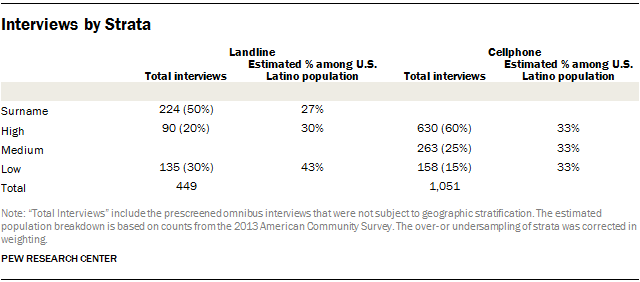
To ensure the highest possible coverage of the eligible population, the study employed a dual-frame landline/cellular telephone design. The sample consisted of a landline sampling frame (yielding 449 completed interviews) and a cellphone sampling frame (1,051 interviews). 7 Both the landline and cellphone sampling frames used a stratified sampling design, oversampling areas with higher densities of Latino residents. Overall the study employed six strata. Landline and cellphone samples were provided by Marketing Systems Group (MSG).

For the landline sampling frame, the sample was compared with InfoUSA and Experian landline household databases, and phone numbers associated with households that included persons with known Latino surnames were subdivided into a surname stratum. The remaining, unmatched and unlisted landline sample was used to generate a stratum with a high incidence of Latinos, based upon the share of Latinos in the sample telephone exchange.

It is important to note that the existence of a surname stratum does not mean the survey was exclusively a surname sample design. The sample is RDD (random-digit dial), with the randomly selected telephone numbers divided by whether or not they were found to be associated with a Spanish surname. This was done to ease administration by allowing for more effective assignment of interviewers and labor hours, as well as to increase the efficiency of the sample.

MSG’s GENESYS sample generation system was used to generate the cellphone sample, which was divided into high and medium strata, based upon the share of Latinos in the sample telephone area code.

Samples for the low-incidence landline and low-incidence cell strata were drawn from previously interviewed respondents in SSRS’s weekly dual-frame Excel omnibus survey. Respondents who indicated they were Latino on the omnibus survey were eligible to be re-contacted for this survey. Altogether, a total of 293 previously interviewed respondents were included in this sample.

A multistage weighting procedure was used to ensure an accurate representation of the national Hispanic population.

  • An adjustment was made for all persons found to possess both a landline and a cellphone, as they were more likely to be sampled than were respondents who possessed only one phone type. This adjustment also took into account the different sampling rate in the landline and cellphone samples.
  • The sample was corrected for a potential bias associated with re-contacting previously interviewed respondents in low-incidence strata.
  • The sample was corrected for within-household selection in landline interviews, which depended upon the number of Latino adults living in the household.
  • The sample was corrected for the oversampling of telephone number exchanges known to have higher densities of Latinos and the corresponding undersampling of exchanges known to have lower densities of Latinos.
  • Finally, the data were put through a post-stratification sample balancing routine. The post-stratification weighting utilized estimates of the U.S. adult Hispanic population based on the 2013 U.S. Census Bureau’s American Community Survey, on gender, age, education, Census region, heritage and years in the U.S. Phone status of the U.S. adult Hispanic population (i.e., cellphone only, dual/landline only) is based on estimates from the January-June 2015 National Health Interview Survey conducted by the U.S. Centers for Disease Control and Prevention; the density of the Latino population is from the 2010 census.
  • Weights are then trimmed to avoid any particular case having too much influence on the overall estimates.

Pew Research Center undertakes all polling activity, including calls to mobile telephone numbers, in compliance with the Telephone Consumer Protection Act and other applicable law.

Appendix A: References

Blumberg, Stephen J. and Julian V. Luke. 2016. “Wireless Substitution: Early Release of Estimates From the National Health Interview Survey, July–December 2015.” Atlanta: Centers for Disease Control and Prevention, May.http://www.cdc.gov/nchs/data/nhis/earlyrelease/wireless201605.pdf

Fox, Susannah and Gretchen Livingston. 2007. “Latinos Online.” Washington, D.C.: Pew Research Center, March. https://alpha.pewresearch.org/pewresearch-org/hispanic/2007/03/14/latinos-online/

Horrigan, John B. and Maeve Duggan. 2015. “Home Broadband 2015.” Washington, D.C.: Pew Research Center, December. https://alpha.pewresearch.org/pewresearch-org/internet/2015/12/21/home-broadband-2015/

Krogstad, Jens Manuel and Ana Gonzalez-Barrera. 2015. “A majority of English-speaking Hispanics in the U.S. are bilingual.” Washington, D.C.: Pew Research Center, March. https://alpha.pewresearch.org/pewresearch-org/short-reads/2015/03/24/a-majority-of-english-speaking-hispanics-in-the-u-s-are-bilingual/

Krogstad, Jens Manuel and Mark Hugo Lopez. 2015. “Hispanic population reaches record 55 million, but growth has cooled.” Washington, D.C.: Pew Research Center, June. https://alpha.pewresearch.org/pewresearch-org/short-reads/2015/06/25/u-s-hispanic-population-growth-surge-cools/

Lopez, Mark Hugo, Ana Gonzalez-Barrera and Eileen Patten. 2013. “Closing the Digital Divide: Latinos and Technology Adoption.” Washington, D.C.: Pew Research Center, March. https://alpha.pewresearch.org/pewresearch-org/hispanic/2013/03/07/closing-the-digital-divide-latinos-and-technology-adoption/

McHenry, Giulia. 2016. “Evolving Technologies Change the Nature of Internet Use.” Washington, D.C.: National Telecommunications & Information Administration, April. https://www.ntia.doc.gov/blog/2016/evolving-technologies-change-nature-internet-use

Patten, Eileen. 2016. “The Nation’s Latino Population Is Defined by Its Youth.” Washington, D.C.: Pew Research Center, April. https://alpha.pewresearch.org/pewresearch-org/hispanic/2016/04/20/the-nations-latino-population-is-defined-by-its-youth/

Pew Research Center. “Internet User Demographics.” Washington, D.C. https://alpha.pewresearch.org/pewresearch-org/internet/data-trend/internet-use/latest-stats/

Smith, Aaron. 2015. “Searching for Work in the Digital Era.” Washington, D.C.: Pew Research Center, November. https://alpha.pewresearch.org/pewresearch-org/internet/2015/11/19/searching-for-work-in-the-digital-era/

Smith, Aaron. 2015. “U.S. Smartphone Use in 2015.” Washington, D.C.: Pew Research Center, April. https://alpha.pewresearch.org/pewresearch-org/internet/2015/04/01/us-smartphone-use-in-2015/

Stepler, Renee and Anna Brown. 2016. “Statistical Portrait of Hispanics in the United States.” Washington, D.C.: Pew Research Center, April. https://alpha.pewresearch.org/pewresearch-org/hispanic/2016/04/19/statistical-portrait-of-hispanics-in-the-united-states/

Appendix B: Additional table