
Pew Research Center

FOR RELEASE JULY 23, 2013

A Growing Share of Latinos Get Their News in English

The language of news media consumption is changing for Hispanics: a growing share of Latino adults are consuming news in English from television, print, radio and internet outlets, and a declining share are doing so in Spanish, according to survey findings from the Pew Research Center.

FOR MEDIA OR OTHER INQUIRIES:

Communications Department
202.419.4372
www.pewresearch.org

RECOMMENDED CITATION

Pew Research Center, July 2013, "A Growing Share of Latinos Get Their News in English"

About Pew Research Center

Pew Research Center is a nonpartisan, nonadvocacy fact tank that informs the public about the issues, attitudes and trends shaping the world. It does not take policy positions. The Center conducts public opinion polling, demographic research, computational social science research and other data-driven research. It studies politics and policy; news habits and media; the internet and technology; religion; race and ethnicity; international affairs; social, demographic and economic trends; science; research methodology and data science; and immigration and migration. Pew Research Center is a subsidiary of The Pew Charitable Trusts, its primary funder.

© Pew Research Center 2026

Table of contents

  • About Pew Research Center
  • A Growing Share of Latinos Get Their News in English
  • II. Demographics and Language of News Media Consumption
  • III. Who Keeps Up with the News?
  • IV. Watching, Reading and Listening to the News
  • V. Assessing the English-Language and Spanish-Language News Media
  • References
  • Appendix A: Additional Tables
  • Appendix B: 2012 National Survey of Latinos Methodology
  • Appendix C: 2012 National Survey of Latinos Topline

A Growing Share of Latinos Get Their News in English

The language of news media consumption is changing for Hispanics: a growing share of Latino adults are consuming news in English from television, print, radio and internet outlets, and a declining share are doing so in Spanish, according to survey findings from the Pew Research Center.

I. Overview

PHC-hispanic-media-1-01

The language of news media consumption is changing for Hispanics: a growing share of Latino adults are consuming news in English from television, print, radio and internet outlets, and a declining share are doing so in Spanish, according to survey findings from the Pew Research Center.

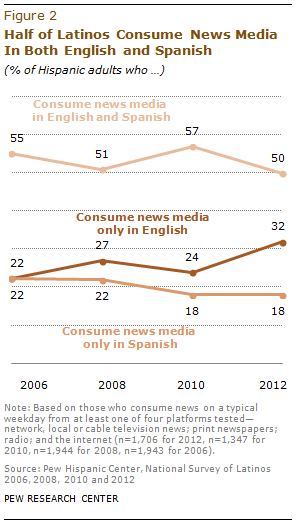
In 2012, 82% of Hispanic adults said they got at least some of their news in English,1 up from 78% who said the same in 2006. By contrast, the share who get at least some of their news in Spanish has declined, to 68% in 2012 from 78% in 2006.2

Half (50%) of Latino adults say they get their news in both languages, down from 57% in 2010.

The rise in use of English news sources has been driven by an increase in the share of Hispanics who say they get their news exclusively in English. According to the survey, one-third (32%) of Hispanic adults in 2012 did this, up from 22% in 2006. By contrast, the share of Hispanic adults who get their news exclusively in Spanish has decreased to 18% in 2012 from 22% in 2006.
PHC-hispanic-media-1-02

These changes in news consumption patterns reflect several ongoing demographic trends within the Hispanic community. For example:

  • A growing share of Latino adults speak English well. Today 59% of Latino adults speak English proficiently, up from 54% in 2006 and 2000, according to U.S. Census Bureau data.
  • Slowing immigration. As migration to the U.S. has slowed (Passel, Cohn and Gonzalez-Barrera, 2012), the share of Hispanic adults who are foreign born has declined. Today about 51% of Hispanic adults were born in another country, down from 55% in 2006 and 54% in 2000, according to U.S. Census Bureau data.
  • Growing time in the U.S. With the slowdown in migration, the average number of years lived in the U.S. among Latino adult immigrants has grown, from 16 years in 2000 and 17 years in 2006 to 20 years in 2011.
  • U.S.-born Latino adults on the rise. Annually about 800,000 young U.S.-born Latinos enter adulthood (Taylor, Gonzalez-Barrera, Passel and Lopez, 2012). Many are the children of immigrants, and a significant share are third or higher generation. These groups are much more English proficient than are immigrants.

Even though the share of Hispanic adults who consume news media in Spanish has declined, the number of potential Spanish news media consumers is growing as a result of the rapid overall rise in the number of Hispanics in the U.S.—to 52 million in 2011, up from 35 million in 2000. According to U.S. Census Bureau data, a record 35 million Hispanics ages 5 and older speak Spanish (at home), up from 25 million in 2000 and 10 million in 1980. At the same time, a record 31 million Hispanics ages 5 and older are proficient in English, up from 19 million in 2000 and 8 million in 1980.3

PHC-hispanic-media-1-03

This report is largely based on a nationally representative bilingual telephone survey of 1,765 Latino adults conducted from September 7 to October 4, 2012. The margin of error for the full sample is plus or minus 3.2 percentage points at the 95% confidence level. For a full description of the survey methodology, see Appendix B.

Among the report’s other findings:

Keeping up with the news

  • About eight-in-ten Hispanic adults say they keep up with the news “a lot” (45%) or “some” (36%) and about two-in-ten keep up “not much” (15%) or “not at all” (4%).
  • Among Hispanics who get their news exclusively in English, 53% say they keep up with the news a lot. Among those who get their news in both English and Spanish, 46% say they do the same. By contrast, 35% of Hispanics who get their news exclusively from Spanish-language news platforms say they keep up with the news a lot.
  • Keeping up with the news is also correlated with educational attainment. Six-in-ten (58%) Hispanics who have at least some college experience say they keep up with the news a lot. Among those with a high school diploma, 44% say the same. And among those with less than a high school diploma, one-third (34%) say they keep up with the news a lot.

Television is the most popular platform for news, but internet is on the rise

  • Fully 86% of Latino adults say that on a typical weekday they get their news from television. That is down slightly from 92% who said the same in 2006 but is higher than the share of Latinos who get their news from radio (56%), the internet (56%) or print newspapers (42%).
  • Use of internet news media has grown among Latino adults. Today more than half (56%) say they consume news media on a typical weekday from the internet, up from 37% in 2006.
  • Radio news media and print newspapers have seen the biggest declines in use among Latino adults. Use of radio is down from 64% in 2006 to 56% in 2012. Use of print newspapers is down even more sharply, from 58% in 2006 to 42% in 2012.

Most Latinos use two or three news media platforms on a typical weekday

  • Latino adults on average use 2.4 news media platforms among the four tested—television, print newspapers, radio and the internet—when they consume news media.
  • Looked at another way, 3% of Latino adults do not use any of the four news media platforms tested, 17% use one, 32% use two, 33% use three and 15% use all four platforms.
  • Six-in-ten (58%) Latinos who consume news media in both English and Spanish use three or four news media platforms. Among Latinos who consume news media only in English, 51% do the same. However, among Latinos who consume news media only in Spanish, just 23% do this.

News reports from both Spanish- and English-language news organizations seen as “accurate”

  • When asked if news organizations get their facts straight or are often inaccurate, 60% of all Hispanics says Spanish-language news organizations “get the facts straight” and 59% say the same of English-language news organizations.
  • Assessments vary by nativity. Two-thirds (65%) of foreign-born Hispanics say Spanish-language news organizations get the facts straight, while 53% of the native born say the same. For English-language news organizations, 64% of the foreign born say they get the facts straight while 54% of the native born say the same.

Spanish-language media seen as doing a better job covering news relevant to Hispanics

  • Overall, seven-in-ten Hispanic adults say the Spanish-language news media do an “excellent” (24%) or “good” job (46%) covering news specifically relevant to Hispanics in the U.S. By contrast, about six-in-ten Hispanic adults say the English-language news media do an “excellent” (17%) or “good” job (42%) covering news relevant to Hispanics in the U.S.
  • Among Latinos who consume news media only in Spanish or consume news media in both languages, about eight-in-ten (80% and 76% respectively) say the Spanish language news media does an “excellent” or “good” job covering news specifically relevant to Latinos in the U.S. By contrast, among Latinos who get news in English only, fewer (54%) say the same.

The Changing Hispanic News Media Landscape

While the Hispanic news media landscape has long been dominated by Spanish television, newspapers, radio and internet outlets, a number of new news outlets that offer Hispanic-focused news in English have been launched in recent years.

Websites such as NBC Latino, Univision’s news tumblr and Fox News Latino all provide news coverage of issues relevant to the Hispanic community in English. And soon ABC News and Univision will launch a new cable network, Fusion, that will provide 24-hour news and information programming in English directed at Hispanics.

At the same time, there has been growth in the number of Spanish-language platforms as television networks Univision and Telemundo have expanded their affiliate networks. In addition, new Spanish-language cable channels directed at U.S. Latinos, such as CNN Latino and MundoFox, have entered the market.

About this Report

This report explores news media consumption among Hispanic adults. The data used in this report are derived primarily from the Pew Hispanic Center’s 2012 National Survey of Latinos (NSL), which was conducted from September 7 through October 4, 2012, in all 50 states and the District of Columbia among a randomly selected, nationally representative sample of 1,765 Latino adults. The survey was conducted in both English and Spanish on cellular as well as landline telephones. The margin of error for the full sample is plus or minus 3.2 percentage points. Interviews were conducted for the Pew Hispanic Center by Social Science Research Solutions (SSRS).

The report also draws on other Pew Hispanic Center surveys. The 2006 National Survey of Latinos was conducted from June 5 through July 3, 2006, among a nationally representative sample of 2,000 Hispanic adults in both English and Spanish. The margin of error is plus or minus 3.8 percentage points at the 95% confidence interval. The 2008 National Survey of Latinos was conducted from June 9 through July 13, 2008, among a nationally representative sample of 2,015 Hispanic adults in both English and Spanish. The margin of error is plus or minus 2.8 percentage points at the 95% confidence interval. The 2010 National Survey of Latinos was conducted from August 17 through September 9, 2010 among a nationally representative sample of 1,375 Hispanic adults. The margin of error is plus or minus 3.3 percentage points.

This report was written by Director Mark Hugo Lopez and Research Associate Ana Gonzalez-Barrera. Paul Taylor, Amy Mitchell and Emily Guskin provided editorial guidance. The authors thank Taylor, Scott Keeter, Leah Christian, Gretchen Livingston, Eileen Patten, Guskin, Rakesh Kochhar, Mitchell, Rich Morin, Seth Motel, Kim Parker, Antonio Rodriguez and Tom Rosenstiel for guidance on the development of the survey instrument. Danielle Cuddington, Patten and Motel provided research assistance. Patten number-checked the report. Marcia Kramer was the copy editor.

A Note on Terminology

The terms “Latino” and “Hispanic” are used interchangeably in this report.

“Native born” or “U.S. born” refers to persons born in the United States and those born in other countries to parents at least one of whom was a U.S. citizen.

“Foreign born” refers to persons born outside of the United States to parents neither of whom was a U.S. citizen. Foreign born also refers to those born in Puerto Rico. Although individuals born in Puerto Rico are U.S. citizens by birth, they are included among the foreign born because they are born into a Spanish-dominant culture and because on many points their attitudes, views and beliefs are much closer to Hispanics born abroad than to Hispanics born in the 50 states or the District of Columbia, even those who identify themselves as being of Puerto Rican origin.

“First generation” refers to foreign-born people. The terms “foreign born,” “first generation” and “immigrant” are used interchangeably in this report.

“Second generation” refers to people born in the 50 states or the District of Columbia, with at least one first-generation, or immigrant, parent.

“Third and higher generation” refers to people born in the 50 states or the District of Columbia, with both parents born in the 50 states or the District of Columbia. This report uses the terms “third generation” and “third and higher generation” interchangeably.

Language dominance, or primary language, is a composite measure based on self-described assessments of speaking and reading abilities. “Spanish-dominant” persons are more proficient in Spanish than in English, i.e., they speak and read Spanish “very well” or “pretty well” but rate their English-speaking and reading ability lower. “Bilingual” refers to persons who are proficient in both English and Spanish. “English-dominant” persons are more proficient in English than in Spanish.

Language of news media consumption is a composite measure based on the language in which respondents say they consume news media from up to four different news platforms: network, local or cable television news; print newspapers; radio; and the internet. Respondents who consume news media only in English are identified as “get news in English only” consumers. Respondents who consume news media only in Spanish are identified as “get news in Spanish only” consumers. Respondents who consume news media in both Spanish and English from any of the news platforms they use or who consume some platforms only in Spanish and other platforms only in English are identified as news media consumers who “get news in both languages.”

II. Demographics and Language of News Media Consumption

Across demographic subgroups of Latino adults, the language of news media consumption varies.

About six-in-ten (59%) of native-born Latinos say they consume news media only in English, 39% say they consume news media in English and Spanish, and just 2% say they consume news media only in Spanish. By contrast, only 11% of immigrant Hispanics say they consume news media only in English, 59% say they do so in both languages and 31% say they get their news in Spanish only.

Immigrant generation is also linked to news media consumption language. For example, while 11% of foreign-born Hispanics get their news exclusively in English, that share rises to 47% among second-generation Hispanics and to 74% among Hispanics in the third generation or higher. Meanwhile, the share that consumes at least some news media in Spanish falls through the generations, from 90% among immigrant Hispanics to 53% among second-generation Hispanics and just 26% among those in the third or higher generation.

Language of news media consumption also varies with language dominance. According to the survey, three-in-four (75%) English-dominant Hispanics get their news only in English. By contrast, among those who are bilingual, 64% consume news media in English and Spanish. And among those who are Spanish dominant, 43% get their news only in Spanish and an additional 54% get news in both English and Spanish.

Age is also related to the language of news consumption. Four-in-ten (41%) Latinos ages 18 to 29 say they consume news media only in English. By contrast, among those ages 65 and older, 43% say they consume news media only in Spanish.

There are also marked differences in language of news media consumption by educational attainment and family income. About half (53%) of Hispanics with at least some college education get their news only in English, while only 9% of those without a high school diploma get their news in English exclusively. Similarly, six-in-ten Hispanics with family incomes above $50,000 get their news only in English, compared with 22% of those with incomes under $30,000.

III. Who Keeps Up with the News?

When asked how often they keep up with the news, 45% of Latino adults say they do so “a lot,” 36% say they keep up with the news “some” and 15% say they don’t keep up with the news much. Just 4% of Latino adults say they do not keep up with the news “at all.”

Keeping up with the news varies among Latino demographic subgroups. Six-in-ten (62%) Latinos in families that earn more than $50,000 a year, 58% of those some college education and 56% of Latinos ages 50 to 64 say they keep up with the news a lot.

By contrast, only 32% of Latino immigrants who have been in the U.S. for less than 10 years, 34% of Latinos who do not have a high school diploma and 35% of Latinos who get news only in Spanish keep up with the news a lot.

Keeping up with the news also rises through the generations. About four-in-ten (42%) immigrant Latinos say they keep up with the news a lot. Among second-generation Latinos, that share is 47%. Among third-generation Latinos, 54% say the same.

There are also differences among Latinos based on the language of their news media consumption. Among Latinos who consume news media only in English, 53% say they follow the news a lot. Among Latinos who get their news in both English and Spanish, 46% say the same. By contrast, of those who get their news only in Spanish, just one-third (35%) say they do this.

IV. Watching, Reading and Listening to the News

Among all news media, television continues to be the number one news platform for Latinos. According to the Pew Hispanic Center survey, in 2012, 86% of Latino adults say they get their news on a typical weekday from network, cable or local television news, down slightly from 2006 when 92% said they got their news from television sources. The share of Latino adults who say they get their news from radio declined from 64% in 2006 to 56% in 2012.

By comparison, the share of Latino adults who get their news on a typical weekday from print newspapers has decreased considerably, from 58% in 2006 to 42% in 2012.

Meanwhile, the share of adult Latinos who consume news from internet outlets has increased steadily, from 37% in 2006 to 56% in 2012.

Use of television, radio and print newspapers has declined among Latinos, as it has among the general public, though the decline has been sharper among the latter (Kohut, Doherty, Dimock and Keeter, 2012). As a result, television, radio and print newspapers remain more popular among Latinos for news than they do among the general public. For example, 86% of Latino adults say that on a typical weekday they get news from network, local or cable television. By comparison, 55% of all U.S. adults say they watched news on television “yesterday.”4

How Many News Platforms Do Latinos Use?

PHC-hispanic-media-4-02

The Pew Hispanic survey asked survey respondents whether they get news on a typical weekday from one of four different news media platforms—television, print newspapers, radio and the internet. Across these four platforms, Latino adults on average use 2.4 platforms when they consume news media. Looked at another way, 15% use all four platforms tested, 33% use three, 32% use two, 17% use one and just 3% of Latino adults do not use any of the four news media platforms.

How many news media platforms Latinos use is correlated with the language of news media consumption. Among Latinos who consume news media in both languages, 22% use four news media platforms, 36% use three platforms, 31% use two platforms and 11% use just one news media platform. Latinos who consume news media only in English use nearly as many news media platforms: 13% use four media platforms, 38% use three platforms, 34% use two platforms and 15% use just one platform.

However, Latinos who consume news media only in Spanish use fewer news media platforms than other Latinos. Just 3% use all four news media platforms, 19% use three platforms, 37% use two and 40% use only one platform. Among those who use only one platform, 85% use television to get news on a typical weekday.

The number of platforms used when consuming news media also varies by age. Overall, Latinos ages 65 and older use fewer platforms than younger Latinos.

The news media platform used is also correlated with the number of platforms used. For example, among Hispanics who get news from television, 18% use all four platforms and 13% use just one platform. By comparison, among Hispanics who get news from print newspapers, 36% use four platforms while just 1% use one. Hispanics who get news from radio and internet platforms also use more platforms than those who use television.

What Language Do Latinos Use with Each News Media Platform?

PHC-hispanic-media-4-03

The language Hispanics use when consuming news media varies with news media platform. Overall, television has the highest share of Hispanic news consumers who get their news in Spanish. Two-thirds (67%) of Hispanics who get their news from television do so only in Spanish (24%) or do so in Spanish and English (43%).

By contrast, Hispanics who get their news from print newspapers and the internet do so largely in English. Among Hispanics who use print newspapers, half (51%) do so only in English, 21% do so only in Spanish and 27% do so in both languages. The share who get news only in English is even higher among Hispanics who get news from the internet. According to the survey, 61% of Hispanics who get news from the internet do so only in English, 10% do so only in Spanish and 28% so do using both languages.

Who Gets Their News from Television?

PHC-hispanic-media-4-04

Fully 86% of Latino adults say that on a typical weekday, they get news from network, local or cable television news, with large majorities of demographic subgroups of Latinos saying they get news from television on a typical weekday. However, some small but notable differences are revealed by the survey.

Use of television for news is correlated with the language of news consumption. While about nine-in-ten Latino adults who get their news only in Spanish (93%) or in both languages (91%) do so from television, a lower share (82%) among those who get news exclusively in English get it from television.

Television use is also correlated with age. Fully 93% 0f Latino adults ages 65 and older say they get their news from television on a typical weekday. By contrast, among Latinos ages 18 to 29, 83% say they do this.

News consumption from television varies little across other demographic subgroups. Across immigrant generations, for example, television use rates are virtually the same: 87% for immigrants, 85% for those of the second generation and 82% among Hispanics in the third or higher generation.

Who Gets Their News from Print Newspapers?

PHC-hispanic-media-4-05

About four-in-ten (42%) Latino adults say that on a typical weekday, they get news from print newspapers. However, consumption of news media from print newspapers varies by several demographic characteristics, including age, nativity and the language of news consumption.

Among Latinos ages 18 to 29, 36% say they get news from print newspapers on a typical weekday. By contrast, 54% of Latinos ages 50 to 64 and half (49%) of Latinos ages 65 and older say they do the same.

Use of print newspapers is greater among native-born Hispanics than foreign-born Hispanics—46% versus 39%. And among the native born, Hispanics in the third generation are more likely than second-generation Hispanics to use print newspapers to get news—53% versus 41%.

Latinos who consume news media exclusively in Spanish have the lowest rate of print newspaper consumption (30%). By comparison, Latinos who consume news media in both English and Spanish are most likely (50%) to say they get news from print newspapers on a typical weekday.

Who Gets Their News from Radio?

PHC-hispanic-media-4-06

Some 56% of Hispanic adults say they get news on a typical weekday from radio. Just as with other news platforms, news consumption from radio varies some among different demographic subgroups of Latinos.

Among Latino adults, those who consume news media in both English and Spanish are more likely to use radio (65%) than those who get their news in only one language, either English (54%) or Spanish (45%).

Similarly, Hispanics who are bilingual (61%) are more likely than Spanish-dominant Hispanics (51%) to get news from radio on a typical weekday. Among English-dominant Hispanics, 54% say they get news from radio.

Younger Latino adults are also more likely to get their news from radio—59% of those ages 30 to 49 and 57% of those ages 18 to 29, compared with 47% of those ages 65 and older.

Who Gets Their News from the Internet?

PHC-hispanic-media-4-07

Overall, 56% of Hispanic adults say they get their news on a typical weekday from the internet. As with other news platforms, use of the internet for news varies among demographic subgroups of Hispanics.

Among the most likely to get their news from the internet are Latinos ages 18 to 29 (78%), Latinos with family incomes of $50,000 or higher (76%) and those with at least some college education (75%).

By contrast, Latino adults who get their news exclusively in Spanish and those ages 65 and older are the least likely to get their news from the internet—18% and 21%, respectively.

Native-born Latinos are 25 percentage points more likely than foreign-born Latinos to say they get news from the internet—70% versus 45%, respectively.

Latinos who consume news media only in English (73%) are more likely to get their news from the internet than those who consume news media in both English and Spanish (63%) or exclusively in Spanish (18%).

Use of the internet for news is also correlated with educational attainment. Three-in-four (75%) Latino adults with at least some college education say they get news from the internet on a typical weekday. This compares with 60% among those with a high school diploma and about a third (32%) among those without a high school diploma.

Family income is another demographic characteristic that differentiates the rate of internet use for news consumption. Among Hispanic adults, 76% of those with family incomes of $50,000 or higher say they use the internet to get news, as do two-thirds (67%) of those whose family incomes are $30,000 to less than $50,000. By comparison, half (50%) of those whose family incomes are below $30,000 do the same.

Who Gets Their News from Social Networking Sites?

PHC-hispanic-media-4-08

Half (47%) of Hispanic adults say they “regularly,” “sometimes” or “hardly ever” get news or news headlines from social networking sites such as Twitter or Facebook. Just as with those who get their news from the internet, the share of who gets their news from social media is greatest among younger Latinos. About seven-in-ten (69%) Latinos ages 18 to 29 say they get news or news headlines from social networking sites. By contrast, just 9% of Latino adults ages 65 and older do the same.

Differences in the use of social networking sites for accessing news among Latino adults vary among most demographic subgroups.

Native-born Hispanics are about 20 percentage points more likely than foreign-born Hispanics to get their news from social media—58% versus 38%, respectively. Among the native born, those whose parents were born abroad (second generation) are nine percentage points more likely to get their news from social networking sites than native-born Latinos whose parents were also born in the U.S. (third or higher generation)—62% and 53%, respectively

English-dominant Latinos are more likely to get their news from social networking sites than those who are bilingual or Spanish dominant—59%, 49% and 35%, respectively.

Latino adults with higher educational attainment are also more likely to say they get their news from social networking sites. A larger share of Latino adults with at least some college education (57%) or a high school diploma (56%) say they do this, compared with 29% of those without a high school diploma.

Family income is another demographic characteristic that differentiates the rate of social media use for news consumption. Among Latino adults, about six-in-ten of those with family incomes of $50,000 or higher (59%) and family incomes of $30,000 to less than $50,000 (58%) say they use social media sites to get their news. This compares with 44% of those whose family incomes are below $30,000.

V. Assessing the English-Language and Spanish-Language News Media

The Pew Hispanic Center survey asked respondents to assess Spanish-language and English-language news organizations on two measures—whether news organizations get the facts straight and how well both news media cover news that is specifically relevant to Hispanics living in the U.S.

Getting the Facts Straight

PHC-hispanic-media-5-01

When it comes to the accuracy of news reporting, Hispanics are just as likely to say Spanish-language news organizations and English-language news organizations “get the facts straight” in their news stories and reports.

According to the survey, six-in-ten (60%) Hispanic adults say that Spanish-language news organizations “get the facts straight” while 26% say the news stories and reports from Spanish-language media are “often inaccurate.” Hispanics’ assessment of English-language news organizations is nearly the same. Overall, 59% of Hispanic adults say English-language news organizations get the facts straight while 31% say English-language news organizations’ stories and reports are often inaccurate.

PHC-hispanic-media-5-02

Immigrant Latinos are more likely than native-born Latinos to say that Spanish-language news organizations get the facts straight in their reporting—65% versus 53%. Assessment of the accuracy of Spanish-language news organizations is also related to the language Hispanics use to get their news. Among Hispanics who consume news in both English and Spanish, 68% say Spanish-language news organizations get the facts straight. Among those who get their news only in Spanish, a similar share (65%) says the same about Spanish-language news organizations. However, among Hispanics who get their news only in English, half (48%) say Spanish news organizations get the facts straight. (But an additional three-in-ten Hispanics who consume news media only in English say they don’t know whether Spanish-language news organizations get the facts straight or if their stories and reports are often inaccurate.)

In the case of English-language news organizations, differences also exist among Latino demographic subgroups. Just as with their assessments of Spanish-language news organizations, immigrant Latinos are more likely than native-born Latinos to say English-language news organizations get the facts straight—64% versus 54%.

Overall, 68% of Hispanics who get their news in both languages say English-language news organizations get the facts straight. By contrast, 53% of Hispanics who get their news only in Spanish and 53% of Hispanics who get their news only in English say the same.

Covering Stories Relevant to Hispanics in the United States

PHC-hispanic-media-5-03

The Pew Hispanic Center Survey also asked respondents to rate the job the Spanish- and English-language news media have done covering news that is relevant to Hispanics living in the U.S. Overall, the Spanish-language news media are seen as doing a better job at this than the English-language news media.

Seven-in-ten Hispanic adults say the Spanish-language news media do an “excellent” (24%) or “good” (46%) job covering news relevant to Hispanics in the U.S. while about one-quarter say it does “only a fair” (20%) or “poor” (3%) job. By contrast, about six-in-ten Hispanic adults say the English-language news media do an excellent (17%) or good (42%) job covering stories specifically relevant to Hispanics living in the U.S., while about four-in-ten say it does an only fair (28%) or poor (9%) job.

Views of how good a job each type of media is doing covering stories relevant to the Hispanic community vary by nativity. About eight-in-ten immigrant Hispanics say the Spanish-language news media do an excellent (29%) or good (48%) job covering stories relevant to Hispanics in the U.S. By contrast, 60% of U.S.-born Hispanics say the same about the Spanish-language news media’s coverage of stories relevant to Hispanics.

Assessments of the job the English-language news media are doing covering stories relevant to the Latino community in the U.S. also vary by nativity. About two-thirds of foreign-born Latinos say the English-language news media are doing an “excellent” (21%) or “good” (43%) job covering stories relevant to the U.S. Latino community. However, among native-born Latinos, assessment of the English-language news media’s job covering Hispanic stories is split. About half of native-born Latinos say the English-language news media are doing an excellent (11%) or good (40%) job covering these stories, while another half  say the English-language news media are doing “only a fair” (34%) or “poor” (13%) job covering stories relevant to Latinos.

PHC-hispanic-media-5-04

Among Latinos who get their news only in Spanish, 80% say the Spanish-language news media do an excellent or good job covering news specifically relevant to Latinos in the U.S. Similarly, 76% of Latinos who get news in both Spanish and English says the same. However, among Latinos who get their news only in English, a smaller share (54%) says the Spanish-language news media do a good job covering news relevant to the U.S. Latino community.

Assessments of the job the English-language news media are doing covering stories specifically relevant to the Hispanic community in the U.S. are lower. Among Hispanics who get their news only in English, about half (47%) say the English-language news media are doing a good job covering stories relevant to the Hispanic community. Among Hispanics who get their news in both English and Spanish, that share rises to 62%. And among Hispanics who get their news exclusively in Spanish, 65% say the same.

References

Blumberg, Stephen J., and Julian V. Luke. 2012. “Wireless Substitution: Early Release of Estimates from the National Health Interview Survey, July-December 2011.” Hyattsville, MD: National Center for Health Statistics, June.

Guskin, Emily and Amy Mitchell. 2011. “Hispanic Media: Faring Better than the Mainstream Media.” Washington, D.C.: Pew Research Center’s Project for Excellence in Journalism, August.

Kohut, Andrew, Carroll Doherty, Michael Dimock and Scott Keeter. 2012. “In Changing News Landscape, Even Television is Vulnerable; Trends in News Consumption: 1991-2012.” Washington, D.C.: Pew Research Center for the People & the Press, September.

Lopez, Mark Hugo, Ana Gonzalez-Barrera and Eileen Patten. 2013. “Closing the Digital Divide: Latinos and Technology Adoption.” Washington, D.C.: Pew Hispanic Center, March.

Passel, Jeffrey, D’Vera Cohn and Ana Gonzalez-Barrera. 2012. “Net Migration from Mexico Falls to Zero—and Perhaps Less.” Washington, D.C.: Pew Hispanic Center, April.

Suro, Roberto. 2004. “Changing Channels and Crisscrossing Cultures.” Washington, D.C.: Pew Hispanic Center, April.

Taylor, Paul, Ana Gonzalez-Barrera, Jeffrey Passel and Mark Hugo Lopez. 2012. “An Awakened Giant: The Hispanic Electorate is Likely to Double by 2030.” Washington, D.C.: Pew Hispanic Center, November.

Appendix A: Additional Tables

PHC-hispanic-media-A1-02
PHC-hispanic-media-A1-03
PHC-hispanic-media-A1-04
PHC-hispanic-media-A1-05
PHC-hispanic-media-A1-06

Appendix B: 2012 National Survey of Latinos Methodology

Results for this study are based on telephone interviews conducted by Social Science Research Solutions (SSRS), an independent research company, among a nationally representative sample of 1,765 Latino respondents ages 18 and older, conducted from September 7 through October 4, 2012. To facilitate a more comprehensive analysis of non-Catholic Latinos, the sample includes interviews with an additional 438 non-Catholic respondents, for a total of 967 non-Catholics.

For the full sample, a total of 759 respondents were native born (excluding Puerto Rico) and 1,006 were foreign born (including Puerto Rico). For results based on the total sample, one can say with 95% confidence that the error attributable to sampling is plus or minus 3.2 percentage points.

PHC-hispanic-media-A2-01

For this survey, SSRS used a staff of Spanish-speaking interviewers who, when contacting a household, were able to offer respondents the option of completing the survey in Spanish or English. A total of 805 respondents (46%) were surveyed in Spanish, and 960 respondents (54%) were interviewed in English. Any person ages 18 or older of Latino origin or descent was eligible to complete the survey.

To ensure the highest possible coverage of the eligible population, the study employed a dual-frame landline/cellphone telephone design. The sample consisted of a landline component (yielding 880 completed interviews) and a cellphone component (885 interviews).5 Both the landline and cellphone components consisted of a stratified sampling design, oversampling areas with higher densities of Latino residents. The same sampling plan was used for the main sample and the non-Catholic oversample.

For the landline sampling frame, the sample was run against InfoUSA and other household databases, and phone numbers that matched to known Latino surnames were subdivided into a Surname stratum. The remaining unmatched and unlisted landline sample was divided into the following mutually exclusive strata, based on census estimates of the density of the Hispanic population in each: Very High Latino, High Latino and Medium Latino.

Marketing System Group’s (MSG) GENESYS sample generation system was used to generate the cellphone sample, which was divided into High and Medium Latino strata. Overall, the study employed eight strata.

PHC-hispanic-media-A2-02

Samples for the low-incidence landline and cell strata were drawn from previously interviewed respondents in SSRS’s weekly dual-frame Excel omnibus survey. Respondents who indicated they were Latino on the omnibus survey were eligible to be recontacted for the present survey. In addition, the incidences in the Very High and Medium landline strata of the non-Catholic oversample were lower than anticipated, so additional interviews with Latinos6 prescreened from the Excel omnibus survey were used to gather additional responses in these strata. Altogether, a total of 293 previously interviewed respondents (17%) were included in this sample.

It is important to note that the existence of a surname stratum does not mean the 2012 National Survey of Latinos was a surname sample design. The sample is RDD, with the randomly selected telephone numbers divided by whether they were found to be associated with or without a Spanish surname. This was done simply to increase the number of strata and thereby increase the ability to meet ethnic targets and ease administration by allowing for more effective assignment of interviewers and labor hours.

A five-stage weighting design was used to ensure an accurate representation of the national Hispanic population:

  • An adjustment was made for all persons found to possess both a landline and a cellphone, as they were twice as likely to be sampled as were respondents who possessed only one phone type.
  • The sample was corrected for a potential bias associated with recontacting previously interviewed respondents in certain strata.
  • The sample was corrected for the likelihood of within-household selection, which depended upon the likelihood that the respondent’s age group would be selected, and within that age group, the particular respondent would be selected.
  • The sample was corrected for the oversampling of telephone number exchanges known to have higher densities of Latinos and the corresponding undersampling of exchanges known to have lower densities of Latinos.
  • Finally, the data were put through a post-stratification sample balancing routine. The post-stratification weighting utilized national 2012 estimates from the U.S. Census Bureau’s Current Population Survey, March Supplement, on gender, age, education, census region, heritage, years in the U.S., phone status (i.e., cellphone only, cellphone mostly, mixed/landline only/landline mostly) and density of the Latino population. After the data were raked, the weighted data were used to determine the benchmark for a Catholic/non-Catholic parameter, which was used in the second stage of raking.7

Appendix C: 2012 National Survey of Latinos Topline

PHC-hispanic-media-A3-02
PHC-hispanic-media-A3-03
PHC-hispanic-media-A3-04
PHC-hispanic-media-A3-05
PHC-hispanic-media-A3-06