
Pew Research Center

FOR RELEASE AUGUST 20, 2012

Hispanic Student Enrollments Reach New Highs in 2011

Now Largest Minority Group on Four-Year College Campuses

BY Richard Fry and Mark Hugo Lopez

FOR MEDIA OR OTHER INQUIRIES:

Communications Department
202.419.4372
www.pewresearch.org

RECOMMENDED CITATION

Pew Research Center, August 2012, "Hispanic Student Enrollments Reach New Highs in 2011"

About Pew Research Center

Pew Research Center is a nonpartisan, nonadvocacy fact tank that informs the public about the issues, attitudes and trends shaping the world. It does not take policy positions. The Center conducts public opinion polling, demographic research, computational social science research and other data-driven research. It studies politics and policy; news habits and media; the internet and technology; religion; race and ethnicity; international affairs; social, demographic and economic trends; science; research methodology and data science; and immigration and migration. Pew Research Center is a subsidiary of The Pew Charitable Trusts, its primary funder.

© Pew Research Center 2026

Table of contents

  • About Pew Research Center
  • Hispanic Student Enrollments Reach New Highs in 2011
  • II. Hispanic Public School Enrollments
  • III. Hispanic College Enrollments
  • IV. College Graduation and Hispanics
  • Appendix A: Public School Enrollments
  • Appendix B: High School Completion and College Enrollment
  • Appendix C: College Degrees Conferred

Hispanic Student Enrollments Reach New Highs in 2011

Now Largest Minority Group on Four-Year College Campuses

I.  Overview
The nation’s Hispanic 1 student population reached a number of milestones in 2011, according to an analysis of newly available U.S. Census Bureau data by the Pew Hispanic Center, a project of the Pew Research Center.

For the first time, the number of 18- to 24-year-old Hispanics enrolled in college exceeded 2 million and reached a record 16.5% share of all college enrollments. 2  Hispanics are the largest minority group on the nation’s college campuses, a milestone first achieved last year (Fry, 2011). But as their growth among all college-age students continues to outpace other groups, Hispanics are now, for the first time, the largest minority group among the nation’s four-year college and university students. And for the first time, Hispanics made up one-quarter (25.2%) of 18- to 24-year-old students enrolled in two-year colleges.

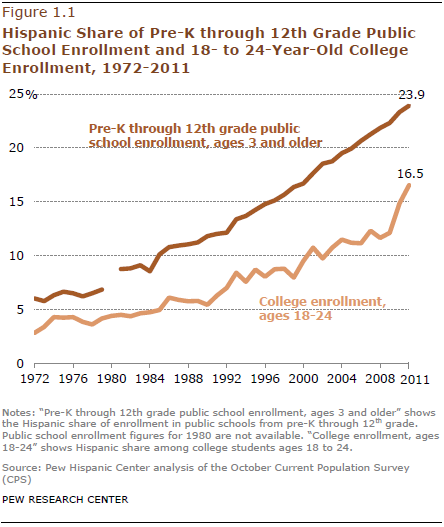
In the nation’s public schools, Hispanics also reached new milestones. For the first time, one-in-four (24.7%) public elementary school students were Hispanic, following similar milestones reached recently by Hispanics among public kindergarten students (in 2007) and public nursery school students (in 2006). Among all pre-K through 12th grade public school students, a record 23.9% were Hispanic in 2011.

The new milestones reflect a number of continuing upward trends. Between 1972 and 2011, the Latino share of 18- to 24-year-old college students steadily grew—rising from 2.9% to 16.5%. During the same period, among all public school students, the Latino share grew from 6.0% to 23.9%. In both cases, rapid Latino population growth has played a role in driving Latino student enrollment gains over the past four decades.

However, population growth alone does not explain all the enrollment gains made by Hispanic students in recent years (Fry, 2011). Today, with the high school completion rate among young Hispanics at a new high, more young Hispanics than ever are eligible to attend college. According to the Pew Hispanic analysis, 76.3% of all Hispanics ages 18 to 24 had a high school diploma or a General Educational Development (GED) degree in 2011, up from 72.8% in 2010. And among these high school completers, a record share—nearly half (45.6%)—is enrolled in two-year or four-year colleges. Both demographic trends and greater eligibility have contributed to growth in the number of Hispanic young people enrolled in college in recent years.

In addition to gains in enrollment, the number of degrees conferred on Latino college students has also reached new highs. 3 In 2010, the number of Latinos who received a bachelor’s degree reached a record 140,000 recipients, according to data published by the National Center for Education Statistics of the U.S. Department of Education (Snyder and Dillow, 2012). A record number of associate degrees were awarded to Latinos in 2010 as well—112,000. In both cases, Latinos are a growing share of all degree recipients—13.2% among those with an associate degree and 8.5% among those who received a bachelor’s degree in 2010. Despite these gains, the Latino share among degree recipients significantly lagged their share among 18- to 24-year-old students enrolled in two-year colleges (21.7%) and four-year colleges and universities (11.7%) in 2010.

Hispanics are the nation’s largest minority group, making up more than 50 million people, or about 16.5% of the U.S. population. Among the 30 million young people ages 18 to 24, 6 million, or 20%, are Hispanics.
II. Hispanic Public School Enrollments

Newly available data indicate that the nation’s Hispanic student population continues to grow. More than 12.4 million Hispanics were enrolled in the nation’s public schools pre-K through 12th grade in October 2011, according to a Pew Hispanic Center analysis of U.S. Census Bureau data. Overall, Hispanic students make up nearly one-quarter (23.9%) of the nation’s public school enrollment, up from one-fifth (19.9%) in 2005 and 16.7% in 2000.

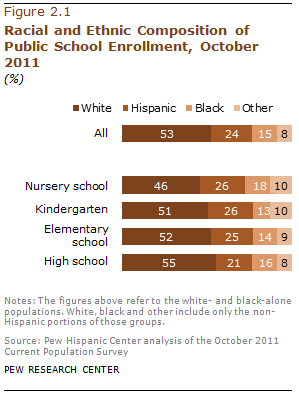
Growth in the share of Hispanics among all public school students reflects growth in their share among younger public school students. In 2011, for the first time, one-quarter (25%) of public elementary school children were Hispanic. This follows on the heels of other Hispanic student population milestones. In 2007, more than 25% of all kindergarten students were Hispanic for the first time, and in 2006 Hispanics reached the one-quarter milestone among all nursery school students. 4 Hispanic children made up 26% of public nursery school enrollments in October 2011. However, Hispanic children are less likely to enroll in nursery schools overall than other children. In October 2011, Hispanic children were only 20% of all nursery school enrollments at both private and public schools.]

In 2011, Hispanics made up 21% of all public high school student enrollments. As students in nursery school progress through kindergarten and into elementary school and high school, Hispanic students will make up a rising share of public high school students and all public school students in coming years. According to the U.S. Census Bureau, by 2036 Hispanics are projected to compose one-third of the nation’s children ages 3 to 17 (U.S. Census Bureau, 2008).

III. Hispanic College Enrollments

Hispanics Continue to Lead Growth in College Enrollments

The ranks of the nation’s young college students continue to grow. In October 2011, 18- to 24-year-old college enrollment reached a record 12.6 million students, up 3% from 2010.

Growth in the number of young Hispanics attending college accounted for the majority of the increase. Between 2010 and 2011, the number of young Hispanics enrolled in college grew by 15%, or 265,000 students, to 2.1 million. This increase follows on the heels of a 24% increase in Hispanic college enrollments between 2009 to 2010 (Fry, 2011). Alone, Hispanic college enrollment growth accounted for nearly three-quarters (74%) of the growth in college student enrollments over the last year.

The white non-Hispanic student population also grew between 2010 and 2011, increasing by 219,000 students, or 3%, to 7.9 million. Meanwhile, the number of blacks enrolled in college and the number of Asians enrolled in college fell, by 3% and 8% respectively between 2010 and 2011.

With fast growth in the Hispanic college student population, Hispanics now make up 16.5% of the nation’s 18- to 24-year-old college students. As recently as October 2006, Hispanics were only 11% of all college students. In just five years, their share has grown by almost 50%. This is a significant milestone because for the first time Hispanic representation among the nation’s traditional college student population matched Hispanics’ overall population representation, also at 16.5%. 5 Even so, Hispanics’ share among college students continues to lag their share (20.0%) among all young people ages 18 to 24.

Hispanics Now Largest Minority Group at Four-Year Colleges

Among 18- to 24-year-olds, Hispanic enrollment at four-year colleges and universities increased 20% from October 2010 (1.0 million) to October 2011 (1.2 million). For the first time, young Hispanic enrollments on four-year campuses exceeded young black enrollments (1.1 million), making Hispanics the largest minority group at four-year colleges and universities. In 2011, Hispanics were 13.1% of all 18- to 24- year olds enrolled at four-year colleges and universities.

This follows a similar change since 2010 among students enrolled at two-year college campuses. Then, the number of Hispanic young people enrolled in two-year colleges was 835,000, higher than the 630,000 black students enrolled at two-year colleges (Fry, 2011). Since then, the number of Hispanics enrolled at two-year colleges has continued to grow. In 2011, some 908,000 Hispanics and 564,000 blacks ages 18 to 24 were enrolled in two-year colleges. In 2011, Hispanics made up one-quarter (25.2%) of all 18- to 24- year old students enrolled in two-year colleges for the first time.

Population Growth and Eligibility Key Reasons for Growth in Hispanic College Enrollments

Some of the growth in Hispanic college enrollments simply reflects continued growth in the nation’s Hispanic population—since 1972, the number of Hispanic 18- to 24-year-olds has grown nearly five-fold, rising from 1.3 million then to 6.0 million in 2011.

However, population growth alone does not explain enrollment gains among Hispanics.

According to Pew Hispanic estimates, a record share of young Hispanics is eligible to attend college. In 2011, 76% of Hispanics ages 18 to 24 had finished high school, the highest level of Hispanic high school completion ever attained and a three-percentage-point increase over the 2010 level (73%). This record-high level of Hispanic high school completion is consistent with the recently noted strong gains in the Hispanic high school graduation rate at the nation’s public schools reported by Education Week (Swanson, 2012). 6

College-going among young Hispanic high school completers also reached a record level in October 2011. Nearly half (46%) were enrolled in college, eclipsing the share (45%) of black high school completers enrolled in college. By comparison, 51% of white high school completers and 67% of Asian high school completers were enrolled in college.

IV. College Graduation and Hispanics

Over the past four decades, the number of Hispanics graduating with either an associate or a bachelor’s degree has increased seven-fold, with growth outpacing that of other groups. As a result, not only has the number of Hispanic degree recipients grown, so too has their share of all college degree recipients. Even so, the number of Hispanics awarded college degrees lags that of other groups, and their share of college graduates remains below that of all college student enrollments.

In 2010, the number of degrees conferred on Hispanics of all ages reached record levels. According to the U.S. Department of Education’s National Center for Education Statistics (Snyder and Dillow, 2012), 112,000 Hispanics received an associate degree and 140,000 Hispanics were awarded a bachelor’s degree—both new highs.7

Despite a record number of degrees conferred on Hispanic college students, they continue to lag other groups. In 2010, 1.2 million bachelor’s degrees were awarded to non-Hispanic white students and 165,000 to non-Hispanic black students. Overall, some 1.7 million bachelor’s degrees were awarded in 2010.

At the associate level, the number of degrees awarded to Hispanics trailed that of non-Hispanic whites (553,000), but nearly matched the number awarded to non-Hispanic blacks (114,000).

The Hispanic share among degree recipients from two-year and four-year colleges has also reached a record. In 2010, 8.5% of all bachelor’s recipients were Hispanic, up from 8.1% in 2009. Among all associate degree recipients, 13.2% were Hispanic, also a record.

While the number of Hispanics receiving a college degree has grown, the number of degrees conferred on Hispanics trails other groups. Among the 1.7 million bachelor’s degrees awarded in 2010, 71% were awarded to non-Hispanic whites, 10% to non-Hispanic blacks, and 7% to non-Hispanic Asian/Pacific Islanders.

Among associate degree recipients in 2010, the share of Hispanics matched that of non-Hispanic blacks—13%—and was more than double the 5% share of non-Hispanic Asian/Pacific Islanders. Two-thirds (65%) of the 849,000 associate degree recipients in 2010 were non-Hispanic white.

References

Fry, Richard. 2011. “Hispanic College Enrollment Spikes, Narrowing Gaps with Other Groups.” Washington, DC: Pew Hispanic Center.

Heckman, James J., and Paul A. LaFontaine. 2007. “The American High School Graduation Rate: Trends and Levels.” Discussion Paper No. 3216. Bonn, Germany: Institute for the Study of Labor (IZA), December.

Passel, Jeffrey, D’Vera Cohn and Mark Hugo Lopez.  2011. “Hispanics Account for More than Half of Nation’s Growth in Past Decade.” Washington, DC: Pew Hispanic Center, March.

Snyder, Thomas D., and Sally A. Dillow. 2012. National Center for Education Statistics, Institute of Education Sciences, U.S. Department of Education. “Digest of Education Statistics, 2011.” Washington, D.C.: June.

Swanson, Christopher B. 2012. “Graduation Rate Keeps Climbing; Strong Gains for Latino Students.” Education Week: June 7.

U.S. Census Bureau. 2011. “CPS Historical Time Series Tables on School Enrollment.” Washington, D.C.

U.S. Census Bureau, Population Division. 2008. “Projected Population by Single Year of Age, Sex, Race, and Hispanic Origin for the United States: July 1, 2000 to July 1, 2050.” Washington, D.C.: August.

Appendix A: Public School Enrollments

Appendix B: High School Completion and College Enrollment

Appendix C: College Degrees Conferred