
Childhood Poverty Among Hispanics Sets Record, Leads Nation
The Toll of the Great Recession
I. Overview
The spread of poverty across the United States that began at the onset of the Great Recession of 2007-2009 and accelerated last year hit one fast-growing demographic group especially hard: Latino children.
More Latino children are living in poverty—6.1 million in 2010—than children of any other racial or ethnic group. This marks the first time in U.S. history that the single largest group of poor children is not white. In 2010, 37.3% of poor children were Latino, 30.5% were white and 26.6% were black, according to an analysis of new data from the U.S. Census Bureau by the Pew Hispanic Center, a project of the Pew Research Center.
This negative milestone for Hispanics is a product of their growing numbers, high birth rates and declining economic fortunes. According to the 2010 U.S. Census, Hispanics today make up a record 16.3% of the total U.S. population. But they comprise an even larger share—23.1%—of the nation’s children (Passel, Cohn and Lopez, 2011), a disparity driven mainly by high birth rates among Hispanic immigrants (Pew Hispanic Center, 2011). According to the 2010 Census, some 53.5% of children are white and 14.6% of children are black.
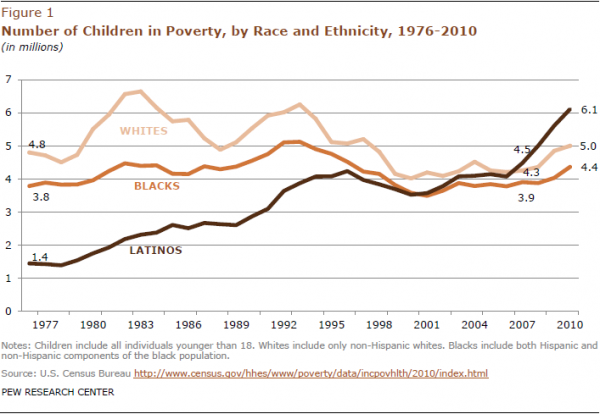
Of the 6.1 million Latino children living in poverty, more than two-thirds (4.1 million) are the children of immigrant parents, according the new Pew Hispanic Center analysis. The other 2 million are the children of parents born in the U.S. Among the 4.1 million impoverished Latino children of immigrants, the vast majority (86.2%) were born in the U.S.

The Great Recession, which began in 2007 and officially ended in 2009, had a large impact on the Latino community. At its beginning, the unemployment rate among Latino workers increased rapidly, especially among immigrant workers (Kochhar, 2008). Today, the unemployment rate among Latinos, at 11.1%, is higher than the national unemployment rate of 9.1% (Bureau of Labor Statistics, 2011). Household wealth among Latinos declined more sharply than either black or white households between 2005 and 2009 (Taylor, Kochhar and Fry, 2011). And according to the U.S. Department of Agriculture, food insecurity among Latino households increased sharply at the start of the Great Recession. In 2008, nearly a third (32.1%) of Latino households with children faced food insecurity, up from 23.8% in 2007 (Nord, Andrews and Carlson, 2009).1
Prior to the Great Recession, more white children lived in poverty than Hispanic children. However, since 2007, that pattern has reversed. Between 2007 and 2010, an additional 1.6 million Hispanic children lived in poverty, an increase of 36.3%. By contrast, even though the number of white and black children living in poverty also grew, their numbers grew more slowly—up 17.6% and 11.7% respectively.
Poverty Rates Among Children
Even though there are more Latino children in poverty than any other racial or ethnic group, the poverty rate among black children is the nation’s highest. In 2010, 39.1% of black children lived in poverty, while 35% of Latino children and 12.4% of white children lived in poverty.
Since 2007, however, poverty rates among Latino children have increased most. Between 2007 and 2010, the Latino child poverty rate increased 6.4 percentage points. Among black children over the same period, the poverty rate increased 4.6 percentage points. And among white children, the poverty rate increased 2.3 percentage points.
Despite the record number of Latino children in poverty, the poverty rate among Hispanic children is not at a record high. In 1994 it stood at 41.5%. Among Hispanic children of immigrant parents, their poverty rate of 40.2% in 2010 is the highest since 1994, when it was 43.9%. Among the Hispanic children with U.S.-born parents, their poverty rate of 27.6% is also not a record high, though it is at its highest level in more than a decade.

The Demographics of Childhood Poverty Among Latino Children
The poverty rate among all Latino children has increased since 2007, but the Great Recession has had a varied impact on different subgroups of Latino children. Between 2007 and 2010, poverty rates among Latino children grew the most among those in families with parents who have a high school diploma or less—up 9.7 percentage points since 2007. By contrast, Latino children with a parent who has a college degree saw the smallest poverty rate increase—just 0.6 percentage points between 2007 and 2010.
Just as the Great Recession had a differential impact on subgroups of Latino children, the prevalence of poverty is not the same across all Latino children. In 2010, Latino children who lived in families headed by single mothers had the highest poverty rate—57.3%. Latino children in families with an unemployed parent also had one of the highest poverty rates overall—43.5% in 2010. By contrast, just 8.7% of Latino children in families with a college-educated parent lived in poverty in 2010.
The U.S. Poverty Rate
Measuring Poverty
The U.S. Census Bureau uses a measure of poverty based on family size and income. Poverty levels are defined by an income threshold depending on family composition and the Consumer Price Index (CPI-U). The measure was adopted as the official federal poverty line (FPL) in the late 1960s as part of the federal government’s war on poverty (Mink and O’Connor, 2004). The definition used today is unchanged since then. In 2010, the official poverty line for a family of four, including two related children, was $22,113. If family income for a family of four is below that line, the family and every individual in it is considered to be in poverty (DeNavas-Walt, Proctor and Smith, 2011).
According to the U.S. Census Bureau, the poverty rate among all Americans has increased since the beginning of the Great Recession. In 2007, the national poverty rate was 12.5%. In 2010, it was 15.1%, the highest it has been since 1993 when it was also 15.1%. Among the nation’s children, the poverty rate rose from 18% in 2007 to 22% in 2010, an increase of 4 percentage points. Among the nation’s largest racial and ethnic groups, the poverty rate among all Hispanics in 2010 was 26.6%, the highest it has been since 1997, and up 5.1 percentage points since 2007. Among blacks, the poverty rate was 27.4% and among whites 9.9%. Both rates were also higher than in 2007 (DeNavas-Walt, Proctor and Smith, 2011).
A Roadmap to the Report
This report provides an in-depth look at Latino children who live in poverty. The next two sections explore poverty rates among many subgroups of Latino children and provide a detailed demographic profile of impoverished Latino children. The report’s appendix includes two tables. The first shows the number of white, black and Latino children in poverty between 1976 and 2010. The second shows the number of Latino children in poverty with immigrant parents and the number of Latino children in poverty with U.S.-born parents between 1993 and 2010.
About this Report
This report focuses on children living in poverty by race and ethnicity in the United States. Children are those ages 17 and younger. The data for this report are derived from the Current Population Survey (CPS) March Supplements from various years. The 1993, 2007 and 2010 estimates are based on Pew Hispanic Center tabulations of March CPS Supplements, including the recently released 2011 March CPS data. Poverty estimates for other years of white, black and Latino children are from historical tables available from the U.S. Census Bureau: http://www.census.gov/prod/2011pubs/p60-239.pdf. Poverty estimates of Latino children with at least one immigrant parent and Latino children with two U.S.-born parents are based on Pew Hispanic Center tabulations of March CPS Supplements from 1994 to 2011.
The CPS March Supplement, also known as Annual Social and Economic Supplement (ASEC), is a survey of about 100,000 households conducted by the Census Bureau for the Bureau of Labor Statistics. It is representative of the non-institutionalized population of the U.S. and is the source for annual, national official estimates of the number of persons living in poverty in the U.S. It also provides annual national estimates of income and health insurance coverage.
This report was researched and written by Associate Director Mark Hugo Lopez and Research Analyst Gabriel Velasco. Paul Taylor provided editorial guidance. D’Vera Cohn, Rakesh Kochhar and Jeffrey Passel provided research guidance and comments. Jeffrey Passel helped with the tabulation of poverty statistics. Seth Motel helped with the production of the report and number-checked it. The report was copy-edited by Molly Rohal.
A Note on Terminology
The terms “Latino” and “Hispanic” are used interchangeably in this report.
Reference to whites in this report refers to its non-Hispanic component. Reference to blacks includes both Hispanic and non-Hispanic components of the black population. The CPS altered its racial identification question in 2003 to allow respondents to identify themselves as being of more than one race. From 2003 onward, references to whites and blacks refer to persons self-identifying as white alone and black alone respectively.
“Foreign born” refers to persons born outside of the United States, Puerto Rico or other U.S. territories to parents neither of whom was a U.S. citizen. “Native born” refers to persons who are U.S. citizens at birth, including those born in the United States, Puerto Rico or other U.S. territories and those born abroad to parents at least one of whom was a U.S. citizen.
The children of immigrant parents are native-born and foreign-born children under age 18 who have at least one parent that was born in another country. The children of U.S.-born parents are native-born children under age 18 who have two U.S.-born parents.


