Pew Research Center

FOR RELEASE JULY 14, 2011

The Mexican-American Boom: Births Overtake Immigration

Births have surpassed immigration as the main driver of the dynamic growth in the nation's Mexican-American population. From 2000 to 2010, the Mexican-American population grew by 7.2 million as a result of births and 4.2 million as a result of new immigrant arrivals. <!--This is a departure from the previous two decades when the number of new immigrants either matched or exceeded the number of births. The relative youth and higher fertility of Mexican-American women have contributed to the increase in births. At the same time, immigration from Mexico declined sharply during the decade.-->

FOR MEDIA OR OTHER INQUIRIES:

Communications Department
202.419.4372
www.pewresearch.org

RECOMMENDED CITATION

Pew Research Center, July 2011, "The Mexican-American Boom: Births Overtake Immigration"

About Pew Research Center

Pew Research Center is a nonpartisan, nonadvocacy fact tank that informs the public about the issues, attitudes and trends shaping the world. It does not take policy positions. The Center conducts public opinion polling, demographic research, computational social science research and other data-driven research. It studies politics and policy; news habits and media; the internet and technology; religion; race and ethnicity; international affairs; social, demographic and economic trends; science; research methodology and data science; and immigration and migration. Pew Research Center is a subsidiary of The Pew Charitable Trusts, its primary funder.

© Pew Research Center 2026

Table of contents

  • About Pew Research Center
  • The Mexican-American Boom: Births Overtake Immigration
  • II. Mexican-American Fertility Patterns
  • III. Comparing Mexicans and Mexican-American Immigrants
  • IV. The Mexican Migration
  • Appendix

The Mexican-American Boom: Births Overtake Immigration

Births have surpassed immigration as the main driver of the dynamic growth in the nation's Mexican-American population. From 2000 to 2010, the Mexican-American population grew by 7.2 million as a result of births and 4.2 million as a result of new immigrant arrivals. <!--This is a departure from the previous two decades when the number of new immigrants either matched or exceeded the number of births. The relative youth and higher fertility of Mexican-American women have contributed to the increase in births. At the same time, immigration from Mexico declined sharply during the decade.-->

I. Overview

Births have surpassed immigration as the main driver of the dynamic growth in the U.S. Hispanic population. This new trend is especially evident among the largest of all Hispanic groups-Mexican-Americans1, according to a new analysis of U.S. Census Bureau data by the Pew Hispanic Center, a project of the Pew Research Center.

In the decade from 2000 to 2010, the Mexican-American population grew by 7.2 million as a result of births and 4.2 million as a result of new immigrant arrivals. This is a change from the previous two decades when the number of new immigrants either matched or exceeded the number of births.

The current surge in births among Mexican-Americans is largely attributable to the immigration wave that has brought more than 10 million immigrants to the United States from Mexico since 1970. Between 2006 and 2010 alone, more than half (53%) of all Mexican-American births were to Mexican immigrant parents. As a group, these immigrants are more likely than U.S.-born Americans to be in their prime child-bearing years. They also have much higher fertility.

Meanwhile, the number of new immigrant arrivals from Mexico has fallen off steeply in recent years. According to a Pew Hispanic Center analysis of Mexican government data, the number of Mexicans annually leaving Mexico for the U.S. declined from more than one million in 2006 to 404,000 in 2010-a 60% reduction.2 This is likely a result of recent developments in both the U.S. and Mexico. On the U.S. side, declining job opportunities and increased border enforcement (Passel and Cohn, 2009) may have made the U.S. less attractive to potential Mexican immigrants. And in Mexico, recent strong economic growth may have reduced the “push” factors that often lead Mexicans to emigrate to the U.S.

As a result, there were fewer new immigrant arrivals to the U.S. from Mexico in the 2000s (4.2 million) than in the 1990s (4.7 million). However, the Mexican-American population continued to grow rapidly, with births accounting for 63% of the 11.2 million increase from 2000 to 2010.3

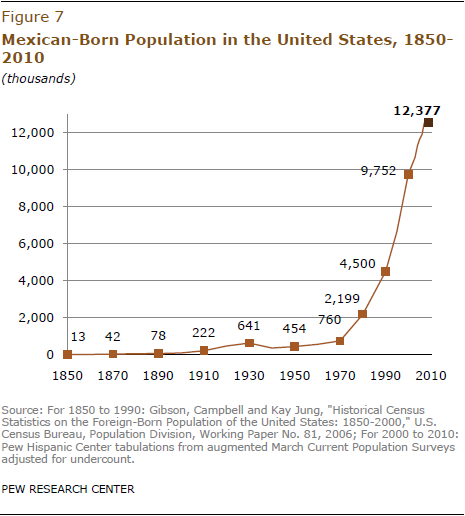
At 31.8 million in 2010, Mexican-Americans comprise 63% of the U.S. Hispanic population and 10% of the total U.S. population (Ennis, Ríos-Vargas and Albert, 2011). According to Pew Hispanic Center tabulations from the March 2010 U.S. Current Population Survey, 39% of Mexican-Americans-or 12.4 million-are immigrants.4 With the exception of Russia, no other country in the world has as many immigrants from all countries as the U.S. has from Mexico alone.5 Nor does any country in the world have as many citizens living abroad as does Mexico. According to the World Bank, more than 10% of Mexico’s native-born population lives elsewhere, with the vast majority (97%) of these expatriates living in the United States.

Overall, the Hispanic population of the United States grew from 35.3 million in 2000 to 50.5 million in 2010, accounting for more than half of the nation’s overall population growth during that decade (Passel, Cohn and Lopez, 2011). Some 58% of this Hispanic population increase came from births rather than the arrival of new immigrants. However, for many non-Mexican-origin Hispanic groups in the U.S., births accounted for less than half of their population growth in the past decade. For example, from 2000 to 2010, births accounted for just 38% of the growth of the Cuban-American population and just 39% of the growth of the population of U.S. Hispanics of Central or South American origin.

Hispanics now comprise 16.3% of the total U.S. population. This share is projected to rise to 29% by the middle of this century, with the bulk of the future increase driven by births, many the descendents of today’s immigration wave, rather than the arrival of new immigrants. (Passel and Cohn, 2008).

II. Mexican-American Fertility Patterns

U.S. births are disproportionately Hispanic, accounting for one-in-four (25%) of the nation’s newborns in 2008 (Martin, et. al, 2008). U.S. births are also disproportionately Mexican-American. While 10% of the nation’s population in 2008 was Mexican-American, 16% of the nation’s births were to Mexican-American mothers.

Two demographic factors explain the high share of births among Mexican-Americans: age and fertility. On average, Mexican-Americans are younger than other major racial and ethnic groups. The median age of Mexican-Americans in this country is 25, compared with 30 for non-Mexican-origin Hispanics, 32 for blacks, 35 for Asians and 41 for whites.6 This means that a higher share of Mexican-American women is of child-bearing age than is the case for other racial or ethnic groups.

In addition, Mexican-American women have more children than do their same-aged counterparts in other racial and Hispanic origin groups. For example, according to Pew Hispanic Center tabulations from the 2006 to 2010 June Fertility Supplements of the U.S. Current Population Survey, the typical Mexican-American woman ages 40 to 44 has given birth to 2.5 children, compared with 1.9 children for the typical same-aged non-Mexican-Hispanic woman, 1.8 children for the typical same-aged white woman, 2.0 for the typical same-aged black woman and 1.8 for the typical same-aged Asian woman.

Mexican-American fertility is also higher than that of non-Mexican-origin U.S. Hispanics. Across all cohorts ages 20 and older, Mexican-American women have anywhere from about 20% to 50% more children than non-Mexican U.S. Hispanic women.

Among Mexican-American women, fertility differs by immigration status. On average, the typical Mexican immigrant woman ages 40 to 44 has about one-third more children over the course of her lifetime than the typical U.S.-born Mexican-American in the same age group—2.7 versus 2.1.

III. Comparing Mexicans and Mexican-American Immigrants

Mexican-American immigrant women ages 40 to 44 have nearly as many children, on average, as their same-aged counterparts living in Mexico—2.7 versus 2.9. This overall similarity in the fertility of Mexicans in Mexico and Mexican emigrants to the U.S. is notable given the vast differences in the past 50 years in the overall fertility patterns of all women in these two neighboring countries. Back in 1960, the total fertility rate7 for women in their child-bearing years was 7.3 children per woman in Mexico versus 3.6 per woman in the U.S. (all women—not just Mexican immigrants). By 2009, the fertility rate in Mexico had fallen to 2.4, while the rate in the U.S. had fallen to 2.0 for all U.S. women.

The sharp decline in fertility rates in Mexico in the past half-century is consistent with the demographic changes that often occur when countries undergo periods of rapid economic growth and modernization (Tuiran, Partida, Mojarro and Zuniga, 2002). In addition, changes in Mexico’s population policy in 1974 played an important part in facilitating fertility declines (Partida-Bush, 2005).

IV. The Mexican Migration

The period between 1970 and 2010 has witnessed one of the largest mass migrations in modern history—the net movement of more than 10 million Mexicans from Mexico into the United States. In 1970, there were fewer than one million Mexican immigrants living in the U.S. By 2000, that number had grown to 9.8 million and by 2007 it reached 12.5 million. Since then, the Mexican-born population has remained roughly constant.

Many Mexican immigrants are in the U.S. without authorization. In 2010 some 6.5 million—more than half (52%) of all Mexican immigrants—were unauthorized immigrants. Among the nation’s 11.2 million unauthorized immigrants from all parts of the world, the majority (58%) are from Mexico (Passel and Cohn, 2011). Many of these unauthorized immigrants have had children in the U.S. Between March 2009 and March 2010, 68% of the 350,000 U.S. births to unauthorized immigrant parents were to Mexican unauthorized immigrants.

Mexican migration to the U.S. has long been characterized, at least in part, by a circular pattern. While many Mexican migrants enter the U.S. to settle permanently, a significant number come to the U.S. to work for a short time, often in seasonal jobs, and return to Mexico. According to a Pew Hispanic Center analysis of Mexican government data, there appears to be less of this return migration now than in the past, possibly because of the increased financial costs of migrating back to the U.S. and the increased danger of crossing the U.S.-Mexico border. In 2006 and 2007, more than 450,000 Mexican migrants returned from the U.S. to Mexico each year. Since then, the number of Mexicans returning to Mexico annually from the U.S. has declined, to 319,000 in 2010.

From Mexico’s perspective, a significant share of its population, especially its working-age population, is abroad. One-in-ten (10%) of everyone born in Mexico resides in the U.S. Among Mexican-born men ages 30 to 44, one-in-five (20%) are in the U.S. Among Mexican-born women in the same age group, more than one-in-seven (15%) are in the U.S.8

Appendix