Pew Research Center

FOR RELEASE FEBRUARY 9, 2011

Latinos and Digital Technology, 2010

Latinos are less likely than whites to access the internet, have a home broadband connection or own a cell phone, according to survey findings from the Pew Hispanic Center.

BY Gretchen Livingston

FOR MEDIA OR OTHER INQUIRIES:

Communications Department
202.419.4372
www.pewresearch.org

RECOMMENDED CITATION

Pew Research Center, February 2011, "Latinos and Digital Technology, 2010"

About Pew Research Center

Pew Research Center is a nonpartisan, nonadvocacy fact tank that informs the public about the issues, attitudes and trends shaping the world. It does not take policy positions. The Center conducts public opinion polling, demographic research, computational social science research and other data-driven research. It studies politics and policy; news habits and media; the internet and technology; religion; race and ethnicity; international affairs; social, demographic and economic trends; science; research methodology and data science; and immigration and migration. Pew Research Center is a subsidiary of The Pew Charitable Trusts, its primary funder.

© Pew Research Center 2026

Table of contents

  • About Pew Research Center
  • Latinos and Digital Technology, 2010
  • II. Internet Use
  • III. Home Internet Use
  • IV. Home Broadband Access
  • V. Cell Phone Ownership
  • VI. Cell Phone Activities
  • Appendix A: Survey Methodology
  • Appendix B: Topline

Latinos and Digital Technology, 2010

Latinos are less likely than whites to access the internet, have a home broadband connection or own a cell phone, according to survey findings from the Pew Hispanic Center.

I. Overview

Latinos are less likely than whites to access the internet, have a home broadband connection or own a cell phone, according to survey findings from the Pew Hispanic Center, a project of the Pew Research Center. Latinos lag behind blacks in home broadband access but have similar rates of internet and cell phone use.1

While about two-thirds of Latino (65%) and black (66%) adults went online in 2010, more than three-fourths (77%) of white adults did so. In terms of broadband use at home, there is a large gap between Latinos (45%) and whites (65%), and the rate among blacks (52%) is somewhat higher than that of Latinos. Fully 85% of whites owned a cell phone in 2010, compared with 76% of Latinos and 79% of blacks.2

Hispanics, on average, have lower levels of education and earn less than whites. Controlling for these factors, the differences in internet use, home broadband access and cell phone use between Hispanics and whites disappear. In other words, Hispanics and whites who have similar socioeconomic characteristics have similar usage patterns for these technologies.

Hispanics, on average, are also younger than whites. However, even within each age group, Hispanics show lower levels of technology use than do whites.

Survey questions also probed for the use of non-voice applications on cell phones. Respondents were asked specifically about whether they access the internet and whether they use email, texting or instant messaging from a cell phone. The findings reveal a mixed pattern of non-voice cell phone application use across ethnic and racial groups. Hispanics are less likely than whites to use any non-voice applications on a cell phone (58% vs. 64%), and they are also less likely than whites to send or receive text messages (55% vs. 61%). However, Hispanics and whites are equally likely to access the internet and send or receive email from a cell phone. And Hispanics are more likely than whites to engage in instant messaging (34% vs. 20%). Compared with blacks, Hispanics are less likely to access the internet (31% vs. 41%) or send or receive email (27% vs. 33%) from a cell phone, but rates of texting and instant messaging are similar for the two groups.

Though they are no more likely than whites to access the internet from a cell phone, Hispanics are more likely to do so in lieu of a home internet connection. Some 6% of Latinos report that they access the internet from a cell phone but have no internet access at home. This rate is the same for blacks, but notably higher than the rate for whites (1%). While controlling for educational attainment and income erases ethnic differences in internet use, broadband access and cell phone ownership, this is not entirely the case when it comes to the ethnic difference in dependency upon a cell phone for internet access. Controlling for income and education erases the differences for the highly educated and most affluent, but differences still persist for those with no college experience, and those earning less than $50,000 annually.

This report is based on two national surveys. The first, the Pew Hispanic Center’s 2010 National Survey of Latinos is a nationally representative bilingual telephone survey of 1,375 adults ages 18 and older. Interviews were conducted from August 17 through September 19, 2010. The margin of error for the full sample is plus or minus 3.3 percentage points at the 95% confidence level. The second, the Pew Internet and American Life Project’s August 2010 Health Tracking Survey is a national representative telephone survey of 3,001 adults, conducted from August 9 through September 13, 2010. The margin of error for the full sample is plus or minus 2.5 percentage points at the 95% confidence level. For a full description of the methodology of both surveys, see Appendix A.

Other key findings include:

Ethnicity

  • Latinos are significantly less likely than whites to have a home internet connection (55% vs. 75%); this difference persists even if the sample is limited to internet users (85% vs. 96%). The likelihood of having a home internet connection among blacks (58%) does not differ from that of Hispanics.
  • Among internet users, Hispanics are less likely to have a home broadband connection (69%) than are whites (84%) or blacks (78%).
  • Among cell phone owners, Hispanics are as likely as whites or blacks to utilize at least one of the four non-voice cell phone applications—more than three-fourths (77%) of Hispanics do so while 75% of whites and 79% of blacks do the same.
  • However, Hispanic cell phone owners are more likely than white cell phone owners to access the internet (40% vs. 34%), email (36% vs. 31%), or instant message (45% vs. 24%) from their cell phone. Meanwhile, Hispanic cell phone owners are less likely than black cell phone owners to access the internet from their cell phone (40% vs. 51%).

Nativity

  • Native-born Latinos are more likely than foreign-born Latinos to be online (81% vs. 54%); to have a home internet connection (71% vs. 45%); to have a home broadband connection (60% vs. 35%); and to own a cell phone (86% vs. 70%).
  • From 2009 to 2010, cell phone ownership among the native born increased six percentage points (from 80% to 86%). This increase was driven primarily by increased cell phone ownership among Latinos who are the children of immigrants, or the so-called second generation (from 79% to 88%).
  • The native born are more likely than the foreign born to use non-voice applications on a cell phone—74% vs. 48%.

Language

  • Spanish-dominant Hispanics trail bilingual and English-dominant Hispanics in internet use, home internet access, home broadband access and cell phone ownership.
    • Some 47% of Spanish-dominant Latinos use the internet, compared with 74% of bilingual Latinos and 81% of English-dominant Latinos.
    • Some 37% of Spanish-dominant Latinos have a home internet connection, compared with 61% of bilingual Latinos and 77% of English-dominant Latinos.
    • About one-fourth (26%) of Spanish-dominant Latinos have home broadband access, compared with about half (52%) of bilingual Latinos, and two-thirds (66%) of English-dominant Latinos.
    • Some 68% of Spanish-dominant Hispanics have a cell phone, compared with 78% of bilingual Hispanics and 86% of English-dominant Hispanics.
  • While the overall internet usage rate among Spanish-dominant Latinos remains low, the share using the internet has increased rapidly—from 36% in 2009 to 47% in 2010.
  • More than three-fourths (76%) of English-dominant Latinos use cell phones for something other than traditional calls, while 62% of bilingual Latinos and 44% of Spanish-dominant Latinos report as much.

Age

  • Among Latinos, internet use, home internet use, home broadband access, and cell phone ownership are less prevalent at older ages.
  • From 2009 to 2010, the share of Latinos ages 18 to 29 who were online jumped from 75% to 85%, and the share with cell phones rose from 81% to 90%.
  • The likelihood of using any type of non-voice cell phone application declines with age for Latinos.

Education and Income

  • Among Hispanics, higher levels of educational attainment and household income are linked to higher rates of internet use, home internet access, having a home broadband connection, and cell phone ownership.
  • The same is true when looking at non-voice cell phone applications—Hispanics with more education and more income are generally more likely to use these mobile applications.

Place of Residence

  • Rates of internet use, home internet access and broadband access are similar for Latinos living in urban, suburban and rural areas.
  • Cell phone ownership is significantly less prevalent in suburban areas than in urban or rural areas.
II. Internet Use

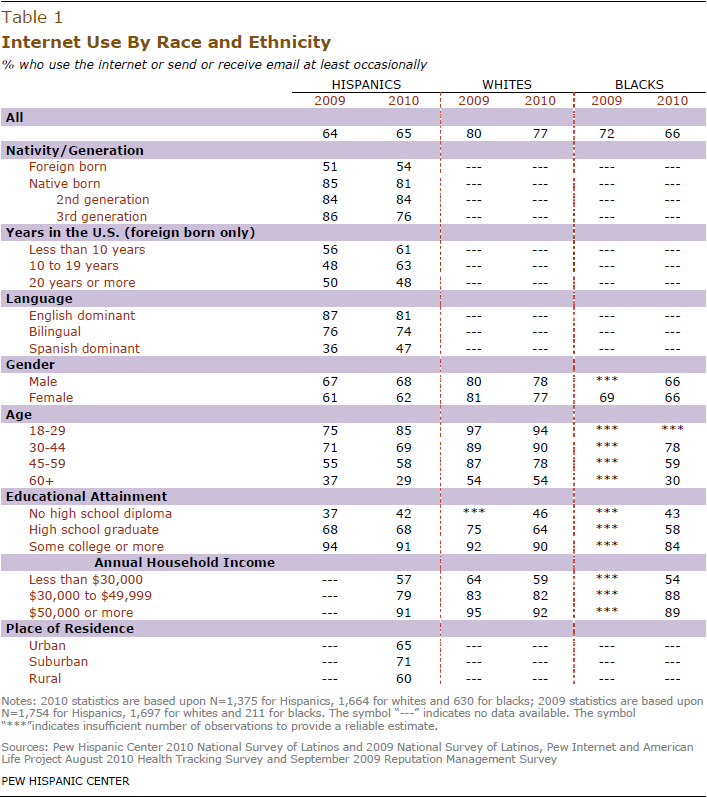
In 2010, almost two-thirds (65%) of Hispanics were online, a rate comparable to that of blacks (66%) and significantly lower than the rate for whites (77%). The difference in internet use between Hispanics and whites is driven in part by the fact that Hispanics tend to have less education and lower incomes than whites. When education or income are controlled for, the ethnic differences in internet use disappear.

More than eight-in-ten (81%) native-born Latinos are online, compared with 54% of foreign-born Latinos. These rates of internet usage were unchanged from 2009. English-dominant Hispanics and bilingual Hispanics have relatively high rates of internet use, which are statistically unchanged from 2009 to 2010. In 2010, some 81% of the English dominant were online, as were 74% of bilingual Hispanics. In contrast, less than half (47%) of Spanish-dominant Hispanics were online in 2010. This is significantly lower than the rate of internet use among English-dominant or bilingual Hispanics, but it also represents a significant increase from 2009, when only 36% of Spanish-dominant Hispanics were online.

Younger Latinos are far more likely than older Latinos to be online. While 85% of Latinos ages 18 to 29 use the internet, this share drops incrementally for each subsequent age group. Some 69% of Latinos ages 30 to 44 are online, as are 58% of those ages 45 to 59 and 29% of those ages 60 and older. Among the youngest Latino adults, there is a significant increase in the share that go online—from 75% in 2009 to 85% in 2010.

Educational attainment is correlated with internet use. While just over four-in-ten (42%) Hispanics lacking a high school diploma are online, this share reaches 68% for Hispanics who are high school graduates. And for Hispanics with at least some college education, the share more than doubles, with 91% reporting that they go online.

Household income is also strongly associated with internet use.3 Some 57% of Latinos living in households with incomes under $30,000 a year use the internet. In comparison, almost eight-in-ten (79%) Latinos in households earning $30,000 to $49,999 annually are online. More than nine-in-ten (91%) Latinos in households with incomes of $50,000 or more are online. In contrast, place of residence is not linked to differences in internet use for Latinos. About two-thirds (65%) of Latino city dwellers are online, compared with 71% of suburban Latinos and 60% of those in rural areas.

III. Home Internet Use

More than half (55%) of all Hispanics report that they use the internet in their home. This is similar to the rate for blacks (58%), but significantly lower than the rate for whites (75%). Differences in internet use explain some, but not all, of the variation between whites and Hispanics in the likelihood of home internet access.While 85% of Hispanic internet users report that they go online from home, almost all (96%) of white internet users report as much. Once again, blacks have a pattern of use similar to Hispanics, with 88% of black internet users reporting that they go online from home.

More than half (55%) of all Hispanics report that they use the internet in their home. This is similar to the rate for blacks (58%), but significantly lower than the rate for whites (75%). Differences in internet use explain some, but not all, of the variation between whites and Hispanics in the likelihood of home internet access.While 85% of Hispanic internet users report that they go online from home, almost all (96%) of white internet users report as much. Once again, blacks have a pattern of use similar to Hispanics, with 88% of black internet users reporting that they go online from home.

While more than seven-in-ten (71%) native-born Latinos report using the internet from home, less than half (45%) of foreign-born Latinos do the same. Nativity differences in internet use decline markedly when the analysis is limited to internet users, but the foreign born still lag slightly behind the native born (82% vs. 88%).

Fully 77% of English-dominant Latinos go online, compared with 61% of bilingual Latinos, and 37% of Spanish-dominant Latinos. These differences are partially explained by language differences in internet use. When examining home internet use for internet users only, the difference between bilingual and Spanish-dominant Latinos disappear, but English-dominant Latinos are still significantly more likely to access the internet from home.

Younger Hispanics are more likely than older Hispanics to use the internet from their home, and these differences are related to differences in the likelihood of using the internet. More than seven-in-ten (72%) of those ages 18 to 29 go online from home, compared with 60% of those ages 30 to 44 and 48% of those ages 45 to 59. Only one-fourth of Hispanics ages 60 and older use the internet from their home.

Less educated Latinos are less likely than Latinos with higher levels of educational attainment to go online from home. Only 30% of those lacking a high school diploma go online from home, compared with 54% of those with a high school diploma and 86% of those with at least some college education. In this case, differences in home internet use are not entirely driven by differences in the likelihood of using the internet. When limiting the analysis to internet users, Latinos with at least some college education remain more likely than less educated Latinos to access the internet from home.

Some 43% of Hispanics with household incomes below $30,000 report using the internet from home, as do more than seven-in-ten (71%) Hispanics with household incomes between $30,000 and $49,999. Fully 88% of Hispanics earning $50,000 or more report accessing the internet from their home. As was the case with education, these differences in the likelihood of using the internet are not driven simply by income differences. Even among internet users, significant income differences persist: 76% of those with household incomes below $30,000 annually access the internet at home, compared with 90% of those with incomes of $30,000-$49,999, and 97% of those with household incomes of $50,000 or more.

The prevalence of home internet connections among Latinos does not differ significantly by place of residence. Some 65% of suburbanites have a home internet connection, compared with 55% of city dwellers and 54% of rural residents.

IV. Home Broadband Access

Latinos lag significantly behind whites in home broadband access. Some 45% of Latinos have a home broadband connection, compared with 65% of whites. Latinos also lag behind blacks, 52% of whom have a home broadband connection. These gaps in broadband access are not driven simply by variations in internet use—even among internet users, Hispanics lag significantly behind whites and blacks. Some 69% of Hispanic internet users report that they have a home broadband connection, compared with 84% of white users and 78% of black users.

Controlling for educational attainment eliminates the ethnic differences in home broadband access. This indicates that the broadband differences are related to differences in educational attainment between these groups.

The ethnic differences in home broadband access also disappear when controlling for income, with one exception. Among those earning less than $30,000 annually, whites are still more likely than Hispanics to have a broadband connection at home (45% vs. 33%).

Six-in-ten (60%) native-born Hispanics have a home broadband connection, while among the foreign born, this share is 35%. The stark nativity differences in internet use are not fully responsible for this variation. Even among internet users, the native born are more likely than the foreign born to have home broadband access (74% vs. 64%).

In terms of language, Latinos who are Spanish dominant are the least likely to have a home broadband connection—just one-fourth (26%) do. In comparison, two-thirds (66%) of English-dominant Latinos and 52% of bilingual Latinos report a home broadband connection. These language differences persist when limiting the analysis to internet users.

Latinos ages 60 and older are significantly less likely than younger Latinos to have a home broadband connection. While one-in-five (20%) older Latinos had home broadband in 2010, this share reached 61% for Latinos 18 to 29. It is 49% for those ages 30 to 44, and 38% for Latinos 45 to 59.4 Virtually all of these differences disappear when the analysis is limited to internet users, indicating that the age differences in broadband use are due almost entirely to age differences in the likelihood of being online.

Only 19% of Hispanics with less than a high school diploma have a home broadband connection, but this share rises to 44% for high school graduates. Among Hispanics with at least some college education, more than three-fourths (77%) have home broadband access. These differences in home broadband access are not due simply to educational differences in internet use in general. Limiting the sample to internet users shows that users with higher levels of education are significantly more likely than less educated users to have home broadband. Some 46% of users with less than a high school diploma have a home broadband connection, compared with 66% of high school graduates and 84% of those with some college education.

Household income, too, is positively linked with having a home broadband connection. One-third (33%) of Latinos with a household income under $30,000 have home broadband access. Among Latinos in households with incomes of $30,000 to $49,999, over half (56%) have broadband access. And fully 82% of Latinos in households with incomes of at least $50,000 had home broadband access in 2010. As with education, these income differences persist when analysis is limited to internet users. Some 57% of internet users with household incomes less than $30,000 have home broadband, as do 71% of those with incomes of $30,000 to $49,999. Home broadband access reaches 90% for Hispanics with household incomes of $50,000 or more.

Hispanics are equally likely to have broadband access whether they live in an urban, suburban or rural area. Some 45% of Hispanics living in cities have home broadband access, as do 48% of those in suburbs and 41% of those living in rural areas.

V. Cell Phone Ownership

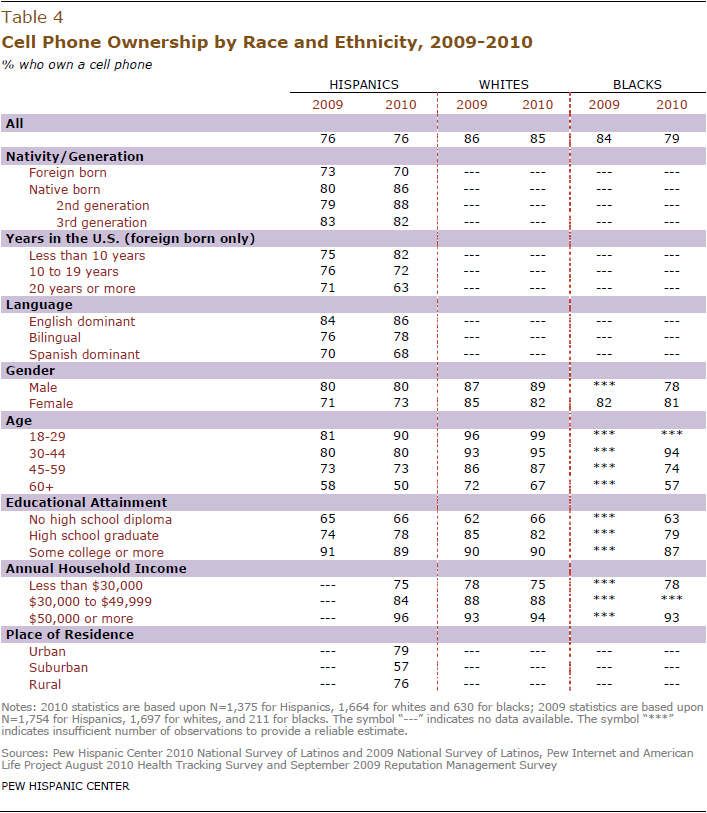
In 2010, some three-fourths (76%) of Hispanic adults were using cell phones—a rate similar to the rate for blacks (79%), and markedly lower than the rate among whites (85%). Controlling for education or household income eliminates the ethnic gap in cell phone use, suggesting that ethnic differences in educational attainment and income contribute to the overall difference in cell phone use.

Foreign-born Latinos lag behind native-born Latinos in cell phone use. While seven-in-ten (70%) of the foreign born use cell phones, this share is 86% for the native born. This gap is fueled in part by a significant increase of six percentage points in cell phone use among the native born since 2009. That increase among the native born, in turn, is driven primarily by increasing cell use among the second generation. In 2010, 88% of second-generation Latinos had cell phones, compared with 79% in 2009.

Spanish-dominant Hispanics lag behind in cell phone ownership. Less than seven-in-ten (68%) have a cell phone. In comparison, 78% of bilingual Hispanics and 86% of English-dominant Hispanics own a cell phone.

The young are far more likely than their older counterparts to have cell phones, with Latinos over 60 being especially unlikely to report using the technology. Nine-in-ten (90%) Latinos ages 18 to 29 used cell phones in 2010—a jump of nine percentage points from 2009. In comparison, 80% of those ages 30 to 44, 73% of those ages 45 to 59, and half of Latinos ages 60 and older report using a cell phone.

Educational attainment is strongly associated with cell phone use. While two-thirds (66%) of Hispanics with less than a high school diploma have a cell phone, this share rose to 78% for those who have a high school diploma. Among Hispanics who have at least some college education, the share with a cell phone further rose to 89%.

Latinos with higher household incomes were more likely than their less affluent counterparts to own a cell phone in 2010. Three-fourths with household incomes below $30,000 own a cell phone. Among Latinos with household incomes of $30,000 to $49,999, 84% own cell phones, and almost all Latinos living in a household with an income of at least $50,000 own a cell phone (96%).

Cell phone users are least prevalent in the suburbs. Some 57% of Hispanic suburbanites own cell phones, compared with 79% in urban areas and 76% in rural areas.

VI. Cell Phone Activities

Cell phones are not just for talking any more. Users can engage in a wide variety of non-voice data applications using these mobile devices, and more than half of Latinos, blacks and whites reported doing so in 2010. Some 58% of Hispanics say that they use their cell phones to do at least one of the following: access the internet, email, text or instant message. This rate does not differ significantly from the rate for blacks (63%), but it is somewhat lower than the rate for whites (64%).

Hispanics are less likely than whites to send or receive text messages from a cell phone (55% vs. 61%) and more likely than whites to send or receive instant messages (34% vs. 20%). The two groups are equally likely to access the internet and to use a cell phone for email. Hispanics and blacks report similar rates of texting and instant messaging, but blacks are more likely than Hispanics to access the internet and send or receive email from a phone. More than four-in-ten (41%) blacks go online from their cell phone, compared with 31% of Hispanics; and one-third (33%) of blacks use email from their cell phone, compared with 27% of Hispanics.

When analysis is limited to cell phone owners, Latinos show higher likelihoods than whites of using three of the four cell phone data applications—internet, email and instant messaging. Conversely, Latino cell phone owners are less likely than black cell phone owners to access the internet from their phones (40% vs. 51%). Rates of texting do not differ by ethnicity.

While Hispanics overall are no more likely than whites to use their cell phones to access the internet, a relatively high share of Hispanics use their cell phones in lieu of a home internet connection. Some 6% report that they have no home internet connection but access the internet from their cell phone. The number is the same for blacks (6%). A lower share of whites—1%—lacks home internet but accesses the internet from a cell phone. These findings lend some support to the notion that mobile technologies may help to narrow the digital divide by providing an alternative on-ramp to the internet for groups that have historically lagged behind others in web access.5

Survey results suggest that affordability may be part of the reason that Latinos are particularly dependent upon cell phones for internet access—but there are likely other factors at play as well. Among Latinos, the less educated and the less affluent are more likely than their more educated and more affluent counterparts to depend on a cell phone for internet access. For instance, 10% of Latinos with household incomes less than $30,000 lack a home internet connection and access the internet from a cell phone; among those with household incomes of $50,000 or more, this share is only 1%. At the same time, though, controlling for educational attainment and income does not eliminate the ethnic differences in dependency on cell phone internet access, suggesting that other factors are also contributing to the differences.

Nativity

Foreign-born Hispanics are generally less likely than their native-born counterparts to utilize data applications on a cell phone. Less than half (48%) of the foreign born do so, compared with 74% of the native born. This is also the case when looking individually at each of the four non-voice applications. These same patterns present themselves when analyzing nativity differences in non-voice applications for cell phone users only.

Language

English dominance is also strongly linked with the use of non-voice cell phone applications. More than three-fourths (76%) of English-dominant Latinos use their cell phones for something other than traditional calls, while 62% of bilingual Latinos and 44% of Spanish-dominant Latinos report as much. English-dominant Latinos are more likely than other Latinos to email, access the internet, and send and receive text messages from their cell phones. However, there are no language differences in the likelihood of instant messaging. And once again, these patterns persist when the analysis is limited to cell phone users, indicating that these differences are not driven by differences in cell ownership.

Age

Younger Hispanics are significantly more likely than older Hispanics to use at least one non-voice cell phone application. Some 84% of Latinos ages 18 to 29 access the internet, email, text and/or use instant messaging from their cell phones. Among Hispanics ages 30 to 44, 65% use non-voice cell phone applications, and among those ages 45 to 59, 44% do so. While older Hispanics are far less likely to use non-voice applications, a sizable minority—20%—do so.

This same age pattern persists across each individual non-voice application, with young Latinos being the most likely users and older Latinos the least likely. Texting is associated with the largest differences by age among Latinos. While 82% of Latinos ages 18 to 29 report texting, this share drops to 62% for those 30 to 44, 41% for those 45 to 59, and 14% for those ages 60 and older. None of these marked age differences are due to age differences in the likelihood of owning a cell phone—the differences persist when looking only at cell phone owners.

Among people ages 18 to 59, Hispanics lag behind whites in the use of any non-voice cell phone application and in the likelihood of texting. When the sample is limited to people with cell phones, Latinos ages 30 to 59 still lag behind their white counterparts in these measures. Hispanics ages 30 to 59 are more likely than their white counterparts to instant message, and among cell phone owners, Hispanics lead whites in instant messaging for all age groups.

Blacks ages 30 to 44 are more likely than Hispanics in that age group to use at least one non-voice data application (82% vs. 65%), to email from a cell phone (44% vs. 30%), to text from a cell phone (82% vs. 62%) and to access the internet from a cell phone (56% vs. 34%). Most of these differences are driven by differences in the likelihood of owning a cell phone. When the sample is limited to cell phone owners, blacks ages 30 to 44 are still more likely than Hispanics to access the internet (59% vs. 42%) but are similar to Hispanics on the other measures. Blacks ages 60 and older are more likely than Hispanics to email from a phone (11% vs. 3%). This difference persists when limiting the analysis to cell phone owners.

Educational Attainment

Highly educated Latinos are more likely than less educated Latinos to use at least one of the four non-voice cell phone applications. For instance, while 42% of Latinos with less than a high school diploma use some type of non-voice data application, this share rises to 60% for high school graduates and 78% for Latinos with some college education. These educational differences among Latinos persist, for the most part, even when the sample is limited to cell phone owners. The one exception occurs for instant messaging; among Latino cell phone owners, there is no difference in the likelihood of instant messaging by educational level.

There are no ethnic differences in the likelihood of using at least one type of non-voice cell phone application at lower educational levels. However, Hispanics with some college education are somewhat more likely than whites with some college to do so (78% vs. 71%). Among respondents with at least a high school diploma, Hispanics are significantly more likely than their white counterparts to access the internet, use email and instant message. This pattern is further accentuated when the sample is limited to cell phone owners. Hispanic cell phone owners with at least a high school diploma lead their white counterparts in the use of every non-voice application.Within educational levels, there are no significant differences between Hispanics and blacks.

Income

Among Latinos, living in a higher income household is associated with a higher likelihood of using at least one type of cell phone data application, and higher likelihoods of emailing, texting and going online from a cell phone. There are no differences by income in the likelihood of instant messaging from a cell phone. The same patterns hold when the sample is limited to cell phone owners.

There are no ethnic differences by income in the likelihood of using at least one type of non-voice cell phone application, or in the likelihood of emailing or texting from a cell phone. Among those with household incomes of $50,000 or more, Hispanics are significantly more likely than whites to access the internet from a cell phone (52% vs. 39%) and at all income levels, Hispanics are significantly more likely than whites to instant message from a cell phone. Conversely, Hispanics are less likely than blacks to access the internet from a cell phone among those with household incomes less than $30,000 (27% vs. 38%) and among those with household incomes between $30,000 and $49,999 (33% vs. 52%).

Place of Residence

Latinos living in urban areas are significantly more likely than their suburban counterparts to use some type of non-voice application on a cell phone. Some 61% do so, compared with 42% among those in the suburbs and 58% among those in rural areas. Suburban Latinos trail their urban counterparts in the use of all four types of non-voice cell phone applications. They are also less likely than their rural counterparts to use instant messaging (16% vs. 36%).

Appendix A: Survey Methodology

The majority of the analysis of Hispanics is based upon the Pew Hispanic Center 2010 National Survey of Latinos (NSL).1 This survey collected data via telephone interviews conducted by Social Science Research Solutions (SSRS), an independent research company, among a nationally representative sample of 1,375 Latino respondents ages 18 and older, from Aug. 17 to Sept. 19, 2010. For results based on the total sample, one can say with 95% confidence that the error attributable to sampling is plus or minus 3.3 percentage points.

For this survey, SSRS maintained a staff of Spanish-speaking interviewers who, when contacting a household, were able to offer respondents the option of completing the survey in Spanish or in English. A total of 548 respondents were surveyed in English and 827 respondents were interviewed in Spanish. Any male or female ages 18 or older of Latino origin or descent was eligible to complete the survey.

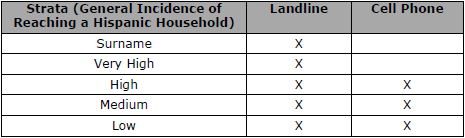
To address the growing number of Hispanic households in the U.S. that are reachable only by cell phone, the study included interviews from both landline (n=710) and cell phone (n=665) sample frames.

Both sample frames were stratified via a disproportionate stratified design. All telephone exchanges in the contiguous 48 states were divided into groups, or strata, based on their concentration of Latino households. For the landline frame, the sample was also run against InfoUSA and other listed databases, and then scrubbed against known Latino surnames. Any “hits” were subdivided into a “surname” stratum, with all other sample being put into four other “RDD” strata. The cell phone sample was divided into three strata. Overall, then, the study employed eight strata.

It is important to note that the existence of a surname stratum does not mean this was a surname sample design. The sample is RDD, with the randomly selected telephone numbers divided by whether they were found to be associated with or without a Latino surname. This was done simply to increase the number of strata and thereby increase the ability to meet ethnic targets and ease administration by allowing for more effective assignment of interviewers and labor hours.

A multistage weighting design was used to ensure an accurate representation of the national Hispanic population:

  • An adjustment was made for all persons found to possess both a landline and a cell phone, as they were twice as likely to be sampled as were respondents who possessed only one phone type.
  • The sample was corrected for the disproportionality of the stratification scheme described earlier.
  • The sample was corrected for the likelihood of within-household selection, which depended upon the likelihood that the respondent’s age group would be selected, and that within that age group, the particular respondent would be selected.
  • The sample was corrected to reflect the percentage that is cell-only, landline-only, or reachable by either a landline or a cell phone, based upon estimates for Hispanics from the 2009 National Health Interview Survey estimates projected to 2010.
  • Finally, the data were put through a post-stratification sample balancing routine. The post-stratification weighting utilized national 2009 estimates from the Census Bureau’s Current Population Survey, March Supplement, on gender, education, age, region, foreign/native born status, year of entry into the U.S. and Hispanic heritage.

Non-Hispanic Data

The 2010 data on non-Hispanic whites and blacks is derived from the Pew Internet and American Life Project August 2010 Health Tracking Survey.2 The data were collected in telephone interviews conducted by Princeton Survey Research Associates International (PSRAI) from Aug. 9 to Sept. 13, 2010, among a sample of 3,001 adults, ages 18 and older. For results based on the total sample, one can say with 95% confidence that the error attributable to sampling is plus or minus 2.5 percentage points. More details on this survey can be found in the recent PIAL report “Americans Living with Disability and Their Technology Profile.”

Appendix B: Topline