
Pew Research Center

FOR RELEASE JANUARY 5, 2011

The 2010 Congressional Reapportionment and Latinos

Hispanic voters are nearly three times more prevalent in states that gained congressional seats and Electoral College votes in the 2010 reapportionment than they are in states that lost seats.

BY Mark Hugo Lopez and Paul Taylor

FOR MEDIA OR OTHER INQUIRIES:

Communications Department
202.419.4372
www.pewresearch.org

RECOMMENDED CITATION

Pew Research Center, January 2011, "The 2010 Congressional Reapportionment and Latinos"

About Pew Research Center

Pew Research Center is a nonpartisan, nonadvocacy fact tank that informs the public about the issues, attitudes and trends shaping the world. It does not take policy positions. The Center conducts public opinion polling, demographic research, computational social science research and other data-driven research. It studies politics and policy; news habits and media; the internet and technology; religion; race and ethnicity; international affairs; social, demographic and economic trends; science; research methodology and data science; and immigration and migration. Pew Research Center is a subsidiary of The Pew Charitable Trusts, its primary funder.

© Pew Research Center 2026

Table of contents

  • About Pew Research Center
  • The 2010 Congressional Reapportionment and Latinos
  • II. Reapportionment Gains and Hispanic Population Growth
  • III. Latino Electoral Strength
  • Appendix

The 2010 Congressional Reapportionment and Latinos

Hispanic voters are nearly three times more prevalent in states that gained congressional seats and Electoral College votes in the 2010 reapportionment than they are in states that lost seats.

I. Overview

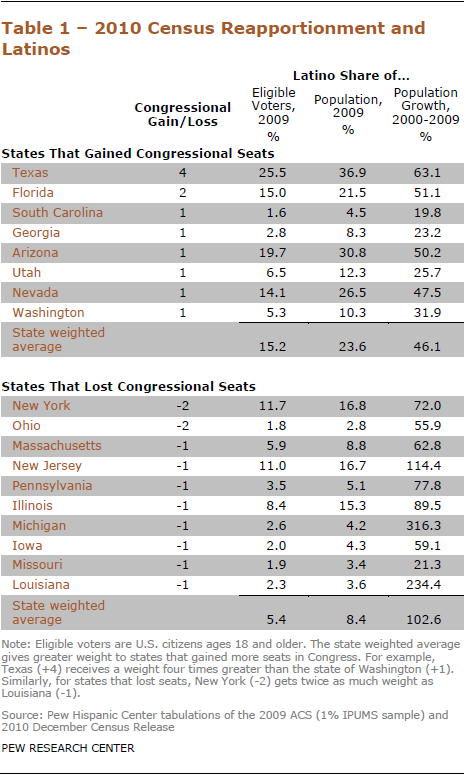
Hispanic voters are nearly three times more prevalent in states that gained congressional seats and Electoral College votes in the 2010 reapportionment than they are in states that lost seats, according to an analysis of Census data by the Pew Hispanic Center, a project of the Pew Research Center. Based on averages reflecting congressional gains and losses, 15.2% of the eligible voter1 population in states that gained seats is Hispanic, compared with just 5.4% of eligible voters in those states that lost seats.
With these reapportionment changes, Latinos likely will play a larger role in national politics in the coming decade. Two states that gained seats, Florida and Nevada, have been key swing battlegrounds in recent presidential elections (having voted for the Republican nominee in 2004 and the Democrat in 2008). In both states, Latinos are a growing share of eligible voters.

According to the Census Bureau, there were 308 million people residing in the U.S. in 2010, up 9% from 2000 (Census Bureau, 2010). Overall, based on 2009 population estimates, Hispanics accounted for more than half (51%) of that growth.2 However, because many Latinos are either too young to vote or are not U.S. citizens, not all of their population growth translates into immediate electoral strength. Among the nation’s 48.4 million Hispanics in 2009, a record 20.1 million are eligible to vote. Yet an even greater number are not eligible to vote. Some 15.5 million3 Hispanics are U.S. citizens 17 years of age or younger and 12.8 million of all ages are not U.S. citizens.4

Even so, the number of the Latinos eligible to vote continues to grow. Since 2000, nearly 6 million more Latinos have become eligible to vote. The bulk of this growth was attributable to the 5 million U.S. born Latino youths nationwide who turned 18 during this past decade. That translates into an additional half-million U.S. born Latinos coming of age each year—a pattern that is certain to persist, and grow, in the coming decades.

No matter what happens with immigration patterns in the future, the aging of the U.S. born Latino youth bulge ensures that the electoral strength of the nation’s largest minority group will continue to grow in the coming decades. And much of that growth will take place in states that have gained congressional seats and Electoral College votes.

II. Reapportionment Gains and Hispanic Population Growth

Based on results of the 2010 Census, eight states—Arizona, Florida, Georgia, Nevada, South Carolina, Texas, Utah and Washington—will gain congressional seats and Electoral College votes. Texas will gain four, Florida two, and all others one. Ten states will lose seats—Illinois, Iowa, Louisiana, Massachusetts, Michigan, Missouri, New Jersey, New York, Ohio and Pennsylvania. New York and Ohio will lose two and all others one (Census Bureau, 2010).

Overall Latinos represent a greater share of eligible voter and resident populations in states that will gain seats than they do in states that will lose seats. Among eligible voters, in states that will gain seats 15.2% are Latino, while in states that will lose seats just 5.4% are Latino. Among resident populations, 23.6% is Latino in states that will gain seats compared with 8.4% in states that will lose seats.

In Texas, Latinos account for one-in-four (25.5%) of the state’s eligible voters and 36.9% of the state’s population. In Florida, Latinos account for one-in-seven (15%) of the state’s eligible voters and 21.5% of the state’s population. And in Arizona and Nevada, Hispanics represent 19.7% and 14.1% of eligible voters respectively.

Many of the states that gained congressional seats did so partly because of rapid population growth among Hispanics. Texas’ population increased by nearly four million, or by 21%, between 2000 and 2010. Nearly two-thirds (63%) of that growth came from growth in the state’s Hispanic population, which increased by almost 2.5 million.5 In Florida, Hispanic population growth accounted for more than half (51%) of the state’s population growth through this decade. Even in states with smaller Hispanic populations, Hispanics accounted for a large share of population growth. In Georgia, Hispanics accounted for 23.2% of the state’s growth. In South Carolina, Hispanics accounted for 19.8% of the state’s growth.

Even in states that lost congressional seats, Latinos contributed significantly to population gains, possibly limiting reapportionment losses. For instance, in New York, 72% of the population growth this decade came from the Latino population. In New Jersey, the state’s population would likely have declined without Hispanic population growth. And in Michigan, Latino population growth kept the state’s population from declining even more than it did.

III. Latino Electoral Strength

Latino voting strength is limited by the fact that one-third of all Latinos is under the age of 18 and by the fact that many Latino adults are not U.S. citizens. Because of these factors, the share of the Hispanic population that is eligible to vote is lower than it is among either whites or blacks, even though the Hispanic population has grown rapidly in recent decades (Suro, Fry and Passel, 2005).

In Texas, for example, even though Hispanic population growth helped to fuel the expansion of the state’s congressional delegation, fewer than half (43.1%) of all Hispanics are eligible to vote, compared with nearly eight-in-ten (77.3%) whites and seven-in-ten blacks (70%). In Florida, fewer than half (48.3%) of the state’s Hispanics are eligible to vote, while eight-in-ten (79.8%) whites and 63.5% of blacks are eligible to vote.

In Georgia—a state where the vast majority of Hispanic adults are foreign born who arrived within the last decade or two—the gap is even wider. There, only 22.9% of the state’s Latinos are eligible to vote, compared with 76.2% of whites and 69.6% of blacks. Similar patterns are present in other “new settlement” states.

Appendix