Pew Research Center

FOR RELEASE DECEMBER 22, 2009

Latinos Online, 2006-2008: Narrowing the Gap

From 2006 to 2008, internet use among Latino adults rose by 10 percentage points, from 54% to 64%, compared with a four percentage point rise among whites and a two percentage point rise among blacks.

BY Gretchen Livingston, Kim Parker and Susannah Fox

FOR MEDIA OR OTHER INQUIRIES:

Communications Department
202.419.4372
www.pewresearch.org

RECOMMENDED CITATION

Pew Research Center, December 2009, "Latinos Online, 2006-2008: Narrowing the Gap"

About Pew Research Center

Pew Research Center is a nonpartisan, nonadvocacy fact tank that informs the public about the issues, attitudes and trends shaping the world. It does not take policy positions. The Center conducts public opinion polling, demographic research, computational social science research and other data-driven research. It studies politics and policy; news habits and media; the internet and technology; religion; race and ethnicity; international affairs; social, demographic and economic trends; science; research methodology and data science; and immigration and migration. Pew Research Center is a subsidiary of The Pew Charitable Trusts, its primary funder.

© Pew Research Center 2026

Table of contents

  • About Pew Research Center
  • Latinos Online, 2006-2008: Narrowing the Gap
  • II. Internet Use
  • III. Internet Use at Home
  • IV. Broadband Access
  • Appendix A: Methodology

Latinos Online, 2006-2008: Narrowing the Gap

From 2006 to 2008, internet use among Latino adults rose by 10 percentage points, from 54% to 64%, compared with a four percentage point rise among whites and a two percentage point rise among blacks.

I. Overview

From 2006 to 2008, internet use among Latino adults rose by 10 percentage points, from 54%1 to 64%. In comparison, the rates for whites rose four percentage points, and the rates for blacks rose only two percentage points during that time period. Though Latinos continue to lag behind whites, the gap in internet use has shrunk considerably.

For Latinos, the increase in internet use has been fueled in large part by increases in internet use among groups that have typically had very low rates of internet use.2

  • While U.S.-born Latinos experienced a two percentage point increase in internet use from 75% in 2006 to 77% in 2008, foreign-born Latinos experienced a 12 percentage point increase during the same period, from 40% to 52%.
  • In 2006, 31% of Latinos lacking a high school degree reported ever going online; in 2008, this number was 41%. In comparison, Latinos with higher levels of education experienced three to four percentage point increases in internet use.
  • Internet use among Latinos residing in households with annual incomes less than $30,000 increased 17 percentage points from 2006 to 2008. For Latinos in households earning $30,000 to $49,999 annually, internet use increased two percentage points, and for Latinos in households earning $50,000 or more annually, there was no change in internet use.

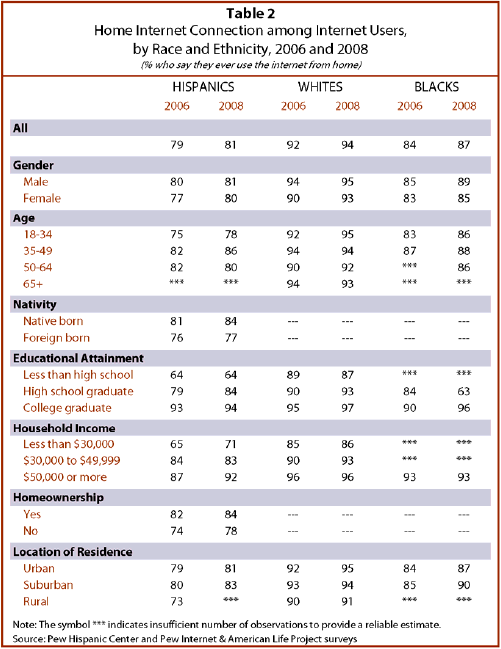
Whereas Latinos gained markedly in overall internet use, the pattern of home internet access changed very little. In 2006, 79% of Latinos who were online had internet access at home, while in 2008, this number was 81%. White and black internet users show a similar leveling off. In 2006, 92% of white internet users had a home connection, compared with 94% in 2008. In 2006, 84% of African American internet users had a home connection, compared with 87% in 2008.

While there was little increase in the likelihood of having a home connection among internet users from 2006 to 2008, rates of broadband connection increased dramatically for Hispanics, as well as for whites and blacks. In 2006, 63% of Hispanics with home internet access had a broadband connection; in 2008 this number was 76%. For whites, there was a 17 percentage point increase in broadband connection from 65% to 82%, and for blacks, the increase was from 63% in 2006 to 78% in 2008.

In order to maintain comparability across years, all results are based upon landline telephone surveys conducted by the Pew Hispanic Center and the Pew Internet & American Life Project from February to October 2006, and from August to December 2008. During this same time period, there was a dramatic increase in the proportion of people living in households with only cell phones, and no landline telephones.3

The rapid increase in cell-only populations, particularly for Latinos and African Americans, coupled with the fact that people in cell-only households tend to be slightly more likely to use other forms of technology than people who are reachable via landline telephone, suggests that if anything, the results shown here may underestimate increases in internet use, especially for Latinos and African Americans.4

Other key findings include:

  • Among Latinos, English-reading ability was linked with internet use—81% of Latinos who read English very well were online, as compared with 63% of Latinos who read pretty well, 52% of Latinos who couldn’t read English well, and 24% of Latinos who couldn’t read English at all.
  • Conversely, Spanish-reading ability was not associated with internet use at all among Latinos.
  • Native-born Latinos had higher rates of internet use and a greater likelihood of having a broadband connection among home internet users.
    • Some 77% of native-born Latinos used the internet, as compared with 52% of the foreign-born.
    • While 83% of native-born home internet users had a broadband connection in 2008, this share was 68% among the foreign-born.
  • Younger Latinos were more likely to use the internet than older Latinos.
    • Among Latinos ages 18 to 34, 77% used the internet; among those ages 35 to 49, 65% used the internet; among those ages 50 to 64, 53% used the internet, and among Latinos ages 65 and older, one-quarter used the internet.
  • Education was linked with increased use of the internet, and greater likelihoods of having a home internet connection, and having a broadband connection among Latinos.
    • Some 41% of Latinos lacking a high school degree went online in 2008; almost three-fourths (74%) of Latinos with a high school degree went online, and 92% of Latino college graduates went online.
    • Among internet users, 64% of Latinos lacking a high school degree had a home internet connection in 2008, as compared with 84% of Latino high school graduates, and 94% of Latino college graduates.
    • Some 62% of Latino home internet users who lacked a high school degree had a broadband connection in 2008; this share was 78% for Latino high school graduates, and 86% for Latino college graduates.
  • For Latinos, higher household income was associated with internet use, having a home internet connection, and having a broadband connection.
    • Some 56% of Latinos in households earning less than $30,000 annually went online in 2008, as compared with 74% of Latinos in households earning $30,000 to $49,999, and 88% of Latinos in households earning $50,000 or more annually.
    • Among Latino internet users, 71% of those with annual household incomes less than $30,000 had a home connection in 2008, as did 83% of those with household incomes of $30,000 to $49,999, and 92% of those with household incomes of $50,000 or more.
    • Some 71% of Latinos with annual household incomes less than $30,000 who had a home internet connection had broadband access in 2008; in comparison, this share was 79% for Latinos in households with income of $30,000 to $49,999, and 85% for Latinos in households with incomes of $50,000 or more.

About this Report

This report focuses on patterns of technology use among Latinos, whites, and African Americans from 2006 to 2008. The estimates used in the report are derived from a total of eight telephone surveys, three of which were conducted for the Pew Hispanic Center, and five of which were conducted for the Pew Internet & American Life Project. All told, the Pew Hispanic Center surveys interviewed 7,554 adults, and the Pew Internet & American Life Project surveys interviewed 13,687 adults.

A Note on Terminology

The terms “Latino” and “Hispanic” are used interchangeably in this report, as are the terms “foreign born” and “immigrant.”

All references to whites, blacks, Asians and others are to the non-Hispanic components of those populations.

“Foreign born” refers to persons born outside of the United States to parents neither of whom was a U.S. citizen. Foreign born also refers to those born in Puerto Rico.

“Native born” refers to persons born in the United States and those born abroad to parents at least one of whom was a U.S. citizen.

II. Internet Use

Overall, 64% of Latino adults ages 18 and older used the internet in 2008, compared with 54% of Latinos in 2006.5 Given this rapid increase in internet use, Latinos are now as likely as blacks to go online (63% of blacks used the internet in 2008). However, Latinos remain significantly less likely to go online than whites, 76% of whom used the internet in 2008.

As is the case across race and ethnic groups, younger Latinos were more likely to be online than their older counterparts. Some 77% of Latinos ages 18 to 34 went online at least occasionally in 2008. Among those ages 35 to 49, 65% went online. Just over half (53%) of those ages 50 to 64 used the internet, and among those ages 65 and older one-in-four Hispanics used the internet.

Latinos who were born in the United States were much more likely than those born outside the U.S. to use the internet — 77% of native-born versus 52% of foreign-born Latinos went online at least occasionally in 2008. Statistical tests show that a gap in internet use between native-born and foreign-born Latinos persists even after accounting for differences in educational attainment, household income, and English proficiency. The difference was even larger in 2006 when only 40% of foreign-born Latinos were online, compared with 75% of the native born.

Lack of English-reading ability appears to be a significant barrier to internet use for Hispanics. The vast majority of those who could read English very well (81%) used the internet in 2008. Among those who could read English pretty well, 63% used the internet. Roughly half (52%) of those who said they couldn’t read English well went online, as did only 24% of those who couldn’t read English at all. The link between English proficiency and internet use does not diminish if other related factors—educational attainment, household income, and nativity—are held constant.

Conversely, the likelihood of being online does not differ significantly for Latinos based upon their Spanish-reading ability—62% of those who read Spanish very well were online in 2008, compared with 67% who read it pretty well, 62% who didn’t read it well, and 66% who couldn’t read speak Spanish at all. The fact that English reading ability, but not Spanish reading ability, was associated with internet use suggests that it is not literacy per se that is affecting internet use for Latinos, but instead it is English literacy.

Education and income were strongly linked to internet use. The overwhelming majority of Latinos (92%) who graduated from college used the internet in 2008, and roughly three-quarters (74%) of Latinos who graduated from high school used the internet. By contrast, only 41% of Latinos who had not graduated from high school went online at least occasionally in 2008.

Among Latinos with annual household incomes of $50,000 or higher, 88% went online at least occasionally in 2008. Those with lower household incomes were less likely to go online. Roughly three-quarters (74%) of those living in households with annual incomes between $30,000 and $49,999 a year used the internet, and even fewer (56%) of those with household incomes of less than $30,000 a year went online.

Since 2006, Latino internet use rose more rapidly among those with less education and lower income, while it leveled off for other groups. In 2006, 31% of those who never graduated from high school used the internet, but the share increased to 41% in 2008. At the same time, for high school graduates, there was a four percentage point increase in internet use, and for college graduates, there was a three percentage point increase.

Internet use among middle- and higher-income Latinos remained relatively stable in recent years, while the percentage of low-income Latinos going online increased significantly. In 2006, only 39% of those with household incomes less than $30,000 used the internet, and that share rose to 56% in 2008. Conversely, there was only a two percentage point increase in internet use for those with household incomes of $30,000 to $49,999 annually, and there was no rise in internet use for people in higher-income households.

III. Internet Use at Home

In spite of the overall increase in internet usage among Latinos from 2006 to 2008, the percent of Latino online users who accessed the internet from home went up only marginally from 79% in 2006 to 81% in 2008. White internet users were more likely than Latino internet user to go online from home – 94% said they did so. Among black online users, 87% reported going online from home.

The fact that Hispanic internet users and, to a lesser extent, African American users, lagged whites in the likelihood of having internet access at home may be related to the fact that Latinos and African Americans are more likely to access the internet using wireless technology such as a cell phone, Blackberry or iPhone (Horrigan 2009).

Both education and household income were linked to the likelihood of having a home internet connection for Latino internet users. While less than two-thirds (64%) of Latino internet users who lacked a high school degree went online from their home in 2008, this share rose to 84% for Latino high school graduates. The overwhelming majority (94%) of Latino users who graduated from college were able to access the internet from their home.

Similarly, while 7-in-10 (71%) Latino internet users with annual household incomes less than $30,000 used the internet from home in 2008, rates were higher for Latinos with higher incomes. For those in households earning $30,000 to $49,999 annually, 83% had a home internet connection, and for those in households with annual incomes of $50,000 or more, 92% had a home connection.

The likelihood of having a home internet connection was not linked to nativity, age, or homeownership for Latinos.

IV. Broadband Access

In many surveys over the past seven years, the Pew Internet & American Life Project has found that internet users with home broadband access are more engaged with the online world. The “always on” internet becomes an information and communications source that people rely on for staying in touch with friends and family and finding out what is going on in their communities (Horrigan 2009).

Among Latinos who went online from home, 76% did so using a broadband connection. This share was up significantly from 2006, when 63% of Latino home internet users had a broadband connection. White and African American home internet users experienced similar steep increases in broadband access. In 2006, 65% of white home internet users had a high-speed connection, while in 2008 this number rose to 82%. For blacks with home internet access, 63% had a broadband connection in 2006, and in 2008, 78% had one.

Once again, education and income figure prominently in the use of broadband. Among Latinos who lacked a high school degree, 62% of home internet users had broadband access. In comparison, this share rose to 78% for Latinos with a high school degree. For those Latinos who were college graduates, some 86% of home internet users had a broadband connection.

The same pattern emerges when looking at annual household income. While about seven-in-ten (71%) Latino home internet users in households earning less than $30,000 annually had a broadband connection in 2008, this share rose to 79% for Latinos in households with incomes of $30,000 to $49,999. Among Latino home internet users in households with annual incomes of $50,000 or more, 85% had a broadband connection in 2008.

Looking specifically at Latinos who went online from home, the native born were more likely than those born outside the U.S. to have used a broadband connection in 2008 (83% vs. 68%). This pattern persists even controlling for nativity differences in educational attainment, household income, English proficiency, and homeownership.

There were no significant differences in broadband access among Latino home users based upon age or homeownership status.

Appendix A: Methodology

Data Regarding Hispanics

The analysis of Hispanics is based upon the merging of three datasets derived from landline telephone surveys conducted by International Communications Research:

All three surveys used similar methodologies. Surveys were conducted by telephone, and targeted U.S. Latinos ages 18 and older, who had the option to respond in Spanish, English, or a combination of the two languages.

The samples for each survey were independently drawn using random digit dialing (RDD). The 2006 National Survey of Latinos (NSL) Survey and the 2006 Hispanic Religion Survey samples were stratified according to the density of Hispanic population and ancestry groups. The 2008 Post-Election Survey sample was stratified according to the density of the Hispanic population.

Following data collection, the data from each of the three surveys were corrected for the disproportionality of the stratification schemes. For the 2006 NSL, data were also weighted based upon age, sex, education, ancestry, years since entering the U.S., and nativity using 2005 Current Population Survey data. For the 2006 Hispanic Religion Survey, data were also weighted based upon age, sex, education, ancestry, years since entering the U.S., nativity, and religion using 2006 Current Population Survey data, as well as past Pew Hispanic Center survey results. Results for the 2008 Post-Election Survey were post-stratified using national estimates of age, gender, education, ancestry, years since entering the U.S., nativity, and region obtained from the 2008 Current Population Survey.

Data Regarding Non-Hispanics

The data regarding blacks and whites are based upon landline interviews from five surveys conducted by Princeton Survey Research Associates for the Pew Internet & American Life Project from 2006 to 2008:

All five surveys used similar methodologies. Surveys were conducted by telephone, and targeted U.S. adults ages 18 and older. The samples for each survey were independently drawn using random digit dialing (RDD).

Following data collection, post-stratification weights were applied to the data. The weights were based upon population parameters for age, gender, education, race/ethnicity, and region. For the 2006 surveys, these weights were derived from the 2005 Current Population Survey, and for the 2008 surveys the weights were derived from the 2007 Current Population Survey. In addition, a county population density factor was calculated based on the 2000 Census. This parameter was then compared with the sample characteristics to construct the sample weights.