Pew Research Center

FOR RELEASE OCTOBER 7, 2009

The Changing Pathways of Hispanic Youths Into Adulthood

Young Latino adults in the United States are more likely to be in school or the work force now than their counterparts were in previous generations.

FOR MEDIA OR OTHER INQUIRIES:

Communications Department
202.419.4372
www.pewresearch.org

RECOMMENDED CITATION

Pew Research Center, October 2009, "The Changing Pathways of Hispanic Youths Into Adulthood"

About Pew Research Center

Pew Research Center is a nonpartisan, nonadvocacy fact tank that informs the public about the issues, attitudes and trends shaping the world. It does not take policy positions. The Center conducts public opinion polling, demographic research, computational social science research and other data-driven research. It studies politics and policy; news habits and media; the internet and technology; religion; race and ethnicity; international affairs; social, demographic and economic trends; science; research methodology and data science; and immigration and migration. Pew Research Center is a subsidiary of The Pew Charitable Trusts, its primary funder.

© Pew Research Center 2026

Table of contents

  • About Pew Research Center
  • The Changing Pathways of Hispanic Youths Into Adulthood
  • II. The Pathways of Youths to Adulthood
  • III. Patterns in Skill Acquisition
  • IV. Rising School Enrollment
  • V. Rising Labor Force Participation
  • VI. Military: A Road Less Traveled
  • VII. Hispanic Male Incarceration Has Increased
  • VIII. The Pathways of Young Hispanic Females by Nativity
  • Appendix A: Data Sources
  • Appendix B: Census Counts of Incarcerated Youths
  • Appendix C: Data Tables

The Changing Pathways of Hispanic Youths Into Adulthood

Young Latino adults in the United States are more likely to be in school or the work force now than their counterparts were in previous generations.

I. Overview
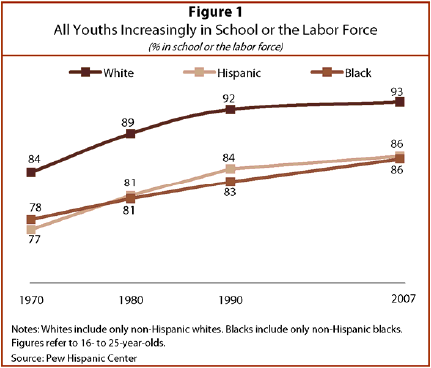
Young Latino adults in the United States are more likely to be in school or the work force now than their counterparts were in previous generations. In 1970, 77% of Hispanics ages 16 to 251 were either working, going to school or serving in the military; by 2007, 86% of Latinos in this coming-of-age group were taking part in these skill-building endeavors, according to a comprehensive analysis of four decades of Census Bureau data by the Pew Hispanic Center, a project of the Pew Research Center.

The growth over time in the share of youths involved in such market-oriented activities is not limited to Latinos. Similar changes have occurred among black and white youths. But the Latino trends are particularly noteworthy because their share of the young adult population has risen so dramatically during this period—to 18% in 2007, more than triple their 5% share in 1970.

The increase in their attachment to school or the work world (which includes employment by the military) has been driven mainly by the changes in the endeavors of young Hispanic females. In 1970, only one-third of young female Hispanics were enrolled in school or college; by 2007, nearly half of young female Hispanics were pursuing schooling.
The labor force participation of young female Latinos has also grown during this time period, from 40% in 1970 to 54% in 2007.

Even with these gains, however, nearly one-in-five (19%) female Latino young adults in 2007 were not in school or in the work force. This figure exceeds the 16% share of young black men who were not in school or in the work force, a surprising comparison in light of the fact that the labor market and schooling difficulties of young black men have received much more public attention than have those of young Hispanic women.

In the case of young Latinas, motherhood accounts for some—but not most—of their detachment from work and school. Birthrates among young Latino women are higher than those of whites or blacks, but these rates have been falling for decades. In 1970, two-thirds of the young Hispanic women who were not in school or the work force were mothers; by 2007, this share had dropped to less than a majority.

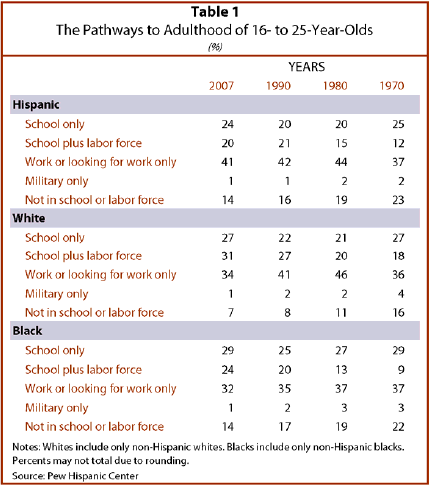
Looking more broadly at the changing pathways into adulthood across all dimensions of race and ethnicity, Hispanic youths (young men and women combined) lagged behind white youths in 2007 by about the same gap that their counterparts trailed whites in 1970. In 2007, 93% of white youths were either in school or working, compared with 86% of Hispanic youths. As Table 1 shows, Hispanics also had a lower school enrollment rate (44%) in 2007 than either white (58%) or black (53%) youths. The labor force participation rate of young Hispanics in 2007—62%—also trailed the rate of white youths (66%), due to the lower labor force participation of young Hispanic females.

Meanwhile, engagement rates for Hispanic and black youths were identical in 2007 (86%), and they were also very close in 1970 (77% and 78%, respectively). The growing attachment of Latino youth with school and work comes during an era of dramatic changes in the U.S. economy. For those without a college degree, the pathways into middle-income status appeared to vanish with the rapid loss of manufacturing jobs.2 The income gap between those with a college degree and those without increased steadily from the 1970s onwards (Pew Research Center, 2008).

Another major development since 1970 is the entry of women into the labor force in large numbers. In 1970, only 43% of all women were working or looking for work. That share rose to 60% by 1999.3

This report analyzes the changing pathways of Latino and other youth into adulthood from 1970 to 2007. In addition to exploring their school and work patterns, it reviews trends in military service and incarceration among young men. For young women, the report also focuses on motherhood.

Patterns in Education

Young Hispanics’ growing pursuit of schooling since 1970 has occurred at both the secondary and postsecondary levels. Hispanic high school dropout rates have sharply declined since 1970, when more than one-third of young Hispanics were high school dropouts. By 2007, fewer than one-fifth were dropouts.

College enrollment has also expanded among Hispanic youths. In 1970, only 25% of young Hispanic high school completers were enrolled in college at the time of interview. By 2007, almost 40% of Hispanic high school completers were pursuing college.

But white and black youths are also increasingly staying in school and attending college, and Hispanic youths continue to trail white and black youths in school enrollment. In 2007, for example, 19% of Hispanic youths were high school dropouts, compared with 10% of black youths and 5% of white youths.

Labor Force Participation

The most notable development is in the increase in labor force participation—share of young adults at work or looking for work—among women. In 1970, 40% of young Latino women were at work or looking for work (whether or not they were also enrolled in school or college). That share rose to 54% by 2007. Among young Latino men the labor force participation rate increased from 65% in 1970 to 68% in 2007. Male Latino youth are active in the labor force at the same rate as male white youth and the share of either exceeds the share of male black youth. However, in spite of the increase in labor force participation by young Hispanic women, they continue to have the lowest rate of labor force participation of all the race/gender groups examined.

Marriage and Parenting

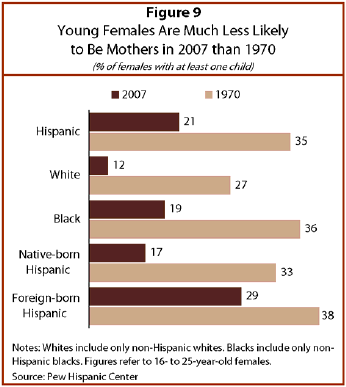
Young Hispanics’ growing pursuit of school or the work world since 1970 reflects changes in patterns of marriage and parenting. During this period, young women, including young Hispanic women, have grown less likely to marry during their youth (Landale, Oropesa, and Bradatan, 2006). They have also become less likely to be mothers. In 1970, 35% of young Hispanic females were mothers. By 2007, only 21% were mothers. Young mothers are less likely than other young women to continue their schooling. As young motherhood has waned, young Hispanics’ pursuit of market-oriented pathways has grown.

Other Pathways: Military Down, Prison Up

One pathway into adulthood that has significantly diminished for young Hispanics is military service. In 1970, at a time when a military draft was in place, 5% of young Hispanic males were in the armed forces. By 2007, only 1% of young Hispanic males were in the military. White and black male youth employment in the military has also declined since 1970. For example, 2% of young white males were in the armed forces in 2007, down from 8% in 1970.

A pathway that has grown more common over time—albeit from a small base—is prison or jail. By 1990, about 2% of Hispanic youths were incarcerated, up from less than 1% in 1970. There has been little change in the incarceration share since 1990. The share of white youths incarcerated has remained about 1% since 1970. Black youths incarceration peaked at about 5% in 2000 and has since declined to 4% in 2007.

Immigration and Demographics

The sharp growth in the Hispanic share of this 16 to 25 age group has been driven by a combination of high immigration levels and high birthrates among Latino immigrants. These trends in turn have altered the demographic profile of Latino youths. The white and African-American youth populations continue to be largely native born. In contrast, the origins of Latino youths have shifted since 1970—not once but twice. In 1970, only one-third of Hispanic youths were foreign born. By 2000, almost half of Hispanic youths were immigrants. Since then, the share of Hispanic youths who are foreign born has receded (to 39% by 2007) as more Latino young adults are the children of the immigrants who arrived in the 1970s, 1980s and 1990s.

About this Report

This report was prepared for the Education Writers Association, Pew Hispanic Center and National Panel on Latino Children and Schooling conference entitled “Latino Children, Families and Schooling.” The conference was held on Tuesday, October 6, 2009.

This report presents a comprehensive analysis of the basic activities or pathways of Hispanic, white and black youths ages 16 to 25. Using data on youths from the Decennial Census micro data files of 1970, 1980, 1990 and 2000 and the comparable U.S. Census Bureau’s 2007 American Community Survey (ACS), all youths residing in the United States are analyzed and thus the important pathways of service in the military as well as incarceration in correctional facilities can be quantified.

A Note on Terminology

The terms “Latino” and “Hispanic” are used interchangeably in this report, as are the terms “foreign born” and “immigrant.” Hispanics born in the 50 states or the District of Columbia are considered “native born.” Hispanics born in outlying areas of the United States (including Puerto Rico) and other countries are defined as “foreign born.”

All references to whites and blacks are to the non-Hispanic components of those populations.

The labor force includes the employed and the unemployed. Those employed in the armed forces are included in the labor force.

“Incarcerated” refers to males institutionalized in prisons and jails, hospitals, and juvenile institutions. See Appendix B for details.

Recommended Citation

Richard Fry. The Changing Pathways of Hispanic Youths Into Adulthood. Washington, DC: Pew Hispanic Center, 2009.
II. The Pathways of Youths to Adulthood

This report focuses on the pathways into adulthood taken by Latino and other youth ages 16 to 25. The analysis includes all youths and is not restricted to civilian youths or noninstitutionalized youths. Hence, we can present a comprehensive portrait of the activities of youths.

Using information on residence and status at the time of interview, male activities or pathways can be divided into six mutually exclusive endeavors (Table 2).4 Both schooling and work are enumerated. Labor market economists consider job search a productive activity, and unemployed youths are included in the labor force. So the “work” pathway in this analysis includes both employed youths and youths who have looked for work. Traditionally, enlistment in the military has been an important entry point into adulthood for young minority males and hence the analysis distinguishes between employment in the military and civilian employment. Nonenrolled employment in the armed forces is the fourth possible endeavor. Finally, among young men who are neither enrolled in school nor part of the labor force, we can distinguish between those incarcerated in prison or jails and those who are not incarcerated.5

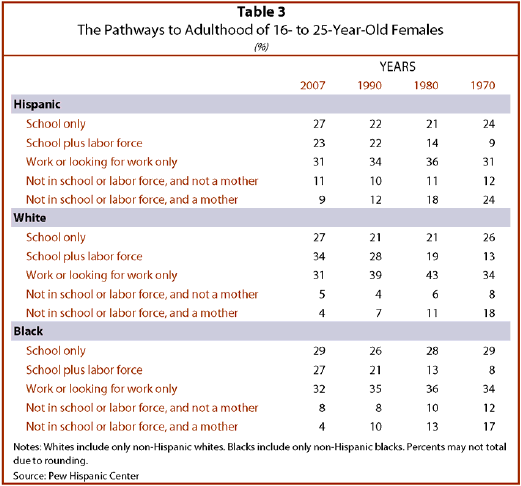
For young women, a slightly different taxonomy of labor market engagement is apropos. Among young women in 2007, fewer than 1 percent were either in the armed forces or incarcerated in correctional facilities and thus little clarity is sacrificed by not enumerating these very small female populations. Significant numbers of young women are mothers, however, and young motherhood is strongly associated with both decisions about school continuation and participation in the labor force (Ahituv and Tienda, 2004). This analysis identifies five mutually exclusive endeavors or pathways for young women (Table 3). As with young men, the first three involve the core activities of either schooling or skill acquisition through the work world. Among young women who are neither enrolled in school nor in the labor force, those who are mothers are distinguished from those who do not have parenting responsibilities.

III. Patterns in Skill Acquisition

[from school or work]

A growing fraction of Hispanic 16- to 25-year-olds are either in school or the labor force. In 2007, 86% of Hispanic youths were in school or the labor force, an increase from 77% in 1970. Black and white youths have also become more engaged in formal labor market-oriented endeavors since 1970. Hispanic youths continue to be more detached from skill-building pathways than their white peers. In 2007, 7% of white youths were in neither school nor the labor force, compared with 14% of Hispanic youths.

Hispanic Females Less Engaged in School or Work than Black Males

The labor market difficulties of young black men have been intensively scrutinized for decades (Holzer, 2009). In 2007, 84% of young black males were either enrolled in school or were in the labor force (Figure 3). In other words, 16% of young black men were not engaged in these activities.

Young black men are not, however, the race-gender group with the lowest proportion engaged in either school or the work world. In 2007, only 81% of young Hispanic females were enrolled in school or active in the labor force. That means almost one-in-five Hispanic females were not pursuing labor market-oriented paths. Thus detachment among young Hispanic females was more pronounced than among young black males. Detachment from school and work was particularly pronounced among foreign-born Hispanic females. More than three-in-ten foreign-born Hispanic females were neither in school nor the labor force.

However, the proportion of young Latino females pursuing formal schooling or acquiring skills in the work world has steeply increased since 1970. At that time, only two out of three female Latinos were in school or the labor force, compared with four out of five female Latinos in 2007.

In contrast, for young Latino men and young black men, there has been little change since 1970 in the proportion of the population in school or the labor force. More than 90% of Latino males were in school or the labor force in 2007, a level of engagement greater than black males (84%) but trailing white males (94%).

Schooling and Work among the Lesser-educated Youths

Labor economists have long observed that the employment crisis among young black males is concentrated among less-educated youths (Welch, 1990; Holzer and Offner, 2001; Freeman and Holzer, 1986). Figure 4 shows the proportion of youths either in school or the labor force among youths who have not completed any education beyond high school. Youths lacking any education beyond high school are less likely than other youths to be either in school or the work world. In 2007, for example, 81% of all young Hispanic females were engaged in labor market-oriented activities (Figure 3), but among young Hispanic females with no formal education beyond high school, only 76% were enrolled or in the labor force (Figure 4).

Among youths with no education beyond high school, it remains the case that Hispanic females were less likely than black males to be either in school or working or looking for work—76% compared with 80% in 2007. However, the trend over time for less-educated Hispanic females is different than for less-educated black males. Whereas the employment situation for less-educated black males has deteriorated since 1970, labor market engagement for less-educated Hispanic females has increased over that period.

IV. Rising School Enrollment

Hispanic youths are increasingly acquiring marketable skills, and a primary avenue is through increased school enrollment (Figure 5). Similar to white and black youths, many more Hispanic youths are enrolled in school or college in 2007 than in 1970.

Among Hispanic youths, increased school enrollment has been concentrated among Hispanic females. In 1970, one-third of Hispanic females were in school or college; in 2007, nearly half were pursuing an education. Among young women in general there has been a very large rise in school enrollment rates (Card and Lemieux, 2000), and young Hispanic women are increasingly attending school as well.

Young Hispanic men overall have not increased their school enrollment since 1970, but that partly is due to changes in composition by nativity. As Figure 5 shows, young Hispanic males born in the United States have an increased school enrollment rate, though the increase lags behind that of other groups.

Increasing High School Attendance

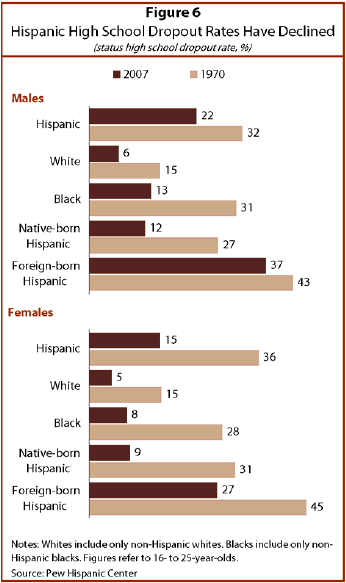
Hispanic school enrollment rates have risen in part because young Hispanics are increasingly staying in school and trying to finish their high school education (National Center for Education Statistics, 2008). In 1970, about one-third of young Hispanics were high school dropouts. In 2007, one-fifth of young Hispanics were high school dropouts. High school dropout rates have declined for young Hispanic males as well as Hispanic females and have particularly plunged for Hispanics born in the United States (Figure 6). For example, in 1970 nearly one-third of young female Latinos who were born in the U.S. were high school dropouts. By 2007, less than one-in-ten U.S.-born female Latinos were high school dropouts.

A Stubborn Dropout Gap Remains

Though Hispanic youths have made tremendous progress staying in school, white and black youths have as well. Thus, it remains the case that Hispanic youths are much more likely than white youths to drop out of school. For example, in 1970 native-born Hispanics, educated in U.S. schools, were about twice as likely (29%) to drop out of high school as white youths (15%). In 2007, U.S.-born Hispanic youths were still about twice as likely to drop out as white youths (10% vs. 5%). In spite of progress, Hispanic youths have not reached parity with white youths in completing high school.

Rising College Enrollment

The overall rise in Hispanic school enrollment also stems from increased college enrollment among Hispanic youths. In 1970, of Hispanic youths who had finished high school, 25% were enrolled in college. By 2007, almost 40% of Hispanics who had finished high school were pursuing college.6

Concentrated among Hispanic Females

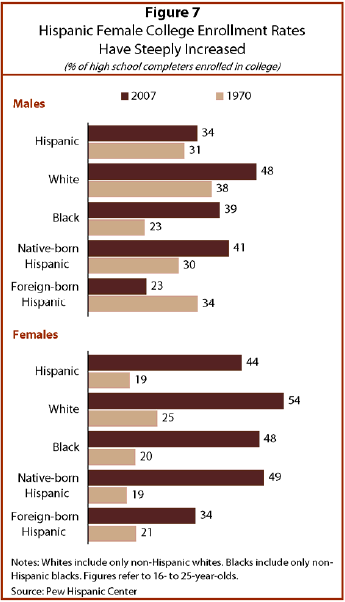
Social scientists have noted the gender revolution that has taken place on the nation’s college campuses. Since 1947, college enrollment has grown increasingly female (Goldin, Katz, and Kuziemko, 2006). Young Latino women have fully participated in this higher education revolution. In 1970, only 19% of female Hispanic high school completers were enrolled in college (Figure 7). By 2007, 44% of young female Hispanics with a high school education were enrolled in college. Among native-born female Latinos who have finished high school, almost half (49%) were enrolled in college in 2007. The college enrollment rates of young Hispanic men have increased (from 31% of high school completers in 1970 to 34% of in 2007), but the gains have not been on the order of magnitude achieved by Hispanic females.

Undergraduate enrollment figures compiled by the U.S. Department of Education dramatize the strides made by young Hispanic females relative to young Hispanic males. Hispanic male undergraduate enrollment has risen fourfold, from about 190,000 in 1976 to 800,000 in 2007 (National Center for Education Statistics, 2009). Hispanic female undergrad enrollment has risen sevenfold over that period, from 160,000 students to more than 1.1 million.7

A Persistent College Enrollment Gap Remains

Although Hispanic youths have markedly increased their college enrollment rates since 1970, white and black youths (particularly white and black young women) are also attending college at much higher rates. As a result, gaps in college participation have not declined much. The white college enrollment rate (calculated among youths who have finished high school) increased from 31% in 1970 to 51% in 2007. Among native-born Hispanic youths, the comparable college enrollment rate increased from 24% in 1970 to 45% in 2007. The gap between white and native-born Hispanic youths in college enrollment has not narrowed much since 1970. Hispanic youths continue to trail white youths in building skills via college.

Partial Explanation: Declining Motherhood

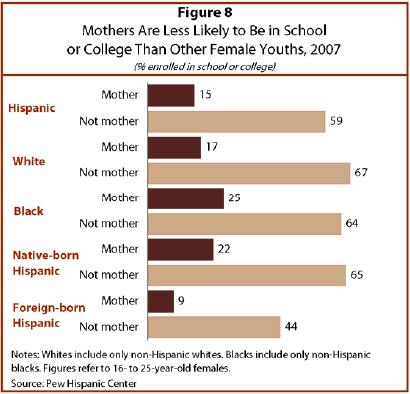
Why are so many more young Hispanic females enrolled in school now than in earlier decades? There are likely many factors involved, but clearly associated with their increased school enrollment rate is a decline in motherhood. Motherhood is an impediment to schooling. Young women who are mothers are much less likely to be enrolled in school or college than young women who don’t have that responsibility (Figure 8). For example, among young Hispanic females who were not mothers, almost 60% were in enrolled in school or college in 2007. Among their counterparts who were mothers, only 15% were enrolled in school.

Similar to other young women, Hispanic females in 2007 are much less likely to be a parent than in 1970. In 1970, more than a third of young Hispanic women had at least one child of her own in her household. By 2007, the rate of motherhood was only one-in-five among young female Latinos (Figure 9).8 The very significant decline in parenting responsibilities would be expected to strongly discourage school leaving and increase college-going (Ahituv and Tienda, 2004).

V. Rising Labor Force Participation

The rise in Hispanic youths’ pursuit of school since 1970 has not come at the expense of work effort or labor force participation. A growing share of Hispanic youths are either working or looking for work (Figure 10). In 1970, 52% of Hispanic youths were in the labor force. By 2007, the labor force participation rate of young Hispanics increased to 62%. Again, much of this increase in labor force participation reflects strong growth among Hispanic females rather than males.

For young Hispanic men, the pathway of formal schooling has modestly declined (Figure 5). More than 90% of young Hispanic men continue to be engaged in either school or the work world (Figure 3) because a modestly rising share of young Hispanic men are participating in the labor force (Figure 11). In 2007, 68% of young Hispanic males were in the labor force, up from 65% in 1970.

Though relatively few young foreign-born Hispanic males are pursuing schooling, many in this population group are working or looking for work. In 2007, 79% of young foreign-born Hispanic males were in the labor force, the highest rate of labor force participation of any of the race-gender-nativity groups considered.

As with young white and black males, labor force participation of native-born Hispanic males has declined in recent years. It peaked at 68% for native-born Hispanic males in 1980 and stood at 61% by 2007. The decline in labor force participation was offset, however, by increased school or college enrollment such that the aggregate share of native-born Hispanic males on skill-building pathways remained unchanged at about 90% (Figure 3).

Accompanying the large rise in the school enrollment rate of young Hispanic women has been a large rise in their labor force participation since 1970 (Figure 12). As with white and black females, the labor force participation rate of young Hispanic women increased from 40% in 1970 to 54% in 2007. In spite of the increase, though, Hispanic females have the lowest rate of labor force participation of any of the race-gender groups examined. In 2007, the labor force participation rate of young black males was 56%.

VI. Military: A Road Less Traveled

Though the overall labor force participation rate of young Hispanic men has modestly increased from 1970 to 2007, the military is a much reduced pathway for young Hispanic males. In 1970, during the Vietnam War, 5% of young Hispanic males were employed in the armed forces (Figure 13).9 In 2007, about 1% were in the military.10 Among native-born Hispanic males, less than 2% were in the military in 2007 and the share of U.S.-born Hispanic males and black males (1.4%) in the military was smaller than the share of white males (2.0%) in the military.11

VII. Hispanic Male Incarceration Has Increased

In 1970, 1.5% of young Hispanic males were incarcerated (Figure 14).12 By 1990 and beyond, 3% of young Hispanic males were in correctional facilities. Native-born Hispanic males are significantly more likely to be in prison or jail than foreign-born Hispanic males.13 Male incarceration rates for white and black youths peaked in 2000. About 1.5% of young white males were incarcerated in 2000, an increase from 1.1% in 1970. Among young black males, more than 9% were incarcerated in 2000, an increase from 4.4% in 1970. Between 2000 and 2007, the young black male incarceration rate declined to 6.9%.

VIII. The Pathways of Young Hispanic Females by Nativity

One-in-five young Latino females was neither in school or the labor force in 2007, a level of disengagement from school and work in excess of young black males. Some of the young Latino females who were not in school or the labor force were mothers. In 2007, about 9% of young Hispanic females were mothers who were in neither school nor the labor force (Figure 15). An additional 11% of young Hispanic females who were not in school or the labor force were not mothers.

Young motherhood among Hispanics has declined (Figure 9), and motherhood as an explanation for the lack of pursuit of school or work has declined as well. In 1970, 36% of young Hispanic females were not in school or working or looking for work, but two-thirds of them were mothers (Table 3). In 2007, less than half of young Hispanic females who were not in school or the labor force were mothers.

Though the fraction of female Latinos neither in school nor working has fallen markedly (from 36% in 1970 to 19% in 2007), the share of female Latinos who were not in school or working and not mothers has declined very little (Table 3). In 1970, 12% of young female Hispanics were not mothers and not in school or the labor force. In 2007, the comparable figure was 11%.

The size of the young out-of-school and out-of-work population is particularly large among young foreign-born female Latinos. Three-in-ten immigrant female Latinos were neither in school nor working in 2007 (Figure 15). About half of the foreign-born female Latinos neither enrolled in school nor in the work world were mothers, but that still leaves 15% of foreign-born female Latinos who are not in school or working and are not mothers. This is quite close to the size of the young black male population that is not in school or working (16%).

Appendix A: Data Sources

The analysis is based on youths ages 16 to 25 in the Decennial Censuses and 2007 American Community Survey (ACS) public use micro samples. The Integrated Public Use Micro Sample (IPUMS) versions of these data, compiled by the University of Minnesota Population Center, were used. The 2007 ACS is a 1% sample of the U.S. population. In 1970, school enrollment information is available only in the Form 2 samples. The three 1970 Form 2 samples were combined to form a 3% sample of 1970 youths. For 1980, 1990 and 2000, the 5% IPUMS files were used. For Hispanic and non-Hispanic black youths, all the observations were used. But, for ease of tabulation, random 1-in-10 subsamples of non-Hispanic white youths were utilized. So, for 1980, 1990, and 2000, the non-Hispanic white results are based on a 0.5% sample of non-Hispanic white youths.

All the results published are based on the appropriate sample weights. The unweighted sample sizes of youths are as follows:

Commencing with the 2000 Decennial Census, the Census altered the racial identification question by permitting respondents to declare multiple racial identifications. Non-Hispanic black and non-Hispanic white youths before 2000 and after 2000 are made comparable by using the IPUMS RACESING variable for the racial designation. See the IPUMS documentation for further details on how RACESING bridges the old and new racial classifications: http://usa.ipums.org/usa-action/variableDescription.do?mnemonic=RACESING

The 1970 Form 2 samples do not inquire about citizenship status. They do, however, have information on place of birth. For this reason, nativity in this report is based on the youth’s place of birth rather than citizenship status. Youths who were born in Puerto Rico or other outlying areas were included in the foreign-born population.

The American Community Survey does not reveal the type of institution where institutionalized youths live. Hence, in the ACS it is not possible to identify youths incarcerated in correctional facilities from other institutionalized youths and only the total count of institutionalized youths is available. For comparability, the Decennial Census counts on incarcerated youths shown herein also refer to the number of institutionalized youths in all institutions, not just correctional facilities. As Appendix B shows, most (more than 90%) institutionalized young males are in correctional facilities.

Results involving the employment or labor force status of youths for 2000 were not published. Census Bureau evaluation studies indicate that the 2000 Decennial Census may not accurately measure a youth’s employment status (Palumbo and Siegel, 2004). Census 2000 underestimates employment and overestimates the number of people not in the labor force (relative to the Current Population Survey for the Census 2000 time period). The classification problems appear to be particularly acute for young age categories and lesser-educated individuals.

The Decennial Census/American Community Survey data have a number of advantages for the examination of the activities of youths. Unlike some other data sets, the universe for the Census is the resident population. As such, youths residing in institutions and those employed in the armed forces are enumerated. Both the institutionalized and those in the military are particularly important for understanding the activities of young males. The census has extremely large samples of youths, providing precise estimates for narrowly defined age and nativity groups. The Current Population Survey (CPS) is often used to examine the school and labor market activities of youths. The CPS did not routinely inquire about citizenship status until 1995 and hence cannot be used to document trends for immigrant and native-born youths. Finally, a number of well-known studies of the activities of black men and immigrants have used the Decennial Census (Welch, 1990; Betts and Lofstrom, 2000).

Appendix B: Census Counts of Incarcerated Youths

This report uses Decennial Census data to examine the fraction of young males incarcerated in correctional facilities. This may be problematic because the American Community Survey and more recent Census public use micro data do not reveal if a youth is incarcerated in a correctional facility. Rather the micro data reveals if the youth is institutionalized. The institutionalized population includes those in juvenile institutions, hospitals and psychiatric facilities in addition to those in correctional facilities. Nevertheless, evidence suggests that the Census accurately captures incarcerated youths and the trends evident in the Census micro data are supported by administrative counts.

First, most young institutionalized males are in correctional facilities. The Census Bureau’s population estimates program generates estimates of the number of young males who are institutionalized. These are shown below for July 1, 2007. The U.S. Bureau of Justice Statistics estimates the number of young males held in state or federal prison or local jails. The table below reports the number of inmates for June 30, 2007.

Around 97% of young institutionalized males are likely incarcerated in correctional facilities.

Second, the Decennial Census appears to fairly accurately count the number of inmates in correctional facilities. The table below reports the number of males of all ages residing in correctional facilities as of April 1, 2000, and compares it to the Bureau of Justice Statistics estimates for the number of inmates in state or federal prisons or local jails for June 30, 2000.

Third, recent trends in young institutionalization evident in the Census micro data are consistent with the Bureau of Justice Statistics estimates. Figure 14 indicates that the fraction of young black males institutionalized has decreased since 2000 from 9% to 7% in 2007. The share of young Hispanic males institutionalized appears to have remained relatively constant at 3%. The Bureau of Justice Statistics estimates incarceration rates for young males and their reported trends are similar:

Appendix C: Data Tables