
Pew Research Center

FOR RELEASE MAY 28, 2009

Latino Children: A Majority Are U.S.-Born Offspring of Immigrants

Hispanics now make up 22% of all children under the age of 18 in the United States--up from 9% in 1980--and as their numbers have grown, their demographic profile has changed.

BY Richard Fry and Jeffrey S. Passel

FOR MEDIA OR OTHER INQUIRIES:

Communications Department
202.419.4372
www.pewresearch.org

RECOMMENDED CITATION

Pew Research Center, May 2009, "Latino Children: A Majority Are U.S.-Born Offspring of Immigrants"

About Pew Research Center

Pew Research Center is a nonpartisan, nonadvocacy fact tank that informs the public about the issues, attitudes and trends shaping the world. It does not take policy positions. The Center conducts public opinion polling, demographic research, computational social science research and other data-driven research. It studies politics and policy; news habits and media; the internet and technology; religion; race and ethnicity; international affairs; social, demographic and economic trends; science; research methodology and data science; and immigration and migration. Pew Research Center is a subsidiary of The Pew Charitable Trusts, its primary funder.

© Pew Research Center 2026

Table of contents

  • About Pew Research Center
  • Latino Children: A Majority Are U.S.-Born Offspring of Immigrants
  • II. The Legal and Generational Status of Hispanic Children
  • III. The Past and Future Generational Status of Hispanic Children
  • IV. A Profile of Hispanic Children
  • Appendix A: Generational Status of Historical Hispanic Children

Latino Children: A Majority Are U.S.-Born Offspring of Immigrants

Hispanics now make up 22% of all children under the age of 18 in the United States--up from 9% in 1980--and as their numbers have grown, their demographic profile has changed.

I. Overview

Hispanics now make up 22% of all children under the age of 18 in the United States–up from 9% in 1980–and as their numbers have grown, their demographic profile has changed.

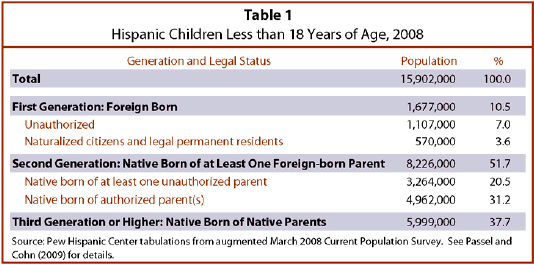
A majority (52%) of the nation’s 16 million Hispanic children are now “second generation,” meaning they are the U.S.-born sons or daughters of at least one foreign-born parent, typically someone who came to this country in the immigration wave from Mexico, Central America and South America that began around 1980. Some 11% of Latino children are “first generation”–meaning they themselves are foreign-born. And 37% are “third generation or higher”–meaning they are the U.S.-born children of U.S.-born parents.

In 1980, only three-in-ten Latino children were second generation, while nearly six-in-ten were in the third generation or higher. These shifts are noteworthy because many social, economic and demographic characteristics of Latino children vary sharply by their generational status. A Pew Hispanic Center analysis of U.S. Census Bureau data finds that:

  • 43% of first-generation Latino children, 21% of those in the second generation and 5% in the third generation or higher are not fluent in English.
  • 47% of first-generation Latino children have parents who have less than a high school education, compared with 40% of second-generation children and 16% of Latino children in the third generation or higher.
  • 34% of first-generation Latino children live in poverty, compared with 26% of those in the second generation and 24% in the third generation or higher.
  • 69% of first-generation Latino children live in married-couple families, compared with 73% of second-generation children and just 52% in the third generation or higher.

Most of these data reflect the classic pattern of socioeconomic gains for immigrant families from one generation to the next. However, there are also some contrary trends. As indicated above, the chances of being raised by a single parent are much greater among Latino children in the third generation or higher than among first- or second-generation Latino children.1

Another characteristic that separates Latino children along generational lines is their legal status. Building on earlier research2 the Pew Hispanic Center estimates that 7% of all Hispanic children are unauthorized immigrants. But this share varies sharply by generational status. Two-thirds of the 1.7 million foreign-born Hispanic children are unauthorized, while none of the 6 million Hispanic children in the third generation or higher are unauthorized (as the U.S.-born children of U.S.-born parents, by definition they are U.S. citizens at birth). As for those in the middle–the second generation–about four-in-ten have at least one unauthorized immigrant parent and are therefore living in a family whose immigration status is legally mixed.

Projects by the U.S. Census Bureau indicate that by 2025, nearly three-in-ten children in this country will be of Latino ancestry. Pew Hispanic Center population projects indicate that the generational composition of Hispanic children will change yet again between now and then. Today’s large cohort of second-generation Hispanic children will eventually form families and produce third-generation offspring. The Center’s projections show that the share of Hispanic children who are second generation will likely peak not much above the current level of 52% and then begin falling roughly a decade from now. The share of Hispanic children who are third generation or higher will likely hit bottom at 35% around 2015 and then begin rising. Given past trends, this change in the generational composition of Hispanic children could well have an impact on their employment, education and social outcomes in future years.

About this Report

This report present findings from several existing and new Pew Hispanic Center analyses of U.S. Census Bureau data as well as Pew Hispanic Center population projections. The analysis of the legal status of Hispanic children underlying Table 1 utilized the augmented March 2008 Current Population Survey. See Passel and Cohn (2009) for further details. The methods and assumptions underlying the generational projections of Hispanic children from 2010 to 2025 are described in detail in Passel and Cohn (2008). The historical and current profile of Hispanic children derives from new analyses of Decennial Census and American Community Survey data. See the data appendix for further details.

A Note on Terminology

Unless otherwise noted, this report uses the following definitions of the first, second, and third or higher generations:

First: Foreign-born; an individual who is not a U.S. citizen at birth or, in other words, who is born outside the U.S., Puerto Rico or other U.S. territories and whose parents are not U.S. citizens.

Second: An individual who is a U.S. citizen at birth (including people born in the United States, Puerto Rico or other U.S. territories, as well as those born elsewhere to parents who are U.S. citizens) with at least one first-generation parent.

Third or higher: An individual who is a U.S. citizen at birth with both parents U.S. citizens at birth. The terms “Latino” and “Hispanic” are used interchangeably in this report, as are the terms “foreign born” and “immigrant.”

Recommended Citation

Richard Fry and Jeffrey S. Passel. “Latino Children: A Majority Are U.S.-Born Offspring of Immigrants.” Washington, D.C.: Pew Hispanic Center (May 2009).
II. The Legal and Generational Status of Hispanic Children

The Growth of Hispanic Children

The nation’s 16 million Hispanic children will likely continue to be one of our fastest- growing child populations. The U.S. Census Bureau projects that the number of Hispanic children will rise to 24 million by 2025 (Census Bureau, 2008). The share of children who are of Latino origin is projected to rise to 29% in 2025 from 22% today. In contrast, the Census Bureau projects that the share of children identifying as either non-Hispanic white or non-Hispanic black will continue to fall.

The nation’s 16 million Hispanic children and its 31 million Hispanic adults have very different generational and legal status profiles. Only 11% of Hispanic children were born outside of the United States (Table 1). In contrast, 55% of Hispanic adults were born in another country and migrated to the United States. As a result, far fewer Hispanic children than Hispanic adults are unauthorized immigrants. Building on prior research on the size and characteristics of the undocumented immigrant population (Passel and Cohn, 2009), the Pew Hispanic Center estimates that 1.1 million Hispanic children, or about 7% of all Hispanic children, are unauthorized immigrants (based on March 2008 data collected by the Census Bureau). In contrast, about one-fourth of all Hispanic adults are undocumented migrants.

Undocumented Children and Public Benefits

Undocumented children are eligible to receive some public benefits but not others. They are legally entitled to public education from kindergarten through high school; to some emergency medical care; and to child and school nutrition programs under the Women, Infants and Children (WIC) legislation. They are not eligible for many other federal programs that provide a safety net for children, including the Supplemental Nutrition Assistance Program (formerly known as the food stamp program), Temporary Assistance for Needy Families (TANF), non-emergency Medicaid and the State Children’s Health Insurance Program (SCHIP). Also, undocumented students are not eligible for federal Pell grants for postsecondary education and in most states are not offered in-state tuition at public colleges and universities.

Nearly nine-in-ten Hispanic children under the age of 18 were born in the United States and are therefore U.S. citizens by birth. However, many are not far removed from their immigrant roots. About half (52%) of all Hispanic children are members of the “second generation,” that is, they are the U.S.-born children of at least one immigrant parent. A majority of this large Hispanic second-generation child population is living with a parent or parents who are legal immigrants. However, a sizable minority are in families whose legal status is mixed, as about two-in-ten Hispanic children are U.S.-born children of unauthorized immigrant parents. Finally, about four-in-ten Hispanic children (6 million) are the U.S.-born children of parents who were born in the U.S. By definition, these children are members of the “third generation” or higher, and their families have been in the United States for at least a generation. Some of these children’s families have been in the country for many generations. In fact, persons of Hispanic descent resided in the United States before the American Revolution. The Decennial Census did not consistently count Hispanics until 1970, but the 1930 Census counted 1.3 million “Mexicans” residing in the U.S. (Census Bureau, 1993).

III. The Past and Future Generational Status of Hispanic Children

In 1980, about 6 million Hispanic children were in the U.S. By 2008, there were about 16 million. As Figure 2 shows, the strong growth in the number of Hispanic children since 1980 has been accompanied by important compositional changes in their generational status. In 1980, a majority of Hispanic children were third generation or higher. As a result of the large immigrant inflows of young Hispanic adults in the 1980s and 1990s, the number of Hispanic children of immigrant parentage sharply increased. The number of second-generation Hispanic children in particular has markedly grown. The size of the Hispanic child second-generation population more than quadrupled from 1980 to 2007 (Figure 3), and the share of children who are second generation rose from 30% in 1980 to 52% by 2007.

Although the number of Hispanic children who are themselves immigrants has grown and is projected to continue to do so until at least 2025, the share of Hispanic children who are immigrants already appears to have peaked around 2000 at about 15% of Hispanic children.

Based on population projections of Pew Hispanic Center senior demographer Jeffrey S. Passel, the share of Hispanic children who are second generation—currently 52%—will soon peak at about 53%. This reflects the fact that the large Hispanic second generation born since 1990 is maturing. As they age into their 20s and 30s and form families, they will produce a growing third-generation Hispanic child population. Indeed, the projections suggest that after reaching its nadir at 35% around 2015, the share of Hispanic children who are third generation or higher will begin increasing. From 2010 to 2025, the Hispanic child second-generation population is projected to grow by 33%. Meanwhile, the Hispanic child population in the third generation or higher is projected to grow by more than 60%.

This generational profile for Hispanic children differs from that of the entire Hispanic population. While the share of Hispanic children who are second generation may soon peak, the share of the entire Hispanic population that is born in the U.S. to at least one immigrant parent has not peaked. Demographic projections suggest that among the entire Hispanic population, the second-generation share will not peak until at least 2050 (Passel and Cohn, 2008).

IV. A Profile of Hispanic Children

The socioeconomic background of Hispanic children is one important set of factors influencing their educational success and overall well-being. Table 2 presents a recent snapshot of the characteristics of Hispanic children by generation. The characteristics in the lower part of Table 2 refer to the nature of the child’s household, not the child per se. First- and second-generation children can reside in the same household (that is, they may be siblings), and so some degree of similarity can be expected in the nature of the household characteristics of first- and second-generation children.

For several key characteristics, there are large differences among Hispanic children by their generational status. Foreign-born Hispanic children are twice as likely as their native-born counterparts to speak English less than “very well.” About one-fifth of Hispanic second-generation children speak English less than “very well.” U.S.-born Hispanic parents overwhelmingly use English at home and transmit English language skills to their children before the onset of kindergarten (Nord and Griffin, 1999). Accordingly, only 5% of Hispanic children in the third generation or higher speak English less than “very well.” English ability matters in part because it is highly related to educational test score performance (Nation’s Report Card, 2007) and high school completion (NCES, 2004).

Hispanic children who are third generation or higher have much better educated parents than their first- and second-generation peers. Almost 85% of children in the third generation or higher have parents who completed high school, and 55% have parents who have completed at least some college education. Hispanic children of foreign-born parents tend to have much less educated parents. For example, only 60% of second-generation children have parents who have completed high school and only 31% of these children have parents who have completed at least some college.

The household earnings and income levels of first- and second-generation Hispanic children are lower than those of children in the third generation or higher. About 30% of Hispanic children in the third generation or higher live in households whose incomes are at least $75,000. The comparable figure for first- and second-generation Hispanic children is just 16%. More than one-third of foreign-born Hispanic children live in poverty, versus about one-quarter of second-generation children and those in the third generation or higher.

Although the basic socioeconomic factors suggest that Hispanic children in the third generation or higher may have a leg up on their peers, not all the advantages lie with the children of parents who were born and educated in the U.S. For example, Hispanic children in the third generation or higher are twice as likely as other Hispanic children to live in a female-headed household (Table 2). Single-mother families are more likely to live in poverty, and adolescents residing with both biological parents tend to display better educational outcomes and less risky behavior than do adolescents raised in other family arrangements (Ellwood and Jencks, 2002).

One of the most extensive investigations of the well-being and outcomes of the children of immigrants found that “Along a number of important dimensions, children and adolescents in immigrant families appear to experience better health and adjustment than do children and youth in native-born families” (Hernandez, 1999). With the exception of obesity, second-generation Hispanic adolescents seem to have fewer physical health problems than their counterparts in the third generation or higher.

In conclusion, many important aspects of the lives of Hispanic children vary by generational status. Projections suggest that the family context of Hispanic children is changing and that in future years a greater share will be born into families that have been in the United States for at least a generation and whose parents will have been born and educated in the U.S. This compositional change will likely affect the educational and social outcomes of Hispanic children—perhaps for the better, perhaps not.

Appendix A: Generational Status of Historical Hispanic Children

Table 2, Figure 1, and the historical portions (1980 to 2007) portions of Figures 2 and 3 are based on new Pew Hispanic Center tabulations of Decennial Census data and the 2007 American Community Survey (ACS). These data provide the self-reported citizenship status of each child. Thus, whether a Hispanic child is or is not a U.S. citizen at birth (and thus “first generation”) can be ascertained for every child. However, among children who are citizens at birth (second generation or higher), there is some imprecision in determining their generation. The Decennial Census data do not ask respondents about their parents’ place of birth. To determine generational status for U.S. citizens at birth, this analysis followed the common methodology of examining the citizenship status of parents residing in the household (Landale, Oropesa and Llanes, 1998; Bleakley and Chin, 2004). The Integrated Public Use Micro Samples (IPUMS) version of these data provide convenient linkages of a mother’s and father’s characteristics (including nativity) to children in the household. Hence, we can establish the generational status for native-born children who reside with at least one parent. But some Hispanic children who are citizens at birth do not reside in households; and even if they do reside in a household, they may not reside with a parent. The generational status of these children in the second generation or higher is unknown. Appendix Table A1 reports the generational status of Hispanic children from 1980 to 2007 broken down into four generational categories: first generation, second generation, third generation or higher, and “generation unknown.” The number of Hispanic children who were citizens at birth and do not reside with any parent in a household (the “generation unknown” category) is not zero, but it also is not a large percentage.

The percentages reported in the text abstract from the fourth “generation unknown” category. That is, the figures report the generational percentages among Hispanic children who have a known generational status.