Pew Research Center

FOR RELEASE APRIL 25, 2007

Changing Faiths: Latinos and the Transformation of American Religion

Hispanics are transforming the nation’s religious landscape, especially the Catholic Church, not only because of their growing numbers but also because they are practicing a distinctive form of Christianity.

FOR MEDIA OR OTHER INQUIRIES:

Communications Department
202.419.4372
www.pewresearch.org

RECOMMENDED CITATION

Pew Research Center, April 2007, "Changing Faiths: Latinos and the Transformation of American Religion"

About Pew Research Center

Pew Research Center is a nonpartisan, nonadvocacy fact tank that informs the public about the issues, attitudes and trends shaping the world. It does not take policy positions. The Center conducts public opinion polling, demographic research, computational social science research and other data-driven research. It studies politics and policy; news habits and media; the internet and technology; religion; race and ethnicity; international affairs; social, demographic and economic trends; science; research methodology and data science; and immigration and migration. Pew Research Center is a subsidiary of The Pew Charitable Trusts, its primary funder.

© Pew Research Center 2026

Table of contents

  • About Pew Research Center
  • Changing Faiths: Latinos and the Transformation of American Religion
  • II. Religion and Demography
  • III. Religious Practices and Beliefs
  • IV. The Renewalist Movement and Hispanic Christianity
  • V. Conversion and Views of the Catholic Church
  • VI. The Ethnic Church
  • VII. Religion and Politics
  • VIII. Ideology and Policy Issues
  • IX: Party Identification and Ideology
  • Survey Methodology
  • Glossary

Changing Faiths: Latinos and the Transformation of American Religion

Hispanics are transforming the nation’s religious landscape, especially the Catholic Church, not only because of their growing numbers but also because they are practicing a distinctive form of Christianity.

I. Overview

Hispanics are transforming the nation’s religious landscape, especially the Catholic Church, not only because of their growing numbers but also because they are practicing a distinctive form of Christianity.

Religious expressions associated with the pentecostal and charismatic movements are a key attribute of worship for Hispanics in all the major religious traditions — far more so than among non-Latinos. Moreover, the growth of the Hispanic population is leading to the emergence of Latino-oriented churches across the country.

To explore the complex nature of religion among Latinos, the Pew Hispanic Center and the Pew Forum on Religion & Public Life collaborated on a series of public opinion surveys that totaled more than 4,600 interviews, constituting one of the largest data collection efforts conducted on this subject. The study examines religious beliefs and behaviors and their association with political thinking among Latinos of all faiths. It focuses special attention on Catholics, both those who retain their identification with the church and those who convert to evangelical churches.

About a third of all Catholics in the U.S. are now Latinos, and the study projects that the Latino share will continue climbing for decades. This demographic reality, combined with the distinctive characteristics of Latino Catholicism, ensures that Latinos will bring about important changes in the nation’s largest religious institution.

Most significantly given their numbers, more than half of Hispanic Catholics identify themselves as charismatics, compared with only an eighth of non-Hispanic Catholics. While remaining committed to the church and its traditional teachings, many of these Latino Catholics say they have witnessed or experienced occurrences typical of spirit-filled or renewalist movements, including divine healing and direct revelations from God. Even many Latino Catholics who do not identify themselves as renewalists appear deeply influenced by spirit-filled forms of Christianity.

Similarly, the renewalist movement is a powerful presence among Latino Protestants. More than half of Hispanics in this category identify with spirit-filled religion, compared with about a fifth of non-Hispanic Protestants.

The study also shows that many of those who are joining evangelical churches are Catholic converts. The desire for a more direct, personal experience of God emerges as by far the most potent motive for these conversions. Although these converts express some dissatisfaction with the lack of excitement in a typical Catholic Mass, negative views of Catholicism do not appear to be a major reason for their conversion.

The practice of religion is not only often renewalist in character, but for most Latinos across all the major religious traditions it is also distinctively ethnic. Two-thirds of Latino worshipers attend churches with Latino clergy, services in Spanish and heavily Latino congregations.

While most predominant among the foreign born and Spanish speakers, Hispanic-oriented worship is also prevalent among native-born and English-speaking Latinos. That strongly suggests that the phenomenon is not simply a product of immigration or language but that it involves a broader and more lasting form of ethnic identification.

These two defining characteristics — the prevalence of spirit-filled religious expressions and of ethnic-oriented worship — combined with the rapid growth of the Hispanic population leave little doubt that a detailed understanding of religious faith among Latinos is essential to understanding the future of this population as well as the evolving nature of religion in the United States.

Beyond the strictly religious realm, this study suggests that the roles Latinos play in U.S. politics and public affairs are deeply influenced by the distinctive characteristics of their religious faith. Most Latinos see religion as a moral compass to guide their own political thinking, and they expect the same of their political leaders. In addition, across all major religious traditions, most Latinos view the pulpit as an appropriate place to address social and political issues.

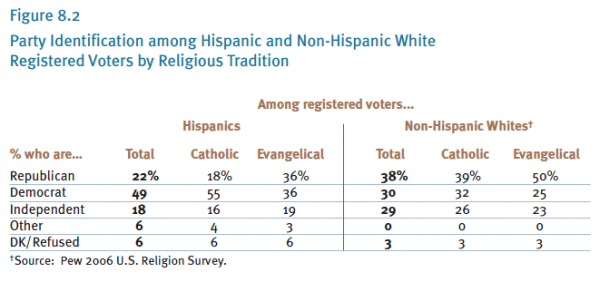
The study also sheds new light on the role religious affiliation plays on party identification among Hispanics. Latinos who are evangelicals are twice as likely as those who are Catholics to identify with the Republican Party. Latino Catholics, on the other hand, are much more likely than Latino evangelicals to identify with the Democratic Party. These differences rival, and may even exceed, those found in the general population.

Both the Pew Hispanic Center and the Pew Forum on Religion & Public Life are projects of the Pew Research Center, a Washington-based, nonpartisan research organization that seeks to provide timely information, free of any advocacy, on issues, attitudes and trends that are shaping America and the world. This study is the result of a yearlong collaboration involving more than a dozen researchers drawn from the staffs of both projects with expertise in a variety of subjects and research methodologies.

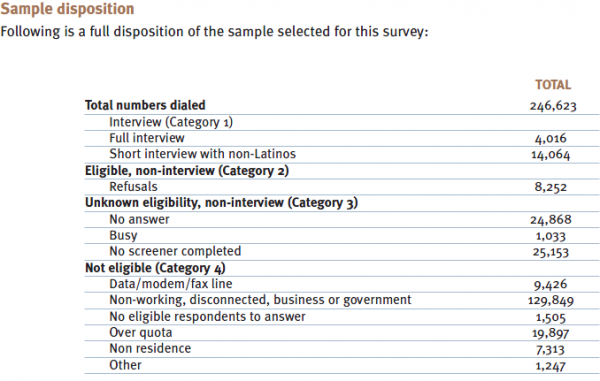
The centerpiece of the study is a telephone survey of a nationally representative sample of 4,016 Hispanic adults conducted between Aug. 10 and Oct. 4, 2006. The survey included an oversample of 2,000 non- Catholics, which permits an examination of the growth of evangelical and pentecostal Christianity among Latinos, including the process of conversion, in unprecedented detail. The sampling methodology also provided for robust numbers of respondents in all the major country-of-origin segments of the Hispanic population, allowing for detailed analysis of results by this important variable.

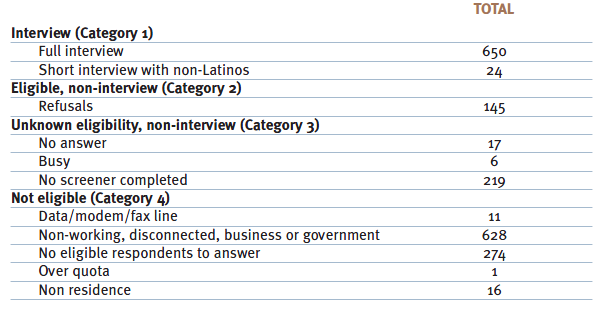
Both the extent of renewalism and of ethnic-oriented worship were further examined in recontact interviews with 650 Catholics drawn from the sample of the first survey. The research team also examined data from a large body of surveys previously conducted by both projects, particularly the latest of the Forum’s extensive surveys of religious belief and behavior in the general population, which offer various comparisons between Hispanics and non-Hispanics on many points.

Report Summary

Religion and Demography

More than two-thirds of Hispanics (68%) identify themselves as Roman Catholics. The next largest category, at 15%, is made up of born-again or evangelical Protestants. Nearly one-in-ten (8%) Latinos do not identify with any religion. Differences in religious identification among Latinos coincide with important differences in demographic characteristics. For example, Catholics are a more heavily immigrant population than evangelicals. Given current demographic trends, Latinos are projected to become an ever-increasing segment of the Catholic Church in the U.S.

Religious Practices and Beliefs

For the great majority of Latinos, regardless of their religious tradition, God is an active force in everyday life. Most Latinos pray every day, most have a religious object in their home and most attend a religious service at least once a month. By significant majorities, Latinos who identify with a religion believe that miracles are performed today just as they were in ancient times. Amid this overall religiosity, important differences emerge among Latinos of different religious traditions and between Latinos and their non-Hispanic counterparts.

The Renewalist Movement and Hispanic Christianity

Renewalist Christianity, which places special emphasis on God’s ongoing, day-to-day intervention in human affairs through the person of the Holy Spirit, is having a major impact on Hispanic Christianity. Among Latino Protestants, renewalism is three times as prevalent as it is among their non-Latino counterparts. A majority (54%) of Hispanic Catholics describe themselves as charismatic Christians, making them more than four times as likely as non-Latino Catholics to identify with renewalist Christianity. The implications of this are particularly important for the Catholic Church, given that the rapidly growing Latino flock is practicing a distinctive form of Catholicism. Latino Catholics nevertheless remain very much Catholic. Indeed, renewalist practices seem to have been incorporated into Hispanic Catholicism without displacing Catholic identity.

Conversion and Views of the Catholic Church

Nearly one-fifth (18%) of all Latinos say they have either converted from one religion to another or to no religion at all. Conversions are a key ingredient in the development of evangelicalism among Hispanics. Half of Hispanic evangelicals (51%) are converts, and more than four-fifths of them (43% of Hispanic evangelicals overall) are former Catholics.

By an overwhelming majority (82%), Hispanics cite the desire for a more direct, personal experience with God as the main reason for adopting a new faith. Among those who have become evangelicals, nine-in-ten (90%) say it was this spiritual search that drove their conversion. A majority of evangelical converts (61%) say the typical Catholic mass is not lively or exciting, although only about one-in-three (36%) cite that as a reason for their conversion.

The Ethnic Church

The houses of worship most frequented by Latinos have distinctly ethnic characteristics. A majority of those in the congregation are Hispanic; some Latinos serve as clergy; and liturgies are available in Spanish. The growth of the Hispanic population is leading to the emergence of Latino-oriented churches in all the major religious traditions across the country. While the prevalence of Hispanic-oriented worship is higher among the foreign born, with 77% saying they attend churches with those characteristics, the phenomenon is also widespread among the native born, with 48% saying they attend ethnic churches.

Religion and Politics

Two-thirds of Hispanics say that their religious beliefs are an important influence on their political thinking. More than half say churches and other houses of worship should address the social and political questions of the day. By nearly a two-to-one margin, Latinos say that there has been too little expression of religious faith by political leaders rather than too much. Churchgoing Hispanics report that their clergy often address political matters, although the extent of that practice varies considerably by issue and by religious tradition.

Ideology and Policy Issues

Religious affiliation and church attendance are strongly related to political ideology and views on a variety of social and public policy issues among Latinos. Even after controlling for language ability, nationality, generation and education, for instance, Latino evangelicals are still significantly more conservative than are Catholics on social issues, foreign policy issues and even in their attitudes toward the plight of the poor. Latino Catholics, in turn, are somewhat more conservative than seculars when it comes to gay marriage, government-guaranteed health care and increases in government services.

Frequency of church attendance tends to be correlated with more conservative views on social issues after controlling for a variety of demographic factors.

Party Identification and Ideology

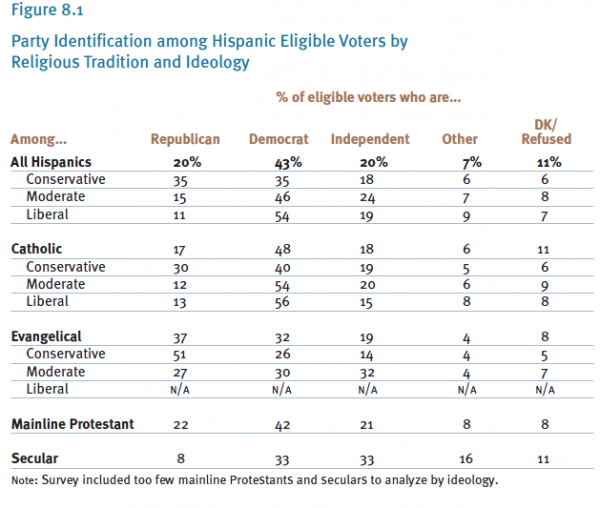
Latino evangelicals are twice as likely as Latino Catholics to be Republicans. That is a far greater difference than exists among whites. Moreover, Hispanic conservatives who are Catholic favor the Democrats, while white conservatives consider themselves Republican regardless of religious tradition.

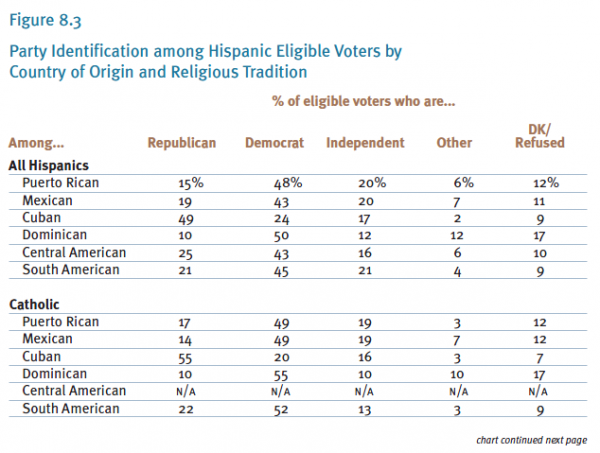
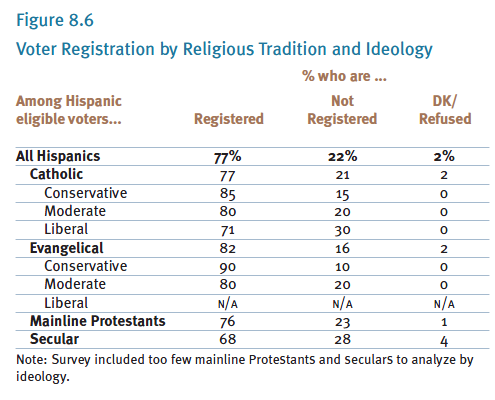
The Democratic Party holds a nearly three-to-one advantage among Latino Catholics who are eligible to vote (48% vs. 17% for Republicans). Because the Latino electorate is overwhelmingly Catholic (63%), Catholics represent the core of Democratic support among Latinos. Indeed, 70% of all Latino eligible voters who identify as Democrats are Catholics. Party identification among Latino evangelicals is more narrowly divided and appears to slightly favor the Republican Party. Among Hispanic eligible voters who are evangelicals, 37% say they consider themselves Republicans and 32% say they are Democrats.

II. Religion and Demography

More than two-thirds (68%) of Hispanics are Roman Catholics. The next largest category, at 15%, is made up of born-again or evangelical Protestants. Although their numbers are increasing, the share of Latino evangelical Protestants is smaller than it is in either the white or black communities.1

Seculars — those who do not identify with a specific religious affiliation or who say they are atheists or agnostics — make up 8% of the Latino population. The rest, about one-tenth of the total, are mostly spread among various Protestant and other Christian denominations. Only a handful of Hispanics — less than 1% of the population — identify with Judaism and other non-Christian faiths.

Among Latinos, differences in religious identification coincide with important differences in demographic characteristics, beginning with nativity. In the Hispanic foreign-born population, for example, 74% of adults identify as Catholic, compared with 58% of the native born.2

Hence, the demographic composition of religious congregations also differs. While about two-thirds (68%) of Hispanic Catholics are foreign born, just a bit more than half (55%) of Latino evangelicals are immigrants.

Given the differences in nativity, it is not surprising that Latino Catholics are less likely to speak English and tend to be less educated and poorer than Hispanics of other religious traditions.

Religious affiliation also varies somewhat by country of origin. For example, the share of Catholics among Latinos who trace their ancestry to Mexico is larger than among those of Puerto Rican origins, a group with a higher percentage of evangelicals.3

This chapter describes the demographic characteristics of religious affiliation among Hispanics and provides a demographic profile of the major religious traditions. It concludes with a set of demographic projections that estimate changes in Hispanic religious affiliation through 2030 and their impact on the Catholic Church.

Determining Religious Affiliation

This study uses a two-stage process to determine the religious affiliation of survey respondents. The first produces a sorting according to denomination. It is based on a sequence of questions that asks respondents to broadly identify their religion, if any. Then non-Catholic Christians are asked to specify the denomination, if any, with which they are affiliated. In the next stage, all Christians are asked whether they would describe themselves as “a born-again or evangelical Christian.” The answers to that question are combined with the information on affiliation with denominations from the first stage to sort all respondents into six categories of religious traditions. This methodology has been used extensively in many other Pew surveys, including surveys of the general population, allowing for robust comparisons with non- Hispanics.

Denominations and religious tradition

While 68% of Hispanics identify themselves as Catholic, most other Latinos are scattered among a variety of Protestant denominations, with no one denomination capturing more than 7% of the total. Fewer than onein- ten Latinos (8%) say that they are atheist or agnostic or that they have no specific religious affiliation; they are termed “seculars” for purposes of this study. This mix of denominations, particularly the predominance of Catholicism, sharply distinguishes Latinos from the rest of the U.S. population.

According to a survey of the entire U.S. population conducted in July 2006 by the Pew Research Center for the People & the Press and the Pew Forum on Religion & Public Life (Pew 2006 U.S. Religion Survey), non-Hispanics are more widely distributed among various denominations. Among whites, 22% are Catholic, 17% are Baptist and no other denomination captures more than 10%, although 11% of whites identify themselves as secular. Among blacks, the largest denomination is Baptist (46%). All data on non-Hispanics in this chapter are drawn from the Pew 2006 U.S. Religion Survey.

Born-again Christians

Aside from denomination, another key measure of religious identity among Latinos is whether they describe themselves as “born again” or “evangelical.” Among Latino Christians, who comprise 99% of Latinos who profess a religious faith, 39% say they use those terms to describe themselves. That includes 28% of Catholics and 70% of non-Catholic Christians.

Tracking Denominational Distribution

The surveys undertaken for this study, previous surveys conducted by the Pew Hispanic Center and the work of other researchers all point to the same basic distribution of adult Latinos by religious denomination. The consistent finding is that about two-thirds of Latinos are Catholic, about a fifth practice some form of Protestantism and slightly less than a tenth identify as secular.

A 2005 Gallup Poll, for instance, found that 63% of Hispanic adults identified as Catholic, 16% considered themselves some other type of Christian and 6% had no religious affiliation. In 2003, The National Survey of Hispanic Adults, sponsored by The Latino Coalition, determined that 61% of respondents were affiliated with Catholicism. The 2002 General Social Survey identified 63% of Hispanics as Catholic and 20% as Protestant or some other Christian denomination. That survey also identified a relatively high proportion of seculars: 15%.

In 2005, The Center for Applied Research in the Apostolate at Georgetown University published an analysis of 11 national surveys conducted since 1990, including two Pew surveys, and produced an estimate of 70% for the share of the adult Hispanic population that is Catholic and 20% that is Protestant or other Christian denomination. (The full report, How Many Hispanics are Catholic? A Review of Survey Data and Methodology, is available at http://cara.georgetown.edu/Hispanic%20Catholics.pdf.)

All of these measures present snapshots of an ongoing, dynamic process marked by population growth and changes in religious affiliation. Simply put, immigration, particularly from Mexico, has added steadily to the number of Latino Catholics. Meanwhile, conversion to other religions, particularly to evangelical Protestantism, has drawn down the number of Catholics. About onein- ten Latinos was once a Catholic but is no longer holding that affiliation.

Six major religious traditions

For purposes of analysis, the report sorts Latinos into the following six religious traditions. The groupings are based on how respondents identify themselves by denomination and by whether they say they were born again or evangelical:

  • Roman Catholics: Those who identify themselves as Catholic, regardless of whether they consider themselves born again or evangelical.
  • Evangelical Protestants: Those who identify themselves as Protestants and say they consider themselves born again or evangelical.
  • Mainline Protestants: Those who identify themselves as Protestants but do not say they consider themselves born again or evangelical.
  • Other Christians: Those who identify themselves as Jehovah’s Witnesses, Mormons or Orthodox Christians.
  • Other faiths: Those who identify themselves as members of Jewish, Muslim or other non-Christian faiths.
  • Seculars: Those who say they have no specific religious affiliation or say that they are agnostic or atheist.

Demographic portrait of the major religious traditions

Among Latinos, each of the major religious traditions has a distinct demographic profile. What follows are the highlights; full details can be found in tables at the end of this section.

Catholics

About two-thirds (68%) of Latinos identify as Catholics. More than half of Latino Catholics say Spanish is their primary language, and more than two-thirds are immigrants. The socioeconomic status of Hispanic Catholics is lower than that of other religious traditions.

  • More than two-thirds (68%) are foreign born.
  • A majority (55%) say Spanish is their primary language.
  • A substantial minority (42%) did not graduate from high school.
  • Roughly five-in-ten (46%) have a household income of less than $30,000 per year.4

Evangelicals

Nearly one-in-six (15%) Hispanics identify themselves as evangelicals. Hispanic evangelicals are a more native-born population compared with Catholics (46% vs. 32%). Latino evangelicals have a somewhat higher socioeconomic status than do Latino Catholics.

  • More than half (55%) are foreign born.
  • Nearly two-thirds (63%) say English is their primary language or that they are bilingual.
  • Roughly two-thirds (64%) have at least a high school diploma.
  • About 39% have a household income of less than $30,000 per year.

Mainline Protestants

About one-in-twenty (5%) Hispanics identify themselves as mainline Protestants. As a group, they are more native born and English speaking than are the other religious traditions.

  • Almost two-thirds (65%) were born in the U.S.
  • Nearly three-in-four (73%) say English is their primary language or that they are bilingual.
  • About seven-in-ten (68%) have at least a high school diploma.
  • About three-in-ten (29%) have a household income of less than $30,000 per year.

Other Christians

About one-in-thirty (3%) Hispanics identify themselves as belonging to other Christian denominations.

  • A majority (57%) are foreign born.
  • Three-in-five (61%) say English is their primary language or that they are bilingual.
  • Six-in-ten (61%) have at least a high school diploma.
  • Less than half (45%) have a household income of less than $30,000 per year.

Other faiths

Latinos who belong to non-Christian faiths are such a small group, less than 1% of the adult population, that it is difficult to generate meaningful tabulations of their demographic characteristics, beliefs or behaviors.

Seculars

Nearly one-in-ten (8%) Hispanics identify themselves as seculars. Latino seculars are predominantly male and younger compared with Hispanics who identify with a religion.

  • Almost half (49%) were born in the U.S.
  • A majority (63%) say English is their primary language or that they are bilingual.
  • Two-thirds (66%) are high school graduates.
  • Four-in-ten (41%) have a household income of less than $30,000 per year.

Differences by country of origin

Some differences in religious traditions are apparent among Latinos — both native born and foreign born — based on country of origin. Mexicans, for example, are more likely to be Catholic than are Puerto Ricans, who in turn are more likely to be evangelical than are Latinos from any other country. Larger shares of Cubans than Latinos as a whole are seculars.

Data on religious affiliation by country of origin suggest that these characteristics, at least to some extent, trace back to Latin America. But in the U.S., differences based on country of origin are statistically significant regardless of nativity.

For example, the tendency to identify as Catholic is significantly higher for both Mexicans born in the U.S. and those born in Mexico. Similarly, the share of Puerto Ricans who identify as evangelicals is higher regardless of whether they were born on the U.S. mainland or on the island.

Looking to the future

An estimated one-third (33%) of all Catholics in the United States are now Hispanics, and, given long-term demographic trends, the Hispanic presence in the nation’s largest single religious denomination is certain to grow. Meanwhile, Latinos comprise about 6% of the evangelical Protestant population. As will be explored in later chapters, these Latinos are distinctive in two important dimensions: their tendency toward Christian renewalist beliefs and practices and the extent to which they cluster in ethnic churches. These characteristics, combined with the potential for continued rapid growth, ensure that Hispanics will have an increasing impact on the nation’s religious landscape.

Over the last quarter century, the overall religious makeup of the U.S. Hispanic population has been broadly shaped by two contemporaneous processes. First, the number of Catholic Latinos has steadily grown through the arrival of new immigrants, especially those from Mexico, and through relatively high fertility rates among immigrants. Second, some Latinos leave the Catholic Church as they choose to practice another religion or stop practicing a religious faith altogether. These are not the only processes at work, but the study shows they involve large numbers of Latinos and thus have a great impact on the distribution of the Hispanic population across religious traditions. The study also affords a detailed look at the key demographic factors (such as age and nativity) that are associated with these processes among Latinos. Meanwhile, the non-Hispanic population also is changing due to the aging of the baby boom generation, declining birth rates and other long-term demographic trends.

What will the Hispanic population look like in the future as these processes play out, and how will this population change U.S. religious institutions in the long term? Approximate answers can be developed with projections that are based on standard demographic estimates for the growth of the Hispanic and non-Hispanic populations and on unique assumptions about the pace of conversions among Latinos based on the results of this study.

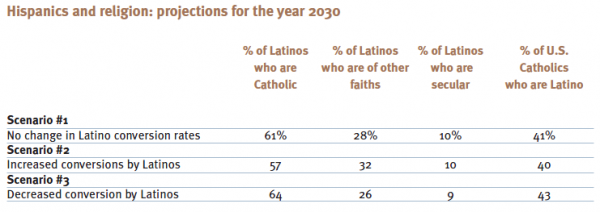
Assuming that the rate of conversion over the past 25 years holds constant for the next 25 years, the share of Latinos who are Catholic would decline from 68% in 2006 to 61% in 2030. Meanwhile, the proportion of U.S. Catholics who are Hispanic would increase over that period from 33% to 41%. In other words, conversions would continue to erode the share of Latinos who are Catholics, although Catholicism would clearly remain the dominant faith among Hispanics. But, meanwhile, Latino population growth through immigration and fertility combined with the demographic decline of the non-Hispanic population would ensure that Latinos become an ever greater share of U.S. Catholics overall.

An alternative scenario shows that Latinos will remain a predominantly Catholic population even if the rate of conversions to secularism and other religious faiths increases by 50% over the next 25 years. In that case, 57% of Hispanics would be Catholics in 2030. And, even with increasing conversions, Hispanics would still comprise a sizeable share of the U.S. Catholic population, reaching 40% of total Catholics in 2030, compared with 33% in 2006.

In sum, demographic trends already in place ensure that Latinos will be a growing presence in the Catholic Church in the U.S. Meanwhile, the pace of conversions will help shape the contours of religious affiliation in the Hispanic population and Latinos’ impact on evangelical and pentecostal churches in the U.S.

Religion in Latin America

Religious affiliation in Latin America is very relevant to any examination of Hispanics in the U.S. The majority of Hispanic adults in the U.S. are foreign born, and most migrated after childhood, so their religious formation usually can be traced to their country of origin.

Surveys conducted by Latinobarometro, a nonprofit polling firm that has tracked opinion and attitudes in Latin America since 1995, show that Catholicism remains dominant in the region but that evangelicalism has gained a significant following. The surveys also reveal important distinctions in religious affiliation depending on the country.

Mexico, the primary country of origin for immigrants in the U.S., is among the most Catholic countries in Latin America. Almost eight-in-ten Mexicans described themselves as Catholic in 2004. Unlike the situation in many other countries, the Catholic Church in Mexico has not lost followers since 1995 and, in fact, has experienced a modest gain. Of the 18 Latin American countries surveyed in 2004, Mexico and Guatemala were the only ones in which the share of Catholics increased. Perhaps more importantly, the evangelical movement in Mexico made virtually no gains over the same period.

Compare Mexico’s experience with that of El Salvador, Honduras and Nicaragua, which also are sources of immigrants to the U.S. Between 1995 and 2004, the number of people identifying themselves as Catholic in those three countries decreased by an average of 15 percentage points. Meanwhile, the share of evangelicals increased by an average of 16 percentage points.

The same pattern is seen in two other Central American countries — Costa Rica and Panama — that have been part of the survey since 1996, although in both countries the losses by the Catholic Church and the gains by evangelicals are somewhat smaller. Guatemala experienced small gains since 1995 in the shares of both Catholics, about five percentage points, and evangelicals, about seven percentage points.

The difference between Catholic losses and evangelical gains is not nearly as pronounced in the 10 countries surveyed in South America: Argentina, Brazil, Chile, Paraguay, Peru, Uruguay, Venezuela, Bolivia, Colombia and Ecuador. In all but Colombia, the share of people identifying themselves as Catholic decreased by an average of eight percentage points, while the share of evangelicals increased by an average of five percentage points. In Colombia, where the share of Catholics decreased by about seven percentage points, the share of evangelicals also decreased, by about two percentage points.

III. Religious Practices and Beliefs

More than nine-in-ten Hispanics identify with a specific religion. That, along with several other measures of belief and behavior, means that Hispanics as a group are highly religious. How does this affinity for spirituality vary among Latinos with different demographic characteristics or religious affiliations? And how precisely do the religious beliefs of Latinos set them apart from the rest of the population?

For the great majority of Latinos, regardless of their religious tradition, God is an active force in daily life. Most Latinos pray every day, most have a crucifix or other religious object in their home and most attend a religious service at least once a month. By significant majorities, Latinos who identify with a religion believe that miracles are performed today just as they were in ancient times and that true believers are rewarded with health and wealth.

In some ways, Hispanics as a group are no different than the rest of the U.S. population, which by and large is also fairly religious. But in other ways, Latinos appear to be different, both in the intensity of their beliefs and in how they practice those beliefs. Sometimes it is a question of degree: Latinos are somewhat more likely than non-Hispanics to say that religion is very important in their lives. Sometimes the difference is within religious traditions: Almost half of Latino Catholics — more than twice the rate of white Catholics — say the Bible is the literal word of God. And sometimes the difference centers on a core belief: More than the public as a whole, Latinos who are religious largely subscribe to the belief that Jesus will return to Earth in their lifetime. That teaching is common among Protestant proponents of rapture theology, which posits that the faithful will be rescued and taken to heaven before the world comes to an end.

Religious beliefs and practices vary among Latinos, and especially between Catholics and evangelicals. Evangelicals pray more, they attend religious services more frequently, they are more avid readers of the Bible and they evangelize — or share their faith with nonbelievers — more than do other Latinos. These differences at times extend to core beliefs. For example, Latino Catholics are very devoted to the Virgin Mary, while Latino evangelicals are far less so. Most evangelicals hold that the Bible is literally true, word for word; while many Catholics agree, they are not nearly as likely to believe this.

There are also differences in how religion is practiced in everyday life. Latinos who are evangelicals take part in prayer groups and read the Bible far more regularly than do those who are Catholics, for instance. For their part, Latino Catholics are more likely than are Latino evangelicals to display religious objects in their home and to pray directly to the saints or to the Virgin Mary. These differences are not in and of themselves measures of religious commitment; they may instead reflect different traditions of spirituality.

This chapter examines Hispanic religious practices and beliefs across different religious traditions, with comparisons to non-Hispanics. It looks at the frequency of attendance at religious services, which is an important indicator of overall religious commitment, as well as how religious beliefs and practices vary among different demographic segments of the Latino population. Finally, there is a separate discussion of how Hispanics view different religious groups.

Religious practices

Among Latinos, significant majorities of Catholics (68%) and mainline Protestants (65%) say religion is very important to them. The percentages are higher still among evangelical Protestants (85%) and other Christians (88%). These figures are somewhat higher than among non-Hispanics.

More than four-in-ten (44%) Hispanics say they attend religious services at least once a week, and 63% attend at least monthly. Non-Hispanics report church attendance at similar levels.

Here again, however, there are substantial differences across religious traditions. While 70% of Latino evangelicals say they attend church at least once a week, attendance rates are much lower among Latino Catholics (42%) and mainline Protestants (36%). Conversely, 28% of Latino Catholics say they attend church “a few times a year or seldom,” compared with 14% of evangelicals. In this regard, however, Latinos are not substantially different from non-Hispanics of the same religious tradition.

There is a similar pattern when it comes to private prayer. Nearly seven-in-ten (69%) Hispanics say they pray every day. But daily prayer tends to be even more common among Latino evangelicals (87%) than it is among mainline Protestants (76%) and Catholics (64%). Again, the same patterns are evident among non-Hispanics of different religious traditions.

Tradition-specific practices

While several religious practices are common to all Hispanics regardless of religious tradition, other behaviors are more tradition-specific. For instance, participation in prayer groups, Bible study groups and other small religious meetings are quite common among Latino evangelicals (75% participate in such groups at least once a month). By contrast, such practices are much less common among Latino Catholics and mainline Protestants; among these groups, fewer than half (31% and 47%, respectively) participate in such activities at least once a month.

The same generally holds true for two other religious activities: Bible reading and evangelism. More than three-quarters of Latino evangelicals (78%) read the Scriptures at least once a week, while only 38% of Latinos who are mainline Protestants and 27% of Latino Catholics do so. And about eight-in-ten Latino evangelicals (79%) evangelize at least once a month. Latinos who are mainline Protestants and Catholics, on the other hand, are much more reticent when it comes to spreading their faith.

Overall, Hispanics participate in these activities at rates roughly comparable to those seen among members of the same religious traditions in the general population. Hispanic evangelicals, however, participate in prayer groups and share their faith with others at somewhat higher rates than do their non-Hispanic counterparts.

Some religious practices are more common among Catholics than among other religious groups, reflecting both the distinctive natures of Protestant and Catholic spirituality and theological differences between the two traditions. For instance, Latino Catholics are far more likely (86%) than any other group to display a crucifix or other religious object in their home; only three-in-ten Latino evangelicals (30%) do so. Nearly eight-inten Catholics (79%) say that they pray to saints or to the Virgin Mary during difficult moments in their lives. By contrast, only 9% of Latino evangelicals and 23% of mainline Protestants acknowledge praying to saints in times of trouble.

Religious beliefs

Divine intervention

A large majority of Hispanics believe that God is actively involved in the world. Among those who identify with a religion, three-in-four say that miracles still occur today just as in ancient times. This belief is held by significant majorities of Latino Catholics, evangelicals and mainline Protestants.

Regardless of religious tradition, Latinos also largely subscribe to views sometimes described as the prosperity gospel, the belief that God rewards the faithful with physical well-being and financial prosperity in this life. About three-in-four Latino Catholics, evangelicals and mainline Protestants subscribe to this view.

Roughly half of all Hispanic Christians (52%) also believe that Jesus will return to Earth in their lifetime. This belief is most common among Latino evangelicals (60%), but it is strong even among Catholics (51%). In this regard, Latinos are very different from non-Hispanic Christians; only about one-in-three non-Hispanic Christians, including 40% of white evangelicals and 22% of white Catholics, believe that Jesus will return during their lifetime.

Contrasts between Catholics and Protestants

One of the most significant differences between Catholics and Protestants concerns their widely disparate views of the Virgin Mary, a central figure for Catholics generally and especially for Hispanic Catholics.

Belief that Mary is the mother of God and that she watches over believers is very common among Latino Catholics (88% agree). Though rarer, the belief also is espoused by some Latino Protestants even though many Protestant churches have traditionally discouraged the kind of devotion to Mary practiced by Catholics. About four-in-ten (43%) Latinos who are mainline Protestants and one-in-three evangelicals (35%) agree with this belief. However, a significant majority (58%) of Latino evangelical Protestants disagree.

If devotion to the Virgin Mary sets Catholics apart from other Hispanics, belief in the literal truth of the Bible distinguishes Latino evangelicals from other groups. More than three-quarters of Latino evangelicals say the Bible is the word of God and is to be taken literally, word for word. Among Latino Catholics and other Christians, by contrast, fewer than half hold that view.

Although Hispanic Catholics are less likely than evangelicals to view the Bible as literally true, they still stand out compared with non-Latino Catholics. Among Latino Catholics, for example, 49% interpret the Bible as literally true, a much higher figure than among non-Hispanic Catholics, only 18% of whom share this view.

Frequency of church attendance

Religious tradition is not the only factor shaping religious practices and beliefs and influencing social values and political attitudes. Research confirms that the level of religious commitment also plays a major role. A simple but effective measure of religious commitment is attendance at religious services.

Frequency of church attendance is closely related to several other measures of religious practice and, as such, serves as a good indicator of religious commitment. Across all three major Christian traditions, for instance, Latinos who attend church at least weekly are much more likely to pray on a daily basis than are those who attend church less often. They also are more likely to say that the Bible is the word of God and is to be interpreted literally, word for word. Similarly, those who attend church on a weekly basis are much more likely than are others to say that religion is very important in their own lives. Similar patterns are found among non- Hispanics.

The frequency of church attendance also has been shown to be closely related to social and political attitudes in the general population. Indeed, a Pew analysis of the results of the 2004 presidential election revealed that frequency of church attendance was one of the most important factors shaping a person’s decision in that election.1 In Chapter 6, we will examine patterns of church attendance to better understand the relationship between religion and politics in the Hispanic population.

The demography of religious practice

Religious practices and beliefs among Hispanics vary somewhat depending on demographic factors, including country of origin. Central Americans, for instance, stand out for the importance they place on religion as well as for their high levels of church attendance. Cubans, by contrast, are less religious than are other Hispanics by these measures.

Language is another important variable. Among Latinos whose primary language is Spanish, for instance, 75% view religion as very important in their daily lives; that is much higher than among Latinos whose primary language is English (59%). Those who are Spanish dominant overwhelmingly agree (83%) that God will grant financial success and good health to believers, whereas among those who are English dominant only a slight majority (54%) agree. Those whose primary language is Spanish also are far more likely to say that Jesus will return to Earth in their lifetime than those whose primary language is English (60% vs. 43%).

Demographic factors are important influences on a variety of religious beliefs and practices, but statistical analysis also reveals that even after these demographic factors are taken into account, religious tradition and church attendance appear to play a significant role in shaping various religious beliefs and practices. In short, both demographic factors and the specifics of religious tradition are closely associated with specific religious beliefs and practices among Hispanics.

Social services and volunteerism

In the study, Latino evangelicals report that they receive services from and volunteer with church groups at higher levels than do Latino Catholics. In response to questions on whether they received help finding a job or housing or in dealing with financial problems, for instance, Latino evangelicals respond more positively than do Catholics by significant margins. Similarly, evangelicals are much more likely to say they received help from their churches with child care and in finding food or clothing. Services on language and literacy training, an important resource for many immigrants, are available at about the same rate at Catholic, evangelical and mainline Protestant churches.

Latino evangelicals also are more than twice as likely as Latino Catholics to say they volunteer with a church group. When it comes to other kinds of activities, such as volunteering for a school or neighborhood group, the differences are much smaller, however. This suggests that although Latino Catholics and evangelicals may not be so different in their general orientation toward volunteerism, evangelical churches themselves are a focal point for this kind of activity.

How They View Other Faiths

Fewer than half of Latino Catholics hold favorable views of other religious traditions. In contrast, majorities of Latino evangelicals voice favorable views of Catholics, Jews, evangelicals and pentecostal Christians. Muslims and Mormons, however, are viewed favorably by only small shares of Latinos, regardless of religious tradition. The same is true for atheists.

There is also some difference in how Latino Catholics and evangelicals view each other. About half (55%) of evangelicals hold favorable views of Catholics. Among Latino Catholics, however, only about four-in-ten (42%) hold a favorable view of evangelicals. (See graph on page 28.)

When it comes to Jews, attitudes are starkly different by religious tradition. Among Latino Catholics, only 38% have favorable views of Jews, compared with 62% of Latino evangelicals. Latino evangelicals also hold very favorable views of pentecostal Christians. These higher favorability ratings among evangelicals may reflect the importance of Israel and the Jewish people in evangelical theology, and the fact that many Latino evangelicals are themselves pentecostal Christians.

Views of Mormons and Muslims, on the other hand, are split or tend to the negative. Only about a third of Latinos (32%) say they hold favorable views of Mormons, with an equal number (33%) expressing unfavorable views. Muslims, too, are viewed rather unfavorably, with roughly a fourth of Hispanics (27%) expressing favorable views, compared with 37% expressing unfavorable views.

Latinos feel more unfavorably toward atheists than they do toward any other group. The negative view prevails by more than a 3-to-1 ratio (62% unfavorable, 19% favorable).

Pew polling from July 2005 allows for a comparison between the views of Latinos and those of the general population on these favorability measures. Opinions of Catholics are very similar (76% of Hispanics have a favorable view of Catholics, compared with 73% among the general public, according to the 2005 survey). Other groups, by contrast, are viewed less favorably by Hispanics than by the public as a whole.

Latinos, for instance, are much less likely than the public as a whole to express a favorable view of Jews (44% vs. 77%) and are more likely as well to express an unfavorable view of Jews (23% vs. 7%). Evangelicals also are viewed less favorably by Hispanics than by the general population (49% vs. 57%).

According to a May 2006 Pew survey, Muslims also receive a higher favorability rating from the public as a whole than from Hispanics (54% vs. 27%).

Although atheists also receive the lowest favorability rating among the general population, Latinos are considerably more negative. The favorability rating of atheists is nearly twice as high among the general population (35%) as among Hispanics (19%).

IV. The Renewalist Movement and Hispanic Christianity

Renewalist Christianity places special emphasis on God’s ongoing, day-to-day intervention in human affairs through the person of the Holy Spirit. Renewalists believe that the power of the Holy Spirit is manifested through such supernatural phenomena as speaking in tongues, miraculous healings and prophetic utterances and revelations. Renewalist Christianity is one of the largest and fastest-growing movements in global Christianity, with its major strands accounting for at least a quarter of all Christians worldwide, or more than 500 million people, according to the World Christian Database.1

This study finds that the renewalist movement is having a major impact on Hispanic Christianity. Indeed, the influence of renewalist Christianity in the U.S. appears to be even more profound among Latinos than among non-Latino Christians. For example, the study finds that more than half of Latino Protestants can be classified as renewalists, meaning that they either belong to traditional pentecostal denominations or describe themselves as charismatic or pentecostal Christians. By contrast, the 2006 Pew Forum Global Survey of Pente – costals found that fewer than one-in-five non-Latino Protestants qualify as renewalist by those definitions.

The overall influence of renewalist Christianity is clearly evident in specific religious practices and beliefs. For instance, pentecostals are more likely than most other Christians to read the Bible regularly, share their faith with nonbelievers, take a literal view of the Bible and express belief in the “prosperity gospel” that God blesses those who have enough faith with good health and financial success.

Hispanic Catholicism also appears to have been dramatically affected by the renewalist movement. Most significantly, a majority of Latino Catholics describe themselves either as charismatic or pentecostal. By contrast, only about one-in-ten non-Latino Catholics accepts those labels. The extent to which the renewalist movement appears to have made significant inroads among Latino Catholics was so striking in the initial survey that it prompted a follow-up survey of Latino Catholics to explore the phenomenon more fully.

The call-back survey provides a more nuanced understanding of the renewalist influence on Hispanic Catholicism. Charismatic Latino Catholics are distinct from other Latino Catholics in certain ways — for example, they are more likely than other Catholics to participate in groups where prophesying or speaking in tongues occur, and they are more likely to have experienced or witnessed an exorcism. However, those differences are often fairly modest.

That may be due, at least in part, to another striking feature of Hispanic Catholicism: According to the survey, even Latino Catholics who do not describe themselves as charismatic or pentecostal are more likely than non- Latino Catholics to report having experienced or witnessed supernatural practices such as divine healings or revelations from God.

While the influence of renewalism is broadly relevant in Hispanic Catholicism, the call-back survey also found that Latino Catholics nevertheless remain very much Catholic. Indeed, renewalist practices seem to have been incorporated into Hispanic Catholicism without displacing Catholic identity. Although Hispanic Catholics as a whole are relatively traditional in their Catholicism, charismatic Catholics are even more likely than non-charismatic Catholics to pray the rosary and serve in their parishes.

Overall, the findings thus suggest that Hispanic Catholics practice a distinctive brand of Catholicism, one that incorporates many of the beliefs and behaviors most commonly associated with pentecostal or renewalist Christianity, while at the same time upholding the main features of traditional Catholic teaching. Given the growth in the proportion of U.S. Catholics who are Hispanics, these findings underscore the ways in which Latinos are helping to shape U.S. religious institutions.

This chapter discusses the impact of renewalism on the practices and beliefs of Latino Christians, as well as the demographics of Hispanic renewalist Christianity. Drawing largely on the results of the follow-up survey of Catholics, it then assesses in greater detail the impact of renewalism on Hispanic Catholicism.

A Note on Terminology

Scholars, journalists and other observers use a number of terms to refer to the renewalist movement as a whole as well as to its various currents or subgroups. In this report, terms are narrowly defined based on responses to several key survey questions.

The term “pentecostal” is used throughout this chapter to describe those who belong to specifically pentecostal denominations, such as the Assemblies of God or the Assembly of Christian Churches.

The term “charismatic” is used to describe Christians (including Catholics) who do not belong to pentecostal denominations but who nevertheless describe themselves as either charismatic or pentecostal Christians.

The terms “charismatic Catholic” and “charismatic Protestant” are used to describe Catholics and Protestants who meet those criteria. Although in the rest of the report Jehovah’s Witnesses, Mormons and Orthodox are grouped together under the label of “other Christians,” in this chapter they are included in the umbrella category of Protestants.

“Renewalist” is an umbrella term that refers to both pentecostals and charismatics as a group.

Renewalism among Hispanics

Latinos identify with renewalist Christianity at significantly higher rates than do non-Hispanics. Among the more than two-thirds of Latinos who are Catholic, a majority (54%) are charismatics, meaning they describe themselves either as charismatic or pentecostal. The extent of renewalism among non-Hispanic Catholics is small by comparison, at slightly more than one-in-ten. Among Hispanic Protestants, an even larger proportion (57%) identify themselves in these terms; 31% are pentecostals and 26% are charismatics. Again, the contrast to the non-Hispanic population is stark: less than one-in-five non-Hispanic Protestants are renewalists.

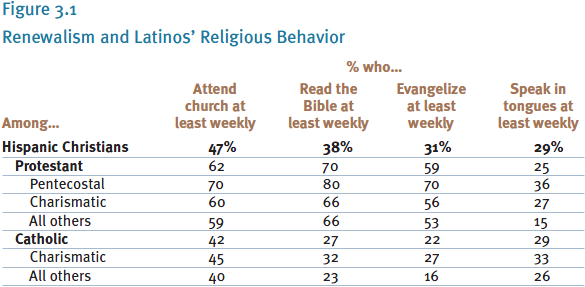
The influence of the renewalist movement in the Hispanic population can be seen in some specific measures of religious practice and belief. These go beyond traditional pentecostal practices such as speaking in tongues. For example, Latinos who are pentecostal Protestants, more than any other Latino group, say they share their faith with others at least weekly (70%), and even more (80%) say they read the Bible at least once a week.

For the most part, Latino Catholics engage in these practices less often than do other Christians, although evangelism and Bible reading are more common among charismatic Catholics than among other Catholics.

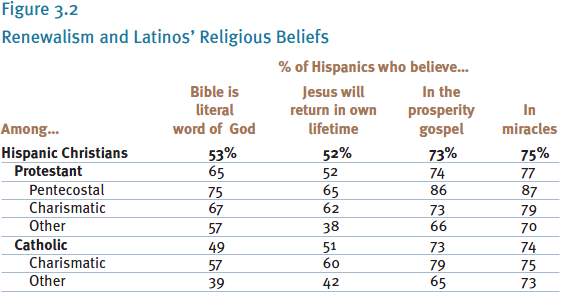
Latino pentecostal Protestants and charismatic Catholics differ significantly from their non-renewalist counterparts not only with respect to certain practices but also with respect to several important measures of religious belief. Strong majorities believe that Jesus will return to Earth in their lifetime, for example. They also are more likely to believe that God will grant financial success and good health to the faithful, although majorities of all Hispanic Christian groups believe that.

Among Latino Protestants, three-quarters of pentecostals (75%) and two-thirds of charismatics (67%) hold a literal view of the Bible. Similarly, Latino charismatic Catholics are nearly 20 percentage points more likely than are other Latino Catholics to be biblical literalists (57% vs. 39%).

Renewalism among Latino Protestants

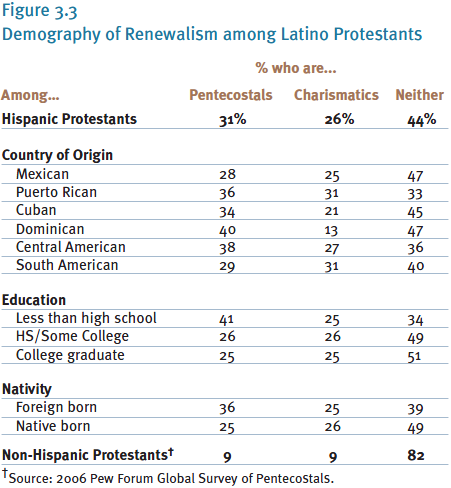
Among Latino Protestants, nearly one-third (31%) are members of classic pentecostal denominations and one-fourth (26%) are charismatics.

By these measures, Hispanic Protestants are substantially more renewalist in their orientation than are non- Hispanics. Indeed, among non-Hispanic Protestants, fewer than one-in-ten are pentecostals, and a similar number (9%) are charismatics. The vast majority (82%) do not identify with the renewalist movement.

The degree of renewalism among Latino Protestants varies somewhat by country of origin. For example, 67% of Puerto Rican Protestants identify themselves in renewalist terms, compared with 53% of Mexicans. Similarly, Hispanics with less than a high school education are somewhat more likely to be pentecostal than are those with higher levels of education.

Renewalism among Catholics

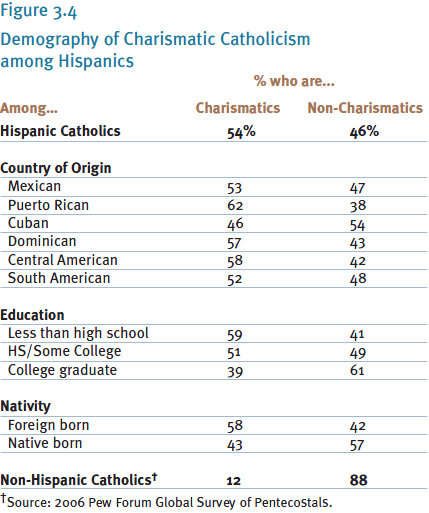
Like other Latino Christians, Latino Catholics identify with renewalist Christianity in large numbers. Indeed, a majority (54%) of Hispanic Catholics are charismatics. By these measures, Latino Catholics are more than four times as likely as non-Latino Catholics to identify with renewalist Christianity.

As is the case with Latino Protestants, Latino Catholics who identify with the renewalist movement also are more prevalent among those with lower levels of education. A majority (59%) of Latino Catholics without a high school education, for example, are charismatics, compared with 39% among college graduates. Foreignborn Latino Catholics also are much more likely (58% vs. 43%) to be charismatic than are native-born Latinos.

A closer look at charismatic Catholics

As noted above, a majority of Latino Catholics describe themselves as charismatic or pentecostal, while only a small minority of non-Hispanic Catholics do. This suggests that the renewalist movement, with its emphasis on an intense personal experience with God and on the role of the Holy Spirit in the lives of believers, is an important and distinctive characteristic of Hispanic Catholicism.

Over the past few decades, charismatic practices have become a growing presence within the Catholic Church in the United States and around the world. But to what extent have Latino Catholics adopted these charismatic teachings? To explore more fully the prevalence of renewalism among Latino Catholics, 650 Catholics from the original survey (both self-described charismatic Catholics as well as other Catholics) were contacted again and asked a series of questions about their experiences with renewalist groups and practices.

The results of the recontact survey confirm that while Latino charismatic Catholics differ from other Latino Catholics on several renewalist measures, these differences are often relatively modest. Nonetheless, it is clear that the charismatic renewal movement has penetrated Hispanic Catholicism in significant ways. As a result, many Latino Catholics — self-described charismatics as well as others — report holding beliefs and having religious experiences that are typical of pentecostal or spirit-filled movements.

Latinos who are charismatic Catholics do not appear to be discarding traditional Catholic teachings in favor of pentecostal Protestant doctrines, however. Rather, they seem to be incorporating renewalist practices without displacing Catholic identity and core Catholic beliefs. In fact, Latinos who are self-identified charismatic Catholics tend to be rather traditional in their approach to the Catholic faith.

Renewalist practices among Hispanic Catholics

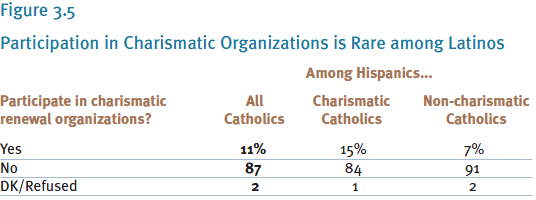
Although charismatic practices and beliefs are fairly widespread among Latino Catholics, formal participation in Catholic charismatic organizations is much less common. For example, only 15% of Latino charismatic Catholics say they ever participate in Catholic charismatic renewal organizations such as Charisma in Missions (Carisma en Misiones) or The Sower (El Sembrador).

Just as very few Hispanics say they are part of formal Catholic charismatic organizations, few also show a familiarity with the baptism of the Holy Spirit (also known as the second baptism or the second blessing), which is central to renewalist theology. At the second baptism, individuals are said to experience a profound indwelling of the Holy Spirit, an occurrence that is often manifested by speaking in tongues or some other supernatural sign. This is typically said to occur in young adulthood or later.

Most Hispanic Catholics (63%) say they are at least somewhat familiar with the concept of the baptism of the Holy Spirit. Less than half (45%), however, say they have received the second baptism. And of these Catholics, the vast majority (37% of all Hispanic Catholics) say they received the second baptism as an infant. This strongly suggests that what they have in mind is the Catholic sacrament of baptism, rather than the baptism of the Holy Spirit as understood in pentecostal circles.

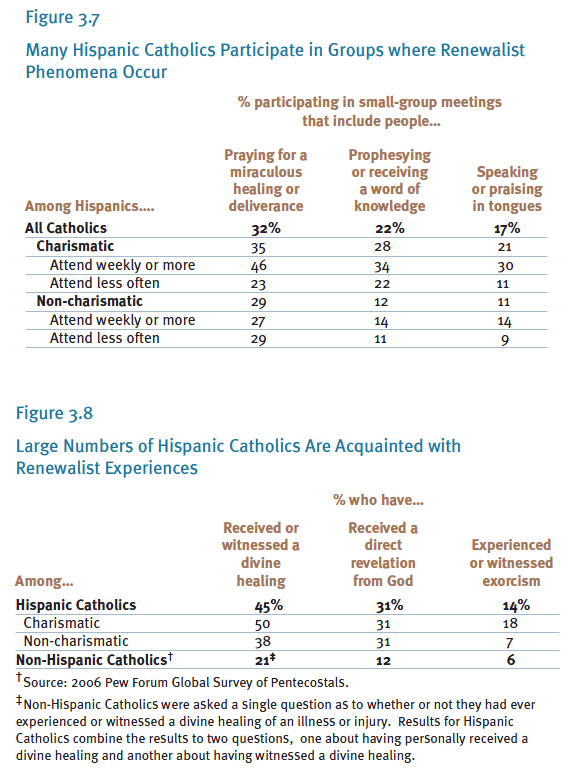
While participation in formal charismatic organizations is relatively rare among Latino Catholics, participation in small groups where distinctively renewalist phenomena take place is fairly common. One-in-three Hispanic Catholics, for instance, including 35% of charismatics and 29% of non-charismatics, say they participate in prayer groups or other small-group meetings that include people praying for miraculous healing or deliverance. Moreover, one-in-five Hispanic Catholics (22%) participate in groups where prophesying or receiving a word of knowledge from God takes place, and nearly as many (17%) participate in small groups where people speak or pray in tongues. Participation in both kinds of groups is more common among charismatic Catholics, especially those who attend church regularly, than it is among non-charismatic Catholics.

The widespread familiarity of Latino Catholics with renewalist practices is further evidenced by the large numbers who report having personally experienced or witnessed divine interventions in daily life. More than one-in-three (35%), for instance, say they have personally witnessed the divine healing of an illness or injury, and nearly as many (29%) say that they themselves have been divinely healed from an illness or injury. In total, nearly half of Latino Catholics (45%), including 50% of charismatics and 38% of other Catholics, say they have either received or witnessed a divine healing of an illness or injury.

Reports of having received a direct revelation from God are less common, though nearly one-in-three Latino Catholics (31%) say they have experienced that. Fewer Latino Catholics (14%) say they have experienced or witnessed the devil or evil spirits being driven out of a person; however, the figure is almost three times as high among charismatics (18%) than among other Catholics (7%).

For the most part, Latino Catholics appear to be more familiar with these types of renewalist experiences than do non-Latino Catholics. Comparisons with the 2006 Pew Forum Global Survey of Pentecostals indicate that Latino Catholics are more than twice as likely to be familiar with divine healings, revelations from God and exorcisms as are their non-Latino counterparts.

The study also finds that the Masses attended by Latino Catholics often exhibit the kind of exuberant atmosphere that is more characteristic of pentecostalism than of traditional American Catholicism. Among Latino Catholics who attend church services, for example, more than six-in-ten (62%) say that the Masses they attend at least occasionally include displays of excitement and enthusiasm such as the raising of hands, clapping, shouting or jumping.

A slim majority (51%) of Hispanic Catholics also report attending Masses that at least occasionally include people speaking or praising in tongues, prophesying, receiving a word of knowledge or praying for divine healing. Seeing people at Mass speaking in tongues or engaging in other activities typical of pentecostalism is common among a majority of Latino charismatic Catholics (56%), but even among other Latino Catholics nearly half (45%) also report observing these phenomena at Mass.

These results make it clear that certain practices associated with renewalist Christianity indeed are widespread throughout Latino Catholicism. Although especially common among self-identified charismatic or pentecostal Catholics, they are present as well to a significant degree even among Latino Catholics who do not personally accept the renewalist label.

Orthodoxy among charismatic Catholics

As noted above, the adoption of many key features of renewalist Christianity by Hispanics does not appear to be undermining their commitment to a more traditional or orthodox Catholicism. On the contrary, Latino Catholics generally tend to be quite devoted to the church and are traditionalist in their practice of Catholicism.

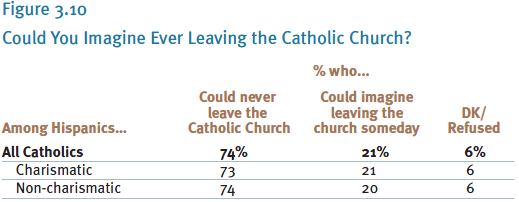
The overwhelming majority of Latino Catholics (74%) say they could never leave the Catholic Church. One-infive (21%), however, admit that they could imagine the possibility of leaving the Catholic Church someday. But despite their greater acquaintance with practices associated with pentecostal Protestantism, Latino charismatic Catholics are no more likely than non-charismatics to say they could imagine leaving the Catholic Church someday.

Large percentages of all Latino Catholics — charismatics and non-charismatics alike — embrace their church’s traditional beliefs and practices. Nearly nine-in-ten Latino Catholics, for instance, believe that in Mass the bread and the wine become the body and blood of Christ — a core Catholic belief. More than eight-in-ten say that they pray to the Virgin Mary. A sizable number of Latino Catholics (43%) also say they pray the rosary at least once or twice per month and 43% go to confession at least once or twice per year. Slightly larger shares of charismatic than non-charismatic Catholics report taking part in these activities, but the differences are quite modest.

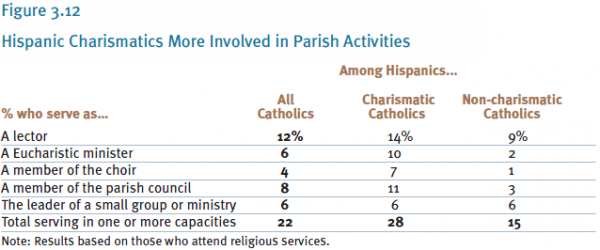
The survey asked Catholics whether or not they serve in any of five roles in their parish — lector, Eucharistic minister, choir member, parish council member or leader of a small group or ministry. While the rate of participation in any single one of these roles is fairly low (ranging from 4% who are choir members to 12% who serve as lectors), more than one-in-five churchgoing Latino Catholics (22%) serves in at least one of those roles. Latinos who are charismatic Catholics, however, are nearly twice as likely as are other Latino Catholics (28% vs. 15%) to serve their parishes in those ways.

Pentecostal and evangelical influences

Although many Latino Catholics appear to have absorbed renewalist beliefs and practices that are more characteristic of Protestant pentecostal and evangelical churches, relatively few Hispanics say that they regularly attend church services at those churches. Overall, 10% of all Latino Catholics, and 12% of Latino charismatic Catholics, report attending evangelical or pentecostal services at least a few times a year.

A final indication of the extent to which Latino Catholics have retained traditional Catholic practices and beliefs despite the influence of renewalist ideas is reflected in their lack of familiarity with the rapture of the church, a commonly held belief among evangelical and pentecostal Protestants.

The teaching of the rapture holds that true believers will be spared from the time of terrible tribulation that will precede Christ’s return to Earth. Instead, the faithful will be caught up in the sky and taken to heaven (or “raptured”) prior to that period; only nonbelievers will be “left behind” (hence the name of the popular fictional book series) to experience “the great tribulation.”

Only one-in-three Latino Catholics say that they have heard at least a little about the teaching concerning the rapture, and fewer still (6%) say they believe in it. The vast majority of Catholics either are unfamiliar with the rapture (69%), have not heard enough about it to say whether or not they believe it (21%) or explicitly reject belief in the rapture (5%).

V. Conversion and Views of the Catholic Church

Most Hispanics are affiliated with the same religious faith they have always practiced, but an important minority, almost one-in-five Latinos, say they have either changed their affiliation from one religion to another or have ceased identifying with any religion at all. The study offers a detailed look at the motivations and attitudes of Latinos who leave one faith to join another or to become secular.

What drives conversion to a new religion? Often it is a response to a very specific spiritual need. By an overwhelming margin, converts say they sought a new religion because they wanted to be closer to God. Sometimes the conversion seems to be rooted in the worship experience; one-in-three evangelical converts from Catholicism say the lack of excitement at Catholic Masses was a factor in their decision to leave the church.

Family members and acquaintances emerge as important factors in the process of conversion; they are the ones who frequently introduce the new religion. That personal relationship is far more important in conversion than is the influence of the media or personal contacts with other members of the church.

Very few Hispanics who converted from Catholicism to a new religion say they did so because they were dissatisfied with the church’s positions on certain issues. Nearly half (47%) of Hispanic Catholics disapprove of the church’s position on divorce, for example, but only 7% of those who have left Catholicism for another religion say it was a reason for their conversion.

To understand the scope and methods of conversion, it is also useful to examine how Hispanics view the Catholic Church. Latinos, overall, hold mixed opinions. Many Hispanics are at odds with the church’s teachings on divorce and whether women and married men should be ordained as priests. And while most Latinos say the typical Mass is lively and exciting, many hold the opposite view. At the same time, the Catholic Church is perceived as welcoming to immigrants. And even though Hispanics are split on whether women should be ordained, most also view the church as having equal respect for men and women.

An analysis of the study’s findings suggests that changes in Latinos’ religious affiliation, particularly from one religion to another, may be associated with the complex processes of migration and assimilation. Conversion is higher among the native born than the foreign born, for example, and it is also higher among English-speaking Latinos than it is among Spanish speakers.

Conversion and secularization

Conversion flows

The vast majority of Latinos (82%) give no indication of ever having changed their religious affiliation. However, almost one-in-five (18%) Latinos say they have either converted from one religion to another or to no religion at all. Given that most Hispanics are Catholic, a large majority of converts (70%) are former Catholics.

Conversions are a key ingredient in the development of evangelicalism among Hispanics. Half of Hispanic evangelicals (51%) are converts, and more than four-fifths of them (43% of Hispanic evangelicals overall) are former Catholics. By contrast, 2006 Pew Forum Global Survey of Pentecostals found that 44% of white evangelicals in the U.S. have changed their religion, and fewer than one-in-ten of them are former Catholics.

Almost two-thirds of Latino seculars (65%) indicate that they had practiced some religious faith at one time in their lives and nearly four-in-ten (39%) of them are former Catholics. The movement of converts to the Catholic Church is much smaller, with only 2% of Latino Catholics saying they previously practiced another religion.

Immigration and assimilation

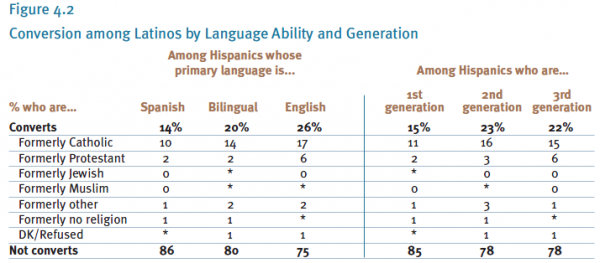
Though it is impossible to determine the precise extent to which conversion is a product of assimilation, it does appear that migrating to the United States, learning English and undergoing the other changes that occur with exposure to American ways do seem to be somewhat associated with changes in religious affiliation. Conversion is more prevalent among native-born Latinos than it is among foreign-born Latinos, for instance. However, there is little difference in the share of converts among the second and third generations (23% vs. 22%, respectively).

In line with the findings on nativity, 26% of all Latinos whose primary language is English converted, compared with 20% of those who are bilingual and 14% of those whose primary language is Spanish. That association persists even when controlling for other factors, such as gender, generation and education.

‘Converts’ to Secularism

More than one-in-four converts (28%) report moving away from religion altogether. As is the case with converts in general, most Latinos who have left religion were previously Catholic (39% of Latino seculars overall). Less than half as many Latino seculars (15%) are former Protestants.

Perhaps the most striking aspect of this segment of the population is the high proportion who are male, 66%, compared with 34% who are female.

On average, converts to secularism are relatively well-off. About 20% have graduated from college, compared with 10% among all Hispanics. Many also have relatively high incomes. Almost a third earn $50,000 or more annually, compared with 17% among all Hispanics. More than half are native born (54%) and more than two-thirds (68%) say they are English dominant or bilingual.

Country of origin

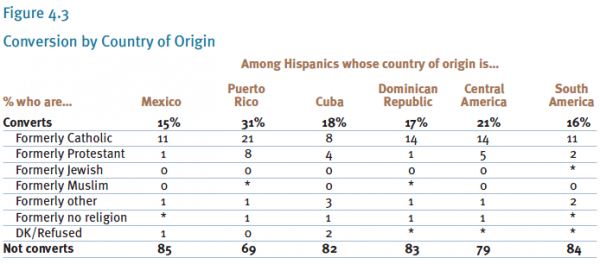
The prevalence of conversion varies little by country of origin, with one noteworthy exception. Almost one-in-three (31%) Puerto Ricans are converts. An analysis of the survey results shows that even when controlling for several demographic and socioeconomic factors, Puerto Ricans are significantly more likely to convert than are other Hispanics.

Reasons for converting to another religion

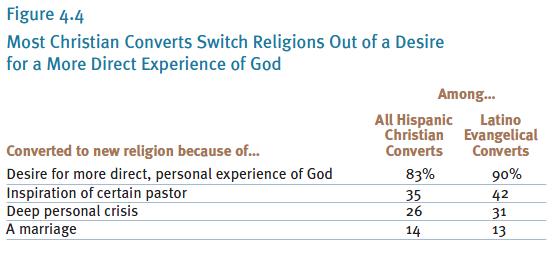
The desire for a more direct, personal experience with God is one factor that drives Hispanics to convert from one religion to another. More than eight-in-ten Latino converts cite this as a reason for adopting a new faith. That belief is particularly strong among those who have become evangelicals, nine-in-ten (90%) of whom say it was that spiritual search that drove their conversion.

About one-in-three Latinos (35%) who have changed affiliation to a new religion say the influence of a certain pastor was a factor in their conversion. About one-in-four (26%) attribute their conversion at least in part to a deep personal crisis, and 14% say they converted as a result of a marriage. Such motivations are not mutually exclusive, of course, and the survey does not attempt to rank them by intensity.

Among Hispanics who are third generation and higher, 40% cite the influence of a pastor, compared with 27% in the first generation. Among converts whose primary language is English, 44% attribute their conversion to the influence of a particular pastor, compared with 25% of Spanish speakers.

Sources of information about a new religion

Converts to Christian denominations were asked how they first heard about their new faith. The answers, while not conclusive, nevertheless provide a tantalizing glimpse into the origins of this complicated process.

Most Hispanic Christian converts say they first heard about what was to become their new religion from relatives (48%) or friends (26%). Only 14% say they first heard about their new religion from members of the church to which they converted. Only 2% say they first heard about their new religion from radio or television.

Views of the Catholic Church among converts

The high percentage of Latino evangelicals who converted — and the fact that most of them are former Catholics — makes them a particularly interesting segment of the Hispanic population. The survey posed four questions to evangelical converts, probing for possible reasons for their leaving the Catholic Church. While many express negative views of some of the teachings and practices of the church they left behind, those opinions do not emerge as widespread motives for converting.

The largest share of negative views came in response to a question about the Catholic Mass. A majority of Latino evangelical converts from Catholicism (61%) say they do not find the typical Catholic Mass to be lively or exciting, and about one-in-three (36%) cite that as a factor in their conversion. Among Latinos who identify as Catholic, on the other hand, 71% say the typical Mass is lively and exciting; 22% disagree.

The church’s restriction on divorce does not weigh substantially on conversion overall. While many evangelical converts (46%) disapprove of the church’s restrictions on divorce, only 5% cite that as a reason for their conversion; 41% explicitly say they did not leave the church because of it. Latino Catholics themselves are similarly split on the church’s teachings on divorce (47% disapproving and 44% approving).

Two-thirds (66%) of Latino evangelical converts say the Catholic Church respects women at least as much as men, and three-in-four view the church as welcoming to immigrants. Neither of these issues is cited by many converts as a reason for leaving the church, and Latino Catholics express positive views on these matters by similar margins.

A slim majority of Hispanics believe that married men should be allowed to serve as Catholic priests, but Latino Catholics are much less likely to hold this point of view (44%) than are evangelicals (71%) or seculars (66%). The difference between Latino Catholics and evangelicals is smaller when it comes to the question of ordaining women; among both groups, less than half (44% among Catholics and 46% among evangelicals) agree that women should be allowed to serve as Catholic priests. This may reflect the fact that, like the Catholic Church, many evangelical denominations do not ordain women. Latino seculars are much more willing than either group to support the ordination of women (65%).

Hispanic Catholics are much more supportive of the church’s position on these issues than are American Catholics as a whole. For example, a 2002 Princeton Survey Research Associates poll conducted for Newsweek found that among all non-Hispanic Catholics, 65% said it would be a good thing to allow women to be ordained as priests and 76% said it would be good to allow married men to become priests.

Although they are split on the church’s prohibition on women priests, a large majority of Hispanics reject the idea that the church respects the contributions of women less than it does the contributions of men.

Most Hispanics (81%) say that the Catholic Church is at least somewhat welcoming to new immigrants, with more than half (56%) describing it as very welcoming. Smaller shares of evangelicals (50%) and seculars (46%) than Catholics (60%) view the church as very welcoming to new immigrants.

The study finds no differences between immigrant and native-born Hispanics in their views on the church’s openness to new immigrants. Among immigrants, second-generation Hispanics and those whose families have been in the U.S. for three generations or more, 80% or more say the church is at least somewhat welcoming to new immigrants. Similarly, there are only small differences on this question among Hispanics of different countries of origins.

VI. The Ethnic Church

The houses of worship most frequented by Latinos have distinctly ethnic characteristics. A majority of those in the congregation are Hispanic1; some Latinos serve as clergy; and liturgies are available in Spanish. The growth of the Hispanic population is leading to the emergence of Latino-oriented churches in all the major religious traditions across the country.

Foreign-born Latinos are most likely to attend Hispanic-oriented churches and to comprise the largest share of Latinos who worship at such churches. However, large shares of native-born Latinos as well as those who speak little or no Spanish also report attending churches with ethnic characteristics. Similarly, while Latinos who live in areas densely populated by Latinos are most likely to report attending Hispanic-oriented churches, smaller but still substantial shares of Latinos who live in areas where Hispanics are a sparse presence also say they attend ethnic churches. Latino-oriented churches, then, are not exclusively a product of either immigration or of residential settlement patterns.

The formation of Hispanic-oriented churches may reflect an enduring characteristic of American religiosity. On Sunday mornings, the devout tend to seek out the company of people they consider similar to themselves. For example, a century ago European immigrants congregated in houses of worship with others of the same nationalities and language preferences. Over time this form of ethnic concentration diminished because of assimilation as well as geographic and economic mobility. Meanwhile, high degrees of segmentation by race and class have proved persistent. This study does not attempt to project the trajectory that Hispanics will follow, but it does demonstrate conclusively that ethnic churches are a widespread and defining attribute of Latino religious practice today.

This study defines an ethnic church as having three characteristics: at least some of the clergy are Latino, services are available in Spanish and most of the congregants are Hispanic. Among churchgoing Latinos, twothirds attend a church with these characteristics. The ethnic church is strongest among Catholics, but it is also a prominent feature among Hispanic evangelicals and those in other Christian traditions.

As with the renewalist beliefs and behaviors described in Chapter 3, the extent to which Latinos worship at Hispanic-oriented churches is a clear indication that the Hispanic population is creating its own distinct forms of religious practice as well as its own religious institutions. By clustering in ethnic churches, the growing Latino population is concentrating its impact on the nation’s religious landscape.

Defining an Ethnic Church

This report used a three-step process to determine the prevalence of ethnically oriented worship among Latinos.

In the first step, the analysis excluded respondents who said they never attended any kind of religious services other than weddings or funerals. That placed 90% of all Latinos in the category of churchgoers. All of the tabulations in this chapter refer to that very large segment of the Hispanic population.

In the second step, churchgoers were asked the following three questions about the place of worship they attend most often:

1) Thinking about the (synagogue/mosque/church) you attend most often, are there any (Hispanic/Latino) (priests/rabbis/imams/pastors) there, or not?

2) If you wanted to attend a (Mass/worship service) in Spanish, is one available at the (synagogue/ mosque/church) you attend most often?

3) Typically, when you attend (Mass/worship service), would you say that most of the other people are (Hispanic/Latino), are some of them (Hispanic/Latino), or are only a few of them (Hispanic/Latino)?

In the third step, respondents were ranked according to how many of the three questions they answered positively. Respondents who answered affirmatively to all three questions were categorized as attending an ethnic church.

The ethnic character of Latino worship

Very large majorities of churchgoing Hispanics say that they attend houses of worship that have distinctly ethnic characteristics. Asked about the churches they attend most often, almost three-quarters (74%) say that most of the people in the congregation are fellow Latinos. Eight-in-ten (80%) say that there are Latino faith leaders at that church, and about nine-in-ten say services are available in Spanish.

Two-thirds (66%) of Hispanics who ever attend religious services (aside from weddings and funerals) say that the church they attend most often has all three of the characteristics that define the ethnic church. Another fifth (21%) respond positively on two of the three characteristics. These results show that a substantial majority of Latinos attend churches that are characterized by a distinctive Hispanic orientation.

The three measures assessed thus far in this section illuminate the characteristics of places of worship. To better understand the value Latinos place on these characteristics, the 650 respondents in the follow-up survey of Catholics were asked about their preferences on all three matters. The results show that the availability of services in Spanish was the most highly valued.

A majority of Latino Catholics (56%) say they prefer to attend Mass in Spanish, while about a third (36%) say it does not matter and fewer than one-in-ten (8%) say they prefer Mass in English. Preferences for the other characteristics are less strongly held. Asked whether it matters whether Mass is celebrated by a Latino priest, three times as many say that it does not matter as say that it does matter (74% vs. 25%). The results are similarly lopsided (77% vs. 23%) in favor of respondents who say it does not matter whether most of the other congregants are Hispanics when they attend Mass.

The ethnic church by religious tradition

Latino-oriented churches are most prevalent among Catholics, but they are also widespread across all other religious traditions. Seven-in-ten Catholics (70%) and six-in-ten evangelicals (62%) say they attend churches with all three characteristics of an ethnic church. Even among mainline Protestants — denominations in which Latinos are a relatively small presence — nearly half (48%) of Latino churchgoers report attending a church with those ethnic characteristics.

Latino Catholics who say they attend Mass at least once a week are just as likely to report that their churches have ethnic characteristics as those who attend less often. Among Latino evangelicals, however, frequency of church attendance is related to the extent to which they report worship in a Latino setting. Two-thirds (67%) of evangelicals who attend church services at least once a week describe their houses of worship as having all three characteristics of an ethnic church, compared with half (50%) of those who attend less often.

The follow-up survey of Latino Catholics further explored the breadth of the ethnic church phenomenon, particularly attendance at Spanish-languages services. For example, 60% of Latino Catholics say the service was in Spanish every time they went to Mass over the past year, and 12% say it was in Spanish most of the times they went.

Not surprisingly, an overwhelming majority (76%) of Latino Catholics who always attend a Spanish-language Mass are immigrants. Nonetheless, almost a quarter (24%) of Latino Catholics who hear Mass in Spanish every time they go to church are native born. Looked at another way, 70% of Latinos who always hear Mass in Spanish are Spanish-dominant; that leaves three-in-ten Latinos in these congregations who are either bilingual or English dominant.

Underscoring the high value Latino Catholics attach to Mass being celebrated in Spanish, four-in-ten Latino Catholics (42%) say they would be willing to travel farther or attend Mass at a less convenient time to hear Spanish Masses. Study findings suggest, however, that such services are widely available closer to home, as 76% of Latino Catholics say they go to Mass at the church nearest their home.

The demography of ethnic worship

Although Latino-oriented worship in the U.S. is most prominent among foreign-born Hispanics, it is by no means exclusively a product of immigration.

The foreign born, by an overwhelming majority (77%), report that the churches they attend most often have all three characteristics of Hispanic-oriented worship. Significant majorities of the native born report attending churches with each of the characteristics, and roughly half (48%) attend churches with all three. The widespread prevalence of Latino-oriented worship even extends to Hispanics of the 3rd generation and higher (the native born of native-born parents).

Given the high incidence of attendance at ethnic churches among foreign-born Latinos, it is not surprising that Latinos whose primary language is Spanish register the highest levels of attendance at places of worship with a Hispanic orientation. Eight-in-ten (80%) Latinos whose primary language is Spanish attend churches with all three characteristics of an ethnic church.

But, as with nativity, language measures also show that this phenomenon is not confined to one segment of the Hispanic population. Two-thirds (64%) of bilingual Latinos and one-third (34%) of those whose primary language is English and who speak little or no Spanish also report attending churches with all three characteristics.

An analysis of the survey data shows that both language and nativity are powerful factors in determining which Hispanics attend Hispanic-oriented churches. The two factors are, of course, intertwined, and it is difficult to determine the individual importance of each. But the analysis shows that both are influential factors that act independently of each other.

It seems, then, that one aspect of the phenomenon is rooted in history: Immigrants tend to seek each other out, in the process giving a distinct ethnic characteristic to neighborhoods, businesses and houses of worship.

Another distinct and related aspect of Latino-oriented worship is more rooted in language: People seek out a place of worship because services are available in their native language.

Beyond immigrants and Spanish speakers

The importance of language preference is seen when comparing Catholics and evangelicals. Larger shares of Latino Catholics than do evangelicals are both foreign born and Spanish speaking. Catholics also score higher than evangelicals on ethnic church measures. This pattern persists even when controlling for differences in nativity and language.

While the size of the ethnic church phenomenon may be, to a great extent, driven by immigration, its vitality across the whole of the Hispanic population is nevertheless compelling. For example, 61% of Latino Catholics who say they can carry on a conversation in English “pretty well” and 23% of those who rate their ability at “very well” say that they prefer to attend Mass in Spanish. These Latinos demonstrate an attachment to ethnically oriented worship that goes beyond linguistic necessity.

Put another way, with 70% of Latinos who are English dominant attending churches where Spanish services are available, the ethnic church phenomenon is plainly not limited to Spanish speakers. Moreover, the fact that over half of Latinos who are native born say they attend services where most of the congregants are also Latino also shows that this phenomenon cannot fully be accounted for by the immigrant experience. Indeed, a great many Latinos who speak only English, were born in the U.S. and trace their ancestry in the U.S. for several generations attend churches that are characterized by a Hispanic orientation.

The prevalence of Hispanic-oriented worship does not vary greatly among Latinos of different countries of origin. Puerto Ricans are the exception, reporting somewhat lower attendance at churches where Hispanics make up most of the congregation.

Ethnic neighborhoods and ethnic churches

Attendance at houses of worship with a Hispanic orientation is most prevalent among Latinos who live in neighborhoods where most residents are Latinos. But large numbers of Latinos who live in non-Hispanic neighborhoods also attend ethnic churches, so the phenomenon is not simply a product of residential settlement patterns. This is particularly important in light of recent demographic trends that have increasingly dispersed the Latino population, so that a little less than half of Hispanic adults now live in neighborhoods where a majority of other residents are Latinos.2

The demographic characteristics of a religious congregation often reflect the characteristics of the population living in neighborhoods around the place of worship. That is true in the Catholic Church, which is primarily organized around parishes that have geographic boundaries. Indeed, in the follow-up survey, three-quarters (76%) of Latino Catholics say they attend Mass at the church nearest their residence. However, Latinos live in many different kinds of neighborhoods, and in all of them, large shares of Latinos attend houses of worship with Hispanic characteristics.

Stratifying Survey Samples by the Density of the Latino Population

The Hispanic samples in the surveys conducted for this study were stratified according to the density of the Latino population in a respondent’s residential area, as determined by telephone area code and exchange (the first three digits of the telephone number). The samples were constructed to reflect the distribution of the Latino population across five strata of density:

  • 75-100% Latino = 17% of respondents
  • 50-74% Latino = 29%
  • 30-49% Latino = 28%
  • 15-29% Latino = 19%
  • 0-14% Latino = 6%

Ethnic church characteristics by population density

Latino churchgoers who live in the most densely Hispanic areas are the most likely to report attending a house of worship with Latino characteristics. For example, 88% of Latinos who live in areas where at least three-quarters of the residents are also Latino report that there is a Hispanic priest or pastor at the house of worship they attend most often, and 92% say services in Spanish are available.

Hispanic-oriented churches are also quite prevalent at the other end of the spectrum. Among respondents who live in areas where fewer than 15% of the residents are Latino, significant majorities say that there is a Hispanic faith leader (62%) and that Spanish services are available (77%). It is not surprising that people in the highest density areas would say that most of the other people at their houses of worship are Latinos, and 85% do. Yet most Latinos (57%) who live in the lowest density areas also respond in the same way.

Examining respondents who say they attend churches with all three characteristics of Hispanic-oriented worship reveals the same pattern. Eight-in-ten residents (80%) in the highest density neighborhoods say the churches they attend most often have Latino clergy and Spanish-language services and are mostly Latino congregations. Among those who live in areas where fewer than 15% of residents are Latino, a little over four-in-ten (43%) attend churches with all three characteristics.

All of this points to the same conclusion: Residential concentration is an important factor in producing the ethnic church phenomenon, but it is hardly the only one. While this phenomenon is most prevalent in areas where Latinos are a very large share of the population, a great many Latinos who live in communities where Hispanics are a sparser presence also report attending Hispanic-oriented churches.

VII. Religion and Politics

Most Latinos see religion as a moral compass to guide their own political thinking, and they expect the same of their political leaders. Most view the pulpit as an appropriate place for the expression of political views. These attitudes are widely shared among Hispanics of all the major religious traditions.

Two-thirds of Hispanics say that their religious beliefs are an important influence on their political thinking. More than half say churches and other houses of worship should address the social and political questions of the day. By nearly a two-to-one margin, Latinos say that there has been too little expression of religious faith by political leaders rather than too much. Churchgoing Hispanics report that their clergy often address political matters, although the extent of that practice varies considerably by issue and by religious tradition.

The extent to which Hispanics believe religion should play an important role in politics varies, often quite starkly, depending on religious tradition. In each of the measures utilized by this study, a role for religion in public life is endorsed by larger shares of evangelicals than by members of other religious traditions.

Compared with evangelicals, for example, Catholics and mainline Protestants are much less likely to say that their religious beliefs are a very important influence on their political thinking, although the difference in views is narrower on other measures. Secular Latinos are predictably far less inclined to grant religion a role in politics. Significantly, however, more than one-in-three seculars acknowledge that religion plays some role in shaping their political thinking.

Nativity also matters. Generally speaking, foreign-born Latinos are more likely to say that their religious views are very important in influencing their political thinking and that political leaders should be more vocal about their faith.

This chapter examines the link between religion and politics by focusing on questions that were designed to probe attitudes in this area. The results for each question are analyzed by religious tradition, by nativity and, where relevant, by frequency of church attendance.

A separate discussion at the end of this chapter focuses on attitudes and perceptions on immigration and discrimination. Both are central to the lives of many Hispanics and, over the past year, have been topics of considerable political debate across the country.

Faith and public life

The importance of religious beliefs on political thinking

Two-in-three (66%) Latinos say that their religious beliefs are a very important or a somewhat important influence on their political thinking. Among Hispanic evangelicals, more than eight-in-ten (86%) feel this way. Indeed, a clear majority of evangelicals (62%) say their religious beliefs are a “very important” influence, a far greater share than among Latino Catholics (36%) and mainline Protestants (38%).

A significant minority (30%) of Hispanics, however, say their religious beliefs are either not too important or not at all important to their political thinking. Almost one-in-three (32%) mainline Protestants hold that view, as do 30% of Catholics.

There is a significant difference among Catholics by nativity on this question. About four-in-ten (41%) foreign-born Catholics say their beliefs are very important in framing their politics, compared with 26% among the native born. The same pattern is evident among mainline Protestants, though to a lesser extent than among Catholics. Notably, there is no difference by nativity among evangelicals, with similar majorities of both the foreign and native born agreeing that their religious beliefs are very important (62% and 64%, respectively).

A large number of secular Hispanics (44%), not surprisingly, say that religious beliefs are not at all important as an influence on their political thinking. However, a substantial minority of secular Latinos acknowledges that religion weighs on their political views. One-in-three (37%) say religious beliefs play either a very important or a somewhat important role in their politics.

Frequency of attendance at religious services is especially significant on this question. By often large margins, and regardless of religious tradition, those who attend religious services at least once a week are more likely to say that their religious beliefs are a very important influence on their political thinking, compared with those who attend church less frequently. Among evangelicals, for example, 68% of weekly churchgoers feel this way, compared with 47% among those who attend less often. The difference is about as large among Catholics (49% vs. 26%). Among mainline Protestants the difference is 54% for weekly churchgoers versus 29% for those who attend less often.

Expressions of faith by politicians and clergy

Responses to two questions offer an indication of the importance Latinos generally place on the role of religion in public life. In the first, a plurality of Hispanics (45%) say political leaders do not express their religious faith often enough. In the second, a majority of Latinos (56%) say that religious institutions should express their opinions on the political and social issues of the day. In both cases, these sentiments are somewhat stronger among evangelicals than among Catholics or mainline Protestants, and they are more prevalent among those who attend church at least weekly than among those who attend less frequently

The Pew 2006 U.S. Religion Survey found that 47% of non-Hispanics say that religious institutions should keep out of political matters while 50% say churches and houses of worship should express their views.

There are pronounced contrasts between Hispanic and non-Hispanic Catholics. A majority of white Catholics (54%) say that churches should keep out of politics, compared with 36% of Latino Catholics. Latino evangelicals, on the other hand, are generally in agreement with their white counterparts on this question, with sizable majorities among both saying the church should have a say on social and political issues (65% for Latinos and 62% among white evangelicals). Overall, Hispanic views on this question more closely resemble those of blacks, who also strongly favor (67%) churches expressing views on political issues.

What Latinos hear from the pulpit

To explore what kinds of political and social issues religious leaders are addressing at churches and houses of worship attended by Latinos, the study asked a series of questions of respondents who reported attending religious services at least occasionally. Each question asked whether the clergy at their house of worship ever speak out on a specific matter of public policy or political involvement. The results varied depending on religious tradition and the specific issue in question.

Abortion and homosexuality

A majority (58%) of Latinos who attend religious services say that abortion is addressed by the clergy at their churches, and the shares are similar among evangelicals (64%) and Catholics (59%).

Overall, Latino churchgoers who say their clergy speak out on laws regarding homosexuality (41%) are surpassed by those who say the topic is not addressed from the pulpit (52%). There are sharp differences between religious traditions, however. About 58% of evangelicals say the issue is addressed from the pulpit, a much higher figure than among Catholics (37%) or among mainline Protestants (42%).

Candidates and elections

As noted above, a majority of Latinos say that churches and other houses of worship should express their views on day-to-day social and political issues. When it comes to candidates and elections, however, the survey shows that most churchgoing Latinos do not hear these subjects addressed by their clergy. By a greater than two-to-one margin (64% vs. 28%), churchgoing Latinos say that their clergy do not speak out on candidates and elections.

Catholics, evangelicals and mainline Protestants, who often differ when it comes to other measures of religion and politics, show remarkable consistency on this question. In each of these religious traditions about seven-in-ten Latinos say their clergy do not speak out about candidates and elections.

Foreign-born Latino Catholics are twice as likely to say their clergy addressed candidates and elections, compared with native-born Catholics (35% vs. 16%). Indeed, Catholics stand out in this regard. In no other religious tradition is nativity such a significant factor. Among evangelicals, for example, there is very little difference on this question between the native and foreign born.

More than half of churchgoing Hispanics do say, however, that their clergy speak on the importance of voting, and the results are similar across the major religious traditions.

Immigration policy and protests

Immigration reform drew considerable attention in 2006 because of the sharp debate in Washington as well as the nationwide protests that resulted. About equal shares of Latino churchgoers say that their clergy speak out about laws on immigration (44%) as say that the issue is not addressed (48%).

Foreign-born Latinos, however, are considerably more likely to say their clergy speak out on immigration (52%) than are the native born (31%). The differences according to nativity are more substantial on this issue than on any of the others in the series of questions exploring what political subjects are addressed by clergy.

Latino Catholics report that their clergy give the most exposure to immigration. Almost half (49%) of Latino Catholics say the clergy in their church speak on immigration, the highest among the religious traditions. By comparison, about a third of evangelicals (35%) and about the same share of mainline Protestants (37%) say their clergy address immigration.

Those distinctions, however, partly reflect differences in the demographic composition of the respective denominations. In all the religious traditions, foreign-born Latinos are more likely to say immigration was addressed. The difference is particularly stark among evangelicals, where 45% of the foreign born report hearing the clergy speak out on immigration, compared with only 23% among the native born. There is also a sizable difference among Catholics (56% foreign born vs. 34% native born). The differences are smaller among mainline Protestants (41% foreign born vs. 35% native born).

Media accounts of the immigration marches in the spring of 2006 often emphasized the involvement of religious organizations. In this study, Hispanics who attend religious services were asked whether they or their churches had participated in an immigration rights protest or boycott in the past year.

About 22% of Latinos who attend religious services say their place of worship participated in an immigration protest in the year prior to the survey. There are, however, some differences depending on religious tradition.

One-in-four Catholics (26%) say their church participated in a protest or boycott, more than twice the rate among evangelicals (12%) and higher also than among mainline Protestants (16%). Compared with their native-born counterparts, foreign-born Catholics and evangelicals are more likely to attend churches that took a more active role on immigration.

Almost one-in-four (24%) Hispanics say they participated in a protest or demonstration in the past year. Foreign-born Catholics are almost twice as likely to say they took part, compared with their native-born counterparts (31% vs. 16%). Indeed, regardless of religious tradition, foreign-born Latinos indicate they participated at higher rates compared with the native born. Among foreign-born evangelicals, for example, almost one-in-four (24%) say they participated, compared with 13% among the native born.

Views on Immigration and Discrimination

Fully two-thirds (66%) of Latinos in the survey say that immigrants strengthen society, while a small but significant minority (23%) takes the opposite view. Catholic and mainline Protestants are in agreement on this question, with more than two-thirds of each saying immigrants strengthen society (67% and 69%, respectively). A somewhat lower proportion of evangelicals (59%) agree with this statement. Conversely, among evangelicals, one-in-three (33%) say immigrants threaten society, the highest number among all the religious traditions.

For the most part, foreign-born Hispanics are more positive on this question than are the native born. The majority of both the foreign born and the native born see immigrants as strengthening the U.S., but there are significant differences on this issue among Catholics and evangelicals.

For example, almost three-quarters (72%) of foreign-born Latino Catholics hold a positive view of immigrants, compared with 58% among the native born. Conversely, almost a third (32%) of native-born Catholics, almost twice the rate of foreign-born Catholics (17%), say immigrants are a threat to traditional American customs or values.

Nearly the same split is evident among evangelicals. In that case, 64% of the foreign born hold a positive view, compared with 54% among the native born. More than four-in-ten (41%) of nativeborn evangelicals view increased migration as a threat, considerably more than among their foreign-born counterparts (26%).

Discrimination

More than eight-in-ten (85%) Hispanics view discrimination as a problem, and more than six-inten (62%) describe it as a major problem facing Latinos. Indeed, a majority of Hispanics across all religious traditions say discrimination is a major problem.

Perceptions of discrimination among Latinos vary depending on nativity. Among Catholics, for example, nearly three-quarters (73%) of the foreign born see discrimination as a major problem, compared with 50% among the native born. The difference is as pronounced among evangelicals (66% vs. 40%) and mainline Protestants (68% vs. 49%).

VIII. Ideology and Policy Issues

The relationship between the religious characteristics of Hispanics and their political views often closely mirrors the relationship between religion and politics among the general population. Hispanic evangelicals, for example, tend to be more conservative than are Catholics and much more conservative than are seculars when it comes to their political ideology, attitudes on social issues such as abortion and gay marriage, and views of the war in Iraq and sympathy for Israel. Frequency of church attendance also is closely correlated with more conservative views on these issues.

While evangelical identity and frequent church attendance are closely associated with conservative positions on some issues, the pattern does not hold for all issues. Views on the death penalty illustrate this point. Latino evangelicals, for instance, are no more likely than are Catholics to express support for capital punishment, the politically conservative point of view on this issue. And among evangelicals and Catholics alike, frequent church attendance is associated with higher levels of opposition to the death penalty.

Religious differences among Latinos also are less evident on other issues. On economic issues, for instance, Hispanics generally support government-guaranteed health insurance for all citizens. Latinos from a variety of religious backgrounds also largely support a larger government providing more services even if it results in higher taxes. At the same time, Latino Christians do not see government as the sole solution for social ills. Almost half of Latino Christians believe that social ills would take care of themselves if enough people were brought to Christ.

Religion is not the only factor that helps to explain the ideological orientation and policy views of Hispanics. Nativity, language and other factors also play a significant role. For instance, Latinos who are foreign born and those whose primary language is Spanish tend to have more conservative views on gay marriage and abortion. Those who were born in the U.S. and those whose primary language is English tend to be more liberal on those issues. But even when these demographic factors are taken into account, religious variables are often strongly related to views on social and foreign policy issues.

General ideology and social issues

Ideology

Hispanic evangelicals are significantly more likely than other Latinos to describe themselves as conservative. Latino Catholics, by contrast, are evenly divided across the ideological spectrum. Among both Catholics and evangelicals, those who attend church frequently tend to be more politically conservative than those who attend church less often. These patterns closely resemble results from surveys of the American population as a whole.

The 2006 Pew U.S. Religion Survey found that half of white evangelicals describe their political views as conservative or very conservative, compared with 38% among white Catholics and only 9% among white seculars. Seculars, on the other hand, are much more likely than any other group to describe their political views as liberal or very liberal.

As with Hispanics, the Pew survey finds a strong association between frequent church attendance and increased political conservatism among non-Hispanics, Catholics and evangelicals.

Gay marriage and abortion

The difference between Hispanic evangelicals and those who adhere to other religious traditions is also reflected in views on social issues such as gay marriage and abortion. While the overwhelming majority of Latino evangelicals (86%) oppose legalizing gay marriage, Catholics are more divided. A slight majority of Catholics (52%) say they are against gay marriage, but a significant minority (32%) favors it. Similarly, Latino evangelicals are more than 20 percentage points more likely than Catholics to say that abortion should be illegal in most or all circumstances. These differences, to a striking degree, also occur among the general population.

Just as religious affiliation helps shape the views of Latinos on these social issues, church attendance also plays a role. In the study, evangelicals who attend religious services at least once a week are significantly more likely to oppose gay marriage and abortion than are evangelicals who attend church less often. The same is true among Catholics. Of the two issues, however, abortion is the one that reveals the greatest difference between weekly churchgoers and those who attend less frequently.

Of course, religion is not the only factor that helps shape Hispanics’ views on social issues like abortion and gay marriage. Previous Pew surveys of the Hispanic population have shown that there are broad differences in attitudes toward abortion and homosexuality among Latinos across generations and depending on the extent of their English-language abilities. The segments of the population that tend to be the most conservative on these social issues are the most recently arrived immigrants and those for whom Spanish is the dominant language.1 Indeed, a statistical analysis of data from a 2002 survey of Latinos conducted with the Kaiser Family Foundation shows that the acquisition of English-language abilities is a key variable in explaining the gradual shift of views on social issues, as well as other matters, in the Latino population.2

This study confirms that Latinos whose primary language is Spanish tend to be more conservative than are others on abortion and gay marriage. Similarly, those who were born in the U.S. have more liberal views on gay marriage and abortion compared with immigrants. Country of origin also plays a role. Central Americans, for instance, stand out for their conservatism on both abortion and gay marriage. Cubans tend to be more conservative than some other Latinos in their views on gay marriage but more liberal when it comes to abortion.

But even after these important demographic factors are taken into account, religious affiliation and behavior are still closely related to views on gay marriage and abortion. For instance, even after controlling for language ability, country of origin, generation and education, statistical analysis reveals that Latino evangelicals are significantly more conservative on both issues compared with Catholics. Catholics, in turn, are more conservative than are seculars in their views on gay marriage, although not in their views on abortion. Frequency of religious attendance, too, is associated with more conservative views on social issues, especially among Catholics.

Foreign policy

Hispanics’ views on foreign policy issues also resemble those found in the general population. Latino evangelicals, for instance, are more supportive of the war in Iraq than are other Latinos. Nearly half of evangelicals say that using force against Iraq was the right decision, compared with 31% among seculars and 27% among Catholics. Previous Pew polling reveals similar differences among the population as a whole.

The divide between evangelicals and Catholics on the war in Iraq is even more pronounced among Latinos than it is among the general population, even after controlling for partisanship. Support for the war was 28 percentage points higher among Latinos who are evangelical and Republican than among Catholic Republicans and 16 percentage points higher among evangelical Democrats than among Catholic Democrats.

Hispanic evangelicals, like their white counterparts in the general population, are very supportive of Israel. More than six-in-ten (62%) support Israel over the Palestinians, far more than among Latino Catholics or seculars (27% and 30%, respectively). Indeed, the gap between Hispanic evangelicals and Hispanic Catholics on this question is roughly three times as large as the gap between white evangelicals and white Catholics. These differences may reflect the importance of the fate of the Jewish people for evangelical theology, which foresees a prominent role for Israel — and the Middle East region more broadly — in the events that eventually will accompany the battle of Armageddon and the end of the world.

About one-third of Latinos (34%) say they sympathize with neither Israel nor the Palestinians, while 18% express no opinion on the matter. Evangelicals are less likely than other Latinos to express no opinion on this question or to say they support neither side in the conflict.

The death penalty

While evangelical identity and frequent church attendance are closely connected with conservative positions on social issues such as gay marriage and abortion, this pattern does not hold for all issues. For example, Hispanic evangelicals, who stand out for their conservatism on gay marriage and abortion, are no more likely than Catholics or seculars to favor the death penalty for people convicted of murder. In fact, evangelicals are slightly more likely than Catholics to oppose capital punishment.

And, among Catholics and evangelicals alike, frequent church attendance is associated with opposition to capital punishment— which is widely seen as a politically liberal point of view. Catholics who attend church at least once a week are more likely than Catholics who attend church less frequently to oppose the death penalty (46% vs. 36%), and evangelicals who attend church at least once a week are 11 percentage points more likely to oppose capital punishment than are those who attend less frequently. The Catholic Church opposes the death penalty, and the U.S. Conference of Catholic Bishops has been campaigning since 1980 to end its use in the U.S.

There is more support for capital punishment among the public as a whole than among Hispanics, with 65% of non-Hispanics expressing support for the death penalty.3 That survey also shows, however, that as with Hispanics, frequent church attendance is associated with increased opposition to capital punishment among white Catholics. (The survey included too few evangelicals who attend church less frequently than weekly to be able to assess the relationship between church attendance and views on capital punishment among non- Hispanic evangelicals.)

Economic issues

Regardless of religious tradition, Latinos take liberal views on economic issues, often in contrast to their conservatism on social issues.

More than two-thirds (69%) of Latinos support publicly funded health insurance for all citizens, for instance, even if this results in higher taxes. On this issue, there is virtually no difference between Latino Catholics and evangelicals. By contrast, Catholics in the general population are somewhat more likely than evangelicals to endorse publicly funded health care. Similarly, almost two-thirds (64%) of all Hispanics, including similar numbers of Catholics and evangelicals, say they would opt for higher taxes if the result were more government services.

Behind this support is the high level of sympathy Latinos express for the plight of the poor. Nearly two-thirds (64%), including large majorities of Catholics, evangelicals and seculars, agree that poor people have hard lives because government benefits do not go far enough; a substantially smaller majority (52%) of non- Hispanics agree with this statement. Fewer than one-in-three Hispanics, by contrast, say that poor people today have it easy because they can get government benefits without doing anything in return.

Differences of opinion on economic issues are not strongly related to nationality. Puerto Ricans express less support than other groups for government-guaranteed health care, and Cubans have a less favorable view than others of a large government providing many services. But there are no consistent patterns that suggest nationality leads to consistently more liberal or conservative views on economic issues.

Though Hispanics largely support an active role for government in providing for the needs of citizens, they do not see government as the only source of solutions for social and economic problems. Indeed, about half of Hispanic Christians (47%) believe that social ills would take care of themselves if enough people were brought to Christ. And while there are few differences across religious groups in views on economic policy issues, there are differences in level of support for the view that social ills would take care of themselves if enough people were brought to Christ. That view is held by a large number of Catholics (45%) but is particularly common among evangelicals (60%). Among Latino Catholics, regular church attenders are somewhat more likely to hold this point of view than are those who attend less frequently.

IX: Party Identification and Ideology

Latino evangelicals are twice as likely to be Republicans as are Latino Catholics. That is a far greater difference than exists among whites. Moreover, Hispanic conservatives who are Catholic favor the Democrats, while white conservatives consider themselves Republican regardless of religious tradition. To make the political portrait of Hispanics even more complex, national origin also plays a role. For some — Cubans and Puerto Ricans — political preferences are heavily influenced by ancestry, with religion playing less of a role.

Democrats have enjoyed a steady two-to-one advantage in party identification among Latinos nationwide for nearly a decade. However, in actual voting, Republicans have periodically narrowed that advantage. In the 2000 and 2004 presidential races and in the 2006 midterm elections, for example, Latino voting for the Republican Party has ranged from 30% to 40% on a national basis. In individual races, a number of Republican candidates in a variety of states have surpassed the 40% mark in Latino support.1

Those developments have led many commentators to label Hispanics as swing voters. At the very least, the results of recent elections show volatility at the margins of Latino voting patterns. The results of this study show that religion is an important factor in shaping Hispanic partisan preferences.

Party Identification: To determine political affiliation, respondents were asked: “In politics today, do you consider yourself a Republican, a Democrat, an independent or something else?”

Ideology: To determine political leaning, respondents were asked: “In general, would you describe your political views as very conservative, conservative, moderate, liberal or very liberal?”

Eligible Voters: All survey respondents were at least 18 years old. Those who responded positively when asked if they are a U.S. citizen were deemed eligible voters.

Registered Voters: Respondents who said they were U.S. citizens and that they are absolutely certain they are registered to vote were deemed registered voters.

This chapter examines party identification among Latinos as well as their views on how effective the two major parties are on several major issues. The analysis is made across several variables, including religious tradition, ideology, country of origin and frequency of church attendance. It also explores registration rates and views of President Bush, again across religious traditions and in relation to other factors.

Comparisons with non-Hispanics are based on data from the Pew 2006 U.S. Religion Survey, using the overall U.S. population and focusing on registered voters to assure full comparability. The rest of the analysis is based on data for Latinos who are eligible to vote; that sample is larger and allows for more detailed tabulations.

Party preference

Measures of party identification in the U.S. population as a whole vary slightly over time, even though voting may shift between candidates of one party or another from one election to the next. Previous Pew surveys have shown that this pattern is also evident among Latinos, where the Democratic Party has steadily held a two-to-one advantage in polls going back nearly a decade.2

In this study, 43% of Hispanic eligible voters say they consider themselves Democrats, while 20% identify as Republicans and another 20% identify as independents. However, these partisan preferences vary according to religious tradition.

The Democratic Party holds an advantage of nearly three-to-one among Latino Catholic eligible voters (48% vs. 17% for Republicans). Given that the Latino electorate is overwhelmingly Catholic (63%), Catholics represent the core of Democratic support among Latinos. Indeed, 70% of all Latino eligible voters who identify as Democrats are Catholics.

Party identification among Latino evangelicals is more narrowly divided and slightly favors the Republican Party. Among Hispanic eligible voters who are evangelicals, 37% say they consider themselves Republicans and 32% say Democrats. In the other religious traditions, the Democratic Party prevails among eligible voters — 42% vs. 22% among mainline Protestants, and 33% vs. 8% among secular Latinos.

Comparing Hispanic and white registered voters

A comparison with the Pew 2006 U.S. Religion Survey, using the same party identification measure, reveals a somewhat different interaction between partisan preferences and religious traditions among non- Hispanics. To make the most accurate comparisons across ethnic groups in the two surveys, the analysis uses data for registered voters. African-Americans represent a distinctive case because they favor the Democratic Party by overwhelming margins, regardless of religious tradition. Even among evangelicals, blacks split in favor of the Democrats by a 60-point margin. Consequently, this analysis focuses on contrasts between Hispanics and whites, two groups where party identification differs more widely by religious tradition.

While Latino Catholics heavily favor the Democratic Party over the Republican Party among registered voters (55% vs. 18%), the partisan split goes the other way — though much more narrowly — among white Catholics (32% for Democrats vs. 39% for Republicans).

Among Latino evangelicals who are registered voters, party identification is evenly divided (36% for each party). In contrast, the Republicans hold a two-to-one advantage over Democrats among white evangelical registered voters (50% vs. 25%).

The connection between religious tradition and identification with the Republican Party reveals an interesting contrast between Hispanics and whites. For Latino registered voters, Republican support among evangelicals (36%) is twice as high as it is among Catholics (18%). Meanwhile, Republican identification among white evangelicals (50%) is less than a third higher than among white Catholics (39%). That suggests that being an evangelical might be an even more potent factor in producing identification with the Republican Party for Latinos than for whites.

Comparing the relative pattern in identification for the Democratic Party shows that the same is true for affiliation with the Catholic Church. Among Latino registered voters, the share identifying as Democrats is oneand- a-half times higher for Catholics (55%) than for evangelicals (36%). Among white registered voters, on the other hand, identification as a Democrat is about a quarter higher among Catholics (32%) than among evangelicals (25%). Here, too, religious affiliation is associated with a greater difference in party identification among Latinos than among whites.

Among both Latinos and whites, the Republicans do better with evangelicals and the Democrats do better with Catholics. However, in both cases the differences between Catholics and evangelicals in party identification are larger among Hispanics than for whites.

Party preference and ideology

The Democratic Party significantly outpaces the Republican Party among Latino eligible voters who identify themselves as liberals. Democrats also have an overwhelming advantage among Latino moderates (46% Democrat vs. 15% Republican). That is especially true among Catholics who are ideological moderates (54% Democrat vs. 12% Republican). Partisanship among evangelicals who are moderates is more closely divided (30% Democratic vs. 27% Republican).

On ideology, the study’s key finding centers on the views of Latinos who identify themselves as conservatives: Conservative ideology does not automatically translate into support for the Republican Party. The Republican Party, for example, captures the loyalty of half (51%) of Latino evangelical eligible voters who identify their ideology as conservative. Latino Catholics with a conservative political ideology in fact favor the Democrats over the Republicans, 40% to 30%. In contrast, among non-Latino registered voters who are politically conservative, the Republicans outpace the Democrats by margins on the order of three-to-one in both religious traditions.

Party preference, church attendance and conversion

Frequency of church attendance does not play a significant role in Latinos’ party preference either for Catholics or mainline Protestants, but there are interesting differences among evangelicals. The Republicans’ share of evangelicals who go to church at least once a week is 42% for eligible voters, compared with 25% for evangelicals who go to church less often.

Among Latino Catholics who have converted to evangelicalism, the partisan split is more similar to that of other members of their new religion than to the faith they left. While Democrats enjoy a significant advantage among Catholics, that is not the case among these former Catholics. In their case, the party preference is nearly an even split (35% for Republicans vs. 33% for Democrats).

Party preference by country of origin

Cubans are the only Latino group where the Republican Party does significantly better than the Democratic Party (49% vs. 24%) among eligible voters. Dominicans (50%) and Puerto Ricans (48%) are the most heavily Democratic while Latinos of Mexican descent — by far the largest country-of-origin group — also favor the Democrats (43% vs. 19%). In some but not all cases, these partisan alignments by country of origin are more significant than are associations by religious tradition.

While Latino Catholics of all other countries of origin solidly favor the Democratic Party, more than half (55%) of Cuban Catholics identify with the Republican Party and only a fifth (20%) support the Democrats. Similarly, Puerto Rican evangelicals run counter to the trend among other evangelicals by solidly favoring the Democrats over the Republicans (52% to 18%).
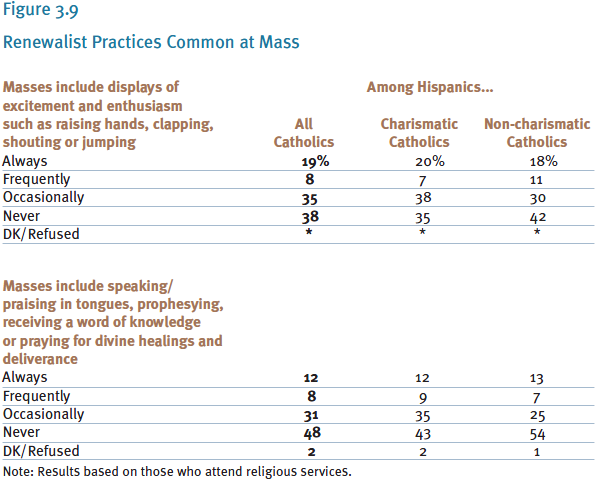
On the other hand, partisan preferences among Latino citizens of Mexican descent differ significantly according to religious tradition. Democrats have a sizable advantage among Mexican Catholics (49% vs. 14%). However, among Mexican evangelicals the partisan split goes the other way (47% for Republicans and 24% for Democrats).

Issues

By significant margins, Hispanic eligible voters say the Democratic Party can do a better job of handling issues ranging from the economy and immigration to the environment and morality. Of the seven issues presented in the survey, the Democratic Party has at least a two-to-one advantage in five of them. Among all Hispanic eligible voters, the smallest margin is on improving morality, and even there the Democratic Party has an 18-percentage-point advantage.

Latino evangelicals are a striking exception to this pattern of Democratic dominance on issues. On five of the seven issues, Latino evangelicals give similar ratings to both political parties. Meanwhile, the Republican Party is judged best suited to improve morality in the country, although the margin over the Democratic Party is relatively small (42% vs. 36%). And, 43% of these eligible voters favor the Democrats on the environment, compared to 33% who pick the Republicans.

President Bush

The patterns of partisan loyalty among Latino eligible voters of various religious traditions are mirrored in attitudes toward President George W. Bush. Catholics disapproved of the president’s performance by more than a two-to-one margin (62% vs. 27%), and the president’s ratings were only slightly better among mainline Protestants.
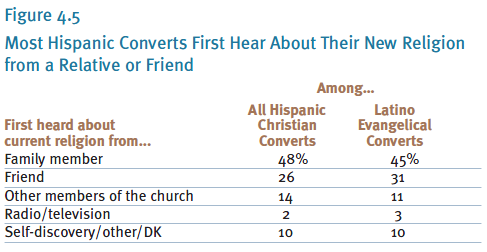
On the other hand, a majority of evangelical Latino eligible voters endorsed the job President Bush is doing (50% vs. 38%). The president did even better among evangelical voters who identify their ideology as conservative, with 63% approving of his performance. These findings are from a survey taken between Aug. 10 and Oct. 4, 2006, and the president’s approval ratings have been subject to change since then.
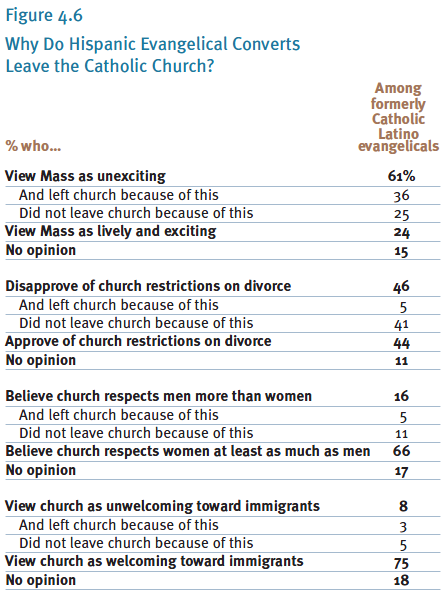
There is a notable difference between Latino evangelical voters who attend religious services weekly and those who attend less often. More than half (57%) of evangelicals who are frequent churchgoers approve of Bush’s performance while a third (33%) disapprove. Latino evangelicals who attend less frequently split by the same proportions, but in the opposite direction (51% disapproving and 36% approving).

The difference is less pronounced for Latino Catholics. Those who attend church less often tend to be only slightly more disapproving of the president than those who are frequent churchgoers (64% vs. 59%).

Voter registration

Latino eligible voters register to vote at roughly similar rates across the major religious traditions. Among Catholics, ideological conservatives report higher registration rates than do liberals.

Survey Methodology

The Pew Hispanic Center and the Pew Forum on Religion & Public Life conducted a public opinion survey among people of Latino background or descent on the topic of religion. The study was conducted via telephone by ICR, an independent research company based in Media, Pa. Interviews were conducted from Aug. 10 to Oct. 4, 2006 among a nationally representative sample of 4,016 Latino respondents age 18 and older. Of those respondents, 2,025 were Catholics and 905 were evangelical Protestants. The margin of error for the total sample is +/-2.5% at the 95% confidence level. The margin of error for Catholic respondents is +/- 3.3% at the 95% confidence level. The margin of error for evangelical respondents is +/-4.8% at the 95% confidence level.

For this survey, ICR maintained a staff of Spanish-speaking interviewers who, when contacting a household, were able to offer respondents the option of completing the survey in Spanish or in English. A total of 1,036 respondents were surveyed in English and 2,949 respondents were interviewed in Spanish, with the remaining 31 interviews conducted partly in English and partly in Spanish.

All interviews were conducted using a Computer Assisted Telephone Interviewing (CATI) system, which ensures that questions were asked in the proper sequence with appropriate skip patterns. CATI also allows certain questions and certain answer choices to be rotated, eliminating potential biases from the sequencing of questions or answers.

Eligible respondent

The survey was administered to any person age 18 and older who was of Latino origin or descent, though some screening was necessary to interview fewer Mexicans and fewer Central Americans (as described below). The survey used a modified most recent birthday method of selecting a respondent in each household; interviewers first asked to speak with the adult male in the household who had the most recent birthday, and if no male was available interviewers asked to speak with the adult female who had the most recent birthday.

Sampling methodology

A disproportionate stratified sample constructed using an optimal sampling allocation technique was used for the survey. A list of all telephone exchanges within a target area (national, by state, etc.) were sorted based on both concentration of Latino households and specific Latino heritage. The exchanges were then divided into various groups, or strata.

The primary stratification variables are the estimates of Latino household incidence and heritage in each area code and exchange combination as provided by the GENESYS System. These estimates are derived from Claritas, a marketing information company, and are updated at the telephone exchange level with each quarterly GENESYS database update. The basic procedure was to rank all area code and exchange combinations in the US by the incidence of Latino households and their ethnicity. This produced strata that were called Mexican, Puerto Rican, Cuban, Dominican, Central American, South American, High Latino, Medium Latino, and Low Latino. These strata were then run against InfoUSA and other listed telephone number databases, to identify households with known Latino surnames. Any households with Latino surnames were subdivided into ‘surname’ strata, with all other sample being put into ‘RDD’ strata.

Overall, the study employed 18 strata, 9 (Mexican, Puerto Rican, etc.) x 2 (surname/RDD). Two features of this design are worth noting. First, the existence of surname strata does not mean this was a surname sample design. The sample is RDD, with telephone numbers divided into strata according to whether or not they were found to be associated with a Latino surname. This was done simply to increase the number of strata (thereby increasing the ability to meet ethnic targets) and to ease administration (allowing for more effective assignment of interviewers and labor hours). Second, even though some strata were labeled by country of origin based on data base information, any Hispanic sampled from the stratum was accepted as a valid respondent for the study. For example, in a stratum called “Mexican,” both Mexicans and non-Mexicans who appeared in the stratum were interviewed.

For purposes of estimation, an optimal allocation scheme was employed. This “textbook” approach allocates interviews to a stratum proportionate to the number of Latino households, but inversely proportionate to the square root of the relative cost, the relative cost in this situation being a simple function of the incidence. As such, the number of completed interviews increases in moving from lower incidence strata to higher incidence strata. Again, this is a known, formulaic approach to allocation that provides a starting point for discussions of sample allocation and associated costs.

One of the major goals of the study was to attain sufficient numbers of non-Catholic Hispanics, since overall about a third of Hispanics say they are not Catholic. The study was designed so that in fact roughly 50% of all completes were from non-Catholics. This was done using two strategies. First, non-Catholics from all ICRconducted Pew studies from 2002 to the present were recontacted for this survey. Second, additional completes were obtained among non-Catholic Hispanics using the sample design described above.

Weighting and estimation

A two-stage weighting design was employed to ensure an accurate representation of the national Hispanic population. First all interviews that were attained of non-Catholics from prescreened sample (sample pulled from prior Pew studies) were analyzed to determine which strata they would have come from had they been interviews from the main study design. They were then temporarily assigned to those strata for weighting purposes. Then, all sample was rebalanced with a pre-weight to correct for the disproportionality of the stratified sampling design.

The file was then split into five main data files by Heritage (Mexican, Puerto Rican, Cuban, Central and South American, and Other). Each data file was put through a post-stratification sample balancing routine. The post-stratification weighting utilized national 2006 estimates from the Census and Claritas on age, gender, education, foreign/native born status and Catholic/non-Catholic status. As the Census is not allowed to ask about religion, counts for Catholic/non-Catholic status were based on the weighted percentages on religion found in all past ICR-conducted Pew Hispanic studies.

Each of the five data files was balanced to the proper proportion of its Heritage group based on national estimates. Thus, with 4,016 overall completes, the Mexican weighting run balanced to 2,538 interviews to reflect the estimate that 63.2 percent of the U.S. Hispanic population is Mexican. In the end, the combination of these five files accurately represents the overall U.S. Hispanic population.

Sample disposition

Following is a full disposition of the sample selected for this survey:

Methodology report – recontact survey of Catholics

In the main survey described above, a total of 2,025 respondents were identified as Catholic. All of these respondents were recontacted and asked to participate in a new battery of questions. Respondents were offered an incentive of $20 to participate. A total of 650 Catholics (376 charismatic Catholics and 274 other Catholics) were interviewed in the recontact survey. The margins of error for the main groups are as follows:

Catholics: +/-5.7%

Charismatic Catholics: +/-7.7%

Other Catholics: +/-8.5%

Eligible respondent

The re-contact survey was administered to any person ages 18 and older who was of Latino origin or descent and who participated in the first survey and identified as Catholic.

Field period

The field period for this re-contact survey was Jan. 5 to Jan. 29, 2007. The interviewing was conducted by ICR/International Communications Research in Media, Pa. All interviews were conducted using the Computer Assisted Telephone Interviewing (CATI) system. The CATI system ensured that questions followed logical skip patterns and that the listed attributes automatically rotated, eliminating “question position” bias.

Weighting and estimation

Using the data from the original survey, data from the recontact survey of Catholics were weighted by age, gender, education and foreign/native born status, so as to be representative of the sample of Catholics from the original survey.

Sample disposition

Following is a full disposition of the sample selected for this survey:

Methodology report – population projections

The Pew Hispanic Center developed estimates of the 2005 civilian, non-institutional population, based in part on the Census Bureau’s 2005 population estimates. The Pew Hispanic Center estimates also incorporated updated estimates of the undocumented population and were specified by age, race/ethnicity, and generation (details in a forthcoming Pew Hispanic Center publication).

Initial religious distributions for non-Hispanics were derived from the Pew 2006 U.S. Religion Survey conducted by the Pew Forum on Religion & Public Life. For Hispanics, initial religious distributions are categorized by generation and are based upon the primary data collection effort for this study. For the purposes of the projections, religion was classified into three categories: Catholic, some other non-Catholic faith and secular.

To project religious distributions into the future, conversion rates were applied to the initial religious distributions among Hispanics and non-Hispanics. The rates of conversion over the next 25 years were estimated to mirror the rates over the past 25 years, which were established through the 2006 Forum Pentecostal Survey (for non-Hispanics) and through the surveys conducted for this study (for Hispanics). Given nativity differences in conversion for Hispanics, the Hispanic conversion rates were further disaggregated by nativity.

Applying the conversion rates to the initial religious distributions produced estimates of the religious distributions for Hispanics and for non-Hispanics for 2030. These religious distributions were then multiplied by the age-specific, race-specific, generation-specific population projections for 2030 to determine the number of Hispanics and non-Hispanics in each religious category, and thus the race/ethnic profile of each of the three religious categories, assuming conversion rates remain constant.

An analogous approach was used to estimate the alternative conversion scenarios. However, instead of assuming that conversion rates would remain constant, the conversion rates away from Catholicism for Hispanics were altered; in one scenario, rates of conversion increased by 50%, and in the other scenario, conversion away from Catholicism decreased by 50%. All three scenarios assumed that conversion rates among non-Hispanics would remain constant.

Glossary

Baptism of the Holy Spirit: A distinctive experience among pentecostals and charismatics in which the believer receives spiritual gifts and powers, such as speaking in tongues, healing and prophecy.

Bilingual: Hispanics who read and speak both English and Spanish, as determined by a series of questions that explore language ability and use.

Charismatics: Those Christians who practice the gifts of the Holy Spirit but who are not members of historical pentecostal denominations. Most belong to Catholic or Protestant denominations, although they engage in spiritual practices, such as speaking in tongues, that are not common in these churches.

Country of origin: For all Latinos, both immigrant and native born, the country where they locate their family ancestry.

Divine healing: The miraculous curing of physical and other illnesses through the direct intervention of the Holy Spirit.

Eligible voters: Respondents who responded positively when asked if they were U.S. citizens. All respondents were at least 18 years old.

English dominant: Hispanics who read and speak in English most of the time and have a limited ability to read or speak in Spanish.

Ethnic church: A house of worship that has some Hispanic faith leaders, where services are available in Spanish and where most of the people in a typical service attended by respondents are Hispanic.

Evangelical Protestants: Those who identify themselves as Protestants and say they consider themselves to be born again or evangelical Christians.

First generation: Born either outside the U.S. or in Puerto Rico. (Although people born in Puerto Rico are U.S. citizens by birthright, for the purposes of this study they are categorized as first generation because they have an experience with migration and share many of the linguistic and cultural attributes of immigrants.)

Foreign born: Born either outside the U.S. or in Puerto Rico. (Although people born in Puerto Rico are U.S. citizens by birthright, for the purposes of this study they are categorized as foreign born because they have an experience with migration and share many of the linguistic and cultural attributes of immigrants.)

Gifts of the Holy Spirit: Listed in 1 Corinthians 12:4-14, these gifts include speaking in tongues, healing, prophesying and the performing of miracles.

Mainline Protestants: Those who identify themselves as Protestants but who do not say they are born again or evangelical.

Native born: Hispanics who were born in the 50 states or the District of Columbia.

Other Christians: Those who identify themselves as Jehovah’s Witnesses, Mormons or Orthodox Christians.

Other Faiths: Those who identify themselves as members of Jewish, Muslim or other non-Christian faiths.

Pentecostals: Protestants who belong to pentecostal denominations, such as the Assembly of Christian Churches, Assemblies of God or the Pentecostal Church of God. Pentecostals are part of the Christian renewalist movement.

Prophesying: A spontaneous utterance spoken in worship settings and believed to be inspired by the Holy Spirit; not necessarily a prediction of future events as the term is commonly understood. One of the spiritual gifts listed in 1 Corinthians 12.

Prosperity gospel: A teaching that has emerged in recent decades in some Christian circles that holds that religious belief will bring good health and material prosperity to the believer. Rapture: The belief that the faithful will be rescued and taken to heaven before Jesus returns in judgment and the world comes to an end.

Registered voters: Refers to eligible voters who said they were absolutely certain they were registered to vote.

Renewalist Christianity or Renewalists: An umbrella term used to refer to pentecostals and charismatics. These spirit-filled movements place great emphasis on God’s ongoing, day-to-day intervention in human affairs through the person of the Holy Spirit. Renewalists believe that the power of the Holy Spirit is manifested through such supernatural phenomena as speaking in tongues, miraculous healings and prophetic utterances and revelations.

Roman Catholics: Those who identify themselves as Roman Catholic.

Second generation: Born in the U.S. of at least one foreign-born parent.

Seculars: Those who say they have no specific religious affiliation or say that they are agnostic or atheist.

Spanish dominant: Hispanics who read and speak in Spanish most of the time and have a limited ability to read or speak in English.

Speaking in tongues: Ecstatic speech or prayer using an unintelligible language that is considered a gift of the Holy Spirit. Third generation: Born in the U.S. of native-born parents.