Pew Research Center

FOR RELEASE NOVEMBER 1, 2005

The Higher Drop-Out Rate of Foreign-Born Teens

A report on high school enrollment points to the importance of schooling abroad in understanding the dropout problem for immigrant teens, finding that those teens have often fallen behind in their education before reaching the United States.

FOR MEDIA OR OTHER INQUIRIES:

Communications Department
202.419.4372
www.pewresearch.org

RECOMMENDED CITATION

Pew Research Center, November 2005, "The Higher Drop-Out Rate of Foreign-Born Teens"

About Pew Research Center

Pew Research Center is a nonpartisan, nonadvocacy fact tank that informs the public about the issues, attitudes and trends shaping the world. It does not take policy positions. The Center conducts public opinion polling, demographic research, computational social science research and other data-driven research. It studies politics and policy; news habits and media; the internet and technology; religion; race and ethnicity; international affairs; social, demographic and economic trends; science; research methodology and data science; and immigration and migration. Pew Research Center is a subsidiary of The Pew Charitable Trusts, its primary funder.

© Pew Research Center 2026

Table of contents

  • About Pew Research Center
  • The Higher Drop-Out Rate of Foreign-Born Teens
  • II. Introduction
  • III. Foreign-Born Teen Populations
  • IV. Most Early Childhood Arrivals are in School
  • V. Schooling Difficulties Abroad Persist in America
  • VI. The Characteristics of Foreign-Born Teen Populations
  • VII. Conclusions
  • Appendix A: Data Source

The Higher Drop-Out Rate of Foreign-Born Teens

A report on high school enrollment points to the importance of schooling abroad in understanding the dropout problem for immigrant teens, finding that those teens have often fallen behind in their education before reaching the United States.

I. Overview

Foreign-born youths are significant contributors to the nation’s teen school dropout population. Only 8 percent of the nation’s teens are foreign born, but nearly 25 percent of teen school dropouts were born outside the United States, according to a Pew Hispanic Center analysis of data from the 2000 U.S. Census.

Many of these foreign-born school dropouts–nearly 40 percent–are recent arrivals to this country who were already behind in school before they left for the United States. In absolute numbers, recently arrived foreign-born teens who had difficulties in school before migration are a relatively small phenomenon–they make up just 6 percent of all foreign-born youths–but they are at high risk of dropping out once they arrive. (A youth is categorized as a dropout if he or she is not currently enrolled in school and has not completed a high school education. This includes those who have never enrolled in school in the United States.)

The impact of schooling difficulties before migration on school enrollment in the U.S. applies widely to youths from all countries of origin. For example, recently arrived teens from China who made adequate progress in school before migrating have a school dropout rate of less than 4 percent. But recent arrivals from China who did not make adequate school progress in China have a dropout rate greater than 30 percent.

How well recent arrivals do at school varies markedly between youths who experienced education difficulties before migration and other foreign-born teens, and the two groups differ in other ways as well. The dropout rate for teens with school problems before migration is in excess of 70 percent, in comparison with 8 percent for other foreign-born youths. And their characteristics, especially for males, suggest that many of them are labor migrants: Their purpose in migrating was probably to seek employment in the labor market, and they may have never enrolled in U.S. schools. Recently arrived males who did not make adequate school progress before migration are twice as likely to be working as other foreign-born males, and nearly 40 percent of them are in the agriculture and construction industries, in comparison with 10 percent of other foreign-born youths. In contrast to the living arrangements of other foreign-born youths, the majority of recent arrivals with prior school problems do not reside with any parent in the household. Given their participation in the labor market and the degree to which they were behind in school, the prospects of enrolling these youths in traditional high school settings appear to be remote.

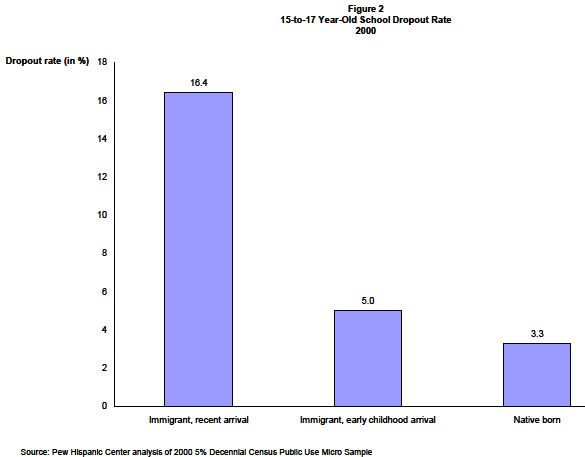
Foreign-born teens who have received most or all of their schooling in America are much more likely to be in school. These early childhood arrivals have a dropout rate of 5 percent, not much higher than the native-born dropout rate of 3.3 percent. For nearly every country of origin, teens who arrived early in childhood are much more likely to be in school than teens who arrived in the United States recently.

The analysis utilizes a large, nationally representative sample of foreign-born teens from the 2000 Decennial U.S. Census. It examines the dropout behavior of teens from over 40 countries or regions of origin. The large Census file permits the analysis to focus on the most relevant age range for school enrollment, 15 to 17, when most U.S. youths enroll in high school, rather than broader ranges beyond traditional high school age.

The study’s key findings include:

  • Foreign-born school dropout rates strongly depend on two linked factors: the age at which the teen migrated and the country that initially educated the teen.
  • Foreign-born teens who arrived in the United States early in childhood have a modestly higher school dropout rate than native-born teens.
  • The small share of foreign-born teens who arrived recently and had education difficulties before migration have an exceedingly elevated school dropout rate. More than 70 percent of such teens are high school dropouts.
  • Recently arrived foreign-born teens with education difficulties before migration are a small share of foreign-born teens but a large share of foreign-born high school dropouts.
  • The pattern of dropout rates by age at arrival and prior schooling history applies to foreign-born teens from all countries of origin.
  • The importance of recently arrived teens with prior education difficulties varies from country to country, but nonetheless, such youths have much greater dropout rates regardless of country of origin.
  • Many of the male recent arrivals who had education difficulties before migration are likely labor migrants, i.e., they came to the United States recently in order to work.

II. Introduction

Foreign-born youths are significantly more likely not to be enrolled in high school than other youths. The adjustment difficulties of immigrant youth are typically conceived as arising from the stresses and disruption of an international move (Warren, 1996) and the lower socioeconomic status and disadvantaged family background characterizing foreign-born youth.1 The pattern of high school dropout rates reveals, however, a large measure of continuity in the school enrollment of recently arrived foreign-born teens. The vast majority of newly arrived immigrant youths appear to have made adequate school progress in their schools before they left for America. Many are enrolled and engaged in high school after arrival. A small sliver of recent arrivals, however, had difficulties and did not make adequate grade progress before coming to the United States. They bring their school problems with them, whether they are from Asia or Latin America. Most of these youths are not in school in the United States. Because of their very high dropout rate, this small group of immigrant teens accounts for nearly 40 percent of all foreign-born high school dropouts.

In the late 1990s at least 1.5 million immigrants came to the United States each year and the foreign-born population increased from 19.8 million in 1990 to 31.1 million in 2000 (Passel and Suro, 2005). Much of the focus on these newly arrived residents is on adult immigrant outcomes—on their economic status, for example, or on where they settle. However, a significant portion of the new arrivals are children. Almost 30 percent of newly arrived immigrants are under the age of 18.2 Schooling is the major formal activity of children, and thus a full evaluation of how newly arrived immigrants are faring in society must include discussion of how foreign-born youths perform in U.S. schools.

This brief report provides a full investigation of a fundamental indicator of school performance, teen school dropout rates, or whether a youth is in school. Foreign-born youths are more likely to be school dropouts than native-born youths. Although the dropout rate is only one measure of school performance, it is critical. Youths who are not in school are much less likely to finish high school and further their education and will not progress in their academic and formal skills.

The greater likelihood that immigrant teens will not be in high school is almost exclusively caused by the dropout difficulties of recently arrived youths. Recent arrivals who struggled in school before coming to the United States are much less likely to be currently enrolled in school than other foreign-born youths. The pattern is apparent for youths from all sending countries. Schooling difficulties abroad are highly predictive of dropout status here. Conversely, many of the large group of recently arrived youths who were on track in school before coming to the United States appear to transition successfully into U.S. schools. Their dropout rate is only modestly above that of youths who came to the United States early in childhood, and the dropout rates are quite low for many countries of origin.

Prior research on the school enrollment of foreign-born youth has shown that a large proportion of Hispanic foreign-born young adults dropped out of school because they never “dropped in”—in other words, they never enrolled in U.S. schools (Vernez and Abrahamse, 1996; NCES, 1997). The contribution of this report is not to confirm this finding, but to enrich it by examining the school performance of foreign-born high school age youths before they came to America. The plausibility that foreign-born youths simply never enrolled in U.S. schools is strengthened if many of them dropped out or got behind in school in their country of origin. This report shows that school enrollment is highly dependent on the progress the youth made in school before coming to the United States.

Recently arrived youths who struggled in school before migration are distinctive in other ways in addition to their very high dropout rate. They have high employment rates and earn considerably more in the labor market than other immigrant youths. They are heavily concentrated in the agriculture and construction industries. Many do not live with their parents and they are more likely than their counterparts to be married. In short, the evidence is consistent with the characterization that some of these youths are labor migrants. Though teenagers, they may have come to America to work and have never entered U.S. schools since they left school in their country of origin well before they departed for the United States.

The report presents detailed school dropout rates using the 2000 Decennial Census Public Use files. This very large sample has over 40,000 foreign-born 15-to-17-year-olds, so dropout rates for youths from more than 40 countries can be tabulated (see the Appendix for further details). The dropout rates calculated are conventional “status dropout rates.” A youth is a “dropout” if he or she is not currently enrolled in school and has not completed a high school education. Otherwise, the youth is considered “in school.” Both the U.S. Census Bureau and the U.S. Department of Education regularly publish status school dropout rates for youth (U.S. Bureau of the Census, 2003; NCES, 2004a).

III. Foreign-Born Teen Populations

In the 2000 Census there were nearly 1 million foreign-born 15-to-17-year-old youths. The importance of foreign-born youths for the school dropout population is clear. Foreign-born youths were 8 percent of all youths in 2000, but they were nearly 25 percent of all young school dropouts.

Some of the foreign-born 15-to-17-year-olds have been in the United States since early childhood and received all or nearly all their schooling in American schools. In 2000, about 400,000 foreign-born 15-to-17-year-olds arrived early in childhood–about 42 percent of all foreign-born youths (Table 1). Following Hirschman (2001), in this report the “early childhood arrivals” have been in the United States at least nine years (they must have arrived before 1992) and thus arrived no later than 8 years of age or second grade. The outcomes of these youths clearly and unambiguously reflect their experience in schools in the United States.

The key group for dropout behavior is the larger group of recently arrived immigrant youths who numbered about 560,000 in 2000. By definition, “recent arrivals” came to the United States in 1992 or later and hence they arrived here no earlier than age 7. On average, these youths arrived at 12 years of age and some did not migrate to the United States until age 17. Recently arrived youths received a significant segment of their early schooling in schools outside the United States. Their current outcomes are not simply a reflection of their experience in U.S. schools, since they clearly were educated abroad in their early school years. Some of them have never been enrolled in U.S. schools.3

It is critical to further break down the 560,000 recently arrived immigrant youths. Some had schooling difficulties before they migrated to the United States. The Census reveals the highest grade of school that a youth has completed, and we can compare the grade that a youth has completed to the age at which he or she migrated to the United States in order to infer whether the youth made normal progress in school before migrating. For example, consider a youth who arrives in the United States at age 15. If the youth made normal progress in school abroad, we would expect him or her to have at least an eighth-grade education.4 If he or she has completed less than the eighth grade, the immigrant was not making normal school progress abroad by U.S. standards. On this basis, about 60,000 recent arrivals had schooling difficulties before migration in that they were not keeping up in school abroad. This small group of youths constituted 6 percent of all foreign-born 15-to-17-year-olds and 11 percent of recent arrivals.

IV. Most Early Childhood Arrivals are in School

Foreign-born youths, particularly recent arrivals, are more likely to be high school dropouts than youths born in the United States. Almost all youths residing in the United States, whether native-born or foreign-born, are in school until age 15. Probably because of compulsory schooling laws, dropout rates are minimal until age 15 (Figure 1). At age 15, nontrivial numbers of youths begin to be out of school. In 2000, 3.3 percent of native-born 15-to-17-year-olds had dropped out of school, in comparison with 11.7 percent of foreign-born 15-to-17-year-olds.

The foreign-born dropout rate is strongly associated with the age at which the youth arrived in the United States. The school dropout rate for early childhood arrivals was 5.0 percent, pretty close to the native-born dropout rate of 3.3 percent (Figure 2).

The beneficial effect of arrival early in childhood could be due to several factors. Fluency in English is related to school outcomes and English language acquisition is easier for younger children and increases with the time spent in the United States (NCES, 2004b). Alternatively, early arrivals are nearly exclusively educated in the United States and are a reflection of the quality of U.S. schools. On average, the quality of schooling received by immigrants in the United States might be above that of schools in other countries. Finally, it is often thought that the act of migration in and of itself has negative consequences for academic outcomes (Warrren, 1996). Migration may disrupt the peer networks valuable for gaining information and academic support. Migration may also generate feelings of alienation from school peers and loss of self-esteem (Kao, 1999). The disruptive effects of migration might be reduced for children who arrive before the onset of school and may dissipate with additional time in the United States.

The school dropout rate for the 560,000 recently arrived foreign-born youths in 2000 was 16.4 percent. This was more than triple the early childhood arrival dropout rate. Recent arrivals are 58 percent of all foreign-born youths, but they are more than 80 percent of all foreign-born school dropouts.

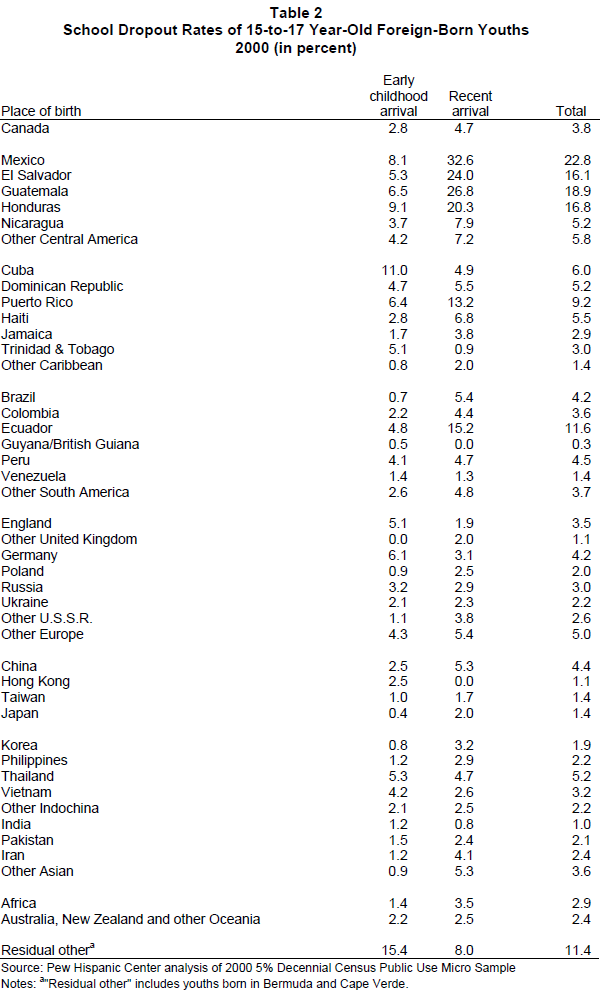
Foreign-born youths come from many countries of origin and school dropout rates vary tremendously across these countries. However, the strong association between early arrival in the United States and reduced dropout rates does not simply reflect that early arrivals originate from different countries than recent arrivals. Table 2 reports the school dropout rates for youths from 45 countries or regions of origin. The beneficial effect of early arrival on lowering the dropout rate is quite widespread. Regardless of country of origin, early childhood arrivals are typically much less likely to be school dropouts than their later-arriving peers. Furthermore, the dropout rates of early arrivals from many countries of origin are below the rate of native-born youth. The dropout rates of early arrivals from South American and Asian countries tend to be relatively low.

Early arrivals from Mexico and some Central American countries are more likely to be out of school than native-born youths. Some of the gap in school enrollment between these early arrival groups and native-born youths can be accounted for by the disadvantaged family background of these youths. Parental education levels tend to be much lower for youths from these countries, and fewer of these youths are residing in intact families in comparison with native-born teens. Accounting for these disadvantages moderates further the difference in school enrollment between Mexican and Central American early arrivals and native-born youths (Hirschman, 2001).

The dropout data clearly show, for nearly every country of origin, that greater time in the United States during childhood is associated with a greater likelihood that a youth will be in school. This evidence raises questions about the effects of exposure to U.S. schools and norms and culture on foreign-born youth outcomes. Some sociologists and psychologists assert that youths from certain countries of origin, such as Mexico, Cuba and the Philippines, display worse outcomes the longer they are in the United States (Portes and Zhou, 1993; Suarez-Orozco and Suarez-Orozco, 1995; Perlmann and Waldinger, 1998). Their concern is that immigrant youths who belong to racial or ethnic minorities and reside in disadvantaged central city neighborhoods may begin to emulate the disaffected behavior of their native-born peers the longer they are in the United States.1 This contrasts with the more straight-line, classic assimilation expectation wherein immigrants initially struggle in their adjustment to the new society, but with additional time in the United States display greater success. Table 2 suggests that longer exposure to the United States is beneficial for foreign-born youth, not deleterious in its effects. The incidence of dropping out is heavily concentrated among recent arrivals, not the early childhood arrivals. This applies to immigrant youths of Hispanic or African American identity as much as to other racial identities. As the next section shows, a large measure of immigrant dropping out is related to the quality of the education received before the youths migrated, not to their experience in U.S. schools and society.

V. Schooling Difficulties Abroad Persist in America

More than four out of five dropouts are recently arrived, and an important explanation can be found in the schooling they received abroad. In the voluminous literature on high school dropout behavior it is well established that a strong predictor of being out of school is earlier schooling difficulties. Youths who have previously dropped out of school or been retained in grade are much more likely to drop out than other youths (Hauser, 1999; NCES, 1997). Similarly, youths who are performing poorly academically are at greater risk of dropping out (Driscoll, 1999; Rumberger, 1995). This basic research finding has not been applied to foreign-born youth.

The elevated non-enrollment rates of recently arrived foreign-born youths are strongly related to schooling difficulties experienced by the youths before migration to the United States. In 2000, the dropout rate for the 60,000 recently arrived youths who had schooling difficulties before migration was above 70 percent (Figure 3). In sharp contrast, about 10 percent of recent arrivals who had continuous schooling abroad are currently out of school. Schooling difficulties before migration are highly predictive of dropout status in the United States.

Recent arrivals who had interrupted education abroad were 6 percent of all foreign-born teens, but because of their inordinately high dropout rate, they constituted 38 percent of all foreign-born school dropouts (Figure 4). It is a small population that is a large part of the immigrant dropouts.

Among recently arrived youths, those who had schooling difficulties before migration are nearly half of the recently arrived school dropouts, although they account for only a tenth of recently arrived youths.

The relevance of the youth’s schooling progress before migration to the youth’s present school status is quite universal. Regardless of country of origin, schooling difficulties before migration presage elevated dropout rates in the United States (Table 3). Among the large Mexican-born population, 21 percent of recent arrivals who do not appear to have had schooling difficulties before migration are dropouts. However, of recently arrived Mexican-born teens who did not keep up in school before coming to the United States, 83 percent are not enrolled in school. About 11 percent of recently arrived Puerto Rican-born youths who stayed on track in Puerto Rico are currently not enrolled in school. Among their counterparts who fell behind in Puerto Rico, 54 percent are out of school. Among recent arrivals from China who made normal progress in Chinese schools before migrating to the United States, about 4 percent are out of school, but among those who lagged in school before coming to the United States, almost 32 percent are school dropouts. Previous education difficulties are highly predictive of current schooling status.

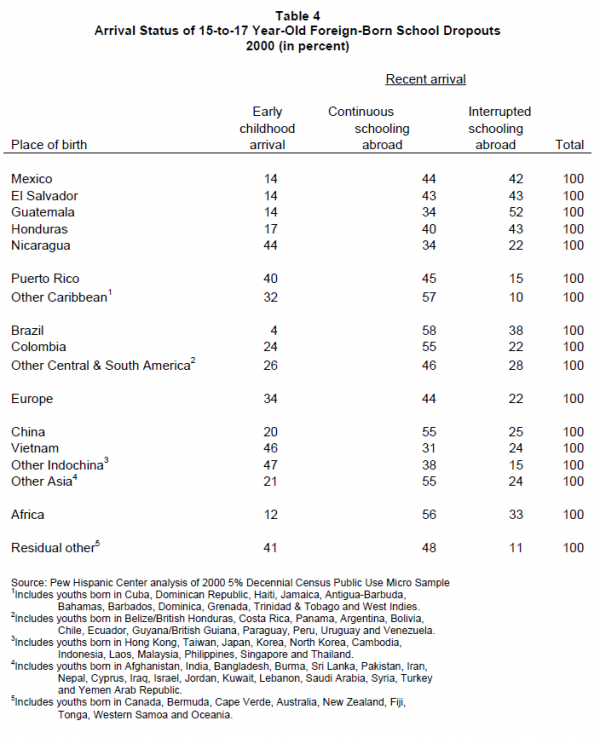
While recent arrivals who had schooling difficulties before migration clearly have elevated dropout rates, are there enough of them to make much of a difference? In the aggregate, the answer is clearly yes. For most countries of origin, there are enough of these youths and their dropout rates are high enough that they constitute a significant portion of the dropouts from that country (Table 4). More than half of the dropouts from Guatemala are recent arrivals who had schooling difficulties before migrating. On the lower end, 10 percent of the dropouts from the Caribbean (other than Puerto Rico) are recent arrivals with interrupted schooling abroad. The importance of recent arrivals with relatively low schooling upon arrival is pertinent to understanding the schooling difficulties of youths from countries of origin besides just Mexico and Central America.

VI. The Characteristics of Foreign-Born Teen Populations

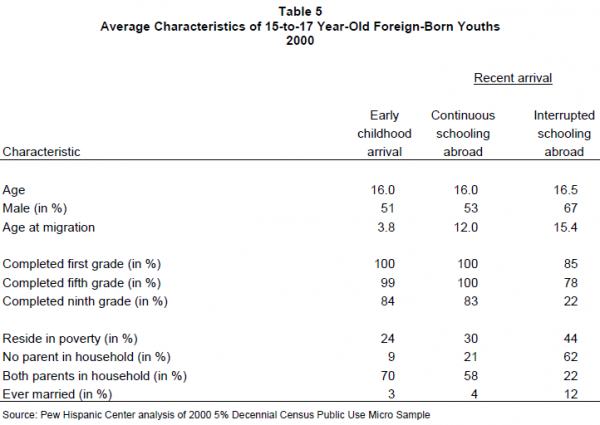
Recent arrivals with interrupted education abroad have characteristics different from other foreign-born youths. These differences likely explain some of the very high dropout rate among recent arrivals who had schooling problems before migration. The characteristics of youths with schooling difficulties before migration are also consistent with the view that many of these youths are labor migrants, i.e., they migrated with the intention of pursuing employment in the United States and have never attended school here. Recent arrivals with interrupted schooling abroad tend to be slightly older and also arrived in the United States at an older age (Table 5). More than 60 percent do not reside with a parent. They tend to be more likely to reside in poverty, and more than 10 percent were or are married.

Partly by definition, recent arrivals with schooling problems before migration also are much farther behind in school than other foreign-born youths. Consider, for example, 16-yearolds. Among other foreign-born 16-year-olds, 90 percent have finished ninth grade. Among recently arrived 16-year-olds with interrupted education abroad, only 16 percent have completed ninth grade and nearly a quarter have not completed fifth grade.

16- and 17-Year-Old Foreign-Born Youths in the Labor Market

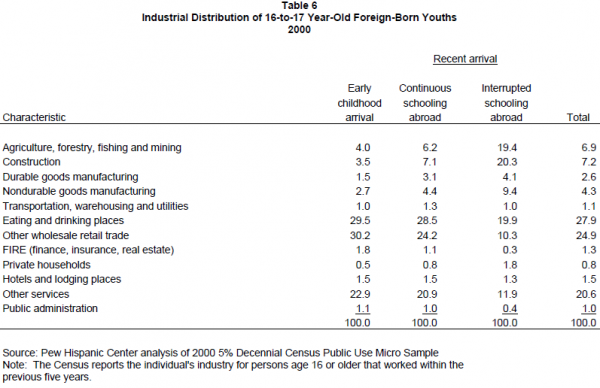
Although the primary activity of teenagers is schooling, many foreign-born youths do have exposure to the labor market. Youths who arrived recently with prior education difficulties are concentrated in different sectors of the labor market from other foreign-born youths. Almost 40 percent of recent arrivals with interrupted schooling before migration are in agriculture and construction (Table 6). These industries employ about 10 percent of other foreign-born youths.

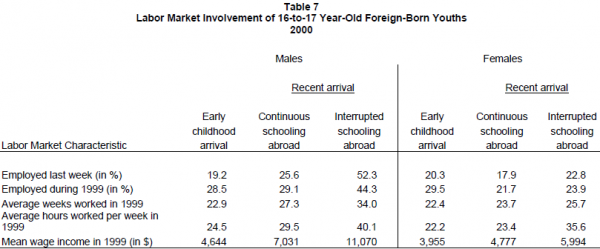
The labor market evidence supporting the assertion that many of the recent arrivals with prior schooling difficulties are labor migrants is strongest for males. The Census only collects labor market information on persons 16 years of age and older. Among male 16- and 17-yearolds, those recently arrived with prior schooling difficulties are much more likely to be employed than other foreign-born males (Table 7). More than half of them were employed at the Census enumeration, in comparison with less than a quarter of other foreign-born 16- to-17-year-old males. They also reported much higher labor earnings in 1999 than their peers. The estimated mean wage income for recently arrived males with education difficulties before migration was $11,070, compared with $7,031 for recent arrivals with continuous schooling abroad and $4,644 for early childhood arrivals.

The evidence of strong labor market engagement is less persuasive among recently arrived females with schooling difficulties before migration. While they are more likely to be working than other immigrant females, their employment levels are not above average. Many high school age youths work, and they work during the school year. In 2000, 33 percent of native-born 16- and 17-year-old females were employed, in comparison with 23 percent of recently arrived females who had schooling difficulties before migration. One indicator consonant with the labor migrant hypothesis among the females is the average hours worked per week. Those recently arrived females with interrupted schooling abroad who worked during 1999 averaged nearly 36-hour workweeks, substantially above other foreign-born 16- and 17- year-old female workers whose workweeks were much closer to 20 hours.

Motherhood among Recently Arrived Females with Prior Education Difficulties

How much of the inordinate dropout rate of recently arrived females with prior schooling difficulties is due to teen fertility and motherhood? Clearly, motherhood cannot be the primary cause of these females’ being out of school: The number of teens who are mothers is far too small. Almost 65 percent of this female population is out of school. Yet only 7 percent of such recently arrived females are mothers. This is also apparent in the much larger native-born female teen population, where motherhood cannot be the primary explanation of female dropout behavior either because it is not sufficiently pervasive (Ahituv and Tienda, 2004). This is not to say that motherhood has nothing to do with dropping out in this population. Nearly all the recently arrived women with prior education difficulties who are mothers are also out of school. But there are far too few mothers to explain the very high dropout rate in this population.

Economic pressures and the necessity to work are likely more important correlates of nonenrollment in school for these females. Not all of these female youths are out of school. Of those in school, 11 percent are working. Among the dropouts, almost 30 percent are working, and again, they are working nearly full time. Thus, their work likely contributes to their lack of school engagement.

VII. Conclusions

School dropout rates are an important basic indicator of youth well-being. Nearly four times as many foreign-born youths as native-born youths are out of school. Youths who do not complete high school have greatly restricted opportunities in post-secondary education and their employment rates and earnings are significantly below those of youths who do finish high school. On average, the prospects of foreign-born youths are clearly diminished by their difficulties in finishing high school.

The aggregate foreign-born dropout rate is a poor indicator of how well immigrant youths are faring in U.S. schools. Nearly one third of immigrant 15-to-17-year-olds lived abroad five years ago. Their schooling outcomes are as much a reflection of schools in their countries of origin as they are of U.S. schools. The dropout rate of foreign-born youths who arrived early in childhood, and thus are educated mostly, if not exclusively, in U.S. schools, is only modestly above the native-born dropout rate. Early childhood arrivals from many countries of origin have lower estimated dropout rates than native-born youths.

Immigrant youths bring their schooling histories with them to America. A small proportion of foreign-born teens had schooling difficulties before arriving in the United States; either they had already dropped out of school in their country of origin or they had been retained in grade. Prior difficulties are highly predictive of current school enrollment status. Most of these youths are not in school currently and this small proportion of foreign-born youths accounts for nearly 40 percent of all foreign-born high school dropouts.

The likelihood of recently arrived, foreign-born school dropouts who had schooling difficulties before migration enrolling in school seems remote. Many of them are behind their peers in their schooling. If they were to enroll they would be attending class with students much younger than themselves. In addition, they display a high degree of attachment to the labor market. Many are working, and working full time. Approaches other than traditional high school retention programs may be needed to address the skill-development needs of these youths.

Much of the recent literature on the adjustment of foreign-born youths has emphasized the effects of exposure to U.S. cultural attitudes and norms as time in the United States increases. Concerns have often been voiced that some immigrant youths living in poor central city localities may adopt the despair and antipathy to formal schooling of more longstanding racial and ethnic minority youths (Perlmann and Waldinger, 1998). The evidence from this investigation of dropout rates suggests that such exposure is a secondary concern. First, the most severe dropout rates among the foreign born do not reflect exposure to American ways, but rather to educational problems before they ever migrated to America. Second, regardless of country of origin, youths who migrate early in childhood to the United States are more likely than their later-arriving peers to be enrolled in high school. Early childhood arrivals, who receive all or nearly all their schooling in the United States and thus have the longest exposure to U.S. schools and society, are the most likely to be in school.

Appendix A: Data Source

The analysis is based on a sample of 15-to-17-year-olds from the 2000 5% Decennial Census Integrated Public Use Micro Sample. The foreign-born sample includes all foreign-born youths as well as those born in Puerto Rico. Youths who were born abroad of American parents are not included. In addition, youths residing in group quarters (institutions, military facilities and college dormitories) are not included. The foreign-born sample has 46,403 youths.

All reported tabulations are based on the appropriate sample weight. The unweighted sample sizes by place of birth are reported in Appendix Table A1.