Recent Changes in the Entry of Hispanic and White Youth into College
In addition to longstanding concerns over high school completion, policymakers are increasingly focused on disparities in outcomes between Hispanic and white college students.
About Pew Research Center
Pew Research Center is a nonpartisan, nonadvocacy fact tank that informs the public about the issues, attitudes and trends shaping the world. It does not take policy positions. The Center conducts public opinion polling, demographic research, computational social science research and other data-driven research. It studies politics and policy; news habits and media; the internet and technology; religion; race and ethnicity; international affairs; social, demographic and economic trends; science; research methodology and data science; and immigration and migration. Pew Research Center is a subsidiary of The Pew Charitable Trusts, its primary funder.
Recent Changes in the Entry of Hispanic and White Youth into College
In addition to longstanding concerns over high school completion, policymakers are increasingly focused on disparities in outcomes between Hispanic and white college students.
I. Overview
In addition to longstanding concerns over high school completion, policymakers are increasingly focused on disparities in outcomes between Hispanic and white college students (President’s Advisory Commission on Educational Excellence for Hispanic Americans, 2003; Council of Economic Advisers, 2000; RAND, 2001). Young Hispanic undergraduates are half as likely as their white peers on campus to finish a bachelor’s degree, a disparity at least as large as the disparity in finishing high school. Many factors contribute to producing this disparity. This study focuses on one: changes in college enrollment patterns.
This report shows that although Hispanics continue to increase their sheer numbers in college, they are likely falling further behind whites in the pursuit of completing the bachelor’s degree. In several key states, white enrollment increases occurred exclusively at four-year colleges and universities. Hispanic enrollment gains occurred at both two-year and four-year colleges. As a result, increases in the number of Latinos pursuing post-secondary education have not produced a reduction in the four-year college enrollment gap between Latinos and whites. Relative to whites, a smaller share of Latinos are obtaining a college education at a four-year college or university, diminishing their likelihood of completing a bachelor’s degree. In effect, Hispanics are chasing a target that is accelerating ahead of them.
This study considers seven states with large Latino populations—California, New York, Arizona, New Jersey, Florida, Texas and Illinois—for the period between 1996 and 2001. About 80 percent of the nation’s Latino college students go to college in those states. According to a Pew Hispanic Center analysis of data compiled by the U.S. Department of Education, first-time, full-time Hispanic freshman enrollment increased in all seven of these states at rates ranging from 6 percent in New York to 53 percent in Florida. The growth of white enrollment at all post-secondary institutions (two-year as well as four-year) was considerably less robust and actually decreased slightly in California.
The shift of white freshman enrollment from two-year to four-year colleges was large enough to trigger an overall decline in two-year college freshman enrollment in four states. The decrease in white freshman enrollment at two-year colleges more than offset increases in the number of Hispanic freshmen entering those colleges. Freshman enrollment in two-year colleges was flat or declining in all states except Texas and Florida. In four key states the number of Hispanic youths beginning college in the lower tiers of post-secondary education significantly increased even as other youths were forgoing those institutions.
Enrollment changes between 1996 and 2001 suggest mixed progress for Latino youth. On the one hand, the proportion of Hispanics enrolling in four-year institutions was generally increasing. This should provide a boost to educational attainment as a greater share of all Latino college students complete a bachelor’s degree. However, in California, New York, New Jersey and Arizona, an even larger additional fraction of white youths enrolled in four-year colleges. Thus, the educational attainment of white youth is likely to receive a greater boost. In a relative sense, therefore, Latino youths are falling further behind their white counterparts in several key states.
Using the widely known Barron’s measure of admissions competitiveness, this report also analyzes the change in full-time freshman enrollment between 1996 and 2001 in selective and non-selective four-year colleges. The analysis finds that the proportion of Hispanic four-year freshmen attending more selective colleges was either flat or dropped in the selected states. But the proportion of white four-year freshmen at selective colleges also declined in tandem fashion. Thus, relative to whites, Latino youths did not lose ground in enrollment at the more selective college campuses.
II. Introduction
There has been marked growth in the enrollment of Hispanic freshmen in colleges in recent years. Nationally, there were 24 percent more Latino freshmen in post-secondary institutions in 2001 than in 1996.1 The increase in Hispanic freshman enrollment cut across different types of colleges and across state boundaries. Latino freshman enrollment in four-year colleges increased by 29 percent and enrollment in two-year colleges was up 14 percent between 1996 and 2001.
This report examines how higher education has accommodated the growth in young Hispanic college entrants between 1996 and 2001 in seven states: California, New York, Arizona, New Jersey, Texas, Florida and Illinois. A state-level, rather than national, analysis is appropriate because there is much diversity across states in the structure of higher education (Goldin and Katz, 1998). The seven states covered in this report accounted for nearly 80 percent of the total Hispanic first-time, full-time enrollment of freshmen in 2001. Thus, the trends in college enrollment in these states are critical for an understanding of the post-secondary prospects of Latino youth. This analysis compares the enrollment change at two-year and four-year colleges, both public and private, in these seven states using data compiled by the U.S. Department of Education.
The enrollment of Latino youth in four-year colleges increased in all seven states between 1996 and 2001. The largest gain—55 percent—was in Florida. Hispanic first-time freshman enrollment in two-year colleges increased in five of the seven states and the largest increase—30 percent—was in Texas. The nature of the increase in white freshman enrollment between 1996 and 2001 was considerably different.2 In the seven states covered in this report, the growth in white freshman enrollment tended to be concentrated in four-year colleges and universities. Enrollment of whites in two-year colleges actually declined in five of seven states. White enrollment at non-degree-granting institutions also fell in five of seven states. As a result, the gap between white and Latino youth in enrollment at four-year institutions widened significantly in several states, most notably in California. Thus, even as Hispanics were making gains in overall college enrollment, the share of white freshmen enrolling in four-year colleges increased more than among Latinos.
Enrollment in a two-year college rather than a four-year institution can have important implications for the likelihood of Latino youths’ acquiring a degree, especially a baccalaureate degree (Ganderton and Santos, 1995; Fry, 2004). Colleges vary widely in their graduation rates (Carey, 2004), and some kinds of colleges are more successful as an entry point into higher education for Latinos than other kinds of colleges. College type is also decisive for the youth’s college experience. Some campuses are exclusively residential; other campuses are devoid of dormitories. The nature of the faculty, instructional resources, the characteristics of the student body and other key facets of the college experience vary by the type of college. Finally, the student’s satisfaction with college varies by the kind of college attended. Overall college satisfaction is also strongly positively related to whether the student leaves home to attend college and to the college’s distance from home (Astin, 1993).
Recent changes in college enrollment reinforce the marked increase in the Hispanic presence at the nation’s college campuses that has occurred over the past 30 years. In 1972 there were an estimated 70,000 Hispanic college students between the ages of 18 and 19. By 2002 their number had increased to 360,000, a more than fivefold increase. Over the same period, the total number of 18-to-19-year-old college students increased from 2.7 million to 3.6 million, an increase of 901,000. Thus, Hispanic youths have been a major component of growth in undergraduate enrollment, accounting for a third of the overall increase.
The increasing number of young Latinos on college campus is not only a function of rapid population growth but also reflects improved educational performance among Hispanics. From 1970 to 2000 the share of U.S.-born Latino 18- to-19 year-olds who completed high school increased from 40 percent to 60 percent (Vernez and Mizell, 2002). Also, more Hispanic youths are pursuing post-secondary education. Among 1972 high school seniors, 51 percent of Hispanics went on to college. By 1992, 70 percent of Hispanic high school seniors went on to college (Adelman, 2004).
This report is based on an analysis of the U.S. Department of Education’s Integrated Post-secondary Education Data System (IPEDS) fall enrollment counts from the public use data files (see the Appendix). The IPEDS data are the only uniformly collected information on enrollments at individual colleges and universities. The fall 2001 enrollment counts are the most recent data available at the time of writing.
This analysis exclusively examines changes in the enrollment of first-time, full-time freshmen students seeking a degree. In fall 2001 there were a total of 14.1 million undergraduates enrolled in U.S. colleges (NCES, 2003a). Of these, about 2.2 million were first-time, full-time, degree-seeking freshmen. This analysis excludes nontraditional, older undergraduates so as to focus on traditional college students who begin postsecondary work in an intensive manner shortly after graduating from high school.3 Other researchers commonly use the first-time, full-time degree-seeking freshmen category to approximate the nation’s young college-going cohort (Carnevale and Rose, 2003; Nettles, Millett and Einarson, 2000).
III. Changes in the Nature of College-Going in States with Large Hispanic Populations
This section assesses changes in first-time, full-time freshman enrollment in seven states with large Hispanic populations: California, New York, Arizona, New Jersey, Florida, Texas and Illinois. Hispanic first-time, full-time enrollment in these seven states accounts for nearly 80 percent of the U.S. total. In 2001, these seven states accounted for nearly 150,000 of the 190,000 beginning Hispanic freshmen in all 50 states. California alone had 52,000 first-time, full-time degree-seeking Hispanic freshmen in 2001.
Overall Freshman Enrollment
The number of Hispanic youths beginning college studies of any kind increased sharply from 1996 to 2001. Hispanic first-time, full-time freshman enrollment grew by an average of 24 percent in the seven states (Figure 1). The biggest increase was in Florida, where the number of Hispanic freshmen increased by more than 6,000 students from 1996 to 2001, an increase of greater than 50 percent. The growth in the Hispanic college-going cohort reflects the increasing number of Hispanic high school graduates.1
White freshman enrollment at colleges and universities grew more modestly than Hispanic enrollments in all seven states. In particular, white freshman enrollment growth was below 15 percent in six of the seven states under consideration. In California the absolute number of white freshmen declined from 1996 to 2001. In New York and Illinois white freshman enrollment was flat. The only states where white freshman enrollment was up by more than 10 percent were Florida and Texas.
College Enrollment by Sector
As their numbers increased rapidly, Hispanic freshmen spread out across all types of colleges and universities. As white enrollment increased more slowly, the growth was concentrated in four-year colleges and universities.
Between 1996 and 2001, the number of Hispanics enrolled in post-secondary education in these seven states increased by nearly 26,000 students, and of these nearly 11,000 or 41 percent attended four-year degree-granting institutions (Figure 2). Meanwhile, among whites, full-time freshman enrollment increased by only 29,000 even though they represent a far greater share of the population. But white four-year enrollment increased by more than 32,000 students in the seven states combined.
The Growing Gap in Enrollment at Four-Year Colleges
Since enrollment growth in the four-year sector was much more robust for whites than their overall increase in enrollment, the share of white freshmen at four-year schools increased markedly. Six of the seven states examined registered increases in the proportion of white freshmen enrolled at four-year institutions (Table 1).2 In California the percentage of white freshmen educated at four-year colleges increased from 38 percent in 1996 to 46 percent in 2001. California and Arizona showed the broadest change, with the share of white freshmen enrolled at four-year schools increasing by 8 percentage points, and New York was not far behind with a 7-point increase. Texas, where the share fell by just 2 percentage points (57 percent to 55 percent), was the exception.
Among Hispanics, growth in the four-year sector was roughly in line with the overall increase in enrollment. As a result, the share of Hispanic freshman enrolling in four-year schools was virtually unchanged in six of the seven states. Only Illinois showed a change of more than 2 percentage points as the share of Hispanic freshmen enrolled in four year campuses there grew by 7 percentage points.
As a result of differing growth patterns for whites and Hispanics, the gap in enrollment at four-year colleges increased considerably in California, New York, Arizona and New Jersey between 1996 and 2001. The largest such increase occurred in California. In 1996, 38 percent of white freshmen and 29 percent of Hispanic freshmen attended four-year schools in California—a 9 percentage point gap. By 2001, Latino freshman enrollment in four-year colleges in California had increased only slightly to 31 percent, but the proportion of white youth had jumped to 46 percent. So a 9-point gap between white and Hispanic students expanded to a 16-point gap by 2001. (Figure 3). The states of New York, Arizona and New Jersey also produced a widening gap between white and Hispanic freshmen in enrollment at four-year degree-granting institutions.
Declining White Freshman Enrollments in Two-year Colleges
Hispanic college enrollment growth was balanced across both four-year and two-year colleges. The white enrollment change was quite different. While white enrollment increased at four-year schools, the number of white freshmen at two-year degree-granting institutions fell in five of the seven states (Figure 4). Only Florida and Texas experienced rising white freshman enrollment at their two-year colleges.
As a result of the decline in white freshman enrollment in two-year colleges, overall first-time, full-time freshman enrollment of students of all races/ethnicities fell at two-year colleges between 1996 and 2001 in several large states (Figure 5). California’s two-year freshman enrollment fell by nearly 4,000 students between 1996 and 2001.
The enrollment of Hispanic and white freshmen in two-year colleges was on opposite tracks in California, Arizona and New Jersey. In New Jersey the increase in nonwhite freshman enrollment in two-year colleges was large enough to more than offset the loss of white freshmen. However, declining white enrollment at two-year colleges was sufficiently large in California and Arizona to lead to an overall decrease in enrollment despite the influx of Hispanic freshmen.
In most states, Hispanics are more likely than their white peers to be educated in two-year colleges. In the seven large states under consideration, 40 percent of Hispanic freshmen were at two-year degree-granting institutions in 2001, compared with 36 percent of white freshmen. Two-year degree-granting institutions are educating a smaller share of both Hispanic and white freshmen in most states. Reflecting the change in the enrollment numbers, Texas was the only state in which a larger share of white freshmen were educated in two-year colleges in 2001 compared with 1996.
Enrollment at Four-Year Colleges with Selective Admissions Policies
Within the four-year sector of post-secondary education there is keen interest in the distribution of enrollment by the selectivity of the institution. Selectivity can be measured different ways, but it commonly refers to the level of competition for admission. A large, robust social science literature shows that students that attend more selective institutions tend to have greater success in college, are more likely to pursue graduate and professional education, and have more success in the work world following college (Bowen and Bok, 1998; Eide, Brewer and Ehrenberg, 1998; Daniel, Black and Smith, 1997). Selectivity also tends to be highly correlated with the size of the institution’s endowment and instructional spending per student (Winston, 1999). Other factors aside from institutional strengths contribute to the positive results. For example, incoming students at more selective colleges are better prepared for post-secondary studies as measured by higher average scores on college admission examinations.
There has been concern that minority enrollments at more selective colleges and universities are decreasing. Some analyses utilize minority application and admissions figures. While these applications and admissions are prerequisites to actual enrollment, they are not informative of attendance at the institution. Most of the attention has been paid to enrollment at the public, flagship colleges and universities such as the University of California system and the University of Texas at Austin. For example, a series of reports by the Tomás Rivera Policy Institute examines changes in admissions at the University of California system. The most recent report finds that the Hispanic share of admitted students has remained unchanged since 1997 throughout the University of California system, but the Hispanic share of admitted students at the University of California at Berkeley has fallen (Tomás Rivera Policy Institute, 2004). Clearly a broader examination is helpful. There are degrees of selectivity, and clearly enrollment in private institutions as well as public flagships should be examined.
A well-known taxonomy of selectivity is the Barron’s ranking of four-year colleges. The Barron’s Profile specifies seven levels of selectivity, running from “most competitive” down to “noncompetitive” and “special” four-year colleges and universities. The 73 “most competitive” institutions in the United States accept fewer than a third of their applicants. “Noncompetitive” and “special” institutions simply tend to require evidence of high school graduation to be admitted. In the results reported here, the seven selectivity categories are aggregated to two categories. “Selective” four-year colleges and universities include four-year colleges and universities identified in the three most competitive Barron’s categories: most competitive, highly competitive and very competitive. Four-year colleges in the lower four Barron’s competitiveness categories are “non-selective.” There are no four-year colleges and universities in Arizona in the three most competitive Barron’s categories, so Arizona’s four-year enrollments cannot be delineated by admissions selectivity.
Barron’s does not rank all four-year degree-granting colleges and universities. In the 1996 IPEDS Fall Enrollment survey, there are 1,821 four-year degree-granting institutions that reported first-time, full-time degree-seeking freshman enrollment. As explained in the Appendix, 1,752 of them are used in the enrollment analysis. Barron’s ranks 1,512 of the four-year degree-granting institutions and those institutions are the basis for the results reported.
Overall, Hispanic four-year freshmen are much less likely than white four-year freshmen to enroll in selective colleges. The proportion of white freshmen in selective colleges in California, New York and New Jersey is nearly twice as high as the proportion for Latino youth (Figure 6). Among the six states examined in this analysis, there are two notable exceptions: In both Florida and Illinois a greater proportion of Hispanic youths are enrolled in selective four-year colleges than white freshmen.
In most states, Hispanics are more likely than their white peers to be educated in two-year colleges. In the seven large states under consideration, 40 percent of Hispanic freshmen were at two-year degree-granting institutions in 2001, compared with 36 percent of white freshmen. Two-year degree-granting institutions are educating a smaller share of both Hispanic and white freshmen in most states. Reflecting the change in the enrollment numbers, Texas was the only state in which a larger share of white freshmen were educated in two-year colleges in 2001 compared with 1996.
Enrollment at Four-Year Colleges with Selective Admissions Policies
Within the four-year sector of post-secondary education there is keen interest in the distribution of enrollment by the selectivity of the institution. Selectivity can be measured different ways, but it commonly refers to the level of competition for admission. A large, robust social science literature shows that students that attend more selective institutions tend to have greater success in college, are more likely to pursue graduate and professional education, and have more success in the work world following college (Bowen and Bok, 1998; Eide, Brewer and Ehrenberg, 1998; Daniel, Black and Smith, 1997). Selectivity also tends to be highly correlated with the size of the institution’s endowment and instructional spending per student (Winston, 1999). Other factors aside from institutional strengths contribute to the positive results. For example, incoming students at more selective colleges are better prepared for post-secondary studies as measured by higher average scores on college admission examinations.
There has been concern that minority enrollments at more selective colleges and universities are decreasing. Some analyses utilize minority application and admissions figures. While these applications and admissions are prerequisites to actual enrollment, they are not informative of attendance at the institution. Most of the attention has been paid to enrollment at the public, flagship colleges and universities such as the University of California system and the University of Texas at Austin. For example, a series of reports by the Tomás Rivera Policy Institute examines changes in admissions at the University of California system. The most recent report finds that the Hispanic share of admitted students has remained unchanged since 1997 throughout the University of California system, but the Hispanic share of admitted students at the University of California at Berkeley has fallen (Tomás Rivera Policy Institute, 2004). Clearly a broader examination is helpful. There are degrees of selectivity, and clearly enrollment in private institutions as well as public flagships should be examined.
A well-known taxonomy of selectivity is the Barron’s ranking of four-year colleges. The Barron’s Profile specifies seven levels of selectivity, running from “most competitive” down to “noncompetitive” and “special” four-year colleges and universities. The 73 “most competitive” institutions in the United States accept fewer than a third of their applicants. “Noncompetitive” and “special” institutions simply tend to require evidence of high school graduation to be admitted. In the results reported here, the seven selectivity categories are aggregated to two categories. “Selective” four-year colleges and universities include four-year colleges and universities identified in the three most competitive Barron’s categories: most competitive, highly competitive and very competitive. Four-year colleges in the lower four Barron’s competitiveness categories are “non-selective.” There are no four-year colleges and universities in Arizona in the three most competitive Barron’s categories, so Arizona’s four-year enrollments cannot be delineated by admissions selectivity.
Barron’s does not rank all four-year degree-granting colleges and universities. In the 1996 IPEDS Fall Enrollment survey, there are 1,821 four-year degree-granting institutions that reported first-time, full-time degree-seeking freshman enrollment. As explained in the Appendix, 1,752 of them are used in the enrollment analysis. Barron’s ranks 1,512 of the four-year degree-granting institutions and those institutions are the basis for the results reported.
Overall, Hispanic four-year freshmen are much less likely than white four-year freshmen to enroll in selective colleges. The proportion of white freshmen in selective colleges in California, New York and New Jersey is nearly twice as high as the proportion for Latino youth (Figure 6). Among the six states examined in this analysis, there are two notable exceptions: In both Florida and Illinois a greater proportion of Hispanic youths are enrolled in selective four-year colleges than white freshmen.
Both Hispanic and white enrollments in the more selective colleges and universities increased in absolute number between 1996 and 2001. However, the increase in enrollments at selective schools did not keep up with the overall growth in enrollments in the four-year sector. Hence, freshman enrollment in selective colleges on a percentage basis was either flat or declined between 1996 and 2001 across the board (Figure 6). In other words, both Hispanic and white freshmen were somewhat less likely to attend selective colleges in 2001 when compared with 1996. Thus, the enrollment gap between white and Hispanic four-year college freshmen in selective institutions did not widen from 1996 to 2001.3
IV. Consequences for the Relative Fortunes of Latino Youth
The greater success of white youths in entering higher education at four-year colleges rather than two-year colleges will likely boost their educational attainment relative to Hispanic youths. Two-year colleges can provide an appropriate education to meet the aims of some youths. Many youth do not aspire to a bachelor’s degree and aim to attain vocational training or an associate’s degree or certificate. Two-year colleges and non-degree-granting institutions can effectively serve students with basic skill deficiencies and whose high school preparation has not given them the skills they need to succeed in a four-year college (NCES, 2003b). These institutions also often provide educational programs and services that are not offered by four-year colleges.
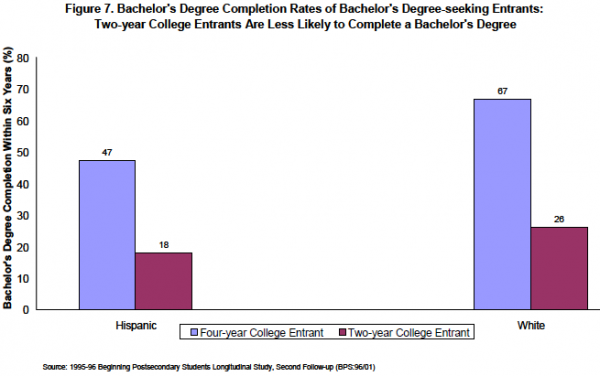
Nonetheless, freshmen starting on two-year college campuses are much less likely to finish a bachelor’s degree than comparable freshmen on four-year campuses. This applies to all youths regardless of race or ethnicity, and this finding appears quite consistently across national post-secondary education data sets. For example, the U.S. Department of Education tracked the educational progress of a nationally representative sample of students that began their post-secondary education in the 1995-96 academic year (NCES, 2002). The most recent follow-up occurred six years after the students had begun post-secondary education. Analysis of this data reveals that almost half of Hispanic undergraduates who sought a bachelor’s degree and began at a four-year college finished a bachelor’s degree within six years (Figure 7). Fewer than one in five of their counterparts who started at a two-year college finished a bachelor’s degree within six years. The importance of post-secondary starting points for bachelor’s degree completion partly reflects the lesser academic preparation of two-year college entrants vis-à-vis four-year college entrants. However, two-year entrants and four-year entrants with similar high school background and college entrance examination scores have markedly different completion rates.7
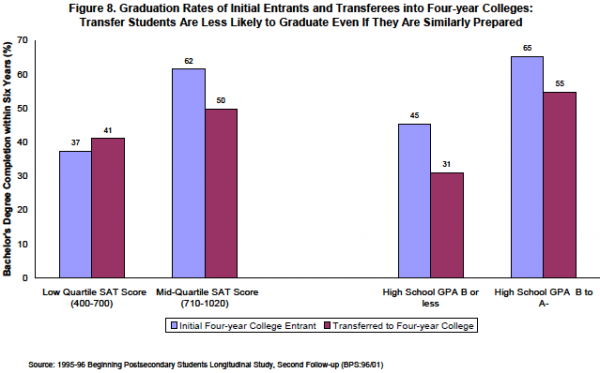
One reason for the relatively low bachelor’s completion rates of two-year students is that many two-year students never get to a four-year college or university. Transfer rates from two-year colleges to four-year colleges are fairly low. Tabulations from the 1995-96 Beginning Post-secondary Students Longitudinal survey referred to above indicate that fewer than 45 percent of Hispanic two-year students seeking a bachelor’s degree transferred to a four-year college within six years of entry. But the uphill climb from a two-year college to a bachelor’s degree does not stop with transferring to a four-year institution. Even two-year students who successfully transfer to a four-year college are less likely to earn a bachelor’s degree than students who start at a four-year college. About 44 percent of transfer students finish a bachelor’s degree within six years.8 This compares with a 63 percent graduation rate among students who begin the quest at a four-year college. As Figure 8 shows, differences in high school background do not fully account for the difference in success.
The recent enrollment changes discussed above suggest mixed progress for Latino youth. On the one hand, the proportion of Hispanics enrolling in four-year institutions increased modestly in six states (the exception is Texas). This should provide a boost to the educational attainment of Latino youths by increasing the fraction who complete a bachelor’s degree. In an absolute sense, these changes are favorable for Latino educational advancement. However, in California, New York, New Jersey and Arizona, an even larger additional fraction of white youths enrolled in four-year colleges. Thus, the educational attainment of white youths is likely to receive a greater boost. In a relative sense, therefore, Latino youths are falling further behind their white counterparts in these states.
V. Conclusions
Though Latino youths have made strides on to four-year college campuses, their white peers have made much bigger strides. In most large states a substantially larger proportion of beginning white full-time freshmen are starting their college education at four-year degree-granting institutions. Hispanics have not kept up and the gap in enrollment at four-year colleges and universities widened in several large states between 1996 and 2001.
At the same time, more Hispanic freshmen enrolled on two-year campuses in most states while white freshman two-year enrollment decreased in five of the seven states.
From 1996 to 2001, Hispanic freshman enrollment at four-year colleges and universities with selective admissions increased in the large states examined. White freshman enrollment at selective institutions also increased. Although Hispanic freshmen are behind whites in enrollment at selective four-year institutions, there is no compelling evidence from the enrollment data that the gap in selective enrollments widened between 1996 and 2001.
Appendix A: Data Source
The post-secondary enrollment tabulations are based on the U.S. Department of Education’s Integrated Post-secondary Education Data System (IPEDS) fall enrollment data (NCES, 2003a). The U.S. Department of Education reports IPEDS enrollment figures in the annual Digest of Education Statistics and it is the only national data set with enrollment figures at the institutional level of detail. The IPEDS is not a sample of institutions, but rather an administrative data collection from the universe of institutions that participate in Title IV federal student financial aid programs. Post-secondary institutions that do not participate in Title IV programs may submit data to the IPEDS. Following NCES practice, we restricted enrollment to post-secondary institutions participating in Title IV. Institutions in outlying areas of the United States are not included.
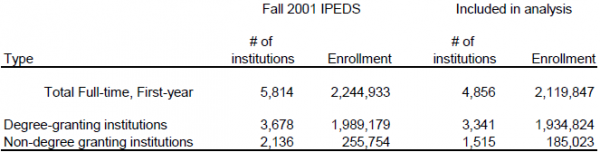
This report’s analyses are based on “line 1” enrollment or enrollment for “full-time, firsttime, first-year degree-seeking undergraduates.” In the fall 2001 enrollment data, 5,814 post-secondary institutions reported enrollment for full-time, first-time, freshmen undergraduates. We do not include all fall 2001 postsecondary institutions reporting line 1 enrollment. 4,856 institutions of the 5,814 institutions also reported line 1 enrollment in the fall 1996, fall 1997 and fall 2000 IPEDS data. The institutions that are not included did not exist in earlier years, did not participate in Title IV programs, or simply did not report line 1 enrollment in all four years. As the following table documents, limiting the analysis to a core set of IPEDS institutions that reported in all four years eliminates about 100,000 full-time, first-time freshmen in fall 2001. Most of the institutions and students are in the non-degree-granting sector:
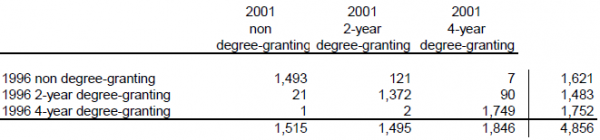
Although we analyze enrollment among a fixed set of 4,856 postsecondary institutions, the status of these institutions may change. The institutional characteristics file of the IPEDS records the degree-granting status, level and control of the institution. It was found that 242 of the 4,856 postsecondary institutions altered their characteristics between 1996 and 2001:
The National Center for Education Statistics has been collecting fall enrollment data since at least 1966 as part of the IPEDS and its predecessor, the Higher Education General Information Survey. In 1996 the NCES changed the reporting universe from higher education institutions as defined by accreditation status to postsecondary institutions participating in Title IV programs (NCES, 1998). Comparable data on fall enrollment are therefore not available before 1996.
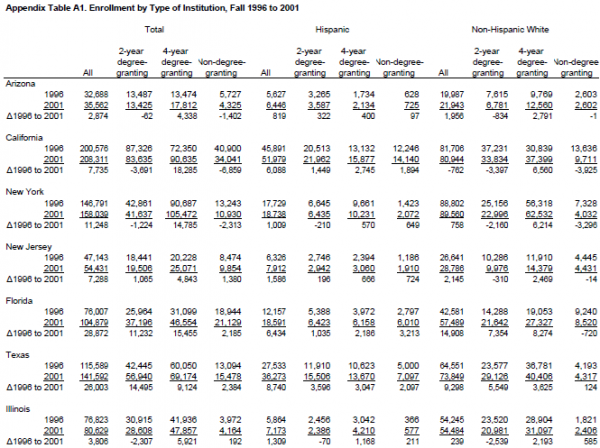
Some of the key findings reported in the text are based on first-time, full-time enrollment by type of institution in California, New York, Arizona, New Jersey, Florida, Texas and Illinois. The table below reports fall 1996 enrollment, fall 2001 enrollment, and the change in enrollment in these states.