A report on the characteristics of high schools attended by different racial and ethnic groups finds that Hispanic teens are more likely than blacks and whites to attend the nation's largest public high schools.
About Pew Research Center
Pew Research Center is a nonpartisan, nonadvocacy fact tank that informs the public about the issues, attitudes and trends shaping the world. It does not take policy positions. The Center conducts public opinion polling, demographic research, computational social science research and other data-driven research. It studies politics and policy; news habits and media; the internet and technology; religion; race and ethnicity; international affairs; social, demographic and economic trends; science; research methodology and data science; and immigration and migration. Pew Research Center is a subsidiary of The Pew Charitable Trusts, its primary funder.
A report on the characteristics of high schools attended by different racial and ethnic groups finds that Hispanic teens are more likely than blacks and whites to attend the nation's largest public high schools.
I. Overview
Most Hispanic students are educated at public high schools that have different characteristics than the public high schools educating white or black students. Hispanic youths are much more likely than white or black youths to attend public high schools that are large, that have a high student-to-teacher ratio, and that have a substantial proportion of students who come from relatively poor families.
The characteristics of high schools matter for student performance. Careful statistical studies have found that schools with larger enrollments are associated with lower student achievement and higher dropout rates. Similarly, research has shown that lower instructional resources as expressed in higher student-to-teacher ratios are also associated with lower school performance. Moreover, the effects of these structural characteristics on achievement appear to be greater in schools with higher concentrations of low socioeconomic status students.
Understanding structural factors such as size, school resources and school processes is important for both policy and research reasons. Much of the research on the achievement gap between Hispanics and whites has focused on the characteristics of the students—factors such as family income, nativity and parents’ level of education and ability to speak English. While all of these factors are important, they do not produce a complete picture. Student characteristics alone do not explain the entire achievement gap. Examining the context of learning—most broadly the characteristics of schools—is also essential. Moreover, educators and educational policymakers have vastly more influence over the characteristics of their schools than the characteristics of their students.
In order to explore the potential role of educational context in student performance, the Pew Hispanic Center tabulated some of the basic characteristics of public high schools of Hispanic students and other students at the national level and state level. This assessment is based on a U.S. Department of Education survey that collects data on every public high school in the country and the students who attend them. The most recent publicly available data are for the 2002-03 school year.
Some of the major findings in this report include:
Latinos are much more likely than whites or blacks to attend the nation’s largest public high schools. Ten percent of public high schools have an enrollment of at least 1,838 students each. More than 56 percent of Hispanics attend these large public high schools, in comparison with 32 percent of blacks and 26 percent of whites.
One quarter of the nation’s public high schools have more than 45 percent of their students eligible for free or reduced-price school lunches. Three hundred of these schools are also among the largest with an enrollment of 1,838 students or more. Almost 25 percent of Hispanic students attend these 300 high schools, in comparison with 8 percent of black students and 1 percent of white students.
Hispanics are more likely to be at high schools with lesser instructional resources. Nearly 37 percent of Hispanics are educated at public high schools with a student/teacher ratio greater than 22 to 1, in comparison with 14 percent of blacks and 13 percent of whites. The average student/teacher ratio in public high schools is 16 to 1 and only 10 percent of schools have more than 22 students for each teacher.
Among students at central city high schools, Hispanic students are nearly twice as likely as black students to be at a high school with more than 1,838 students.
High schools in seven states educate nearly 80 percent of Hispanic youth. These seven states with large Hispanic high school enrollment have larger public high schools, on average, than the rest of the nation.
In the states with large Hispanic high school enrollment, Hispanics are more likely than either whites or blacks to attend large and relatively more disadvantaged high schools. In California, nearly 40 percent of Hispanics attend large, relatively disadvantaged high schools, in comparison with 8 percent of whites and 30 percent of blacks.
II. Introduction
Efforts to improve secondary education increasingly emphasize the size and structure of high schools. The U.S. Secretary of Education is actively promoting the expansion of the standards-based performance measures mandated in the No Child Left Behind Act of 2001 to high schools as well as a discussion of the most effective models of high school reform. In addition to measuring progress and accountability and grappling with staffing and curriculum issues, many school districts are focusing on the size, design and characteristics of their high schools. Many urban school districts are planning to build new, smaller high schools and break up larger high schools into smaller “learning communities” (Harris, 2003). The National Governors Association’s 2004-05 Chairman’s Initiative is titled Redesigning the American High School and it highlights state commitments to “open smaller, personalized high schools” as part of its agenda for reform (National Governors Association, 2005a).1 The U.S. Department of Education, in collaboration with the Council of Great City Schools, included “create smaller learning communities” as an ingredient in all successful urban high schools (U.S. Department of Education, 2000).
The high school reform movement includes prominent endeavors from the non profit sector as well as from governments. The Bill and Melinda Gates Foundation has been an outspoken critic of the current structure of American high schools and a prominent funder of efforts to create what it deems better-quality high schools. The foundation asserts that “It is time to rethink the purpose and structure of the American high school. Today’s large comprehensive high schools are obsolete.” (Bill and Melinda Gates Foundation, undated a). The foundation unambiguously includes the size and structure of high schools at the heart of its high school reform efforts: “We know where to start. We need to redesign large, ineffective schools, create new, small high schools, and replicate proven models.” (Bill and Melinda Gates Foundation, undated b). The foundation has invested over $1 billion to improve education, “including supporting the creation of new, small, high-quality high schools and the conversion of existing low-performing schools into smaller, personalized learning communities.” (Bill and Melinda Gates Foundation, 2005)
Since 1992 the New York City school system has prominently and aggressively opened small and experimental high schools in an attempt to improve secondary education with support from the Bill and Melinda Gates Foundation, the Annenberg Foundation and other philanthropies. The Los Angeles Unified School District is implementing a plan to change its high schools by constructing nontraditional high schools as part of its building program and overhauling existing schools by creating “smaller learning clusters.”
While there has not been a voluminous amount of empirical research on the effects of school characteristics, “research has suggested that small and moderate size high schools foster more positive social and academic environments than large high schools, especially for economically disadvantaged students.” (NCES, 2003a). Careful statistical studies conclude that students in large high schools (especially those with more than 2,100 students) learn less and are more likely to drop out of school.
Associated with the movement toward smaller learning communities is a longstanding concern regarding concentrated poverty in schools. Concentrations of economically disadvantaged students may adversely affect school performance, and the effects of school size may also interact with lower socioeconomic status. There is some evidence that smaller schools are particularly conducive to learning in schools with a higher incidence of student poverty.
This report analyzes the characteristics of the public high schools attended by Hispanic students in comparison with schools attended by white and African American students. The educational outcomes of Latino students, especially high school dropout rates, have been widely monitored,2 but the characteristics of the schools attended by Hispanic teens have received much less attention. For example, the U.S. Department of Education’s summary volume Status and Trends in the Education of Hispanics does not present any information on the characteristics of schools attended by Latinos, omitting their size, the characteristics of teachers or school principals, the guidance counseling and support-staff resources of the school and the instructional expenditures per pupil (NCES, 2003b).
While understanding student characteristics and outcomes is important, school characteristics, including design, processes and organization, are critical as well. Schools and educational policymakers can only directly influence characteristics of the school; student background and behavior are not directly in their purview. Furthermore, the nature of schools is growing increasingly important as the No Child Left Behind mandates hold individual schools accountable for the achievement gains of students. The characteristics of the school are important context for judging how well a school is performing.
Hispanic students tend to attend public high schools with different characteristics than the public high schools attended by white or black students. Hispanics are more likely to attend extremely large high schools. The typical American high school has about 750 students, and the most recent high school enrollment figures indicate that 10 percent of American public high schools have enrollments of 1,838 or more students. More than half of Hispanic public high school students attend the largest 10 percent of high schools in terms of enrollment. Hispanics are not only more likely than whites to attend the largest 10 percent of public high schools, they are almost twice as likely as blacks to attend public high schools with more than 1,838 students. This is in spite of the fact that Hispanic and black public high school students are equally likely to attend schools located in central city areas.
Hispanic teens are more likely than any other racial or ethnic group to attend public high schools that have the dual characteristics of extreme size and poverty (the latter measured in terms of the percent of the student body eligible for free or reduced-price lunches). For example, Hispanics are six times more likely than blacks to attend public high schools that are both greater than 1,838 students in size and have more than 67 percent of the student body eligible for free or reduced-price lunches.3 Hispanics are more than 50 times as likely as whites to go to a public high school with both these characteristics.
The distinct nature of the public high schools attended by Hispanics arises partly from residential patterns. Public high schools tend to differ in their characteristics across states. In particular, the public high schools in the states with the largest Hispanic enrollments are different, on average, than the high schools in the rest of the United States. White and black youths are more evenly distributed across the country and so smaller shares of their total high school populations are in the states where Hispanics are concentrated. The differing geographic concentration of Latino youths across states is, however, only part of the explanation of the national differences in high school characteristics between Latino and white youths. Even when they reside in the same state, Hispanics and whites tend to go to very different kinds of public high schools.
This report is based on the data collected on high schools in the U.S. Department of Education’s Public Elementary/Secondary School Universe Survey of its Common Core of Data (CCD) survey system. The information is based on the entire universe of public high schools, not a sample of high schools. Thus, there are no sampling errors and confidence intervals associated with the analysis. The National Center for Education Statistics (NCES) works actively with state education agencies to minimize inaccurate reporting of the information. The CCD is the only uniformly collected data available on enrollment at individual high schools throughout the entire country. The most recently released data are for the 2002-03 school year.
This report analyzes high schools in the 50 states and the District of Columbia and omits other geographic entities (for example, schools in outlying areas of the United States) included in the CCD (see the Appendix for further details). NCES regularly publishes school enrollment tallies from the Public Elementary/Secondary School Universe Survey in its annual Digest of Education Statistics volume, but the tabulations for high schools and by race and ethnicity are quite limited.
III. National Characteristics of Public High Schools Attended by Hispanic, White and Black Youth
By and large, the nation’s Latino public high school students do not attend the same public high schools that white students or black students attend. The first and most obvious difference is a product of concentration. Taken as a whole, the enrollment at the nation’s 17,500 public high schools is 13% Hispanic. Among them, 4,432 high schools have enrollments that are more than 13% Hispanic, meaning that they are disproportionately Hispanic. These 4,432 public high schools educate over 85 percent of all Hispanic public high school students. Most white and black students do not attend these 4,432 public high schools. Disproportionately Hispanic schools educate 18 percent of the nation’s white youth and 29 percent of the nation’s black youth.
As discussed later in the report, the concentration of Hispanic students in certain high schools follows in part from their patterns of geographic concentration. Most Hispanic students are educated in seven states: California, Texas, Florida, New York, Arizona, Illinois and New Jersey. White and black students are more geographically dispersed across the nation. But even within these seven large Hispanic states, Hispanics largely attend different public high schools than whites and blacks attend.4
The public high schools attended by most Hispanics have some notably different characteristics than the public high schools attended by most whites and most blacks. The majority of Hispanics go to public high schools that have much larger enrollments than the national average in size: schools with 1,838 students or more in comparison with the typical American public high school of 754 students.5 Not only are most Hispanics in large schools, their schools also have relatively high concentrations of disadvantaged students. Furthermore, some measures of the instructional resources at high schools attended by Latinos lag the national average.
Public high schools that are disproportionately Hispanic, on average, are bigger, are more likely to be in the central city, and have more economically disadvantaged student bodies. Table 1 shows the average characteristics of all 17,500 public high schools across the country and the average characteristics of the subset of 4,432 disproportionately Hispanic public high schools. Among all 17,500 public high schools, the average school has 754 students. The average disproportionately Hispanic high school has 941 students. Nearly 21 percent of America’s high schools are in the central city. The high schools serving most Hispanic students are twice as likely to be in the central city. The affluence of a high school’s student body can be gauged by student participation in the free and reduced-price programs of the National School Lunch Act. The average public high school has 32 percent of its students eligible for these lunches. The schools educating most Hispanics, on average, have 41 percent of their students qualifying for the lunch programs. Alternatively, in terms of Title I status, 28 percent of the nation’s public high schools are Title I eligible.6 About 39 percent of disproportionately Hispanic public high schools are Title I eligible. In terms of instructional resources, the typical high school has 16 students per teacher. The high schools educating most Latinos average 18 students per teacher.
In order to know precisely how many students are educated in what kind of school, we need to look at students, not schools. Table 1 looks at schools, so it does not tell us precisely how many Hispanic students are educated in a particular kind of high school. In what follows, we examine students across different kinds of high schools.
Size of High School
Hispanics tend to be educated in very large public high schools. Ten percent of the nation’s public high schools have 1,838 or more students enrolled at the school. About 56 percent of the nation’s Hispanic high school students attend these very large high schools (Figure 1). Fewer than one third of black students and about one quarter of white students attend these large schools. A quarter of public high schools have 1,145 or more students. Nearly 80 percent of Hispanics go to these large schools, compared with 66 percent of black students and 55 percent of white students.
At the other end of the size continuum, half of the nation’s public high schools have 493 students or fewer. Relatively few Hispanics attend them (8.8 percent) and Hispanics are less likely than black (9.0 percent) or white students (15.5 percent) to go to a small high school.
Free or Reduced-Price Lunch Eligibility
About a third of the student body at the average public high school is eligible for free or reduced-price lunch programs. However, 10 percent of high schools have more than two thirds of their students eligible for the lunch programs. Latino students disproportionately attend the high schools that display greater economic disadvantage by this measure (Figure 2). Nearly 19 percent of Hispanic students are in schools with more than 67 percent of their students eligible for the lunch programs, in comparison with only 2 percent of white students. The most disadvantaged quarter of high schools have more than 45 percent of the student body eligible for free or reduced-price lunches. More than 44 percent of Hispanic students attend the most disadvantaged quarter of high schools, compared with only 9 percent of white students.
Title I Eligibility
An alternative proxy for poverty status is Title I eligibility. Federal Title I funds are targeted toward schools with high concentrations of poor students. Among the states that reported Title I eligibility status, there were 4,648 public high schools that were Title I eligible in 2002-03. Nearly 48 percent of Hispanic high school students attended these Title I eligible schools, in comparison with 17 percent of white students and 32 percent of black students.
Large and Relatively Disadvantaged High Schools
The gap between Hispanic and other students is even larger when the focus is shifted to high schools that are both big and that educate high proportions of students from economically disadvantaged families. As shown above, well over half of Hispanic public high school students attend very large high schools with more than 1,838 students. Some of these very large high schools also have relatively less affluent student bodies. Among public high schools with more than 1,838 students, 297 schools have more than 45 percent of their students eligible for free or reduced-price lunches.7 That means there are 297 public high schools that are both extremely large in terms of student enrollment and that have a relatively large proportion of their student body demonstrating economic disadvantage. These 297 schools educate about 750,000 students, or about 6 percent of the nation’s students. One quarter of the nation’s Latino students attend these 297 schools (Figure 3). About 1 percent of the nation’s white students are enrolled in these schools and 8 percent of the nation’s black students attend these schools.
Turning to the large and most disadvantaged high schools in terms of free or reducedprice lunch eligibility, 87 public high schools have more than 1,838 students and more than two thirds of their students eligible for free or reduced-price lunches. These 87 high schools educate 10 percent of the nation’s Latino high school students but only 0.2 percent and 1.7 percent of the nation’s white and black public high school students, respectively.
Community Context
Nearly 50 percent of all Hispanic students attend a high school located in a central city (Figure 4). Fewer than 20 percent of white youths go to central city high schools. Black students are as likely as Hispanic students to attend schools in the central city, but they are not attending the same kinds of central city high schools as Latinos. Latino students in the central city are twice as likely as black central city students to go to very large high schools (schools with 1,838 or more students). A similar pattern appears if we examine Latino and black students who attend schools in urban metropolitan areas outside the central city. Hispanics in this “urban fringe” are more likely to attend very large high schools (58 percent) when compared with blacks attending school in the urban fringe (41 percent).
Student/Teacher Ratio
Associated with the fact that Hispanics tend to go to large high schools is the fact that Hispanics are more likely to be in high schools with higher student-to-teacher ratios.8 Ten percent of U.S. high schools had 22 students or more for every teacher employed in 2002-03. The average school had 16.1 students for every teacher, and half the high schools had fewer than 15.1 students per teacher. Hispanics are much more likely than whites or blacks to attend the schools with the higher numbers of students per teacher (Figure 5).9 About 37 percent of Hispanics attend schools with more than 22 students per teacher, compared with 13 percent of whites and 14 percent of blacks.
Magnet Status
One characteristic that black and Hispanic high school students share is their likelihood of attending a magnet high school.10 Magnet high schools are rare. Fewer than 3 percent of high schools are magnet schools, and the magnet high schools are concentrated in central city areas. Among both black and Hispanic students, an identical 11 percent attend magnet high schools, in comparison with 2 percent of white high school students.
The Concentration of Black Students
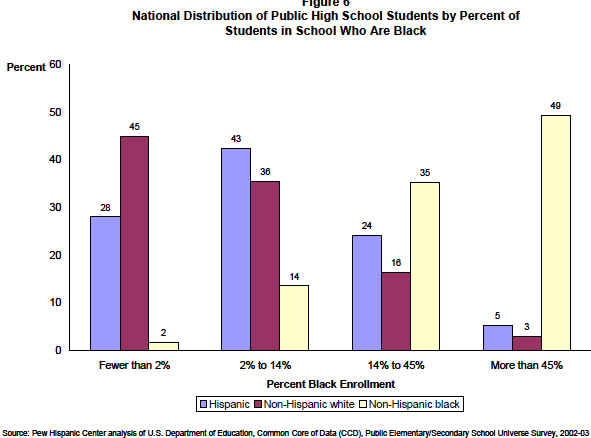
The nation’s African-American students are highly concentrated in a quarter of America’s high schools. Almost 85 percent of black students attend the 4,450 high schools that have more than 14 percent black enrollment (Figure 6). But this quarter of high schools is not the same quarter of high schools that educate the preponderance of Hispanic youth. Fewer than 30 percent of Hispanic students attend these high schools with above-average black enrollment and fewer than 20 percent of white students attend such schools.
Percent Minority
In about 10 percent of the nation’s high schools more than 88 percent of the student body is made up of racial or ethnic minorities. Among Hispanic students, 33 percent attend these densely minority high schools, compared with fewer than 1 percent of white students (Figure 7). One quarter of the nation’s schools have more than 52 percent minority enrollment. Nearly 71 percent of Latinos attend schools with more than 52 percent minority enrollment, compared with 10 percent of white students.
IV. Differences in Public High School Characteristics at the State Level
A second factor underlying why Hispanic youths attend different kinds of high schools at the national level is that Hispanic youths attend differing kinds of high schools at the state level compared to the high schools educating white or black youth. In the seven states with large Hispanic enrollments the public high schools that Latinos attend tend to be larger, to have more economically disadvantaged students and to be located in the central city than the public high schools that whites or blacks attend.11
Size of High School
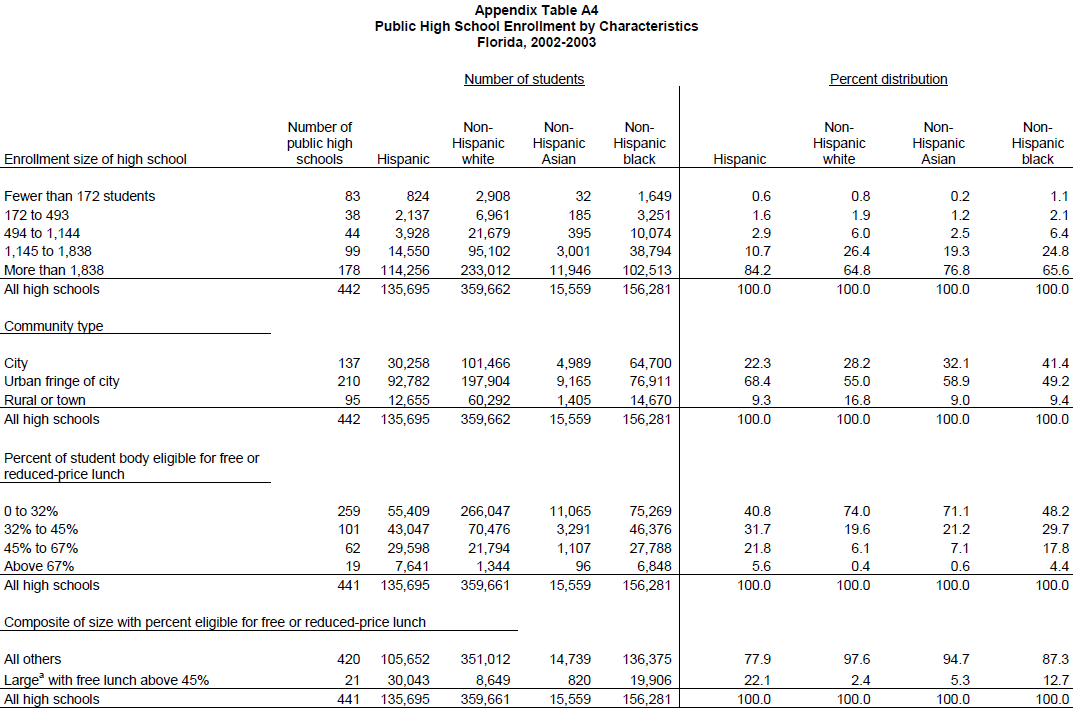
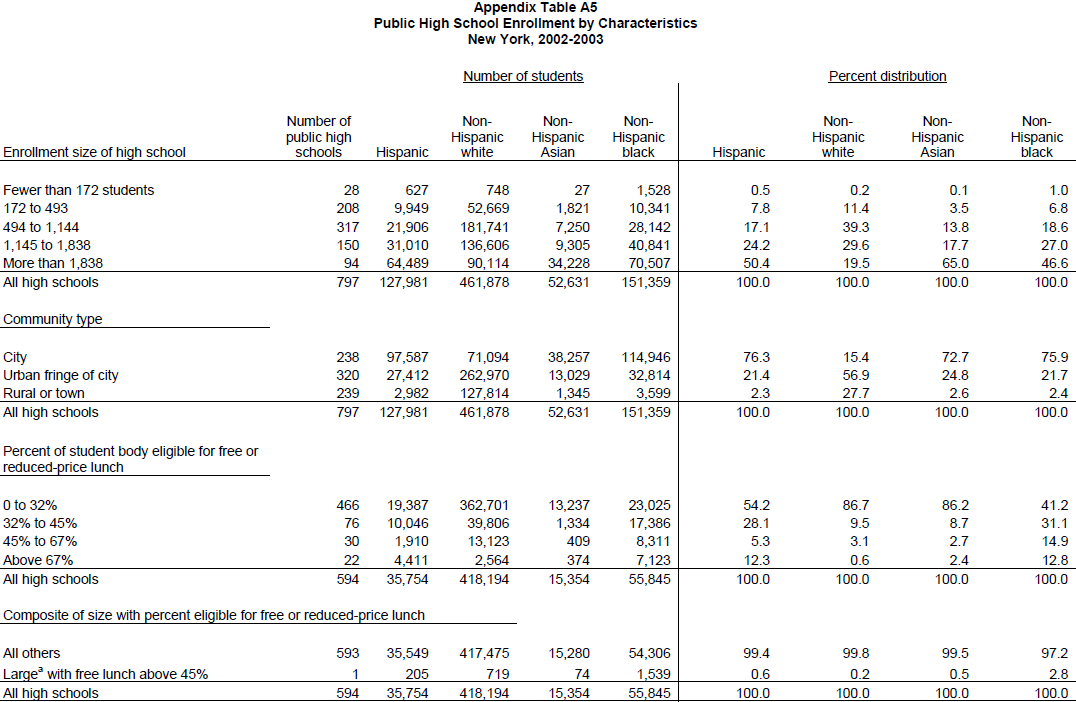
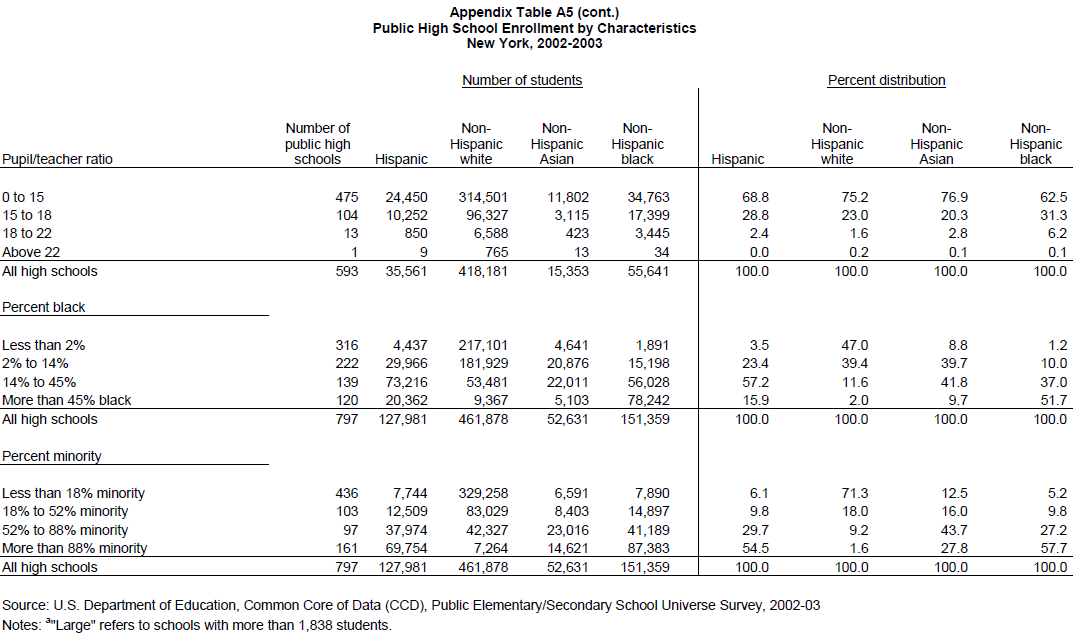
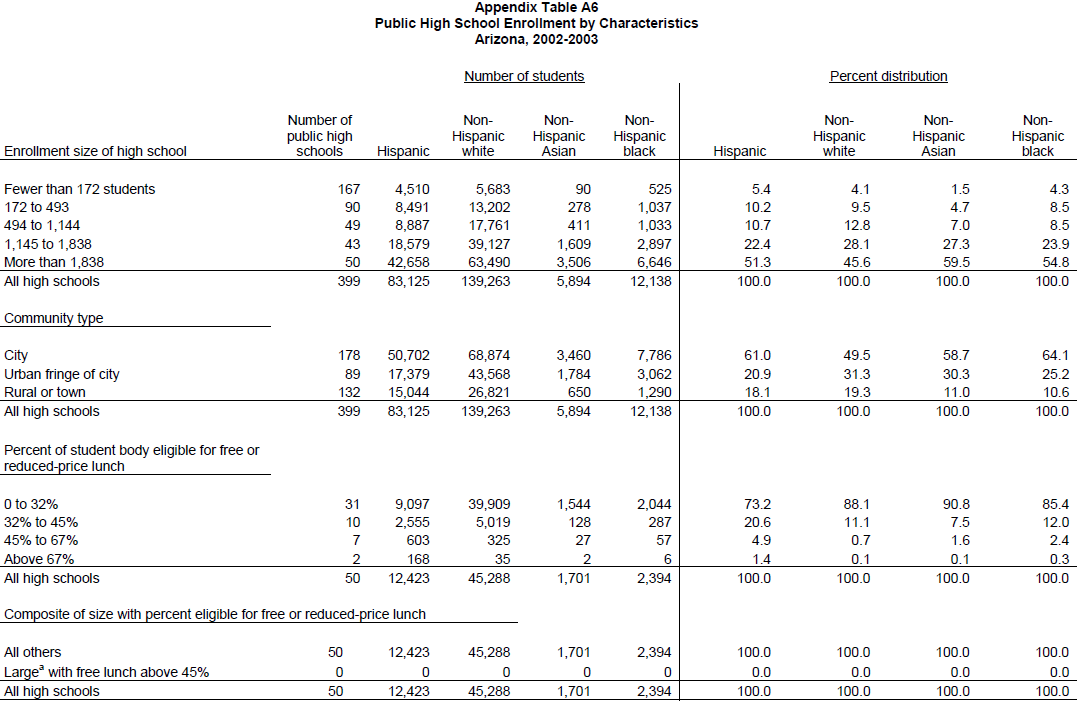
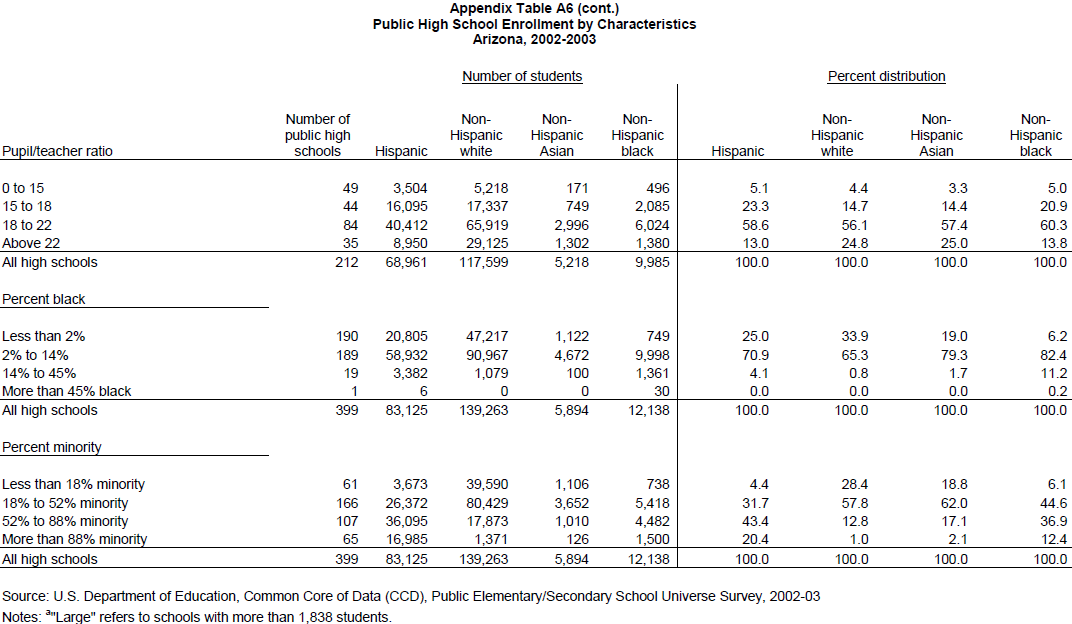
In California, Texas, Florida, New York, Arizona, Illinois and New Jersey, Hispanic public high school students are more likely than their white peers to attend a public high school with more than 1,838 students (Figure 8). Consider, for example, public high schools in Florida. The average public high school in Florida has 1,514 students, so Florida tends to have very large public high schools relative to other states. In Florida, 84 percent of Hispanic public high school students are educated at a school with more than 1,838 students. In Florida, 65 percent of white public high school students are educated at a school with more than 1,838 students. In each of the other six large Hispanic enrollment states, Hispanics are more likely than their white peers to attend a public high school with more than 1,838 students.
So, using Florida as an example, we can understand the twofold reason why Hispanics are in much larger schools than whites nationally. First, in percentage terms more Hispanics (6.7 percent, from Table 2) than whites (4.3 percent) are educated in the state of Florida with its large public high schools on average. That alone would tend to result in Hispanics’ being at larger high schools than whites at the national level. Second, within Florida Hispanics and whites do not attend equally large high schools. Florida Hispanics are more likely than Florida whites to go to the largest public high schools. So there is a second, intrastate effect that reinforces the effects of geographic concentration described above.
Community Context
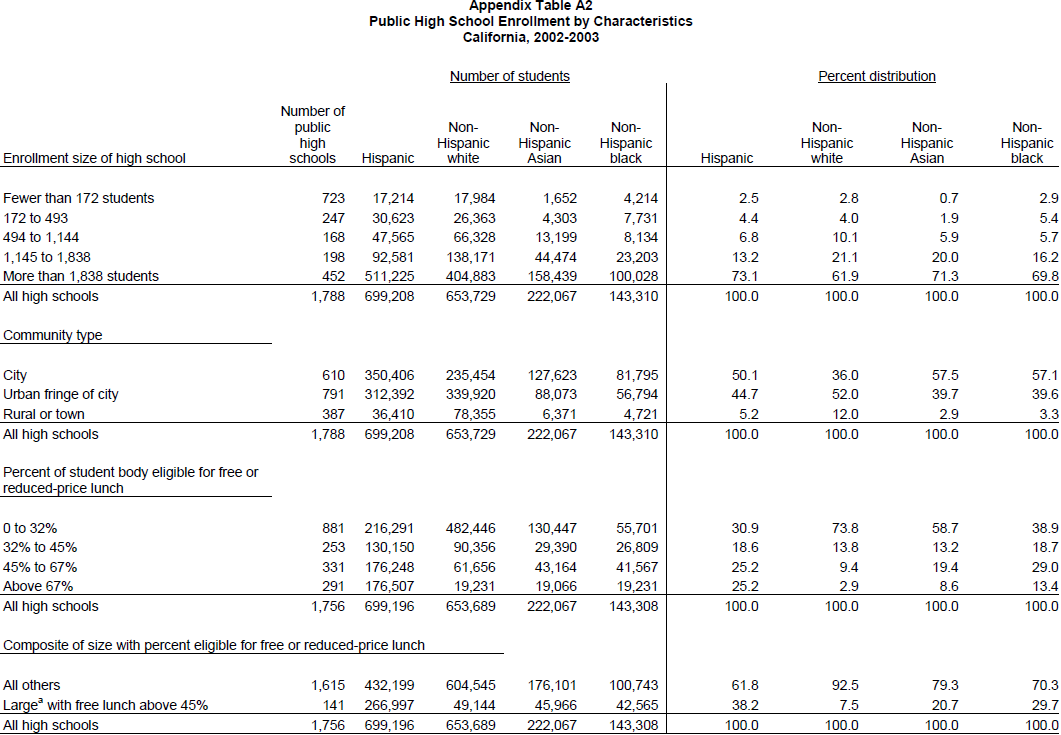
In most of the seven large Hispanic enrollment states, Hispanic public high school students are more likely than white public high school students to be educated at a school in the central city (Figure 9). In California, 50 percent of Hispanic public high school students are educated at schools in the central city, compared with 36 percent of California white students educated at central city schools.
Free or Reduced-Price Lunch Eligibility
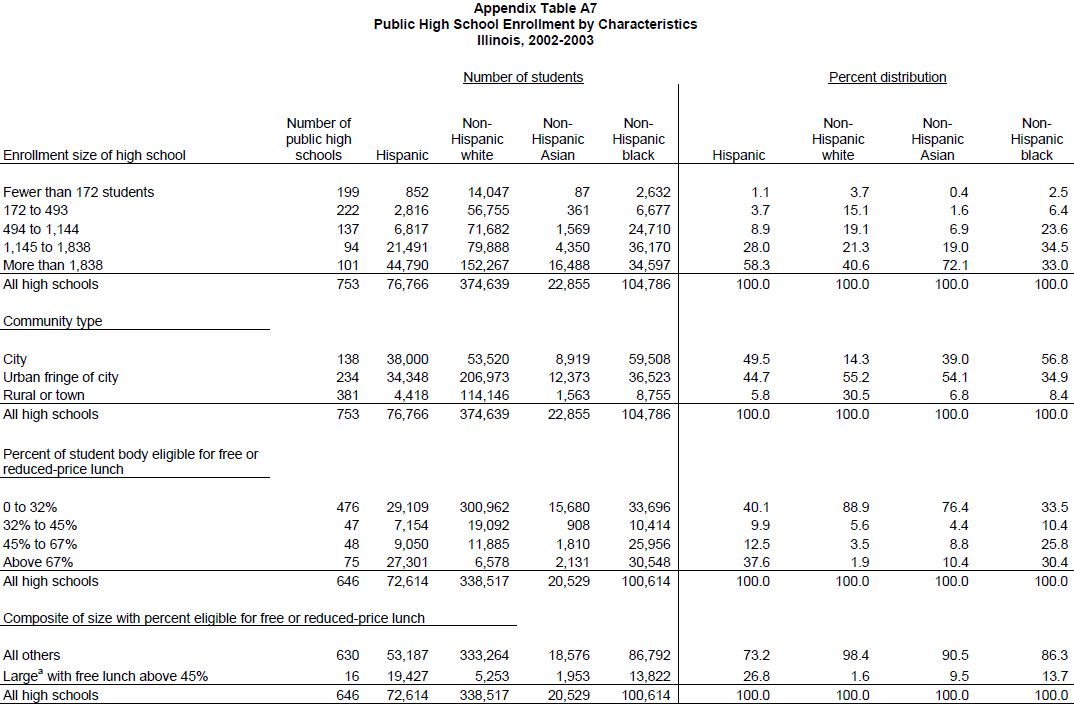
In California, Texas, Florida, Illinois, and New Jersey, Hispanics are much more likely than whites to attend a public high school with a very large percent of its student body qualifying for free or reduced-price lunches (Figure 10). For example, in Illinois 38 percent of Hispanic public high school students are at schools where more than 67 percent of the students are eligible. Among white public high school students in Illinois, only 2 percent attend schools with this level of student-body poverty.
Large and Relatively Disadvantaged High Schools
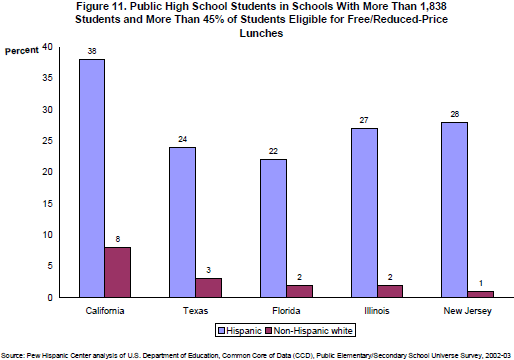
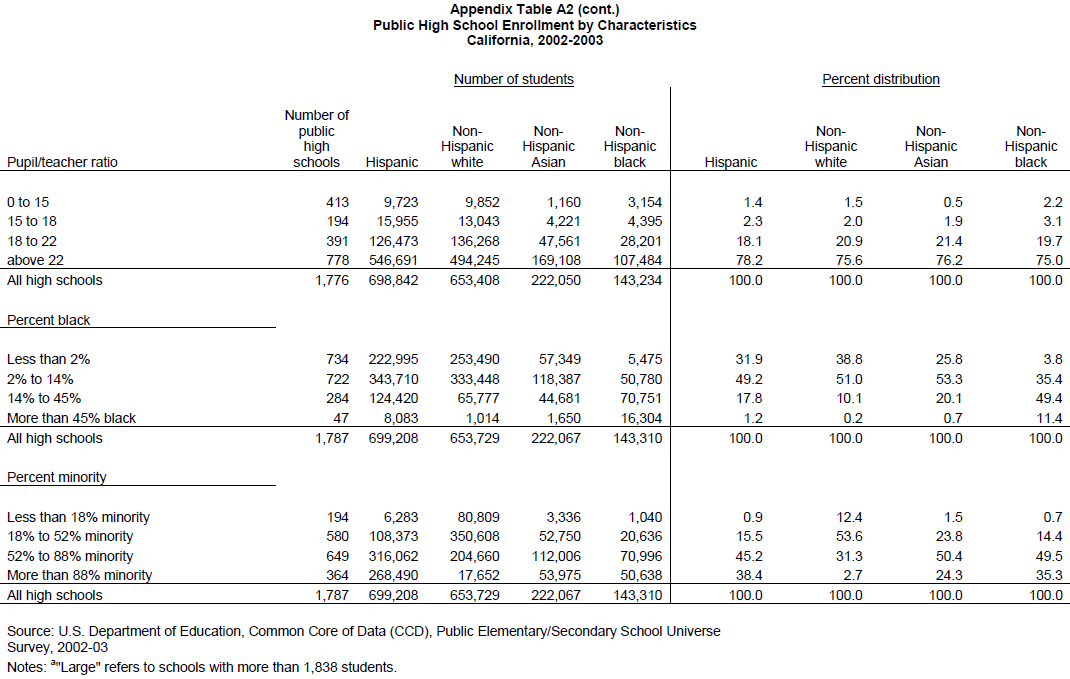
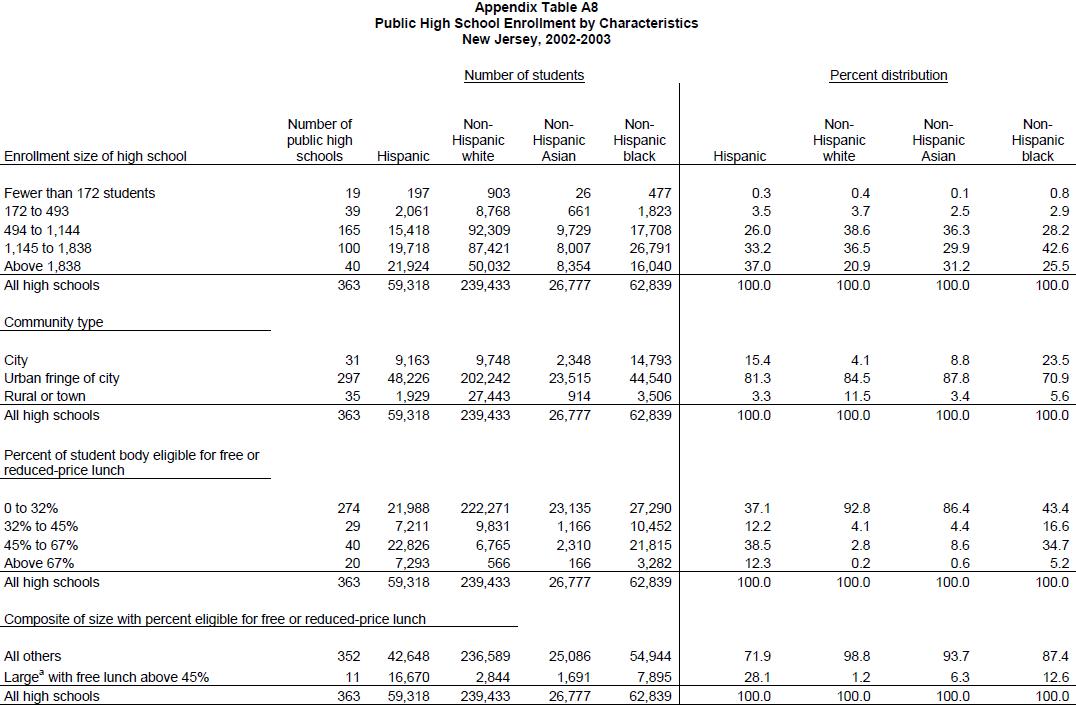
Some large public high schools also have a significant proportion of their student bodies qualifying for free or reduced-price lunches. Figure 11 shows the proportion of Hispanic and white students who are educated at schools with more than 1,838 students and more than 45 percent of students eligible for free or reduced-price lunches. In the five large Hispanic states that provide information on lunch eligibility, Hispanics are much more likely than whites to attend a large high school that has more than 45 percent of students eligible. In California, 38 percent of Hispanics attend a large high school with a relatively disadvantaged student body, compared with 8 percent of whites. Hispanics are also more likely than blacks in California, Texas, Florida, Illinois and New Jersey to attend a public high school with more than 1,838 students and more than 45 percent of the student body qualifying for free or reduced-price lunches.12
Student/Teacher Ratio
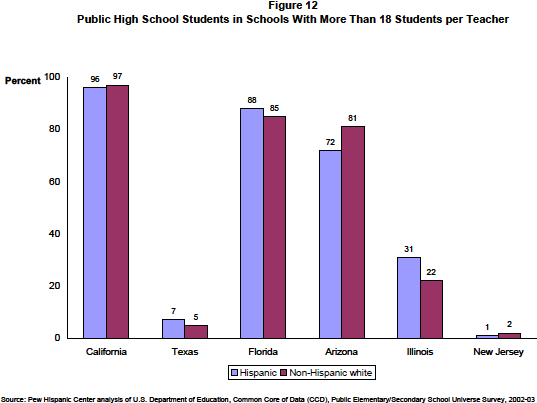
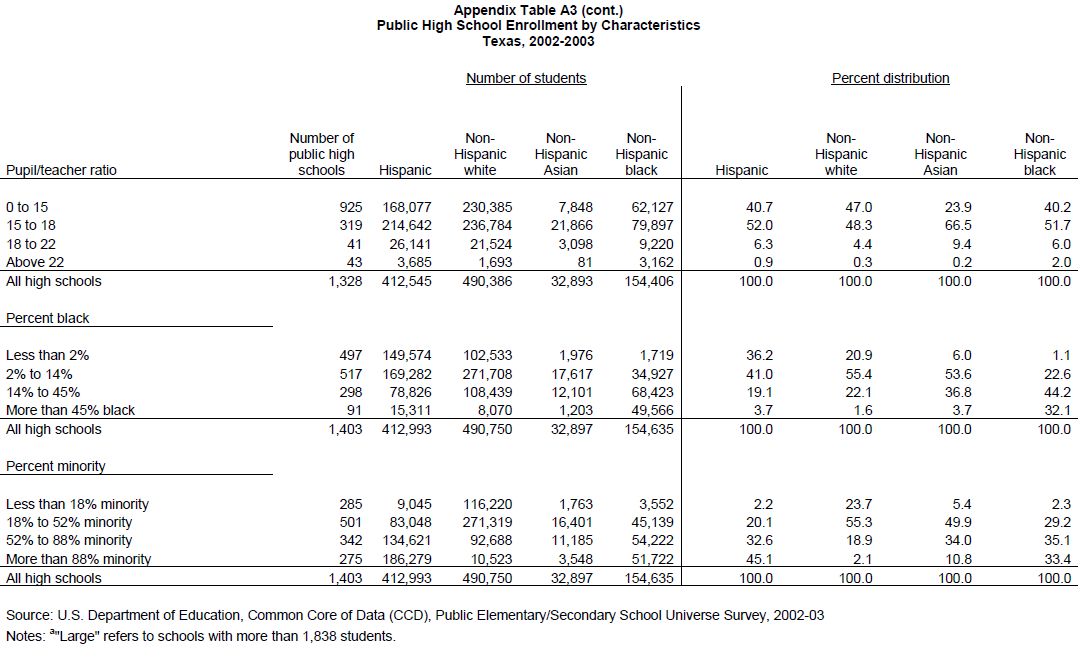
In the states with the largest Hispanic enrollments there are no appreciable differences between Hispanics and whites in high school student-teacher ratios. Figure 12 shows the percentage of Hispanic and white public high school students who attend schools with more than 18 students per teacher. Whites are about as likely as Hispanics to attend such schools. There are no large intrastate differences in student-teacher ratios between Hispanic and white public high school students.
In sum, at least two factors account for the fact that Hispanic public high school students are much more likely than white public high school students to attend schools that are large, located in the central city and possessing student bodies that display a greater concentration of less affluent students and higher student-teacher ratios. One factor is that Hispanic public high school students are geographically concentrated in California, Texas, Florida, New York, Arizona, Illinois, and New Jersey. Reinforcing this is the second factor, which is that within each of these states Hispanics are educated at public high schools that are larger, more likely to be located in the central city, and more likely to have less affluent student bodies than the schools that educate whites.
V. High School Characteristics Matter
Although much of the literature on educational outcomes concentrates on the characteristics of the student, a growing body of research shows that the structure and resources of the high school and school processes matter for student performance. In short, “schools exert a powerful influence on students’ achievement” (Rumberger and Thomas, 2000). In regard to structural characteristics of high schools, most of the debate has focused on the benefits of public versus private control and whether there is a Catholic school advantage.
Size of High School
Recent research suggests that larger high schools are less likely to retain their students, i.e., they have higher dropout rates. On the basis of a nationally representative sample of 190 urban and suburban high schools, Lee and Burkam (2003) find that students in high schools enrolling fewer than 1,500 students more often stay in school. They conclude that “our results demonstrate that school size is quite important and that students in medium-sized schools are the least likely to drop out.”
High school size is also related to student learning. Lee and Smith (1997) examine how students’ test score gains in mathematics and reading during high school are influenced by the size of the high school they attend. They find that the ideal size for a high school in terms of student learning is between 600 and 900 students. Students in high schools with fewer than 600 students learn less; students in larger high schools (especially over 2,100 students) learn considerably less.
Larger schools may lead to lower student achievement, particularly among economically disadvantaged students (Bickel et al., 2001). One reason that students in larger schools may learn less is that larger schools tend to feature more elaborate and differentiated academic curricula. They have more nonacademic offerings, and not all students must complete most of the course sequence to graduate. Curriculum differentiation has negative effects for student learning and size facilitates curriculum differentiation (Lee and Bryk, 1989).
Although teachers’ perception of student behavioral problems is not necessarily related to student performance, teachers in larger high schools are more likely to report that their students have problems. The percentage of teachers reporting that student apathy, tardiness, absenteeism, dropping out, alcohol use, drug abuse and fighting among their students are “serious” problems in their school increases with high school size (NCES, 2003a).
Additional Structural Characteristics of High School
Characteristics other than size also influence student dropout rates. Schools in urban areas and with higher student-teacher ratios have higher dropout rates (Rumberger and Thomas, 2000). An important non-finding is that neither minority concentration nor ethnic concentration appears to be associated with high dropout rates after taking other school characteristics into account (Lee and Burkam, 2003; Rumberger and Thomas, 2000).
VI. Conclusions
In most communities, access to schools is determined by the neighborhood in which a youth resides. Hispanics do not live in the same communities as blacks and whites and do not attend the same high schools. The most recent enrollment data reveal that Hispanics not only attend different schools than other youths, they attend high schools with different structural characteristics as well. The most glaring structural difference is high school size. The average enrollment in the nation’s public high schools is 754 students but the largest 10 percent of schools have enrollment in excess of 1,838 students. Whether in rural areas, suburbs or central cities, Hispanic teens are much more likely than their white or black counterparts to attend high schools with more than 1,838 students.
Some of the size difference reflects the fact that Hispanic high schools students are disproportionately educated in states with large high schools. Even so, within every one of the seven Hispanic states, Hispanic youths are more likely than white youths to go a school with relatively large enrollment, and in six of the states Hispanics are more likely than blacks to go a relatively large school. Thus, the concentration of Hispanic students in seven states with large public high schools is not the sole reason that Hispanics attend larger high schools than their white or black counterparts.
The research literature suggests that in addition to the size of a school’s student body, the economic status of those students is also an important structural characteristic that helps to shape educational outcomes. “Our findings suggest size is much more important for learning in schools with high concentrations of disadvantaged students” (Lee and Smith, 1997). Assuming that eligibility for the school lunch program is an adequate proxy for economic disadvantage, Hispanic youths are much more likely than white or black youths to be educated in a relatively large high school with a high percentage of poor students. Nearly 300 of the nation’s public high schools enroll more than 1,838 students and have more than 45 percent of their student body qualifying for the lunch program. These 300 large high schools with concentrated poverty educate nearly 25 percent of Latinos, but only 8 percent of blacks and 1 percent of whites.
Appendix
The Public Elementary/Secondary School Universe Survey indicates that there were 97,531 public schools in operation in school year 2002-03 in the 50 states and the District of Colombia. Of these public schools, 92,330 schools had students in membership or positive student enrollment. All the tabulations reported herein are limited to high schools that had student membership.
Of the public schools that had membership, about 17,800 are “high schools.” Following U.S. Department of Education definitions, a “high school” is a school that has a lowest grade of enrollment from 7 to 12 and must extend through grade 12 (NCES, 2003c). The analysis in this report is confined to the 17,505 public high schools that reported valid Hispanic and non-Hispanic white student enrollment counts.
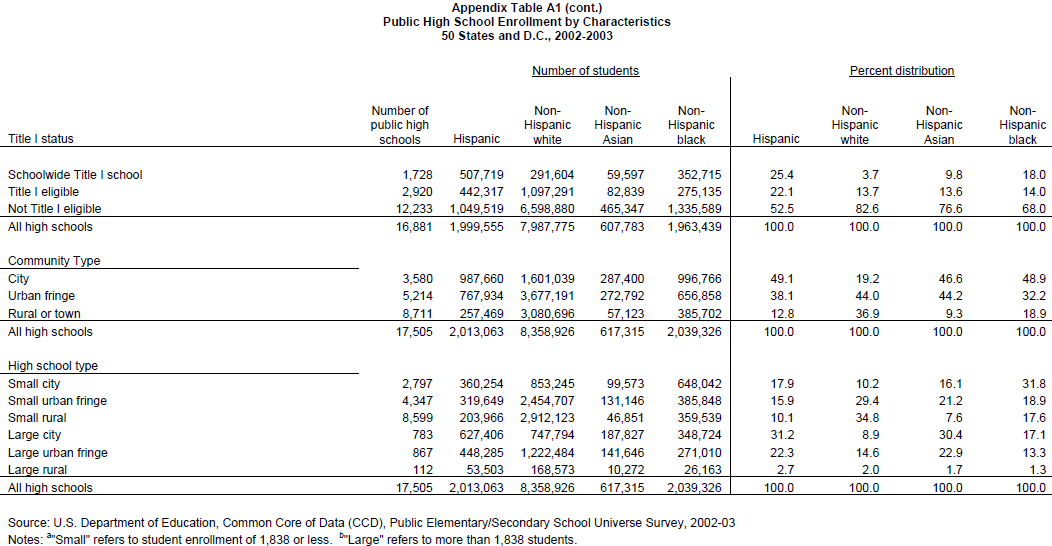
The community type designation is based on the NCES locale code. The CCD specifies eight school locales. This analysis collapsed them to three: city, urban fringe and rural or town. “City” refers to the central city of a Core Based Statistical Area (CBSA) or Consolidated Statistical Area (CSA). “Urban fringe” refers to any incorporated place, Census Designated Place, or nonplace territory within a CBSA or CSA and defined as urban by the U.S. Census Bureau. “Rural or town” refers to any other locale and consists of the CCD designated locales “large town,” “small town,” “rural, outside CBSA,” and “rural, inside CBSA.”
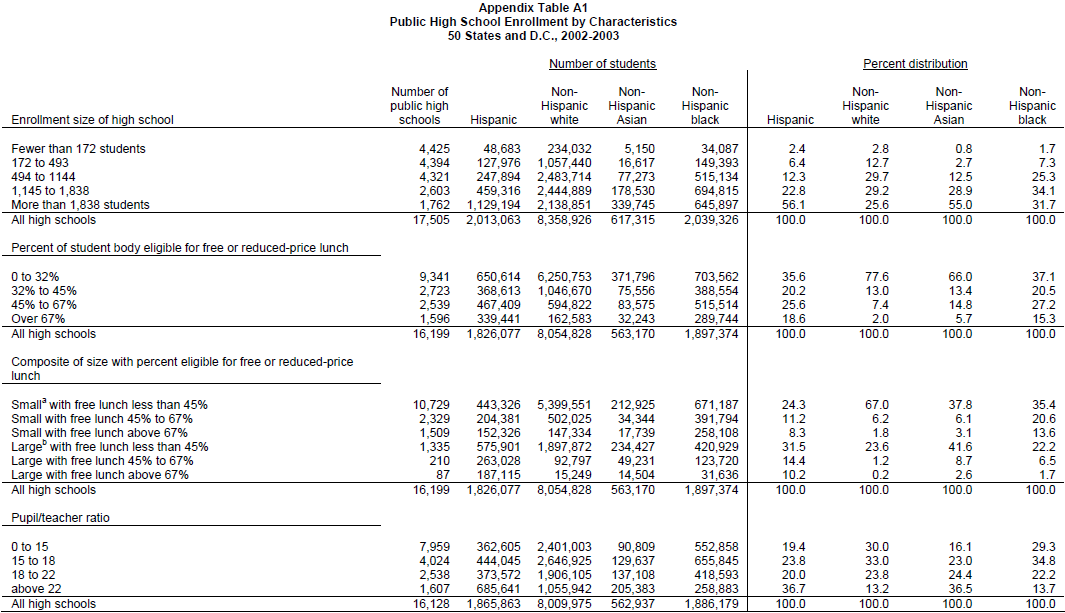
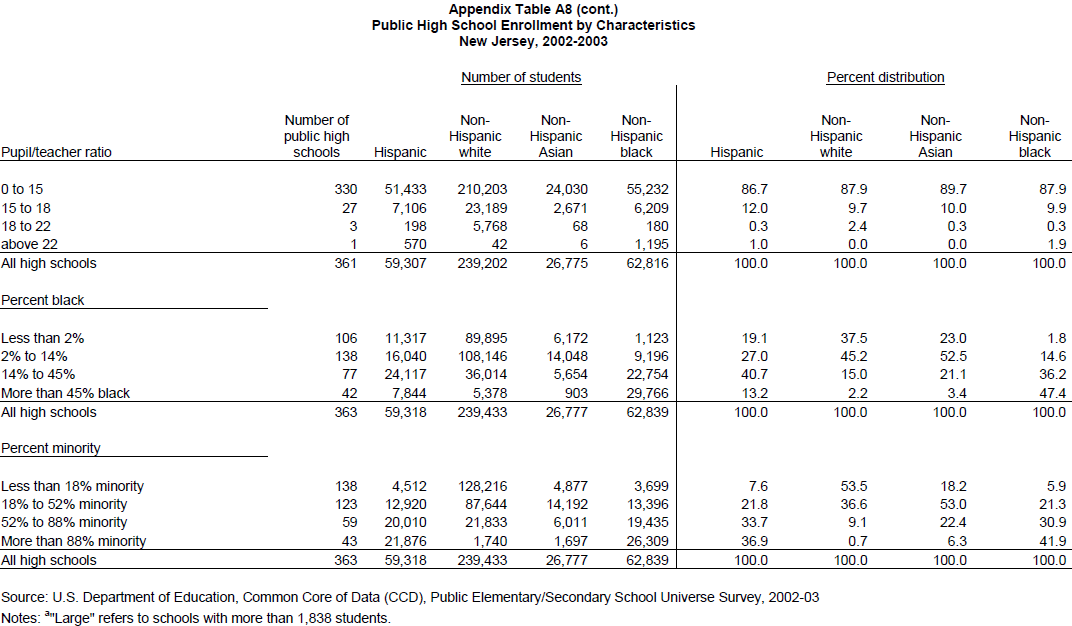
Appendix Table A1 provides the levels of public high school enrollment and the percentage distribution by school characteristics for the 50 states and the District of Colombia. Appendix Tables A2 to A8 provide the enrollment levels and percentage distribution for select school characteristics for the seven major Latino states.
III. Why Hispanics Attend Different Kinds of High Schools: The Role of Geographic Concentration
One explanation for why Hispanic youths attend different kinds of high schools than other youths stems from their geographic concentration in certain states. Hispanics tend to be educated in public high schools in different states than the public high schools that educate whites and blacks. Table 2 reports the distribution of Hispanic, white and black public high schools students in seven states—California, Texas, Florida, New York, Arizona, Illinois and New Jersey—and in the rest of the United States. These seven states have relatively large Hispanic public high school enrollments. Public high schools in these seven states educate almost 80 percent of the nation’s 2 million Hispanic public high school students; high schools in California and Texas alone educate more than 55 percent of them. White and black youths are less likely to be educated at high schools in those states. High schools in the seven states with large Hispanic enrollment educate fewer than one third of the nation’s white and black youths.
Geographic concentration matters because public high schools in the seven large Hispanic states tend to have different characteristics than public high schools in other states. Public high schools in the seven large Hispanic states tend to be larger, have greater concentration of less affluent students and have higher student to teacher ratios than public high schools elsewhere. Because proportionally more Hispanics than whites or blacks are educated in these seven states, there is an automatic tendency for Latino students to be enrolled in large, more disadvantaged schools with greater student to teacher ratios.
Nationally, the average public high school enrolled 754 students in school year 2002-03 (Table 1). Public high schools in the seven states on average enroll more than 754 students (Table 3). Arizona is the only large Hispanic-enrollment state that has public high schools with average enrollment below 754 students (they average 651 students).
Similarly, the type of community in which public high schools are located is fairly uniform within the seven large Hispanic enrollment states. Their public high schools are considerably more likely to be in the central city than is the case for high schools in the other 43 states and the District of Colombia. The percentage of public high schools located in the central city ranges from 18.3 percent in Illinois to 44.6 percent in Arizona (Table 3). Outside the seven large Hispanic states, 16 percent of public high schools are located in central cities.
As for minority enrollment, in each of the seven large Hispanic states public high schools on average have student bodies made up of more minorities than is the case for high schools elsewhere in the United States. Public high schools elsewhere average 23.2 percent minority enrollment among their student bodies. That compares with 57.6% of the student body in California, 49.6% in Texas, 43.2% in Florida, 35.1% in New York, 50.6% in Arizona, 27.2% in Illinois and 36.7% in New Jersey.
So, public high schools in the seven states tend to be larger, are more likely to be located in the central city and have greater minority enrollment on a percentage basis than public high schools elsewhere.
Public high schools in the seven states do not uniformly educate more students who qualify for free or reduced-price lunches. On average, public high schools nationwide have 31.9 percent of their students eligible for this program (Table 1). Public high schools in California and Texas, on average, have 35.7 percent and 38.9 percent student eligibility. Thus, public high schools in these two key Hispanic states tend to have more economically disadvantaged students.
Finally, turning to the student-to-teacher ratio, public high schools in some of the seven large Hispanic states have average ratios that are greater than the national high school average. Nationally, public high schools average 16.1 students per teacher (Table 1). Public high schools in California, Florida and Arizona have an average ratio greater than 16.1 students per teacher (Table 3).