Pew Research Center

FOR RELEASE AUGUST 16, 2005

Attitudes toward Immigrants and Immigration Policy: Surveys among Latinos in the U.S. and in Mexico

A survey of U.S. Latinos shows that views are not unanimous on unauthorized migrants and U.S. policy toward them.

BY Roberto Suro

FOR MEDIA OR OTHER INQUIRIES:

Communications Department
202.419.4372
www.pewresearch.org

RECOMMENDED CITATION

Pew Research Center, August 2005, "Attitudes toward Immigrants and Immigration Policy: Surveys among Latinos in the U.S. and in Mexico"

About Pew Research Center

Pew Research Center is a nonpartisan, nonadvocacy fact tank that informs the public about the issues, attitudes and trends shaping the world. It does not take policy positions. The Center conducts public opinion polling, demographic research, computational social science research and other data-driven research. It studies politics and policy; news habits and media; the internet and technology; religion; race and ethnicity; international affairs; social, demographic and economic trends; science; research methodology and data science; and immigration and migration. Pew Research Center is a subsidiary of The Pew Charitable Trusts, its primary funder.

© Pew Research Center 2026

Table of contents

  • About Pew Research Center
  • Attitudes toward Immigrants and Immigration Policy: Surveys among Latinos in the U.S. and in Mexico
  • II. The Views of U.S. Hispanics
  • III. Attitudes toward Migration in Mexico

Attitudes toward Immigrants and Immigration Policy: Surveys among Latinos in the U.S. and in Mexico

A survey of U.S. Latinos shows that views are not unanimous on unauthorized migrants and U.S. policy toward them.

I. Overview

Although an overwhelming majority of Hispanics expresses positive attitudes toward immigrants, relatively few Hispanics favor increasing the flow of legal immigration from Latin America and a significant minority, concentrated among native-born Latinos, is concerned that unauthorized migrants are hurting the economy. One hotly-debated means to discourage unauthorized migration—laws that deny drivers’ licenses to people who are in the country illegally—draws support from a majority of the native born, according to a survey of the Latino population in the United States conducted by the Pew Hispanic Center (PHC).1

Meanwhile, separate PHC surveys conducted in Mexico show that about four of every ten adults in the Mexican population say they would migrate to the United States if they had the means and opportunity and that two of every ten are inclined to live and work here without legal authorization. The willingness to migrate, even illegally, is evident in all sectors of Mexican society including the middle class and the well-educated as well as those who are poor and who only completed low-levels of schooling.

Several major immigration reform bills were introduced in Congress earlier this summer, and President George W. Bush has said recently that he expects to see action on the topic when he and the Congress return to Washington in September. The various proposals under consideration generally aim to deal with two broad sets of policy challenges: Determining the status of the estimated 11 million persons, most of them Latinos, who currently live in the country without authorization. And, managing future migration flows.

Regarding the unauthorized population already in the United States, the PHC Survey of U.S. Latinos shows greater support among Hispanics for proposals that would offer permanent legal status to unauthorized migrants now in the country than for President Bush’s suggestion to create a temporary worker program. Latino public opinion overall looks favorably on immigrants. For example, clear majorities of U.S. Hispanics in several PHC surveys have said that unauthorized migrants help the economy by providing low cost labor. But these views are neither unanimous nor monolithic. At least a third of the native born consistently complain that the unauthorized hurt the economy by driving down wages. Attitudes among Latinos toward options in immigration policy reflect a variety of views on immigrants and their impact on the country as well as assessments of the specific pros and cons of individual measures.

In terms of future migration flows, the PHC Mexico Survey shows that a large share of the Mexican population would consider participating in a temporary work program. However, the policy challenges may still grow given that the inclination to migrate is evident across a broad swath of the Mexican population.

The Center has conducted extensive and repeated surveys of the U.S. Hispanic population for more than three years and has probed attitudes toward immigrants, immigration and immigration policy options in a variety of ways. A review of those findings, which can be found in Appendix A of this report, shows substantial consistency in these views. When asked to prioritize public policy issues, Latinos do not rank immigration as highly as education, health care or jobs. On the flow of legal immigrants from Latin America, more Hispanics want to see the numbers either kept as they are or reduced than favor an increased flow. On this question and others, nativeborn Latinos are less enthusiastic about immigration than the foreign born. Roughly speaking, between a fifth and a third of native-born Hispanics offer negative responses to various questions about immigrants, particularly the undocumented, or on policies that would help the unauthorized acquire legal status. These sentiments are generally strongest among the middleaged and the middle class in the native-born Latino population.

The PHC Survey of U.S. Latinos, June 2005 was conducted by telephone among a nationally representative sample of 1,001 Latino respondents from June 14 to June 27. The survey has a margin of error of 3.1% for the full sample.

Major findings include:

  • An overwhelming majority of Latinos (80%) say that immigrants today strengthen the United States because of their hard work and talents while only a small share (14%) say they are a burden because they take jobs, housing and health care. The breadth of this positive assessment differs according to respondents’ nativity. The foreign born are nearly unanimous (89% vs. 5%) in taking a positive view of immigrants while the native born are somewhat more divided (65% vs. 28%).
  • Asked specifically about undocumented or illegal migrants, most Latinos (68%) say they help the economy by providing low-cost labor rather than hurt the economy by driving wages down (23%). The foreign born are again more positive (76% vs. 15%) than the native born (55% vs. 34%).
  • Hispanics are divided in their views of laws that deny drivers’ licenses to unauthorized migrants with 41% saying they approve of measures that prohibit licenses to anyone who is here illegally or without authorization while 55% disapprove. Among the native born 60% approve of such laws while 29% disapprove. The foreign born split the other way with 29% approving and 66% disapproving. A slight majority (53%) of Latino registered voters said they approve of such measures.
  • Most Hispanics think that the number of legal immigrants coming to the United States from Latin America should stay the same (43%) or be reduced (13%). A little less than a third (31%) believe the number should be increased.
  • A slight majority (56%) of Hispanics favors proposals to create a temporary worker program that would allow currently illegal migrants to live and work in the United States legally for a number of years before obliging them to return home. A much larger majority (84%) favors proposals that would give unauthorized migrants permanent legal status here and eventually allow them to become U.S. citizens.

In order to probe the views of potential migrants in Mexico, the nation that is by far the largest single source of new arrivals to the United States, the Center conducted surveys of nationally representative samples of the Mexican population in February and May of this year. Both surveys had samples of 1,200 adults who were interviewed in their homes and both had a 3% margin of error. Identical questions on migration were asked in both surveys and produced similar results.

Major findings include:

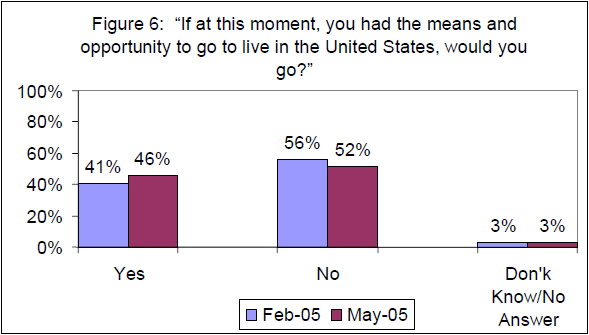
  • Asked whether they would go live in the United States if they had the means and opportunity, 41% responded positively in the February survey and 46% in the May survey.
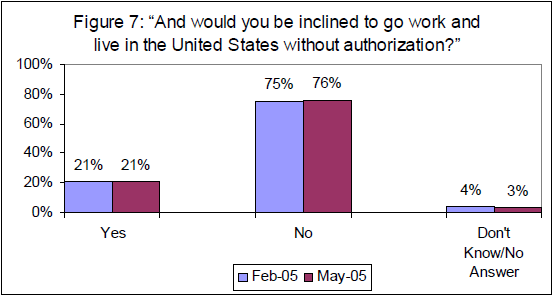
  • A fifth of Mexican adults (21% in both surveys) said they would be inclined to go live and work in the United States without authorization.
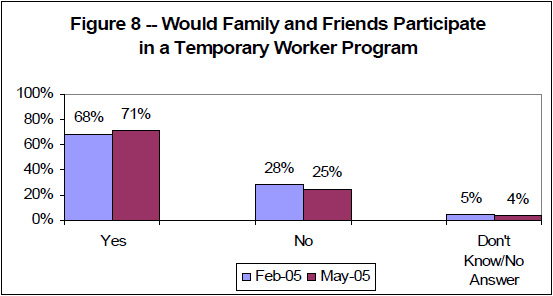
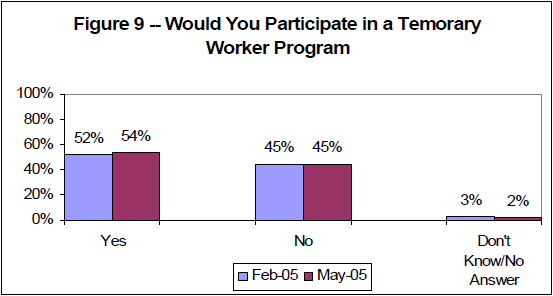
  • A majority of Mexicans (52% in February and 54% in May) say they would be inclined to go to the United States through a temporary worker program that would require them to return to Mexico in some years and even greater majorities (68% in February and 71% in May) said their relatives and friends would be interested in participating.
  • The propensity to migrate is evident in all sectors of Mexican society although it is somewhat higher among males, young adults and people with relatives already in the United States. It is by no means restricted to either the poor or the less educated. For example, more than a third (35%) of Mexican college graduates said they would go to the United States if they had the means and the opportunity and more than one in eight (13%) said they were inclined to do so without authorization.

The Pew Hispanic Center is a nonpartisan research organization supported by The Pew Charitable Trusts. Its mission is to improve understanding of the U.S. Hispanic population and to chronicle Latinos’ growing impact on the entire nation. The Center does not advocate for or take positions on policy issues. It is a project of the Pew Research Center, a nonpartisan “fact tank” in Washington, DC that provides information on the issues, attitudes and trends shaping America and the world.

II. The Views of U.S. Hispanics

Since December 2002 the Pew Hispanic Center has conducted or collaborated on four surveys of the Latino population in the United States that have asked questions about immigration, immigrants and immigration policy. An earlier survey conducted by The Washington Post in partnership with the Kaiser Family Foundation and Harvard University in October 1999 adds further depth to this series. All of the surveys were conducted by telephone in both Spanish and English using Random Digit Dialing (RDD) methodology. Fieldwork for all of the surveys was conducted by International Communications Research (ICR) of Media, PA. The results of responses to immigration-related questions from all these surveys can be found in Appendix A of this report.

The most recent of these surveys was conducted as part of ICR’s Hispanic EXCEL series of monthly omnibus surveys from June 14 to June 27, 2005 with a nationally representative sample of 1,001 Latino adults. The survey has a margin of error of +/-3.1% for the full sample. For the native born (n=320) the margin of error is +/-5.48% and for the foreign born (n=679) it is +/- 3.76%.

As with many other issues, views on immigration matters are not uniform across the entire Hispanic population, and the most consistent and significant differences arise in contrasting the attitudes of Latinos born in the United States with those born outside the country. These differences are especially significant regarding policy matters because the native born make up a much larger share of the registered voters than of the total Hispanic adult population. According to the November 2004 Current Population Survey (CPS), which is conducted by the Census Bureau, the native born made up 44% of the total Hispanic adult population and 74% of Latino registered voters. In the current PHC survey 37% of all respondents were native born and 79% of registered voters.2

Immigration Policy as a Priority

Immigration is not a top concern for Latinos, even the foreign born. The most recent PHC survey posed a series of issues to respondents and asked them whether each was important to the Hispanic community. Education, the economy and jobs and health care ranked as the matters of highest importance and immigration lagged significantly behind (See Table 1). In this series of questions there was little difference in the responses of the native and foreign born. On immigration, for example, 75% of the native born said it was “extremely” or “very” important compared to 80% of the foreign born. Less than a third of the native born (31%) and of the foreign born (32%) said that immigration was an “extremely important” concern for the Latino community. In contrast, education was rated as “extremely important” by 52% of the native born and 45% of the foreign born.

The prioritization of issues by Hispanics in the current survey was virtually identical to that in responses to a similar question asked in the 2004 National Survey of Latinos: Politics and Civic Engagement which was conducted by the Center in collaboration with the Kaiser Family Foundation. That survey, released in July 2004, asked the question in the context of the presidential campaign then underway. Then, as now, education, jobs and health care far outpaced immigration for all Latinos as issues of importance.

Attitudes Toward Immigrants

Latinos have an overwhelmingly favorable attitude toward immigrants, and their views are much more positive than those of the general population. The current survey asked respondents to choose between two starkly different statements characterizing immigrants, and 80% picked the favorable option (See Table 2). In contrast, a survey conducted in December 2004 by the Pew Research Center for the People and the Press, which like the PHC is a project of the Pew Research Center, asked the same question of a sample representative of the entire U.S. adult population and 45% picked the favorable statement. In this regard, the views of native-born Latinos are less positive (65% chose the favorable statement) than those of the foreign born (89%).

When asked about illegal or undocumented migrants, a clear majority of Latinos expresses a positive view although by a significantly smaller margin, and again the attitudes of the native born and the foreign born diverge. In response to a question about the economic impact of unauthorized migration, 68% of Latinos in the current survey said that illegal or undocumented migrants help the economy by providing low cost labor while 23% said that they hurt the economy by driving wages down (See Table 3).

Views were more narrowly split among native-born Latinos (55% help vs. 34% hurt) than among the foreign born (76% vs. 15%). The highest shares of negative views were among those of advanced middle aged and the higher income ranges of the middle class (See Figures 1 and 2). Among Latino registered voters, 62% said unauthorized migrants help the economy while 29% said they hurt. The Center has asked this question in four surveys since 2002, and the pattern of the responses has been similar.

Policy on Legal Immigrants

Less than a third (31%) of Latinos think that the United States should increase the number of legal immigrants from Latin America while a majority says that the flow should be kept the same (43%) or reduced (13%) (See Table 4). The differences between the native and foreign born are small on this score, and similar questions in past surveys have produced similar results.

Policy on Unauthorized Migrants

Earlier this year Congress passed and the President signed the REAL ID Act which in effect requires states to verify that an applicant is a U.S. citizen or a legal immigrant before granting them a driver’s license. Since the terrorists attacks of September 11, 2001 all states have considered similar legislation. Currently, 11 states do not require proof of lawful presence in the United States, according to the National Immigration Law Center.

Latinos are more closely split on drivers’ licenses laws than on any other major aspect of immigration policy, and the differences by nativity are the most substantial. While 41% of all Latinos say they approve of such laws, 55% say they disapprove. Among the native born 60% approve and 36% disapprove. The balance of opinion goes the other way among the foreign born with 29% approving and 66% disapproving (See Table 5). Given the predominance of native-born Latinos among the Latino registered voter population, it is not surprising that 53% of Latino registered voters approve of the restrictions while 43% disapprove. Attitudes also vary significantly by age and income (See Figures 3 and 4). In addition, this issue produces a rare difference by gender with 45% of males approving of the laws compared to 36% of females.

Two major options have developed in Congress for dealing with the unauthorized population now living in the United States. One would create means for illegal migrants to gain legal status, remain in the country permanently and eventually become U.S. citizens. The other, following the preferences outlined by President George W. Bush in January, 2004 would allow the unauthorized to remain in the country legally as temporary workers for several years on the condition that they eventually return to their home countries. Both proposals draw support from a majority of Latinos but approval of permanent legal status (84%) is much higher than for a temporary worker program (56%) (See Tables 6 and 7). Virtually the same responses were given when Latinos were asked about these options last year.

Attitudes Toward Immigrants and Views on Policy Options

PHC surveys have examined Latino views on four aspects of immigration policy: the size of legal immigration flows, legalization programs, temporary worker programs and driver’s license restrictions. In each case attitudes towards immigration and immigrants appear to be an important but not determinative factor. Views among the native born and the foreign born often differ significantly. But, for both groups, assessments of policy options appear to involve more than their underlying views as to whether immigrants are a positive or a negative factor in American life. These findings clearly indicate that in a policy debate Latinos will not automatically or unanimously adopt what might be commonly perceived as the pro-immigrant position. The survey data also suggest that the distribution of views on a policy proposal among Latinos will be shaped by the proposal’s merits, the persuasiveness of advocates for and against, as well as other factors in addition to Latinos’ general attitudes towards migration.

Data from PHC surveys taken over the last three years shows that a significant minority of Latinos, especially among the native born, expresses unease and even displeasure with current flows of migration. These sentiments, however, do not automatically translate into support for measures to reduce those flows. Nonetheless, on one of the most controversial and wellpublicized policy developments of the past few years—federal and state laws to prevent unauthorized migrants from acquiring drivers’ licenses, native-born Hispanics decisively break ranks with the foreign born to support the restrictions. Because the native born are three times more numerous among Latino registered voters, the views of this concerned minority could have an impact on future policy debates.

To reiterate the findings noted above, here are some of the major indicators of the size of this minority and the nature of its concerns from PHC’s most recent survey of U.S. Hispanics:

  • 28% of the native born think that immigrants are a burden on the country rather than strengthen it versus 5% of the foreign born.
  • 34% of the native born think that illegal or undocumented migrants hurt the economy rather than help it versus 15% of the foreign born.
  • 16% of the native born favor reducing the number of legal immigrants coming from Latin America versus 12% of the foreign born.
  • 15% of the native born oppose programs that would offer unauthorized migrants a path to legal permanent residence versus 4% of the foreign born.
  • 60% of the native born support laws that prohibit the unauthorized from getting drivers’ licenses versus 29% of the foreign born.

Native-born and foreign-born Latinos take contrasting views on a variety of issues like abortion and the war in Iraq, but immigration might be expected to produce more uniform attitudes.3 After all, many, perhaps most, native-born Latinos have family memories of a migrant ancestor and expressions of Hispanic identities often relate to migration. Indeed, a majority of native born Latinos consistently expresses favorable views of migrants, but a significant minority does not, particularly when it comes to the unauthorized. In repeated surveys, more than a third of the native born has said that illegal migrants hurt the U.S. economy by driving wages down, more than twice the share of the foreign born (See Figure 5).

How do such views translate into attitudes on policy options? A clear majority of Latinos— though by a much greater margin among the foreign born—say that immigrants are a source of strength for the nation rather than a burden (See Table 2 above). However, less than a third of all Latinos in the most recent survey (31%) say that the number of legal immigrants from Latin America should be increased, and on this score the difference between the native born (28%) and the foreign born (33%) is not statistically significant (See Table 4 above). Thus, it appears that even among the foreign born, largely positive views of immigrants do not automatically translate into support for more generous immigration policies. The share of Latinos favoring increased legal immigration from Latin America is less than half the percentage that says that immigrants strengthen the country.

Some of the same ambivalence is evident on the negative side as well: Unfavorable views of unauthorized immigrants do not produce the same level of opposition to generous immigration policies. While 34% of the native born say that unauthorized migrants hurt the economy, only 15% oppose proposals that would grant those migrants legal permanent residence and eventual citizenship in the United States. Views on temporary workers programs are more difficult to assess in this context. Many Latino leaders, native and foreign born alike, have expressed disapproval of the idea because they consider it unworkable, unjust or insufficient. Other opponents of temporary programs take the opposite tack and prefer measures to push the unauthorized out of the country altogether. Thus those who publicly disapprove of temporary worker programs include both people who take positive views of migrants as well as those with negative views. It seems reasonable to assume that the same mix is evident to some extent in survey responses among Latinos.

This year’s debate over restrictions on drivers’ licenses appears to have struck a somewhat different chord. Proponents of the restrictions argued that requiring proof of citizenship or legal immigration status before granting a license is an important anti-terrorism measure and some see another benefit in discouraging illegal migration. Many pro-immigration and Latino advocates argued that the restrictions were unfair to migrants and ineffective as a security measure. Among both the foreign born and the native born roughly twice as many Latinos supported the restriction as said that the unauthorized hurt the economy.

III. Attitudes toward Migration in Mexico

More migrants come to the United States from Mexico than from any other country, and Mexicans comprise 30% of the total foreign born population and 58% of the Latino foreign born. In order to explore views among Mexicans who are not now migrants, the Center has been conducting a series of monthly surveys in Mexico on topics related to migration since the beginning of 2005. This is the first report on those surveys. The data for each survey was collected through household interviews of adults conducted in 120 locations across the country. The interview sites were chosen through a well-established process designed to produce a nationally representative sample. A sample of 1,200 people was interviewed for each of the two surveys cited here, and the results for the total population have a margin of error of plus or minus 3%. All of the fieldwork was conducted by Consulta Mitofsky, a public opinion polling and social science research firm headquartered in Aguascalientes and Mexico City, as part of its monthly omnibus survey of the Mexican population, the Ómnibus Mensual ABC. Findings are presented here from two surveys. The first was conducted from February 11 to 19, 2005 and the second was conducted from May 13 to 17, 2005. The same questions were asked on each survey, and both were conducted with the same methodology. But, they are two separate polls with entirely different samples.

The Inclination to Migrate

[Si en estos momentos usted tuviera la manera y la oportunidad de irse a vivir a los Estados Unidos, ¿usted se iría?]

An estimated 10 million adult Mexicans now live in the United States and somewhat more than half lack authorization. In other words, about one of every eight adults born in Mexico now lives in the United States. In the PHC surveys, 46% of Mexican adults in February and 37% in May said they have a relative living or working in the United States. Those Mexicans who have already migrated serve as a draw for future migration. Respondents with family members here were more likely to say they would migrate if they could (52% in February and 54% in May) than those who do not have relatives in the United States (33% and 40%).

The willingness to migrate is higher among men than women and among the young than the old. This sentiment is distributed almost evenly across income ranges, and significant shares of well-educated Mexicans and those who live well beyond poverty also say they would come here if they could (See Table 8). These findings suggest that simple economic or social status alone is not the primary determinant of whether an individual is willing to consider migration. Rather, this survey data reinforces a substantial body of research literature which shows that the decision to migrate is influenced by the workings of family networks, perceptions of relative economic opportunity and other factors aside from socio-economic status.

Differences in the willingness to migrate according to respondents’ levels of education suggest the effects of economic expectations as opposed to absolute poverty. Mexicans with the lowest levels of education—primary school or less—are not necessarily the most likely to migrate. As a result of improvements in Mexico’s public education system in recent decades, adults who never got beyond a primary education are now concentrated among the middle aged and the elderly. Migration is most typically an activity of young adults who in Mexico are better educated than their elders on average. As a result, the educational profile of Mexican migrants to the United States has been improving over the past 40 years or so.

The survey data suggest that Mexico’s improvements in education have not stemmed the inclination to migrate so much as shifted up from those with barely a primary education—typical in the mid-20th century—to persons with some secondary education and even the college educated. The disposition to migrate is highest among those who have completed secundaria, a lower form of secondary education that often focuses on vocational training and does not qualify a student for bachelor’s-level college studies. The next highest educational category in willingness to migrate is Mexicans who completed preparatoria, which is the equivalent of a U.S. college-prep high school education. These individuals have benefited from improvements in the Mexican educational system, but their willingness to migrate in large numbers suggests that they have not yet benefited from an expansion of economic opportunities commensurate to their skills.

The PHC Mexico Surveys also show that the willingness to migrate is widely felt in the most accomplished sectors of Mexican society. For example, 35% of those with at least a college education and 45% of those earning at least seven times the minimum wage said they were prepared to migrate. The same holds true when Mexicans are asked whether they are inclined to migrate illegally. More than one-eighth (13%) of those with at least a college degree and more than a fifth (22%) of those earning at least seven times the minimum wage said they would come without authorization.

Temporary Worker Programs

[Pensando en sus parientes y amigos, ¿ cree usted que les interesaría irse legalmente a trabajar en los Estados Unidos mediante un programa de trabajo temporal a condición de regresar al cabo de algunos años?]