
Charting Congress on Social Media in the 2016 and 2020 Elections
The 2020 election featured dramatic increases in lawmaker posts and audience engagement, but less overlap in the sources shared by members of each party
This report examines how lawmakers used social media in the months surrounding the 2016 and 2020 elections. To conduct this analysis, Pew Research Center collected every Facebook post and tweet created by every voting member of Congress between Sept. 8-Dec. 8, 2016, and Sept. 3-Dec. 3, 2020. The analysis includes official, campaign and personal accounts. The resulting dataset contains nearly 166,000 Facebook posts from 1,408 congressional Facebook accounts and more than 357,000 tweets from 1,438 congressional Twitter accounts. These steps are described in greater detail in the methodology .
The 2020 election occurred in a cultural and political climate that was vastly different than that of the 2016 race. The unique nature of each election cycle was also visible in the ways members of Congress used Facebook and Twitter to engage with the public in the months before and after Election Day. Most obviously, the 2020 election was much more online than the preceding presidential cycle. Lawmakers shared tens of thousands more posts – and received orders of magnitude more engagement from other social media users – than was the case in 2016.
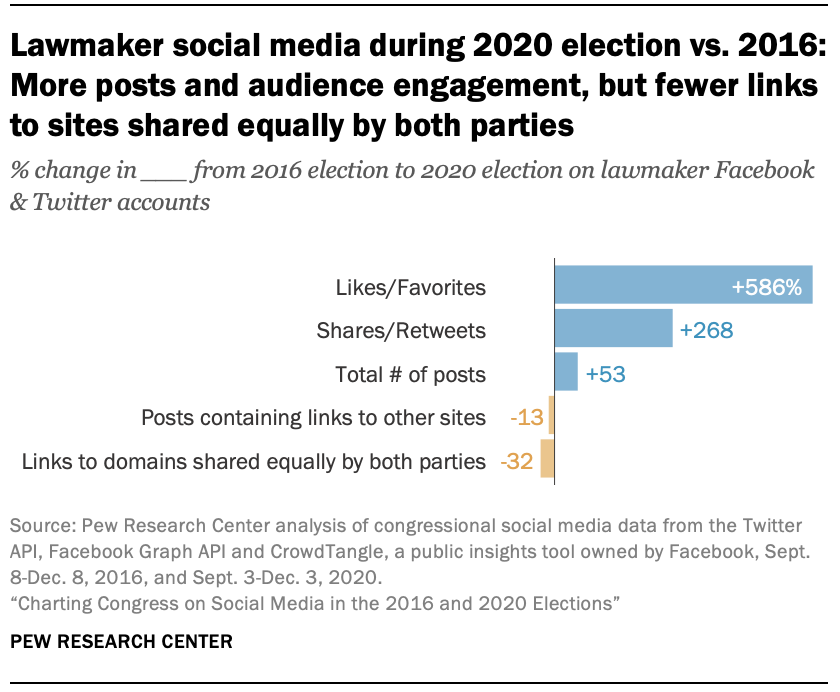
Beyond the increases in the sheer volume of posts and engagement, the content of lawmakers’ social media feeds can shed light on the contours of each election and the broader environment of modern political communication. It highlights key differences between the two parties, like how Democratic members disproportionately mentioned terms related to voting rights and access to the polls across both study periods. It also highlights broader trends in social media as a tool for information spread, such as the fact that a rising share of links posted by lawmakers go to sources that are shared largely or exclusively by members of one party.
These are among the key findings of an analysis of lawmaker Facebook and Twitter posts between Sept. 8-Dec. 8, 2016, and Sept. 3-Dec. 3, 2020:
Donald Trump was a mainstay of Democratic lawmakers’ social media feeds in both 2016 and 2020. In 2016,“Trump” was the second-most common term used by Democratic lawmakers on social media. And in 2020, “Trump” was the single-most mentioned word among Democratic lawmakers, appearing more than 33,000 times in their posts. By contrast, the 10 most-used words among Republicans lawmakers did not mention either of the Democratic presidential nominees in 2016 or 2020.
Lawmakers from each party used distinctive language to engage with their constituencies on social media. Across both elections, Democratic and Republican lawmakers communicated with language that was disproportionately used by their own party relative to the other. In 2020, Democrats’ most distinctive language referred to equality and representation (“equality”), voting (“make [a] plan [to] vote”), and aspects of the COVID-19 pandemic and healthcare in general (“COVID case[s],” “health insurance”). Meanwhile, Republicans’ most distinctive language used terms such as “bless,” “Israel,” “defund” and “liberal.”
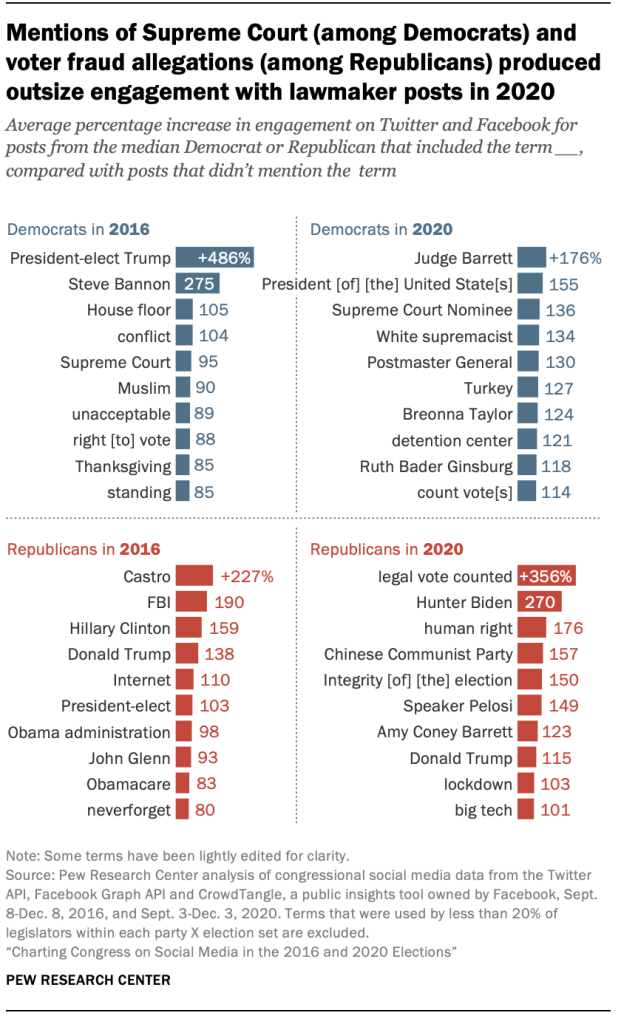
Key terms and topics are associated with increases in audience engagement when used in lawmakers’ social media posts. In each election study period, certain terms produced an outsize response from the social media audience in the form of likes and shares. In many cases, these terms referenced polarizing opposition figures and high-profile political conflicts. In 2016 for instance, Democrats received the largest increases in audience engagement by mentioning the election of Donald Trump (“President-elect Trump”) and then-White House chief strategist Steve Bannon. And in 2020, Republican lawmakers received a large boost in audience engagement on posts demanding to make sure that every “legal vote counted,” or that referenced Joe Biden’s son Hunter.
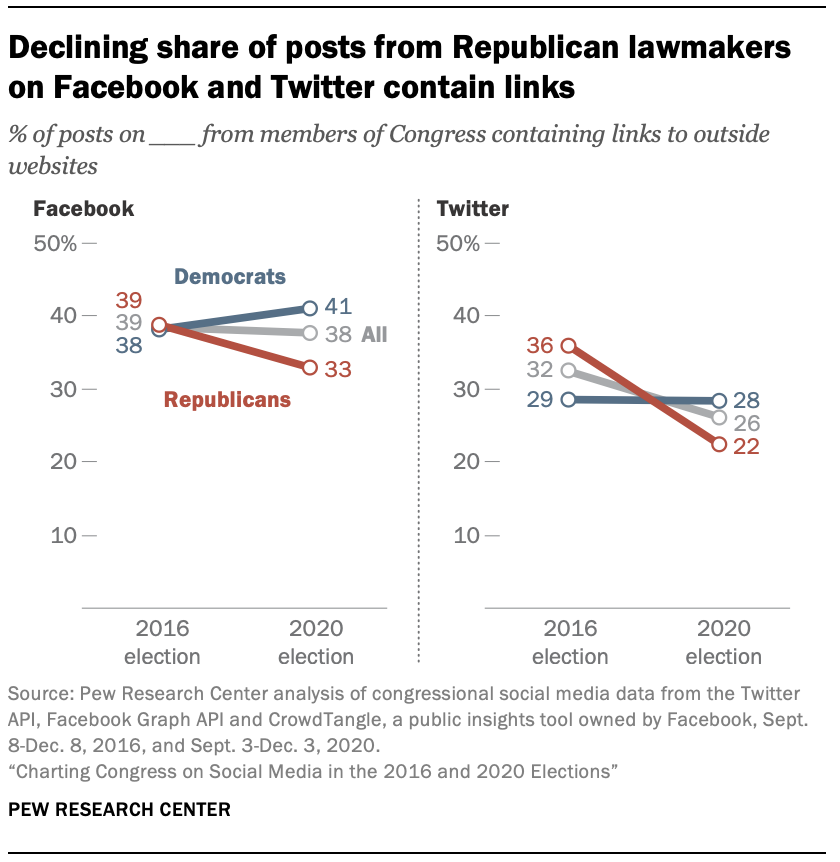
A declining share of posts from lawmakers contain links to outside content, and this trend is largely being driven by the posting habits of Republican members on Twitter. Members of Congress have grown less likely over time to include links to outside websites in their social media posts. Just 30% of lawmaker posts during the 2020 election contained a link, down from 34% in 2016. This decline was especially pronounced among Republican lawmakers on Twitter. The share of tweets from Republicans that included a link fell from 36% during the 2016 election to 22% in 2020.
“Link polarization” is on the rise, as a growing proportion of popular domains are shared primarily or exclusively by members of one party. When members of Congress did share links, the vast majority went to a small number of popular web domains. Just 188 individual domains accounted for 62% of all the links posted by lawmakers during the last two election cycles. And the number of these popular domains shared exclusively by members of one party – and not at all by lawmakers from the opposing party – increased from 20 in 2016 to 31 in 2020.
Lawmakers posted far more content – and received far more audience engagement – on social media during the 2020 election than in 2016
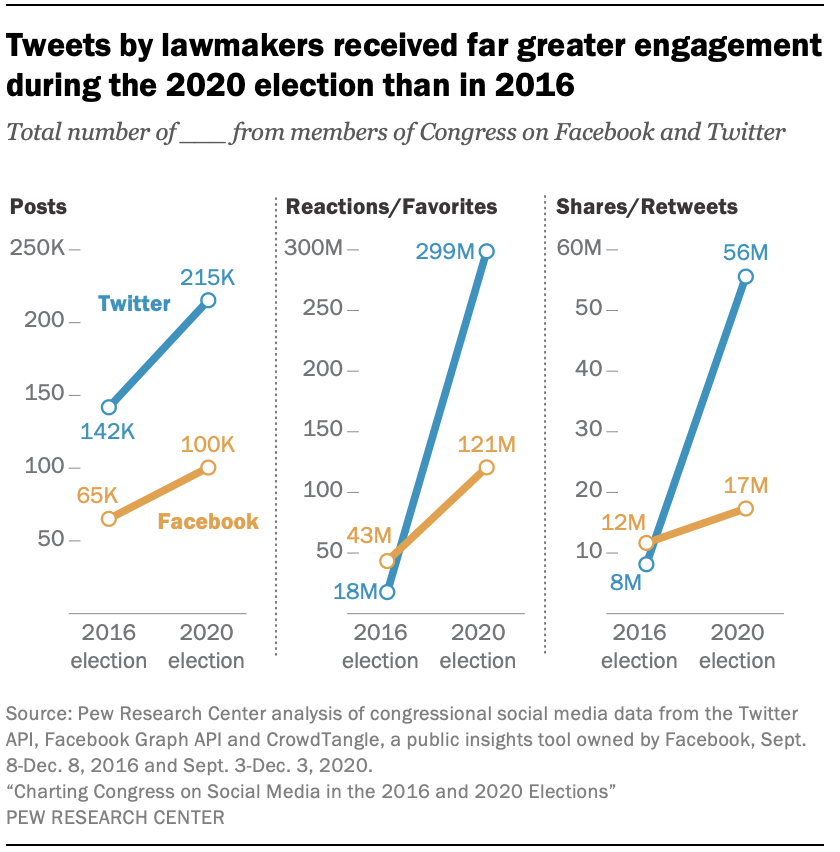
Lawmakers produced far more social media content during the 2020 election than in the 2016 study period. Between Sept. 8 and Dec. 8, 2016, legislators produced 207,009 posts on Facebook and Twitter combined. During a similar time period (Sept. 3 to Dec. 3) in the 2020 election, lawmakers produced 315,818 posts across these two platforms. And this increase occurred on both major social media platforms: Lawmakers created around 35,000 more Facebook posts and nearly 74,000 more tweets in 2020 than in 2016. In total, the study periods contain nearly 166,000 Facebook posts from 698 different members of Congress who used a total of 1,408 Facebook accounts, and more than 357,000 tweets from 669 different members of Congress who used a total of 1,438 Twitter accounts.
Audience engagement with the posts produced by lawmakers on social media also increased across both platforms, but especially on Twitter. Lawmakers on Twitter received more than 16 times as many favorites and nearly seven times as many retweets during the 2020 election study period as in 2016. This increase largely aligns with our previous report on the congressional social media landscape from 2015 to 2020.
Democratic lawmakers used ‘Trump’ more than any other word on social media during the 2020 election
Lawmakers from both parties used a common set of popular words in their election season social media posts in both 2016 and 2020.1 The most-mentioned terms by Democrats and Republicans alike in each election study period included basic expressions such as “today,” “great” and “year.”
At the same time, there are distinct differences in the most popular terms used by members of each party. For Democrats in particular, they highlight the extent to which Donald Trump was a fixture of social media discourse in both 2016 and 2020. In 2016, the word “Trump” was mentioned nearly 9,000 times by Democratic lawmakers in the months surrounding the election. Only the word “today” (with almost 12,000 mentions) was used more frequently. And in 2020, Democratic lawmakers used the word “Trump” more than 33,000 times – making it the single-most-used word in that election study period, just ahead of “vote.” In comparison, Republican lawmakers mentioned the Democratic presidential nominee by name just over 4,300 times in 2016 (“Clinton”) and just over than 8,000 times in 2020 (“Biden”).
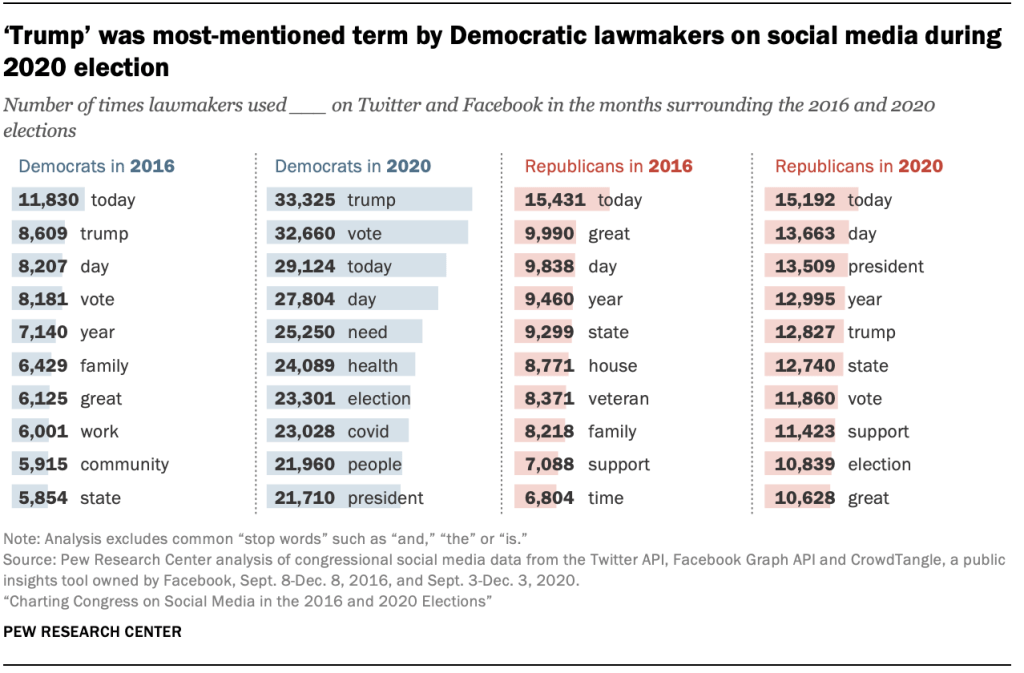
In addition to references to the former president, Democratic lawmakers in 2020 also frequently used the words “health” (the sixth-most used word) and “COVID” (the eighth-most commonly used word). By comparison, both of these fell out of the top 10 most-used terms among Republicans, with “COVID” being the 18th-most frequently used term among Republicans while “health” ranked 46th.
Lawmakers from each party used distinctive language to engage with their constituencies on social media
Beyond the terms that were used most frequently in each election study period, certain terms and phrases were distinctive to either Democrats or Republicans – that is, used widely by lawmakers from one party, but relatively rarely by members of the other.
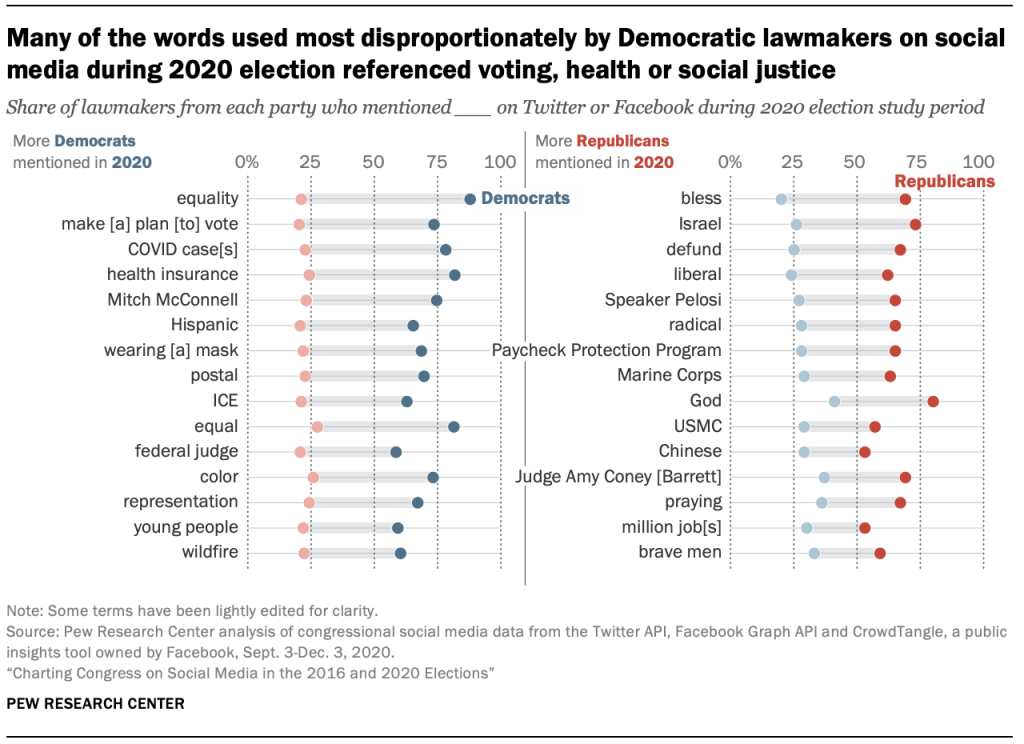
Several of the most distinctive terms used by Democratic lawmakers in 2020 focused on equality and representation. Indeed, the single-most distinctive word for Democrats in 2020 was “equality,” which was used by some 88% of Democratic lawmakers compared to just 21% of Republicans. Similarly, Democrats were nearly three times as likely to use words like “equal” (81% vs. 27%) or “representation” (67% vs. 24%).
Looking across election periods, Democratic lawmakers in both 2016 and 2020 were more likely to use terms related to voting. In 2016, “right [to] vote” and “voter registration” were among the top three most distinctive terms among Democratic lawmakers. Similarly, in 2020 the term “make [a] plan [to] vote” was also among the top three most distinctive terms, used by some 74% of Democratic lawmakers but just 20% of Republicans.
Democrats also disproportionately mentioned terms related to rising coronavirus cases and to healthcare more broadly during the 2020 election. For instance, 78% of Democrats – but just 23% of Republicans – mentioned the phrase “COVID case[s]” on social media during the 2020 study period. And 82% of Democrats – but 24% of Republicans – mentioned the term “health insurance” during this time period.
The most distinctive terms used by Republican lawmakers during the 2016 campaign included issues such as “Obamacare,” “regulation,” “terrorism” and the “Obama administration.” And in the 2020 study period, the most distinctively Republican words were “bless” and “Israel.” In the months surrounding the 2020 election, both of these words were used by nearly three-quarters of Republican elected officials but only around 25% of Democrats. Along with these terms, words such as “liberal” and “radical” are present in the most distinctively Republican language during the 2020 study period.
Notably, the word “defund” (frequently used in the phrase “defund the police”) was far more commonly used by Republican lawmakers than by Democrats. Nearly three times as many Republican lawmakers as Democratic lawmakers used the word “defund” on social media during the 2020 election study period.
The preceding analysis highlights the most distinctive terms used by each party (relative to the other) across the time around the election. But a similar method can also be used to highlight terms that were used much more regularly within a single party after the election results were called by news organizations (relative to the time before that). This framing highlights the extent to which Republican lawmakers shifted to casting doubt on the validity of the 2020 election results themselves as the post-Election Day period unfolded.
Following the news media’s announcement of Joe Biden’s victory on Nov. 7, 2020, posts mentioning the election by Republican lawmakers were more likely to use terms such as “recount,” “fraud” and “irregularity” than they were in the period before the race was called (when they were much more likely to include terms like “polling location,” “early voting” and “[make your] voice heard”). By contrast, the most distinctive term used by Democrats in posts mentioning the election following Trump’s victory in 2016 was “President-elect Trump.”
Mentions of key terms and topics produced increases in audience engagement with lawmaker social media posts
Mentions of certain words and phrases were associated with higher-than-usual audience engagement as measured by favorites and retweets on Twitter, or reactions and shares on Facebook – during the 2016 and 2020 study periods.
During the 2016 race, mentions of the phrase “president-elect Trump” by Democratic lawmakers received nearly 500% more audience interactions relative to the average post during that time period. Mentions by Democratic lawmakers of chief campaign executive and then-White House chief strategist Steve Bannon were also highly engaging, producing a 275% increase relative to the average.
Among Republican lawmakers in 2016, references to former Cuban dictator Fidel Castro (who died during the study period on Nov. 25, 2016) produced the highest engagement increase (227%) over the average post during the time period. Words such as “FBI,” “Hillary Clinton” and “Donald Trump” also lead to significant engagement boosts when used by Republicans during the 2016 study period.
During the 2020 election study period, two phrases in particular led to increased engagement on posts from Republicans. These included admonitions to make sure every “legal vote [is] counted” (a 356% increase over the average), and mentions of “Hunter Biden,” many of which included allegations of corruption against Hunter Biden (a 270% increase). And among Democrats, two of the three terms associated with the largest increase in average engagement (“Judge Barrett” and “Supreme Court nominee”) referenced the passing of Associate Justice Ruth Bader Ginsburg before the election and the nomination of Judge Amy Coney Barret as her replacement.
A declining share of posts from Republican lawmakers – especially on Twitter – contain links to outside content
During the months surrounding the 2016 election, 34% of lawmaker tweets and Facebook posts contained links to sites elsewhere online. But link sharing was somewhat less prevalent during the 2020 election, when that share fell to 30%.
In this analysis, a link is a web address that points to a specific page or article online. A domain is the top-level web address that hosts these links. For example, the CDC’s COVID-19 resource page, interactive COVID data tracker and guide to traveling during the pandemic are each individual links on the parent CDC.gov domain.
This decline was especially pronounced on Twitter, as the share of lawmaker tweets that included a link fell from 32% during the 2016 election to 26% in 2020. This decrease in the share of tweets that contain links during the presidential election study periods is part of a longstanding and steady decline over the past several years, and is most pronounced among Republican lawmakers.
The share of tweets from Democratic lawmakers containing links was nearly identical during the 2016 (29%) and 2020 (28%) elections. But among Republican lawmakers, the share of tweets containing links fell dramatically – from 36% in 2016 to 22% in 2020.
The share of lawmaker Facebook posts that included links in the 2016 and 2020 election study period remained virtually unchanged. But although the share of Facebook posts from Democratic lawmakers containing links rose slightly between 2016 and 2020 (from 38% to 41%), the share among Republicans fell modestly over the same time period (from 39% in 2016 to 33% in 2020).
In addition to including links on a larger share of their posts, Democratic lawmakers also tend to link to a larger number of distinct web domains in those posts relative to Republicans. And this gap between Democrats and Republicans has increased substantively over the last two election study periods. During the 2016 election, the median (typical) Democrat shared links to 30 distinct domains, compared with 27 for the median Republican.
Similarly, the number of links shared by lawmakers from each party increased in 2020, but by a substantially greater amount among Democrats. During the 2020 election, the median Democratic legislator shared links to 50 different domains, 19 more than the number of domains shared by the median Republican (31).
A small number of very popular domains make up a majority of the links shared by lawmakers
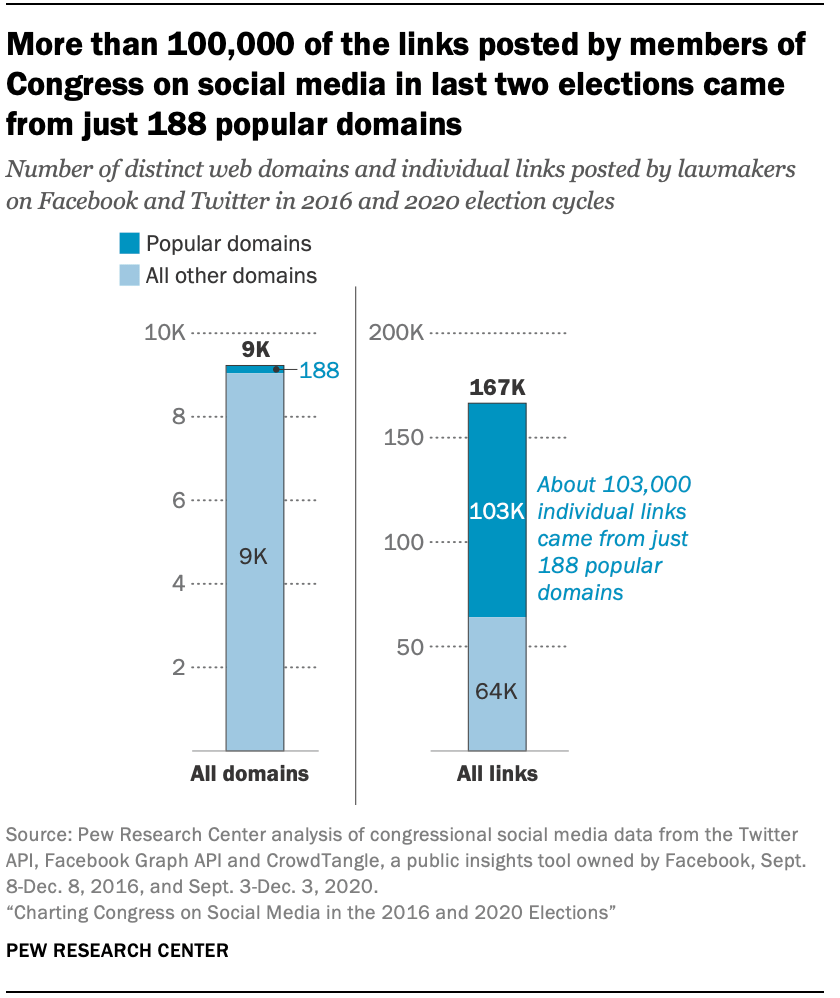
Legislators posted 166,552 individual links to 9,228 different domains during the 2016 and 2020 elections. But in both elections, the majority of links pointed to a small handful of domains. Indeed, just 2% of these domains (a total of 188 out of the more than 9,000 domains shared across the 2016 and 2020 campaigns), accounted for 62% of all links posted. At the other end of the spectrum, 70% of all domains linked to by lawmakers over the last two election study periods were shared fewer than five times.
A growing share of domains are shared primarily or exclusively by lawmakers from one party
Over time, an increasing proportion of links shared by members of Congress are to domains that are shared predominantly or exclusively by members of one party or the other. Researchers from the Center grouped these domains shared by legislators into three distinct categories:
- Those that were exclusively shared by lawmakers from one party and never by those from the other party.
- Those shared predominantly by lawmakers from one party (meaning more than 75% of the links to that domain came from either Democratic or Republican lawmakers).
- Those shared roughly equally by lawmakers from both parties (meaning that in the range of 50% and 75% of the links to that domain came from members of one party or the other).
In 2016, 52% of links to all domains posted by members of Congress went to domains that were shared predominately or exclusively by members of one party. But in the 2020 election study period, that share rose to 67% of all links. Meanwhile, the proportion of links to domains shared roughly equally by members of both parties fell from 48% in 2016 to 33% in 2020.
Even among the most popular domains, most links belong primarily to exclusively shared domains

A similar shift is apparent even when limiting this analysis to domains that were highly popular among lawmakers (that is, shared at least 25 times) in both election study periods. In total, 188 domains meet this criteria. And collectively, they account for more than 62% of the links shared by legislators during both time periods. To view these top domains, visit this link.
During the 2016 election, 20 of these 188 domains were shared exclusively by members of one party. But that figure rose to 31 domains during the 2020 study period. By contrast, the number of domains that were shared by members of both parties fell from a total of 80 in 2016 to 65 in 2020.
Nearly 20% of popular domains in 2020 were not shared at all in 2016
Many of the most popular domains during the 2020 election were ones that were never used or used sparingly during the 2016 election. In total, 418 domains were shared at least 25 times during the 2020 election by lawmakers. And of these domains, 18% were not shared at all during the 2016 campaign (another 37% were shared less than 25 times but also greater than zero).
Some examples of popular “2020 only” domains include:
- New platforms for online donations and mobilization, such as mobilize.us (1,517 shares) or winred.com (532 shares)
- Sites related to the 2020 Census, such as my2020census.gov (1,023 shares) or 2020census.gov (894 shares)
- Sites that gained prominence during the pandemic and subsequent lockdowns, such as the videoconferencing service zoom.us (288 shares)
- Politically-oriented news sites founded after the 2016 campaign, such as axios.com (308 shares)
- Sites for specific government agencies or politicians, such as eac.gov (159 shares), republicanleader.gov (148 shares), joebiden.com (131 shares) or farmers.gov (116 shares)