Pew Research Center

FOR RELEASE DECEMBER 17, 2019

In a Politically Polarized Era, Sharp Divides in Both Partisan Coalitions

Partisanship remains biggest factor in public's political values

FOR MEDIA OR OTHER INQUIRIES:

Communications Department
202.419.4372
www.pewresearch.org

RECOMMENDED CITATION

Pew Research Center, December 2019, "In a Politically Polarized Era, Sharp Divides in Both Partisan Coalitions"

About Pew Research Center

Pew Research Center is a nonpartisan, nonadvocacy fact tank that informs the public about the issues, attitudes and trends shaping the world. It does not take policy positions. The Center conducts public opinion polling, demographic research, computational social science research and other data-driven research. It studies politics and policy; news habits and media; the internet and technology; religion; race and ethnicity; international affairs; social, demographic and economic trends; science; research methodology and data science; and immigration and migration. Pew Research Center is a subsidiary of The Pew Charitable Trusts, its primary funder.

© Pew Research Center 2026

Table of contents

  • About Pew Research Center
  • In a Politically Polarized Era, Sharp Divides in Both Partisan Coalitions
  • 1. Views of the major problems facing the country
  • 2. Views of government and the nation
  • 3. Views of the economic system and social safety net
  • 4. Views on race and immigration
  • 5. Gender, family and marriage, same-sex marriage and religion
  • 6. Views of foreign policy
  • 7. Domestic policy: Taxes, environment, health care
  • Methodology
  • Appendix

In a Politically Polarized Era, Sharp Divides in Both Partisan Coalitions

Partisanship remains biggest factor in public's political values

Partisanship continues to be the dividing line in the American public’s political attitudes, far surpassing differences by age, race and ethnicity, gender, educational attainment, religious affiliation or other factors. Yet there are substantial divisions within both parties on fundamental political values, views of current issues and the severity of the problems facing the nation.

Wide partisan gaps on political values across a number of areas, but the largest differences are on guns and race

The issues that divide the partisan coalitions are different for Republicans than for Democrats. Age differences are generally wider among Republicans than Democrats – particularly in opinions about foreign policy, immigration and homosexuality – while educational attainment is a bigger divider among Democrats.

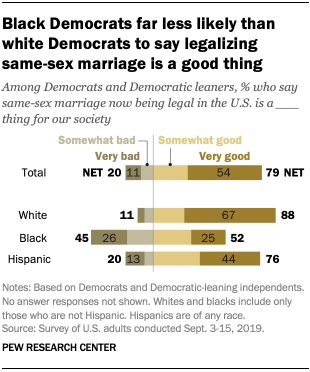
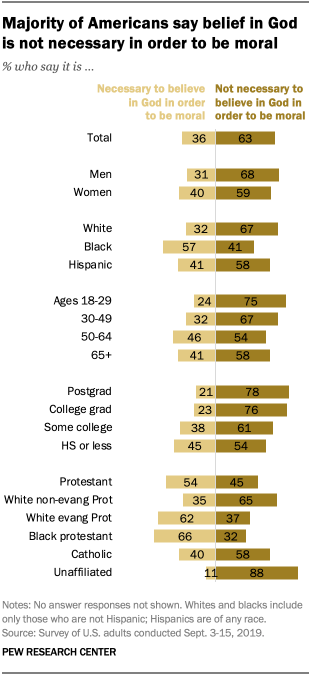
Democrats also are divided by race, with black Democrats much more likely than white Democrats to associate belief in God with morality and less likely to say that same-sex marriage has been good for society. Racial differences in attitudes are far less consequential for Republicans, who are predominantly non-Hispanic white.

Ideological differences are evident in both parties. Conservative Republicans, who make up a majority of all Republicans, are nearly 30 percentage points less likely than GOP moderates and liberals to say that legalizing same-sex marriage has been good for society. And among Democrats and Democratic leaners, there are notable differences between liberals (who make up around half of all Democrats) and the party’s conservatives and moderates on religion, same-sex marriage, racial discrimination and foreign policy.

Partisan gaps dwarf race, education, other differences in political values

Yet it remains the case that the differences between the two parties are starker than those within the two parties. Across 30 political values – encompassing attitudes about guns, race, immigration, foreign policy and other realms – the average partisan gap is 39 percentage points.

The gaps are substantially wider on some political values, especially those related to guns and race, than others. For two political values on whether guns should be generally more or less available (not specific gun policies), the average difference is 57 percentage points. An overwhelming share of Democrats and Democratic-leaning independents (86%) say the nation’s gun laws should be stricter than they are today; just 31% of Republicans and Republican leaners say the same.

The partisan differences on political values related to race are nearly as wide (55 points). For example, Democrats are seven times as likely as Republicans to say white people benefit “a great deal” from societal advantages that black people do not have (49% vs. 7%).

Across all 30 political values, the differences between Republicans and Democrats dwarf all other differences by demographics or other factors. The 39-point average gap is more than twice the difference between white and nonwhite adults (17 percentage points); people who regularly attend religious services and those who do not (14 points); college graduates and those who have not completed college (10 points); younger and older adults (also 10 points); and men and women (6 points).

The size of the partisan divide on political values has not changed much in recent years. But since 1994, the differences between parties on these measures has more than doubled, while the size of other gaps has been largely unchanged.

The current survey, conducted Sept. 3-15 among 9,895 U.S. adults, is the first time Pew Research Center’s political values survey has been conducted on the online American Trends Panel; previous values surveys have been conducted by telephone. (For more, see “Trends are a cornerstone of public opinion research. How do we maintain them when there’s a shift in survey mode?”)

The GOP’s age gap

Across multiple measures, Republicans who are under age 50 have different views from those 50 and older. Age divides among Democrats are much more modest.

A chart shows that younger and older Republicans differ on foreign policy, immigration, largely agree on race and guns

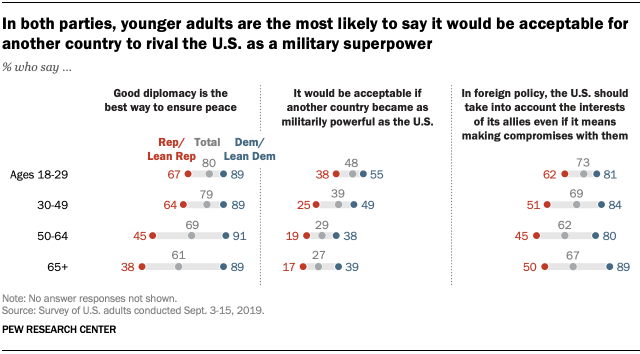
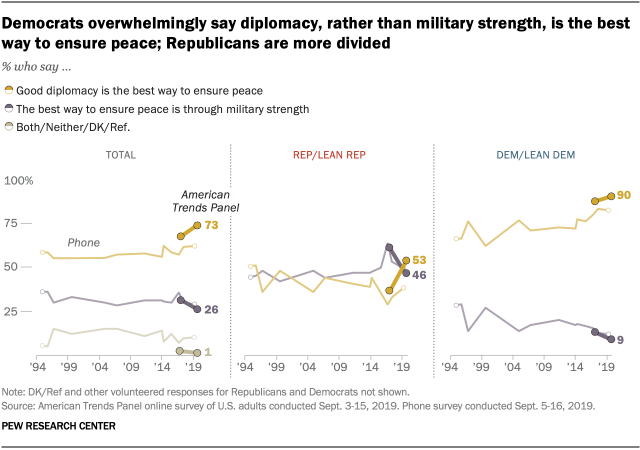
A majority of younger Republicans and Republican-leaning independents (65%) say peace is best ensured with good diplomacy. Among older Republicans and Republican leaners, 42% express this view, while a majority (57%) says peace is best ensured through military strength.

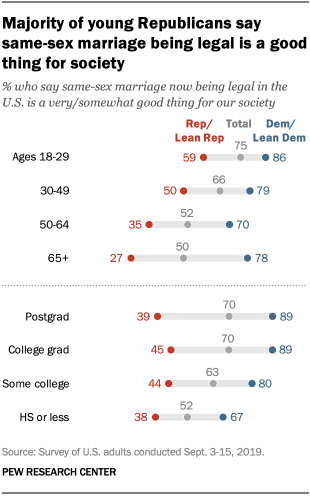
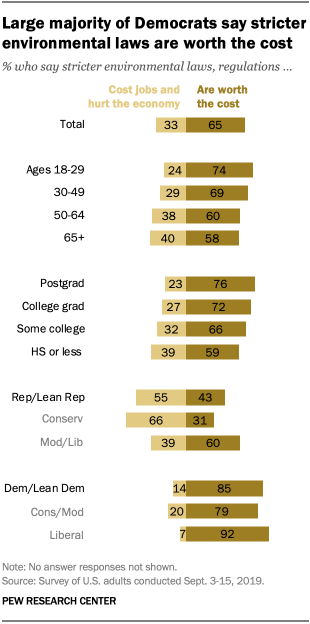
The age differences are about as large in opinions about the impact of newcomers from other countries, whether stricter environmental laws are worth the cost and whether legalizing same-sex marriage has been a good thing for the United States.

The Republicans’ age (and generational) differences extend beyond the items shown here: Younger Republicans are more likely than older Republicans to say that human activity contributes a great deal to climate change and that marijuana use should be legal.

And in some instances, these differences also are seen in perceptions of the major problems facing the country. A substantial majority of Republicans ages 50 and older (80%) say illegal immigration is a “very big problem” facing the U.S.; that compares with only about half (51%) of younger Republicans.

Yet there also are important areas of agreement between younger and older Republicans. Relatively small shares of both Republicans younger than 50 (30%) and those ages 50 and older (25%) say white people benefit from societal advantages that black people do not have. Among other areas of agreement, only about one-in-five younger and older Republicans say it is more important to control gun ownership than protect gun rights.

Today, about as many Republicans and Republican leaners are under age 50 (48%) as ages 50 and older (52%). Adults under age 50 make up a majority (54%) of Democrats and Democratic leaners. For Pew Research Center’s most recent analysis of the demographic profiles of the parties and trends in partisan identification among registered voters, released in 2018, see “Wide Gender Gap, Growing Educational Divide in Voters’ Party Identification.”

Racial, educational divisions among Democrats

A chart shows that black and white Democrats diverge sharply on whether belief in God is necessary for morality

Black Democrats have long been more likely than white Democrats to describe themselves as Christian and to attend religious services more frequently.

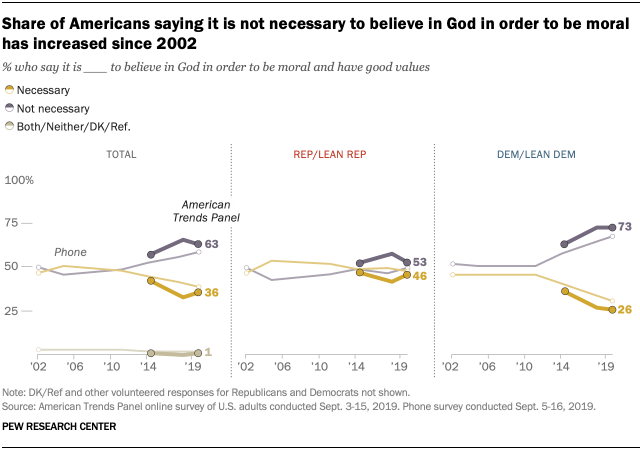
These differences are reflected in sharp divides between black and white Democrats and Democratic leaners in opinions related to faith and religion. White Democrats are nearly twice as likely as black Democrats to say that it is not necessary to believe in God in order for a person to be moral (89% vs. 44%).

On this measure, the views of black Democrats are similar to those of Republicans. Among all Republicans and Republican leaners, 53% say belief in God is not necessary for morality, while 46% say it is necessary.

There also are wide differences between black and white Democrats in views of the impact of legalizing same-sex marriage on the country. While an overwhelming share of white Democrats (88%) say same-sex marriage being legal is a good thing for society, only about half of black Democrats (52%) say the same.

There are significant, though less pronounced, racial differences in Democrats’ attitudes about other issues, including the environment and business profits. And while majorities of black and white Democrats say the country has not gone far enough in giving blacks equal rights with whites, black Democrats are more likely to express this view (81% vs. 65%).

The racial differences among Democrats also are reflected in their views of some problems facing the country. While 58% of black Democrats say terrorism is a very big problem in the U.S., just a quarter of white Democrats say this. The gap is about as wide in views of job opportunities (52% of black Democrats, vs. 25% of white Democrats).

However, black and white Democrats share similar views about many issues, particularly when it comes to the government’s social safety net. For example, nearly identical majorities of black (73%) and white Democrats (72%) say the government should do more to help needy Americans, even if it means going deeper into debt.

There also are some significant differences between Democrats with four-year college degrees and those with less educational attainment. Most of these differences are evident even when race is held constant.

A chart shows that Democratic college grads more likely than non-college Democrats to view government performance positively

Across the 30 political values items, the differences between college graduates and adults who have not completed college are generally wider among Democrats than among Republicans.

Perhaps the most striking educational gap among Democrats is in assessments of government performance.

Among Democrats and Democratic leaners who have four-year degrees, 66% say government often does a better job than it gets credit for, while 32% say it “is almost always wasteful and inefficient.” Non-college Democrats are more skeptical: 43% say government does a better job than it is credited for, while a 54% majority says it is often wasteful.

Republicans are more likely than Democrats, regardless of educational attainment, to say that government is usually wasteful (68% say this) and there are more modest differences by education among Republicans than Democrats.

Democratic college graduates also are more likely than non-college Democrats to say the U.S. should take an active role in world affairs (by 21 percentage points), that newcomers to the U.S. do more strengthen than burden the country (by 17 points) and that gun laws should be made stricter (by 14 points).

A majority of Democrats and Democratic leaners (63%) do not have a four-year college degree, while 37% are college graduates. That is a sharply different educational profile from 20 years earlier, when college graduates made up only 22% of Democrats. Currently, about a quarter of Republicans and Republican leaners (27%) have four-year college degrees, which is virtually unchanged from 1999 (26%).

Income divides within both parties, but on different issues

A chart shows that Republican income divides on business, govt. safety net; Democrats differ on govt. performance

The most striking income difference among Republicans is over corporate profits. A 59% majority of Republicans and Republican leaners with family incomes of less than $50,000 say business corporations make too much profit. Fewer than half of Republicans (41%) with higher incomes ($50,000 or more) say the same.

Lower-income Republicans also are more likely than those with higher family incomes to support more government assistance for needy people and to say the government has a responsibility to provide health coverage to all Americans.

Democrats, regardless of family income, hold similar attitudes about business profits and the government safety net. Yet higher-income Democrats express more positive views of government performance than do those with family incomes less than $50,000. These differences mirror educational differences among Democrats.

Other important findings

Majority of public says U.S. corporations have “too much power.” Nearly three-quarters of Americans (73%) say major corporations in the U.S. have too much power; just 22% say they have the right amount of power, while only 4% say they have too little power. Democrats are more likely than Republicans to view corporate power as excessive; still, majorities in both parties express this view (83% of Democrats and Democratic leaners, 62% of Republicans and Republican leaners).

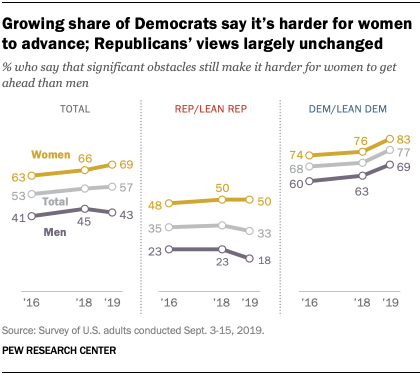
Growing share of Democrats, but not Republicans, say it’s harder for women to advance. Majorities of Democratic women (83%) and men (69%) say significant obstacles continue to make it harder for women than men to get ahead. The shares of both Democratic women and men who say this have increased by 9 percentage points since 2016. By contrast, half of Republican women and just 18% of Republican men say obstacles still block women’s progress. There has been virtually no change in opinions among Republican women since 2016, while the share of Republican men who say obstacles hinder women’s progress has ticked down (from 23% then to 18% today).

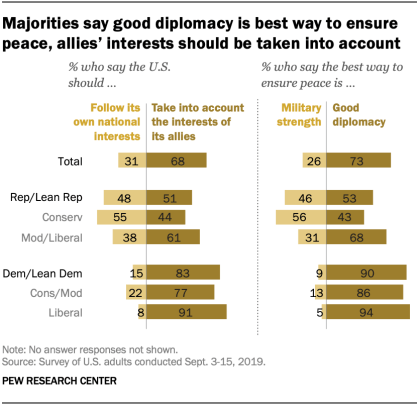
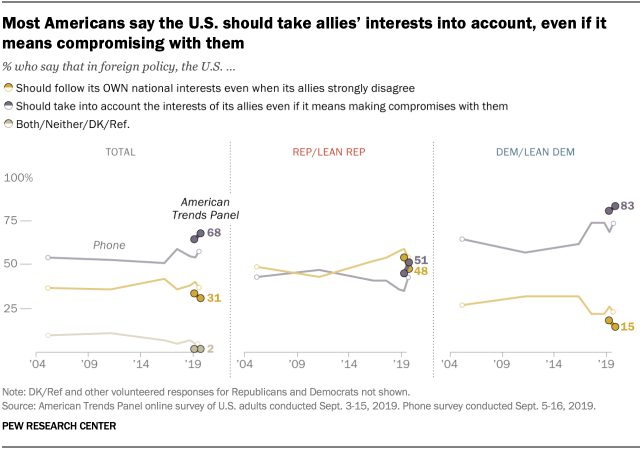
Most Americans want the U.S. to maintain its position as sole global superpower. A majority of Americans (61%) say U.S. policies should try to keep it so the country is the only military superpower, while 36% say it would be acceptable if another country became as militarily powerful as the U.S. Partisanship is a factor in these views, with Democrats twice as likely as Republicans to say it would be acceptable if another country becomes as militarily powerful as the U.S. (46% vs. 23%). There also are sizable age differences: Nearly half of adults younger than 30 (48%) say it would be acceptable if another country becomes as militarily powerful, compared with 28% of adults ages 50 and older.

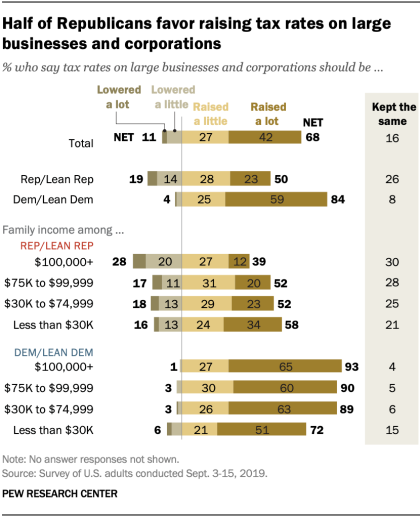
Majority favors raising tax rates on high incomes. A majority of the public (58%) says tax rates on household income over $250,000 should be raised a little or a lot, while 16% say rates on high incomes should be lowered a little or a lot; 22% say they should be kept the same as they are now. Across most partisan and income categories, there is more support for raising than lowering tax rates on high incomes; the only exception are Republicans with family incomes of $100,000 or more, whose views are divided.

1. Views of the major problems facing the country

Note: For 2023 survey data on problems facing the country, read “Inflation, Health Costs, Partisan Cooperation Among the Nation’s Top Problems“

A chart shows health care affordability, drug addiction widely viewed as 'very big' problems facing the country

When asked to consider the major problems facing the country, the affordability of health care and drug addiction top the American public’s list.

Other issues, including illegal immigration and climate change, are seen as less pressing, due in part to stark partisan disagreements over the importance of these issues.

Two-thirds of Americans view the affordability of health care as a very big problem for the country today, while another 26% say it is a moderately big problem. Fewer than one-in-ten say affording health care is a small problem (6%) or not a problem at all (2%).

A comparable majority says drug addiction is a major problem: 64% say it is a very big problem in the country and 28% say it is a moderately big problem.

Narrower majorities say the affordability of a college education (55%) and the federal budget deficit (53%) are very big problems in the country. About half say this about climate change (48%).

Somewhat smaller shares of the public cite other issues as very big problems for the country. For instance, 43% say this about illegal immigration and 39% say this about terrorism.

Sexism and job opportunities rank at the bottom of the public’s list of problems in the country. At a time when the public holds positive views of the economy overall, just 25% say job opportunities for all Americans is a very big problem. About the same share (26%) calls sexism a very big problem.

For the most part, assessments of the pressing problems facing the U.S. have not changed a great deal in recent years. However, the shares of Americans who say that terrorism and job opportunities for all Americans are very big problems have declined substantially since November 2016, shortly before the presidential election. At that time, 53% viewed terrorism as a very big problem; today, 39% express this view. And the share who view job opportunities as a very big problem is only about half the level it was three years ago (25% now, 47% then).

Wide partisan differences in views of most major problems

A chart shows little partisan agreement on the major problems facing the U.S.

As in the past, there are wide partisan differences on the perceived seriousness of most of the problems asked about in the survey. Democrats and Democratic-leaning independents are far more likely than Republicans and GOP leaners to say several concerns are very big problems – especially climate change, economic inequality and racism.

Majorities of Democrats say all three are very big problems, compared with fewer than a quarter of Republicans. For example, 73% of Democrats say climate change is a very big problem, compared with just 17% of Republicans. (For more on partisanship and views of climate change, see “U.S. Public Views on Climate and Energy.”)

Republicans, by contrast, are more likely to say illegal immigration is a very big problem. Two-thirds of Republicans say illegal immigration is a very big problem; the only problem cited by similar shares of Republicans is drug addiction (68%). Just 23% of Democrats cite illegal immigration as a very big problem, the lowest share for any of the 11 issues included in the survey.

There are a handful of issues that are viewed similarly across partisan lines: Majorities in both parties say drug addiction is a very big problem, though Republicans are more likely than Democrats to express this view (68% vs. 61%). About half of Republicans (54%) and Democrats (52%) say the federal budget deficit is a very big problem. Terrorism ranks relatively low as a concern among Republicans (41%) and Democrats (36%).

Among Democrats and Republicans, there are areas of ideological agreement – and some notable differences – on the severity of problems in the U.S.

On climate change, liberal Democrats (84%) are significantly more likely than conservative and moderate Democrats (64%) to say this is a very big problem. Among Republicans, 28% of moderates and liberals say climate change is a very big problem compared with an even smaller share of conservatives (11%).

A chart shows in both parties, ideological differences in views of several major problems facing the U.S.

Illegal immigration is the top national problem among conservative Republicans (75% say it is a very big problem), but is viewed as a major problem by fewer moderate and liberal Republicans (53%). Conservative and moderate Democrats are twice as likely as liberal Democrats to say illegal immigration is a very big problem (30% vs. 15%).

Notably, one national concern – drug addiction – is viewed as a very big problem by majorities across the ideological spectrum. Two-thirds of conservative and moderate Democrats (66%) say drug addiction is a very big problem; a smaller majority of liberal Democrats (57%) say the same. Nearly identical shares of conservative Republicans (68%) and moderate and liberal Republicans (66%) say drug addiction is a very big problem.

Age differences in views of the nation’s biggest problems

A chart shows that adults under 30 are the only age group in which a majority views climate change as a very big problem

In views of several national problems, the age differences are fairly modest. For example, comparable majorities across age categories say the affordability of health care is a very big problem.

Yet there are notable age differences on such issues as illegal immigration, the federal budget deficit, terrorism and climate change.

On three of these four issues – illegal immigration, the deficit and terrorism – older adults are more likely than young people to regard them as very big problems. For example, 57% of those ages 65 and older and nearly as many ages 50 to 64 (53%) view illegal immigration as a major problem. Fewer than half of those ages 30 to 49 (38%) and only about a quarter of those younger than 30 (23%) say the same.

By contrast, adults under age 30 are the only age group in which a majority (59%) views climate change as a very big problem. Smaller shares of those 30 to 49 (47%), 50 to 64 (42%) and 65 and older (44%) place the same level of importance on the issue.

A chart showing illegal immigration is seen as major problem by most older Republicans, only about a third those under 30

While there are sizable age differences in views of some national problems, these differences are far more pronounced among Republicans and Republican leaners than Democrats and Democratic leaners.

The most striking age gap, by far, in opinions among Republicans is on illegal immigration: Republicans ages 65 and older are 50 percentage points more likely than those younger than 30 to say illegal immigration is a very big problem for the country (85% vs. 35%).

The youngest Republicans also are less likely than older adults in the GOP to say terrorism and the federal budget deficit are very big problems for the country.

On climate change, the age pattern among Republicans runs in the opposite direction. Just 15% of Republicans ages 30 and older say climate change is a very big problem for the country. The youngest Republicans are more likely to see the issue as a very big problem; still, the overall share of young Republicans who say this is relatively modest (32%).

Views of top problems vary by race and ethnicity

Black adults are far more likely than whites to view racism, economic inequality as major problems

Views of the country’s most pressing problems also differ by race and ethnicity. In general, black and Hispanic adults tend to be more likely than whites to assign high importance to a range of issues.

One of the largest divides in views is over the issue of racism. Majorities of blacks (75%) and Hispanics (61%) view racism as a very big problem in the country today. By contrast, just 33% of whites give the issue the same level of importance.

Two-thirds of blacks (66%) view economic inequality as a very big problem for the country; 51% of Hispanics share this view. Among whites, 39% view economic inequality as a very big problem.

When it comes to job opportunities for all Americans, 53% of black adults say this is a very big problem for the country today, compared with smaller shares of Hispanics (31%) and whites (18%).

Democrats differ by race and ethnicity in their views of some of the major problems in the country. (Differences by race and ethnicity among Republicans were not analyzed due to insufficient sample sizes. Most Republicans and Republican leaners are white; the share of nonwhites in the GOP is far smaller than among Democrats.)

Climate change viewed as a major problem by more white and Hispanic Democrats than black Democrats

Among Democrats and Democratic leaners, 52% of whites say racism is a very big problem for the country, compared with larger shares of black (79%) and Hispanic (70%) Democrats.

White Democrats are ideologically divided on this issue: While a 60% majority of white liberals say racism is a very big problem, just 41% of white conservative and moderate Democrats say the same.

In addition, black Democrats (52%) are more likely than white (25%) or Hispanic Democrats (37%) to view job opportunities for all Americans as a very big problem.

Economic inequality is viewed as a major problem by nearly identical shares of black and white Democrats (70% and 68% respectively); a somewhat smaller majority of Hispanic Democrats (59%) view inequality as a very big problem. Yet there are wide ideological differences among white Democrats: 78% of white liberals see inequality as a very big problem, compared with 56% of white conservative and moderate Democrats.

Climate change divides Democrats by race and ethnicity, and white Democrats by ideology. Among white and Hispanic Democrats, roughly as many cite climate change as a very big problem for the country as cite the affordability of health care. Among black Democrats, however, 56% say climate change is a very big problem, compared with 79% who say the affordability of health care is a major problem.

Among white Democrats, an overwhelming share of liberals (89%) say climate change is a very big problem for the country. A smaller majority of white conservative and moderate Democrats (69%) say climate change is a major problem for the U.S.

2. Views of government and the nation

In broad assessments of government, the American public expresses more support for an active – rather than limited – role for government and sees a need for government regulation of business. At the same time, concerns about waste and inefficiency are widely held. Republicans and Democrats are far apart in how they view government, particularly when it comes to how large a role it should play.

Overall, 55% of U.S. adults say that government should do more to solve problems, while 43% say government is doing too many things better left to businesses and individuals.

Large majorities of Democrats and Democratic-leaning independents (78%) say the government should do more to solve problems; only 21% say it is doing too many things better left to businesses and individuals. Liberal Democrats (85%) are especially likely to support an active role for government; 72% of conservative and moderate Democrats also say the government should do more.

By contrast, most Republicans prefer a limited role for government: 71% of Republicans and Republican leaners say that government is doing too many things better left to individuals and businesses, compared with 28% who say it should play a larger role. Eight-in-ten conservative Republicans say government is doing too many things better left to others. Views among moderate and liberal Republicans are more mixed: 58% say government is doing too many things, while 40% say it should do more to solve problems.

There are also sizable demographic differences in these views, with large shares of younger adults, blacks and Hispanics saying government should do more to solve problems.

Black and Hispanic adults both overwhelmingly say the government should do more to solve problems; at least seven-in-ten or more in each group say this. In contrast, whites are more divided: 51% say government is doing too many things better left to businesses and individuals, while 48% say the government should do more to solve problems.

By about a two-to-one margin, adults under age 30 say the government should do more to solve problems (65% vs. 34%). Older adults are more likely to say the government is doing too many things, including 54% of adults 65 years of age and older.

When asked to consider other aspects of government’s role and performance, a majority of Americans say government is inefficient. However, a comparable share also says there’s an important role for government to play in regulating business.

Overall, 56% say government is almost always wasteful and inefficient, compared with 42% who say it often does a better job than people give it credit for. Nearly seven-in-ten Republicans say government is wasteful and inefficient. Views among Democrats are more divided: 47% say the government is almost always wasteful and inefficient, while about as many (51%) say it often does a better job than it gets credit for.

Majority of Americans say government is ‘wasteful and inefficient,’ but a majority also sees its regulation as necessary

A majority of the public (58%) says that government regulation of business is necessary to protect the public interest; fewer (41%) say government regulation of business usually does more harm than good. The partisan divide in these opinions is even larger than in views of government efficiency: 75% of Democrats say government regulation of business is necessary to protect the public interest, while 61% of Republicans say it usually does more harm than good.

Views of the reasons for America’s success

About half of U.S. adults (52%) say the United States has been successful more because of its ability to change; a slightly smaller share (46%) says the nation’s success has more to do with its reliance on long-standing principles.

Partisans differ widely in views of why the U.S. has been successful

Among Republicans and Republican leaners, 63% say reliance on principles has more to do with why the United States has been successful. Democrats and Democratic leaners take the opposite view: 64% say the country has been successful more because of its ability to change.

There are sizable differences in views within both parties by ideology. A large majority of conservative Republicans (75%) say the country’s reliance on principles has more to do with its success, while just 24% say it is more because of its ability to change. Views among moderate and liberal Republicans tilt in the opposite direction: 54% cite the country’s ability to change, while 45% point to reliance on principles.

Among Democrats, 74% of liberals say the nation’s ability to change has more to do with its success than its reliance on long-standing principles; a smaller majority of conservative and moderate Democrats take this view (56%).

Views also differ significantly by age. Adults under age 50 are more likely than those ages 50 and older to say the country’s ability to change has more to do with its success than its reliance on long-standing principles.

Younger adults more likely to link U.S. success to its ability to change

Younger adults in both parties are more likely than older people to say the country’s ability to change is the primary reason the nation has been successful.

About seven-in-ten Democrats under age 50 say the country’s success is attributable to its ability to change. This compares with 59% of Democrats ages 50 to 64 and 45% of those ages 65 and older.

Among Republicans, just 28% of those ages 65 and older say the ability to change has more to do with the country’s success. Larger shares of younger Republicans take this view, though majorities of Republicans across age groups point to reliance on long-standing principles as the bigger reason for the country’s success.

Views of the country’s ability to solve its problems

Republicans more likely than Democrats to say Americans can always find solutions to their problems

Overall, 55% of adults say that “as Americans, we can always find ways to solve our problems and get what we want.” A smaller share (44%) says “this country can’t solve many of its important problems.”

About six-in-ten Republicans (62%) are optimistic that Americans can find ways to solve their problems. However, among Democrats, about as many say the country cannot solve many of its important problems (50%) as say it can (49%).

Few Americans say other countries are better than the U.S.

Far more Republicans than Democrats say U.S. ‘stands above’ other countries

Most Americans (79%) say either that the U.S. “stands above all other countries in the world” (24%) or that it is “one of the greatest countries, along with some others” (55%). About two-in-ten (21%) say there are other countries that are better than the U.S.

Four-in-ten Republicans and Republican leaners say the U.S. stands above all other countries in the world; another 51% say it is one of the greatest countries, along with some others. Just 9% of Republicans say there are other countries that are better than the U.S.

Views among Democrats and Democratic leaners are not as positive: Just 10% say the U.S. stands above all other countries in the world, and 58% say it is one of the world’s greatest countries. About three-in-ten Democrats (31%) say there are other countries that are better than the U.S. Liberal Democrats (43%) are about twice as likely as conservative and moderate Democrats (21%) to say there are other countries that are better than the U.S.

Across age groups, older adults are more positive about the United States’ global standing. For instance, 91% of those 65 and older say either that the U.S. stands above all other countries (34%) or is one of the greatest countries in the world (57%). Among those ages 18 to 29, a smaller majority (63%) says the U.S. is the greatest (15%) or one of the greatest (47%) countries in the world.

Long-term opinion trends about government

In recent years, Pew Research Center has transitioned from probability-based telephone surveys to the American Trends Panel, a probability-based online panel. The transition from phone surveys conducted with an interviewer to online self-administered surveys brings with it the possibility of mode differences – differences arising from the method of interviewing.

This section includes opinion measures about government performance and regulation, as well as views of the country’s ability to solve its problems. These questions, which have long-standing telephone trends, were included on a survey conducted in September on the American Trends Panel (ATP), on which this report is largely based, and a contemporaneous telephone survey.

In the online survey, 56% say government is almost always wasteful and inefficient, while 42% say it often does a better job than people give it credit for. There is a 21 percentage point partisan gap, with 68% of Republicans and Republican-leaning independents saying that government is almost always wasteful and inefficient, compared with about half of Democrats and Democratic leaners (47%). Views in the phone survey, overall and within both partisan groups, are nearly identical.

Shifting partisan views on government waste and inefficiency

Overall public sentiment about government efficiency has been generally stable for more than a decade, with narrow majorities consistently saying that they view the government as wasteful and inefficient. However, there has been some movement in views among partisans, generally coinciding with changes in party control of the White House.

The share of Republicans saying government is wasteful and inefficient is now somewhat lower than it was during the Obama administration. However, Republicans’ perceptions of government wastefulness during George W. Bush’s presidency were lower than they are today.

Democrats have shifted in the opposite direction since Trump took office and are now somewhat more likely to see government as wasteful and inefficient than they had been in previous years. Still, Democrats offered more critical assessments of government during George W. Bush’s second term than they do today.

Another long-standing trend (dating to 1994) asks about whether government regulation of business “is necessary to protect the public interest” or “usually does more harm than good.”

The American Trends Panel survey finds that 58% say government regulation of business is necessary to protect the public interest, while 41% say it usually does more harm than good. In the phone survey, 48% say regulation is necessary, while 44% say it does more harm than good. The share offering no opinion is higher on the telephone survey (7%) than on the online survey (just 2%), a commonly observed mode difference.

The partisan gap is similar in the two formats (online: 37 percentage point gap in the share saying government regulation is necessary, telephone: 36-point gap). The telephone trend shows that the partisan gap in these views is relatively unchanged over the last eight years, but is substantially wider than it was in the 1990s (when the question was first asked) and early 2000s.

Most Democrats continue to say government regulation is necessary, while most Republicans say it does more harm than good

Overall, 55% of the public takes the view that “as Americans, we can always find ways to solve our problems and get what we want,” while 44% say “this country can’t solve many of its important problems.” On the telephone survey, 59% are optimistic about Americans’ ability to solve problems, while 37% say the country can’t solve many of its own problems.

Republicans are more likely than Democrats to say Americans can always find ways to solve their problems; the size of the partisan gap is similar on the telephone and online surveys.

The telephone trend shows that the partisan gap in these views has fluctuated over the last quarter century: In August of 2016, when the question was last asked, Democrats were slightly more likely than Republicans to take the optimistic view, and in 2014 there was no difference between the partisan groups on this question.

Republicans now more likely than Democrats to say Americans can always find ways to solve the nation’s problems


3. Views of the economic system and social safety net

The American public is broadly critical of the power held by major corporations in the United States and the profits made by business corporations.

Nearly three-quarters of U.S. adults (73%) say major corporations in the country have too much power; far fewer (22%) say they have the right amount of power and just 4% say they have too little power.

There is some bipartisan agreement in views of corporate power. A majority of Republicans and Republican-leaning independents (62%) say major corporations in the U.S. have too much power; an even larger majority of Democrats and Democratic leaners (83%) also hold this view.

Liberal Democrats (90%) are somewhat more likely than conservative and moderate Democrats (78%) to say corporations have too much power. Among Republicans, conservatives (59%) are 9 percentage points less likely than moderates and liberals (68%) to view corporations as too powerful.

The public also is critical of the profits made by business corporations: 65% say corporations make too much profit, compared with 33% who say they make a fair and reasonable amount of profit.

Democrats and Democratic leaners overwhelmingly say that most business corporations make too much profit (80%). By contrast, Republicans and Republican leaners are divided in their views: 48% say corporations make too much profit, while about as many (50%) say they make a fair and reasonable amount of profit.

Within the GOP there are significant divides in these views by ideology. Most conservative Republicans (59%) say business corporations make a fair and reasonable amount of profit. Views tilt in the opposite direction among moderate and liberal Republicans: 61% say business corporations make too much profit.

There are more modest differences by ideology among Democrats: 87% of liberals and 75% of conservatives and moderates say most business corporations make too much profit.

Views of corporate power by level of household income

High-earning Reps and Dems are far apart in their views of corporate power

Among the general public, views of corporate power are similar across income levels. For instance, 73% of those with family incomes of $100,000 a year or more and 72% of those earning less than $30,000 a year say major corporations have too much power.

However, there are income differences on this question between Republicans and Democrats, and the respective partisan patterns run in different directions.

Among Republicans and Republican leaners, lower earners are more likely to see corporations as too powerful than higher earners. For instance, 71% of Republicans earning less than $30,000 a year say corporations have too much power, compared with 52% of those earning at least $100,000 a year.

By contrast, Democrats and Democratic leaners with the lowest levels of household income are somewhat less critical of corporate power than those with higher incomes: 73% of Democrats earning less than $30,000 a year say corporations have too much power, compared with roughly nine-in-ten Democrats with incomes of $100,000 or more (91%).

As a result, higher-income Republicans and Democrats are far apart in their views on corporate power, while among lower-income Americans there is little difference between the views of Republicans and Democrats.

Leaders in business and technology get low marks on empathy

Bipartisan agreement that business and tech leaders do not understand the challenges faced by members of public

In addition to concerns over corporate power and profits, the public is critical of how well leaders in business and technology understand the needs of everyday people.

Overall, 68% say business and technology leaders understand the needs of people like them either not too well (46%) or not at all well (22%). Just 31% say these leaders understand their needs very (4%) or somewhat well (27%).

Criticism of business and technology leaders on this measure is bipartisan: 71% of Democrats and Democratic leaners and 66% of Republicans and Republican leaners say leaders in technology and business do not understand the challenges they face in their own lives.

Partisan, demographic differences in views of government aid to needy

Democrats support more government assistance to people in need

Americans are divided in their views on government aid to poor and needy people, and partisan differences on these questions are among the largest seen in the survey. In addition, level of household income is tied to attitudes on these questions, with those earning less more supportive of government aid.

Overall, 40% say the government should provide more assistance to people in need, while 26% say the government should provide less assistance; 33% say the current level of assistance to people in need is about right.

A majority of Democrats and Democratic leaners (59%) say the government should provide more assistance to people in need. Three-in-ten say the current level of assistance is about right, and just 10% say the government should provide less assistance to people in need. Liberal Democrats (72%) are much more supportive of expanding aid to needy people than are conservative and moderate Democrats (49%)

Republicans and Republican leaners are far less supportive of expanded aid to people in need: 46% say the government should provide less assistance, while 37% say the current level of assistance is about right. Relatively few (17%) say the government should provide more assistance to people in need. Among conservative Republicans, 54% say the government should provide less assistance to people in need; about a third of moderate and liberal Republicans (32%) say the same.

In addition to partisan differences, views on this question diverge by age and level of household income.

Younger adults are more supportive of expanding assistance to people in need than are older adults. For instance, 46% of those ages 18 to 29 support greater government assistance, compared with 35% of those 65 and older.

Among Republicans, those with lower incomes are more supportive of government assistance to needy

Those with the lowest levels of household income are most supportive of expanding aid to people in need. A majority of those earning less than $30,000 a year (55%) say the government should provide more assistance to people in need. Support is much lower among those with annual household incomes of $30,000-$74,999 (38%), $75,000-$99,999 (28%) and $100,000 or more (34%).

Among Republicans and Republicans leaners, 37% of those earning less than $30,000 a year support greater government assistance to people in need. Among higher-earning Republicans, support for this policy is much more limited.

Among Democrats and Democratic leaners, there is a modest gap in support for more assistance to people in need between the lowest earners (64%) and the highest earners (58%). Half of those with family incomes of $75,000-$99,999 a year support this policy, as do 59% of those making $30,000-$74,999.

Public split over government aid to people in need

The public is divided on two other questions about the government’s role providing aid to poor and needy people, with Republicans and Democrats holding contrasting views.

When asked which statement comes closer to their views, 50% of Americans say that “poor people have hard lives because government benefits don’t go far enough to help them live decently,” while roughly the same share (47%) say “poor people today have it easy because they can get government benefits without doing anything in return.” About three-quarters of Republicans and Republican leaners (74%) say poor people have it easy because of the government benefits they can receive. A similar share of Democrats and Democratic leaners (72%) say poor people have hard lives because government benefits to do not go far enough.

On a related measure, 49% say the government should do more to help needy Americans, even if it means going deeper into debt, compared with 48% who say the government can’t afford to do much more to help the needy. Here again, partisan differences are stark: 72% of Republicans say the government can’t afford to do much more to help the needy; 67% of Democrats say the government should do more to help the needy, even if it means going deeper into debt.

Views on opportunity and fairness of economic system

Majority believes that most people can get ahead if they’re willing to work hard

Americans are deeply pessimistic about the fairness of the U.S. economic system. Still, a majority of the public maintains the belief that most people can get ahead through hard work.

Overall, 60% say that most people who want to get ahead can make it if they’re willing to work hard, while 39% say that hard work and determination are no guarantee of success for most people.

The youngest adults are less likely than older adults to say people can get ahead if they’re willing to work hard: 53% of those ages 18 to 29 say this. By comparison, majorities of those ages 30 to 49 (58%), 50 to 64 (61%) and 65 and older (68%) take this view.

Nearly eight-in-ten Republicans and Republican leaners (78%) believe that most people can make it if they’re willing to work hard. Democrats and Democratic leaners are divided: 45% say hard work is enough for most people to get ahead, but 54% say that hard work and determination are no guarantee of success.

By about two-to-one (66% to 34%), liberal Democrats say hard work is no guarantee of success for most people. Among conservative and moderate Democrats, 56% say most people can get ahead through hard work, while 43% say hard work is no guarantee of success.

Widespread belief that U.S. economic system unfairly favors the powerful

When it comes to views of the U.S. economic system, 70% say the system unfairly favors powerful interests, while just 29% say the economic system in the country today is generally fair to most Americans. A large majority of Democrats (86%) believes the economic system unfairly favors powerful interests. Republicans are evenly split: 50% say it is generally fair to most Americans, and 50% say it unfairly favors powerful interests.

Among Republicans, there are substantial differences on this question by ideology. Most conservative Republicans (58%) say the economic system is generally fair to most Americans. By contrast, 62% of moderate and liberal Republicans say it unfairly favors powerful interests.

Higher-income partisans are far apart in views of economic opportunity, fairness

Among Republicans, a majority of those with household incomes of less than $30,000 a year (59%) say the economic system unfairly favors powerful interests. This view is less widely held among higher earners. For instance, fewer than half of Republicans earning $100,000 a year or more (37%) believe the economic system is unfair. Lower-earning Republicans also are more likely than higher earners to say that hard work and determination are no guarantee of success for most people; however, this view remains a minority opinion among Republicans across income levels.

Among Democrats, income differences on these questions are smaller than among Republicans. But to the extent that they do exist, Democrats with lower incomes are somewhat less critical of the economic system and more positive about the ability to succeed through hard work than higher-earning Democrats.

As a result of different dynamics among Republicans and Democrats, overall income differences in views of economic fairness and the relationship between hard work and success are relatively modest. And the partisan gaps on these two questions are much larger among higher-earning Republicans and Democrats than they are among lower-earning partisans.

Long-term opinion trends: Views of the social safety net and nation’s economic system

In recent years, Pew Research Center has transitioned from probability-based telephone surveys to the American Trends Panel, a probability-based online panel. The transition from phone surveys conducted with an interviewer to online self-administered surveys brings with it the possibility of mode differences – differences arising from the method of interviewing.

This section includes opinion measures on views of the social safety net and the U.S. economic system. Several questions on these subjects have long-standing telephone trends and were included on a survey conducted in September on the American Trends Panel (ATP), on which this report is largely based, and a contemporaneous telephone survey. This allows for a comparison of any “mode effects” and places the current panel estimates in the context of telephone data.

Democrats increasingly say that poor people have hard lives because government benefits do not go far enough to help them live decently

On the American Trends Panel, 50% say poor people have hard lives because government benefits do not go far enough to help them live decently, while 47% say poor people today have it easy because they can get government benefits without doing anything in return. On the telephone survey, 52% say poor people have hard lives, compared with 36% who say they have it easy. As is often the case, the share offering no opinion is much higher on the phone survey (12%) than the online survey (3%).

The partisan gap on this question is very large, in both the phone and panel data. On the ATP, three times as many Democrats and Democratic-leaning independents as Republicans and Republican leaners say the poor have hard lives because government benefits are insufficient to allow them to live decently (72% vs. 24%). The gap between Republicans and Democrats has widened over the past two decades, largely because Democrats increasingly say the poor have hard lives because government benefits do not go far enough.

There also is a striking partisan divide in views of whether or not the government should do more to help the needy, even if it means going deeper into debt. On the American Trends Panel, 49% of the public overall says the government should do more to help the needy, even if this adds to the nation’s debt; 48% say the government can’t afford to do much more to help the needy. On the contemporaneous phone survey, 52% say the government should do more to aid the needy even if it raises the debt, while 40% say the government can’t afford this.

In the online survey, two-thirds of Democrats and Democratic leaners say the country should to more to help the needy, even if it means increasing the debt; just 27% of Republicans and Republican leaners say the same. Partisan differences on this question today are much larger than they were throughout much of the 1990s and 2000s.

Growing partisan gap in views of increased government aid for the needy

In surveys conducted online and by telephone, majorities say the nation’s economic system unfairly favors powerful interests. However, on the American Trends Panel, 70% say the economic system unfairly favors powerful interests, while 29% say it is generally fair to most Americans. On the phone survey, 60% say the system unfairly favors the powerful, while 37% say it is generally fair.

Majority of Americans say the economic system ‘unfairly favors powerful interests’

There have long been sizable partisan differences on this question. Republicans are more likely than Democrats to say the economic system is fair. Half of Republicans say this on the online survey (60% on the phone survey); an overwhelming share of Democrats (86% on the ATP, 80% on the phone survey) say the system unfairly favors powerful interests.

On the American Trends Panel, nearly twice as many say that business corporations make too much profit (65%) as say most corporations make a fair and reasonable profit (33%). On the phone survey, 56% say corporations make too much profit, while 38% say profits for most corporations are fair and reasonable.

Online, nearly half of Republicans (48%) say corporations make too much profit; 36% express this view on the phone survey. Majorities of Democrats on the ATP survey (80%) and by phone (73%) say business corporations make too much profit.

Growing majority of Democrats say business corporations make too much profit

For more than two decades, majorities of Americans have said that most people can get ahead if they are willing to work hard; fewer have expressed the view that hard work is no guarantee of success for most.

On the current online survey, 60% say most people can succeed through hard work, while 39% say hard work is no guarantee of success. On the telephone survey, 65% say hard work leads to success; 32% say hard work does not necessarily ensure success.

Consistent majorities of Republicans (78% on the ATP) say that hard work leads to success for most people. Democrats have long been less likely to express this view: 45% say this in the online survey.

Republicans steadfast in belief that most people can get ahead through hard work

4. Views on race and immigration

Some of the starkest partisan divides on political values are seen in views about race and immigration: Democrats are substantially more likely than Republicans to say that the country has not gone far enough to give black people equal rights and that white people benefit from societal advantages that black people do not have. Democrats also express more positive views of immigrants and the nation’s growing ethnic and racial diversity.

Yet there are substantial demographic divisions within both parties on some of these values. For instance, among Democrats, there are both racial and ideological differences on issues of race. And younger Republicans are more likely than older Republicans to express positive views of immigrants and to say that openness is a defining characteristic of the nation’s identity.

Partisan and racial differences in views of ‘white privilege’

Wide racial, partisan divides over whether white people have societal advantages black people don’t

Nearly six-in-ten Americans (58%) say that white people benefit either “a great deal” (29%) or “a fair amount” (29%) from advantages that black people do not have. About four-in-ten (41%) say white people benefit “not too much” (23%) or “not at all” (18%) from societal advantages.

Nearly nine-in-ten black adults (89%) say white people benefit at least a fair amount from advantages that black people do not have, including 68% who say white people benefit a great deal. A far smaller share of white adults say that white people benefit at least a fair amount from advantages in society that black people do not have (47%), with just 19% saying whites benefit a great deal.

The partisan divide on this question is particularly stark. About seven-in-ten Republicans and Republican-leaning independents (71%) say white people get few or no advantages in society that black people do not have.

By contrast, 83% of Democrats and Democratic leaners say white people benefit a great deal or a fair amount from advantages not available to black people, while only 16% see little or no such advantages.

About eight-in-ten or more black, white and Hispanic Democrats say that whites benefit a great deal or a fair amount from advantages that black people do not have. However, black Democrats are substantially more likely than others to say that whites benefit “a great deal” from these advantages (70% say this, compared with 40% of white Democrats and 47% of Hispanic Democrats).

The differences between black and white Democrats and Democratic-leaning independents are evident across demographic subgroups.

Among Democrats, sizable racial gaps over how much whites benefit from advantages blacks do not have

For instance, 68% of black Democrats without a bachelor’s degree say that whites benefit a great deal from societal advantages that black people do not have, compared with just 30% of white Democrats without a degree. There’s also a racial gap in views among Democrats who have graduated from college: 78% of black college graduates say whites benefit a great deal from societal advantages that black people do not have, compared with about half of white Democrats who have graduated from college (51%).

Overall, liberal Democrats are more likely than conservative and moderate Democrats to say whites benefit a great deal from societal advantages black people do not have (59% vs. 40%). And this pattern holds among both black and white Democrats.

White liberal Democrats and Democratic leaners are more than twice as likely as white conservative and moderate Democrats to say whites benefit a great deal from advantages in society black people do not have (54% vs. 22%). However, white liberal Democrats are less likely than both black liberal Democrats (80%) and black conservative and moderate Democrats (66%) to say this.

Most Democrats say the country hasn’t gone far enough on racial equality

About four-in-ten Americans (43%) say that the country has not gone far enough when it comes to giving black people equal rights with whites, while the same share (43%) says that this has been about right; 14% say the U.S. has gone too far.

But these views are deeply divided by race. Roughly a third of white adults (34%) say the U.S. has not gone far enough when it comes to giving black people equal rights, while about half (49%) say the U.S. has been about right when it comes to this issue; 16% say the country has gone too far on equal rights.

Majority of Democrats say country hasn’t gone far enough in giving black people equal rights

By comparison, 80% of black adults say the country hasn’t gone far enough to ensure equal rights, while only 15% say it has been about right and 5% say it has gone too far.

And while 67% of Democrats say that the country has not gone far enough when it comes to giving black people equal rights with whites, just 15% of Republicans say the same. About six-in-ten Republicans (62%) say the country has been about right in these efforts, and 23% say the country has gone too far when it comes to giving black people equal rights.

Most say the prospect of a majority-minority U.S. is neither good or bad

About two-thirds of Americans say that demographic predictions of a majority of the U.S. population being made up of African Americans, Latinos and people of Asian descent over the next several decades will be neither good nor bad for the nation. About two-in-ten (21%) say that this will be a good thing, while 13% say that it will be a bad thing.

Across all demographic groups, the most common response is that this change will be neither good nor bad for the country. Nevertheless, black (43%) and Hispanic (35%) adults are more likely than white adults (12%) to characterize this as a good thing.

Most say long-term growth in racial and ethnic diversity is neither a good nor a bad thing for the U.S.

These views also differ by partisanship. While majorities of both Republicans and Republican-leaning independents (73%) and Democrats and Democratic-leaners (60%) say that racial and ethnic minorities making up a majority of the population would be neither good nor bad, Republicans are much less likely than Democrats to say that this change is good (6% vs. 33%). And while relatively small shares in either party say this change is bad, Republicans are more likely than Democrats (21% vs. 7%) to say this.

Americans are now somewhat less likely to see the prospect of a majority-nonwhite nation in the next several decades as a bad thing for the country than they were in 2016 (13% today, down from 22% in 2016).

Since 2016, fewer Republicans say prospect of a majority-minority nation is a bad thing

Over the past three years, the share of Republicans who say that this population change would be a bad thing has decreased from 39% to 21%, while the share saying that it would be neither good nor bad increased from 57% to 73%. Among Democrats, 33% now say that this population change is a good thing, up from 23% in 2016.

Most say openness to people from around the world is essential to U.S. national identity

Two-thirds of Americans (67%) say that openness to people from all over the world is essential to who America is as a nation, while 32% say that if America is too open to people from all over the world, the country risks losing its identity as a nation. And by 57% to 41%, more Americans say that the growing number of newcomers from other countries strengthens American society rather than threatens traditional American customs and values.

Majorities of the public have positive views of nation’s ‘openness’ and the impact of newcomers on the U.S.

There are stark partisan divides on these two questions. Among Republicans and Republican-leaning independents, 45% say that America’s openness is essential, while 86% of Democrats and Democratic leaners say the same. Only about three-in-ten Republicans (31%) say that newcomers from other countries strengthen American society, while 78% of Democrats hold this view.

People with more education, nonwhites and younger people are more likely than others to both view the growing number of newcomers from around the world positively and to say America’s openness to the world is an essential component of the national identity.

For example, while roughly seven-in-ten black (68%) and Hispanic (69%) adults say a rising number of newcomers to the country strengthens the nation, white adults are more divided: 51% say this strengthens the nation, while 48% say it threatens traditional American customs and values.

Growing shares in both parties say newcomers from other countries strengthen American society

The age and educational divides on this question are particularly pronounced: While 71% of those ages 18 to 29 and 61% of those 30 to 49 say the growing number of newcomers strengthens American society, that compares with about half (48%) of those ages 50 and older. And while 73% of those with postgraduate degrees and 67% of those with a bachelor’s degree say newcomers from around the world strengthen the country, a narrower majority of those with some college experience (56%) and only 47% of those with no college experience say the same.

There are similar demographic patterns of opinion in views of whether America’s openness to people from around the world puts the national identity at risk or is a central component of it.

The share of Americans holding the view that newcomers strengthen American society is 11 percentage points higher than it was in the spring of 2016: 57% now say this, up from 53% from March 2018 and 46% in May 2016.

Both Democrats and Republicans are now more likely to view newcomers as strengthening the country than they were three years ago.

Older Republicans are the least likely to see immigrants as strengthening the U.S. While roughly half of Republicans ages 18 to 34 (49%) say newcomers strengthen American society, just a third of Republicans ages 35 to 49 (33%) and 22% of those 50 and older say the same.

Sharp age divide among Republicans in views of the impact of newcomers from other countries

Similarly, four-in-ten Republicans ages 50 and older say America’s openness is essential to the nation’s identity, compared with 47% of Republicans ages 35 to 49 and 56% of those 18 to 34.

Among Democrats, there are only modest age differences in these views.

There are educational differences in these views within both parties, with college graduates more likely than non-college graduates to view America’s openness to people from around the world as an essential component of the national identity and to say that the growing number of newcomers strengthens U.S. society.

Long-term trends on immigration values

In recent years Pew Research Center has transitioned from probability-based telephone surveys to the American Trends Panel, a probability-based online panel. The transition from phone surveys conducted with an interviewer to online self-administered surveys brings with it the possibility of mode differences – differences arising from the method of interviewing.

This section includes trends in public opinion on two questions about immigration values: whether newcomers from other countries strengthen or threaten American society and values, and whether immigrants strengthen or burden the country economically. These measures, which have long-standing telephone trends, were included on a survey conducted in September on the American Trends Panel (ATP), on which this report is largely based, and a contemporaneous telephone survey. This allows for a comparison of any “mode effects” and places the current panel estimates in the context of telephone data.

Declining share of Americans say growing number of newcomers from other countries threatens American customs and values

In the online survey, 57% say the growing number of newcomers in the country strengthens American society, while 41% say this threatens traditional American customs and values. In the phone survey, the share saying newcomers strengthen society is 4 percentage points higher (61%) than on the American Trends Panel survey, while the share saying newcomers threaten the country is 8 points lower (33%). In the online survey, a lower share of people refuse the question than do over the phone, a common mode difference.

Opinion among Democrats and Democratic leaners is similar in the online and telephone formats. By contrast, the share of Republicans and Republican-leaning independents saying that newcomers threaten the country’s traditional American customs and values is 13 percentage points higher in the online survey than on the phone (67% vs. 54%); the share of Republicans saying newcomers strengthen American society is 6 points lower online (31% vs. 37%).

This question has been asked on the American Trends Panel surveys since the spring of 2016, and over the past three years the phone and online surveys show the same trends (both overall and within the two party coalitions): an increase in the share saying newcomers strengthen the country and a decline in the share saying newcomers threaten the country.

The telephone trend shows that the partisan gap in these views is now substantially wider than it was when the question was first asked 15 years ago. And while the gap is somewhat more pronounced online than on the telephone, it is one of the widest partisan values gaps in both formats.

On a different question, 61% on the American Trends Panel say “immigrants strengthen our country because of their hard work and talents” while 36% say “immigrants are a burden on our country because they take our jobs, housing and health care.” On the telephone survey, 66% say immigrants do more to strengthen the country, while 24% view them as more of a burden. As is typically the case, the share offering no opinion is much higher on the telephone survey (10%) than on the online survey (just 3%).

In the online survey, 58% of Republicans and Republican-leaning independents characterize immigrants as a burden on this question; 44% say this in the phone survey. The share of Republicans saying immigrants strengthen the country is roughly the same in both formats (just 3% offer no opinion online, while 15% do so on the phone). Relatively small shares of Democrats and Democratic leaners express this view that immigrants are more of a burden, but a larger share expresses this view on the ATP (19%) than on the telephone survey (8%).

Since 1994, Republicans and Democrats have diverged sharply in views of whether immigrants do more to strengthen or burden the country

There are wide partisan differences evident in both modes on this question. The telephone trend shows that these differences have increased substantially over the past 25 years.

5. Gender, family and marriage, same-sex marriage and religion

Americans generally believe that women continue to face obstacles that make it more difficult for them to get ahead than men. While there are sizable gender differences in these opinions, the partisan divide is even more pronounced.

Nearly twice as many men as women say obstacles to women’s advancement ‘are largely gone’

Overall, 57% of adults say that “significant obstacles still make it harder for women to get ahead than men.” About four-in-ten (42%) say that the obstacles that once made it harder for women to get ahead are largely gone.

The public’s views on whether it is more difficult for women to advance have changed modestly since 2016, when 53% of the public said women still face significant obstacles.

Men and women hold very different views on whether obstacles continue to stand in the way of women’s advancement: Nearly seven-in-ten women (69%) say there are still significant obstacles that make it harder for women to get ahead than men, compared with 43% of men.

Among Republicans, wide gender gap in views of barriers to women’s progress

But the partisan differences are even wider: While 77% of Democrats and Democratic-leaning independents say significant obstacles continue to make it harder for women to get ahead, just a third of Republicans and Republican leaners say the same.

White adults (53%) are less likely than black (72%) and Hispanic (63%) adults to say significant obstacles remain that make it harder for women to get ahead than men. Black adults (25%) are the least likely to say the obstacles women face are largely gone.

While six-in-ten or more adults with postgraduate (65%) or college degrees (60%) say obstacles make it difficult for women to advance than men, about half of adults without a college degree (54%) say the same.

Combining gender and partisanship, Republican men stand out for their view that the obstacles standing in the way of women’s progress are largely gone. A large majority of Republican men (81%) say such obstacles are mostly a thing of the past. By contrast, Republican women are evenly divided: 49% say the obstacles to women’s progress are largely gone, while 50% say significant obstacles remain.

Gender differences among Democrats are not as stark, but a larger majority of Democratic women (83%) than men (69%) say significant obstacles still make it harder for women to advance.

Growing share of Democrats say it’s harder for women to advance

Since 2016, there has been a modest increase in the share of the public that says there are still  obstacles that make it harder for women to get ahead than men. While 53% held this view three years ago, 57% now say there are still obstacles making it harder for women to advance.

Growing share of Democrats say it’s harder for women to advance; Republicans’ views largely unchanged

However, virtually all of the change has occurred among Democrats; Republicans’ views have remained stable.

Today, 77% of Democrats say significant obstacles continue to stand in the way of women’s progress, up from 68% three years ago. Since 2016, the shares of both Democratic women and men expressing this view have increased by 9 percentage points.

A third of Republicans say women still face significant obstacles, little changed from three years ago (35%). But the share of Republican men who say this has ticked down, from 23% in 2016 (and 2018) to 18% currently. Opinions among Republican women have remained fairly stable over this period (50% currently).

Only a third of Americans say society is better off prioritizing marriage and children

Republicans divided on whether people should prioritize marriage and children

Nearly two-thirds of Americans (65%) say society is just as well off if people have priorities other than marriage and having children – a significant increase from the 57% who said this in 2016. The share of Americans saying society is better off if people prioritize marriage and children has decreased: 33% say this today, compared with 40% three years ago.

Overall, views among Republicans are split: 51% say society is just as well off with people having priorities other than marriage and children, while 48% say society is better off if people focus on marriage and having children.

Among Republicans, there are stark differences in these views by ideology. Nearly six-in-ten conservative Republicans (58%) say society is better off if people make marriage and children a priority, while roughly two-thirds of moderate and liberal Republicans (65%) say society is just as well off if people do not.

While nearly eight-in-ten Democrats (78%) say that society is just as well off if people have priorities other than getting married and having children, liberal Democrats (85%) are more likely than conservative and moderate Democrats (72%) to say this.

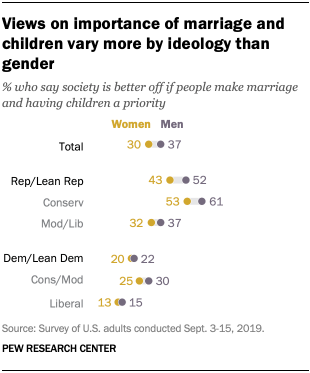
Views on importance of marriage and children vary more by ideology than gender

Overall, men (37%) are more likely than women (30%) to say that society is better off if people prioritize marriage and having children. However, these gender differences are much less pronounced than partisan and ideological differences on this question.

Among both Republican men and women, conservatives are much more likely than their moderate and liberal counterparts to say this. For example, 53% of conservative Republican women – compared with 32% of moderate and liberal Republican women – hold the view that people should prioritize starting a family, a difference of 21 percentage points.

Similarly, a far larger share of conservative Republican men (61%) than moderate and liberal Republican men (37%) say society would be better off if people prioritized marriage and having children.

Among Democrats, there are no significant gender differences in these views. Still, conservative and moderate Democratic men (30%) and women (25%) are about twice as likely to say people should prioritize marriage and children than their liberal Democratic counterparts (15% of liberal Democratic men and 13% of liberal Democratic women say this).

Most adults view legalization of same-sex marriage as positive step

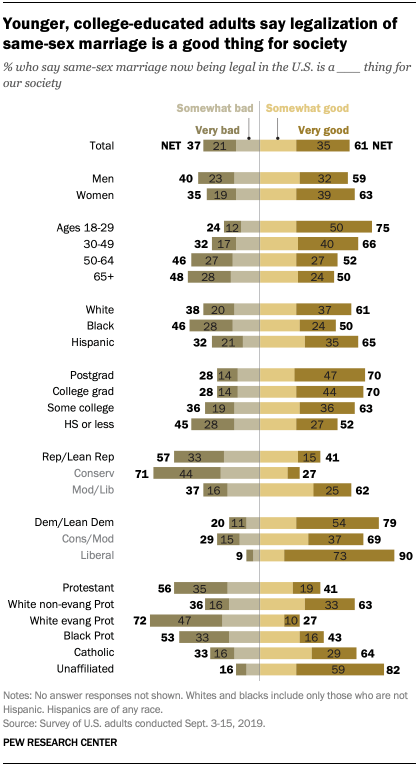
Younger, college-educated adults say legalization of same-sex marriage is a good thing for society

A majority of U.S. adults (61%) say that same-sex marriage being legal in the U.S. is a very good (35%) or somewhat good (25%) thing for society. About four-in-ten (37%) say legalization of same-sex marriage is bad, with 21% saying it is very bad.

Views of the effect of same-sex marriage on our society have grown more positive over the past year. In 2018, 56% of Americans said same-sex marriage now being legal in the U.S. was a good thing.

Over the past two decades, public support for allowing gays and lesbians to marry legally has increased dramatically. Earlier this year, 61% favored allowing gays and lesbians to marry legally.

As with support for same-sex marriage, opinions about its impact on our society differ by age, race, education, religion and partisanship.

Opinions about the effect of same-sex marriage have become more positive among members of both parties over the past year. Currently, 41% of Republicans and Republican-leaning independents say same-sex marriage has had a positive effect, up from 34% in 2018. Conservative Republicans continue to be far less likely than moderates and liberals in the GOP to have a positive view of legalization of same-sex marriage (27% and 62% respectively say it is a good thing).

Nearly eight-in-ten Democrats and Democratic leaners (79%) say the legalization of same-sex marriage has a been a good thing for our society; last year, 73% expressed this view. Although the ideological divide is less pronounced among Democrats than Republicans, liberal Democrats are more likely than conservative and moderate Democrats to say same-sex marriage is a good thing for society (90% vs. 69%).

A large majority of white evangelical Protestants (72%) and a smaller share of black Protestants (53%) say the legalization of same-sex marriage has been a bad thing for our society. By contrast, 63% of white non-evangelical Protestants say that same-sex marriage has been a good thing for our society.

Nearly two-thirds of Catholics say the legalization of same-sex marriage has been a very good (29%) or somewhat good (35%) thing for our society; 33% of Catholics say it has been a bad thing. Religiously unaffiliated adults are among the most positive about the impact of same-sex marriage: 82% say it has been a good thing for society.

Republicans differ by age in views of same-sex marriage; Democrats differ by education and race

Majority of young Republicans say same-sex marriage being legal is a good thing for society

There are stark differences in views of same-sex marriage among Republicans, with relatively modest age differences in these views among Democrats. However, there are educational divides among Democrats in these views, as well as a wide gap between the views of white and black Democrats.

A clear majority of Republicans and Republican leaners under 30 (59%) say the legalization of same-sex marriage has been a good thing for society – the highest share of any GOP age group. Those ages 30 to 49 are split in their views (50% say legal same-sex marriage has been a good thing, 49% a bad thing). Republicans ages 50 and older are less likely to have a positive view: Just 31% say legal same-sex marriage is a good thing for society.

Among Democrats, 70% or more across all age groups say same-sex marriage now being legal is a good thing for society.

Black Democrats far less likely than white Democrats to say legalizing same-sex marriage is a good thing

However, views among Democrats vary by education and race. Democrats with at least a bachelor’s degree (89%) are more likely than Democrats with no college experience (67%) to say same-sex marriage is a good thing for society.

Nearly nine-in-ten white Democrats (88%) say the legalization of same-sex marriage is good thing for society, compared with 76% of Hispanic Democrats and 52% of black Democrats. And while 67% of white Democrats say this development is very good for society, 44% of Hispanic Democrats and just 25% of black Democrats say the same.

Views on belief in God and morality

Majority of Americans say belief in God is not necessary in order to be moral

About six-in-ten Americans (63%) say it is not necessary to believe in God in order to be moral, while 36% say it is necessary to believe in God in order to be moral and have good values.

While majorities of white (67%) and Hispanic Americans (58%) say it is not necessary to believe in God in order to be moral, fewer black Americans (41%) say the same. Nearly six-in-ten black Americans (57%) say belief in God is necessary to be moral.

Majorities of adults across all age groups say that morality is not reliant on belief in God. However, adults under the age of 50 are more likely to say this (70% vs. 56% of those 50 and older).

Nearly half of adults with no more than a high school diploma (45%) say it is necessary to believe in God to be moral. That compares with 38% of those with some college experience but no degree and just 23% with more educational experience.

Similar shares of white evangelical Protestants (62%) and black Protestants (66%) say it is necessary to believe in God in order to be moral. But a large share of white non-evangelical Protestants (65%) say it is not necessary. A majority of Catholics (58%) and those without a religious affiliation (88%) also share this view.

Conservatives in both parties more likely to say belief in God is necessary to be moral

Liberal Democrats overwhelmingly say morality is not linked to belief in God

Although a majority of Americans say belief in God is not necessary for a person to be moral, there are sizable differences of opinion by partisanship and ideology.

Overall, a narrow majority of Republicans (53%) say it is not necessary to believe in God in order to be moral. Conservative Republicans are divided (52% say belief in God is necessary for morality, while 48% say it is not necessary), while a majority of moderate and liberal Republicans (61%) say morality is not contingent on belief in God.

Nearly three-quarters of Democrats (73%) say it is not necessary to believe in God in order to be moral, while 26% say this belief in God is necessary. Liberal Democrats particularly stand out for this view. An overwhelming majority of liberal Democrats (86%) say it is not necessary to believe in God in order to be moral and have good values; that compares with a smaller majority (61%) of conservative and moderate Democrats.

Among Democrats, wide racial and ethnic differences on belief in God and morality

Wide racial difference among Democrats on whether belief in God is necessary to be moral

Among Democrats, there are stark racial and ethnic differences in the importance of belief in God for morality.

While roughly nine-in-ten white Democrats (89%) say it is “not necessary to believe in God in order to be moral,” a much narrower majority of Hispanic Democrats (57%) say the same. Among black Democrats, a 55% majority says it is necessary to believe in God in order to be moral, while 44% of black Democrats say that morality is not linked to belief in God.

Public divided in views of Islam and violence

Sizable partisan gap in views of Islam and violence

The public is evenly divided in opinions about whether the Islamic religion is more likely than others to encourage violence among its believers. About half of Americans say Islam is more likely than other religions to encourage violence among its believers, while as many say that the religion does not encourage violence more than others (48% each).

As in the past, partisanship is a major factor in these attitudes. By a wide margin (72% to 25%), Republicans say Islam is more likely to encourage violence. Democrats, by nearly the same margin (69% to 28%), say Islam does not encourage violence more than other religions.

There are also wide ideological divisions within partisan groups. Conservative Republicans (81%) are more likely than moderate and liberal Republicans (59%) to say Islam encourages violence among its believers. Among Democrats, a greater share of liberal Democrats than conservative and moderate Democrats say Islam does not encourage violence more than other religions (78% vs. 62%).

These views also differ by age, level of educational attainment and religion. A majority of those under age 50 (55%) say Islam does not encourage violence more than other religions; 55% of those 50 and older say it is more likely to encourage violence.

Adults with postgraduate degrees (37%) are less likely to say that Islam encourages violence than those with a bachelor’s degree (44%), some college experience (49%) or those with a high school diploma or less education (54%).

Two-thirds of white Protestants – 55% of white non-evangelical Protestants and 74% of white evangelical Protestants – say Islam is more likely to encourage violence among its believers. However, black Protestants are more likely to say the opposite: 66% say Islam does not encourage violence more than other religions.

Among Catholics, more say that the Islamic religion encourages violence (52%) than say that it does not (44%). About six-in-ten of those who are not affiliated with a religion (61%) say the Islamic religion does not encourage violence more than other religions; 37% of those in this group say Islam does encourage violence.

Long-term opinion trends: Views of Islam and violence, importance of belief in God

In recent years, Pew Research Center has transitioned from probability-based telephone surveys to the American Trends Panel, a probability-based online panel. The transition from phone surveys conducted with an interviewer to online self-administered surveys brings with it the possibility of mode differences – differences arising from the method of interviewing.

This section includes opinion measures on whether Islam is more likely than other religions to encourage violence and whether it is necessary to believe in God to be a moral person. Both questions, which have long-standing telephone trends, were included on a survey conducted in September on the American Trends Panel (ATP), on which this report is largely based, and a contemporaneous telephone survey.

Since 2002, growing differences between Republicans and Democrats on whether Islam is more likely than other religions to encourage violence

On the American Trends Panel, 48% say the Islamic religion is more likely than others to encourage violence among its followers, while an identical share says it is not. On the telephone survey, 40% say Islam is more likely to encourage violence, while 49% say it is not. As is typically the case, the share offering no opinion is much higher on the phone survey (11%) than on the online survey (just 4%).

There are wide partisan differences evident in both modes. The telephone trend shows that these differences have increased substantially since the question was first asked in 2002. On the American Trends Panel survey, 72% of Republicans and Republican leaners say the Islamic religion encourages violence more than other religions, compared with just 28% of Democrats and Democratic leaners. The partisan gap in the shares in each party saying Islam is more likely to encourage violence is similar on the ATP (44 percentage points) and the contemporaneous phone survey (46 points).

On the American Trends Panel survey, 63% say it is not necessary to believe in God to be moral; 36% say belief in God is necessary for morality. A majority (59%) on the phone survey says belief in God is not necessary to be moral, while 39% say it is necessary.

Partisan differences on this question also have widened in recent years. In the survey conducted on the ATP, 73% of Democrats and Democratic leaners say belief in God is not a prerequisite for being moral and having good values, while 53% of Republicans and GOP leaners say the same. This partisan gap was much narrower a decade ago.

Share of Americans saying it is not necessary to believe in God in order to be moral has increased since 2002

6. Views of foreign policy

Roughly seven-in-ten Americans (73%) say that good diplomacy is the best way to ensure peace, while 26% say that military strength is the best way to do this. By a similar margin, more Americans say the U.S. should take the interests of allies into account, even if it means making compromises, than think the U.S. should follow its own national interests when allies disagree (68% vs. 31%).

Majorities say good diplomacy is best way to ensure peace, allies’ interests should be taken into account

There are stark partisan divides on both of these foreign policy values. Wide majorities of Democrats and Democratic-leaning independents see good diplomacy as the best way to ensure peace (90%) and say the U.S. should take allies’ interests into account even if that results in compromises (83%).

By comparison, Republicans and Republican leaners are more divided in both of these views. About half (53%) see good diplomacy as the best means of ensuring peace, while 46% think military strength will best achieve this. The GOP split is nearly identical in views of how to consider allies’ interests: 51% say allies’ interests should be taken into account even if it means making compromises, while 48% say America’s national interests should be followed even if allies strongly disagree.

Ideological differences within the parties over foreign policy also are evident, particularly among Republicans. A narrow majority of conservative Republicans (56%) say military strength is the best way to ensure peace, while nearly seven-in-ten moderate and liberal Republicans place more importance on good diplomacy. Democrats are more consistent in their views, with overwhelming majorities of both conservative and moderate Democrats (86%) and liberal Democrats (94%) saying good diplomacy is the best way to ensure peace.

There is a similar pattern in views about whether the U.S. should take allies’ interests into account when there is disagreement: While 55% of conservative Republicans say the U.S. should follow its own national interests even when allies disagree, a 61% majority of liberal and moderate Republicans say the U.S. should take the interests of allies into account, even it it means making compromises.

Wide majorities of Democrats across the ideological spectrum favor taking allies’ interests into account, though liberals are more likely than conservatives and moderates to say this (91% vs. 77%).

Most Democrats say playing an active role in world affairs benefits the nation

Overall, 53% of U.S. adults say “it’s best for the future of our country to be active in world affairs,” while 46% say “we should pay less attention to problems overseas and concentrate more on problems here at home.” Democrats are more likely than Republicans (62% vs. 45%) to say global engagement is best for the nation.

Most Republicans say policies should try to maintain U.S. superpower status

When it comes to America’s standing as a military superpower, 61% of the public thinks U.S. policies should try to keep it so America is the only military superpower, while 36% say it would be acceptable if another country became as militarily powerful as the U.S.

Republicans are particularly likely to say policies should focus on keeping the U.S. the only military superpower: Nearly three-quarters (74%) say this, while just 23% say it would be acceptable for another country to become as militarily powerful as the U.S. While conservative Republicans are somewhat more likely than moderate and liberal Republicans to say American foreign policy should prioritize maintaining singular superpower status (80% vs. 65%), this is the clear majority view among both ideological groups in the GOP.

Democrats are considerably more divided on this issue. Roughly half (51%) are in favor of U.S. policies that would maintain the country’s position as the only military superpower, while 46% say it would be acceptable for another country to become as militarily powerful as the U.S. There is a sizable ideological gap among Democrats in these views: 60% of conservative and moderate Democrats prioritize keeping America the only military superpower, while nearly the same share of liberal Democrats (57%) say it would be acceptable if another nation rivaled the U.S. for superpower status.

Age differences – particularly within GOP – in key foreign policy values

While majorities of adults in all age groups say the best way to ensure peace is through good diplomacy, those younger than 50 are more likely to hold this view than older Americans. And although about half of adults under 30 (48%) say it would be acceptable if another country became as militarily powerful as the U.S., only about a quarter of those 65 and older (27%) say the same. There are no substantial age differences in views of whether the U.S. should compromise with allies when there are foreign policy disagreements.

On all three of these measures of foreign policy values, there are substantial age divides within the GOP, while Democratic views differ little by age for two of the three questions.

About two-thirds of Republicans under 50 (65%) say that good diplomacy is the best way to ensure peace, while just 45% of those ages 50 to 64 and 38% of those 65 and older say the same. A similar trend in opinion is evident in views of the importance of America’s standing as a military superpower: Just 18% of Republicans ages 50 and older say it would be acceptable if another country became as militarily powerful as the U.S., compared with 25% of those ages 30 to 49 and nearly four-in-ten (38%) of those 18 to 29.

In both parties, younger adults are the most likely to say it would be acceptable for another country to rival the U.S. as a military superpower

Younger and older Republicans differ modestly when it comes to views of allies’ interests in foreign affairs. Republicans under 30 are somewhat more likely than those in older age groups to favor compromising with allies when there is disagreement (62%, compared with about half of older Republicans).

In general, age differences in these foreign policy views among Democrats are less pronounced. Roughly nine-in-ten Democrats in all age groups say that good diplomacy, rather than military strength, is the best way to ensure peace. Similarly, eight-in-ten or more Democrats in all age groups say the U.S. should take allies’ interests into account in foreign policy, even if it means making compromises.

Younger Democrats are, however, more likely than older Democrats to express a willingness to see a country other than the U.S. become a military superpower: 55% of 18- to 29-year-old Democrats and about half of 30- to 49-year-old Democrats (49%) say this, compared with only about four-in-ten Democrats ages 50 and older.

Views of U.S. involvement in global economy linked to education level

Most say U.S. involvement in global economy is a ‘good thing’

Nearly three-quarters of Americans say the country’s involvement in the global economy “is a good thing because it provides the U.S. with new markets and opportunities for growth,” while just 24% say “it is a bad thing because it lowers wages and costs jobs in the U.S.”

Republicans and Democrats offer similarly positive assessments of American involvement in the global economy. Majorities of all partisan and ideological groups say U.S. involvement in the global economy is a good thing; liberal Democrats are especially likely to take this view.

As in the past, attitudes toward U.S. involvement in the global economy are more positive among those with higher levels of educational attainment: 86% of those who have at least a four-year college degree say U.S. involvement a good thing. That compares with 73% of those who have completed some college, and a narrower majority (64%) of those who have not attended college.

Long-term trends on foreign policy values

In recent years, Pew Research Center has transitioned from probability-based telephone surveys to the American Trends Panel, a probability-based online panel. The transition from phone surveys conducted with an interviewer to online self-administered surveys brings with it the possibility of mode differences – differences arising from the method of interviewing.

This section includes opinion measures on whether the best way to ensure peace is through diplomacy or military strength; whether the U.S. should take into account the interests of allies or pursue its own national interests; and whether or not it is best for the future of the country to be active in world affairs. These measures, which have long-standing telephone trends, were included on a survey conducted in September on the American Trends Panel (ATP), on which this report is largely based, and a contemporaneous telephone survey. This allows for a comparison of any “mode effects” and places the current panel estimates in the context of telephone data.

Democrats overwhelmingly say diplomacy, rather than military strength, is the best way to ensure peace; Republicans are more divided

Americans have long held the view that peace is best ensured though diplomacy rather than military strength. However, while nearly identical shares in both modes say military strength is the best way to ensure peace (26% on the ATP survey, 28% on the contemporaneous phone survey), the share saying good diplomacy is the best way to ensure peace is 11 percentage points higher in the online self-administered survey (73% vs. 62%). This is the result of a much lower share of people refusing the question in the online format, which is a common mode difference. The same pattern is seen in both parties.

As has been the case since 1994, when the question was first asked, far more Democrats than Republicans say diplomacy is the best way to ensure peace. On the ATP, 90% of Democrats and Democratic leaners express this view, compared with 53% of Republicans and Republican leaners.

Another long-standing trend (dating to 2004) is the question of whether the U.S. should take into account the interests of allies even if it means making compromises, or whether the U.S. should follow its own interests even when allies strongly disagree.

In the online survey, 68% say that in foreign policy the U.S. should take into account the interests of its allies, even if it means making compromises with them; a smaller share (31%) says the U.S. should follow its own national interests, even when its allies strongly disagree. In the phone survey, most also say the U.S. should take into account the interests of its allies, though by a somewhat narrower margin (59% to 36%). The partisan gap, which has been evident since this question was first asked, is nearly identical in the two formats (there’s a 32 percentage point gap between the shares of Republicans and Democrats who say allies’ interests should be taken into account in the online survey; in the telephone survey the partisan gap is 31 points).


Most Americans say the U.S. should take allies’ interests into account, even if it means compromising with them

In recent years, the public has been divided on whether it is best for the future of the U.S. to be active in world affairs, or to pay less attention to problems overseas and focus on problems in this country.

In the online survey, 53% say it is best to be active in world affairs, while 46% say less attention should be paid to overseas problems; in the phone survey, 48% say it is best for the U.S. to be active internationally and 47% prefer focusing on problems in this country. Partisan differences on this measure have increased in recent years; in the American Trends Panel survey, 62% of Democrats and 45% of Republicans say it is best for the U.S. to be active globally.

Public is divided on whether it is best for the U.S. to be active in world affairs, or to pay less attention to overseas problems and focus more on problems at home

7. Domestic policy: Taxes, environment, health care

Most Americans have doubts about the fairness of the federal tax system. About six-in-ten (62%) describe the current tax system as either not too fair (39%) or not at all fair (23%). About a third describe the system as moderately fair (35%) and just 2% say it is very fair.

Overall views of the tax system are similar across levels of family income. There are much larger differences by party: Democrats are broadly critical of the fairness of the tax system, while Republicans hold more mixed views. About half of Republicans and Republican-leaning independents (48%) say the tax system is either moderately or very fair, while about as many (51%) say it is not too fair or not at all fair. By contrast, 71% of Democrats and Democratic leaners describe the federal tax system as not too fair or not at all fair; just 29% of Democrats say the system is at least moderately fair.

When asked to consider their own tax burden, 51% of adults say they pay more than their fair share in taxes, considering what they get from the federal government. Fewer adults (40%) say they pay about the right amount; just 8% say they pay less than their fair share in taxes.

About half say they pay more than their fair share of taxes

While Republicans have more positive views of the federal tax system than Democrats, they are more critical of their own tax burden. A majority of Republicans (56%) say they pay more than their fair share in taxes, compared with 38% who say they pay about the right amount. Democrats are more evenly divided: 46% say they pay more than their fair share, while 43% say they pay about the right amount.

Adults with family incomes below $30,000 a year are less critical of their own tax burden than those with higher incomes. Among those with incomes of less than $30,000 a year, 40% say they pay more than their fair share; about half or more in higher income categories say the same.

Higher-income Republicans most likely to say their tax burden is unfair

Higher-income Republicans are much more likely than lower-income Republicans to say they pay more than their fair share in taxes, considering what they get from the federal government. There are smaller differences in views among Democrats across income levels.

As a result, partisan differences in views of personal tax burdens are much larger among higher earners than lower earners. For instance, 67% of Republicans with family incomes of at least $100,000 a year say they pay more than their fair share in taxes, compared with fewer than half of Democrats (45%) in the same income range. This pattern is also seen among those with incomes of $75,000 to $99,999 a year.

By contrast, there is no partisan gap among those earning less than $75,000 a year. Similarly, 41% of both Republicans and Democrats with family incomes of less than $30,000 a year say they pay more than their fair share in taxes.

Views of tax rates for high earners and corporations

Majorities of Democrats across income levels favor raising taxes on households earning over $250,000

Overall, 58% of the public says that tax rates on household income of more than $250,000 should be raised either a lot (22%) or a little (36%). About two-in-ten (22%) think tax rates on income over $250,000 should be kept the same as they are now, while just 16% think rates should be lowered either a lot or a little.

Democrats are more likely than Republicans to favor raising tax rates on household income over $250,000. Seven-in-ten Democrats and Democratic leaners (71%) say these rates should be raised, including 31% who say they should be raised by a lot.

Views among Republicans and Republican leaners are more mixed: 44% say taxes on income over $250,000 per year should be increased, while 31% say they should be kept the same and 21% say they should be lowered.

Republicans with family incomes of at least $100,000 a year are about as likely to say tax rates on household income over $250,000 should be lowered (34%) as raised (30%). Among Republicans with lower family incomes, by contrast, there is more support for raising than lowering tax rates on high incomes. For instance, 54% of Republicans with family incomes of less than $30,000 think tax rates on household income over $250,000 should be raised, while just 16% think these rates should be lowered.

Majorities of Democrats at all income levels favor an increase in tax rates for household income above $250,000, though Democrats with incomes of less than $30,000 show somewhat less support for this policy (58% say these tax rates should be raised) than those with higher incomes (more than 70% say they should be raised).

Half of Republicans favor raising tax rates on large businesses and corporations

The public also broadly supports raising taxes on large businesses and corporations. About two-thirds (68%) say tax rates on large businesses and corporations should be increased either a lot (42%) or a little (27%). Relatively few think corporate taxes should be lowered (11%); 16% say they should be kept the same as they are now.

A wide majority of Democrats (84%) say corporate taxes should be raised either a lot (59%) or a little (25%). Most Democrats across income levels hold this view, though those with the lowest family incomes (less than $30,000) are somewhat less supportive of this than those with higher incomes.

Republicans are divided: 50% support higher taxes on businesses and corporations, while 26% favor rates staying the same and 19% say they should be lowered.

Among Republicans, those with the highest family incomes are the least supportive of raising corporate taxes: 39% of those with incomes of $100,000 a year or more support increasing taxes for large businesses and corporations, compared with about half or more of those with lower incomes.

Public sees decline in unions as bad for the country

Over the past several decades, there has been a large reduction in the percentage of workers who are represented by unions. A majority of Americans (57%) say this change has been bad for the country, while about four-in-ten (41%) say it has been good.

Partisans strongly disagree over whether the decline of organized labor has been good or bad. About six-in-ten Republicans and Republican-leaning independents (61%) say this change has been good for the country. By contrast, almost three-quarters of Democrats and Democratic leaners (74%) say the change has been bad. This divide is consistent with other recent Pew Research Center surveys showing that Democrats are much more likely to view labor unions positively than Republicans.

Conservative Republicans say the long-term decline in union membership has been good for the country

Ideological divides in views of organized labor exist within both parties. Among Republicans, 69% of conservatives say that the reduction in union representation has been good for the country. Moderate and liberal Republicans are more evenly divided: 50% say the decline has been good for the country, while 48% say it has been bad for the country.

Among Democrats, a large majority of liberals (81%) say the reduction in the share of workers represented by unions has been bad for the country; a somewhat smaller majority of conservative and moderate Democrats (68%) says the same.

In general, Republicans who are older, are wealthier and have higher levels of education are more likely to say that the decline in union representation has been good for the country than Republicans who are younger, less wealthy and have less education.

Republican attitudes toward unions differ by age, education and income

Nearly three-quarters of Republicans and Republican leaners ages 65 and older (73%) say the decline in organized labor has been good for the country. Smaller shares of Republicans ages 50 to 64 (60%), 30 to 49 (58%) and 18 to 29 (50%) hold this view.

The share of Republicans who say the reduction in union membership has been good for the country increases with income and educational attainment. A narrow majority of Republicans who have a high school diploma or less education (55%) say the decline in unions has benefited the country. Larger majorities of those with more education say the same. Similarly, Republicans with family incomes of $100,000 (73%) are more likely than those with incomes of less than $30,000 (52%) to view the decline of unions positively.

Democrats’ views about labor unions vary only slightly across age groups and levels of education and income. Majorities of all groups say the decline in unions has been bad for the country.

Views of stricter environmental laws, climate change

On environmental issues, 65% of adults say that stricter environmental laws and regulations are worth the cost, compared with 33% who say they cost too many jobs and hurt the economy.

A large majority of Democrats and Democratic leaners (85%) say stricter environmental laws are worth the cost, including 92% of liberal Democrats and 79% of conservative and moderate Democrats.

Large majority of Democrats say stricter environmental laws are worth the cost

Republicans and Republican leaners are more likely to say stricter environmental laws cost jobs and hurt the economy (55%) than that they are worth the cost (43%). However, there is a wide divide in views among Republicans by ideology. Two-thirds of conservative Republicans (who make up about two-thirds of Republicans and Republican leaners) say stricter environmental laws hurt the economy. Views among moderate and liberal Republicans are nearly the reverse: 60% say stricter environmental laws are worth the cost.

Majorities across age groups and levels of educational attainment say stricter environmental laws are worth the cost. Adults younger than 30 (74%) and those with a postgraduate degree (76%) are among the most likely to say this.

As other surveys have found, there also continue to be wide partisan differences in opinions about climate change. Among the public overall, 52% say the Earth is getting warmer mostly because of human activity, while 17% say it is getting warmer mostly due to natural patterns in the environment. About two-in-ten (21%) say there is no solid evidence that the Earth is getting warmer, and 9% say they are not sure.

Democrats, college grads, young adults are most likely to say Earth is warming due to human activity

More than three-quarters of Democrats (77%) say the Earth is getting warmer mostly because of human activity, including 87% of liberals and 68% of conservatives and moderates.

Republicans are divided in their views. Overall, 45% think the Earth is getting warmer, but this group is split between those who think this is due mostly to human activity (23% of all Republicans) and those who say it is mostly because of natural patterns (22%).

About four-in-ten Republicans (37%) say there is no solid evidence that the Earth is getting warmer, while 18% say they are not sure. This is much higher than the 2% of Democrats who express uncertainty about this.

Conservative Republicans (43%) are more likely than moderate and liberal Republicans (28%) to say there is no solid evidence the Earth is getting warmer.

Among the public, majorities of those with a four-year college degree or more education and those under the age of 50 say the Earth’s temperature is getting warmer because of human activity. Smaller shares of older adults and those with lower levels of education hold this view.

Majority of Americans say government has responsibility to ensure health coverage

A majority of the public (59%) says that the federal government has a responsibility to make sure that all Americans have health care coverage, while 41% say this is not the government’s responsibility.

Democrats divided ideologically over whether health care should be provided through single govt. program

However, most of those who say the government does not have a responsibility to provide health coverage nonetheless favor continuing programs like Medicare and Medicaid. Roughly a third of the public (35%) holds this view. Just 6% say the government should not be involved in providing health insurance at all.

Among those who say it is the government’s responsibility to make sure all Americans have health care coverage, there are differences over how to achieve this goal.

Overall, 30% of adults say government is responsible for ensuring that all Americans have health care coverage and that health insurance should be provided through a single national health insurance system run by the government. A similar share of the public (28%) thinks health care for all Americans is a government responsibility but supports providing health insurance through a mix of private companies and government programs.

Seven-in-ten Republicans and Republican leaners say it is not the government’s responsibility to make sure all Americans have health insurance. Among Republicans, conservatives (81%) are much more likely than moderates and liberals (53%) to take this view. Still, just 12% of conservative Republicans say the government should not be involved in health care at all.

Among Democrats and Democratic leaners, 83% say it is the government’s responsibility to ensure that all Americans have health care coverage, including 90% of liberals and 78% of conservatives and moderates.

Democrats differ about best way for government to ensure health coverage

While a large majority of Democrats believe that the federal government has a responsibility to guarantee access to health insurance, Democrats are divided over how government should meet this aim.

Among Democrats, 44% prefer that health insurance be provided through a single national system run by the government, while 38% prefer a mix of private insurance companies and government programs.

A majority of Democrats ages 65 and older (56%) prefer a mix of government and private insurance, compared with only 27% of those ages 18 to 29. Half of this younger group (50%) says there should be a single national government program. White Democrats (48%) are somewhat more likely to prefer a single government program than black (33%) or Hispanic (40%) Democrats.

There also is a clear ideological divide on this question among Democrats. A majority of liberal Democrats (55%) prefer a single national health insurance program run by the government, compared with 34% who prefer a mix of private and government programs.

Conservative and moderate Democrats are more evenly divided, with 35% favoring a single national program and 42% favoring a mix of programs.

Ideological differences within GOP on gun policy

Six-in-ten Americans say that gun laws should be more strict than they are today, while just 11% say gun laws should be less strict; 28% say current gun laws are about right.

Democrats overwhelmingly back stricter gun laws, GOP views are more divided

Democrats and Democratic leaners overwhelmingly support stricter gun laws, with 86% saying this. By comparison, Republicans are more divided. About half of Republicans and Republican leaners (49%) say that current gun laws are about right. Three-in-ten Republicans say that gun laws should be more strict, and two-in-ten say they should be less strict.

About half of conservative Republicans say gun laws today are about right, while 22% say they should be more strict and a similar share (25%) say they should be less strict. By comparison, 44% of moderate and liberal Republicans (who make up about one-third of Republicans and Republican leaners) say that gun laws should be stricter, while roughly as many say they are about right (42%); 13% say they should be less strict. There are only modest ideological differences among Democrats on this issue, with 81% of conservative and moderate Democrats and 90% of liberal Democrats saying gun laws should be stricter than they are today.

(For more on views about gun policy, see the October 2019 post “Share of Americans who favor stricter gun laws has increased since 2017.” )

Long-term opinion trends about stricter environmental regulation

In recent years, Pew Research Center has transitioned from probability-based telephone surveys to the American Trends Panel, a probability-based online panel. The transition from phone surveys conducted with an interviewer to online self-administered surveys brings with it the possibility of mode differences – differences arising from the method of interviewing.

This section includes a question about whether stricter environmental laws and regulations “cost too many jobs and hurt the economy” or “are worth the cost.” This question has been asked on the Center’s telephone surveys beginning in 1994 and was included both on a survey conducted in September on the American Trends Panel (ATP), on which this report is largely based, and a contemporaneous telephone survey.

Partisan gap in views of whether stricter environmental regulations are ‘worth the cost’ remains much wider than it was in the 1990s

In the online survey, 65% say stricter environmental regulations are worth the cost, while 33% say they cost too many jobs and hurt the economy. Views in the phone survey are similar (61% vs. 35%).

The wide partisan gap on this question is also roughly the same online (42 percentage point gap in the share saying stricter regulations are worth the cost) as they are in the phone survey (40-point gap).

The telephone trend shows that although the partisan divide on these views is little changed over the past five years, it has grown substantially since the question was first asked in 1994. Throughout most of the 1990s and 2000s, Republicans and Republican leaners were more likely to say regulations were worth the cost than to say they cost too many jobs and hurt the economy, but since 2011 the balance of opinion within the GOP coalition has shifted. At the same time, the trend of opinion among Democrats and Democratic leaners has moved in the opposite direction: While the view that stricter environmental regulations are worth the cost has consistently been held by a majority of Democrats, the size of that majority has grown.

Methodology

The American Trends Panel survey methodology

Most of the analysis in this report is based on a survey conducted September 3 to September 15, 2019, on Pew Research Center’s American Trends Panel. Some analysis of long-term phone trends includes a telephone survey conducted September 5 through September 16, 2019.

The American Trends Panel (ATP), created by Pew Research Center, is a nationally representative panel of randomly selected U.S. adults. Panelists participate via self-administered web surveys. Panelists who do not have internet access at home are provided with a tablet and wireless internet connection. The panel is being managed by Ipsos.

Data in this report are drawn from the panel wave conducted September 3 to September 15, 2019. A total of 9,895 panelists responded out of 10,478 who were sampled, for a response rate of 94%. This does not include four panelists who were removed from the data due to extremely high rates of refusal or straightlining. The cumulative response rate accounting for nonresponse to the recruitment surveys and attrition is 5.9%. The break-off rate among panelists who logged onto the survey and completed at least one item is 0.8%. The margin of sampling error for the full sample of 9,895 respondents is plus or minus 1.5 percentage points.

American Trends Panel recruitment surveys

The sample consisted of all existing panelists who had completed the annual profile survey as of August 25, 2019. Panelists who had not yet completed the profile survey were ineligible.

The ATP was created in 2014, with the first cohort of panelists invited to join the panel at the end of a large, national, landline and cellphone random-digit-dial survey that was conducted in both English and Spanish. Two additional recruitments were conducted using the same method in 2015 and 2017, respectively. Across these three surveys, a total of 19,718 adults were invited to join the ATP, of which 9,942 agreed to participate.

In August 2018, the ATP switched from telephone to address-based recruitment. Invitations were sent to a random, address-based sample (ABS) of households selected from the U.S. Postal Service’s Delivery Sequence File. In each household, the adult with the next birthday was asked to go online to complete a survey, at the end of which they were invited to join the panel. For a random half-sample of invitations, households without internet access were instructed to return a postcard. These households were contacted by telephone and sent a tablet if they agreed to participate. A total of 9,396 were invited to join the panel, and 8,778 agreed to join the panel and completed an initial profile survey. Of the 18,720 individuals who have ever joined the ATP, 10,478 remained active panelists and continued to receive survey invitations at the time this survey was conducted.
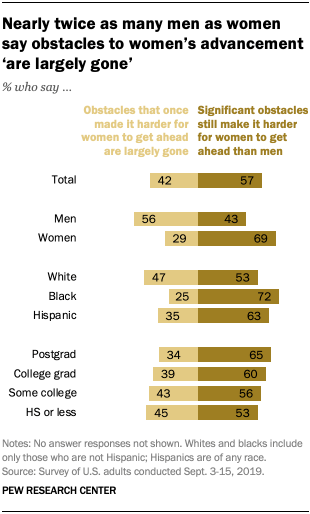
The U.S. Postal Service’s Delivery Sequence File has been estimated to cover as much as 98% of the population, although some studies suggest that the coverage could be in the low 90% range.1

Weighting

Weighting dimensions

The ATP data were weighted in a multistep process that begins with a base weight incorporating the respondents’ original survey selection probability and the fact that in 2014 and 2017 some respondents were subsampled for invitation to the panel. The next step in the weighting uses an iterative technique that aligns the sample to population benchmarks on the dimensions listed in the accompanying table.

Sampling errors and test of statistical significance take into account the effect of weighting. Interviews are conducted in both English and Spanish, but the American Trends Panel’s Hispanic sample is predominantly U.S. born and English speaking.

In addition to sampling error, one should bear in mind that question wording and practical difficulties in conducting surveys can introduce error or bias into the findings of opinion polls.

The following table shows the unweighted sample sizes and the error attributable to sampling that would be expected at the 95% level of confidence for different groups in the survey:

Unweighted sample sizes and error attributable to sampling expected at the 95% level of confidence for different groups in survey

Sample sizes and sampling errors for other subgroups are available upon request.

Survey conducted September 5-16, 2019, via telephone

Some analysis in this report is based on telephone interviews conducted September 5 to September 16, 2019, among a national sample of 2,004 adults, 18 years of age or older, living in all 50 U.S. states and the District of Columbia (401 respondents were interviewed on a landline telephone, and 1,603 were interviewed on a cellphone, including 1,106 who had no landline telephone). The survey was conducted by interviewers under the direction of Abt Associates. A combination of landline and cellphone random-digit-dial samples were used; both samples were provided by Survey Sampling International, LLC. Interviews were conducted in English and Spanish. Respondents in the landline sample were selected by randomly asking for the youngest adult male or female who is now at home. Interviews in the cell sample were conducted with the person who answered the phone, if that person was an adult 18 years of age or older. The weighting procedure corrected for the different sampling rates. For detailed information about our survey methodology, see U.S. Survey Research.

The combined landline and cellphone sample is weighted using an iterative technique that matches gender, age, education, race, Hispanic origin and nativity, and region to parameters from the Census Bureau’s 2017 American Community Survey one-year estimates and population density to parameters from the decennial census. The sample also is weighted to match current patterns of telephone status (landline only, cellphone only, or both landline and cellphone), based on extrapolations from the 2018 National Health Interview Survey. The weighting procedure also accounts for the fact that respondents with both landline and cellphones have a greater probability of being included in the combined sample and adjusts for household size among respondents with a landline phone.

Appendix