Public’s Priorities for U.S. Asylum Policy: More Judges for Cases, Safe Conditions for Migrants
Most continue to favor legal status for undocumented immigrants
The American public is broadly critical of the way that the federal government is dealing with the increased number of people seeking asylum at the U.S.-Mexico border. When it comes to what should be done about the situation, large majorities say it is important to increase the number of judges handling asylum cases and to provide safe and sanitary conditions for asylum seekers.

Nearly two-thirds of Americans (65%) say the federal government is doing a very bad (38%) or somewhat bad (27%) job dealing with the increased number of people seeking asylum at the U.S.-Mexico border; just 33% say the government is doing a good job, according to the new survey by Pew Research Center conducted July 22-Aug. 4 among 4,175 adults.
In assessing the situation at the U.S.-Mexico border, the public views several goals as important. But more people give priority to addressing the backlog of asylum cases and improving conditions for asylum seekers than to making it harder – or easier – for asylum seekers to be granted legal status.
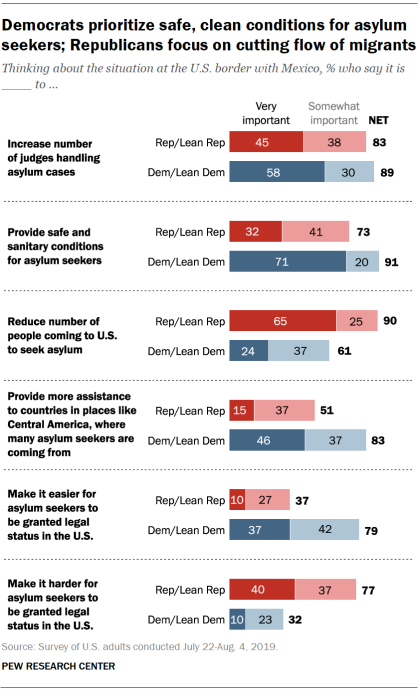
Overall, 86% say it is either very (52%) or somewhat (34%) important to increase the number of judges handling asylum cases. Nearly as many (82%) say it is important to provide safe and sanitary conditions for asylum seekers once they arrive in the United States, including 52% who say this is very important.
The public also emphasizes stemming the flow of people to the border: 74% say it is at least somewhat important to reduce the number of people coming to the U.S. to seek asylum, and 69% say it is important to provide more assistance to countries in places like Central America, where many asylum seekers are coming from.
Fairly similar shares of the public view as at least somewhat important the conflicting goals of making it easier (60%) or harder (53%) for asylum seekers to be granted legal status in the U.S. These views are deeply divided along partisan lines, with 77% of Republicans saying it is important to make it more difficult for asylum seekers to gain legal status and a comparable majority of Democrats (79%) saying it is important to make this process easier.
The survey also finds:
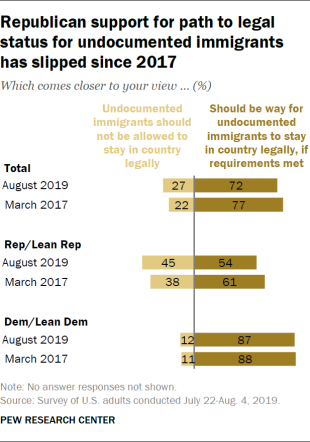
Broad public support for path to legal status for undocumented immigrants. Nearly three-quarters of Americans (72%) say undocumented immigrants should be allowed to stay in the U.S. legally if certain conditions are met. This is a modest decline from 77% in March 2017, with most of the change occurring among Republicans.
Most Americans say people who are in the U.S. illegally are no more likely than citizens to commit serious crimes. Nearly seven-in-ten (69%) say this. Large majorities also say undocumented immigrants mostly fill the jobs that American citizens don’t want (77%) and are as honest and hardworking as American citizens (73%).
As many agree with the Republican Party as with the Democratic Party on illegal immigration. Among the public overall, 40% say they agree with the Democratic Party’s policies on illegal immigration and 39% agree with the GOP’s positions; 19% don’t agree with either party on this issue. Republicans are more likely than Democrats to agree with their own party on illegal immigration.
Partisans’ priorities for U.S. asylum policy
In many respects, Republicans and Democrats differ in their priorities for the situation at the border, especially over the process for granting legal status to asylum seekers. However, there are some areas of general agreement.
For instance, majorities of Democrats and Democratic-leaning independents (89%) and Republicans and Republican leaners (83%) say it is important to increase the number of judges handling asylum cases. However, a larger share of Democrats (58%) than Republicans (45%) rate this as very important.
On other dimensions as well, there are pronounced partisan differences in the intensity of sentiment. For example, majorities in each party say it is at least somewhat important that asylum seekers are provided safe and sanitary conditions once they arrive in the U.S. (91% of Democrats, 73% of Republicans).
However, Democrats are more than twice as likely as Republicans to say providing safe and sanitary conditions for asylum seekers is very important (71% vs. 32%).
By contrast, while majorities in both parties say it is important to reduce the number of people coming to the U.S. to seek asylum, 65% of Republicans say this is very important, compared with just 24% of Democrats.
Partisans take opposing views on how difficult the process of asylum seekers being granted legal status should be. Most Republicans (77%) say it’s important to make it harder for asylum seekers to be granted legal status in the U.S., though fewer than half (40%) say this is very important. Just a third of Democrats view this as important.
Most Democrats (79%) say it is important to make it easier for asylum seekers to be granted legal status; a much smaller share of Republicans (37%) say the same.
However, just 37% of Democrats say it is very important to make it easier for asylum seekers to get legal status; far larger shares of Democrats place high importance on increasing the number of judges handling asylum cases (58%) and providing safe and sanitary conditions to asylum seekers (71%).
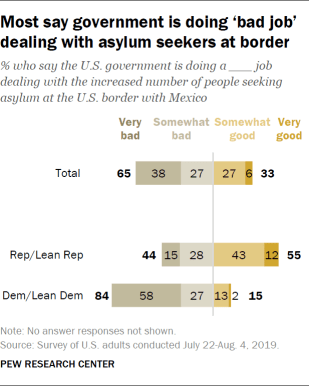
The public is highly critical of the way the government is dealing with asylum seekers. While there are clear partisan differences in these views, a sizable minority of Republicans and Republican leaners (44%) say the government is doing a bad job in dealing with the increased number of asylum seekers at the border; 55% say the government is doing a good job.
A substantial majority of Democrats and Democratic leaners (84%) say the government is doing a bad job – with 58% saying it is doing a very bad job.
Majority continues to favor path to legal status for undocumented immigrants in U.S.
When it comes to undocumented immigrants who are currently living in the U.S. illegally, a majority of Americans continue to support a way for them to stay in the country legally.
Overall, 72% say there should be a way for undocumented immigrants to stay in the country legally, if certain requirements are met; far fewer (27%) say there should not be a way for undocumented immigrants to stay in the country legally. The share who supports a path to legal status for undocumented immigrants has edged lower since March 2017 (from 77%), driven by a shift in Republican views.
Among Republicans and Republican leaners, 54% say there should be a way for undocumented immigrants to stay in the country legally, compared with 45% who say there should not be a path to legal status. In March 2017, Republicans supported a path to legal status by a wider margin (61% to 38%).
In the current survey, conservative Republicans are especially skeptical about legal status for undocumented immigrants living in the U.S.: 47% support a way for them to stay in the country legally, while 52% are against this. By comparison, 63% of moderate and liberal Republicans say there should be a way for undocumented immigrants to stay in the country legally.
Democrats and Democratic leaners overwhelmingly support a way for undocumented immigrants to gain legal status, if certain requirements are met: 87% support this, which is virtually unchanged from two years ago. Comparable majorities of liberal Democrats (91%) and conservative and moderate Democrats (85%) back a path to legal status.
In a follow-up question, most of those who are against a path to legal status for undocumented immigrants say they would support a national law enforcement effort to deport all immigrants who are now living in the U.S. illegally. Overall, 23% of the public opposes legal status for undocumented immigrants and supports a national effort to deport all immigrants living in the country illegally. Among Republicans and Republican leaners, 42% – including nearly half (49%) of conservative Republicans — would support an effort to deport all undocumented immigrants in the U.S.
Most say undocumented immigrants fill jobs U.S. citizens don’t want
The public expresses relatively positive views of undocumented immigrants currently in the U.S. when asked to consider traits such as honesty and hard work, their likelihood to commit serious crimes and their impact on jobs.
About three-quarters (77%) say undocumented immigrants mostly fill jobs American citizens don’t want; just 20% say they fill jobs citizens would like to have. In addition, 73% say undocumented immigrants are as honest and hardworking as American citizens and 69% say they are no more likely than citizens to commit serious crimes.
Nearly nine-in-ten Democrats say undocumented immigrants are as honest and hardworking as U.S. citizens (89%), mostly fill jobs citizens do not want (88%) and are no more likely than citizens to commit serious crimes (88%).
Republicans are less positive in their views of undocumented immigrants. Still, nearly two-thirds of Republicans (64%) say undocumented immigrants in the U.S. mostly take jobs citizens do not want, and a narrow majority (54%) say they are as honest and hardworking as U.S. citizens.
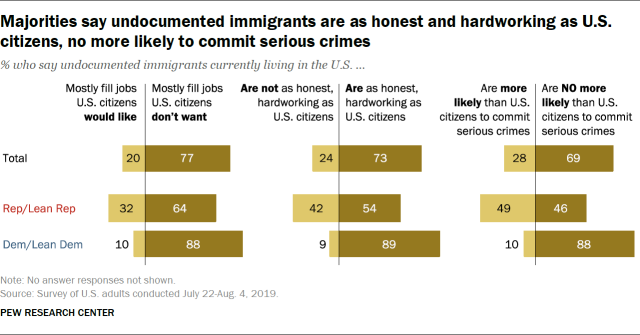
Republicans are divided on whether undocumented immigrants are more likely than U.S. citizens to commit serious crimes: 49% say they are more likely to do this, while 46% say they are not. Among conservative Republicans, 54% say undocumented immigrants are more likely than citizens to commit serious crimes; fewer moderate and liberal Republicans (43%) express this view.
Similar shares of the public agree with each party’s approaches in dealing with illegal immigration
Republicans are more likely than Democrats to agree with their own party’s policies on illegal immigration. The gap is especially wide on strong agreement with their party on this issue.
Among the public overall, 40% say they agree with the Democratic Party on illegal immigration, while about as many (39%) agree with the Republican Party. Large shares of partisans favor their own side’s positions, but views are not entirely parallel.
Overall, 77% of Republicans and Republican leaners say they agree with their own party’s policies to deal with illegal immigration. A slightly smaller majority of Democrats and Democratic leaners (70%) say they agree with the Democratic Party’s policies on the issue. In addition, a greater share of Republicans (54%) than Democrats (37%) say they strongly agree with their own party’s stance on illegal immigration.
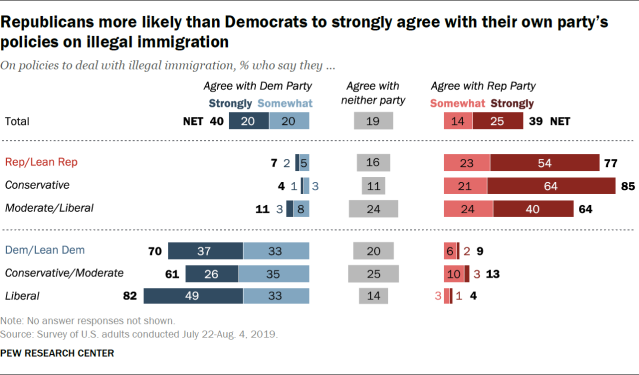
Among Republicans, conservatives (85%) are more likely to agree with their party’s positions on illegal immigration than moderates and liberals (64%). Similarly, a larger share of liberal Democrats (82%) than conservative and moderate Democrats (61%) agree with their own party’s positions on the issue.