
Pew Research Center

FOR RELEASE JULY 11, 2018

Obama Tops Public’s List of Best President in Their Lifetime, Followed by Clinton, Reagan

Reagan is top choice among Boomers, Silents

FOR MEDIA OR OTHER INQUIRIES:

Communications Department
202.419.4372
www.pewresearch.org

RECOMMENDED CITATION

Pew Research Center, July 2018, "Obama Tops Public’s List of Best President in Their Lifetime, Followed by Clinton, Reagan"

About Pew Research Center

Pew Research Center is a nonpartisan, nonadvocacy fact tank that informs the public about the issues, attitudes and trends shaping the world. It does not take policy positions. The Center conducts public opinion polling, demographic research, computational social science research and other data-driven research. It studies politics and policy; news habits and media; the internet and technology; religion; race and ethnicity; international affairs; social, demographic and economic trends; science; research methodology and data science; and immigration and migration. Pew Research Center is a subsidiary of The Pew Charitable Trusts, its primary funder.

© Pew Research Center 2026

Table of contents

  • About Pew Research Center
  • Obama Tops Public’s List of Best President in Their Lifetime, Followed by Clinton, Reagan
  • Methodology

Obama Tops Public’s List of Best President in Their Lifetime, Followed by Clinton, Reagan

Reagan is top choice among Boomers, Silents

Survey Report

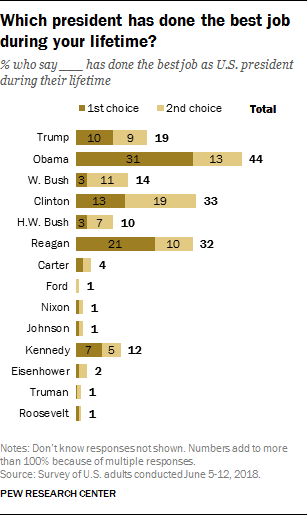
When asked which president has done the best job in their lifetimes, more Americans name Barack Obama than any other president. More than four-in-ten (44%) say Obama is the best or second best president of their lifetimes, compared with about a third who mention Bill Clinton (33%) or Ronald Reagan (32%).
Which president has done the best job during your lifetime?

Not yet halfway through his term, 19% say Donald Trump has done the best or second best job of any president of their lifetimes. That is comparable with the share who viewed Obama as one of the best presidents in 2011 (20%).

The survey by Pew Research Center, conducted June 5-12 among 2,002 adults, asks people in an open-ended format which president has done the best job in their lifetimes. The analysis is based on their first and second choices.

About one-in-ten adults (12%) say John F. Kennedy did the best job in office during their lifetimes. But Kennedy is named as the best or second best president by about a quarter of those who were alive during his presidency: 24% of Baby Boomers and 25% of those in the Silent Generation.

Generations’ views of the best president

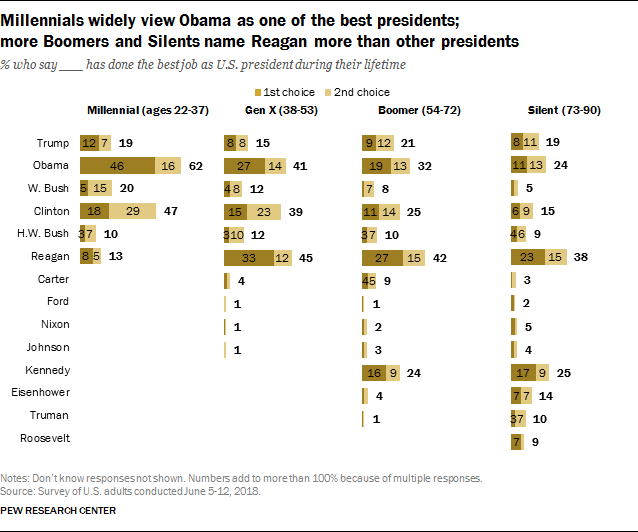
People’s views of the best president of their lifetimes are partly tied to their ages. Millennials, who are currently ages 22 to 37, are far more likely than older generations to name Obama as one of the best presidents in their lifetimes: About six-in-ten Millennials (62%) view Obama as one of the top two, with nearly half, 46%, naming him the best president.

Older generations are much more likely than Millennials to name Reagan as one of the best presidents. Reagan was president before most Millennials were born.

Gen Xers (ages 38 to 53) are divided in their assessments: 45% of Gen Xers name Reagan, while nearly as many mention Obama (41%) or Clinton (39%).
Millennials widely view Obama as one of the best presidents; more Boomers and Silents name Reagan than other presidents

Reagan is the top choice among Boomers (ages 54 to 72) and Silents (ages 73 to 90); about four-in-ten in the two older generations name Reagan (42% of Boomers, 38% of Silents). But within both generations, there are a range of opinions, with Obama, Kennedy, Clinton and Trump all receiving mentions from 15% or more Boomers and Silents.

Changing views of the best president
More Americans name Obama as best president than did so in 2011; share citing Clinton has declined

As was the case in 2011, many people, including many in the president’s own party, do not name the current president as the best in their lifetimes.

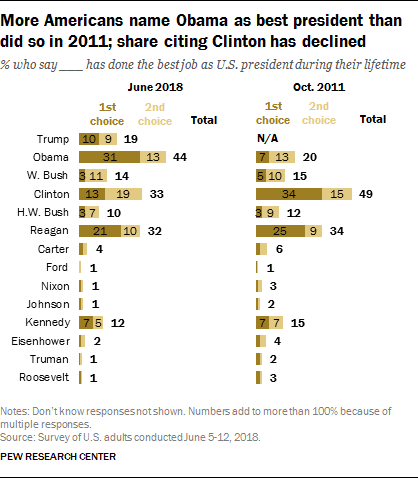
Currently, 44% name Obama as their first or second choice for having done the best job of any president of their lifetimes, while 33% name Clinton, 32% Reagan and 19% Trump. In 2011, 49% said Clinton had been one of the top two presidents, compared with 34% who cited Reagan and 20% who mentioned Obama.

The share naming Obama has more than doubled since 2011 (from 20% to 44%), while the share mentioning Clinton has declined, from 49% to 33%.

The ratings for other presidents have not changed much since 2011: 32% cite Reagan (34% in 2011); 14% name George W. Bush (15% then); and 12% name Kennedy (15% then).

Partisan differences in views of best president

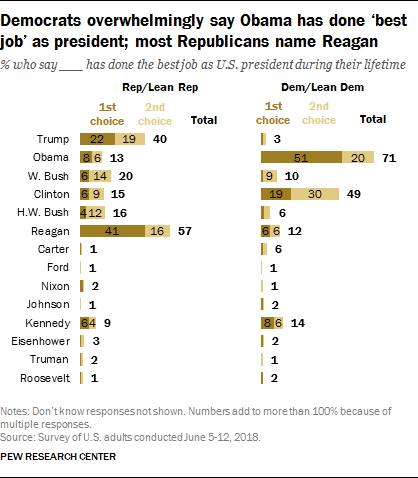
A sizable majority of Democrats and Democratic-leaning independents say Barack Obama (71%) is the best (51%) or second best (20%) president in their lifetimes. About half of Democrats name Clinton (49%). Another 14% of Democrats name Kennedy as one of their top two, 12% name Reagan and 10% mention George W. Bush.
Democrats overwhelmingly say Obama has done ‘best job’ as president; most Republicans name Reagan

In 2011, Clinton was named most often as the best or second best president by 69% of Democrats, while 36% named Obama.

A majority of Republicans and Republican-leaning independents say Reagan (57%) ranks in the top two presidents in their lifetimes. Another 40% of Republicans name Trump, while 20% name George W. Bush, 16% name George H.W. Bush and 15% mention Clinton.

Republicans’ choices for the best president also have changed since 2011, though the share pointing to Reagan has not changed since then (57%).

Republicans are less likely to name Clinton than in 2011 (28% then, 15% today), while somewhat more say Obama has done the best job of any president of their lifetimes (5% then, 13% today).

Republicans’ evaluations of other presidents, Republican and Democratic, have changed little. One-in-five Republicans say George W. Bush is the best president of their lifetimes (27% said this in 2011); 16% say Bush’s father, George H.W. Bush, is the best president (20% in 2011).

Methodology

The analysis in this report is based on telephone interviews conducted June 5-12, 2018 among a national sample of 2,002 adults, 18 years of age or older, living in all 50 U.S. states and the District of Columbia (502 respondents were interviewed on a landline telephone, and 1,500 were interviewed on a cell phone, including 998 who had no landline telephone). The survey was conducted by interviewers under the direction of Abt Associates. A combination of landline and cell phone random digit dial samples were used; both samples were provided by Survey Sampling International, LLC. Interviews were conducted in English and Spanish. Respondents in the landline sample were selected by randomly asking for the youngest adult male or female who is now at home. Interviews in the cell sample were conducted with the person who answered the phone, if that person was an adult 18 years of age or older. For detailed information about our survey methodology, see https://alpha.pewresearch.org/pewresearch-org/methodology/u-s-survey-research/.


The combined landline and cell phone sample is weighted using an iterative technique that matches gender, age, education, race, Hispanic origin and nativity and region to parameters from the 2016 Census Bureau’s American Community Survey one-year estimates and population density to parameters from the Decennial Census. The sample also is weighted to match current patterns of telephone status (landline only, cell phone only, or both landline and cell phone), based on extrapolations from the 2016 National Health Interview Survey. The weighting procedure also accounts for the fact that respondents with both landline and cell phones have a greater probability of being included in the combined sample and adjusts for household size among respondents with a landline phone. The margins of error reported and statistical tests of significance are adjusted to account for the survey’s design effect, a measure of how much efficiency is lost from the weighting procedures.

The following table shows the unweighted sample sizes and the error attributable to sampling that would be expected at the 95% level of confidence for different groups in the survey:

Methodology

Sample sizes and sampling errors for other subgroups are available upon request.

In addition to sampling error, one should bear in mind that question wording and practical difficulties in conducting surveys can introduce error or bias into the findings of opinion polls.

Pew Research Center undertakes all polling activity, including calls to mobile telephone numbers, in compliance with the Telephone Consumer Protection Act and other applicable laws.

Pew Research Center is a nonprofit, tax-exempt 501(c)(3) organization and a subsidiary of The Pew Charitable Trusts, its primary funder.