Pew Research Center

FOR RELEASE OCTOBER 5, 2017

The Partisan Divide on Political Values Grows Even Wider

Sharp shifts among Democrats on aid to needy, race, immigration

FOR MEDIA OR OTHER INQUIRIES:

Communications Department
202.419.4372
www.pewresearch.org

RECOMMENDED CITATION

Pew Research Center, October 2017, "The Partisan Divide on Political Values Grows Even Wider"

About Pew Research Center

Pew Research Center is a nonpartisan, nonadvocacy fact tank that informs the public about the issues, attitudes and trends shaping the world. It does not take policy positions. The Center conducts public opinion polling, demographic research, computational social science research and other data-driven research. It studies politics and policy; news habits and media; the internet and technology; religion; race and ethnicity; international affairs; social, demographic and economic trends; science; research methodology and data science; and immigration and migration. Pew Research Center is a subsidiary of The Pew Charitable Trusts, its primary funder.

© Pew Research Center 2026

Table of contents

  • About Pew Research Center
  • The Partisan Divide on Political Values Grows Even Wider
  • 1. Partisan divides over political values widen
  • 2. Government, regulation and the social safety net
  • 3. Foreign policy
  • 4. Race, immigration and discrimination
  • 5. Homosexuality, gender and religion
  • 6. Economic fairness, corporate profits and tax policy
  • 7. Global warming and environmental regulation, personal environmentalism
  • 8. Partisan animosity, personal politics, views of Trump
  • Methodology

The Partisan Divide on Political Values Grows Even Wider

Sharp shifts among Democrats on aid to needy, race, immigration

Overview

The divisions between Republicans and Democrats on fundamental political values – on government, race, immigration, national security, environmental protection and other areas – reached record levels during Barack Obama’s presidency. In Donald Trump’s first year as president, these gaps have grown even larger.
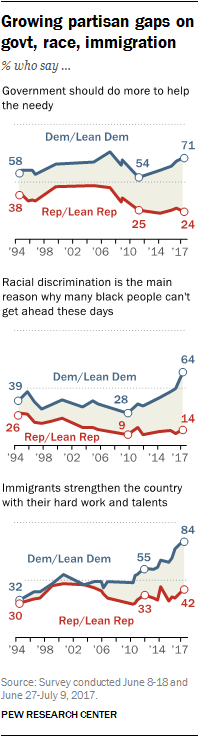
Growing partisan gaps on govt, race, immigration

And the magnitude of these differences dwarfs other divisions in society, along such lines as gender, race and ethnicity, religious observance or education.

A new study by Pew Research Center, based on surveys of more than 5,000 adults conducted over the summer, finds widening differences between Republicans and Democrats on a range of measures the Center has been asking about since 1994, as well as those with more recent trends. But in recent years, the gaps on several sets of political values in particular – including measures of attitudes about the social safety net, race and immigration – have increased dramatically.

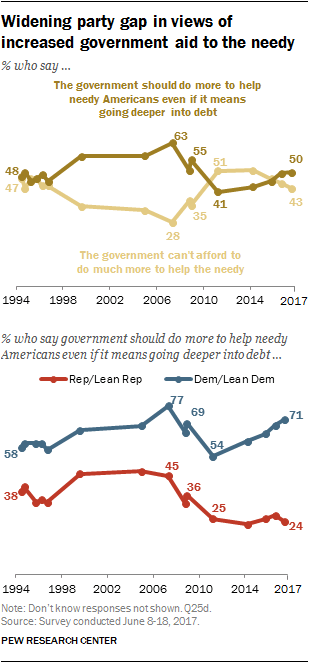
Government aid to needy. Over the past six years, the share of Democrats and Democratic-leaning independents saying the government should do more to help the needy, even if it means going deeper into debt, has risen 17 percentage points (from 54% to 71%), while the views of Republicans and Republican leaners have barely changed (25% then, 24% today). However, Republicans’ opinions on this issue had shifted substantially between 2007 and 2011, with the share favoring more aid to the needy falling 20 points (from 45% to 25%).

The result: While there has been a consistent party gap since 1994 on government aid to the poor, the divisions have never been this large. In 2011, about twice as many Democrats as Republicans said the government should do more for the needy (54% vs. 25%). Today, nearly three times as many Democrats as Republicans say this (71% vs. 24%).

Racial discrimination. In recent years, Democrats’ views on racial discrimination also have changed, driving an overall shift in public opinion. Currently, 41% of Americans say racial discrimination is the main reason many blacks cannot get ahead – the largest share expressing this view in surveys dating back 23 years. Still, somewhat more Americans (49%) say blacks who cannot get ahead are mostly responsible for their own condition.

When the racial discrimination question was first asked in 1994, the partisan difference was 13 points. By 2009, it was only somewhat larger (19 points). But today, the gap in opinions between Republicans and Democrats about racial discrimination and black advancement has increased to 50 points.

Immigration. Nearly two-thirds of Americans (65%) say immigrants strengthen the country “because of their hard work and talents.” Just 26% say immigrants are a burden “because they take our jobs, housing and health care.” Views of immigrants, though little changed from a year ago, are more positive than at any point in the past two decades.

As with views of racial discrimination, there has been a major shift in Democrats’ opinions about immigrants. The share of Democrats who say immigrants strengthen the country has increased from 32% in 1994 to 84% today. By contrast, Republicans are divided in attitudes about immigrants: 42% say they strengthen the country, while 44% view them as a burden. In 1994, 30% of Republicans said immigrants strengthened the country, while 64% said they were a burden.

“Peace through strength.” About six-in-ten Americans (61%) say good diplomacy is the best way to ensure peace, while 30% say peace is ensured by military strength. Opinions in both parties have changed since the 1990s; Democrats increasingly say peace is ensured by good diplomacy, while Republicans say it is military strength that ensures peace. Today, 83% of Democrats and Democratic leaners see good diplomacy as the way to ensure peace, compared with just 33% of Republicans and Republican leaners.

The surveys were conducted June 8-18 among 2,504 adults and June 27-July 9 among 2,505 adults, with a follow-up survey conducted Aug. 15-21 among 1,893 respondents. This report was made possible by The Pew Charitable Trusts, which received support for the surveys from The William and Flora Hewlett Foundation.

Party gaps much larger than demographic differences

The partisan shifts on political values over the past 23 years have had different trajectories across different sets of issues. While there has been greater movement among Democrats than Republicans on several issues, on others Republicans have shown more change.

In views of stricter environmental laws and regulations, for example, there has been a larger long-term change among Republicans than Democrats. Republicans are far less supportive of stricter environmental laws than they were in the mid-1990s, while Democrats have become somewhat more supportive.

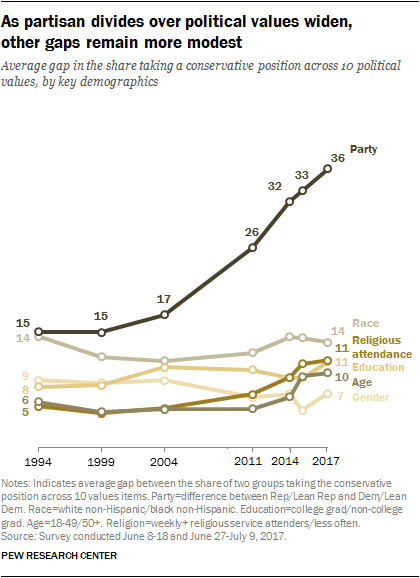
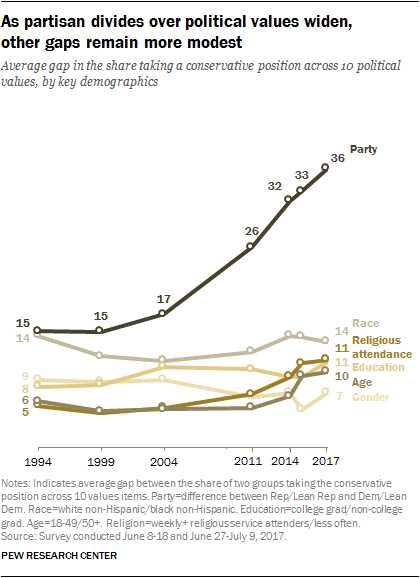
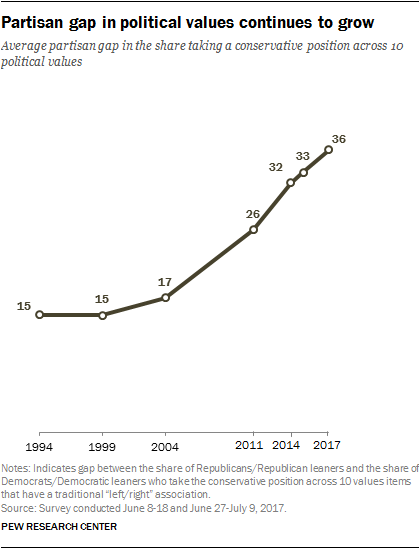
But the bottom line is this: Across 10 measures that Pew Research Center has tracked on t
As partisan divides over political values widen, other gaps remain more modest

he same surveys since 1994, the average partisan gap has increased from 15 percentage points to 36 points.

Two decades ago, the average partisan differences on these items were only somewhat wider than differences by religious attendance or educational attainment and about as wide as the differences between blacks and whites (14 points, on average). Today, the party divide is much wider than any of these demographic differences.

Partisan gaps have grown even on measures in which opinion in both parties has moved in the same direction, such as support for societal acceptance of homosexuality. Currently, 70% of Americans say homosexuality should be accepted – the highest percentage ever.

For the first time, a majority of Republicans (54%) favor acceptance of homosexuality; just 38% did so in 1994. Yet over this period, the increase in the share of Democrats saying homosexuality should be accepted has been much larger (from 54% to 83%). As a result, partisan differences have gotten larger.

The surveys find that while Republicans and Democrats have grown further apart, there are sizable divisions within both parties on many political values. Younger Republicans differ from older Republicans in attitudes about immigration and several other issues. Among Republicans and Republican leaners younger than 30, 62% say immigrants strengthen the country; half as many Republicans ages 65 and older say the same (31%).

In recent years, there has been a decline in the share of Democrats who say that most people can get ahead if they work hard. Only about half of Democrats (49%) express this view, down from 58% three years ago. A large majority of Republicans (77%) continue to say hard work pays off for most people.

Democrats are divided by education and race in their views of hard work and success. White Democrats and those with higher levels of education are less likely than nonwhite Democrats and those with less education to say that hard work leads to success.

Other important findings

Partisan antipathy remains extensive. The shares of Republicans and Democrats who express very unfavorable opinions of the opposing party have increased dramatically since the 1990s, but have changed little in recent years. Currently, 44% of Democrats and Democratic leaners have a very unfavorable opinion of the GOP, based on yearly averages of Pew Research Center surveys; 45% of Republicans and Republican leaners view the Democratic Party very unfavorably. In 1994, fewer than 20% in both parties viewed the opposing party very unfavorably.
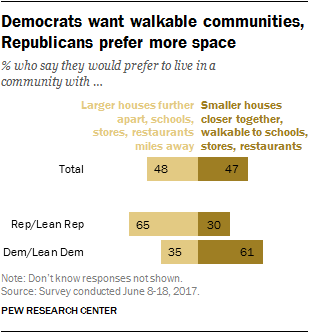
Democrats want walkable communities, Republicans prefer more space

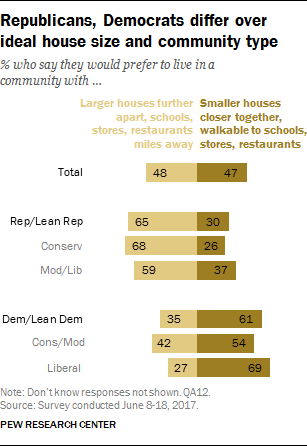
Big house, small house. Our studies of political polarization and partisan antipathy both found that the disagreements between Republicans and Democrats go far beyond political values and issues. They also have markedly different preferences about where they would like to live. Most Republicans (65%) say they would rather live in a community where houses are larger and farther apart and where schools and shopping are not nearby. A majority of Democrats (61%) prefer smaller houses within walking distance of schools and shopping.

Deep differences over factors for nation’s success. About half of Americans (52%) attribute the country’s success more to “its ability to change,” while 43% say the nation’s “reliance on long-standing principles” has been more important. Most Democrats (68%) link the nation’s success more to its ability to change, while 61% of Republicans point to its reliance on principles. In addition, there are wide age differences, with young people far more likely than older adults to say America’s success is mainly linked to its ability to change.
1. Partisan divides over political values widen

The gap between the political values of Democrats and Republicans is now larger than at any point in Pew Research Center surveys dating back to 1994, a continuation of a steep increase in the ideological divisions between the two parties over more than a decade.

The subsequent chapters explore Americans’ attitudes across individual political values and policy issues, in most cases including data dating back to the late 1990s or early 2000s. In nearly every domain, across most of the roughly two dozen values questions tracked, views of Republicans and Republican-leaning independents and those of Democrats and Democratic leaners are now further apart than in the past.

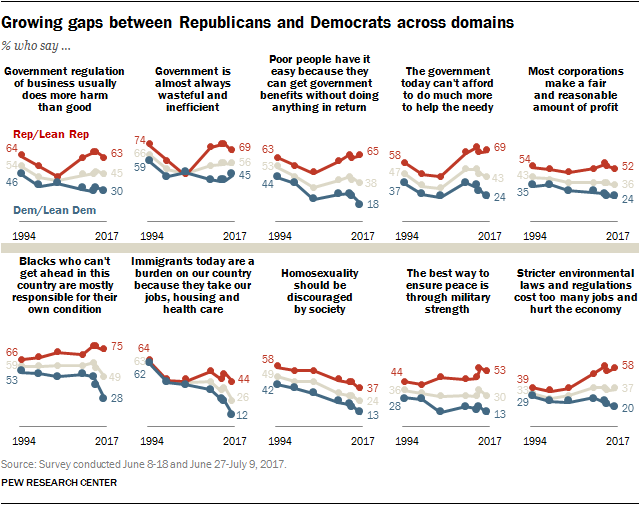
Growing gaps between Republicans and Democrats across domains

While the overall partisan gap across a variety of political values has steadily grown, the dynamic underlying the growing gap differs across issue areas. In some cases, the gap has grown because the parties have moved in different directions, with growing shares of Democrats taking liberal positions and increasing shares of Republicans taking conservative positions. But in other areas, shifts are greater among one set of partisans than another.

In a few issue areas, notably views of homosexuality and of immigrants, public opinion in both parties has clearly shifted in a more liberal direction over the past several decades. Nevertheless, the partisan gaps on both of these values have gotten wider over the past two decades, as the long-term shifts are more pronounced among Democrats than Republicans.

Overall partisan gap widens over two decades

Partisan gap in political values continues to grow

The 10 political values questions shown above have been asked together in surveys seven times since 1994. On average, there is now a 36-percentage-point difference between Democrats and Republicans across these questions. The current gap represents a modest increase in the partisan divide over the past two years (from 33 points in 2015), but it is substantially wider than two decades ago (the gap was just 15 points in 1994).

Looking at the identical set of items over more than two decades provides a picture of a growing partisan divide. While this analysis is limited to questions consistently asked together going back to 1994, other political values and policy questions that have long trends show a similar pattern of growing partisan divides.

For example, a question about whether Islam is more likely than other religions to encourage violence among its followers is not included among the 10 measures asked since 1994 (it was first asked in 2002). But partisan differences in these attitudes have increased steadily over the past 15 years. What was an 11-percentage-point difference on this question in 2002 now stands at 40 percentage points.

And a question about whether it is more important to control gun ownership or protect gun rights – first asked in 1993 – shows a similar trend of widening differences.

It is important to note that while members of the two parties have grown further apart over the past two decades, this does not necessarily mean there has been a rise in politically “extreme” thinking among either Republicans or Democrats, as Pew Research Center’s 2014 study of political polarization found.

Other societal divisions less pronounced than partisan differences

As partisan divides over political values widen, other gaps remain more modest

The extent of the partisan divide across the 10 political values far exceeds divisions along basic demographic lines, such as age, education, gender and race. Even so, some of these divisions also are somewhat wider than in the past.

For instance, on average, there is now a 10-percentage-point gap between Americans ages 50 and older and younger Americans on these questions. That average difference was 6 points in 1994.

And the average gap between those who regularly attend religious services and those who do not has roughly doubled over the past few decades, from just 5 percentage points in 1994 to 11 points today. To some extent, the growing gaps within these demographic groups reflect the increasing degree to which these demographics are associated with partisanship.

Ideological distance and partisanship

Using these 10 questions to create an ideological scale provides another way of illustrating changes in the public’s political values, and a growing divide along partisan lines.

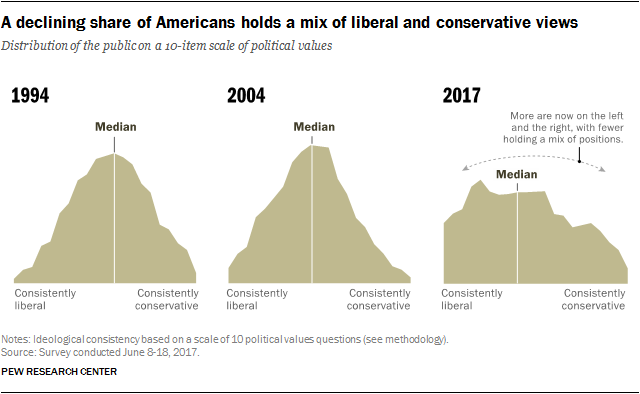
Overall, although many Americans continue to hold a mix of liberal and conservative views across different issue areas, that share has declined over time.

A declining share of Americans holds a mix of liberal and conservative views

At the same time, the center of the scale has shifted in a somewhat liberal direction over time. To a large extent, this is the result of the public’s growing acceptance of homosexuality and more positive views of immigrants, shifts that are seen among both Democrats and Republicans (GOP attitudes about immigrants are little changed over the last decade, but Republicans are substantially less likely to view immigrants as a burden on the country than they were in the 1990s).

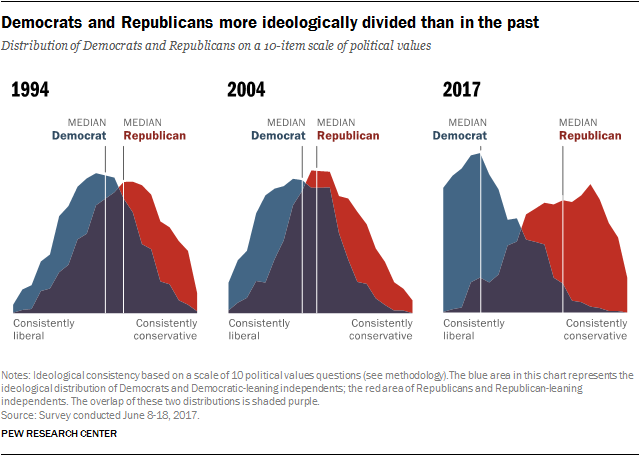
Democrats and Republicans more ideologically divided than in the past
What is the ideological consistency scale?

This scale is composed of 10 questions asked on Pew Research Center surveys going back to 1994 to gauge the degree to which people hold liberal or conservative attitudes across many political values (including attitudes about size and scope of government, the social safety net, immigration, homosexuality, business, the environment, foreign policy and racial discrimination). The individual items are discussed at the beginning of this section, and additional details about the scale can be found in the methodology.

Where people fall on this scale does not always align with whether they think of themselves as liberal, moderate or conservative. The scale is not a measure of extremity, but of consistency.

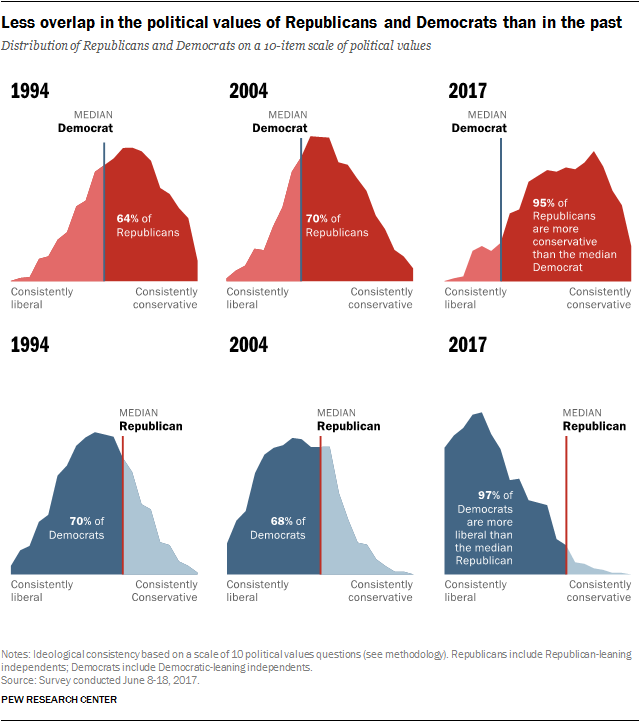
Reflecting the growing partisan gaps across the 10 questions (even those where both parties have shifted in the same direction), Republicans and Democrats are now further apart ideologically than at any point in more than two decades, a continuation of the trend Pew Research Center first documented with these measures in 2014. For instance, overall, on this scale of 10 political values, the median (middle) Republican is now more conservative than 97% of Democrats, and the median Democrat is more liberal than 95% of Republicans.

By comparison, in 1994 there was substantially more overlap between the two partisan groups than there is today: Just 64% of Republicans were to the right of the median Democrat, while 70% of Democrats were to the left of the median Republican. Put differently, in 1994 23% of Republicans were more liberal than the median Democrat; while 17% of Democrats were more conservative than the median Republican. Today, those numbers are just 1% and 3%, respectively.

Less overlap in the political views of Republicans and Democrats than in the past

2. Government, regulation and the social safety net

The public has become more supportive of government aid to the needy in recent years, and there has been uptick in the share saying they prefer a bigger government with more services over a smaller government with fewer services.

Widening party gap in views of increased government aid to the needy

For the most part, Democrats are driving the recent shift in opinions about the social safety net in a more liberal direction. For instance, the share of Democrats who say the government should do more to help the needy, even if it means going deep into debt, has increased dramatically since 2011, returning to levels last seen in 2008. Republicans’ positions on these questions have changed little over the last several years, but reflect a long-term GOP shift in a conservative direction.

As has been the case for most of the past two decades, a majority of the public continues to view government as “almost always wasteful and inefficient.” Opinions remain divided on whether government regulation of business is necessary to protect the public interest.

Changing views of government social safety net

Currently, about as many Americans prefer a bigger government with more services (48%) as prefer a smaller government with fewer services (45%). This marks a change from views during the Obama administration, when the balance of opinion was in favor of smaller government. (For more, see “With Budget Debate Looming, Growing Share of Public Prefers Bigger Government.”)

Similarly, there has been a shift in public attitudes on whether the government should do more to help the needy. Currently, 50% say the government should do more to help needy people even it means going deeper into debt, while 43% say the government can’t afford to do much more to assist the needy.  This marks the first time since 2008 that significantly more Americans favor than oppose providing more assistance to needy Americans.

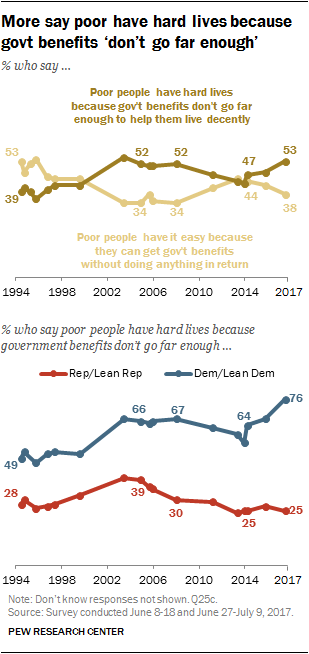
More say poor have hard lives because govt benefits 'don't go far enough'

About seven-in-ten (71%) Democrats and Democratic-leaning independents say the government should do more to help the needy, up from a Democratic low of just 54% six years ago. Republicans’ views have shown little change over this period; today, just 24% Republicans favor the government doing more to help the needy, among the lowest levels measured since 1994.

Democrats’ views about adequacy of government benefits for the poor also have changed dramatically. Currently, 76% of Democrats say “poor people have hard lives because government benefits don’t go far enough to help them live decently.” This is the highest share of Democrats saying this over the 23 years the question has been asked.

Just 25% of Republicans say poor people have hard lives because government benefits do not go far enough to help them live decently; more than twice as many (65%) say “poor people have it easy because they can get government benefits without doing anything in return.” Republicans’ attitudes on this measure have shown relatively little change in recent years, though a somewhat greater share of Republicans (around four-in-ten) said the poor had hard lives just over a decade ago (from 2003 to 2005).

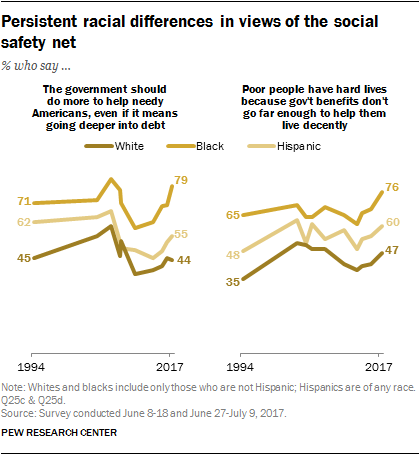
Persistent racial differences in views of the social safety net

Since 1994, there have been consistent differences in opinion by race about government benefits for the poor. In the current survey, 76% of blacks say poor people have hard lives because government benefits do not go far enough. That compares with 60% of Hispanics and only 47% of whites who say this.

But the belief that government benefits do not go far enough to help the poor has increased across all three groups since 2013: by 15 percentage points among blacks (from 61% to 76%), 11 points among Hispanics (49% to 60%) and 8 points among whites (39% to 47%).

Most continue to view government as ‘wasteful and inefficient’

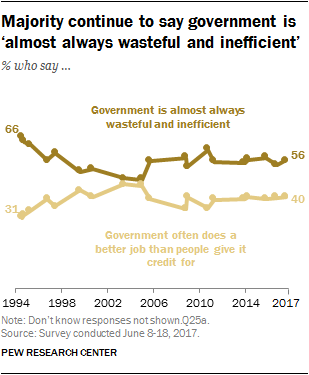
Majority continue to say government is 'almost always wasteful and inefficient'

A majority of Americans (56%) say the government “is almost always wasteful and inefficient.” Fewer (40%) say the government “often does a better job than people give it credit for.”

For much of the past two decades, majorities have viewed the government as wasteful and inefficient. The share expressing this view hit a high point in October 1994 (66%), a month before that year’s midterm elections.

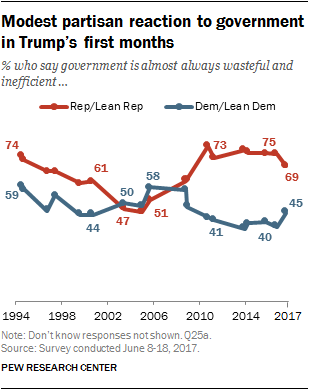
Modest partisan reaction to government in Trump's first months

Currently, 69% of Republicans and 45% of Democrats say government is wasteful and inefficient. These views have changed only modestly from 2015, when Republicans were somewhat more likely (75%), and Democrats somewhat less likely (40%), to express this view.

In recent decades, partisan views on this question have shifted somewhat in response to the party of the administration. During the Bush administration, Republicans held a less negative view of governmental efficiency, while Democrats were more critical than during Democratic administrations. In September 2005, for example, 58% of Democrats said government was wasteful and inefficient, compared with 51% of Republicans.


Little change in public’s views of need for regulation of business

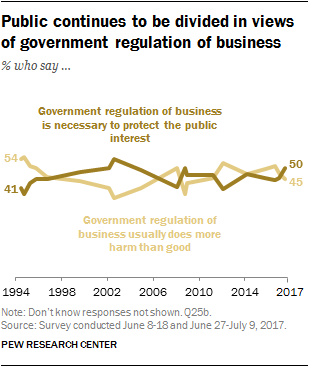
Public continues to be divided in views of government regulation of business

Half of the public says “government regulation of business is necessary to protect the public interest,” while 45% say “government regulation usually does more harm than good.” Views on this question have been divided for the past several years.

As with views of government aid to the poor, Democrats’ opinions about the necessity of government regulation of business have moved in a more liberal direction.

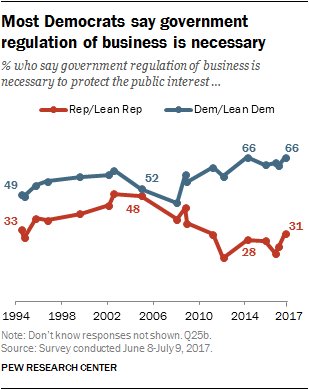
Most Democrats say government regulation of business is necessary

Two-thirds of Democrats (66%) say government regulation of business is necessary to protect the public interest. That is comparable to the shares of Democrats who said this in 2016 (63%) and 2014 (66%).  However, Democratic support for regulation of business is now higher than it was during much of the 1990s and 2000s. For example, in 2008, fewer than half of Democrats said government regulation of business was necessary to protect the public interest.

Just 31% of Republicans say government regulation of business is needed; about twice as many say such regulation “usually does more harm than good.” These views have changed little over the past eight years, but, during the Bush administration, Republicans tended to express greater support for government regulation of business.

In both parties, there are ideological differences in opinions about regulation of business. About three-quarters of liberal Democrats (76%) say regulation of business is needed to protect the public interest; a smaller majority of conservative and moderate Democrats (58%) say the same. Among Republicans, conservative Republicans (67%) are more likely than moderate and liberal Republicans (57%) to say regulation of business usually does more harm than good.

Views about the reasons underlying America’s success

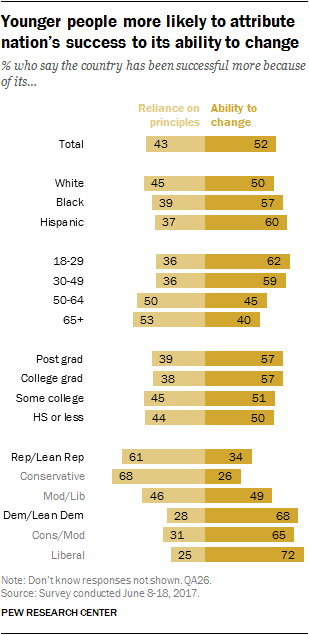
Younger people more likely to attribute nation's success to its ability to change

Americans continue to be more likely to say that this country has been successful more because of its “ability to change” (52%) than its “reliance on long-standing principles” (43%). Views on this question are little changed since it was last asked in 2015.

Americans younger than 50 are more likely than older adults to credit the country’s success to its ability to change: 60% say this, compared with 43% among those 50 and older.

Democrats and Democratic-leaning independents (68%) remain about twice as likely as Republicans and Republican leaners (34%) to say the U.S. has been successful more because of its ability to change rather than its reliance on principles. And the ideological divide in these views is particularly pronounced: By roughly three-to-one, liberal Democrats are more likely to say the U.S. has been successful due to its ability to change (72%) than its reliance on long-standing principles (25%). In contrast, conservative Republicans are much more likely to credit the country’s reliance on long-standing principles as more responsible for its success (68%) rather than its ability to change (26%).

3. Foreign policy

The public is evenly divided over whether the U.S. should be active in world affairs, but the share expressing positive views of U.S. global involvement has increased since 2014. In addition, more Americans say that the United States should take into account the interests of its allies when conducting foreign policy than did so just a year ago.

There has been less change in overall opinions about the principle of “peace through strength.” As in the past, more people think the best way to ensure peace is through good diplomacy rather than military strength.

And, when it comes to views of U.S. standing in the world, a majority of the public continues to view the United States as “one of the greatest countries in the world, along with others.” Smaller shares say either that the U.S. “stands alone” among nations or that there are other countries better than the United States.

Democratic support for active U.S. global role  increases

Currently, 47% say “it’s best for the future of our country to be active in world affairs,” while an identical percentage says “we should pay less attention to problems overseas and concentrate on problems here at home.”

Just three years ago, 35% said it was best for the U.S. to be active globally, while a majority (60%) said the nation should pay less attention to overseas problems.

This overall change in opinion since 2014 is almost entirely the result of shifting views among Democrats and Democratic-leaning independents. As a result, while there was no partisan gap on this question in surveys conducted during the Obama administration, there is currently a wide divide.

Today, a 56% majority of Democrats and Democratic leaners say it’s best for the future of the country to be active in world affairs while 39% say the country should pay less attention to overseas problems and concentrate on domestic problems. In 2014, the balance of Democratic opinion was the reverse: 58% said the country should focus more on problems at home, compared with just 38% who supported an active U.S. role in world affairs. While the views of both liberal Democrats and conservatives and moderates associated with the party have shifted, the shift is more pronounced among liberals, and what was a modest intraparty gap has widened.

Nearly seven-in-ten (69%) liberal Democrats say it’s better for the nation to be active in world affairs while just 27% say there should be less focus abroad and more on problems at home. Conservative and moderate Democrats are split on this question (46% say more active, 48% say less attention overseas).

Among Republicans and Republican leaners, 54% say the country should pay less attention to problems overseas and concentrate on problems at home, while 39% say it’s best for the country to be active in world affairs. Views have shifted only modestly from 2014, when 60% favored focusing more on problems at home and 36% backed an active role for the country in world affairs.

As in the past, there also are substantial educational differences in opinions about the country’s global role. Nearly two-thirds of those with at least a four-year college degree (64%) say it’s best for the nation’s future to be active in world affairs. Only 40% of those who have not completed college say the same. Among both groups, the shares favoring an active global role for the U.S have increased since 2014 (by 13 percentage points among college graduates and 11 points among adults with less education). Most have positive view of U.S. involvement in global economy

About two-thirds (65%) say that “U.S. involvement in the global economy is a good thing because it provides the country with new markets and opportunities for growth.” Just 29% say, “U.S. involvement in the global economy is a bad thing because it lowers wages and costs jobs in the country.”

The partisan gap on this question is relatively modest: 70% of Democrats and Democratic leaners and 60% of Republicans and Republican leaners say U.S. involvement in the global economy is a good thing because it provides the U.S. with new markets and opportunities for growth.

Positive views of U.S. involvement in the global economy are especially high among better-educated adults. Nearly eight-in-ten (78%) college graduates say the U.S. involvement in the global economy is a good thing. A smaller majority of those who have not graduated from college (59%) share this view.

Majority of public favors U.S. cooperating with allies

When it comes to dealing with U.S. allies in global affairs, nearly six-in-ten (59%) say the U.S. should take into account the interests of its allies even if it means making compromises with them; 36% say the U.S. should follow its own national interests even when its allies strongly disagree.

The share saying the U.S. should pay heed to the interests of its allies has increased 8 percentage points since April of last year (from 51% to 59%).

This shift has come entirely from Democrats, while the views of Republicans are unchanged from a year ago (41% say this). The share of Democrats and Democratic leaners saying the U.S. should take allies’ interests into account in making foreign policy has risen 12 points (from 62% to 74%) since 2016.

As was the case in 2016, there are ideological differences in both parties over cooperating with allies. Nearly half of moderate and liberal Republicans say the U.S. should consider the interests of its allies, compared with 37% of conservative Republicans. Among Democrats, 84% of liberals say the U.S. should take allies’ interests into account, compared with 66% of moderate and conservative Democrats. Among both groups of Democrats, greater numbers favor this approach than did so in April 2016.

Public says good diplomacy is best way to ensure peace

For more than two decades, majorities have consistently expressed the view that good diplomacy, rather than military strength, is the best way to ensure peace. Today, 61% say good diplomacy is the better way to ensure peace, while just 30% say military strength is the better approach.

But while overall opinions have been fairly stable, the partisan gap in these views – which has long been substantial – is as wide as at any point since the question was first asked in 1994.

In the current survey, 83% of Democrats and Democratic leaners say good diplomacy is the best way to ensure peace. That is little different from a year ago (80%) but is an all-time high among Democrats.

Just 33% of Republicans and Republican leaners say peace is best ensured with good diplomacy – which is among the lowest share saying this since the question was first asked in 1994. As recently as 2014, 44% of Republicans said good diplomacy provided the best way to guarantee peace.

Views about Islam and violence

Overall, 49% of the public says that the Islamic religion does not encourage violence more than other religions, while slightly fewer (43%) say it is more likely than others to encourage violence among its believers.

Opinion on this question has fluctuated in a relatively narrow range over the last decade, with neither view being held by a clear majority of the public. In 2002, when the question was first asked shortly after the Sept. 11th terrorist attacks, more said the Islamic religion did not encourage violence among its believers (51%) than said it did (25%); 24% did not offer a view.

Democratic and Republican views of whether Islam encourages violence diverge

While overall public views have shifted only modestly, the partisan gap on this question has steadily widened over the past several years as a growing share of Democrats say Islam does not encourage violence more than other religions, while the share of Republicans who say that it does also has grown.

As a result, what was a 11-point partisan gap in 2002 between the shares of Republicans and Democrats  who saw Islam as more likely to encourage violence than other religions has grown to 40 points in the current survey.

Today, about two-thirds (65%) of Republicans and Republican leaners say the Islamic religion is more likely to encourage violence among its believers than other religions. Throughout much of the 2000s, roughly half of Republicans expressed this view.

Among Democrats and Democratic leaners, 69% now say that the Islamic religion does not encourage violence more than other religions. The share expressing this view is as high as it has been in Pew Research Center surveys dating to 2002.

Views on tradeoff between security and privacy in anti-terrorism efforts

The public is roughly split over the question of whether Americans need to sacrifice some privacy and freedoms in order to be safe from terrorism. About half (51%) say sacrificing some privacy and freedoms is necessary to be safe from terrorism; slightly fewer (46%) say Americans do not need to do this.

There is an age gap in these views, with adults younger than 50 somewhat more likely to say Americans do not need to give up privacy to be safe from terrorism (51%) than to say that they do (46%). Older adults lean in the opposite direction: 56% of those 50 and older say Americans need to give up some privacy to be safe from terrorism, compared with 39% who say they do not need to do this.

The partisan differences in attitudes about privacy and terrorism are relatively modest. By 54% to 42%, more Republicans say that Americans need to sacrifice privacy and freedoms to be safe from terror. Democrats are evenly split: 50% say Americans need to sacrifice some privacy and freedoms to be safe from terrorism, while 48% say they do not.

Most say the U.S. is among the greatest countries in the world

As has been the case for the past several years, far more people say that the United States is among the world’s greatest nations than say it stands above all other nations or that it lags behind other countries.

In the current survey, 56% of Americans say that the U.S. “is one of the greatest countries in the world, along with others,” while 29% say the U.S. “stands above all other countries in the world.” Just 14% say there are countries that are better than the U.S. (See a more detailed writeup of this question: “Most Americans say the U.S. is among the greatest countries in the world.”)

There are sizable age and partisan differences in views of the United States’ standing in the world. While about half or more in all age groups view the U.S. as one of the greatest countries, young people are less likely than older adults to say the U.S. “stands alone.”

Just 12% of those younger than 30 say the U.S. stands above all other countries, the lowest percentage in any age group. Among those 65 and older, 44% say this.

Partisans’ views on this question differ as well. Republicans and Republican leaners (41%) are about twice as likely as Democrats and Democratic leaners (19%) to say the U.S. stands above all other countries in the world, but larger shares of both groups say that the U.S. is among the greatest countries, along with others (52% of Republicans, 60% of Democrats). Just 7% of Republicans and 20% of Democrats say there are countries better than the United States. These views have been largely stable over the past several years.

4. Race, immigration and discrimination

The public has long been divided over issues of race: The extent to which discrimination exists and what – if any – approaches should be undertaken to address it. In recent years, growing shares of the public say more needs to be done to address racial equality and see discrimination against blacks as an impediment to this.

Views of immigration have also shifted in recent years, as Americans increasingly view immigrants as a source of strength, rather than as a burden, for the nation.

Partisan divides in both of these areas have only grown over the last several decades, as the public shift in these views is largely driven by Democrats who are increasingly likely to take racially liberal and pro-immigrant positions, while Republican views have remained relatively stable.

Shifting racial attitudes

Overall, 61% say the country needs to continue making changes to give blacks equal rights with whites, compared with 35% who say the country has made the changes needed to give blacks equal rights with whites.

The current balance of opinion has changed little over the past few years but marks a shift from 2014 and earlier when the public was more evenly divided on this question. In March 2014, 49% thought the country had made the changes needed to give blacks equal rights with whites, while 46% said there was more to do. A wide majority of Democrats and Democratic leaners (81%) now say the country needs to continue making changes to give blacks equal rights with whites. The share holding this view is up 18 points since 2014, when a smaller majority (63%) of Democrats said this.

Among Republicans and Republican leaners, most (59%) say the country has already made the needed changes to give blacks equal rights with whites; 36% say that more needs to be done. While it continues to be the minority view, the share of Republicans saying the country needs to continue making changes to give blacks equal rights with whites has increased since 2014.

(Note that this question was fielded before the events in Charlottesville, Virginia in August. In a survey conducted shortly after those events, a growing share of the public saw racism as a big problem for the country. See the Aug. 29, 2017 post “Views of racism as a major problem increase sharply, especially among Democrats”).

Significant differences in views on this question remain across racial and ethnic groups. However, in recent years the share of Hispanics and whites saying the country needs to continue making changes to give blacks equal rights with whites have grown significantly, narrowing the opinion gap with blacks. 

Among Hispanics, 69% say the country needs to do more to give blacks equal rights with whites, while 27% say it has made the necessary changes. The share saying the country needs to do more to address racial inequality is up 15 points since 2014 and up 22 points from 2009, when the question was first asked.

The trajectory of views among whites is similar to that of Hispanics. Currently, 54% of whites think the country needs to continue making changes to give blacks equal rights with whites; somewhat fewer (41%) say the country has made the changes needed. This marks a significant shift from 2014, when just 39% of whites said the country needed to continue making changes to give blacks equal rights and 52% thought the country had made the needed changes.

Blacks overwhelmingly say the country needs to continue making changes to give blacks equal rights with whites (88%). This also reflects an increase from 2014, when 79% said this.

Within Democrats and Democratic leaners, there is now a relatively modest gap between the views of blacks, whites and Hispanics on the question of whether the country needs to do more on black equality. This is a substantial change from 2009, when whites and Hispanics were about 30 percentage points less likely than blacks to say the country needed to continue making changes to give blacks equal rights with whites.

In the current survey, 90% of black Democrats, 80% of white Democrats and 76% of Hispanic Democrats say the country needs to do more to give blacks equal rights with whites. In 2009, 81% of black Democrats said more changes were needed, compared with 50% of white and 49% of Hispanic Democrats.

Public opinion also has shifted on perceptions of racial discrimination. Overall, 49% say that blacks who can’t get ahead in this country are mostly responsible for their own condition; 41% say racial discrimination is the main reason why many black people can’t get ahead these days.

The share who says racial discrimination is the main reason why many blacks can’t get ahead is up 9 points since last year and is the highest it has been in Pew Research Center surveys dating to 1994. Opinion is dramatically different than in November 2009 – one year after Barack Obama was elected president – when just 18% said discrimination was the main reason many black people could not get ahead.

This shift in overall attitudes about whether discrimination inhibits the progress of blacks in the country is almost entirely the result of changing views among Democrats. Republican views have moved only modestly. As a result, the already wide partisan gap on this question has grown considerably larger over the course of recent years.

Overall, 64% of Democrats and Democratic leaners say that racial discrimination is the main reason why many black people can’t get ahead these days, compared with 28% who say blacks who can’t get ahead are mostly responsible for their own condition. As recently as 2014, fewer than half (41%) of Democrats said discrimination was the bigger impediment to black progress.

Most Republicans reject the idea that discrimination is the main reason why blacks can’t get ahead. Three-quarters (75%) say that blacks who can’t get ahead in this country are mostly responsible for their own condition; just 14% say racial discrimination is the main reason why many blacks can’t get ahead. The share of Republicans who say racial discrimination is the main reason many blacks can’t get ahead has changed little in recent years and is lower than it was in 1994, when 26% said this.

As in the past, there remain wide racial and ethnic, age, and educational differences in views of whether discrimination affects the progress of blacks.

By 59% to 31%, blacks say that racial discrimination is the main reason why many black people can’t get ahead in the country today. By contrast, more whites say that black people who can’t get ahead are mostly responsible for their own condition (54%) than say that racial discrimination is the bigger impediment to black progress (35%). Hispanics are divided in their views: 48% see discrimination as the main reason for a lack of black progress, while 45% say that blacks are mostly responsible for their own condition.

Notably, over the course of the more than two decades Pew Research Center has asked this question, the views of black and white Democrats have been roughly the same. Today, 66% of white Democrats and 62% of black Democrats say racial discrimination is the main reason blacks can’t get ahead.

Young adults (those ages 18 to 29) are the only age group in which a majority (54%) says that discrimination is the main reason many blacks can’t get ahead; 42% say black people are mostly responsible for their own condition. Views on this question among those ages 30-49 are divided. And among those 50 and older, a majority (56%) says that blacks are mostly responsible for their own condition.

Affirmative action programs now viewed more positively


Growing share views affirmative action programs positively

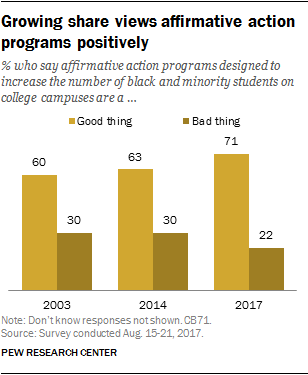
The share of the public saying affirmative action programs “designed to increase the number of black and minority students on college campuses are a good thing” has increased over the last several years. Today, 71% of Americans say this, up from 63% three years ago.

The rise in positive views of affirmative action programs in college admissions is evident across the political spectrum, though substantial partisan differences remain.

Today, about half (52%) of Republicans and Republican leaners say these programs are a good thing, while 39% say they are a bad thing. In 2014, Republican views were divided (46% good, 47% bad).

Democrats have long expressed positive views of affirmative action programs. Currently 84% of Democrats and Democratic leaners view these programs positively, a modest increase from 78% in 2014.

While blacks and Hispanics continue to view affirmative action more positively than whites (82% of blacks and 83% of Hispanics say these programs are good, compared with 66% of whites), this gap is narrower than in the past. Black and Hispanic views are little changed over the last three years, while whites’ views have grown increasingly positive (in 2014, 55% said affirmative action programs were a good thing).

Is discrimination overstated or understated?

When asked generally about discrimination in the country today, 57% say the bigger problem is people not seeing discrimination where it really does exist; 39% say the bigger problem for the country is people seeing discrimination where it really does not exist.

Fully 84% of blacks say the bigger problem is people not seeing discrimination where it really exists. Two-thirds (66%) of Hispanics also hold this view. Among whites, opinion is more divided: 49% say the bigger problem in the country is people not seeing discrimination where it really does exist, while about as many (46%) say the bigger problem is people seeing discrimination where there is none.

Among Republicans and Republican leaners, 63% say the bigger problem in the country is people seeing discrimination where there actually is none. Conservative Republicans (68%) are 16 points more likely to take this view than moderate and liberal Republicans (52%).

Views among Democrats and Democratic leaners are the reverse: 79% say that the bigger problem in the country is people not seeing discrimination where it really does exist. Comparably large majorities of liberal Democrats (82%) and conservative and moderate Democrats (76%) say this.

Most say immigrants strengthen the country

Most Americans have a positive view of the contributions of immigrants to the country. About two-thirds (65%) say that immigrants strengthen the country because of their hard work and talents; 26% say that immigrants are a burden because they take jobs, housing and health care.

Positive views of immigrants have continued to increase in recent years. Attitudes today are the reverse of what they were in 1994. At that time, 63% said immigrants did more to burden the country, while just 31% said they did more to strengthen the country. As recently as 2011, about as many said immigrants burdened (44%) as strengthened (45%) the country.

The public’s increasingly positive views of immigrants reflect a sharp shift in attitudes among Democrats, in particular. Overall, 84% of Democrats and Democratic leaners say immigrants do more to strengthen than burden the country. Opinion among Democrats has shifted steadily since 2010, when 48% thought immigrants did more to strengthen the country and 40% said they did more to burden the country.

Republicans are split in their views of the contributions of immigrants: 44% say immigrants do more to burden the country, while about as many (42%) say they do more to strengthen the country. Republican attitudes toward immigrants have fluctuated over the past few decades, though the share viewing immigrants as strengthening the nation has never surpassed the share saying immigrants are a burden. But Republican views today are slightly less positive than they were in the early 2000s. For example, in June 2003, 46% said immigrants strengthened the country.

As a result of differing opinion trends among Republicans and Democrats, the once modest partisan difference in views of immigrants has ballooned to 42 points in the current survey – the widest gap since the question was first asked in 1994.

Beyond partisanship, there remain significant demographic differences in views of immigrants’ overall impact on the country. Overall, 83% of Hispanics say immigrants strengthen the country because of their hard work and talents. This compares with 70% of blacks and 60% of whites who say this.

Majorities of those across levels of educational attainment take a positive view of immigrants’ contributions to the country. However, views are the most positive among those with the highest levels of education. For example, 82% of postgraduates say immigrants strengthen the country, compared with 59% of those with no college experience.

Adults ages 18-29 overwhelmingly say immigrants do more to strengthen (82%) than burden (13%) the country. Views also are broadly positive among those ages 30-49 (71% strengthen, 22% burden). Views among those 50 and older also tilt positive but by smaller margins (55% to 35%).

Within both parties, young adults are the most positive towards immigrants. Among Republicans and Republicans leaners, a 62% majority of those ages 18-29 say immigrants strengthen the country. This compares with far smaller shares among those ages 30-49 (47%), 50-64 (36%) and 65 and older (31%). Among Democrats, nearly all (94%) of those ages 18-29 say immigrants strengthen the country because of their hard work and talents. Somewhat smaller, though still sizeable, majorities of those ages 30-49 (88%), 50-64 (79%) and 65 and older (72%) say the same.

Views about immigrants and the nation largely parallel attitudes about whether openness to people from all over the world is an essential aspect of the national character: 68% say openness to foreigners is essential to “who we are as a nation,” while 29% say that if America is too open to people from all over the world “we risk losing our identity as a nation.” (For more on this question, see the Aug. 4, 2017 post, “Most Americans view openness to foreigners as ‘essential to who we are as a nation.”)

5. Homosexuality, gender and religion

Over the past two decades, there has been a dramatic increase in public acceptance of homosexuality, as well as same-sex marriage. Still, the partisan divide on the acceptance of homosexuality has widened.

In views of challenges facing women, a majority of Americans say women continue to confront obstacles that make it more difficult for them to get ahead than men. Opinions about the obstacles facing women are divided along gender lines, but the partisan gap is wider than the gender gap.

Most Americans now say that it is not necessary to believe in God to be moral and have good values; this is the first time a majority has expressed this view in a measure dating back to 2002. While Republicans’ views have held steady over this period, an increasing share of Democrats say belief in God is not necessary in order to be a moral person.

Changing views on acceptance of homosexuality

Seven-in-ten now say homosexuality should be accepted by society, compared with just 24% who say it should be discouraged by society. The share saying homosexuality should be accepted by society is up 7 percentage points in the past year and up 19 points from 11 years ago.

Growing acceptance of homosexuality has paralleled an increase in public support for same-sex marriage. About six-in-ten Americans (62%) now say they favor allowing gays and lesbians to marry legally. (For more on views of same-sex marriage, see: “Support for Same-Sex Marriage Grows, Even Among Groups That Had Been Skeptical,” released June 26, 2017.)

While there has been an increase in acceptance of homosexuality across all partisan and demographic groups, Democrats remain more likely than Republicans to say homosexuality should be accepted by society.

Overall, 83% of Democrats and Democratic-leaning independents say homosexuality should be accepted by society, while only 13% say it should be discouraged. The share of Democrats who say homosexuality should be accepted by society is up 20 points since 2006 and up from 54% who held this view in 1994.

Among Republicans and Republican leaners, more say homosexuality should be accepted (54%) than discouraged (37%) by society. This is the first time a majority of Republicans have said homosexuality should be accepted by society in Pew Research Center surveys dating to 1994. Ten years ago, just 35% of Republicans held this view, little different than the 38% who said this in 1994.

The growing acceptance of homosexuality has been broad-based, and majorities of most demographic groups now hold this view. However, differences remain across demographic groups in the size of the majority saying homosexuality should be accepted by society.

Age is strongly correlated with support for acceptance of homosexuality. Overall, 83% of those ages 18 to 29 say homosexuality should be accepted by society, compared with 72% of those ages 30 to 49, 65% of those 50 to 64, and 58% of those 65 and older.

Acceptance is greater among those with postgraduate (81%) and bachelor’s (77%) degrees than among those with some (69%) or no college experience (64%).

Do women continue to face obstacles to advancement?

Most Americans (55%) say that “there are still significant obstacles that make it harder for women to get ahead than men,” while 42% say “the obstacles that once made it harder for women than men to get ahead are now largely gone.”

Nearly two-thirds (64%) of women say there are still significant obstacles that make it harder for women to get ahead, while 34% say they are largely gone. By contrast, men are somewhat more likely to say obstacles to women’s progress are now largely gone (51%) than to say significant obstacles still exist (46%). The gender gap on this question is among the widest seen across the political values measured in this survey.

About seven-in-ten blacks (69%) think significant obstacles remain that make it harder for women to get ahead than men. This compares with 53% of whites and 52% of Hispanics.

Among both blacks and whites, the gender gap roughly mirrors that of the public overall. For example, 77% of black women and 60% of black men say significant barriers remain to women’s advancement (among whites, 62% of women and 43% of men say this). Among Hispanics, however, there is not a pronounced gender gap.

More postgraduates say significant obstacles to women’s progress still exist (70%) than say they are largely gone (28%). About six-in-ten college graduates (59%) also say women continue to face significant obstacles that men don’t. Views are more closely divided among those with some college experience and those with no more than a high school diploma.

There is a wide partisan gap in views of whether or not women continue to face greater challenges than men. By nearly three-to-one (73% vs. 25%), more Democrats and Democratic leaners say women continue to face significant obstacles that make it harder for them to get ahead than men. Republicans and Republican leaners take the opposite view: 63% say the obstacles that once made it harder for women to get ahead are now largely gone; fewer (34%) say significant obstacles still remain.

Within both party coalitions, women are more likely than men to say significant obstacles to women’s progress still remain. Among Democrats, 79% of women say women still face significant obstacles, compared with 65% of men.

Among Republicans, a large majority of men (70%) say obstacles once faced by women are now largely gone. A smaller majority of Republican women (53%) share this view.

Views on religion, its role in policy

When it comes to religion and morality, most Americans (56%) say that belief in God is not necessary in order to be moral and have good values; 42% say it is necessary to believe in God in order to be moral and have good values.

The share of the public that says belief in God is not morally necessary has edged higher over the past six years. In 2011, about as many said it was necessary to believe in God to be a moral person (48%) as said it was not (49%). This shift in attitudes has been accompanied by a rise in the share of Americans who do not identify with any organized religion.

Republicans are roughly divided over whether belief in God is necessary to be moral (50% say it is, 47% say it is not), little changed over the 15 years since the Center first asked the question. But the share of Democrats who say belief in God is not a condition for morality has increased over this period.

About two-thirds (64%) of Democrats and Democratic leaners say it is not necessary to believe in God in order to be moral and have good values, up from 51% who said this in 2011.

The growing partisan divide on this question parallels the widening partisan gap in religious affiliation.

About six-in-ten whites (62%) think belief in God is not necessary in order to be a moral person. By contrast, roughly six-in-ten blacks (63%) and 55% of Hispanics say believing in God is a necessary part of being a moral person with good values.

There is a strong correlation between age and the share saying it is necessary to believe in God to be a moral person. By 57% to 41%, more of those ages 65 and older say it is necessary to believe in God in order to be moral and have good values. By contrast, 73% of those ages 18 to 29 say it is not necessary to believe in God to be a moral person (just 26% say it is).

Those with more education are less likely to say it is necessary to believe in God to be moral than those with less education. Overall, 76% of those with a postgraduate degree say it is not necessary to believe in God in order to be a moral person and have good values, compared with 69% of college graduates, 58% of those with some college experience and just 42% of those with no college experience.

Most black Protestants (71%) and white evangelical Protestants (65%) say it is necessary to believe in God to be a moral person. But the balance of opinion is reversed among white mainline Protestants: By 63% to 34%, they say belief in God is not a necessary part of being a moral person.

Among Catholics, 61% of Hispanics think belief in God is a necessary part of being moral, while 57% of white Catholics do not think this is the case. An overwhelming share of religiously unaffiliated Americans (85%) say it is not necessary to believe in God in order to be moral.

When it comes to religion’s role in government policy, most Americans think the two should be kept separate from one another. About two-thirds (65%) say religion should be kept separate from government policies, compared with 32% who say government policies should support religious values and beliefs.

A narrow majority of Republicans and Republican leaners (54%) say religion should be kept separate from government policies. However, conservative Republicans are evenly split; 49% say government policies should support religious values and beliefs, while 48% think religion should be kept separate from policy. By roughly two-to-one (67% to 31%), moderate and liberal Republicans say religion should be kept separate from government policy.

Among Democrats and Democratic leaners, 76% think religion should be kept separate from government policies. A wide 86% majority of liberal Democrats say this; a somewhat smaller majority of conservative and moderate Democrats (69%) take this view.

White evangelical Protestants are one group where a narrow majority says government policies should support religion: 54% say this, while 43% say religion should be kept separate from policy. In comparison, majorities of both black Protestants (55%) and white mainline Protestants (70%) think religion should be separate from government policy.

About two-thirds of white Catholics (68%) think religion should be kept separate from government policy; 53% of Hispanic Catholics share this view. Among those who do not affiliate with a religion, 89% think religion and government policy should be kept separate.

6. Economic fairness, corporate profits and tax policy

The public continues to view the economic system as unfair to most Americans, while a substantial majority regards economic inequality as either a very big or moderately big problem.

As has been the case for the past two decades, most Americans say it is possible to get ahead through hard work, though Democrats have become increasingly skeptical that hard work can guarantee success.

There has been little change as well in public attitudes about corporate profits, with a majority of Americans viewing profits as excessive.

And as Congress begins to consider proposals for reforming the tax system, the survey finds little support for reducing taxes on high-income households or large businesses and corporations. Far more Americans favor increasing than lowering taxes on both.

Most see economic system as unfair

Americans are broadly skeptical of the fairness of the U.S. economic system. About two-thirds (65%) say the economic system in this country unfairly favors powerful interests, while 32% say the system is generally fair to most Americans.

These views have changed little since the question was first asked in 2014, but partisan differences have widened.

Democrats and Democratic-leaning independents overwhelmingly see the economic system in this country as unfair: 82% say this, while just 17% think it treats most people fairly. The share of Democrats who say the economic system is unfair has grown 11 percentage points over the past three years.

By contrast, Republicans and Republican leaners are roughly divided in their views of the U.S. economic system: 50% say it is generally fair to most Americans, while nearly as many (46%) say it unfairly favors powerful interests. In recent years, including as recently as March 2016, somewhat more Republicans said the economic system unfairly favored the powerful than said it generally treated most people fairly (54% vs. 44%).

By 55% to 42%, conservative Republicans say the U.S. economic system is generally fair to most Americans. Moderate and liberal Republicans tilt in the opposite direction: 55% say the system unfairly favors powerful interests, while fewer (42%) say it’s generally fair. Among Democrats, liberals (88%) are somewhat more likely than moderates and conservatives (77%) to say the U.S. economic system is unfair.

Along with skepticism about the fairness of the economic system, most Americans view economic inequality as a problem in the country.

Overall, 48% say economic inequality is a “very big” problem in the country and another 34% say it is a “moderately big” problem. Relatively few say it is a small problem (10%) or not a problem at all (5%).

Blacks (65%) and Hispanics (55%) are more likely than whites (42%) to see economic inequality as a very big problem in the country.

Across levels of family income, 56% of those living in households earning less than $30,000 a year say economic inequality is a very big problem. Somewhat fewer of those in households with higher incomes say the same.

And there is a wide partisan divide in views of economic inequality. Two-thirds of Democrats and Democratic leaners (66%) say economic inequality is a very big problem in the country today; 27% say it is a moderately big problem. Among Republicans and Republican leaners, only about a quarter (26%) say economic inequality is a very big problem, while 43% say it is a moderately big problem.

Within both parties, there are significant divides on this question by ideology. Conservative Republicans (23%) are less likely than moderate and liberal Republicans (32%) to view economic inequality as a very big problem. Among Democrats, 74% of liberals see economic inequality as a very big problem, compared with 59% of moderates and conservatives.

Within the GOP, there also are differences in views by levels of family income. Republicans earning less than $30,000 a year (40%) are much more likely than those with higher incomes (22%) to view economic inequality as a very big problem in the country. Among Democrats, there is little difference in views across income levels.

Most Americans continue to say hard work leads to success

While Americans see economic inequality as a problem and have doubts about the fairness of the economic system, they maintain a fundamental belief in the ability to succeed through hard work.

About six-in-ten (61%) say that most people who want to get ahead can make it if they’re willing to work hard; by contrast, 36% say that hard work and determination are no guarantee of success for most people. Majorities of most demographic groups believe that people can get ahead if they’re willing to work hard.

Since 1994, Republicans and Republican leaners have been consistently more likely than Democrats and Democratic leaners to say people can get ahead through hard work. But the gap has widened in recent years, as the share of Democrats who see hard work as a guarantee of success has declined.

Through the 1990s and 2000s, majorities of Democrats said hard work leads to success for most people, but that figure dipped to 48% in late 2011. Since then, Democrats’ views have fluctuated; today, 49% say most people can get ahead through hard work.

By contrast, for the past two decades about 70% or more Republicans have consistently said hard work leads to success.

Among Democrats, whites are more skeptical than either blacks or Hispanics that hard work leads to success. And while 57% of Democrats with at least a four-year degree say hard work is no guarantee of success for most people, fewer Democrats (45%) with less education say this.

Although some of the educational gap among Democrats reflects racial and ethnic differences in educational attainment – as with the public overall, white Democrats are more likely than black and Hispanic Democrats to have a college degree – the gap is evident among whites. Six-in-ten white Democrats with a college degree say hard work is no guarantee of success, compared with 53% of white Democrats without a degree.

Large majorities of Republicans with four-year degrees (82%) and those who have not completed college (76%) say most people can get ahead with hard work.

Views of corporate profits

Majority of Americans think business corporations make ‘too much profit’

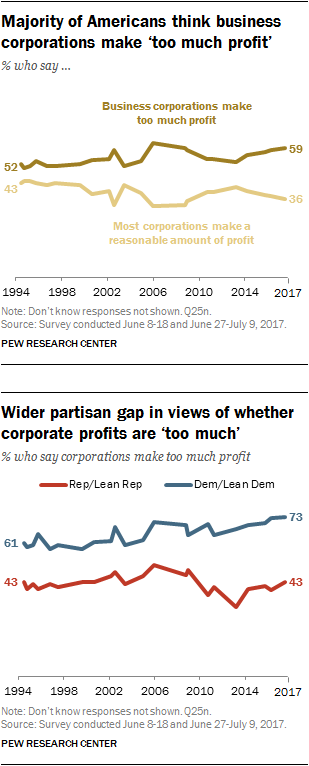
The public holds a critical view of corporate profits. Overall, 59% say that business corporations make too much profit, compared with 36% who say most corporations make a fair and reasonable amount of profit.

Overall, 73% of Democrats and Democratic-leaning independents say business corporations make too much profit. By 52% to 43%, more Republicans and Republican leaners say corporations make a fair and reasonable amount of profit than say they make too much.

Among Republicans, those with lower levels of income and education are more critical of corporate profits than those with higher incomes and more education.

While 59% of Republicans with family incomes of $75,000 a year or more say corporations make a reasonable amount of profit, 42% of Republicans making less than $30,000 a year say the same.

Similarly, by roughly two-to-one (65% to 30%) Republicans with a college degree say corporations make a fair profit. Among Republicans without a college degree, views on corporate profits are split (47% too much profit, 47% reasonable profit). Majorities of Democrats across levels of income and education say business corporations make too much profit.

Views of taxes on corporations, high incomes

About half of Americans (52%) say that taxes should be raised a lot or a little on large businesses and corporations. Only about quarter (24%) say taxes should be lowered a lot or a little, while 21% think taxes on corporations should be kept the same as they are now.

Americans are somewhat less supportive of raising taxes on those with household incomes over $250,000: 43% say taxes on high incomes should be raised (by a lot or a little), 24% say they should be lowered and 29% think they should be kept the same as they are now.

Democrats broadly support raising taxes on both corporations and high incomes, while Republicans’ views are more divided. Nearly seven-in-ten Democrats and Democratic leaners (69%) say taxes on large businesses and corporations should be raised, with 37% saying they should be raised “a lot.”

Among Republicans and Republican leaners, 41% say taxes on corporations should be lowered, while nearly a third (32%) favor raising them; 23% support keeping corporate taxes as they are. More conservative Republicans (48%) than moderate and liberal Republicans (28%) favor cutting taxes on corporations. Among Democrats, there are more modest ideological differences in views of corporate taxes. 

Republicans are divided in opinions about tax rates for household incomes over $250,000. While about a third (36%) say they should be lowered, nearly as many (33%) say they should be kept at their current rate and 26% favor raising taxes on high incomes.

Most Democrats (57%) say taxes on household incomes of more than $250,000 should be raised, but this attracts much more support from liberal Democrats (70%) than from conservative and moderate Democrats (46%).

(For more on this question, see the Sept. 27, 2017 post, “More Americans favor raising than lowering tax rates on corporations, high household incomes”)

7. Global warming and environmental regulation, personal environmentalism

An increasing share of Americans – Republicans and Democrats alike – say there is solid evidence that the Earth’s average temperature has been getting warmer. But attitudes about global warming and the value of stricter environmental laws remain deeply divided along partisan lines.

In fact, the partisan divide about whether stricter environmental laws are worth the cost, or hurt the economy, is now about as wide as the differences over global warming. This marks a major shift from a decade ago, when majorities in both parties said stricter environmental laws were worth the cost.

Most Americans say it is important to do things to help the environment. But those with higher family incomes are more likely than less affluent adults to say they take steps to help the environment, even if it costs time or money.

Changing views on global warming

Large majority says there is ‘solid evidence’ the Earth is warming

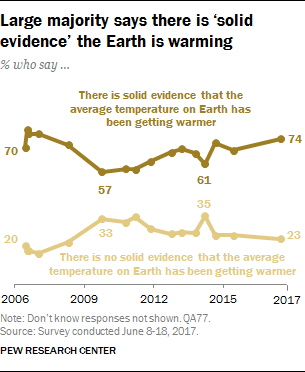
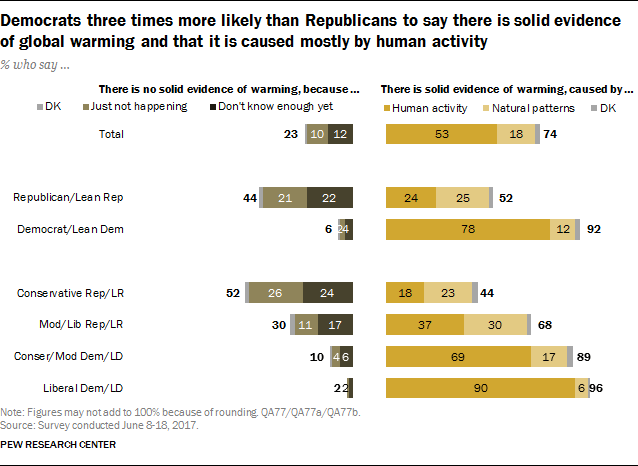
In the survey, conducted in June, 74% say there is solid evidence that the average temperature on Earth has been getting warmer, while 23% say there is no solid evidence that the Earth has been warming.

When asked a follow-up question about the causes of global warming, most people who see solid evidence of global warming – 53% of the public – say it is caused mostly by human activity such as burning fossil fuels, while fewer (18% of the public) say it is caused mostly by natural patterns in the Earth’s environment.

Overall, 10% of the public says there is no solid evidence of warming and thinks it is because climate change is “just not happening,” while a similar share (12% of the public) believes there is no solid evidence and says  “we just don’t know enough yet about whether the Earth is getting warmer.”

In both parties, more say solid evidence of global warming, but wide gap persists

The share of Americans who say there is solid evidence of global warming – and that this has been caused mostly by human activity – has increased since 2014. At that time, 61% of the public said there was solid evidence of warming, and 40% of the public said the Earth was warming and attributed this mostly to human causes.

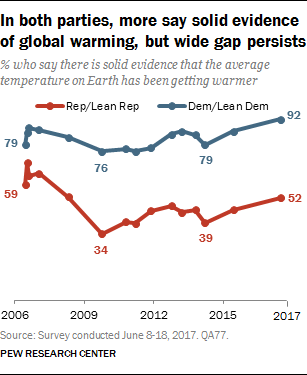
Since then, growing numbers of both Republicans and Democrats say there is solid evidence that the Earth’s temperature is increasing, but substantial differences persist.

About half of Republicans and Republican-leaning independents (52%) say there is solid evidence of rising global temperatures, up from 39% in 2014. Still, while the share of Republicans who say there is solid evidence of global warming has increased in recent years, it remains lower than a decade ago. By contrast, while clear majorities of Democrats have long said the Earth’s temperature is rising, the current share (92%) is as high as it has ever been in surveys since 2006.

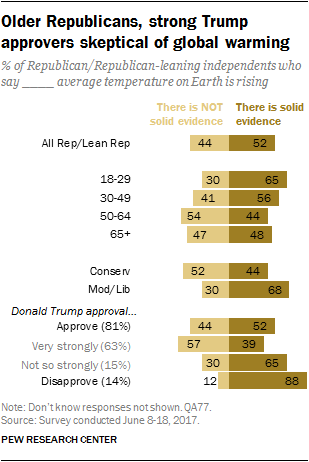
Older Republicans, strong Trump approvers skeptical of global warming

Unlike Democrats, Republicans are internally divided in views of global warming. Nearly two-thirds (65%) of Republicans and Republican leaners younger than 30 say there is solid evidence of global warming. Among those 50 and older, just 46% say this.

In addition, Republicans who strongly approve of Trump’s job performance (63% of Republicans and Republican leaners) are more likely than those who approve of him less strongly (or those who disapprove) to say there is no solid evidence of rising global temperatures.

Just 39% of Republicans who approve of Trump strongly say there is solid evidence that the Earth is warming, compared with majorities of those who approve of him not so strongly (65%) and those who disapprove (88%).

Few Republicans attribute rising global temperatures to human activity

While a growing share of Republicans say there is solid evidence of global warming, Republicans who express this view are divided about whether this is caused mostly by human activity. Only about a quarter of Republicans (24%) say there is solid evidence of rising global temperatures and that this is caused mostly by human activity; about as many (25%) say it is caused mostly by natural patterns in the environment.

Republicans who do not think there is solid evidence of global warming are divided in views of whether, in effect, this is a settled issue. Nearly identical shares of Republicans say global warming is “just not happening” (21%) and that not enough is yet known about this issue (22%).

An overwhelming share of Democrats (78%) say there is solid evidence the Earth’s average temperature has been rising and that this has been caused mostly by human activity. While 90% of liberal Democrats express this view, a somewhat smaller majority of conservative and moderate Democrats say the same (69%).

Democrats three times more likely than Republicans to say there is solid evidence of global warming and that it is caused mostly by human activity

Among conservative Republicans, just 18% say there is solid evidence of global warming and that this has been caused mostly by human activity. About twice as many moderate and liberal Republicans express this view (37%).

Wider partisan gap in views of stricter environmental regulations

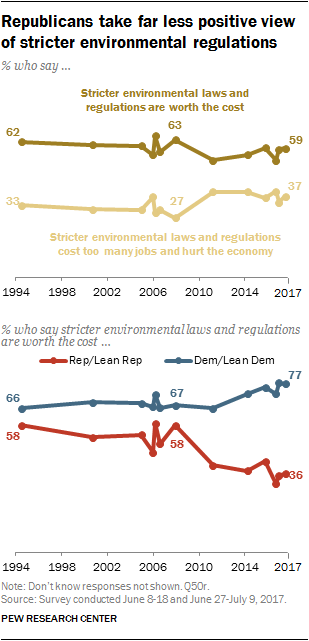
Republicans take far less positive view of stricter environmental regulations

When it comes to environmental laws and regulations, fully 59% of the public believes they are worth the cost. Less than half of the public (37%) believes stricter environmental laws and regulations cost too many jobs and hurt the economy. While these attitudes have fluctuated modestly since 1994, the partisan divide has grown substantially.

This has largely been caused by changes among Republicans and Republican-leaning independents. A decade ago, 58% of Republicans said stricter environmental regulations were worth the cost; 34% said stricter environmental regulations cost too many jobs and hurt the economy.

Today, these opinions have reversed: Just 36% of Republicans say stricter environmental laws are worth the cost, while 58% say they cost too many jobs and hurt the economy.

Democrats’ views have been more stable over the past two decades, but the share of Democrats who  say stricter environmental laws are worth the cost has increased by 10 percentage points since 2007 (from 67% to 77%).

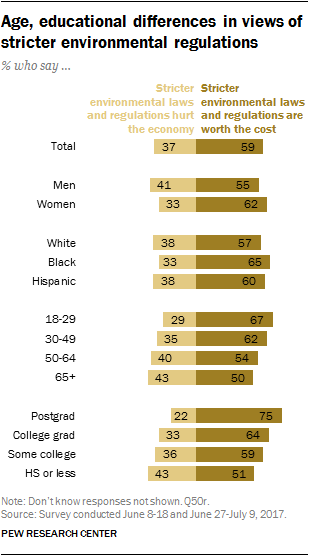
Younger adults are more likely than older Americans to express positive views of tougher environmental regulations. Two-thirds (67%)

Age, educational differences in views of stricter environmental regulations

of those younger than 30 say such regulations are worth the cost, compared with 52% of those 50 and older.

People with higher levels of education are more likely than those with less education to say stricter environmental regulations are worth the cost. Three-quarters (75%) of those with a postgraduate degree say stricter environmental laws are worth the cost, compared with 64% of college graduates, 59% of those with some college experience and 51% of those with no college experience.

Views of importance of personal action to protect environment

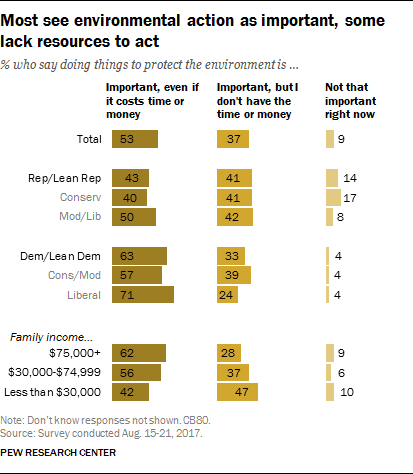
Most Americans say it is important for them to take action to protect the environment, but some say they are not able to do this because they lack time or money. About half of the public (53%) says environmental protection is so important that they take action, even when it costs time or money; 37% say this is important, but they do not have the time or money to help the environment; and 9% say protecting the environment is not that important.

These attitudes vary by partisan ideology and family income. A majority of Democrats and Democratic leaners (63%) say taking action to protect the environment is personally important, even if it costs time or money. About four-in-ten Republicans (43%) say the same.

Those with higher family incomes are more likely than lower-income households to say that

Most see environmental action as important, some lack resources to act

acting to protect the environment is important, even if it costs time or money. About six-in-ten (62%) of those earning $75,000 a year or more say it’s important to do things to protect the environment, even if it costs time or money. Among those earning less than $30,000 a year views are mixed: 47% say protecting the environment is important but they don’t have the time or money to help, while 42% say it’s important and they do things in their everyday life to help.

The view that it’s important to take action on the environment even if it costs time or money is particularly widely held among those with family incomes of $150,000 or more (74%), the highest income bracket measured in the survey.

8. Partisan animosity, personal politics, views of Trump

As Republicans and Democrats have moved further apart on political values and issues, there has been an accompanying increase in the level of negative sentiment that they direct toward the opposing party. Partisans have long held unfavorable views of the other party, but negative opinions are now more widely held and intensely felt than in the past.

Among members of both parties, the shares with very unfavorable opinions of the other party have more than doubled since 1994.

In addition, the friend networks of both Republicans and Democrats are dominated by members of their own party and include few members of the other party.

And while opinions of Donald Trump have been deeply polarized along partisan lines since well before he was elected president, the partisan gap in his job approval ratings – based on surveys conducted earlier this year – is larger than for any president in six decades.

More negative views of the opposing party – and its members

As noted in the Center’s 2014 study of political polarization, Republicans and Democrats have long had negative opinions of the other party. But in the past, more partisans had mostly unfavorable views than very unfavorable views.

This is no longer the case. About eight-in-ten Democrats and Democratic-leaning independents (81%) have an unfavorable opinion of the Republican Party, based on an average of surveys conducted this year – with 44% expressing a very unfavorable view. Two decades ago, a smaller majority of Democrats (57%) viewed the GOP unfavorably, and just 16% held a very unfavorable view.

The share of Republicans with highly negative opinions of the Democratic Party has followed a similar trajectory. Currently, 81% of Republicans and Republican leaners have an unfavorable impression of the Democratic Party, with 45% taking a very unfavorable view. In 1994, 68% of Republicans had a negative view of the Democratic Party; just 17% had a very unfavorable opinion.

Last month, a separate Pew Research Center study found that most Republicans and Democrats also had negative views of the members of the opposing party. Majorities in both parties rated each other “coldly” on a 0-100 thermometer scale. Republicans and Democrats rated each other more coldly than they did in December 2016.

Partisans’ close friends tend to be like them politically

Republicans and Democrats both say their friend networks are predominantly made up of people who are like-minded politically.

Most Democrats, Republicans have ‘just a few’ or no friends in opposing party

Overall, 57% of those who identify as Republicans say a lot of their close friends are also Republicans, while another 21% say some of them are. An even larger share of Democrats (67%) say a lot of their close friends are Democrats; an additional 18% say some of their close friends are members of their own party.

By contrast, far fewer partisans say they have friends in the opposing party. About four-in-ten Republicans (39%) say they have a lot or some friends who are Democrats; most Republicans (55%) say just a few or none of their friends are Democrats.

Even fewer Democrats (31%) have at least some friends who are Republicans. About two-thirds of Democrats (64%) have just a few or no Republican friends.

Big houses, small houses

Partisan differences extend even to the type of community in which people prefer to live. Most Republicans favor a community that features more space, even if amenities are farther away. Democrats, by contrast, express a preference for a community where houses are smaller and closer together but amenities are nearby.

Republicans, Democrats differ over ideal house size and community type

About two-thirds of Republicans and Republican-leaning independents (65%) say they would prefer to live in a community where the houses are larger and farther apart, but where schools, stores and restaurants are several miles away. By contrast, 30% would rather live in a community where the houses are smaller and closer to each other, but schools, stores and restaurants are within walking distances.

Views among Democrats and Democratic-leaning independents are almost the reverse: By 61% to 35%, more say they would prefer a community with smaller houses close to one another that has amenities nearby. Liberal Democrats (69% to 27%) express a preference for this community type by a greater margin than conservative and moderate Democrats (54% to 42%).

Drivers of partisan identity

While partisans increasingly express highly negative views of the other political party, most Republicans and Democrats say the reason they affiliate with the political party of their choice is more because they are for what it represents rather than against what the other party stands for.

Overall, 53% of Republicans and Republican leaners say they consider themselves Republicans or lean to the party more because they are for what the GOP represents. Still, about four-in-ten (43%) say it is more because they are against what the Democratic Party represents.

Views among Democrats are similar: 56% of Democrats and Democratic leaners say they consider themselves Democrats or lean to the Democratic Party more because they are for what the party represents, compared with 40% who say it is more because they are against what the Republican Party represents.

However, among both the Republican and Democratic coalitions, those who identify with a party are much more likely than those who lean to a party to say their identity is influenced by support for their own party. By 65% to 31%, Democratic identifiers say they consider themselves Democrats more because they are for what their party represents than against the Republican Party. By contrast, 56% of independents who lean toward the Democratic Party say their affiliation has more to do with being against the Republican Party; 41% say it’s more about being for the Democratic Party. Among those who affiliate with the Republican Party, 59% of identifiers, compared with 45% of leaners, say they affiliate with the GOP more because of what the party represents. (For more on the roots of partisanship, see “Partisanship and Political Animosity in 2016.”)

Most who identify as Republicans and Democrats view their party connection in positive terms; partisan leaners more likely to cite negative partisanship

Republicans and Democrats differ on views of compromise

In general terms, the public continues to express a preference for elected officials who seek political compromises. About six-in-ten (58%) say they like elected officials who make compromises with people with whom they disagree, while fewer (39%) say they like politicians who stick to their positions.

In principle, public prefers elected officials who are willing to compromise

About seven-in-ten Democrats and Democratic leaners (69%) say they like elected officials who compromise. Liberal Democrats (76%) are more likely to hold this view than conservatives and moderates (63%).

Republicans and Republican leaners have much more mixed views: 52% say they like elected officials who stick to their positions, while 46% say they like elected officials who make compromises with people they disagree with. By 56% to 41%, conservative Republicans prefer elected officials who stick to their positions. By contrast, a greater share of moderate and liberal Republicans say they like officials who make compromises (55%) than say they like officials who stick to their positions (43%).

Those with higher levels of education are especially likely to have a positive view of officials who make compromises. Fully 77% of postgraduates say they like elected officials who compromise with people they disagree with, compared with 68% of college graduates, 55% of those with some college experience and 51% of those with no college experience.

While there are mostly positive views of elected officials who make compromises in principle, previous research has shown that liberals and conservatives favor political compromises in which their side gets most of what of it wants to solutions that “split the difference” between their side and the opposition.

Trump’s job ratings in historical context

Presidential job approval ratings have been growing increasingly divided along partisan lines. However, Trump’s first-year job approval ratings are the most polarized of any president dating back to Dwight D. Eisenhower in 1953.

Wider partisan gap on Trump job rating than for any president in six decades

In three surveys conducted in February, April and June, 88% of Republicans, on average, approved of his job performance. By contrast, just 8% of Democrats approved.

The historic partisan gap in Trump’s job ratings is in large part because of his unusually low ratings among Democrats. Trump has the lowest approval marks from the opposing party of any president in the past six decades.

Even before Trump took office, there had been a downward trend in presidential approval ratings among members of the party not in control of the White House. The previous lows were during the presidencies of Bill Clinton, whose average rating among Republicans was just 22% during his first year in office, and Barack Obama (23%). George W. Bush was an exception to this trend in his first year (46% average job rating among Democrats), largely because of his extraordinarily high level of support after the 9/11 attacks. Across his two terms, Bush’s average rating among Democrats was just 23%, the lowest of any president among members of the opposition party except Obama (14%).

Trump’s first-year job ratings among members of his own party have been on par with many recent presidents, including Obama and Bush. Among presidents since Eisenhower, Clinton (72%), Jimmy Carter (also 72%) and Gerald Ford (66%) were the only ones to receive job ratings below 80% from members of their own party during their first years in office.

Trump’s impact on the Republican Party

The public has mixed views on Trump’s impact on the Republican Party. Overall, 39% say Trump has changed the Republican Party for the worse, while about as many (38%) say he hasn’t changed the party much; just 20% say he has changed the GOP for the better.

Few Republicans say Trump has changed GOP for the worse

Among Republicans and Republican leaners, 45% say he hasn’t changed the party much, while 40% say he has changed it for the better. Few Republicans (12%) say he has changed the party for the worse. Conservative Republicans (45%) are more likely than moderate and liberal Republicans (32%) to say Trump has changed the party for the better.

Democrats have a highly negative view of Trump’s impact on the GOP. Overall, 63% of Democrats and Democratic leaners say Trump has changed the Republican Party for the worse; 30% say he hasn’t changed the party much, and just 5% say he has changed it for the better. There is little difference between the views of liberal Democrats and conservative and moderate Democrats on this question.

Correction: The labels at the top of the chart “Wider partisan gap on Trump job rating than for any president in six decades” have been updated to exclude independents who lean Democratic or Republican. The numbers have not changed.

Methodology

Surveys conducted June 8-18, 2017 and June 27-July 9, 2017

Most of the analysis in this report is based on two telephone surveys conducted June 8-July 9, 2017. The first survey includes interviews conducted June 8-18, 2017 among a national sample of 2,504 adults, 18 years of age or older, living in all 50 U.S. states and the District of Columbia (628 respondents were interviewed on a landline telephone, and 1,876 were interviewed on a cell phone, including 1,109 who had no landline telephone). The second survey includes interviews conducted June 27 – July 9, 2017 among a national sample of 2,505 adults, 18 years of age or older, living in all 50 U.S. states and the District of Columbia (627 respondents were interviewed on a landline telephone, and 1,878 were interviewed on a cell phone, including 1,148 who had no landline telephone). These surveys were conducted by interviewers at Princeton Data Source under the direction of Princeton Survey Research Associates International. A combination of landline and cell phone random digit dial samples were used; all samples were provided by Survey Sampling International. Interviews were conducted in English and Spanish. Respondents in the landline sample were selected by randomly asking for the youngest adult male or female who is now at home. Interviews in the cell sample were conducted with the person who answered the phone, if that person was an adult 18 years of age or older. For detailed information about our survey methodology, see https://alpha.pewresearch.org/pewresearch-org/methodology/u-s-survey-research/

The combined landline and cell phone samples are weighted using an iterative technique that matches gender, age, education, race, Hispanic origin and nativity and region to parameters from the 2015 Census Bureau’s American Community Survey and population density to parameters from the Decennial Census. The samples also are weighted to match current patterns of telephone status (landline only, cell phone only, or both landline and cell phone), based on extrapolations from the 2016 National Health Interview Survey. The weighting procedure also accounts for the fact that respondents with both landline and cell phones have a greater probability of being included in the combined sample and adjusts for household size among respondents with a landline phone. The margins of error reported and statistical tests of significance are adjusted to account for the surveys’ design effects, a measure of how much efficiency is lost from the weighting procedures.

The following table shows the unweighted sample sizes and the error attributable to sampling that would be expected at the 95% level of confidence for different groups in the surveys:

Error table

Sample sizes and sampling errors for other subgroups are available upon request.

In addition to sampling error, one should bear in mind that question wording and practical difficulties in conducting surveys can introduce error or bias into the findings of opinion polls.

Survey conducted August 15-21, 2017

The analysis in this report also is based on telephone interviews conducted Aug. 15-21, 2017 among a national sample of 1,893 adults. The interviews were conducted among adults 18 years of age or older previously interviewed in one of two Pew Research Center surveys conducted June 8-18, 2017, of 2,504 adults and June 27-July 9, 2017, of 2,505 adults. The survey was conducted by interviewers at Princeton Data Source under the direction of Princeton Survey Research Associates International. Interviews were conducted on both landline telephones and cell phones (517 respondents for this survey were interviewed on a landline telephone, and 1,376 were interviewed on a cell phone). Interviews were conducted in English and Spanish. Interviewers asked to speak with the respondent from the previous interview by first name, if it was available, or by age and gender. For detailed information about our survey methodology, see https://alpha.pewresearch.org/pewresearch-org/methodology/u-s-survey-research/

Weighting was performed in two stages. The weight from the original sample datasets was used as a first-stage weight for this project. This first-stage weight corrects for different probabilities of selection and differential non-response associated with the original interview. The sample of all adults contacted for this survey was then raked to match parameters for sex by age, sex by education, age by education, region, race/ethnicity, population density, phone use. The non-Hispanic, white subgroup was also raked to age, education and region. These parameters came from the 2015 Census Bureau’s American Community Survey and population density to parameters from the Decennial Census. The sample also is weighted to match current patterns of telephone status (landline only, cell phone only, or both landline and cell phone), based on extrapolations from the 2016 National Health Interview Survey. Sampling errors and statistical tests of significance take into account the effect of weighting.

The following table shows the unweighted sample sizes and the error attributable to sampling that would be expected at the 95% level of confidence for different groups in the survey:


Sample sizes and sampling errors for other subgroups are available upon request.

In addition to sampling error, one should bear in mind that question wording and practical difficulties in conducting surveys can introduce error or bias into the findings of opinion polls.

Ideological consistency scale

Chapter 1 of this report utilizes a scale composed of 10 questions asked on Pew Research Center surveys going back to 1994 to gauge the extent to which people offer mostly liberal or mostly conservative views across a range of political value dimensions. In short, while there is no ex-ante reason for people’s views on diverse issues such as the social safety net, homosexuality and military strength to correlate, each of these views have a traditional “left/right” association, and the scale measures this growing association over time.

The individual questions in the scale are shown here. Each question was recoded as follows: “-1” for a liberal response, “+1” for a conservative response, “0” for other (don’t know/refused/volunteered) responses. As a result, scores on the full scale range from -10 (liberal responses to all 10 questions) to +10 (conservative responses to all 10 questions). The graphics use the full set of points on the scale (note that graphics in chapter 1 are smoothed by showing the average of two consecutive points on the scale). For additional detail about the scale, see Appendix A of Pew Research Center’s 2014 report on political polarization.

Pew Research Center undertakes all polling activity, including calls to mobile telephone numbers, in compliance with the Telephone Consumer Protection Act and other applicable laws.

Pew Research Center is a nonprofit, tax-exempt 501(c)(3) organization and a subsidiary of The Pew Charitable Trusts, its primary funder.