
Pew Research Center

FOR RELEASE JULY 25, 2017

From Brexit to Zika: What Do Americans Know?

Modest partisan differences in knowledge of current affairs

FOR MEDIA OR OTHER INQUIRIES:

Communications Department
202.419.4372
www.pewresearch.org

RECOMMENDED CITATION

Pew Research Center, July 2017, "From Brexit to Zika: What Do Americans Know?"

About Pew Research Center

Pew Research Center is a nonpartisan, nonadvocacy fact tank that informs the public about the issues, attitudes and trends shaping the world. It does not take policy positions. The Center conducts public opinion polling, demographic research, computational social science research and other data-driven research. It studies politics and policy; news habits and media; the internet and technology; religion; race and ethnicity; international affairs; social, demographic and economic trends; science; research methodology and data science; and immigration and migration. Pew Research Center is a subsidiary of The Pew Charitable Trusts, its primary funder.

© Pew Research Center 2026

Table of contents

  • About Pew Research Center
  • From Brexit to Zika: What Do Americans Know?
  • Methodology

From Brexit to Zika: What Do Americans Know?

Modest partisan differences in knowledge of current affairs

Survey Report

Before you read the report, test your own News IQ by taking the interactive knowledge quiz. The short quiz tests your knowledge of questions recently asked in a national poll. After completing the quiz, you can compare your score with the general public and with people like yourself.
Take the Quiz

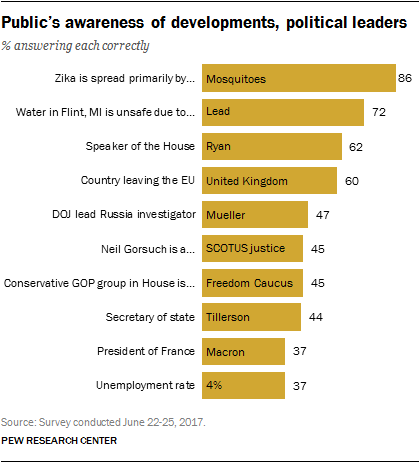
Public’s awareness of developments, political leaders

The latest Pew Research Center News IQ quiz finds that many Americans struggle when it comes to identifying some major political figures, though a majority knows that Paul Ryan is speaker of the House of Representatives.

On the other hand, there is broad awareness of details related to how the Zika virus is spread (86% know it is primarily spread by mosquitoes). In addition, 72% know that tap water in Flint, Michigan, is unsafe because it contains too much lead.

While 62% correctly identify Paul Ryan as speaker of the House, fewer (45%) know that Neil Gorsuch is a Supreme Court justice. (Full question wording available here.)

About half (47%) identify Robert Mueller as the person leading the Justice Department’s investigation into Russian involvement in the 2016 election, while 44% know that the current secretary of state is Rex Tillerson.

Public knowledge of international developments varies. Six-in-ten (60%) identify the United Kingdom as the country that has officially begun the process of leaving the European Union. However, just 37% identify Emmanuel Macron as president of France (the survey was conducted before President Donald Trump’s visit to France).

The new survey, conducted June 22-25 among 1,002 adults, finds substantial age differences in knowledge about several Washington figures.
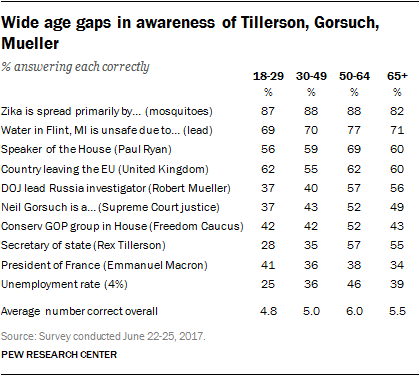
Wide age gaps in awareness of Tillerson, Gorsuch, Mueller

For instance, a majority of those 50 and older (56%) know that Tillerson is secretary of state, compared with 32% of those younger than 50.

Older adults also are more likely to know that Gorsuch is a Supreme Court justice, and that Mueller is leading the investigation into Russia’s involvement in the presidential campaign. However, majorities across age categories correctly identify Ryan as House speaker.

There are no significant age differences in awareness of the United Kingdom as the country taking steps to leave the EU or in the share who correctly identify Macron as president of France.

And large majorities, regardless of age, are able to correctly state that mosquitoes are the primary way the Zika virus is spread to humans and to identify lead as the reason the tap water in Flint, Michigan, is unsafe.

Modest partisan differences in knowledge of events, people
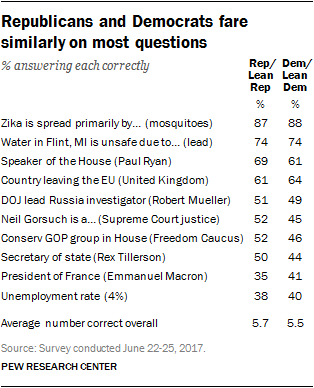
Republicans and Democrats fare similarly on most questions

There is little difference in news knowledge across partisan groups, with Republicans and Republican-leaning independents and Democrats and Democratic leaners answering about the same number of questions correctly on average (5.7 questions vs. 5.5 questions, respectively).

Republicans are somewhat more likely than Democrats to correctly identify Paul Ryan as the speaker of the House (69% vs. 61%). There are only modest partisan differences on other questions in the survey.


Education gaps in knowledge of current events
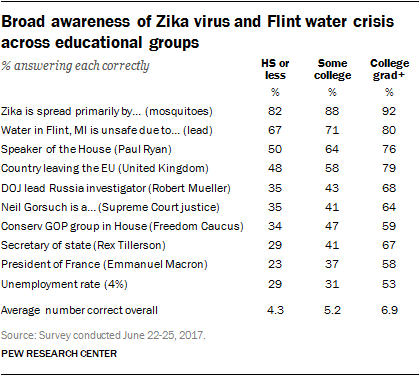
Broad awareness of Zika virus and Flint water crisis across educational groups

As in past surveys, college graduates perform better than those with less education on the News IQ quiz. Those with a bachelor’s degree or more education answer an average of 6.9 questions correctly, compared to 5.2 correct answers from those with some college experience and 4.3 from those with no more than a high school diploma.

The educational divide is evident across all of the questions asked, but majorities regardless of educational attainment are able to correctly answer that the Zika virus is spread primarily by mosquitoes and that the tap water in Flint, Michigan, is unsafe due to lead.

Methodology

The analysis in this report is based on telephone interviews conducted June 22-25, 2017 among a national sample of 1,002 adults, 18 years of age or older, living in the continental United States (500 respondents were interviewed on a landline telephone, and 502 were interviewed on a cell phone, including 329 who had no landline telephone). The survey was conducted by interviewers at Princeton Data Source under the direction of Princeton Survey Research Associates International. A combination of landline and cell phone random digit dial samples were used; both samples were provided by Survey Sampling International. Interviews were conducted in English and Spanish. Respondents in the landline sample were selected by randomly asking for the youngest adult male or female who is now at home. Interviews in the cell sample were conducted with the person who answered the phone, if that person was an adult 18 years of age or older. For detailed information about our survey methodology, see https://alpha.pewresearch.org/pewresearch-org/methodology/u-s-survey-research/

The combined landline and cell phone sample are weighted using an iterative technique that matches gender, age, education, race, Hispanic origin and region to parameters from the 2015 Census Bureau’s American Community Survey and population density to parameters from the Decennial Census. The sample also is weighted to match current patterns of telephone status (landline only, cell phone only, or both landline and cell phone), based on extrapolations from the 2016 National Health Interview Survey. The weighting procedure also accounts for the fact that respondents with both landline and cell phones have a greater probability of being included in the combined sample and adjusts for household size among respondents with a landline phone. The margins of error reported and statistical tests of significance are adjusted to account for the survey’s design effect, a measure of how much efficiency is lost from the weighting procedures.

The following table shows the unweighted sample sizes and the error attributable to sampling that would be expected at the 95% level of confidence for different groups in the survey:

Sample sizes and sampling errors for other subgroups are available upon request.

In addition to sampling error, one should bear in mind that question wording and practical difficulties in conducting surveys can introduce error or bias into the findings of opinion polls.

Pew Research Center is a nonprofit, tax-exempt 501(c)(3) organization and a subsidiary of The Pew Charitable Trusts, its primary funder.