Public Dissatisfaction With Washington Weighs on the GOP
Ryan job rating at 29%; Republicans view their party as divided
About Pew Research Center
Pew Research Center is a nonpartisan, nonadvocacy fact tank that informs the public about the issues, attitudes and trends shaping the world. It does not take policy positions. The Center conducts public opinion polling, demographic research, computational social science research and other data-driven research. It studies politics and policy; news habits and media; the internet and technology; religion; race and ethnicity; international affairs; social, demographic and economic trends; science; research methodology and data science; and immigration and migration. Pew Research Center is a subsidiary of The Pew Charitable Trusts, its primary funder.
Public Dissatisfaction With Washington Weighs on the GOP
Ryan job rating at 29%; Republicans view their party as divided
Survey Report
Nearly three months after the Republican Party took control of the White House and Congress, the public gives low job ratings to the president and even lower ratings to the speaker of the House.
The new Congress is viewed about as unfavorably as the previous Congress. And while both parties are viewed less positively than in January, the GOP’s ratings are more negative than the Democratic Party’s.
On issues, the Republicans hold their traditional advantage on terrorism, and the two parties continue to run about even on handling the economy – which, along with terrorism, tops the public’s agenda.
But the Democratic Party has made sharp gains compared with a year ago on several issues – notably, foreign policy and immigration. Currently, 49% of Americans say the Democratic Party is better able to make wise decisions about foreign policy, while 36% favor the GOP. A year ago, Republicans were favored on foreign policy, 46% to 38%. Democrats also lead on dealing with immigration, 50% to 39%; in recent years, the parties have run about even on this issue.
And, with budget debates looming this month in Congress, 48% say the Democratic Party better represents their views on government spending, while 40% say the Republican Party does.
The national survey by Pew Research Center, conducted April 5-11 among 1,501 adults, finds some signs of public disillusionment with both parties. The favorability ratings of both parties have declined since January – seven percentage points for the Republican Party (from 47% to 40%) and six points for the Democratic Party (51% to 45%).
However, with the Republicans now in control of government, much of the public’s criticism is aimed toward the GOP and its leaders:
Less confidence in Trump in dealing with Congress. Donald Trump’s overall job rating stands at 39%, the same as it was in February. As was the case then, his job rating today is lower – and more politically divided – than other recent presidents at comparable points in their first year. For more, see detailed demographic tables on Trump job approval.
In addition, fewer than half (46%) are very or somewhat confident in Trump’s ability to work effectively with Congress; in December, this had been seen as a relative strength for Trump – 60% were confident he could work well with Congress. Over this period, the share expressing confidence in Trump to avoid major scandals in his administration also has fallen eight percentage points, from 44% to 36%.
Many see U.S. in weaker position internationally. The public is divided in its views of the impact of Trump’s policies on terrorism. While 31% say Trump’s policies have made the U.S. safer when compared with the policies of Barack Obama’s administration, 33% say they have made the country less safe; another 33% say they haven’t made much of a difference. But more say Trump’s policies have placed the U.S. in a weaker than stronger position internationally (45% vs. 31%), while 20% say his policies have put the U.S. in about the same position as Obama’s policies.
Ryan’s negative job rating. Just 29% approve of the way Paul Ryan is handling his job as speaker of the House, while nearly twice as many (54%) disapprove. About half of Republicans and Republican-leaning independents (51%) give Ryan a positive job rating, while 31% disapprove. Democrats and Democratic leaners overwhelmingly disapprove of Ryan’s job performance (75% disapprove).
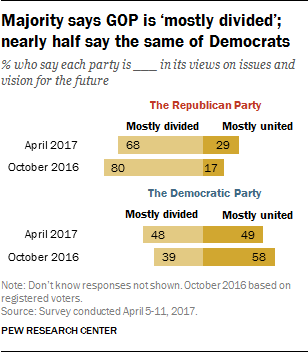
Republican Party still seen as “mostly divided.” About two-thirds of the public (68%) say the Republican Party is “mostly divided,” while just 29% say it is “mostly united.” In October, 80% of registered voters said the GOP was divided.
By contrast, about as many say the Democratic Party is divided as not (48% mostly divided, 49% mostly united). But that represents a change from October, when 39% of registered voters thought the party was divided.
In the current survey, 57% of Republicans see their party as mostly divided, while a similar majority of Democrats (58%) say their party is mostly united.
Views of parties’ traits. The public’s overall impressions of the parties are little changed from about a year ago. About half (52%) view the GOP as “too extreme,” while fewer (40%) say that phrase describes the Democratic Party. Democrats also are more widely viewed as having “good policy ideas” (58% say this applies to the Democratic Party, 49% to the GOP). But neither party is widely seen as having “high ethical standards.” About half (49%) say this describes the Democratic Party and 45% say it applies to the Republican Party.
Republicans say GOP lawmakers not obliged to support Trump. A majority of Republican and Republican leaners (55%) say Republicans in Congress are under no obligation to support Trump’s policies if they disagree with him. About four-in-ten (43%) say they have an obligation to support his policies because he is a Republican president.
Low awareness of House Freedom Caucus. Just 19% of the public says they have heard “a lot” about the House Republican group known as the Freedom Caucus; 39% say they have heard a little about the group, while 42% have heard nothing at all. Republicans who have heard at least a little about the group view it favorably by more than two-to-one (59% to 25%); Democrats who have heard of the Freedom Caucus view it unfavorably by a wide margin (66% to 19%).
1. Views of Trump
Ratings of Trump’s job performance remain more negative than positive: 54% say they disapprove of the job he is doing, while 39% approve. Public evaluations of Trump’s job performance are about the same as they were in February.
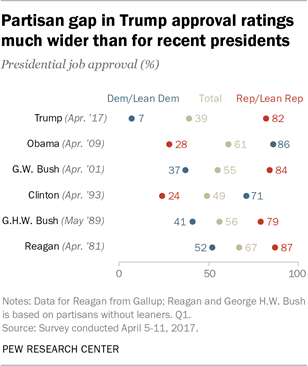
Ratings of Trump continue to trail those of recent presidents at similar points in their presidencies. In April of their first years, a larger share of the public approved than disapproved of each of the last five presidents, beginning with views of Ronald Reagan in 1981.
The lack of movement in Trump’s early ratings is not unusual, when compared with recent presidents. For example, both George W. Bush and Barack Obama saw only modest shifts in their approval ratings between February and April of their first years.
As was the case in February, just 6% of the public does not offer a job rating for Trump – this is a smaller share than for his recent predecessors at this point in their presidencies.
There remain stark demographic differences in ratings of Trump’s job performance, with wide gaps in assessments of him by race and ethnicity, gender, age and education.
Half of whites (50%) approve of Trump’s job performance; 44% say they disapprove. By contrast, large majorities of blacks (81%) and Hispanics (78%) disapprove of the job Trump is doing.
By 60%-33%, more women disapprove than approve of Trump’s job performance. Men are about evenly divided (46% approve, 48% disapprove).
And while most of those under age 50 disapprove of the job Trump is doing, those ages 50 and older are roughly divided in their assessments.
A 71% majority of those with a postgraduate degree disapprove of the job Trump is doing. Smaller majorities of those with a college degree (57%) or some college experience (55%) also disapprove. Those with no more than a high school diploma are split in their assessments: 44% approve of Trump, while 48% disapprove.
For more on demographic differences in ratings of Trump’s job performance, see the detailed tables.
The partisan gap in ratings of Trump is wider than for any of the last five presidents at similar points in their presidencies. Overall, 82% of Republicans and Republican leaners approve of the job Trump is doing, compared with just 7% of Democrats and Democratic leaners – a 75-percentage point gap.
Republican support for Trump is comparable to the levels of early support recent presidents received from members of their own party. For example, 86% of Democrats approved of Obama in April 2009, and 84% of Republicans approved of George W. Bush in April 2001. Trump’s ratings among Republicans are actually somewhat more positive than the ratings Democrats gave Bill Clinton in April 1993, when 71% said they approved of the way he was handling his job.
Trump’s approval ratings among Democrats are considerably lower than the ratings any of the last five presidents received from the other party at this stage in their administrations. In April 2009, 28% of Republicans said they approved of the job Obama was doing as president, and 24% of Republicans approved of Bill Clinton’s performance at this point in his presidency. Republican presidents George W. Bush, George H. W. Bush and Ronald Reagan fared even better among Democrats at similar points: 37% approved of George W. Bush in April 2001, 41% of Democrats approved of George H.W. Bush in May 1989 and 52% of Democrats approved of Reagan in April 1981.
There are differences in Trump’s approval ratings by ideology. Nine-in-ten conservative Republicans say they approve of Trump (including 73% who approve very strongly), compared with 68% of moderate and liberal Republicans (including 50% who approve very strongly). Among Democrats, 94% of liberal Democrats disapprove of Trump, compared with 81% of conservative and moderate Democrats. Intense opposition is widespread among liberal Democrats: 85% say they disapprove of Trump very strongly; 64% of conservative and moderate Democrats disapprove of Trump’s job performance very strongly.
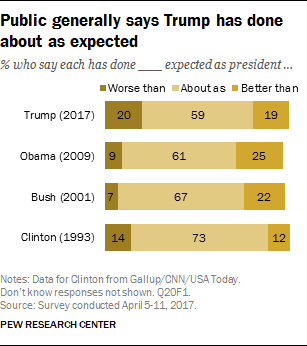
While Trump’s approval rating remains more negative than positive, most say that he has done about as they expected as president. Overall, 59% say Trump has done about as they expected, while 20% say he’s done worse than they expected and 19% say he’s done better. These views of Trump at this early stage of his administration are generally similar to those of recent presidents; majorities also said that Bill Clinton (73%), George W. Bush (67%) and Barack Obama (61%) had performed about as they expected in surveys conducted in April of their first year. Nonetheless, the share saying that Trump has been worse than expected (20%) is slightly higher than for each of these three previous presidents.
While Republicans and Democrats differ dramatically in most assessments of Trump, both say his performance is in line with their expectations. Among Republicans, 53% say he has performed about as they expected; 38% say he has done better than they expected, and just 7% say he has done worse. Among Democrats, most also say he has done about as they expected (63%); 32% say he has been worse than expected, while just 3% say he has done better.
Among those who approve of his overall job performance, 55% say he has performed about as expected, 43% say he has done better (just 1% say he has done worse). Among those who disapprove, 59% say he has done about as they expected, while 36% say he has done worse (just 2% say he has done better).
When asked to compare Trump with previous presidents, 51% say they trust what Trump says less than they trusted what previous presidents said while in office, compared with 30% who say they trust him more and 16% who say they trust what he says about the same as what previous presidents said.
Many of the demographic patterns in views on this question mirror patterns in Trump’s overall job approval. For example, women, blacks, Hispanics, young adults and those with a postgraduate degree are especially likely to say they trust what Trump says less than other previous presidents. Evaluations of Trump’s trustworthiness are less negative among men, whites, older adults and those without a college degree; however, fewer than half of all of these groups say they trust Trump more than previous presidents.
Fully 83% of Democrats and Democratic leaners say they trust what Trump says less than what previous presidents said in office. By contrast, 66% of Republicans and Republican leaners trust what he says more than other presidents. There is a significant divide in views among Republicans: Three-quarters of conservative Republicans say they trust Trump more than past presidents, compared with 50% of moderate and liberal Republicans.
Majority continues to say Trump’s decision making is ‘too impulsive’
The public continues to have concerns about Trump’s decision making. Overall, 63% say that Trump is too impulsive in making important decisions, while 32% say his approach is about right; just 2% say he is too cautious in making important decisions. Views on this question are similar to those shortly before he took the oath of office: In January, 58% said they thought Trump would be too impulsive in making important decisions.
An overwhelming majority of Democrats view Trump as too impulsive: 87% say this, compared with just 9% who say his decision-making approach is about right and only 1% who say he is too cautious. Among Republicans, most (65%) say Trump’s approach is about right, though 30% say he is too impulsive (only 4% say he is too cautious).
Declining confidence in Trump to work with Congress, prevent scandals
In the wake of a failed effort by Trump and Republicans in Congress to repeal and replace the 2010 health care law, the public expresses less confidence in Trump’s ability to work effectively with Congress than they did on the eve of his taking office. Currently, 46% say they are either very or somewhat confident in Trump’s ability to effectively work with Congress; somewhat more (52%) say they are not too or not at all confident in his ability to do this. In December, 60% said they were confident in Trump’s ability to work effectively with Congress.
Confidence in Trump also has declined when it comes to his ability to prevent major scandals in his administration. The public was not particularly optimistic about Trump’s ability in this area in December when 44% said they were very or somewhat confident in his ability to prevent major scandals. The current survey finds that confidence in Trump to prevent major scandals in his administration has fallen 8 points, to 36% — the lowest level of confidence across the five items tested in this question.
There has been little change in confidence in Trump to use military force wisely: 45% are very or somewhat confident in his ability in this area; 44% expressed confidence in his ability to use force wisely in December. Similarly, confidence in Trump’s ability to handle an international crisis also has not changed much (48% confident now, 45% in December). Most of the survey was completed after the U.S. launched missile strikes against Syria on April 6. A majority of Americans (58%) approved of the strikes.
In addition, half of Americans say they are very or somewhat confident in Trump’s ability to manage the executive branch effectively, while about as many (49%) say they have little or no confidence in Trump’s ability to do this.
Overall, the partisan gaps on most of these measures of confidence are little different than they were in December. Roughly three- quarters or more Republicans and Republican leaners say they are at least somewhat confident in Trump’s ability to handle these aspects of the presidency, while no more than a quarter of Democrats express this level of confidence on any of these measures.
But confidence in Trump’s ability to work effectively with Congress has declined among both Republicans and Democrats. In December, 40% of Democrats and Democratic leaners said they were at least somewhat confident in Trump’s ability to work with Congress; since then, Democratic confidence in Trump on this measure has dropped 16-percentage points to 24%. And while a 79% majority of Republicans and Republican leaners continue to say they are either very or somewhat confident in Trump’s ability to work effectively with Congress, this reflects a nine-point decline since December.
And the already wide partisan gap in confidence in Trump to handle an international crisis has widened over the last several months. Fully 85% of Republicans now say they are at least somewhat confident in Trump’s ability to handle an international crisis, including 57% who say they are very confident. In December, just under half (45%) said they were very confident in him on this measure.
By contrast, Democrats – who already expressed little confidence in Trump to handle an international crisis – express even lower levels of confidence in him in this area today. Currently, 85% say they are not too or not at all confident in Trump’s handling of a future international crisis, including fully 64% who say they are “not at all” confident in him to do so. In December, though about eight-in-ten (79%) expressed little or no confidence in him in a global crisis, only about half (53%) expressed no confidence at all.
Impact of Trump’s policies on terrorism, international standing
Early in the Trump administration, the public has mixed views on the impact of his policies on the country’s security from terrorism. When asked to compare Trump’s policies to those of the Obama administration, 31% say Trump has made the U.S. safer from terrorism, while about as many (33%) say his policies have made the U.S. less safe; another 33% say they haven’t made a difference.
Most Republicans and Republican leaners (63%) say Trump’s policies have made the U.S. safer from terrorism compared with those of the Obama administration. A quarter say they haven’t made a difference and just 7% say they have made the U.S. less safe. Conservative Republicans (70%) are significantly more likely than moderate and liberal Republicans (50%) to say Trump’s policies have made the U.S. safer.
Democrats take the opposite view. Fully 57% say the country is less safe from terrorism as a result of the Trump administration’s policies. Only 7% say they have made the U.S. safer, while 36% believe they have not made much difference. As with Republicans, there are differences in views among Democrats by ideology: 71% of liberal Democrats say Trump’s policies have made the U.S. less safe, while about as many conservative and moderate Democrats say his policies haven’t made a difference (47%) as say they have made the U.S. less safe (45%).
In June 2009, a plurality (44%) said that Barack Obama’s policies, compared with those of the Bush administration, hadn’t made a difference in the country’s security situation; 28% said Obama’s policies had made the country safer, while 21% said they had made the country less safe.
Partisans are more likely to say Trump’s policies have had an impact on the country’s security (either positive or negative) than they were to say this about Obama’s policies in 2009.
Eight years ago, 43% of Democrats (the party that controlled the White House) said Obama’s policies had made the country safer from terrorism. In the current survey, fully 63% of Republicans say Trump’s policies have made the country safer from terrorism.
Similarly, the share of Democrats who say Trump’s policies have made the country less safe (57%) is greater than the share of Republicans who said this about Obama in 2009 (47%).
While the public is evenly split over the impact of Trump’s policies on the country’s security, many say Trump’s policies have put the U.S. in a weaker position internationally. Overall, 45% say that, compared with the Obama administration, Trump’s policies have put the U.S. in a weaker position internationally; fewer (31%) say they have put the country in a stronger position internationally and 20% say the country is in about the same position as it was.
Republicans and Democrats hold opposing views on this question. Seven-in-ten Republicans and Republican leaners say Trump’s policies have strengthened the country’s international position, compared with the policies of Obama; 21% say the country’s position is about the same and just 6% think Trump has weakened the country’s international standing. By contrast, 73% of Democrats and Democratic leaners say Trump has weakened the country’s position internationally, while 17% say it’s in about the same position (6% say Trump has strengthened U.S. global standing).
2. Views of the parties
Public assessments of the Republican and Democratic parties have worsened over the last few months. While the GOP’s image continues to be somewhat more negative than the Democratic Party’s, both parties are currently viewed more unfavorably than favorably. This is similar to their standing among the public this time last year.
About half (51%) of Americans have an unfavorable view of the Democratic Party, while 45% have a favorable view. In January, slightly more had a favorable than unfavorable view (51% favorable to 45% unfavorable).
Today, 57% of Americans have an unfavorable view of the GOP, while 40% have a favorable view. In January, Americans were about equally likely to view the GOP favorably (47%) as unfavorably (49%).
About three-quarters of Republicans and Republican leaners (74%) rate the GOP positively, little changed over the last several months. Just 15% of Democrats and Democratic leaners share that view, down eight percentage points from January but on par with other points in recent years.
Seven-in-ten Democrats and Democratic-leaning independents (70%) now express a favorable view of the Democratic Party. However, these ratings of the party among its backers are now lower than at any point since December 2014, after the Democrats’ midterm election loss. As recently as January, 82% of Democrats and leaners held a positive view of the Democratic Party, and fully 87% did so in October.
This decline is most pronounced among Democratic leaners. In January, about seven-in-ten (73%) Democratic leaners said they viewed the Democratic Party favorably; that share has fallen 18 points to just 55% today, one of the lowest ratings the party has received from its leaners over the last two decades.
Republicans and Republican leaners’ ratings of the Democratic Party are also somewhat lower than they were in January (17% favorable vs. 22%). The current ratings are in line with other points over the last several years.
About half of Americans continue to say GOP is ‘too extreme’
The public’s perceptions of the characteristics associated with Republican and Democratic parties have not changed much over the past few years. Compared with last spring, slightly larger shares say the Republican Party (49% today, 45% last March) and the Democratic Party have “good policy ideas” (58% today, 53% last March), but the Democratic Party continues to have an advantage on this measure.
The public also remains more likely to characterize the Republican Party as “too extreme.” About half (52%) say the Republican Party is too extreme, while 40% say the same for the Democratic Party.
Half of Americans (50%) say the GOP can do “a good job managing the federal government,” and a similar share (54%) says this about the Democratic Party. These views are nearly identical to views in October 2015. And roughly half (49%) say the Democratic Party “has high ethical standards,” about as many (45%) as say this about the Republican Party.
Democrats gain on key issues
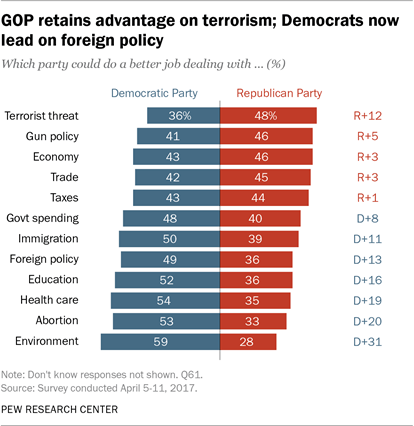
The Democratic Party holds sizable advantages over the Republican Party on a number of major issues. More say the Democratic Party could do a better job than the GOP when it comes to dealing with the environment (59% to 28%), abortion and contraception (53% to 33%), health care (54% to 35%) and education policy (52% to 36%). It is also favored over the GOP on foreign policy (49% to 36%), immigration (50% to 39%) and government spending (48% to 40%).
On just one issue does the Republican Party have a significant edge: About half (48%) of the public says the Republican Party can better deal with the terrorist threat at home; 36% say the Democratic Party could do a better job.
Neither party enjoys an advantage on key economic issues: 46% say the Republican Party is better able to deal with the economy and 43% say the Democratic Party. Similarly, the public is split over which party would do a better job dealing with trade agreements between the U.S. and other countries (45% say the GOP, 42% the Democratic Party) and with taxes (44% say the Republican Party, 43% say the Democratic Party).
When it comes to reflecting their views on gun policy neither party enjoys a significant edge among the public: 46% say the Republican Party does a better job of this, 41% say the Democratic Party.
While public views of which party could better deal with the economy or taxes are little changed over the past year, views on which party is better equipped to handle trade agreements with other nations and government spending have shifted in recent years.
The Democratic Party now runs roughly even with the Republican Party on trade, an issue on which the GOP enjoyed an 11-percentage point advantage last spring. And Democrats now have an eight-point edge as the party that could do the better job representing people’s views on government spending: 48% say this, 40% say the GOP. In January 2013, when the question was last asked, just 36% said Democrats could do the better job representing their views on government spending (the share saying the GOP could do the better job is little changed).
The Democratic Party now holds a 13-percentage point edge as the party seen as able to do a better job “making wise decisions about foreign policy” (49% to 36%). This is the widest advantage on foreign policy the Democratic Party has had since August 2009 and reflects a significant swing on this measure from a year ago, when the Republican Party held an eight-point advantage (46% to 38%).
The Democratic Party also holds an 11-point advantage over the Republican Party when it comes to immigration (50% to 39%); last year the public was evenly split on which party could do a better job on this issue (44% said the Democratic Party, 42% said the GOP).
More Americans continue to see the Republican Party as better able than the Democratic Party to handle the threat of terrorism (48% to 36%). This balance of opinion is little changed in recent years.
The Democratic Party continues to be preferred over the Republican Party by wide margins on several domestic issues: education policy, health care, the environment, and abortion and contraception.
One exception is gun policy, on which neither party holds a significant edge: Today, the public is nearly evenly split between the Republican Party (46%) and the Democratic Party (41%) on this issue.
The Democratic Party now enjoys a 16-percentage point advantage on education policy and a 20-point advantage on policies related to abortion and contraception, both little changed over the last few years.
By a similarly wide 19-point margin (54% to 34%), more now say the Democratic Party could do the better job dealing with health care. Democrats have long had an advantage on this issue, but the size of the party’s advantage has widened.
By roughly two-to-one, more now say the Democratic Party could do a better job than the GOP dealing with the environment (59% vs. 28%); the Democratic advantage on this issue is slightly wider that when the question was last asked in December 2015
Public split over whether Democratic Party is divided
Americans continue to see the Republican Party as divided in its views on the issues and vision for the future: 29% say it is mostly united, while 68% say it is mostly divided. The share viewing the GOP as united has increased since the weeks before the 2016 election: In October, just 17% of registered voters saw the Republican Party as united.
In contrast, the public is about evenly split over whether the Democratic Party is mostly divided (48%) or mostly united (49%). The share saying the Democratic Party is united has declined since the fall; in October, 58% of registered voters said the party was mostly united.
Majority of Republicans say GOP is divided
While majorities of both Democrats and Republicans say the GOP is mostly divided in its views on issues and visions for the future, Democrats are far more likely than Republicans to say this: 80% of Democrats and Democratic leaners say this, compared with 57% of Republicans and Republican leaners; 42% of Republicans and Republican leaners say their party is mostly united.
By a 58% to 38% margin, Republicans and Republican leaners think the Democratic Party is mostly divided. Views are nearly reversed among Democrats: 58% say their party is mostly united, 39% say it is mostly divided.
Conservative Republicans and Republican leaners are more likely than GOP moderates and liberals to see a united party: About half of conservatives (48%) say the Republican Party is mostly united; just 30% of moderate and liberal Republicans and Republican leaners say the same.
No similar ideological differences are seen among Democrats. Roughly six-in-ten of both conservative and moderate (58%) and liberal (60%) Democrats and Democratic leaners say that their party is mostly united.
3. Views of Congress
The public continues to hold negative views of Congress. Today, about six-in-ten (62%) say they have a very (24%) or mostly (38%) unfavorable opinion of Congress, compared with about a third (34%) who give a favorable rating.
Majorities of Republicans and Democrats alike have given Congress poor ratings in recent years, but the views among Republicans have grown more positive over the last year, following Trump’s election. Overall, 44% of Republicans and Republicans leaners have a favorable opinion of Congress, up from 31% last June.
By contrast, only about a quarter (27%) of Democrats and Democratic leaners express a positive view of Congress – down slightly from 32% last June — while 69% say they have an unfavorable view.
A year and a half into his tenure as House Speaker, Paul Ryan is viewed more negatively than positively: 54% say they disapprove of the job Ryan is doing, 29% approve; 17% do not have an opinion.
Ryan’s approval rating of 29% is lower than the approval ratings for John Boehner (36%), Nancy Pelosi (35%) and Newt Gingrich (43%), measured shortly after each of their terms as Speaker of the House began.
The share of the public that offers an opinion of Ryan’s job performance (83%) is greater than the shares that could assess Boehner’s performance in April 2011 (71%) or Pelosi’s performance in April 2007 (65%). In April 1995, about as many were able to rate the job Gingrich was doing as speaker (85%).
About half of Republicans and Republican leaners (51%) say they approve of the job Ryan is doing, while 31% say they disapprove. A greater share of Republicans currently disapprove of the job Ryan is doing than disapproved of Boehner in 2011 (19%) or Gingrich in 1995 (23%).
And while Democrats have consistently rated a Republican Speaker of the House more negatively than positively, attitudes toward Ryan are overwhelmingly negative. Fully three-quarters of Democrats disapprove of Ryan’s performance today; about half of Democrats said this of Boehner in 2011 (49%) and about six-in-ten (61%) disapproved of Gingrich in 1995.
Many say Trump and Hill Democrats are doing too little to work with opposition
About half of Americans (53%) say that the Trump administration is doing too little to work with congressional Democrats; just 7% say it has done too much, while 36% say the administration is doing about the right amount. And overall public views about how congressional Democrats are working with the Trump administration are nearly identical: 57% say they are doing too little to work with the Trump White House, only 5% say they are doing too much; 34% think they have done about the right amount.
On one level, Republicans and Democrats take similar views of efforts at cooperation with the political opposition: 84% of Democrats and Democratic leaners say the Trump administration is doing too little to work with congressional Democrats; an identical share of Republicans say Democrats are doing too little to work with the administration.
But for the most part, Republicans are not inclined to fault the Trump administration for doing too little to work with Democrats: 64% say the administration has handled this about right, while 20% say they have done too little (and 12% say they have done too much to work with Democrats).
Democrats are more critical of their party’s approach: 52% say congressional Democrats’ efforts to work with Trump have been about right, while 38% say they have done too little – almost double the share of Republicans who say the Trump administration has not done enough to work with Democrats in Congress. Only 6% of Democrats say congressional Democrats are doing too much to work with the administration.
Most Republicans say GOP lawmakers are not obliged to back Trump if they disagree with him
About four-in-ten Republicans and Republican leaners (43%) say that Republicans in Congress have an obligation to support Donald Trump’s politics and programs because he is a Republican president, while a narrow majority (55%) say they do not have such an obligation if they disagree with him.
Conservative Republicans are roughly evenly divided on this question. However, by roughly two-to-one (66% vs. 32%), more moderate and liberal Republicans say GOP members of Congress do not have an obligation to back Trump if they disagree with him.
Younger Republicans are more likely than older Republicans to say congressional Republicans do not have an obligation to back the president: Just 31% of Republicans and Republican leaners younger than 50 say there is an obligation to back Trump because he is a GOP president. By contrast, 49% of Republicans 50-64 say this, along with fully 61% of Republicans 65 and older.
Views of whether GOP representatives have an obligation to back Trump are not associated with opinion about the House Freedom Caucus.
Views of the Freedom Caucus
Despite its high-profile role in unsuccessful efforts to repeal and replace the Affordable Care Act, many Americans say they have not heard about the Freedom Caucus, a group of conservative Republicans in the House of Representatives.
Overall, 42% say they have heard nothing at all about the Freedom Caucus, while 39% say they have heard a little and just 19% say they have heard a lot about the group.
Republicans and Democrats have similar levels of awareness of the Freedom Caucus. Overall, 42% of Republicans and Republican leaners have heard nothing at all about them, while 39% have heard a little and 19% have heard a lot. Among Democrats and Democratic leaners, 40% have heard nothing at all about the Freedom Caucus compared with 39% who have heard a little and 20% who have heard a lot.
Conservative Republicans are more likely than moderate and liberal Republicans to have heard of the Freedom Caucus. Overall, 64% of conservative Republicans have heard either a lot (22%) or a little (41%) about the group, while 36% have heard nothing at all. Among moderate and liberal Republicans, about as many have heard a lot or a little about the Freedom Caucus (48%) as nothing at all (52%).
There is a similar divide by ideology among Democrats. About seven-in-ten (69%) liberal Democrats have heard a lot (29%) or a little (40%) about the Freedom Caucus; 30% say they have heard nothing at all. Conservative and moderate Democrats are less familiar with the group: 52% have heard a lot or a little, while 47% have heard nothing at all.
Across age groups, young adults ages 18-29 are the least familiar with the Freedom Caucus: 53% have heard nothing at all about the group, while 46% have heard at least a little. Among all older age cohorts, most have heard at least something about the Freedom Caucus. For example, 61% of those ages 65 and older have heard a lot or a little about the group.
Among those who have heard of the Freedom Caucus, 36% view it favorably, compared with a greater share (48%) who view it unfavorably; 16% have heard of the group but cannot offer a rating of it.
Republicans and Republican leaners who have heard of the Freedom Caucus hold a broadly positive view of it. About six-in-ten (59%) Republicans view it favorably, while 25% hold an unfavorable view. Views among Democrats and Democratic leaners who are aware of the group are the reverse: 66% view it unfavorably and just 19% view it favorably.
Conservative Republicans have a much more positive view of the Freedom Caucus than their moderate and liberal counterparts. Two-thirds of conservative Republicans who have heard of the group view it favorably; just 21% take an unfavorable view. Among moderate and liberal Republicans, about as many view the Freedom Caucus favorably (40%) as unfavorably (36%).
Almost three-quarters (74%) of liberal Democrats who are familiar with the Freedom Caucus hold an unfavorable view of the group. A somewhat smaller majority of moderate and conservative Democrats (59%) view the Freedom Caucus unfavorably.
Though Trump has been critical of some members of the Freedom Caucus, Republicans who have a favorable view of the group are significantly more likely than Republicans with an unfavorable view to approve of his job performance.
Overall, 94% of Republicans and Republican leaners who view the Freedom Caucus favorably say they approve of the job Trump is doing as president. By comparison, a somewhat smaller majority (75%) of Republicans who hold an unfavorable view of the Freedom Caucus approve of Trump.
Republicans who have a favorable view of the Freedom Caucus are more likely than those with an unfavorable view to describe their own political views as conservative (81% vs. 57%). (Conservative Republicans express more widespread and intense approval of Trump than do moderate and liberal Republicans).
Views of Speaker Paul Ryan are not significantly different between Republicans who view the Freedom Caucus favorably and those who view it unfavorably.
Methodology
The analysis in this report is based on telephone interviews conducted April 5-11, 2017 among a national sample of 1,501 adults, 18 years of age or older, living in all 50 U.S. states and the District of Columbia (375 respondents were interviewed on a landline telephone, and 1,126 were interviewed on a cell phone, including 693 who had no landline telephone). The survey was conducted by interviewers at Princeton Data Source under the direction of Princeton Survey Research Associates International. A combination of landline and cell phone random digit dial samples were used; both samples were provided by Survey Sampling International. Interviews were conducted in English and Spanish. Respondents in the landline sample were selected by randomly asking for the youngest adult male or female who is now at home. Interviews in the cell sample were conducted with the person who answered the phone, if that person was an adult 18 years of age or older. For detailed information about our survey methodology, see https://alpha.pewresearch.org/pewresearch-org/methodology/u-s-survey-research/
The combined landline and cell phone sample are weighted using an iterative technique that matches gender, age, education, race, Hispanic origin and nativity and region to parameters from the 2015 Census Bureau’s American Community Survey and population density to parameters from the Decennial Census. The sample also is weighted to match current patterns of telephone status (landline only, cell phone only, or both landline and cell phone), based on extrapolations from the 2016 National Health Interview Survey. The weighting procedure also accounts for the fact that respondents with both landline and cell phones have a greater probability of being included in the combined sample and adjusts for household size among respondents with a landline phone. The margins of error reported and statistical tests of significance are adjusted to account for the survey’s design effect, a measure of how much efficiency is lost from the weighting procedures.
The following table shows the unweighted sample sizes and the error attributable to sampling that would be expected at the 95% level of confidence for different groups in the survey:
Sample sizes and sampling errors for other subgroups are available upon request.
In addition to sampling error, one should bear in mind that question wording and practical difficulties in conducting surveys can introduce error or bias into the findings of opinion polls.
Pew Research Center undertakes all polling activity, including calls to mobile telephone numbers, in compliance with the Telephone Consumer Protection Act and other applicable laws.
Pew Research Center is a nonprofit, tax-exempt 501(c)(3) organization and a subsidiary of The Pew Charitable Trusts, its primary funder.