
Pew Research Center

FOR RELEASE MAY 5, 2016

Public Uncertain, Divided Over America’s Place in the World

Growing support for increased defense spending

FOR MEDIA OR OTHER INQUIRIES:

Communications Department
202.419.4372
www.pewresearch.org

RECOMMENDED CITATION

Pew Research Center, May 2016, "Public Uncertain, Divided Over America’s Place in the World"

About Pew Research Center

Pew Research Center is a nonpartisan, nonadvocacy fact tank that informs the public about the issues, attitudes and trends shaping the world. It does not take policy positions. The Center conducts public opinion polling, demographic research, computational social science research and other data-driven research. It studies politics and policy; news habits and media; the internet and technology; religion; race and ethnicity; international affairs; social, demographic and economic trends; science; research methodology and data science; and immigration and migration. Pew Research Center is a subsidiary of The Pew Charitable Trusts, its primary funder.

© Pew Research Center 2026

Table of contents

  • About Pew Research Center
  • Public Uncertain, Divided Over America’s Place in the World
  • 1. America’s global role, U.S. superpower status
  • 2. Views of impact of global economic involvement, policies toward developing countries
  • 3. International threats, defense spending
  • 4. U.S. military action against ISIS, policy toward terrorism
  • 5. Views of Israel and Palestinians
  • 6. NATO, U.S. allies, the EU and UN
  • 7. Foreign policy, the parties and Obama
  • 8. Perceptions of U.S. global power and respect
  • Methodology

Public Uncertain, Divided Over America’s Place in the World

Growing support for increased defense spending

The public views America’s role in the world with considerable apprehension and concern. In fact, most Americans say it would be better if the U.S. just dealt with its own problems and let other countries deal with their own problems as best they can.

With the United States facing an array of global threats, public support for increased defense spending has climbed to its highest level since a month after the 9/11 terrorist attacks, when 50% favored more defense spending.

Currently, 35% say the U.S. should increase spending on national defense, 24% say it should be cut back and 40% say it should be kept about the same as today. The share favoring more defense spending has increased 12 percentage points (from 23%) since 2013.

Most of the increase has come among Republicans. Fully 61% of Republicans favor higher defense spending, up 24 percentage points from 2013. Support for more defense spending has increased much more modestly among other partisan groups. And the gap in support for higher military spending between Republicans and Democrats, which was 25 percentage points three years ago, now stands at 41 points.
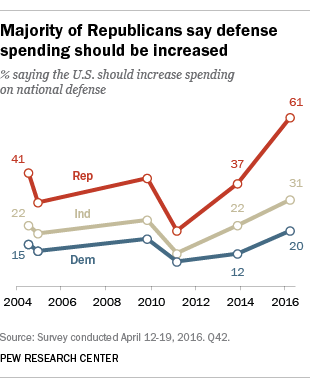
Majority of Republicans say defense spending should be increased

This shift underscores the deep partisan and ideological divisions in attitudes about U.S. foreign policy – differences that extend to how to deal with terrorism, the nature of global threats, views of the Israeli-Palestinian conflict and how deeply involved the United States should be in the world.

Amid a presidential campaign that has highlighted conflicting visions about America’s global role, many of these differences are reflected in the attitudes of the candidates’ supporters in the primary campaigns. Note: This survey was conducted before Ted Cruz and John Kasich suspended their presidential campaigns earlier this week.

Among GOP voters, majorities of Donald Trump (66%) and Ted Cruz (64%) supporters want to boost U.S. defense spending, compared with 52% of John Kasich supporters. Among Democratic voters, Bernie Sanders supporters are far more likely than those who support Hillary Clinton to favor cutting back U.S. defense spending (43% vs. 25%).
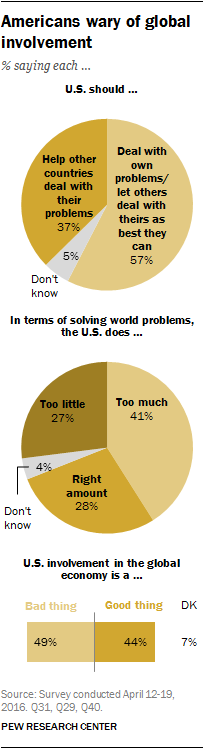
Americans way of global involvement

These are among the main findings of America’s Place in the World, a survey of foreign policy attitudes conducted periodically by Pew Research Center. In June, Pew Research Center will also publish a report exploring European public opinion on key foreign policy issues, including perceptions of major international threats and views about international engagement. The report will compare European and American views on many of these topics.

The new survey, conducted April 12 to 19 among 2,008 U.S. adults, finds the public remains wary of global involvement, although on some measures, support for U.S. internationalism has increased modestly from the historically low levels found in the 2013 study.

Still, 57% of Americans want the U.S. to deal with its own problems, while letting other countries get along as best they can. Just 37% say the U.S. should help other countries deal with their problems. And more Americans say the U.S. does too much (41%), rather than too little (27%), to solve world problems, with 28% saying it is doing about the right amount.

The public’s wariness toward global engagement extends to U.S. participation in the global economy. Nearly half of Americans (49%) say U.S. involvement in the global economy is a bad thing because it lowers wages and costs jobs; fewer (44%) see this as a good thing because it provides the U.S. with new markets and opportunities for growth.

On each of these measures, Republicans express greater skepticism about U.S. international engagement than do Democrats. Roughly six-in-ten Republicans (62%) say the United States should deal with its own problems and let other countries deal with their problems as best they can, compared with 47% of Democrats. And 55% of Republicans view global economic engagement negatively, compared with 44% of Democrats.
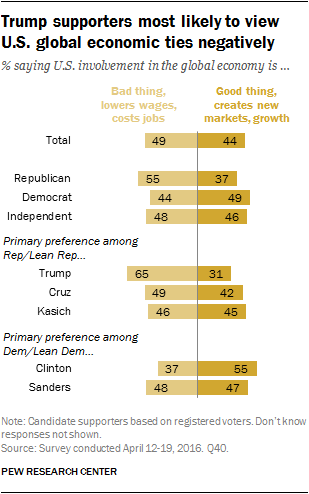
Trump supporters most likely to view U.S. global economic ties negatively

Trump’s primary campaign supporters stand out for their negative assessments of U.S. involvement in the global economy. Fully 65% of Republican registered voters who prefer Trump for the Republican presidential nomination say U.S. involvement in the global economy is a bad thing, compared with only about half of those who prefer Cruz (49%) or Kasich (46%).

Differences among Democratic voters are less pronounced, but Clinton supporters view U.S. global engagement positively, 55% to 37%, while Sanders supporters are divided (47% good, 48% bad).

The skepticism of Trump supporters toward U.S. global economic ties extends to increasing the level of imports from developing countries. Among Trump backers, just 32% support importing more goods from developing countries, while 67% are opposed. By comparison, 52% of those who prefer Kasich and Cruz, along with majorities of backers of both Democratic candidates, support an increase in imports from these nations.

While Americans remain skeptical of U.S. international involvement, many also view the United States as a less powerful and important world leader than it was a decade ago. Nearly half (46%) say the United States is a less powerful and important world leader than it was 10 years ago, while 21% say it is more powerful, and 31% say it is about as powerful as it was then.
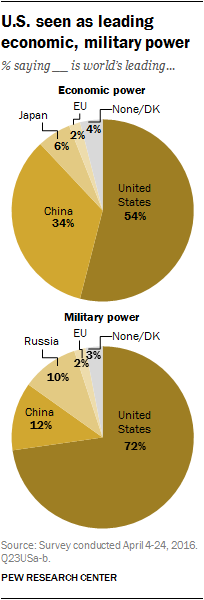
U.S. seen as leading economic, military power

The share saying the U.S. has become less powerful has declined since 2013, from 53% to 46%, but is among the highest numbers expressing this view in the past four decades. These attitudes also are divided along partisan lines: Republicans (67%) remain more likely than independents (48%) or Democrats (26%) to say that the U.S. has become less powerful and important.

However, although many Americans believe the U.S. has become less powerful than it was in the past, the predominant view among the public is that the United States is the world’s leading economic and military power.

In a separate Pew Research Center survey conducted April 4 to 24 among 1,003 U.S. adults, a majority of Americans (54%) say the United States is the world’s leading economic power, with China a distant second at 34%. This is the first time, in surveys dating back to 2008, that more than half of the public has named the United States as the leading economic power.

The gap between the United States and other nations in perceptions of military power is even greater: 72% say the U.S. is the leading military power, while 12% say it is China and 10% Russia. The share saying the U.S. is the top military power has grown from 64% in 2013.

Perceptions of global threats

In the view of the public, the top global threat facing the United States is ISIS – a concern that was not on the radar when the prior America’s Place in the World study was conducted three years ago. Currently, 80% say the Islamic militant group in Iraq and Syria known as ISIS is a major threat to the well-being of the United States, while 72% view cyberattacks from other countries as a major threat and 67% say the same about global economic instability.

Public attitudes about most global threats have held steady in recent years, including some, such as China’s emergence as a global power, that have received attention in the current presidential campaign. The share of Americans who say China’s emergence as a power is a major threat to the U.S., currently 50%, has not changed substantially in surveys dating back more than a decade.

There are partisan differences over a number of global concerns, but the widest gap, by far, is over the threat to the United States from global climate change. Nearly eight-in-ten Democrats (77%) view global climate change as a major threat to the U.S., compared with just 26% of Republicans.

Widest partisan differences on threats posed by climate change, refugees from the Middle East

Climate change ranks as the top global threat for Democrats, along with ISIS (76% say the group is a major threat). Among Republicans, climate change is the lowest of the eight threats included in the survey.

Republicans and Democrats also differ sharply over the seriousness of the threat posed by large numbers of refugees leaving countries such as Iraq and Syria. Nearly three-quarters of Republicans (74%) view the refugee exodus as a major threat to the well-being of the United States, compared with just 40% of Democrats.

For those who back Trump in the primary campaign, the large number of refugees leaving Iraq and Syria is especially worrisome. More than eight-in-ten GOP voters who support Trump (85%) say the refugees are a major threat to the U.S., compared with 74% of those who prefer Cruz and 59% who prefer Kasich. Among Trump supporters, only the threat from ISIS (93% major threat) ranks higher than refugees, among the eight issues included. Among Democratic voters, just 40% of Clinton supporters and 34% of Sanders supporters view the refugee migration as a major threat.

Campaign issues: Israel, ISIS, NATO
Wide gap between Clinton, Sanders supporters in views of Israel

On other international issues that have emerged in the 2016 campaign – including views of Israel and the Palestinians and policies to address the threat from ISIS – there also are differences between partisans and candidates’ supporters.

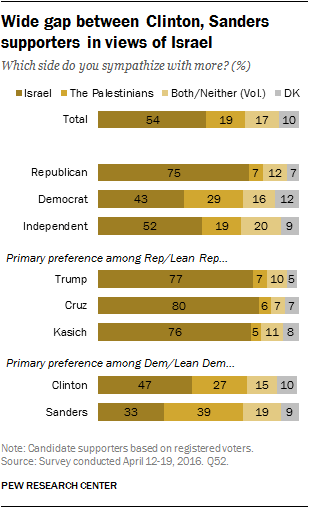
As has been the case for nearly four decades, more Americans say they sympathize more with Israel (54%) than the Palestinians (19%). About one-in-ten (13%) volunteer that they side with neither Israel nor the Palestinians in their dispute, while 3% sympathize with both sides.

Since July 2014, there has been a modest rise in the share of the public saying they sympathize more with the Palestinians, from 14% then to 19% today. Virtually all of this increase has come among Democrats, especially liberal Democrats. The number of liberal Democrats sympathizing more with the Palestinians has nearly doubled over the past two years, from 21% to 40%.

The Democrats’ differences over Israel and the Palestinians are reflected in the way Sanders and Clinton supporters view the situation. Far more Clinton supporters sympathize with Israel (47%) than the Palestinians (27%). Sanders backers are statistically divided, with 39% sympathizing more with the Palestinians and 33% more with Israel. Overwhelming shares of GOP voters side with Israel, regardless of which candidate they support.

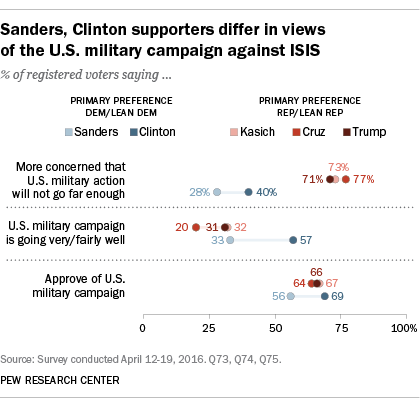
Public support for the U.S. military campaign against ISIS has changed little since 2014. Currently, 62% approve of the military campaign, while 33% disapprove. While there is broad and continuing support for the military campaign, there are sharp partisan differences over whether the greater concern is that the U.S. will go too far, or not far enough, in pursuing military action against ISIS.
Sanders, Clinton supporters differ in views of the U.S. military campaign against ISIS

Most Republicans (74%) say their bigger concern is the U.S. will not go far enough in stopping Islamic militants in Iraq and Syria, while just 23% are more concerned that the U.S. will go too far in getting involved in the situation. Most Democrats (57%), by contrast, are more concerned that the U.S. will go too far militarily.

Among Democratic voters, about two-thirds of Sanders supporters (68%) are more worried that the U.S. will go too far in Iraq and Syria, compared with about half (53%) of Clinton supporters. Most GOP voters, regardless of their preference in the primary contest, say their greater concern is that the U.S. will not go far enough in stopping ISIS.

While Trump recently called into question the value of U.S. participation in NATO, Americans overwhelmingly view NATO membership as beneficial for the United States. About three-quarters of Americans (77%) say being a member of NATO is a good thing for the United States, while just 16% see this as a bad thing. Large majorities in both parties say NATO membership is good for the U.S. But 30% of those who prefer Trump in the GOP primary contest say being a member of NATO is a bad thing for the U.S., higher than among other GOP voters or supporters of the Democratic presidential candidates.

Other major findings

GOP leads on terrorism, foreign policy. As has been the case for more than a decade, more people say the Republican Party can do a better job than the Democratic Party in dealing with the terrorist threat at home (46% vs. 37%). The Republicans also lead the Democrats on foreign policy (46% to 38%) and trade (48% to 37%), while the Democrats hold a sizable advantage on global climate change (51% to 30%).

Little change in Obama job rating on foreign policy. Currently, 40% approve of the way Barack Obama is handling the nation’s foreign policy, while 53% disapprove. About four-in-ten (41%) think the Obama administration takes into account the interests of other nations too much, while 18% say it takes other nations’ interests into account too little; 36% say the administration gives about the right amount of attention to the interests of other countries.

Little change in concerns over China, Russia. Only about a quarter of Americans (23%) view China as an “adversary” of the United States, while an identical percentage (23%) says the same about Russia. Pluralities describe both countries as serious problems but not adversaries (44% each). These opinions have changed little in recent years.
Sanders, Clinton supporters differ in concerns about U.S. anti-terror policies

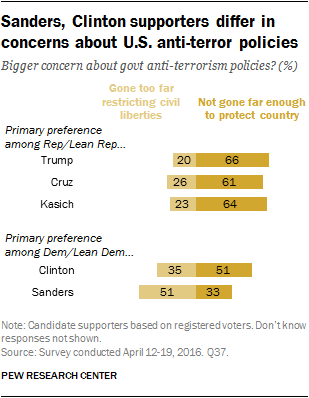
Sanders supporters stand out for civil liberties concerns. Half of Americans say their bigger concern about government anti-terrorism policies is that they have not gone far enough to adequately protect the country; 35% are more concerned that they have gone too far in restricting civil liberties.

Large majorities of Republican voters, regardless of their primary preference, say their bigger concern is that anti-terror policies have not gone far enough to protect the country. On the Democratic side, supporters of the two candidates differ in their views. Among Sanders supporters, 51% say their bigger concern is that U.S. policies have gone too far in restricting civil liberties, while 33% say they have not gone far enough in protecting the U.S. Opinion among Clinton supporters is reversed (51% not gone far enough, 35% too far).

1. America’s global role, U.S. superpower status

The public remains wary of U.S. international involvement, although on some measures opposition to an active U.S. global role has declined since the last America’s Place in the World study in 2013. While more Americans say the U.S. does too much (41%) than say it does too little (27%) to solve world problems, the share saying the United States does too much globally is 10 percentage points lower than three years ago (51%).

The number of Americans who say the U.S. should “mind its own business internationally” – which in 2013 surpassed 50% for the time in a half-century (52%) – has declined to 43% in the current survey.

However, just 37% say the U.S. “should help other countries deal with their problems,” while a majority (57%) say the nation should “deal with its own problems and let other countries deal with their problems the best they can.

Views of U.S. efforts to solve global problems

Shifting partisan opinions on U.S. efforts to solve global problems

Republicans’ views of U.S. efforts to address global problems have fluctuated in recent years. In 2013, nearly three times as many Republicans said the U.S. did too much (52%) as said it did too little (18%) in helping to solve global problems (26% said it did about the right amount).

In 2014, as ISIS first emerged as a major concern, slightly more Republicans said the U.S. did too little internationally (46% vs. 37% who said it did too much), with 14% saying the U.S. was doing about right amount internationally. In the current survey, GOP opinion has shifted again: 44% think the U.S. does too much internationally, 33% too little and 17% about the right amount.

Majority of Trump supporters say U.S. does ‘too much’ globally

Currently, 36% of Democrats say the U.S. does too much internationally, 19% say it does too little, and 42% say it does about the right amount. These views are little changed since 2014, but in 2013 more Democrats (46%) said the U.S. did too much. Among independents, 43% say the U.S. does too much internationally, 30% say it does too little and 23% say it does about the right amount. Independents’ views, like those of Democrats, have changed little since 2014, but three years ago a majority of independents (55%) thought the U.S. did too much globally.

Among Democratic voters, 45% of those who support Hillary Clinton for the Democratic nomination say the U.S. does the right amount to help solve world problems; fewer (30%) Bernie Sanders supporters say this (42% say it does too much). Among GOP voters, a slim majority of those who support Trump (54%)  say the U.S. does too much to help solve world problems. This is little different than views among those who prefer Cruz (48%), though fewer Kasich backers (30%) say this.

Most want U.S. ‘to deal with its own problems’

Most want U.S. to let other countries deal with their own problems

Nearly six-in-ten Americans (57%) want the United States “to deal with its own problems and let other countries deal with their own problems the best they can.” Far fewer (37%) favor the U.S. helping other countries address problems.

There are substantial ideological and educational differences in these opinions. Liberal Democrats stand out for their support for helping other nations. Six-in-ten (60%) liberal Democrats say the U.S. should help other nations, while 37% say it should deal with its own problems.

Among other partisan and ideological groups – including conservative and moderate Democrats (57%) – majorities say the U.S. should deal with its own problems and let other nations cope with their own problems.

Across educational groups, most favor the U.S. dealing with its own problems, with the exception of those with postgraduate degrees. Postgrads are the only group in which more say the U.S. should help other countries (56%) than say it should deal with its own problems and let other countries deal with their problems (39%). Majorities of those with less education favor the U.S. dealing with its own problems and letting other countries deal with their own problems the best they can.

Long-term attitudes about U.S. global involvement

In the 2013 America’s Place in the World study, more Americans agreed (52%) than disagreed (38%) that the U.S. “should mind its own business internationally” for the first time in nearly 50 years of opinion surveys. In the current survey, 43% agree that the U.S. should mind its own business internationally, while 50% disagree. That is similar to opinion on this question in 2011 (46% agreed, 50% disagreed).

While most Americans agree the U.S. “should concentrate more on our own national problems” – and have done so since the 1960s – fewer concur with this sentiment than did so in 2013 (69% now, 80% then). And since 2009, there has been an 11-point decline in the share of Americans who agree that “we should go our own way in international matters” without worrying too much about other countries (from 44% then to 33% now).

Fewer say the U.S. should ‘mind its own business internationally’ than in 2013

Partisan differences on these measures are relatively modest. Identical shares of Republicans and Democrats (39% each) – as well as 47% of independents – say the U.S. should mind its own business internationally. Republicans (73%) and independents (75%) are more likely than Democrats (64%) to say the U.S. should focus more on national problems and less on international terms. And more Republicans (40%) than Democrats (30%) or independents (31%) say the U.S. should go its own way when it comes to international matters.

Public to next president: Focus more on domestic than foreign policy

Looking ahead, 70% of Americans say it is more important for the next president to focus on domestic policy than foreign policy. Just 17% say the next president’s main focus should be on foreign policy while 11% volunteer that both should be priorities.

Most want next president to focus domestically

This sentiment is not new. In September 2008, 60% said the next president should focus on domestic policy more than foreign policy. In the past, when asked whether the current president should focus more on foreign or domestic policy, large majorities also have prioritized domestic policy, with few exceptions.

In recent years, there has been only one occasion when the public was divided over whether it was more important for the president to focus domestically or internationally. In January 2007, after President George W. Bush announced he was sending additional U.S. troops to Iraq, 40% said Bush should focus on more foreign policy, while 39% said he should focus more on domestic policy.

In the current survey, large majorities of Democrats (73%), independents (73%) and Republicans (65%) say it is more important for the next president to focus on domestic policy rather than foreign policy.

Majority favors keeping U.S. as sole military superpower

Despite the public’s ambivalence about U.S. global involvement, a majority of Americans (55%) support policies maintaining America’s status as the only military superpower. Only about a third (36%) say it would be acceptable if another country became as militarily powerful as the U.S.

Young people less likely to support policies aimed at keeping U.S. as sole military superpower

Overall views are similar to those found in a November 2013 survey; the question in that survey asked if it would be acceptable if “China, another country or the EU became as militarily powerful as the U.S.” In that survey, 56% wanted the U.S. to remain the sole superpower and 32% said they would be OK with China, another country, or the EU becoming as powerful.

As in the past, there are partisan differences in opinions about whether the U.S. should try to maintain its status as the world’s sole superpower. Two-thirds of Republicans (67%) say U.S. policies should be aimed at keeping the U.S. as the sole superpower, compared with about half of Democrats (50%) and independents (52%).

Democrats are divided ideologically over whether the U.S. should attempt to keep its superpower status. Nearly two-thirds of conservative and moderate Democrats (64%) say U.S. policies should try to keep the U.S. as the sole superpower, compared with just 35% of liberal Democrats who say the same. Among Republicans, majorities of both conservatives (70%) and moderates and liberals (60%) say the U.S. should try to maintain its superpower status.

Young people are far less likely than older adults to say U.S. policies should try to ensure its sole superpower status. Just 43% of those under age 30 support this goal, while 51% say it would be acceptable if another nation became as militarily powerful as the U.S. Among older adults, half or more – including 68% of those 65 and older – say policies should try to keep the U.S. as the only superpower.

Little change in views of U.S. global leadership, broadly defined

Going back more than two decades, the public generally has preferred that the United States play a shared leadership role. Currently, 73% say the U.S. should play a shared leadership role. Just 15% want the U.S. to be the single world leader, and even fewer (9%) want the U.S. to have no leadership role.

As in the past, most prefer a shared global leadership role for the U.S.

When those who favor a shared leadership role are asked if the U.S. should be the most active of leading nations, or about as active as others, a majority of this group (comprising 48% of the public) wants the U.S. to be about as active as other leading nations; 23% say the U.S. should be most active.

These attitudes have changed little since the early 1990s. After the 9/11 terrorist attacks, a third said the U.S. should be most active of leading nations, the highest level during this period. But the public’s fundamental preference for a shared leadership role was little changed.

Majorities of Democrats (78%), Republicans (67%) and independents (74%) say the U.S. should have a shared leadership role. About twice as many Republicans (23%) as Democrats and independents (12% each) say the U.S. should be the single world leader.


2. Views of impact of global economic involvement, policies toward developing countries

The public is wary about U.S. involvement in the global economy. And when it comes to dealing with developing countries, no more than about half support increasing foreign aid or imports, or increasing investments by U.S. companies in developing countries.

Is being part of a global economy good or bad for the U.S.?

Nearly half view U.S. involvement in global economy as a bad thing

Roughly half of the public (49%) say global economic engagement is “a bad thing because it lowers wages and costs jobs in the U.S.” Slightly fewer (44%) view it as “a good thing because it provides the U.S. with new markets and opportunities for growth.”

There are partisan differences in views of U.S. involvement in the global economy. A majority of Republicans (55%) view global involvement as a bad thing (37% say it is a good thing). Democrats and independents are divided; roughly equal shares say it is a good thing (49% and 46%, respectively) as say it is a bad thing (44% and 48%).

Within both parties, views among registered voters vary considerably by primary preferences. Republican and Republican-leaning voters who back Donald Trump are the most skeptical of U.S. involvement in the global economy: By a roughly two-to-one margin (65% to 31%) more say it is a bad thing. By contrast, only around half of those who prefer Cruz (49%) or Kasich (46%) say global engagement is a bad thing.

On the Democratic side, a majority of Clinton supporters (55%) view U.S. global economic involvement as a good thing while fewer (37%) say it is a bad thing. Roughly equal shares of Sanders supporters say it is good for the U.S. to be involved globally (47%) as say it is bad (48%).

Age, education and party differences in views of U.S. role in global economy

There are also substantial age and education gaps on attitudes about the United States’ involvement in the global economy. About half of adults under 30 (53%) believe that U.S. global economic engagement is a good thing, while 43% say it is a bad thing. Older adults are more skeptical; 52% of those ages 65 and older say U.S. involvement in the global economy is a bad thing.

More-highly educated Americans are more likely to view global economic engagement positively. Majorities of those with a postgraduate degree (60%) and a college degree (54%) say that, on balance, U.S. global engagement is a good thing. Only 36% of those with no more than a high school degree and 44% of those with some college experience say the same.

Views of U.S. participation in a global economy also vary by family income. Nearly six-in-ten (58%) of those with family incomes of $150,000 or more have positive views of U.S. global economic involvement. Among those in the lowest income category – $30,000 or less – just 40% say involvement in the global economy is a good thing for the United States.

How to deal with developing countries

Mixed views of U.S. policies toward developing countries

Narrow majorities of the public support importing more goods from developing countries (52%) and increasing U.S. companies’ investment in developing countries (also 52%). More than four-in-ten say they would oppose each of these measures.

Opinion is divided over whether the U.S. should increase foreign aid to developing countries. Half of the country (50%) is opposed while a roughly equal share (48%) would support increasing foreign aid.

Views on these items vary widely by age and education level. About six-in-ten of those under 30 express support for all three of these issues, while no more than four-in-ten of those 65 and older say the same.

Wide partisan gap on U.S. foreign aid to developing nations

More-highly educated adults also tend to be more supportive of increased engagement with developing nations than those with less education.

There are wide partisan differences in views of how the U.S. should deal with developing countries. On all three issues, Republicans express far less support than Democrats, while independents fall in the middle.

Roughly four-in-ten Republicans say they would support importing more goods from developing nations (42%) and increasing investment from U.S. companies (44%). Fewer say they would be in favor of increasing foreign aid (32%).

About six-in-ten Democrats and around half of independents say they would be in favor of each of these policies.

On all three questions, Trump supporters are more likely than backers of Cruz or Kasich to oppose engagement with developing nations. Nearly eight-in-ten Trump supporters oppose increasing foreign aid to developing nations (78%); two-thirds are against importing more goods from these nations (67%); and about six-in ten disapprove of increasing U.S. companies’ investment abroad (63%).

On the Democratic side, there are no significant differences between the views of Clinton and Sanders supporters on these issues.

Trump backers broadly oppose proposals aimed at helping developing countries

3. International threats, defense spending

The Islamic militant group known as ISIS remains the American public’s top international concern. Overall, 80% say ISIS is a major threat to the well-being of the United States, while 16% say it is a minor threat and 3% say it is not a threat; views are little changed from December.

ISIS, cyberattacks seen as greatest concerns to U.S.

Cyberattacks from other countries rank second on the public’s list of global threats: 72% say they are a major threat, while about two-thirds (67%) view global economic instability as a major threat.

Six-in-ten Americans (60%) view the rapid spread of infectious diseases from country to country as a major threat, up somewhat from 52% in August 2014 (in the midst of the Ebola crisis).

The large number of refugees leaving countries such as Iraq and Syria is seen as a major threat by 55% of Americans. About the same share (53%) say global climate change is a major threat, little changed from December. China’s emergence as a world power is viewed by half of Americans (50%) as a major threat, while 42% say tensions with Russia present a major threat to the country; perceptions of both China and Russia’s threat to the U.S. are on par with public opinion in December.

Ideologically polarized views of threats posed by refugees, climate change

There continue to be wide partisan and ideological differences in views of the top global concerns for the U.S. Overall, Democrats – particularly liberal Democrats – are less likely than Republicans to see many of these issues as a major threat to the country’s well-being. Climate change is the only one of these issues that is seen as a major threat by a greater share of Democrats than Republicans.

ISIS is viewed as a major threat by overwhelming majorities of conservative Republicans (93%), moderate and liberal Republicans (88%), and conservative and moderate Democrats (87%). Though ISIS tops the list of threats for independents as well, somewhat fewer (76%) say it is a major threat to the well-being of the U.S. And among liberal Democrats a sigificantly smaller majority (64%) say it is a major threat.

By contrast, global climate change tops the list of major threats among liberal Democrats: Fully 81% in this group view it as a major threat to the U.S., a far greater share than say this about any other threat asked about on the survey. Nearly as many conservative and moderate Democrats consider climate change to be a major threat to the well-being of the U.S. (75%), though it ranks alongside other threats and behind ISIS among this group. Far fewer independents (52%) and moderate and liberal Republicans (41%) see global climate change as a major threat to the country; and conservative Republicans are particularly unlikely to see climate change as a threat – just 18% say that it is. This gap in partisan and ideological views of global climate change as a major threat is unchanged from last December.

There are also wide partisan gaps over whether the large number of refugees leaving countries like Iraq and Syria poses a major threat to the U.S.: Eight-in-ten conservative Republicans (80%) view this as a major threat, compared with 61% of moderate and liberal Republicans and roughly half of both independents (55%) and conservative and moderate Democrats (49%). Just 30% of liberal Democrats see these refugees as a major threat to the well-being of the U.S.

Liberal Democrats are also the least likely to view China’s emergence as a world power, tensions with Russia and global economic instability as major threats to the U.S. There are more-modest partisan and ideological differences in perceptions of the threat of cyberattacks from other countries, global economic instability or the rapid spread of infectious diseases from country to country.

Trump supporters most likely to view refugee crisis as major threat to U.S.

Though a majority of Republican and Republican-leaning registered voters view the large number of refugees leaving countries as a major threat to the nation, this view is more widespread among those who prefer Donald Trump in the contest for the GOP nomination. Fully 85% of Trump supporters say the large number of these refugees is a major threat. That compares with 74% of those who back Cruz and 59% of Kasich supporters.

Among Democratic and Democratic-leaning registered voters, Clinton and Sanders supporters are about equally likely to consider large numbers of refugees leaving Iraq and Syria as a major threat: Just 40% of Clinton supporters and 34% of Sanders supporters say this.

China and Russia seen as problems, but few say they are U.S. adversaries

There is no sign of growing public concern about either China or Russia. Roughly a quarter of the public (23%) views each as an adversary, while 44% say each is a serious problem but not an adversary. About three-in-ten say neither China nor Russia pose much of a problem for the U.S.

Few see China or Russia as ‘adversary’

Over the past two years, there has been no rise in the share of the public that sees Russia as an adversary. More now say Russia is not much of a problem than did so in 2014, shortly after the country’s annexation of Ukraine’s Crimea region (30% today, 15% then).

Views of China are little changed over the last several years.

There are minor partisan differences in views for both countries. Though only about a quarter of Republicans (27%) say China is an adversary, they are somewhat more likely than Democrats (20%) to say this.

Similarly, while 29% of Republicans view Russia as an adversary, 20% of Democrats and 22% of independents say the same.

Growing share say defense spending should increase

Rising support for defense spending

For the first time in more than a decade a greater share of Americans say spending on national defense should be increased (35%) than say it should be cut back (24%). A plurality (40%) say that spending should be kept roughly the same.

In November 2013, the last time this question was asked, more Americans said we should reduce our spending than increase it (28% cut back vs. 23% increase).

Two-thirds of conservative Reps say defense spending should be increased

Support for increasing defense spending is particularly pronounced among Republicans – especially conservative Republicans. Today, two-thirds of conservative Republicans (67%) favor increasing the defense budget, up 28 percentage points from when the question was last asked. The share of other partisan groups saying defense spending should increase has also risen, although somewhat more modestly.

There are wide partisan and ideological differences when it comes to national defense spending. Though most conservative Republicans (67%) think defense spending should be increased, moderate and liberal Republicans are more divided: 45% say the national defense budget should increase, 39% say it should stay the same, and 14% think it should be reduced.

Only 20% of Democrats say there should be more spending on defense; 30% say the defense budget should be cut back, while roughly half (49%) say it should remain near current levels.

Conservative and moderate Democrats are about equally likely to say defense spending should go up (26%) as to say it should be cut back (22%), though roughly half (51%) say it should remain about the same. Liberal Democrats, in contrast, are about three times as likely to say defense spending should be cut as to say it should be increased (39% vs. 12%); 48% say it should be kept the same.

Among Republican and Republican-leaning registered voters, those who support Donald Trump (66%) and Ted Cruz (64%) in the primary contest are somewhat more supportive of increasing the defense budget than are backers of John Kasich (52%).

Among Democratic voters, roughly as many Clinton supporters say defense spending should be increased (21%) as say it should be decreased (25%), while 52% say it should be kept at about the same level as current spending. Bernie Sanders supporters are more likely to say spending should be cut back: 43% say this, while nearly as many (39%) say spending should be kept about the same; just 16% say it should be increased.

4. U.S. military action against ISIS, policy toward terrorism

A majority of the public (62%) continues to approve of the U.S. military campaign against Islamic militants in Iraq and Syria; fewer (33%) say they disapprove. Support for U.S. military action in Iraq and Syria has held steady over the course of the past year.

Comparable majorities of Republicans (66%) and Democrats (65%) support the U.S. military campaign against ISIS. Independents are slightly less likely than partisans to approve of the campaign: 57% say this, while 38% say they disapprove.

Support for the U.S. military campaign against Islamic militants in Iraq and Syria extends across those with different preferences for the 2016 Democratic and Republican presidential nominations. Among Republican and Republican-leaning registered voters, about two-thirds of Donald Trump (66%), Ted Cruz (64%) and John Kasich (67%) supporters say they approve of the military campaign against Islamic militants in Iraq and Syria.

On the Democratic side, 69% of Democratic and Democratic-leaning registered voters who support Clinton approve of the U.S. military action. A narrower majority of Democratic voters who support Sanders (56%) say they approve of the military campaign.

Clinton supporters stand out in saying U.S. campaign vs. ISIS is going well

While majorities approve of the U.S. military campaign, most do not think the effort against Islamic militants in Iraq and Syria is going well at present. About six-in-ten (58%) say the campaign is going not too or not at all well, compared with just 38% who say it is going very or fairly well.

Assessments of the campaign are particularly negative among Republicans. Nearly seven-in-ten (68%) say the U.S. effort is not going well. Majorities of Cruz (75%), Kasich (67%) and Trump (66%) supporters have negative impressions of the current state of the campaign.

By contrast, Democratic views of the current state of U.S. efforts against Islamic militants in Iraq and Syria are mixed. About as many say the campaign is going very or fairly well (48%) as say it is going not too or not at all well (46%). But there are key differences within the Democratic voters by candidate preference on this question. Among Clinton supporters more say the effort is going well than not well by a 57%-38% margin. By contrast, most Sanders supporters (62%) say things are going not too or not at all well, while just 33% say things are going very or fairly well.

Partisan, age gaps on concerns about military action in Iraq and Syria

When it comes to the public’s greater concern about U.S. military action in Iraq and Syria, somewhat more continue to say their greater concern is that the U.S will not go far enough to stop the militants (50%) than say their greater concern is that the U.S. will go too far getting involved in the situation (43%).

Republicans are much more concerned that the U.S. will not go far enough to stop the militants (74%) than that it will get too involved in the situation (23%). The balance of opinion among Democrats is the reverse: 57% say their bigger concern about military action in Iraq and Syria is that the U.S. will go too far getting involved in the situation, compared with just 35% who are more concerned the U.S. won’t do enough to stop the militants. Independents overall are split (47% worry the U.S. will not go far enough, while 46% worry it will go too far), but those who lean toward a party express views similar to those of straight partisans.

By a wide 68%-28% margin, Democratic supporters of Sanders are more concerned the U.S. will go too far in getting involved in the situation in Iraq and Syria than that it will not go far enough to stop the militants. Clinton supporters also express more concern about the U.S. getting too involved in the situation, but by a less one-sided 53%-40% margin.

Among Republican voters, similar majorities of Cruz (77%), Kasich (73%) and Trump (71%) supporters say their greater concern about military action in Iraq and Syria is that the U.S. will not go far enough to stop Islamic militants there.

In addition to wide partisan divides, there are large differences on this question across age groups, with younger adults more likely to express concern about the U.S. getting too involved in Iraq and Syria and older adults more likely to express concern about the U.S. not going far enough to stop Islamic militants. For example, by a 57%-38% margin, adults ages 18-29 say their greater concern is the U.S. getting too involved in the situation; by contrast, adults ages 65 and older are more concerned the U.S. will not go far enough to stop the militants (61%-33%).

Views on U.S. ground troops to fight Islamic militants in Iraq and Syria

The public is divided over whether the U.S. should send ground troops to fight Islamic militants in Iraq and Syria: 46% favor this, while 50% are opposed. Views are little changed over the course of the past year.

Nearly seven-in-ten Republicans (68%) favor sending ground troops to fight ISIS in Iraq and Syria; 72% of conservative Republicans say this, compared with somewhat fewer (58%) moderate and liberal Republicans.

By a 65%-31% margin, Democrats are broadly opposed to sending U.S. ground troops to fight in Iraq and Syria. Liberal Democrats oppose using U.S. ground troops by a wide 75%-21% margin. Among conservative and moderate Democrats, opposition outweighs support by 57%-41%.

A 60% majority of young adults (those 18-29) oppose sending U.S. ground troops to Iraq and Syria. Older groups are more divided: For example, among those 65 and older, 48% favor sending U.S. ground troops to fight Islamic militants, while 44% are opposed.

Those with higher levels of education are less likely to support ground troops than those with less education. More adults with postgraduate degrees oppose than favor sending troops (59% vs. 37%). By contrast, those with no more than a high school degree are more split (50% favor, 46% oppose).

Republicans’ ratings of government efforts against terrorism plummet

Job ratings of U.S. government efforts to reduce the threat of terrorism

Currently, 54% say the U.S. government is doing very or fairly well reducing the threat of terrorism, compared with 45% who say it is doing not too or not at all well. The share giving the government positive ratings is up eight points from December, when assessments of the government’s job performance hit a post-9/11 low in the wake of the Paris and San Bernardino terrorist attacks.

Just 29% of Republicans say the government is doing very or fairly well reducing the threat of terrorism, compared with 75% of Democrats. The current 46-point gap between the views of Republicans and Democrats is wider than it was at in early 2015 (22 points), when overall ratings of the government’s performance reducing the terror threat were more positive.

Independents’ views of the job the government is doing reducing the terror threat are mixed: 51% say it is doing very or fairly well, while 47% say it is doing not too or not at all well.


Views about anti-terrorism policies and civil liberties

Government anti-terrorism policies and concern over security and civil liberties

By a 50%-35% margin, more say their greater concern about the government’s anti-terror policies is that they have not gone far enough to adequately protect the country than say they have gone too far in restricting the average person’s civil liberties. Since December, shortly after terrorist attacks in Paris and San Bernardino, the share expressing greater concern that government policies do not go far enough has declined six points, while the share saying they are more concerned about civil liberty restrictions has increased seven points.

A majority of Republicans (64%) say they are more concerned that government policies have not gone far enough to protect the country; just 23% are more concerned about civil-liberties restrictions. Democrats and independents hold more mixed views: 46% of Democrats and 47% of independents say their greater concern is that government policies have not gone far enough to adequately project the country, while about four-in-ten of both groups (40% of Democrats, 39% of independents) say they are more concerned that government policies have gone too far restricting the average person’s civil liberties.

About half of Sanders supporters say anti-terror policies ‘have gone too far’

Supporters of Clinton are somewhat more likely to say government anti-terror polices have not gone far enough to protect the country (51%), than say they have gone too far restricting the average person’s civil liberties (35%). Among Sanders supporters, the balance of opinion is reversed: 51% say policies have gone too far in restricting civil liberties, while 33% are more concerned that policies have not gone far enough to protect the country.

Within the GOP, there are no significant differences in these views by primary candidate preference.

Views of use of ‘overwhelming’ military force against global terrorism

When it comes to the best approach for dealing with global terrorism, as many say that using overwhelming military force is the best way to defeat terrorism around the world (47%) as say that relying too much on military force to defeat terrorism creates hatred that leads to more terrorism (47%).

These views have changed little over the course of the past year. However, in 2014 – before ISIS registered widely as a security threat with the public – more said relying too much on military force created hatred and more terrorism than said that it is was the best way to defeat terrorism around the world.


Deep partisan divide on best approach to defeating global terrorism

There continue to be wide partisan gaps over the use of overwhelming force to confront terrorism.

Fully 70% of Republicans say military force is the best approach to defeating global terrorism, compared with just 24% who say it does more to create hatred and lead to further terrorism. Conservative Republicans (77%) are more likely than liberal and moderate Republicans (56%) to take this view.

By contrast, 65% of Democrats say relying too much on military force to defeat terrorism creates hatred that leads to more terrorism, while only 31% see it as the best way to defeat terrorism around the world. Liberal Democrats take this view by a much more one-sided margin (77%-19%) than conservative and moderate Democrats (56%-41%).

5. Views of Israel and Palestinians

As has been the case for decades, the American public expresses more sympathy toward Israel than the Palestinians. Just over half of Americans (54%) say that in the dispute between the two they sympathize more with Israel, while 19% sympathize more with the Palestinians; 13% volunteer that they sympathize with neither side and 3% sympathize with both.

These views are only modestly changed from July 2014. The share sympathizing more with Israel is little changed, while the share sympathizing more with the Palestinians has ticked up from 14% then to 19% today.

The partisan gap remains wide. Three-quarters of Republicans (75%) say they sympathize more with Israel (just 7% say they sympathize more with the Palestinians). And though a larger share of Democrats sympathize more with Israel than with the Palestinians, that margin is much narrower (43% vs. 29%). By 52% to 19%, independents express more sympathy for Israel than the Palestinians.

While independents are more likely to express sympathy toward Israel by a 52% to 19% margin, there is a large difference between those who lean toward the Democratic Party and those who lean toward the GOP. Republican leaners sympathize more with Israel by an overwhelming margin (72% vs.9%), in line with the views of Republican identifiers. The sympathies of Democratic leaners, however, are divided: 34% say they sympathize more with Israel and 33% say the Palestinians, while another third either volunteer that they sympathize with both (3%) or neither (16%), or do not offer an opinion (13%). Democratic leaners are less likely than Democratic identifiers to sympathize with Israel.

There is also a wide ideological difference within the Democratic Party. By more than two-to-one (53% vs. 19%) conservative and moderate Democrats sympathize more with Israel. Liberal Democrats, on the other hand, are statistically divided in their views: 33% sympathize more with Israel and 40% sympathize more with the Palestinians.

Among Republicans, an overwhelming majority of conservative Republicans (79%) sympathize more with Israel, as do a slightly narrower majority of moderate and liberal Republicans (65%).

Notably, there are no differences in views by candidate support among GOP voters. By contrast, while Clinton supporters, on balance, are more likely to sympathize with Israel (47% vs. 27%), Sanders supporters are divided (33% sympathize more with Israel, 39% sympathize more with Palestinians).

Growing share of liberal Democrats sympathize more with the Palestinians than with Israel

Over the past decade, the share of Americans saying they sympathize more with Israel has grown among most ideological groups – with the exception of liberal Democrats.

Today 33% of liberal Democrats say they sympathize more with Israel, a share that is little changed over the last 10 years. At the same time, the share of liberal Democrats who say they sympathize more with the Palestinians is now higher than it has been at any point in the last 15 years (40%), due in part to somewhat fewer liberal Democrats volunteering that they sympathize equally with both sides, or neither side, or that they do not know.

Conservative and moderate Democrats, by contrast, express more sympathy toward Israel (53%) than the Palestinians (19%) today. And the balance of opinion among conservative and moderate Democrats is little changed over the last decade.

Both moderate and liberal Republicans and conservatives in the party have become more sympathetic to Israel over the last 10 years.

Millennials more likely than older generations to sympathize with the Palestinians

There also are generational differences in sympathies in the Israeli-Palestinian conflict. Older generations tend to be more sympathetic toward Israel than younger generations.

Currently, 43% of Millennials report sympathizing more with Israel, while 27% are more sympathetic to the Palestinians. The share sympathizing with the Palestinians has risen significantly in recent years, from 9% in 2006 to 20% in July 2014 to 27% today. The share sympathizing with Israel is little changed over this period.

Among older generations, the balance of opinion is little changed over the course of the decade. Baby Boomers and those in the Silent generation sympathize more with Israel by about four-to-one. Generation Xers are somewhat less sympathetic toward Israel than older generations; still, by roughly three-to-one (54% vs. 17%), they say they sympathize more with Israel than the Palestinians.

Can Israel and an independent Palestinian state peacefully coexist?

Conservative Republicans are skeptical of a peaceful, two-state solution

By a 50% to 42% margin, more Americans say that there is a way for Israel and an independent Palestinian state to coexist peacefully than say that there is not. More now say a two-state solution is possible than said this in August 2014 (43%) shortly after the end of weeks of hostilities between Israel and Hamas.

Younger adults are the most likely to say a peaceful two-state solution is possible: 60% of those under 30 say this. Older adults are more skeptical than younger people; nearly half of those ages 65 and older (49%) say a two-state solution is not possible.

There also are partisan differences on this issue. Conservative Republicans are the most doubtful about the viability of an independent Palestinian state peacefully coexisting with Israel; 60% say it is not possible to find such a solution. On the other end of the ideological spectrum, two-thirds of liberal Democrats (67%) say a peaceful two-state solution is possible.

There are modest educational and racial differences. More-educated Americans are more likely to say the two states could coexist peacefully, while less-educated Americans are divided. And white Americans are divided while majorities of blacks and Hispanics say an independent Palestinian state could peacefully exist alongside Israel. Overall, more now say a two state solution is possible than said this in 2014.

More Democrats say a peaceful, two-state solution is possible

Democrats, in particular, are more likely now to say that a way can be found for two states to coexist than they were two years ago: Today 61% say there is a way for an independent Palestinian state to coexist peacefully with Israel, up from 49% in August 2014.

But Republican views are little changed from two years ago: 38% now say Israel and an independent Palestinian state could peacefully coexist, identical to the share saying this in 2014.

About half of independents (51%) see a two-state solution as possible, up from 43% in August 2014, but little different than in April 2014.

6. NATO, U.S. allies, the EU and UN

By large margins, the American public has positive views of NATO, the North Atlantic Treaty Organization. Fully 77% say being a member is good for the U.S., and by about a two-to one-margin, more say they have a favorable view of NATO than an unfavorable one (53% vs. 25%). Yet the U.S. public is about equally likely to say the alliance is more important to its non-U.S. members (37%) as to say it is about as important to the U.S. as it is to other member nations (41%). Few (15%) consider the NATO alliance to be of more import to the U.S. than it is to other member countries.

Though U.S. allies are largely viewed positively, a sizeable minority of the public expresses some reserve over the broader question of how much allies’ interests should be taken into account in U.S. foreign policy: While roughly half (51%) say the U.S. should take into account the interests of its allies even if it means making compromises with them, a sizeable minority (42%) says the U.S. should follow its own interests, even when allies strongly disagree.

Views of the United Nations and the European Union remain substantially more positive than negative. And Americans continue to say the country’s ties to European nations are more important to the U.S. than ties to Asian nations (52% to 32%).

Most say NATO benefits the U.S.

NATO favorability, 2009-2016

About three-quarters of Americans (77%) say that, on balance, being a member of NATO is a good thing for the U.S. Just 16% say it is bad for the country.

Although Americans are largely in agreement that the alliance is good for the country, there is less consensus about whether the U.S. and its NATO allies benefit equally from the alliance: 41% say the NATO alliance is about equally important to the U.S. and other NATO member countries, while nearly as many (37%) say the alliance matters more for other countries than for the U.S. Only 15% say the alliance is more important for the U.S. than it is for its NATO allies.

Partisan agreement on value of NATO, some skepticism among Trump backers

Overall impressions of NATO are little changed in recent years: About half (53%) have a favorable opinion of NATO, while a quarter (25%) hold an unfavorable view of the alliance (21% do not offer an opinion). There are no significant partisan differences in ratings of NATO.

There also is broad partisan agreement that the NATO alliance is good for the U.S.: Three-quarters or more of Republicans (75%), Democrats (81%) and independents (78%) say the country’s membership in NATO is a good thing.

But supporters of Donald Trump in the GOP primary contest are more likely than other GOP voters to express skepticism about NATO’s benefits to the U.S. Nearly two-thirds (64%) of Republican and Republican-leaning voters who back Trump say being a member of NATO is good for the U.S., compared with 80% of Cruz and 84% of Kasich supporters.

Reps, Inds more likely to say NATO alliance is more important to allies

Although there are few differences by party in views about whether NATO membership has been good for the country, Republicans (43%) and independents (41%) are more likely than Democrats (28%) to say the alliance is more important to other NATO member nations than it is to the U.S. But no more than two-in-ten among any partisan group say the alliance is of greater import to the U.S. than it is to other NATO member countries.


Wide ideological divide over whether to compromise with allies

Liberal Democrats, college grads support compromising with allies

The public is divided along age and ideological lines when it comes to opinions on cooperating with allies. Overall, 51% say the U.S. should take into account allies’ interests even if it means making compromises, while 42% say the United States should follow its national interests even when the allies strongly disagree.

Roughly half of Republicans (52%), including nearly identical shares of the party’s conservatives and moderates and liberals, say the U.S. should pursue its own interests even if allies strongly object. Democrats are more divided along ideological lines: 45% of conservative and moderate Democrats say the U.S. should follow its national interests even if the allies disagree, but just 20% of liberal Democrats share this view.

Among people younger than 50, 55% say the U.S. should take into account allies’ interests even if it means making compromises; 39% want the U.S. to follow its own interests even when allies disagree. Older adults are evenly divided (46% say the U.S. should take allies’ interests into account, 46% say the U.S. should follow its own interests).

There also are educational differences in these attitudes. A majority of those with at least a college degree (63%) say the U.S. should heed allies’ interests even if it means making compromises. Among those with less education, opinion is more evenly divided.

Views of the United Nations and the European Union

A majority of Americans have a favorable view of the United Nations (64%); roughly three-in-ten have an unfavorable view (29%).

Opinions of the UN have grown slightly more positive since 2013, the last time this question was asked, when 58% expressed a positive view.

European Union favorability, 2002-2016

Views of the European Union also more positive than negative (53% favorable, 27% unfavorable), although the share of the public with a favorable view of the European Union is down slightly from 58% in 2014 to 53% today.

There are wide partisan differences in views of both institutions. Large majorities of Democrats hold a positive view of the UN (80%) and the EU (64%). By contrast, only about four-in-ten Republicans (43%) report having a favorable opinion of either institution. Two-thirds of independents (64%) have a favorable view of the UN, and 54% say the same of the EU.


Are ties to European nations or to Asian nations more important?

European ties viewed as more important than Asian ties

When it comes to the relationships the United States has with European and Asian nations, about half of the public (53%) views ties with Europe as most important, while 32% say relationships with Asia are most important. One-in-ten volunteer that both are equally important to the U.S.

6_9alt

These views are little changed from 2013 and over much of the last two decades. One exception was in 2011, shortly before a state visit from Chinese President Hu Jintao, when more (47%) thought Asian nations were most important (37% said European nations were most important).

Young adults are divided: 46% of those ages 18 to 29 say Europe is more important, while roughly as many say Asia is more important (41%). Among older adults, particularly those ages 50 and older, clear majorities say European ties are more important.

A 57% majority of those with no college experience say ties to European nations are more important than ties to Asian nations, while 29% say Asian ties are more important. By comparison, 46% of those with college degrees say European ties are more important, while 36% say Asian ties are more important.

There are only modest differences in views among partisans: Roughly equal majorities of Republicans (60%) and Democrats (55%) say Europe is more important to the U.S than Asia. Roughly half of independents (48%) say European ties are more important, though they are somewhat more likely (38%) than either Democrats (29%) or Republicans (27%)  to say Asian ties are of more import.

7. Foreign policy, the parties and Obama

The GOP continues to have an advantage over the Democratic Party as the party the public says is best able to handle several foreign policy issues, while the Democratic Party holds an advantage when it comes to handling global climate change.

More say the Republican Party could do a better job making wise decisions about foreign policy than say the Democratic Party could do a better job (46% vs. 38%), with 16% declining to choose one party over the other. The Republican Party’s ability to handle foreign policy is seen more positively now than it was in July 2015, when about equal shares said the Republican Party (38%) and Democratic Party (41%) would do a better job on foreign policy.

In part, the Democrats’ lower rating for handling foreign policy comes from the relatively critical marks the party receives from Democratic-leaning independents. Just 53% of Democratic-leaning independents favor the Democrats on foreign policy. By comparison, 76% of Republican leaners prefer the GOP.

This partly arises from dissatisfaction with the party among Sanders supporters, many of whom lean toward the Democratic Party but do not identify as Democrats. Among Democratic and Democratic-leaning registered voters, 81% who support Clinton for the party’s nomination say the Democratic Party is better able to make wise decisions about foreign policy, compared with 59% of Sanders supporters.

As has been the case since 2002, Republicans also have a sizable advantage over Democrats on the issue of terrorism. In the current survey, 46% say the Republican Party could do a better job dealing with the terrorist threat at home, while 37% say the Democratic Party could do the better job.

The GOP holds a similar (11-point) lead over the Democratic Party when it comes to dealing with trade agreements with other countries. As with views of which party can better handle foreign policy, Clinton supporters give the Democratic Party higher marks than do Sanders supporters (77% vs. 65%).

The Democratic Party is preferred to the Republican Party by a wide margin when it comes to the issue of climate change. About half (51%) say the Democratic Party could do a better job dealing with climate change, while 30% say the Republicans could do a better job.

Obama and foreign policy

More disapprove than approve of Obama on foreign policy, immigration and Iran

About as many approve of the job Barack Obama is doing as president (48%) as disapprove (47%). Last month, 51% said they approved of the president’s performance and 44% disapproved.

More disapprove of Obama’s handling of the nation’s foreign policy than approve (53% vs. 40%). Similar shares say they disapprove of the president’s job dealing with the threat of terrorism (51%), and Iran (52%).

Obama’s handling of immigration also is viewed more negatively than positively: Just 38% approve, while 55% disapprove.

On balance, evaluations of Obama’s performance on the issue of global climate change are somewhat more positive: 47% say they approve of the president’s handling this issue, while 41% disapprove.

When it comes to Obama’s approach to foreign policy, 41% say the Obama administration is taking the interests of other countries into account too much, 36% say the administration considers other countries’ interests about the right amount and just 18% say the president takes into account the interests of other countries too little.

Partisan divide over how Obama addresses other countries' interests

Nearly six-in-ten Republicans (58%) think the Obama administration takes into account the interests of other countries too much, while 25% say it pays too little attention to other countries’ interests; just 12% say it strikes the right balance.

The view that the Obama administration takes other countries into account too much also is held by 47% of independents; 31% think the administration’s approach is about right and 19% say it accounts for other countries’ interests too little.

A majority of Democrats (63%) say the Obama administration’s approach to foreign policy is about right when it comes to accounting for the interests of other countries; just 22% of Democrats say the administration is too concerned about the interests of other countries, and only 11% say it is concerned too little with other countries.

8. Perceptions of U.S. global power and respect

The public continues to view the U.S. as less powerful globally – and less respected by other nations – than it was in the past. But Americans also say the United States is the world’s leading economic and military power.

Nearly half say U.S. plays a less powerful global leadership role than it did 10 years ago

Nearly half of Americans (46%) say the U.S. plays a less important and powerful role as a world leader than it did a decade ago. Just 21% say it plays a more important and powerful role, while 31% say it is as important as it was 10 years ago. These views have changed only modestly since 2013, when 53% said the U.S. was less powerful than it had been 10 years previously. But in 2004, just 20% said the U.S. was less powerful.

A majority of the public (61%) also says the U.S. is less respected by other countries, although this is lower than the share that said this in 2013 (70%).

Yet when asked which nation is the world’s leading economic power, 54% point to the U.S., with China a distant second at 34%. And even more (72%) view the U.S as the world’s leading military power.

Views of U.S. power and importance

Most Republicans think U.S. importance as world leader has declined

Opinions about U.S. global power have long been divided along partisan lines. In 2004, during George W. Bush’s administration, 63% of Republicans said the U.S. was more important and powerful as a world leader than it had been 10 years earlier, while just 8% said it was less important (27% said the U.S. was about as powerful).

In 2009, Barack Obama’s first year in office, the balance of opinion among Republicans shifted. Half (50%) said the U.S. was a less powerful and important world leader, compared with just 17% who said it had become more important. Since then, the share of Republicans saying the U.S. is less powerful has increased, reaching 74% in 2013, before slipping to 64% a year later. Currently, 67% say the U.S. is less powerful and important than it was 10 years ago.

Democrats’ views of U.S. global power and importance have shown far less change over the course of the past two administrations. Currently, 29% say the U.S. is more important and powerful than it was a decade ago, 26% say it is less important and 42% say it is about the same. Democratic opinions were similar in 2004 (32% more important, 27% less, 37% about the same).

Independents’ views tend to be similar to the public’s overall. In the current survey, 48% say the U.S. is less important than it was 10 years ago, 20% say it is more important and 31% say it is about the same.

There also are age differences in opinions about U.S. global power. Currently, 52% of those ages 50 and older think the U.S. now plays a less important role, as do 45% of those ages 30 to 49. Just 33% of those younger than 30 say the U.S. plays a less important role than it did in the past.

Views of global respect for the U.S.

Public continues to say the U.S. is less respected globally than it was in the past

As has been the case since the Bush administration, most Americans (61%) say the United States is less respected by other countries than it was in the past. Just 14% say it is more respected, while 22% say it is about as respected. Nonetheless, the share who says the U.S. is less respected has declined from 70% in 2013.

Among those who say the United States is less respected internationally than in the past, most say it is a major problem: 38% of the public overall view this as a major problem. Fewer say that the U.S. is less respected but regard this as a minor problem (18% of the public) or not a problem at all (4% of the public).

Majorities in both parties continue to say U.S. is less respected globally

Although majorities of all partisan groups currently say the U.S. is less respected globally than it was in the past, Republicans (71%) are more likely than Democrats (59%) and independents (58%) to say this. Both Republicans’ and independents’ views have become less downbeat about America’s image since 2013.

In 2008, during the Bush administration, majorities of all partisan groups also said the U.S. was less respected internationally than it had been in the past. At that time, however, a larger share of Democrats (81%) than independents (72%) and Republicans (60%) said this.

Leading economic and military superpower

U.S. seen as leading economic, military power

Almost three-quarters of Americans (72%) say the U.S. is the predominant military force in the world, and 54% say it is the leading economic power. About one-third (34%) say China is the world’s leading economic power, while 6% name Japan and 2% say it is the countries of the European Union. Meanwhile, 12% say China is the world’s leading military power, 10% say it is Russia and 2% say the EU.

In annual surveys dating back to 2008, this is the first time that more than half of Americans have said the U.S. is the world’s leading economic power. This share is up eight percentage points since June of 2015 (from 46% then to 54% now).

The share saying the U.S. is the world’s military leader also increased eight percentage points, from 64% in November 2013 to 72% today. Over that time span, the share calling China the world’s military power fell from 19% to 12%, while the proportion saying Russia was the world’s military leader doubled from 5% to 10%.

Clear majorities of Democrats (73%), Republicans (66%) and independents (76%) say the U.S. is the world’s leading military power. And there are no partisan differences in the shares who say the U.S. is the world’s leading economic power (56% of Republicans, 55% of Democrats and 50% of independents say this).

Methodology

Survey conducted April 12-19, 2016

Most of the analysis in this report is based on telephone interviews conducted April 12-19, 2016 among a national sample of 2,008 adults, 18 years of age or older, living in all 50 U.S. states and the District of Columbia (505 respondents were interviewed on a landline telephone, and 1,503 were interviewed on a cell phone, including 914 who had no landline telephone). The survey was conducted under the direction of Abt SRBI. A combination of landline and cell phone random digit dial samples were used; both samples were provided by Survey Sampling International. Interviews were conducted in English and Spanish. Respondents in the landline sample were selected by randomly asking for the youngest adult male or female who is now at home. Interviews in the cell sample were conducted with the person who answered the phone, if that person was an adult 18 years of age or older. For detailed information about our survey methodology, see https://alpha.pewresearch.org/pewresearch-org/methodology/u-s-survey-research/

The combined landline and cell phone sample are weighted using an iterative technique that matches gender, age, education, race, Hispanic origin and nativity and region to parameters from the 2014 Census Bureau’s American Community Survey and population density to parameters from the Decennial Census. The sample also is weighted to match current patterns of telephone status (landline only, cell phone only, or both landline and cell phone), based on extrapolations from the 2015 National Health Interview Survey. The weighting procedure also accounts for the fact that respondents with both landline and cell phones have a greater probability of being included in the combined sample and adjusts for household size among respondents with a landline phone. The margins of error reported and statistical tests of significance are adjusted to account for the survey’s design effect, a measure of how much efficiency is lost from the weighting procedures.

The following table shows the unweighted sample sizes and the error attributable to sampling that would be expected at the 95% level of confidence for different groups in the survey:

Methodology, survey conducted April 12-19

Survey conducted April 7-10, 2016

Some of the analysis in this report is based on telephone interviews conducted April 7-10, 2016 among a national sample of 1,000 adults, 18 years of age or older, living in the continental United States (500 respondents were interviewed on a landline telephone, and 500 were interviewed on a cell phone, including 318 who had no landline telephone). The survey was conducted by interviewers at Princeton Data Source under the direction of Princeton Survey Research Associates International. A combination of landline and cell phone random digit dial samples were used; both samples were provided by Survey Sampling International. Interviews were conducted in English and Spanish. Respondents in the landline sample were selected by randomly asking for the youngest adult male or female who is now at home. Interviews in the cell sample were conducted with the person who answered the phone, if that person was an adult 18 years of age or older. For detailed information about our survey methodology, see https://alpha.pewresearch.org/pewresearch-org/methodology/u-s-survey-research/

The combined landline and cell phone sample are weighted using an iterative technique that matches gender, age, education, race, Hispanic origin and region to parameters from the 2014 Census Bureau’s American Community Survey and population density to parameters from the Decennial Census. The sample also is weighted to match current patterns of telephone status (landline only, cell phone only, or both landline and cell phone), based on extrapolations from the 2015 National Health Interview Survey. The weighting procedure also accounts for the fact that respondents with both landline and cell phones have a greater probability of being included in the combined sample and adjusts for household size among respondents with a landline phone. The margins of error reported and statistical tests of significance are adjusted to account for the survey’s design effect, a measure of how much efficiency is lost from the weighting procedures.

The following table shows the unweighted sample sizes and the error attributable to sampling that would be expected at the 95% level of confidence for different groups in the survey:

Methodology, survey conducted April 7-10

Survey conducted April 4-24, 2016

Additionally, some of the analysis in this report is based on telephone interviews conducted April 4-24, 2016 among a national sample of 1,003 adults, 18 years of age or older, living in all 50 U.S. states and the District of Columbia (250 respondents were interviewed on a landline telephone, and 753 were interviewed on a cell phone, including 447 who had no landline telephone). The survey was conducted by interviewers at Princeton Data Source under the direction of Princeton Survey Research Associates International. A combination of landline and cell phone random digit dial samples were used; both samples were provided by Survey Sampling International. Interviews were conducted in English and Spanish. Respondents in the landline sample were selected by randomly asking for the youngest adult male or female who is now at home. Interviews in the cell sample were conducted with the person who answered the phone, if that person was an adult 18 years of age or older. For detailed information about our survey methodology, see https://alpha.pewresearch.org/pewresearch-org/methodology/u-s-survey-research/

The combined landline and cell phone sample are weighted using an iterative technique that matches gender, age, education, race, Hispanic origin and nativity and region to parameters from the 2014 Census Bureau’s American Community Survey and population density to parameters from the Decennial Census. The sample also is weighted to match current patterns of telephone status (landline only, cell phone only, or both landline and cell phone), based on extrapolations from the 2015 National Health Interview Survey. The weighting procedure also accounts for the fact that respondents with both landline and cell phones have a greater probability of being included in the combined sample and adjusts for household size among respondents with a landline phone. The margins of error reported and statistical tests of significance are adjusted to account for the survey’s design effect, a measure of how much efficiency is lost from the weighting procedures.

The following table shows the unweighted sample sizes and the error attributable to sampling that would be expected at the 95% level of confidence for different groups in the survey:

Methodology, survey conducted April 4-24

Sample sizes and sampling errors for other subgroups are available upon request.

In addition to sampling error, one should bear in mind that question wording and practical difficulties in conducting surveys can introduce error or bias into the findings of opinion polls.

Pew Research Center is a nonprofit, tax-exempt 501(c)(3) organization and a subsidiary of The Pew Charitable Trusts, its primary funder.