
Pew Research Center

FOR RELEASE MARCH 31, 2016

Campaign Exposes Fissures Over Issues, Values and How Life Has Changed in the U.S.

Just 38% of GOP voters say party would ‘solidly unite’ behind Trump

FOR MEDIA OR OTHER INQUIRIES:

Communications Department
202.419.4372
www.pewresearch.org

RECOMMENDED CITATION

Pew Research Center, March 2016, "Campaign Exposes Fissures Over Issues, Values and How Life Has Changed in the U.S."

About Pew Research Center

Pew Research Center is a nonpartisan, nonadvocacy fact tank that informs the public about the issues, attitudes and trends shaping the world. It does not take policy positions. The Center conducts public opinion polling, demographic research, computational social science research and other data-driven research. It studies politics and policy; news habits and media; the internet and technology; religion; race and ethnicity; international affairs; social, demographic and economic trends; science; research methodology and data science; and immigration and migration. Pew Research Center is a subsidiary of The Pew Charitable Trusts, its primary funder.

© Pew Research Center 2026

Table of contents

  • About Pew Research Center
  • Campaign Exposes Fissures Over Issues, Values and How Life Has Changed in the U.S.
  • 1. Views of the primaries, press coverage of candidates, attitudes about government and the country
  • 2. Views on immigration, diversity, social issues
  • 3. Views on economy, government services, trade
  • 4. Perceptions of the presidential candidates, and primary preferences
  • Methodology

Campaign Exposes Fissures Over Issues, Values and How Life Has Changed in the U.S.

Just 38% of GOP voters say party would ‘solidly unite’ behind Trump

The 2016 presidential campaign has exposed deep disagreements between – and within – the two parties on a range of major policy issues. But these divisions go well beyond the issues and extend to fundamentally different visions of the way that life in the United States has changed.

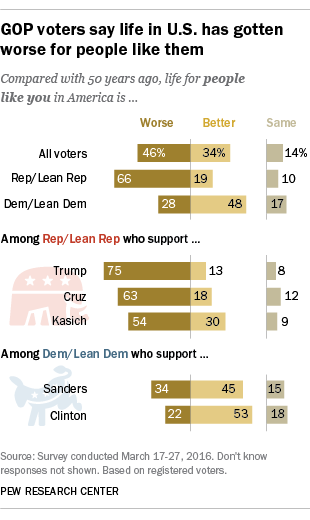
Overall, 46% of registered voters say that life in America today is worse than it was 50 years ago “for people like them,” while 34% say life is better and 14% think it is about the same. Republican and Republican-leaning voters are more than twice as likely as Democratic voters to say life in this country has gotten worse over the past half-century for people like them (66% to 28%).
GOP voters say life in U.S. has gotten worse for people like them

Among GOP voters, fully 75% of those who support Donald Trump for the Republican presidential nomination say life for people like them has gotten worse, compared with 63% of Ted Cruz supporters and 54% of those who back John Kasich. While Democratic voters generally express more positive views of how life in the U.S. has changed over the past 50 years, those who favor Bernie Sanders are more negative (34% say life has gotten worse) than those who support Hillary Clinton (22%).

The latest national survey by Pew Research Center, conducted March 17-27 among 2,254 adults, including 1,787 registered voters, finds higher levels of dissatisfaction – with long-term changes in the country, the federal government, as well as with the economy and personal finances – among Trump supporters than among those who back any other candidate, Republican or Democrat.

Overall, there has been no increase in voter anger toward the federal government since before the start of the presidential campaign. Currently, 22% of registered voters say they are “angry” at the federal government, while 59% are “frustrated” and 17% “basically content.” These opinions are little changed from last fall, in Pew Research Center’s major study of attitudes toward government, and from early 2014.

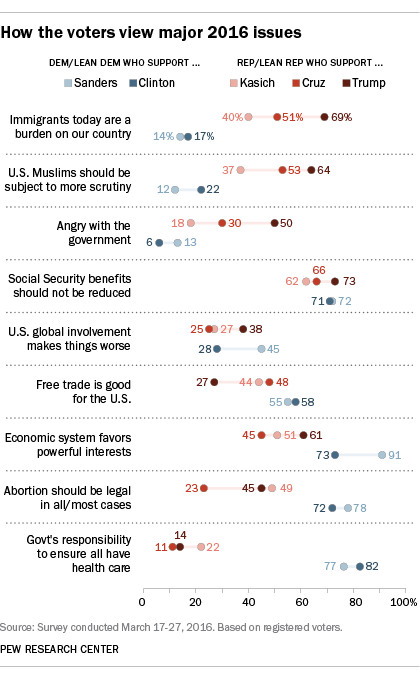
Republican and Republican-leaning voters (35%) continue to be more likely than Democrats and Democratic leaners (10%) to express anger at government. Within the GOP, anger at government is heavily concentrated among Trump supporters – 50% say they are angry at government, compared with 30% of Cruz backers and just 18% of those who support Kasich.
How the voters view major 2016 issues

GOP voters who support Trump also stand out for their pessimism about the nation’s economy and their own financial situations: 48% rate current economic conditions in the U.S. as “poor” – no more than about a third of any other candidate’s supporters say the same. And 50% of Trump supporters are not satisfied with their financial situations, the highest among any candidate’s supporters.

The major issues that have emerged in the presidential campaign reveal divisions within the two parties in different ways. But for the most part, the gaps are much wider among Republican voters than among Democrats, especially when it comes to opinions about immigrants and immigration policy, government scrutiny of Muslims in the United States, and abortion and other social issues.

Overall, 57% of all registered voters say that immigrants in the United States today strengthen the country because of their hard work and talents, while 35% say they are a burden because they take jobs, housing and health care. Republican and Republican-leaning voters are more than three times more likely than Democrats and Democratic leaners to view immigrants as a burden (56% vs. 17%).

Among those who support Trump for the GOP nomination, 69% say immigrants are a burden, compared with 51% of Cruz supporters and 40% of Kasich supporters. Fewer than one-in-five Clinton (17%) and Sanders supporters (14%) consider immigrants a burden on the country.

Overall, most voters continue to oppose subjecting Muslims living in the United States to greater scrutiny solely because of their religion. Again, GOP voters are divided: most Trump (64%) and Cruz supporters (53%) say U.S. Muslims should be subject to heightened scrutiny; most of those who support Kasich (58%) say they should not. Large majorities of Sanders (85%) and Clinton supporters (75%) oppose subjecting U.S. Muslims to additional scrutiny solely because of their religion.

On the other hand, there are differences within both parties in opinions about the fairness of the U.S. economic system. Democrats overall say the system unfairly favors powerful interests, but Sanders supporters (91%) are more likely than Clinton supporters (73%) to describe the economic system as unfair. Among Republicans, a majority of those who back Trump (61%) view the system as unfair, compared with 51% of Kasich supporters and 45% of Cruz supporters.

A majority of all voters (60%) say that global problems would be worse without U.S. involvement, while 34% say U.S. efforts to solve problems “usually end up making things worse.” Among Sanders supporters, 45% say U.S. international efforts make things worse, compared with 28% of Clinton supporters. Trump supporters (38%) are more likely than Kasich (27%) or Cruz (25%) supporters to say the same.

Trade has emerged as a contentious issue in both parties’ candidate debates, but majorities of both Clinton (58%) and Sanders supporters (55%) say that free trade agreements have been a good thing for the United States. Cruz supporters (48% good thing) and Kasich supporters (44%) are divided, but among Trump supporters, just 27% say trade agreements are beneficial for the U.S, while 67% say they are bad thing.

Social issues, such as abortion and same-sex marriage, divide Republicans along different lines than do immigration or trade. Far more Cruz supporters (73%) than Trump (53%) or Kasich (50%) supporters say abortion should be illegal in most or all cases.  Only about a quarter of Clinton supporters (24%) and 21% of Sanders supporters favor making abortion illegal in at least most cases.

Not all issues are so divisive. Among all voters, 71% say that, when thinking about the future of Social Security, benefits should not be reduced (26% say reductions need to be considered). Among supporters of the presidential candidates, majorities ranging from 62% to 73% say Social Security benefits should not be reduced.

The 2016 Campaign

As the primary campaigns move into a pivotal stage, 41% of Republican and Republican-leaning registered voters say they would like to see Trump nominated as the party’s presidential candidate, compared with 32% who favor Cruz and 20% who support Kasich. Reflecting the pattern seen in several GOP primary contests thus far, Trump nationally draws more support from Republican voters who have not completed college than from college graduates.

Kasich’s strongest groups are the mirror image of Trump’s – he fares better among better-educated Republican voters and those with higher incomes. Cruz gets higher levels of support among religiously observant GOP voters than those who are less observant.

Among Democratic and Democratic-leaning registered voters, 49% prefer Clinton, while 43% support Sanders. As has been the case in several primary contests to date, Clinton nationally draws greater support among blacks than whites. Sanders has much broader appeal among young voters, especially young men, than among older voters.

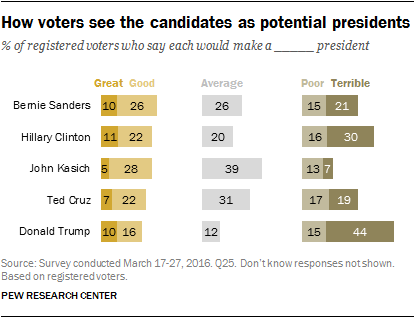
As they were in January, registered voters are generally skeptical that any of the presidential candidates would make a good president. Far more voters continue to say that Trump would make a poor or terrible president (59%) than a good or great chief executive (26%). The share anticipating that Trump would be a “terrible” potential president has increased six percentage points, from 38% to 44%, since January.
How voters see the candidates as potential presidents

Though viewed less negatively than Trump, more voters also say both Clinton and Cruz would make poor or terrible presidents than good or great ones, while expectations of a Sanders presidency remain mixed. These views are little changed since January.

Kasich, meanwhile, is better known than he was in January and more voters view him as a potentially good or great president than did so then (33% now, 13% then). One-in-five voters (19%) say Kasich would be poor or terrible in the White House (24% said this in January), while 39% view him as a potentially average president (up from 32% two months ago.)

Presidential primary campaigns are typically bruising affairs, but the current contest has taken an especially heavy toll on Republican unity. Many supporters of both Kasich and Cruz take a dim view of Trump as a potential president. A majority of Kasich supporters (55%) say Trump would be a poor or terrible president, with 36% describing him as terrible. Half of Cruz supporters (50%) think a Trump presidency would be poor or terrible, with 28% saying Trump would make a terrible president.

Among Democrats, only about a quarter of Sanders supporters (28%) say Clinton would make a poor or terrible president.

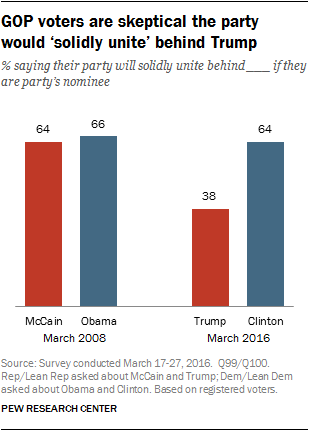
GOP voters also are skeptical that the party will unite behind Trump if he is the party’s nominee. Just 38% say the party would “unite solidly” behind Trump, while 56% say disagreements within the party would keep many Republicans from supporting him. That is much lower than the share of Republican voters who expected the party to unite behind Mitt Romney (65%) and John McCain (64%) at comparable points in the 2012 and 2008 nomination campaigns.
GOP voters are skeptical the party would ‘solidly unite’ behind Trump

By contrast, most Democratic voters (64%) think their party will solidly unite behind Clinton if she is the nominee. In March 2008, about as many Democrats (66%) said the party would unite behind Barack Obama if he won the Democratic nomination.

Thus far, the 2016 presidential campaign has attracted very high levels of interest – fully 85% of registered voters say they have given “quite a lot” of thought to the election. That is higher than the shares of voters who said they had given a great deal of thought to the election at this point in 2012 (66%) and 2008 (78%).

Yet the primary process gets relatively low marks from voters in both parties, with the notable exception of Trump supporters. Just 35% of registered voters – including 42% of Republicans and 30% of Democrats – view the primary system as a good way of determining the best-qualified nominees. Among Trump supporters, however, 60% have a positive view of the primary process, compared with no more than about 40% of the supporters of any other candidate.

There also is general agreement among the supporters of the remaining candidates – again, with the exception of Trump backers – that the billionaire has received too much press coverage. Overall, 75% of voters say news organizations have given too much coverage to Trump. No more than about four-in-ten say that about any of the other candidates (41% say Clinton has gotten too much coverage).

In a campaign that has been punctuated by harsh personal attacks, about two-thirds of voters (68%) say that “personally insulting political opponents is never fair game;” only 30% say personal attacks are sometimes fair game. Two-thirds or more of supporters of all candidates — with the exception of Trump supporters — say personal attacks are off-limits; Trump supporters are more divided (47% say they are sometimes fair game, while 51% say they never are).

The Political Landscape
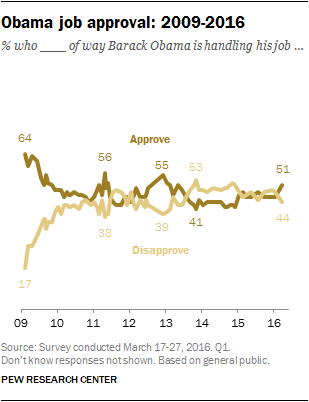
Obama job approval: 2009-2016

With less than a year to go in his presidency, Barack Obama’s job rating is in positive territory for the first time in nearly three years. Currently, 51% of the public approves of the way Obama is handling his job as president, while 44% disapprove. In January, Obama’s job ratings were more mixed (46% approve vs. 48% disapprove).

The public’s views of the nation’s economy are little changed from December: 29% view economic conditions as excellent or good, 43% say they are only fair, while 28% say they are poor. As was the case in December, economic optimism remains somewhat limited. Currently, 22% say they expect conditions to be better a year from now, 17% say they will be worse and 55% say they will be the same.
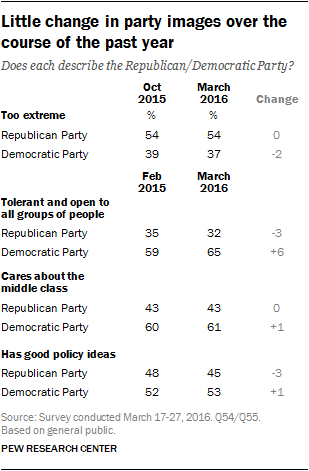
Little change in party images over the course of the past year

The public’s perceptions of the Republican and Democratic parties have shown little change over the past year. A majority of Americans (54%) say the Republican Party is “too extreme,” which is unchanged since last fall. Fewer (37%) continue to describe the Democratic Party as too extreme.

Similarly, perceptions of whether the parties are tolerant and open to all groups of people, care about the middle class and have good policy ideas have changed little since February 2015. About twice as many view the Democratic Party as tolerant and open than describe the GOP this way (65% vs. 32%). More also say the Democratic Party cares about the middle class (61%) and has good policy ideas (53%) than say this about the Republican Party (43% and 45%, respectively).

1. Views of the primaries, press coverage of candidates, attitudes about government and the country

The 2016 presidential campaign continues to attract strong interest, even as the primary process draws widespread criticism. Most registered voters do not think the presidential primaries have been a good way of determining the best-qualified nominees. This is in line with opinions in recent campaigns, but two decades ago voters had a more positive view of the primary process.

As was seen in a major report on attitudes about government released last fall, voters continue to be more frustrated than angry with government. Frustration – rather than anger – is the dominant emotion in voters’ views of politics as well. That report also found that neither Republicans nor Democrats have a great deal of confidence in the political wisdom of the American people. These sentiments have persisted into the presidential campaign.

Views of the nation’s long-term progress – and its future prospects – are deeply divided along racial, age and political lines. More than half of white voters say life for “people like them” has gotten worse over the past half-century, while black and Hispanic voters are more positive in these evaluations.

Campaign draws interest, primaries engender skepticism

Record interest in the 2016 campaign

Fully 85% of registered voters say they have given a lot of thought to the 2016 election. That is not only greater interest than at comparable points in recent campaigns, it is the highest level of interest measured at any point in all elections since 1988.

Fully 89% of Republican and Republican-leaning registered voters say they are giving a lot of thought to the election, compared with 82% of Democratic and Democratic-leaning voters.

At this stage in the 2012 campaign, when only the GOP had a contested nomination, 71% of Republicans and 64% of Democrats said they were giving a lot of thought to the election. In March 2008, when both parties had nomination fights, 83% of Democrats and 76% of Republicans were giving a great deal of thought to the election.

In line with previous Pew Research Center surveys, voters take a dim view of the primary system’s ability to produce well-qualified nominees.

Just 35% of voters say the primaries produce the best-qualified nominees

Only 35% of voters say that the primary system is a good way of determining the best qualified nominee. That is a smaller share than in the 2008 campaign, but in line with views of the primary process in 2000 and 1992.

Democrats and Republicans differ on whether the presidential primaries are a good way determining the best-qualified nominees. Currently, 42% of Republican voters have a positive view of the primary process, compared with 30% of Democrats.

The share of Democrats expressing a positive view of the primary process has declined 22 percentage points (from 52%) in February 2008. Republicans views are little different than in 2000 or 2008.

Democrats less positive about primary process than in 2008

Yet the current partisan differences are largely the result of the highly positive views Trump backers have of the primary process. Six-in-ten GOP voters who support Trump for the Republican nomination say the primaries have been a good way of determining the best-qualified nominees. Majorities of those who support the four other candidates say they have not.

All candidates’ supporters - except for Trump’s – view the primaries negatively

Among Republicans, Cruz supporters express more positive views of the primaries than do Kasich backers (40% vs. 17%). Among Democrats, Clinton supporters are more likely than those who support Sanders to say the primaries are a good way of determining the best-qualified nominees (37% vs 25%).


Most voters see personal insults by politicians as out of bounds

In a campaign that has been punctuated by harsh personal attacks, 68% of registered voters say that “personally insulting political opponents is never fair game.” Just 30% say personal attacks are sometimes fair game.

Large majorities say personal insults are ‘never fair game’ in politics

There are partisan differences in opinions about of the acceptability of personal insults by politicians. But as with views of the primary process, these differences arise largely from the distinctive views of those who back Trump.

Trump supporters are divided: Nearly as many say personal insults are sometimes fair game (47%) as say they are never fair game (51%). Among supporters of the other candidates – Cruz, Kasich, Clinton and Sanders – majorities of between 66% and 74% say that personal insults against political opponents are always off limits.


How voters view the candidates’ amount of press coverage

Voters overwhelmingly say that Trump has received too much news coverage. Three-quarters (75%) of all registered voters say that news organizations have given too much coverage to Trump.

Three-quarters of voters say Trump has gotten ‘too much’ news coverage

Views of coverage of most other presidential candidates are much less one-sided. About four-in-ten (41%) say Clinton has received too much coverage, while 48% say news organizations have given about the right amount of coverage to Clinton.

Few voters say Cruz, Sanders or Kasich have received too much coverage. A majority of voters (57%) say Cruz has gotten about the right amount of coverage, and 53% say the same about news coverage of Sanders.

Most voters (60%) say news organizations have given too little coverage to Kasich – by far the highest share saying that about coverage of any candidate. Only about half as many voters (29%) say Kasich has received about the right amount of coverage.

How supporters of GOP candidates view news coverage of the Republican field

Perceptions of the amount of coverage each candidate has received vary widely across backers of each of the candidates, although in each case a candidate’s supporters are less likely than those who prefer their rivals to say their candidate receives too much (and more likely to say the candidate receives too little) coverage.

Overwhelming majorities of Cruz (84%) and Kasich supporters (90%) think Trump has gotten too much coverage. Most Trump supporters (55%) say he has gotten about the right amount of coverage, although 33% say coverage of their candidate has been excessive.

Nearly half of Cruz supporters (47%) think their candidate has gotten about the right amount of coverage, while 43% say he has gotten too little coverage. Majorities of Trump (66%) and Kasich backers (63%) say Cruz has gotten the right amount of news coverage.

Roughly eight-in-ten Kasich supporters (82%) say their candidate has gotten too little coverage, a view that is shared by a majority (54%) of Cruz supporters and 42% of Trump backers.

Among Democratic voters a majority (66%) also say news organizations have given Kasich too little coverage. Most Democrats (56%) think Cruz has gotten about the right amount of coverage, while Democrats are about as likely as GOP supporters of Kasich and Cruz to say that Trump has gotten too much coverage (88%).

How Democratic voters view news coverage of Clinton and Sanders

Clinton and Sanders supporters also differ in their perceptions of the amount of coverage each candidate receives. Nearly three-quarters of Clinton supporters (73%) say their candidate has gotten the right amount of coverage, while just 12% say Clinton has gotten too much coverage. Among Sanders supporters, about half (51%) think the amount of coverage devoted to Clinton has been appropriate, while 41% say she has gotten too much coverage.

A majority of Sanders backers (58%) say the Vermont senator has received too little coverage. Among Clinton supporters, 26% say Sanders has been under-covered, while 64% feel he has received the right amount of coverage.

Among Republican voters, 58% say news organizations have given Clinton too much coverage. Roughly the same share of GOP voters (55%) say Sanders has gotten about the right amount of news coverage.

Little confidence in public’s political wisdom

Voters’ confidence in the political wisdom of the public has changed little since last fall, before the presidential primaries. Just a third of registered voters say they have either a very great deal of confidence or a good deal of confidence in the wisdom of the public when it comes to making political decisions. Nearly two-thirds (65%) say they have little or no confidence in the public’s political wisdom.

Across partisan lines, an erosion of confidence in public’s political wisdom

Since 2007, the shares of both Republicans and Democrats who express at least a good deal of confidence in the public’s political wisdom has fallen sharply. Currently, just 35% of Republican voters and 32% of Democratic voters say they have at least a good deal of confidence in the public’s wisdom in politics, down from 61% and 58%, respectively, nine years ago.

Four-in-ten Trump supporters (40%) say they have a very great deal or good deal of confidence in the public’s political wisdom, along with 33% of Cruz backers and 30% of Kasich supporters.

Among Democrats, Clinton supporters (36%) are somewhat more likely than Sanders supporters (27%) to express at least a good deal of confidence in the public’s political wisdom.

Feelings of frustration toward government

As the primary campaigns continue, overall feelings toward the federal government have remained steady. About six-in-ten registered voters (59%) say they feel frustrated with the federal government, while 22% say they are angry and just 17% say they are basically content.

Most continue to be frustrated with the government

Anger toward the federal government is no higher among voters today than it was in October 2015 (24%); and it is lower than in October 2013 (32%), during the 16-day shutdown of the federal government.

Republican and Republican-leaning registered voters continue to express higher levels of anger toward than federal government than Democratic and Democratic-leaning registered voters.

Overall, 35% of Republican voters say they are angry at government; more (58%) describe themselves as frustrated and just 6% say they are basically content with the federal government. Republican anger toward government is about the same as it was last fall and is slightly lower than it was in October 2013, when it reached a recent high of 41%.

GOP voters remain more likely than Democrats to feel anger toward gov’t

Democratic and Democratic-leaning registered voters express lower levels of anger toward the federal government than Republicans: Just 10% of Democrats say they are angry at government. About six-in-ten Democrats (61%) say they are frustrated with the federal government, while 27% say they are basically content.

In recent administrations, members of the party that does not control the White House have consistently express greater levels of anger toward the federal government than members of the president’s party.

Voters express frustration with politics, as well as with government

In the current survey, half of respondents were asked about their feelings toward the “federal government,” while the other half of respondents were asked about their feelings toward “politics today.”

There are only modest differences between the results of the two questions. While 59% of voters say they are frustrated with government, 67% express frustration with politics. About one-in-five (22%) express anger at the government, while an almost identical percentage (23%) says they are angry at politics today.

What is the main reason you are angry about politics today?

Those who express anger at politics were asked in an open-ended format why they are angry. More than half (55%) of voters who are angry about politics cite an aspect of politicians’ conduct as the main reason. A quarter (25%) specifically mentions dishonest and self-serving politicians as a cause for anger. About one-in-six say they are angry about politicians’ inability to get things done (18%) or mention that politicians are out of touch (15%). Some voters express anger about particular political figures: While 4% point to Barack Obama as the main reason they are angry about politics, roughly the same number (5%) mention Republicans as the reason for their anger.

Anger at government – and politics – is much more pronounced among Trump backers than among supporters of any other presidential candidate, Republican or Democrat.

Half of Trump supporters are angry at the federal government

Half of Trump supporters (50%) say they are angry at the federal government, compared with 30% of Cruz supporters and 18% of Kasich supporters. Even smaller shares of Sanders (13%) and Clinton supporters (6%) express anger at government.

Four-in-ten of those who support Trump say they are angry at politics – again, the highest share among supporters of any candidate.

Views of the country’s past and future

Voters are divided in assessing the changes the country has undergone over the past 50 years. While 46% say life in America today is worse for “people like them,” 34% say it is better and 14% say it is about the same.

Wide racial differences in views of how life in America has changed for ‘people like you’

Most white voters (54%) say life in this country has gotten worse for people like them over the past half-century, while most blacks (58%) say life has gotten better. Hispanics express mixed views (41% better, 37% worse, 14% about the same).

There also are wide educational differences in these views, with better educated voters more likely to say life in this country for people like them has improved.

Looking at these differences among white voters, 60% of those who have not completed college say life has gotten worse for people like them, while just 23% say things have gotten better (11% say life is about the same). Among whites with a college degree or more education, 42% say life has gotten worse while nearly as many say it has gotten better (36%) and 15% think it is about the same.

Among all registered voters the ideological divide in these opinions is stark: 70% of conservative Republicans think life in the U.S. has gotten worse for people like them, compared with 20% of liberal Democrats. About half of liberal Democrats (52%) say life has gotten better for people like them.

When registered voters assess prospects for the next generation of Americans, the outlook is gloomy. About half (51%) say the future for the next generation will be worse, while only about half as many (24%) think life will be better; 18% say life will be about the same as it is today.

There are substantial racial, age and partisan gaps in these opinions as well, but the educational differences are far more modest than in views about how life in the U.S. has changed. For instance,  52% of white voters with at least a college degree expect life for the next generation of Americans to be worse, as do 56% of white voters who have not completed college.

2. Views on immigration, diversity, social issues

Republican and Democratic registered voters remain far apart on key questions regarding perceptions of immigrants and immigration policy, views on the security treatment of U.S. Muslims and views on issues such as abortion and same-sex marriage.

These gaps across parties are familiar. The gaps within parties by primary candidate support vary by issue. In general, disagreements among Republican voters are more common – and larger in magnitude – than disagreements among Democratic voters when it comes to questions on immigrants and immigration, U.S. Muslims, and same-sex marriage and abortion.

On the Republican side, Trump supporters tend to hold more conservative views than Cruz and Kasich supporters on immigration and in their views of U.S. Muslims. Large majorities of Trump supporters say immigrants burden the country, back building a wall along the entire U.S.-Mexico border and say U.S. Muslims should be subject to additional security scrutiny – fewer Cruz or Kasich supporters agree. However, when it comes to the issues of abortion and same-sex marriage, Ted Cruz supporters are the most likely to take conservative positions and say that abortion should be illegal in all or most cases and that gays and lesbians should not be allowed to marry legally.

By contrast, there is broad agreement among Clinton and Sanders supporters that immigrants make positive contributions to the U.S., that there should not be a border wall and that Muslims should not be subject to additional security scrutiny because of their religion. On some issues, modest differences emerge between Sanders and Clinton supporters, but these differences are limited to the size of the majority expressing an opinion. For example, 83% of Sanders supporters say gays and lesbians should be allowed to marry legally, compared with fewer – but still most – Clinton supporters (68%).

Divides within the GOP in views of immigration policy

Section2_1

Republican and Democratic registered voters take opposing views on whether immigrants are more of a strength or burden for the United States. By a wide 78%-17% margin, Democratic and Democratic-leaning registered voters say immigrants today do more to strengthen the country through their hard work and talents than burden the country because they take jobs, housing and health care. By contrast, 56% of Republican and Republican-leaning registered voters view immigrants more as a burden for the country, compared with just 32% who say immigrants strengthen the country.

Nearly seven-in-ten Republican voters who support Donald Trump (69%) say immigrants burden the country, compared with just 20% who say they strengthen the country. Ted Cruz supporters are 18 points less likely than Trump supporters to hold this view, though by a narrower margin, (51%-36%) more also view immigrants in the U.S. as a burden rather than a strength. By contrast, supporters of John Kasich are roughly as likely to say immigrants strengthen the country (49%) as to say they burden the country (40%).

On the Democratic side, wide majorities of Sanders (82%) and Clinton supporters (78%) say immigrants today do more to strengthen the country rather than burden the country.

Section2_2

While a majority of Republican registered voters say immigrants are a burden on the country, a majority (57%) also say there should be a way for undocumented immigrants currently in the country to stay legally, if certain requirements are met; fewer (41%) say undocumented immigrants should not be allowed to stay in the country legally. Among Democratic voters, nearly nine-in-ten (88%) say there should be a path to legal status for undocumented immigrants, while 11% say there should not be.

Republicans and Republican leaners who support Donald Trump are split on whether undocumented immigrants currently in the country should be able to stay here legally, if certain requirements are met: 47% say there should be a way for them to stay legally, while 52% say undocumented immigrants should not be allowed to stay in the country legally. Among Republicans who support Ted Cruz (58%-41%) or  John Kasich (75%-24%), more say there should be a way for undocumented immigrants to stay in the country legally than say there should not be a way for them to stay in the U.S. legally.

An overwhelming majority of both Bernie Sanders (90%) and Hillary Clinton (87%) supporters say there should be a way for undocumented immigrants currently in the country to stay here legally, if certain requirements are met.

Section2_3

Most voters who oppose a way for undocumented immigrants to stay in the country legally also support a national effort to deport all undocumented immigrants currently in the country. Those who oppose a path to legal status for undocumented immigrants (25% of all voters) were asked a follow-up question about deportation: A wide majority of those against legal status (19% of all voters) say there should be a national law enforcement effort to deport all immigrants now living in the country illegally. A much smaller share of those against legal status for undocumented immigrants say there should not be a national deportation effort (5% of all voters).

Among Republican and Republican-leaning voters, 32% say there should be a national law enforcement effort to deport all immigrants who are now living in the U.S. illegally. Supporters of Donald Trump are the most likely to take this position (42% say this, compared with 30% of Ted Cruz supporters and just 17% of John Kasich supporters).

Section2_4

Among Democratic voters, few (8%) think there should be a law enforcement effort to deport all immigrants in the U.S. illegally, with no significant difference between the views of Clinton and Sanders supporters.

About six-in-ten voters (59%) say they oppose building a wall along the entire border with Mexico, while 38% say they are in favor of building a wall. Republican voters back a wall along the U.S.-Mexico border by a 67%-31% margin. By contrast, Democratic voters are broadly opposed: 86% do not want to build a wall along the entire border with Mexico, compared with just 13% who support this.

Among Republican and Republican-leaning registered voters, those who support Donald Trump as the party’s presidential nominee stand out for their strong support for building a wall along the border. Overall, 84% of Republicans who support Donald Trump favor building a wall along the entire border with Mexico, while just 14% say they are opposed. Most Ted Cruz supporters also favor building a wall, though by a somewhat more modest 64%-32% margin. Among Republican voters who support John Kasich, 53% oppose building a wall, while 45% are in favor.

Among Democratic and Democratic-leaning registered voters, large majorities of those who support Sanders (91%) and Clinton (83%) oppose building a wall along the entire border with Mexico.

The impact of growing diversity in the country today

Section2_5

About six-in-ten voters (59%) say an increasing number of people from many different races, ethnic groups and nationalities in the U.S. makes the country a better place to live; 31% say increasing diversity does not make much difference either way, while just 8% say increasing diversity makes the U.S. a worse place to live.

Among Republican voters who support Donald Trump, about as many say diversity makes the U.S. a better place to live (39%) as say it doesn’t make a difference (42%); 17% say it makes the U.S. a worse place to live. Ted Cruz supporters are somewhat more likely than Trump supporters to say diversity makes the U.S. a better place to live (48% vs. 39%); 38% of Cruz supporters say diversity doesn’t make a difference, while 11% say it makes the country a worse place to live. Among Republicans who support John Kasich, more say diversity improves life in the U.S. (54%) than say it doesn’t make a difference (35%); just 9% think it makes life in the country worse.

Among Democratic voters, roughly seven-in-ten of both Sanders (73%) and Clinton (72%) supporters say increasing diversity makes the country a better place to live, while about a quarter of both groups say it doesn’t make much difference either way. Hardly any Democratic voters say growing diversity makes the country a worse place to live.

Should U.S. Muslims be subject to additional security scrutiny?

Section2_6

Most voters continue to say that Muslims living in the U.S. should not be subject to additional security scrutiny solely because of their religion (61%), while 33% say that they should be subject to more scrutiny than people in other religious groups. Views are unchanged from December of last year. (There was no significant difference in attitudes measured during the first five nights of interviewing – conducted before the March 22 terror attacks in Brussels – and the final six nights of interviewing).

Somewhat more Republican registered voters say the federal government should give U.S. Muslims additional scrutiny because of their religion (53%) than say they should not (41%). The view that Muslims should be subject to additional security scrutiny is most widely held among Republican voters who support Donald Trump: 64% of Trump supporters take this view compared with just 28% who say Muslims should not be subject to additional scrutiny solely because of their religion. Among Republicans who support Ted Cruz, 53% say U.S. Muslims should receive additional scrutiny; 42% say they should not. Most Republicans who support John Kasich (58%) do not think U.S. Muslims should be given additional security scrutiny by the federal government because of their religion, while 37% think that they should be.

Among Democratic voters, large majorities of both Clinton and Sanders supporters oppose additional government scrutiny of U.S. Muslims because of their religion. However, this view is somewhat more widely held among Sanders (85%) than Clinton (75%) supporters.

Views on abortion

Section2_7

On the issue of abortion, there continue to be deep divisions along partisan lines. About three-quarters (74%) of Democratic voters say abortion should be legal in all or most cases, while 23% say it should be illegal in all or most cases. By contrast, 58% of Republican voters say abortion should be illegal in all or most cases; 39% think it should be legal in all or most cases.

Among Republican voters, supporters of Ted Cruz are much more likely than those who support Trump or Kasich to say abortion should be illegal. Nearly three-quarters of Cruz supporters (73%) say abortion should be illegal in all or most cases, compared with 53% of Trump supporters and 50% of Kasich supporters.

Among Democratic voters, there is little difference in the views of Clinton and Sanders supporters: Large majorities of both Sanders (78%) and Clinton (72%) supporters say abortion should be legal in all or most cases.

Same-sex marriage divides GOP supporters more than Democrats

Section2_8

A majority of the public continues to support the legalization of same-sex marriage (57%), as was the case both before and after the Supreme Court decision last June. There remains a wide gap in opinion between partisans, with Democratic registered voters broadly in favor, and a narrow majority of Republican registered voters opposed. Within the Republican Party, there are clear differences in views by primary candidate preference; differences are much more modest within the Democratic Party.

Those who support Ted Cruz for the Republican nomination are overwhelmingly opposed to same-sex marriage. Fully 70% of Cruz backers oppose allowing gays and lesbians to marry legally, while just a quarter (25%) say they are in favor.

Supporters of Donald Trump hold more mixed views: 52% oppose allowing gays and lesbians to marry legally, compared with 38% who favor this. John Kasich backers stand alone on the Republican side in their general support for same-sex marriage: 56% of those who support John Kasich are in favor of allowing gays and lesbians to marry legally, while fewer (37%) are opposed.

On the Democratic side, most Clinton and Sanders supporters express support for allowing gays and lesbians to marry legally, though a larger majority of Sanders supporters (83%) than Clinton supporters (68%) say this.

3. Views on economy, government services, trade

Questions on the state of the U.S. economic system, free trade and the role of government – both generally and in specific areas such as health care – surface differences within both political parties.

On the Republican side, supporters of Donald Trump stand out for their unfavorable views of free trade, negative assessments of national economic conditions and their own personal finances, and for being more likely than supporters of other GOP candidates to say the economic system in this country unfairly favors powerful interests. Despite these divisions, much also unites Republican registered voters who back different primary candidates. On policy, there is broad consensus that the government should not be responsible for ensuring that all Americans have health care coverage. And on broader values, large majorities of Republicans believe that hard work leads to success in this country and that government is doing too much better left to businesses and individuals.

There also are many points of general agreement among Democrats: That corporate profits are too high, that the government should ensure health care coverage for all Americans, and that the government should be doing more to solve problems. But differences also emerge among Democrats in their views of the country. Most Sanders supporters say that hard work is no guarantee of success in this country, while Clinton supporters take the view that people who want to get ahead can make it if they’re willing to work hard. In addition, most Clinton supporters say problems in the world would be even worse without U.S. involvement; Sanders supporters aren’t so sure: About as many say U.S. efforts to solve problems around the world usually end up making things worse as say global problems would be even worse without U.S. efforts.

Views of national economic conditions

Trump supporters say U.S. economic system unfairly favors powerful

Most registered voters continue to see an uneven economic playing field in the U.S.: 68% say the economic system in the country unfairly favors powerful interests, while just 30% say the economic system is generally fair to most Americans.

Republican and Republican-leaning registered voters are slightly more likely to view the U.S. economic system as unfairly favoring powerful interests (54%) than being fair to most Americans (44%). This view is much more widespread among Democratic and Democratic-leaning registered voters. By a roughly four-to-one (80%-19%) margin, Democratic voters say the U.S. economic system unfairly favors powerful interests.

Among Republicans, a clear majority (61%) of Trump supporters say the economic system is tilted towards the powerful, compared with fewer (38%) who say it is generally fair. By contrast, about as many supporters of Cruz and Kasich say the U.S economic system is generally fair to most people as say it unfairly favors powerful interests.

An overwhelming 91% of Sanders supporters view the U.S. economic system as unfair, while just 9% say it is generally fair. Most Clinton supporters also hold this view, but by a somewhat less overwhelming margin (73%-25%).

Large partisan divide in views of corporate profits

Three-quarters of Democratic registered voters (75%) say that business corporations make too much profit, while just 22% say they make a fair and reasonable amount of profit. Among Republican registered voters a 58% majority believes that business corporations generally make a fair profit; 37% who say they make too much profit.

On balance, supporters of the three remaining Republican candidates see corporate profits as fair and reasonable rather than too high. However, the share of Trump supporters who say corporations make too much profit (43%) is somewhat higher than the share of Kasich (32%) or Cruz (31%) supporters who say this.

As with views of the fairness of the economic system, differences on the Democratic side are limited to the size of the majorities expressing a shared view. Fully 82% of Sanders supporters say business corporations make too much profit; a somewhat smaller majority (69%) of Clinton supporters also holds this view.

Mixed views of current economic conditions

Heading into the election, views of current economic conditions in the U.S. today are mixed. A plurality of registered voters report that conditions are only fair (43%); smaller shares say that conditions are excellent or good (28%) or poor (29%). As has been the case throughout the Obama administration, Republican registered voters are more likely than Democratic registered voters to view economic conditions negatively.

Trump supporters have particularly negative perceptions of the state of the economy: Nearly half (48%) say conditions are poor and 39% say they are only fair; just 12% call them excellent or good. Supporters of Cruz and Kasich are less negative: Roughly three-in-ten Cruz (31%) and Kasich supporters (28%) say economic conditions are poor. Pluralities of Cruz and Kasich supporters (47% each) say that economic conditions in the country today are only fair.

Among Democratic voters, Clinton supporters have a brighter view of current economic conditions than Sanders supporters. Overall, 43% of Clinton supporters say that the economy is in excellent or good shape, while 41% say conditions are only fair and just 15% say the economy is in poor shape. Sanders supporters are more likely to describe conditions as only fair (46%) than as excellent or good (30%); 23% say conditions are poor.

Most Trump, Sanders supporters say jobs are difficult to find in their area

Despite differing views on the state of the national economy, Republicans and Democrats have similar views about job availability in their local area. Roughly half of both Democratic and GOP registered voters say that jobs are difficult to find in their community (50% and 51%, respectively) while slightly smaller shares of both groups (43% of Democrats, 45% of Republicans) say there are plenty of jobs available.

A majority of Trump supporters (56%) say jobs are difficult to find in their community, while fewer (39%) say there are plenty of jobs available. Supporters of John Kasich offer more positive evaluations of their local job situation: 53% say there are plenty of jobs available in their community, while 42% say that jobs are difficult to find. Among Cruz supporters, 51% say jobs are difficult to find compared with 46% who say there are plenty of jobs available.

Among Democratic voters, Sanders supporters (55%) are more likely than supporters of Hillary Clinton (47%) to say jobs are difficult to find.

Trump supporters least satisfied about their personal finances

Trump supporters less satisfied with own finances than Cruz, Kasich backers

When it comes to assessments of personal finances, Donald Trump’s supporters are less satisfied with their own situation than backers of Ted Cruz or John Kasich. Half (50%) of Trump supporters say they are not very satisfied with their own financial situation, while 48% say they are generally satisfied with the way things are going for them financially. Among Kasich (73%-24%) and Cruz (61%-38%) supporters, far more say they are generally satisfied with their personal financial situation than not very satisfied.

Among Democratic voters, 65% of Hillary Clinton supporters and 57% of Bernie Sanders supporters say they are generally satisfied with their own personal financial situation.


Sanders supporters say hard work is no guarantee of success for most people

Despite doubts about the fairness of the U.S. economic system, a majority of registered voters (61%) continue to say that most people who want to get ahead can make it if they’re willing to work hard, while 37% say hard work and determination are no guarantee of success for most people.

Democratic and Democratic-leaning voters are divided in their views on this question. Most Sanders supporters (57%) say that hard work and determination are no guarantee of success for most people, while 42% say that most people who want to get ahead can make it through hard work. Views among Clinton supporters are the reverse: By a 59%-39% margin, Clinton backers say that most people who want to get ahead can make it if they’re willing to work hard.

There are no significant differences in views among Republican and Republican-leaning voters, with at least seven-in-ten of those who support Trump, Cruz or Kasich saying most people who want to get ahead can make it if they’re willing to work hard.

Partisans remain deeply divided over federal role in health care

Partisans split on government's role in providing health care coverage

One of the widest partisan divides on issues is whether or not it is the responsibility of the federal government to ensure that all Americans have health care coverage. A broad 83%-majority of Republican registered voters say this is not the federal government’s responsibility; a similarly large 78%-majority of Democratic registered voters say this is the responsibility of the federal government.

Within the two parties there is little variation across supporters of each of the candidates. Broad majorities of Trump, Cruz and Kasich supporters say it is not the responsibility of the federal government to make sure all Americans have health care coverage, while large shares of Clinton and Sanders supporters say this is the responsibility of the federal government.


Little appetite for considering reductions in Social Security

Broad opposition to future reductions in Social Security benefits

When asked about the long-term future of Social Security, about seven-in-ten registered voters (71%) say that benefits should not be reduced in any way, while only about a quarter (26%) says some reductions in benefits for future retirees need to be considered.

While many questions regarding government benefits elicit opposing views among Republicans and Democrats, there is broad consensus on preserving Social Security benefits. Clear majorities of Republican and Democratic registered voters — and backers of all five presidential candidates — oppose reductions to the Social Security benefits of future retirees.


Free trade agreements viewed positively by Democratic voters

Trump supporters view free trade agreements as bad for U.S.

Registered voters are currently split in their overall view of how free trade agreements have impacted the U.S.: 47% say free trade agreements between the U.S. and other countries have been a good thing for the U.S., while about as many (43%) say they have been a bad thing. Opinions about free trade agreements among voters have turned more negative since May 2015, when more said they had been a good thing (53%) than a bad thing (37%) for the U.S. Current views are similar to those measured in March 2011 and April 2009.

Views of U.S. free trade agreements are more positive among Democratic and Democratic-leaning voters (56% good thing vs. 34% bad thing) than Republican and Republican-leaning voters (38% good thing vs. 53% bad thing). This marks a shift from May 2015, when both groups took a positive view of free trade, on balance.

Among Republican voters, Trump supporters stand out for their negative views of free trade: 67% of Trump supporters say free trade agreements have been a bad thing for the U.S., while just 27% say they have been a good thing. Republican supporters of Ted Cruz (48% good thing vs. 40% bad thing) and John Kasich (44% good thing vs. 46% bad thing) hold more mixed views.

By a 58% to 31% margin, more Clinton supporters say free trade agreements have been a good thing than a bad thing for the U.S. Views among supporters of Bernie Sanders are similar (55% good thing vs. 38% bad thing).

Trump supporters say they have been harmed by free trade agreements

Registered voters’ perceptions of the personal impact of free trade agreements also are mixed: 42% say free trade agreements have definitely or probably helped the financial situation of their family; about as many (39%) say these agreements have definitely or probably hurt their family’s finances. Overall views on this question are little changed from May 2015, although attitudes have shifted within partisan groups since then.

In the current survey, more Republican and Republican-leaning registered voters say free trade agreements have hurt their family’s finances (48%) than say they have helped (36%). In May 2015, about as many Republican voters said they had helped their family’s financial situation (38%) as hurt it (41%). By contrast, views among Democratic and Democratic-leaning registered voters in the current survey (48% helped vs. 32% hurt) are slightly more positive than they were in May 2015 (43% helped vs. 38% hurt).

As with views of the impact of free trade agreements on the country overall, Trump supporters are much more likely than Cruz or Kasich supporters to say free trade has hurt their own personal financial situation. By a 60% to 26% margin, more Republicans who support Trump for their party’s presidential nomination say free trade agreements have definitely or probably hurt their family’s finances than definitely or probably helped. Far fewer Kasich (42% helped vs. 42% hurt) or Cruz (45% helped vs. 36% hurt) supporters think free trade agreements have hurt the financial situation of their own family.

Among Democratic voters, supporters of Clinton take a slightly more positive view of free trade’s impact on their personal finances than supporters of Sanders. About half of Democratic voters who support Hillary Clinton (51%) say trade agreements have helped their finances, while fewer (29%) say they have hurt their finances. Among Sanders supporters, 36% say free trade agreements have hurt their family’s finances, compared with 46% who say they have helped.

Views of U.S. efforts to solve problems around the world

Most say global problems would be worse without U.S. efforts

When it comes to U.S. engagement with global problems, a majority of registered voters see the U.S. as having a positive impact. Six-in-ten (60%) say problems in the world would be even worse without U.S. involvement, while 34% say that U.S. efforts to solve problems around the world usually end up making things worse. Majorities of Republican (65%) and Democratic (58%) voters say U.S. global efforts usually do more good than harm.

Among Democrats, there is a divide in opinion about the impact of U.S. global involvement between Sanders and Clinton supporters. Two-thirds (66%) of Democratic and Democratic-leaning registered voters who support Hillary Clinton say that problems in the world would be even worse without U.S. involvement, compared with just 28% who say U.S. efforts usually make things worse. By contrast, about as many Sanders supporters say U.S. efforts to solve world problems usually end up making things worse (45%) as say problems in the world would be even worse without U.S. involvement (49%).

Among Republican and Republican-leaning registered voters, 72% of Cruz supporters and 70% of Kasich supporters say that problems in the world would be even worse without U.S. involvement; a narrower majority of Trump supporters (57%) also takes this view.

Role of government divides parties, not candidates’ supporters

Republican and Democratic voters remain divided on role of government

Republican and Democratic registered voters continue to express fundamentally different views on the role of government in this country.

About three-quarters of Republican voters (76%) say government is doing too many things better left to businesses and individuals, while just 22% say government should do more to solve problems. Democratic voters want a bigger role for government: 65% say it should do more to solve problems, compared with just 30% who say it is doing too much better left to business and individuals.

The preference for a government that does less is shared by large majorities of Republican supporters of Kasich (81%), Cruz (79%) and Trump (73%).

On the Democratic side, similar majorities of Sanders supporters (68%) and Clinton (66%) supporters say government should do more to solve problems.

4. Perceptions of the presidential candidates, and primary preferences

In the 2016 presidential race, registered voters remain skeptical about how each of the candidates would fare as president. No more than 36% say any of the remaining five candidates would be a good or great president, and in the case of three of the candidates (Hillary Clinton, Ted Cruz and Donald Trump), more voters say each would be a “poor” or “terrible” president than say they would be “good” or “great.” Only John Kasich is seen by more as a potentially good or great president (33%) than as a poor or terrible one (19%), with the plurality of voters (39%) saying that Kasich would make an “average” president.

About a quarter of voters (26%) say that Trump would be a good or great president, while nearly six-in-ten (59%) say he would make a poor or terrible president. Just 12% say Trump would be an average president, far fewer than say this about any of the other candidates. While about as many say Cruz would be a good or great president as say this about Trump (29%), far fewer (36%) say he would make a poor or terrible one; 31% say a Cruz presidency would be average.

Of the Democratic candidates, Clinton is somewhat more polarizing than Sanders: One-third of voters (33%) say she would be a great or good president, while 46% say she would make a poor or terrible president. Just 20% say Clinton would be an average president. Although about as many voters (36%) view Bernie Sanders’ potential presidency as good or great as say this about a potential Clinton presidency, fewer voters offer negative evaluations of a possible Sanders  presidency (35%), while somewhat more (26%) say he would be average.

The share of voters saying a Kasich presidency would be good or great has grown from just 13% in January to 33% today, and somewhat fewer now say he would make a poor or terrible president (19% today, 24% then). In January, nearly a third of voters (31%) did not offer an opinion about a possible Kasich presidency; today 9% do not. Although overall views of most other candidates as possible presidents are little changed over the last few months, the share of voters who say Trump would be a poor or terrible president is up seven points (from 52% to 59%).

Partisans’ views of the candidates as possible presidents

About half of Republican and Republican-leaning registered voters say Trump (49%) would make a good (29%) or great (21%) president, while 30% say he would be poor (12%) or terrible (19%).

The share of GOP voters saying Trump would be a good or great president has declined seven points since January (from 56%), while the share saying he would be poor or terrible has increased eight points. Though this change is seen across most Republican groups, the rising share saying he would be poor or terrible is somewhat more pronounced among Republican women than men. Today, 38% of GOP women say he would be a poor or terrible president, up from 24% in January (by comparison, just 24% of Republican men say Trump would be poor or terrible, little changed from 20% in January).

Section4_2

The possibility of a Cruz presidency is also viewed positively by about half of Republican voters (48%); 33% say Cruz would be an average president, while only 17% say he would be a poor or terrible one. These views are slightly less positive than they were in January (when 53% said he would be good or great and 13% said he would be poor or terrible).

About four-in-ten Republican voters (38%) now say Kasich would make a good or great president, while roughly as many say he would be an average one (37%); 18% say he would be poor or terrible.

Although fewer GOP voters rate a potential Kasich presidency as good or great than say this of Trump or Cruz, evaluations of Kasich as a possible president have grown significantly more positive over the course of the last two months. Today 38% of GOP voters say Kasich would be a good or great president, up from 17% in January, and just 18% say he would be poor or terrible (25% in January).

Among Democratic voters overall, Clinton and Sanders are viewed similarly. Roughly six-in-ten say Clinton (57%) and Sanders (59%) would make good or great presidents, while nearly three-in-ten say they would be average presidents.

Section4_3

The share of Democratic voters saying Clinton would make a good or great president is down seven points since January (64% then, 57% today), while views of Sanders’ potential presidency as good or great have increased by a similar share (51% then, 59% today). As was the case in January, few today say either Clinton (14%) or Sanders (10%) would be poor or terrible presidents.

Democratic voters remain intensely negative in their evaluations about a potential Trump presidency. Fully 84% say he would make a poor or terrible president—including 67% who believe he would be terrible. Just 7% say Trump would be average, while 6% say he would be good or great.

Though Democratic views of the other GOP candidates are not particularly positive, they are considerably less negative. Cruz, for instance, is expected to be a poor or terrible president by about half of Democratic voters (52%), while only 14% say he would be good or great (29% say he would be average). And Democratic voters view a Kasich presidency more positively than negatively: 42% say Kasich would be an average president, 29% say he would be good or great, while just 20% say he would be poor or terrible.

Among Republican voters, a possible Clinton presidency is viewed more negatively than a Sanders presidency. Still, both are viewed as poor or terrible potential presidents by the majority of Republicans (81% say this of Clinton, 64% of Sanders).

How GOP primary backers view the other Republican candidates

Section4_4

More than eight-in-ten supporters of each of the three GOP candidates say their candidate will make a good or great president, but they are far less positive in their assessments of the other two men in the field. Across the board, fewer than a third of any Republican candidate’s supporters say either of the other candidates would be good or great presidents.

But Trump stands out for his relatively poor performance among Cruz and Kasich supporters. Fully 50% of Cruz supporters say Trump would be a poor (22%) or terrible (28%) president. Kasich supporters are similarly negative about Trump: 55% say he would make a poor (19%) or terrible (36%) president.

By contrast, only 25% of Kasich supporters say Cruz would be a poor or terrible president, while just 17% of Cruz supporters say this about Kasich. And roughly a quarter of Trump supporters say Cruz (25%) and Kasich (26%) would be poor or terrible presidents.

How supporters view Sanders and Clinton as possible presidents

Section4_5

More than eight-in ten supporters of Clinton (88%) and Sanders (82%) say their candidate would make a good or great president. But views about their intraparty opponent are not as overwhelmingly positive.

Sanders supporters, in particular, have mixed views of a potential Clinton presidency: A 45% plurality say she would be an average president, while about as many say she would be a good or great president (27%) as say she would be a poor or terrible one (28%).

By comparison, a 45% plurality of Clinton supporters say Sanders would be a good or great president, while about a third (34%) say he would be an average one. Just 16% of Clinton supporters say Sanders would be a poor or terrible president.

The GOP primary race

Section4_6

Overall, Donald Trump is supported by 41% of Republican and Republican-leaning registered voters; 32% favor Ted Cruz and 20% support John Kasich.

Trump performs better among Republican men than women. While significantly more Republican men back Trump (45%) than support either of the other GOP candidates (30% Cruz, 19% Kasich), the proportion of women who prefer Trump is little different than the share who back Cruz (38% Trump, 34% Cruz).

There are only modest age differences in GOP candidate support, with older people slightly more likely than younger people to back Trump. But there are substantial educational, income and religious differences.

Trump garners more support from those with lower levels of education and income: Nearly half of Republican voters who have not attended college (48%) and 44% of those with some college education but no degree support Trump, compared with only about a third of those with bachelors (32%) or postgraduate (30%) degrees. Conversely, Kasich performs better among more highly educated Republicans: Fully 41% of those with postgraduate degrees back Kasich for the nomination, compared with just 11% of those who did not attend college. Support for Cruz varies little by education.

Among white evangelical Protestant Republican voters, support is roughly divided between Trump (38%) and Cruz (41%), while a clear majority (57%) among the smaller share of the GOP electorate that is religiously unaffiliated supports Trump. Republican voters who regularly attend religious services are more likely to back Cruz (44%) than either Trump (29%) or Kasich (20%), while Trump leads among less frequent attenders.

Roughly equal shares of self-described conservative Republican voters (43%) and moderate and liberal Republican voters (38%) support Trump. Cruz performs better among conservative Republicans than among moderates and liberals (37% vs. 23%). And a greater share of moderate and liberal Republican voters than conservative Republican voters support Kasich (30% vs. 15%).

The Democratic primary race

Section4_7

Hillary Clinton is supported by 49% of Democratic and Democratic-leaning registered voters, while Bernie Sanders is backed by 43%.

There are substantial age and gender differences in support for the two Democratic candidates.

Democratic voters under 30 prefer Sanders by more than three-to-one (74% Sanders, 21% Clinton), while those 30-49 are more divided (43% Clinton, 48% Sanders), and Democratic voters 50 and older back Clinton by substantial margins (she leads among those 50-64 by 35 points and by 58 points among those 65 and older).

Democratic women back Clinton by a 13-point margin (52% vs. 39%), while Democratic men are more divided in their preferences (46% Clinton, 48% Sanders).

But gender differences are particularly pronounced among younger people: There is a 16-point gap among those under 50 in support for Sanders between Democratic men and Democratic women (68% vs. 52%). By comparison, there is no gender gap among Democratic voters ages 50 and older (69% of men and 67% of women back Clinton).

Black Democratic voters are more likely than whites to support Clinton (58% vs. 47%). Clinton also performs better among Democrats who regularly attend religious services (58% vs. 45% among those who attend less frequently), and among self-identified conservatives and moderates (55% vs. 44% among those who identify as liberal).

Would Trump and Clinton unite their parties?

Section4_8

A 56% majority of Republican registered voters expect that disagreements within the GOP will keep many Republicans from supporting Donald Trump if he becomes the party’s nominee; just 38% say the party will unite solidly behind him.

By contrast, 64% of Democratic voters say the Democratic Party will unite solidly behind Hillary Clinton if she becomes the party’s nominee, while just 30% expect that disagreements within the party will keep many from supporting her.

Section4_9

In March 2008, similar majorities of Democrats said the party would unite behind Barack Obama (66%) if he became the nominee or Clinton herself if she became the nominee (64%).

But the share of Republican and Republican-leaning registered voters who say the Republican Party will unite solidly behind Trump (38%) is far lower than for other GOP frontrunners in elections dating back to 1996.

In both 2008 and 2012, clear majorities of Republican voters expected the GOP would unite behind John McCain and Mitt Romney, respectively. And in 1996, about as many said the party would unite behind Bob Dole as said disagreements would keep many from supporting him (46% vs. 39%).

Section4_10

Among Republicans, about two-thirds of those who support Ted Cruz (66%) and John Kasich (68%) say the disagreements within the GOP would keep many Republicans from uniting behind Trump if he were to become the nominee, while roughly a quarter of each say the party would unite behind Trump. More than half of Trump supporters (55%) expect Republicans to unite behind him, while 39% say they expect divisions to prevent many from supporting their candidate.

Section4_11

Though Democrats overall are more optimistic about the party’s ability to unite behind Clinton if she becomes the nominee, Sanders supporters are divided on this question: About half (48%) say the party will come together to support Clinton, while about as many say disagreements within the party will keep many from supporting her (46%). By an overwhelming margin, most Clinton supporters say that the party will unify behind her (81% say this).

Methodology

The analysis in this report is based on telephone interviews conducted March 17-27, 2016 among a national sample of 2,254 adults, 18 years of age or older, living in all 50 U.S. states and the District of Columbia (566 respondents were interviewed on a landline telephone, and 1,688 were interviewed on a cell phone, including 983 who had no landline telephone). The survey was conducted under the direction of Abt SRBI. A combination of landline and cell phone random digit dial samples were used; both samples were provided by Survey Sampling International. Interviews were conducted in English and Spanish. Respondents in the landline sample were selected by randomly asking for the youngest adult male or female who is now at home. Interviews in the cell sample were conducted with the person who answered the phone, if that person was an adult 18 years of age or older. For detailed information about our survey methodology, see https://alpha.pewresearch.org/pewresearch-org/methodology/u-s-survey-research/

The combined landline and cell phone sample are weighted using an iterative technique that matches gender, age, education, race, Hispanic origin and nativity and region to parameters from the 2014 Census Bureau’s American Community Survey and population density to parameters from the Decennial Census. The sample also is weighted to match current patterns of telephone status (landline only, cell phone only, or both landline and cell phone), based on extrapolations from the 2015 National Health Interview Survey. The weighting procedure also accounts for the fact that respondents with both landline and cell phones have a greater probability of being included in the combined sample and adjusts for household size among respondents with a landline phone. The margins of error reported and statistical tests of significance are adjusted to account for the survey’s design effect, a measure of how much efficiency is lost from the weighting procedures.

The following table shows the unweighted sample sizes and the error attributable to sampling that would be expected at the 95% level of confidence for different groups in the survey:

Methodology

Sample sizes and sampling errors for other subgroups are available upon request.

In addition to sampling error, one should bear in mind that question wording and practical difficulties in conducting surveys can introduce error or bias into the findings of opinion polls.

Pew Research Center is a nonprofit, tax-exempt 501(c)(3) organization and a subsidiary of The Pew Charitable Trusts, its primary funder.