
Mixed Views of Initial U.S. Response to Europe’s Migrant Crisis
Influx of Migrants Registers Widely with Public
Survey Report

The public has mixed reactions to the U.S. response to the influx of hundreds of thousands of migrants arriving in Europe in recent weeks. By a narrow 51%-45% margin, more approve than disapprove of the U.S. decision to increase the number of refugees it accepts to help deal with this situation.
When asked to assess the United States’ response to the refugee situation more generally, 44% say the U.S. should be doing more, while 19% say it should be doing less; 31% say the U.S. is doing about what it should.
The latest national poll by the Pew Research Center, conducted Sept. 22-27 among 1,502 adults, finds that the migrant crisis has registered widely with the public: 55% say they have heard a lot about the large number of migrants fleeing violence in Syria and other countries and entering Europe, and an additional 32% have heard a little. Just 12% have heard nothing about the migrant crisis.
Opinion about the U.S. response to the European migrant situation is divided along partisan lines. By more than two-to-one (69%-29%), Democrats approve of the U.S. decision to increase the number of refugees it accepts. By about the same margin (67% to 30%), Republicans disapprove of this decision.
Half of Democrats (50%) say the U.S. should be doing more to address the refugee situation, while just 11% say it should be doing less and 35% say the U.S. is doing about what it should. Among Republicans opinion is divided: 35% say the U.S. should be doing more, 29% say it is doing about what it should and 28% say it should be doing less.
Differences by Age, Ethnicity in Views of U.S. Decision to Accept More Refugees
The partisan and demographic differences in views of the decision to accept more refugees mirror differences in opinions of immigrants and their impact on the United States.
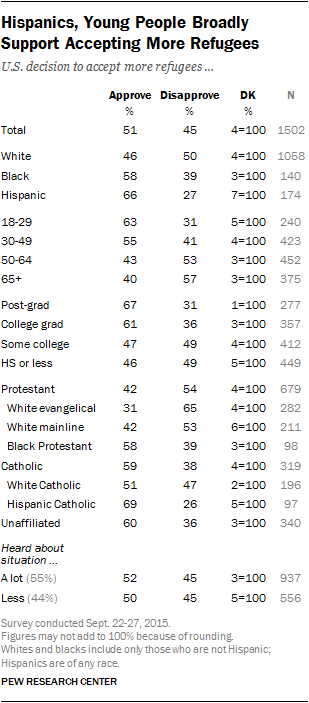
Hispanics are particularly supportive of the U.S. decision to increase the cap on the number of refugees it accepts over the next few years: 66% approve of this decision while just 27% disapprove. Blacks also approve of the decision by a 58%-39% margin. Among whites, opinion is divided: 46% approve, 50% disapprove.
Younger adults are much more likely to approve of the decision than are older adults. About six-in-ten (63%) of those ages 18-29 say they approve of the U.S. accepting more refugees, compared with just 40% of those age 65 and older.
Across educational lines, 67% of those with post-graduate degrees support increasing the number of refugees the U.S. accepts, as do 61% of those with college degrees. Among those without a college degree, about as many disapprove as approve of the decision.
Views of the U.S. decision to increase the number of refugees it accepts also differ by religious affiliation. About six-in-ten Catholics (59%) – including 69% of Hispanic Catholics and about half (51%) of white Catholics – say they approve of the decision to accept more refugees. White evangelical Protestants disapprove of the decision by a 65%-31% margin; views among white mainline Protestants are more mixed (53% disapprove-42% approve). By contrast, black Protestants say they approve of the U.S. raising its refugee cap (58%-39%).
There are more modest demographic differences when it comes to assessments of the United States’ response to the refugee situation more generally.
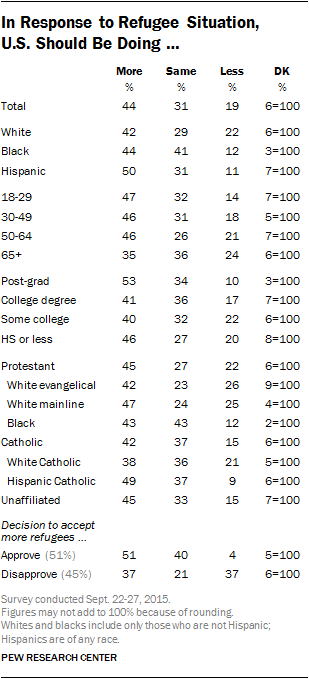
Overall, 44% say the U.S. should be doing more to address the refugee situation, 19% say it should be doing less and 31% say it is doing about what it should.
Among those who approve of the U.S. decision to increase the number of refugees it accepts, 51% say the U.S. should be doing more to address the situation; just 4% say it should be doing less and 40% say it is doing about what it should.
Those who disapprove of the U.S. decision on the refugee cap hold more mixed views about the U.S.’s efforts: As many say the U.S. should be doing less to address the situation as say it should be doing more (37% each); 21% say the U.S. is doing about what it should.
