
Pew Research Center

FOR RELEASE JANUARY 14, 2015

Obama Job Rating Ticks Higher, Views of Nation’s Economy Turn More Positive

But Most Still Say They Are ‘Falling Behind’ Financially

FOR MEDIA OR OTHER INQUIRIES:

Communications Department
202.419.4372
www.pewresearch.org

RECOMMENDED CITATION

Pew Research Center, January 2015, "Obama Job Rating Ticks Higher, Views of Nation’s Economy Turn More Positive"

About Pew Research Center

Pew Research Center is a nonpartisan, nonadvocacy fact tank that informs the public about the issues, attitudes and trends shaping the world. It does not take policy positions. The Center conducts public opinion polling, demographic research, computational social science research and other data-driven research. It studies politics and policy; news habits and media; the internet and technology; religion; race and ethnicity; international affairs; social, demographic and economic trends; science; research methodology and data science; and immigration and migration. Pew Research Center is a subsidiary of The Pew Charitable Trusts, its primary funder.

© Pew Research Center 2026

Table of contents

  • About Pew Research Center
  • Obama Job Rating Ticks Higher, Views of Nation’s Economy Turn More Positive
  • Section 1: Views of Obama; Personal Traits; Historical Legacy
  • Section 2: Views of the Nation’s Economy
  • Section 3: The Parties and Congress in 2015
  • About the Survey

Obama Job Rating Ticks Higher, Views of Nation’s Economy Turn More Positive

But Most Still Say They Are ‘Falling Behind’ Financially

President Obama enters the seventh year of his presidency in a familiar position when compared with his recent predecessors. His 47% job approval rating places him squarely between George W. Bush (33%) and Bill Clinton (63%) at similar points in their second terms. Obama’s rating is comparable to Ronald Reagan’s in January 1987 (49%), when Reagan was embroiled in the Iran-Contra affair.

The latest national survey by the Pew Research Center, conducted Jan. 7-11 among 1,504 adults, finds that Obama’s job approval has risen five points since December (42%). The president’s job rating changed very little over the course of 2014.

Obama is being helped by a steady improvement in public views of the nation’s economy. Currently, 27% say the economic conditions are excellent or good, up from 16% a year ago. Perhaps more important, almost twice as many expect the economy to be better than worse a year from now (31% vs. 17%).

For the first time in five years, more Americans say Obama’s economic policies have made conditions better (38%) than worse (28%); 30% say they have not had much of an effect. And Obama engenders more confidence on the economy than do the leaders of the new Republican majority in Congress.
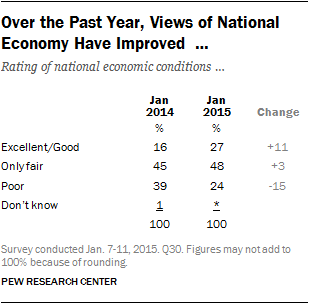
Over the Past Year, Views of National Economy Have Improved …

But the new survey finds stubborn skepticism about the strength of the economic recovery, and little evidence that people think that their personal financial fortunes have improved. A small but growing share of Americans (16%) say the economy is recovering strongly. However, many more (66%) think the economy is recovering, ‘but not so strongly.’
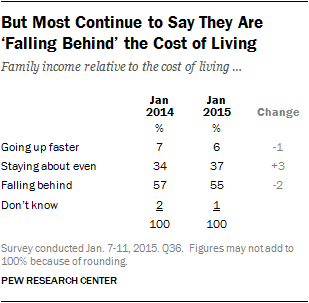
But Most Continue to Say They Are ‘Falling Behind’ the Cost of Living

The percentage of Americans who say the economy is doing well has increased by 11 points since Obama’s last State of the Union in January 2014. The percentage rating economic conditions as ‘poor’ has fallen 15 percentage points over the same period. Moreover, 36% say there are plenty of jobs of available in their communities, among the highest during Obama’s presidency.

Yet there has been no change in perceptions about whether incomes are keeping pace with the cost of living. Currently, 55% say their family’s income is ‘falling behind’ the cost of living; 37% say they are ‘staying about even,’ while just 6% say their incomes are going up faster than the cost of living. In January 2014, 57% felt as if they were falling behind financially.

Other Findings
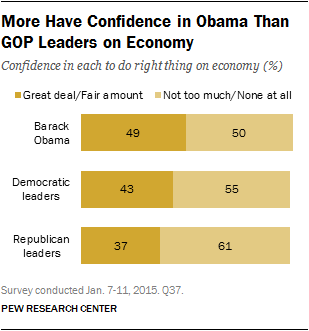
More Have Confidence in Obama Than GOP Leaders on Economy

Obama Draws More Confidence Than GOP Leaders on Economy. Overall, about half of Americans (49%) say they have a great deal or fair amount of confidence in Obama to ‘do the right thing’ in dealing with the economy, while 50% have not too much confidence or no confidence at all. That compares with 43% who have at least a fair amount of confidence in Democratic congressional leaders, and 37% who express confidence in GOP leaders on the economy.

Outlook for New Congress: More Partisan Bickering. As recent Pew Research Center surveys have found, the public has very low expectations for partisan cooperation in the coming year. The new poll finds that 71% think Republicans and Democrats in Washington will ‘bicker and oppose one another more than usual.’ Just 22% say they will work together more. Shortly before Obama took office in 2009, only 39% predicted more partisan bickering.

Nearly Half Disapprove of GOP Leaders’ Plans. Currently, 40% approve of Republican leaders’ plans and policies for the future, while somewhat more (49%) disapprove. Shortly after the midterm elections, when Republicans gained full control of Congress, about as many approved as disapproved of GOP future plans (44% approved vs. 43% disapproved). The public has mixed opinions about whether Republicans will be successful in getting their programs passed into law; 45% say they will be successful, while 46% say they won’t.

Obama Seen as ‘Not Tough Enough’ on Foreign Policy. Most Americans (55%) continue to say that Obama is not tough enough in approaching foreign policy and national security issues. Just 37% say his approach is about right, while 5% say he is too tough. These views are little changed from last August (54% said Obama was not tough enough) and November 2013 (51%).
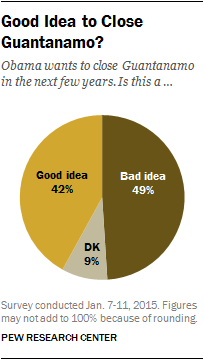
Good Idea to Close Guantanamo

Concerns Over Closing Guantanamo. Obama has long sought the closure of the U.S. prison holding terrorist suspects at Guantanamo Bay, Cuba. More Americans think closing the prison in the next few years is a bad idea (49%) than say it is a good idea (42%). Republicans overwhelmingly say that closing the prison is a bad idea (80%), while 64% of Democrats think it’s a good idea.

Public Divided Over Tougher Economic Regulation. As the new Congress debates rolling back some provisions of the Dodd-Frank economic regulation law, the public is evenly divided over whether the government has gone too far (45%) or not far enough (47%) in regulating financial institutions and markets. There also is a stark partisan divide in these attitudes – 64% of Republicans say financial regulation has gone too far, while 61% of Democrats say it has not gone far enough.

Section 1: Views of Obama; Personal Traits; Historical Legacy

Shortly after Obama’s reelection in 2012, 55% approved of his job performance, while 39% disapproved. But his job rating became more negative than positive in the fall of 2013 – and remained in negative territory through the end of last year. Currently, about as many Americans approve (47%) of his overall job performance as disapprove (48%).

Independents’ Views of Obama Tick Up

Over the last several months, Obama’s standing among independents has ticked up: Today, 42% approve of his job performance, up from 35% last July. Obama’s job performance continues to be viewed positively by most Democrats: Eight-in-ten (80%) approve, little different from Democratic evaluations over the last few years (though eight points higher than views last month). Among Democrats, 84% of liberals and 77% of conservatives and moderates approve of his job performance.

As has been the case throughout much of Obama’s presidency, few Republicans rate him positively: Today, just 10% approve — including just 5% of conservative Republicans.


Little Change in Views of Obama’s Personal Traits

Obama Traits: Lower Marks for Leadership Than for Standing for Beliefs, Communication

Evaluations of Obama’s personal characteristics are little changed over the course of the last year. Obama continues to be seen by clear majorities as someone who stands up for what he believes in (69% say this phrase reflects their impression of him) and as a good communicator (63%).

Somewhat fewer view Obama as someone who cares about people like them (56%) or as trustworthy (55%).  Obama gets his lowest ratings for leadership and effectiveness. About half (49%) say Obama is a strong leader; an identical percentage (49%) says he is not a strong leader. And while 45% say he is able to get things done, 50% disagree.

Wide Partisan Divide in Views of Obama

Although these impressions are on par with public views of Obama in December 2013 and July 2014, Obama was viewed far more positively on all of these traits earlier in his presidency.

As in the past, partisans differ widely in their impressions of Obama. Some of the largest gaps are in views of Obama’s trustworthiness and leadership: 88% of Democrats say Obama is trustworthy, compared with just 16% of Republicans. And while 79% of Democrats think Obama is a strong leader, just 11% of Republicans think so.

Obama is viewed positively by Republicans on just one of the seven traits asked about —  standing up for his beliefs; 56% of Republicans say this description applies to Obama (89% of Democrats say this). About six-in ten independents (62%) also view Obama as standing up for what he believes in, and a similar number (58%) say the president is a good communicator. He gets lower marks from independents on leadership and efficacy: 43% view him as a strong leader, while 40% say he is able to get things done.

More See Obama as ‘Liberal’ than ‘Middle of the Road,’ ‘Conservative’

Perceptions of Obama’s Ideology Little Changed

Overall, about half (48%) of Americans say that Obama is liberal, while 37% say he is ‘middle of the road’ ideologically; just 12% describe him as conservative. The balance of opinion in these perceptions has changed little over the last several years.

Partisans see the president’s ideological positioning very differently. Nearly three-quarters of Republicans (74%) say that Obama is liberal. By contrast, only about half as many Democrats (38%) describe Obama as liberal, while 43% say that he is middle of the road; 16% of Democrats view Obama as a conservative. Among Democrats, 56% of liberal Democrats say Obama is a liberal, while 36% say he is middle of the road. Among conservative and moderate Democrats, just 25% say he is liberal and 49% see Obama as middle of the road.

Independents’ views of Obama are similar to those of Democrats: 41% say he is liberal and 44% say he is middle of the road, while just 12% say he is conservative.

Obama’s Impact on the Economy

Impact of Obama’s Economic Policies

Nearly four-in-ten (38%) say Obama’s economic policies since taking office have made economic conditions better, while 28% say they have made the economy worse; three-in-ten (30%) think they have not had much of an effect. On balance, this is the most positive rating of Obama’s economic impact since December 2009.

Democrats overwhelmingly give Obama’s policies credit for improving economic conditions: 64% say they have made the economy better, 5% say they have made it worse, and 27% say they have not had much of an effect. Republicans largely say Obama’s policies have worsened economic conditions (57%), with 10% saying they have improved the economy and 31% saying they have not had much of an effect. Among independents, 36% say Obama’s policies have made the economy better, 31% worse, and 32% say the policies have not had much of an effect.

The public’s opinions about the issue have improved since a slightly different version of this question was last asked in June 2013, when as many said Obama’s policies had made the country’s economic conditions better as worse (35% each); in that survey, 27% said his policies had not had an effect so far. The change since then is largely due to improving views among independents since 2013, when a greater share said Obama’s policies had made the economy worse (43%) than better (26%).

Obama’s Approach to Foreign Policy

Since 2012, More See Obama as ‘Not Tough Enough’ on Foreign Policy

Since 2012, there has been a sharp increase in the share of Americans who say Obama’s approach to foreign policy and national security issues is ‘not tough enough.’ In September of that year, during the presidential campaign, 41% said Obama was not tough enough, while about as many (42%) said his approach was about right.

Republicans, Older Adults Say Obama Is Not Tough Enough on Security Issues

In November 2013, 51% said Obama was not tough enough, up 10 points from a year earlier. And in two polls since then, including the current survey (55%), the share saying Obama is not tough enough has surpassed 50%.

About nine-in-ten Republicans (89%) say Obama is not tough enough in dealing with foreign policy and national security. While this has been the majority view among Republicans throughout Obama’s presidency, the share saying this is greater than in the past (77% said this in August).

A 56% majority of Democrats say Obama’s approach is about right, but this view is more prevalent among liberal Democrats (64% say this) than among conservatives and moderates in the party (52%).

Independent views largely mirror those of the overall public: 54% say Obama is not tough enough, while 37% think his approach is about right and just 5% say he is too tough.

There is also a substantial age divide in these views of Obama’s approach to foreign policy: Those younger than 30 are divided on the question: 45% say his approach is about right, while 43% say  he is not tough enough. Older Americans — particularly those 50 and older — are more likely to say Obama’s foreign policy stance is not tough enough

Views of Obama’s Legacy

Obama’s Long-Term Prospects Seen as Better Than Bush’s, Worse than Clinton’s

Heading into his seventh year in office, public views of how Obama’s presidency will be seen in the long run are divided: 32% say he’ll be a successful president, 38% say he’ll be unsuccessful, while 29% say it is too early to tell. These public prognostications are similar to views last January.

Predictions about the long-term success of Obama’s presidency have fluctuated somewhat since he took office. On the eve of his inauguration in January 2009, 30% said he would be successful while just 4% disagreed; 65% said it was too early to tell. Since then, opinions have been more evenly divided.

Compared with prospects for success at a comparable point in their presidencies, Obama fares better than his immediate predecessor George W. Bush, but not as well as Bill Clinton.

Though Bush garnered positive ratings on this measure early in his presidency, in January of 2007 just 24% of Americans thought he would be a successful president, while nearly twice as many (45%) said he would be unsuccessful. By contrast, Clinton’s ratings on this measure were far better later in his presidency than earlier, and in January 1999 his ratings were the inverse of Bush’s:44% said he would be successful, while just 24% said he would be unsuccessful.

A similar pattern is seen in views of the administration’s accomplishments and failures; today the public is divided: 44% say the Obama administration’s accomplishments will outweigh its failures, while 50% say its failures will outweigh its accomplishments. In January 2007, the balance of opinion in this evaluation of the Bush administration was negative (53% failures outweigh accomplishments, 31% accomplishments outweigh failures), while in January 1999 the balance of opinion in views of the Clinton administration was positive (50% accomplishments outweigh failures, 34% failures outweigh accomplishments).

Section 2: Views of the Nation’s Economy

Amid accelerating economic growth and falling unemployment, public views of the U.S. economy have improved. Overall, 27% describe economic conditions as either excellent (4%) or good (23%), while 48% say they are only fair, and 24% call them poor. The percent rating economic conditions as poor has declined nine points since October (from 33%). This marks the first time in Obama’s presidency that about as many have described the economy as excellent or good (27%) as poor (24%).

Going forward, expectations for the economy have also improved somewhat. More say they expect the economy will be better in a year (31%) than worse (17%); 51% expect conditions to be about the same as they are now. In October, 27% expected the economy to improve over the next year compared with 21% who thought it would get worse.

Partisan Divide in Views of the Economy

While views of the economy have improved, economic ratings remain highly partisan. Nearly four-in-ten Democrats (39%) describe economic conditions in the country as excellent or good, compared with just 14% of Republicans; among independents, 27% call the economy excellent or good.

And while Democrats (+9 points) and independents (+7 points) have become more likely to rate the economy as excellent or good since October, there has been no significant shift in views among Republicans (+3 points).

Economic Recovery Seen as Tepid

Just 16% See Robust Economic Recovery

While overall views of the economy are improving, the strength of the economic recovery continues to be seen as tepid. When asked which statement best describes their views of the economy, 66% say it is recovering but not so strongly, while 16% say it is recovering strongly, and 17% say the economy is not recovering at all.

Attitudes on this question have also moved in a positive direction over recent months. Since October, the share saying the economy is not recovering at all has fallen five points (from 22%), while the share saying the economy is recovery strongly has gone up six points (from 10%); an identical 66% in both October and the current survey described the economy as recovering but not so strongly.


Views of Jobs Improving, but Most Still Say ‘Difficult to Find’

Job Opportunities in Local Area

When it comes to job opportunities, 57% say that jobs are difficult to find in their community, while 36% say that there are plenty of jobs available. Views of job availability have edged higher over the past several years as the unemployment rate has declined. The percentage saying that there are plenty of jobs available in their community has not been higher since November 2007, before the start of the Great Recession.

Education, Income Gaps in Job Views

Views of job availability differ significantly across demographic groups. People under 50 (41%) are more likely to say that jobs are available in their area than are those 50 and older (31%).

Across socioeconomic lines, those with higher levels of education and income are more likely to say that there are plenty of jobs available than are those with less education and income. For example, 44% of college graduates say that jobs are available in their community, compared with just 31% of those with no college experience.

The partisan divide in views of job availability is relatively modest: 40% of Democrats say that there are plenty of job opportunities, compared with slightly fewer Republicans (32%). Among independents, 35% say jobs are available in their community.

Most Still Say ‘Falling Behind’ Cost of Living

Nearly Two-Thirds of Low-Income Adults Say They Are ‘Falling Behind’ Financially

Despite improving views of the economy and job situation, most Americans continue to say that they are falling behind the cost of living. Overall, 55% say their family’s income is falling behind the cost of living, while 37% say it’s staying about even; only 6% think their family income is going up faster than the cost of living. Views on this question have shown no improvement over the course of the last year; in August 2014, 56% said they felt they were falling behind the cost of living.

While the sense of falling behind is widely held, there are differences in this view across demographic groups. Among those with family incomes of less than $30,000, more than twice as many (65%) say their incomes are failing to keep pace with living costs. Yet even among those at the top of the income scale, relatively few say their income is increasing faster than the cost of living. Just 19% of those earning $100,000 a year or more say their income is going up faster than the cost of living; 48% say it’s staying about even, and 31% say it is falling behind.

Nearly two-thirds (65%) of those with no college experience say their income is falling behind the cost of living, compared with 53% of those with some college experience and 42% of college graduates.

And adults under age 30 are about as likely to say their income is staying about even (44%) as falling behind (47%) the cost of living. Among older adults, larger percentages say they are falling behind than staying even.

Confidence in Obama, Congressional Leaders on Economy

When it comes to political leaders in Washington and the economy, more express confidence in Obama to do the right thing than in Democratic or Republican congressional leaders.

More Have Confidence in Obama on Economy Than in Rep or Dem Leaders

About half of the public (49%) expresses either a great deal or a fair amount of confidence in Obama to do the right thing on the economy, while about as many (50%) say they have not too much or no confidence at all in Obama on this issue.

By comparison, just 37% say they have a great deal or a fair amount of confidence in Republican leaders in Congress; about six-in-ten (61%) say they have not too much or no confidence at all in GOP leaders.

Democratic congressional leaders are viewed slightly better than their Republican counterparts: 43% express confidence in their ability to do the right thing on the economy, while 55% have little or no confidence.

Confidence in Obama and Congressional leaders on the economy is little changed from views in December 2013 prior to the Republican Party winning control of the Senate in the 2014 midterm elections.

Public Divided on Financial Regulation

Wide Ideological Differences on Government Regulation of Markets

Overall, as many say the government has gone too far regulating financial institutions and markets, making it harder for the economy to grow (45%) as say it hasn’t gone far enough regulating financial institutions and markets, leaving the country at risk of another financial crisis (47%). Views on this question are little changed from September of 2013.

There are stark differences in views on this question across political and ideological lines. Fully 64% of Republicans – and 71% of conservative Republicans – say the government has gone too far regulating financial institutions and markets, making it harder for the economy to grow.

By contrast, 61% of Democrats – and 72% of liberal Democrats – say the government has not gone far enough in regulating financial institutions and markets, leaving the country at risk of another financial crisis.

Independents are evenly split on this question: 47% say government has not gone far enough regulating financial institutions and markets, while 46% say it has gone too far.

Views of Personal Finances

Personal Financial Assessments

Ratings of people’s personal financial situation tend to be much more stable than assessments of the national economic picture.

In the current survey, 42% say they are in excellent or good shape financially, while 37% say they are in only fair shape, and 21% say they are in poor shape. These ratings are unchanged from last August and are similar to assessments of personal finances over the past several years.

Looking ahead, 67% expect their own financial situation to improve ‘a lot’ or ‘some’ over the course of the next year; far fewer (19%) think it will get a little or a lot worse. While not a sea-change in sentiment, this is as high as personal financial optimism has been over the course of the past seven years.

Section 3: The Parties and Congress in 2015

With the new Republican-led Congress in session, overall views of both parties have shifted in a more favorable direction over the last month, but the public sees few prospects for partisan cooperation on the horizon and a record-high gulf between what the Republican and Democratic parties stand for. Against this backdrop, Americans are divided in their views of GOP policies and plans and their likelihood of legislative success.

GOP Plans and Policies for Future

Mixed Views of GOP Agenda

Overall, 49% say they disapprove of Republican congressional leaders’ policies and plans for the future; slightly fewer (40%) say they approve. Views of GOP policies have ticked lower since immediately after the midterm elections, when 44% said they approved of Republican plans and 43% said they disapproved.

Expectations for Republican legislative achievement in the new Congress are limited. About as many say they think Republican leaders will be unsuccessful (46%) as successful (45%) in getting their programs passed into law. These views also have become slightly more negative since early November; at that time, 49% thought GOP leaders would be successful passing their programs into law, while 40% thought they would be unsuccessful.

Partisan Divides in Views of Republican Leaders’ Plans for the Future

Not surprisingly, views of congressional Republicans’ plans and policies are highly partisan. By a wide 74%-19% margin, rank-and-file Republicans approve of their congressional leaders’ plans for the future. Support is higher among conservative Republicans (78% approve) than among moderate and liberal Republicans (66% approve).

By contrast, seven-in-ten Democrats (70%), including 79% of liberal Democrats, disapprove of Republican congressional leaders’ policies and plans for the future.

Among independents, somewhat more say they disapprove (50%) than approve (38%) of GOP congressional leaders’ plans.

Public Expects More Partisan Bickering in 2015

Increased Expectation for Bickering in Coming Year

About seven-in-ten (71%) Americans say they expect Republicans and Democrats will bicker and oppose one another more than usual this year while just 22% say Republicans and Democrats in Washington will work together more in the coming year to solve problems.

Optimism for Bipartisan Cooperation Up Among Republicans, Down Among Democrats

The public has had low expectations for cooperation in Washington at the outset of the last several congressional terms. However, expectations today are even more pessimistic than in January 2013 (when 66% said bickering and opposition would be greater than usual) and January 2011 (when 61% said this). That contrasts with public views on the eve of Obama’s first inauguration when Americans were far more optimistic: In January 2009, just 39% expected more bickering and opposition, while 50% thought the parties would work together more.

Optimism is in short supply across the board, but Republicans, having regained control of both chambers of Congress, are now somewhat more likely (27%) than Democrats or independents (both 20%) to say they expect the parties to work together more than in the past.

By comparison, in January 2013 following Obama’s re-election, Democrats were more optimistic than Republicans (33% vs. 17%).

Views of the Parties

While the Democratic Party continues to be viewed somewhat more favorably than the Republican Party, both parties have seen an uptick in their favorability since last month. Currently 46% rate the Democratic Party favorably (a rebound from last month when just 41% viewed it favorably, but on par with views throughout 2014) and 41% have a favorable opinion of the GOP (up four points since December).

Both Parties’ Favorability Ratings Improve; Democrats Hold Narrow Edge
Partisans on Both Sides Rate Own Parties Better

Fully 86% of Republicans rate the GOP favorably, an eight-point improvement from December. The GOP’s rating among Republicans hasn’t been higher since before the 2012 election.

And 84% of Democrats view their party favorably. This is eight points better than last month and similar to their views of the party before the midterm elections.

More Democrats than Republicans feel very strongly about their own party: About three-in-ten Democrats (29%) have a ‘very’ favorable opinion of their party, while 18% of Republicans feel very favorably about the GOP.

Across the aisle, nearly all Republicans have negative views of the Democratic Party: 90% say their opinion of the Democratic Party is unfavorable (including 40% who say it is ‘very’ unfavorable), and just 9% rate them favorably. Among Democrats, 18% are favorable toward the GOP and 79% are unfavorable (44%  unfavorable).

Plurality Says ‘Great Deal’ of Difference Between Two Major Parties

Increasingly, the public thinks there are large differences between the Republican and the Democratic parties. Fully 44% now say there is ‘a great deal’ of difference between the parties. Though these views are little changed since last February, the proportion saying this has increased six points since 2010, and is at its highest point since the Pew Research Center first asked this question in 1987.

Democrats See Large Distinctions Between Parties

Democrats are especially likely to see a great deal of difference between the two parties (58%), while 26% of Democrats say there is a fair amount of difference and 13% say hardly any. About half of Republicans (48%) say there is a great deal of difference; 37% see a fair amount and 12% say hardly any.

Independents are the least likely to see big gaps between the two parties: About one-third (34%) see a great deal of difference, 31% say there is a fair amount and 30% say there is hardly any difference. More Democratic-leaning independents (42%) than Republican-leaning independents (31%) see a great deal of difference between the parties.


Republicans Critical of Their Party

Republicans Remain Critical of Party’s Performance on ‘Traditional Positions’

Fully 72% of Republicans and Republican-leaning independents say the GOP is doing only a fair or poor job ‘standing up for its traditional positions on such things as reducing the size of government, cutting taxes and promoting conservative social values.’ Just 27% say the party is doing an excellent or good job in advocating for these traditional positions.

The proportion of Republicans and GOP leaners giving the party positive ratings is little changed over the past few years.

Democrats remain less likely than Republicans to criticize their party’s performance in standing up for its traditional positions (55% vs. 72%). Still, more Democrats and Democratic-leaning independents say their party is doing an only fair or poor job (55%) than think their party is doing an excellent or good job (44%) of standing up for its traditional positions, such as ‘protecting the interests of minorities, helping the poor and needy and representing working people.’

About the Survey

The analysis in this report is based on telephone interviews conducted January 7-11, 2015 among a national sample of 1,504 adults, 18 years of age or older, living in all 50 U.S. states and the District of Columbia (528 respondents were interviewed on a landline telephone, and 976 were interviewed on a cell phone, including 563 who had no landline telephone). The survey was conducted by interviewers at Princeton Data Source under the direction of Princeton Survey Research Associates International. A combination of landline and cell phone random digit dial samples were used; both samples were provided by Survey Sampling International. Interviews were conducted in English and Spanish. Respondents in the landline sample were selected by randomly asking for the youngest adult male or female who is now at home. Interviews in the cell sample were conducted with the person who answered the phone, if that person was an adult 18 years of age or older. For detailed information about our survey methodology, see http://pewresearch.org/pewresearch-org/politics/methodology/

The combined landline and cell phone sample are weighted using an iterative technique that matches gender, age, education, race, Hispanic origin and nativity and region to parameters from the 2013 Census Bureau’s American Community Survey and population density to parameters from the Decennial Census. The sample also is weighted to match current patterns of telephone status (landline only, cell phone only, or both landline and cell phone), based on extrapolations from the 2014 National Health Interview Survey. The weighting procedure also accounts for the fact that respondents with both landline and cell phones have a greater probability of being included in the combined sample and adjusts for household size among respondents with a landline phone. Sampling errors and statistical tests of significance take into account the effect of weighting.

The following table shows the unweighted sample sizes and the error attributable to sampling that would be expected at the 95% level of confidence for different groups in the survey:

About the Survey

Sample sizes and sampling errors for other subgroups are available upon request.

In addition to sampling error, one should bear in mind that question wording and practical difficulties in conducting surveys can introduce error or bias into the findings of opinion polls.