
Pew Research Center

FOR RELEASE APRIL 2, 2014

America’s New Drug Policy Landscape

Two-Thirds Favor Treatment, Not Jail, for Use of Heroin, Cocaine

FOR MEDIA OR OTHER INQUIRIES:

Communications Department
202.419.4372
www.pewresearch.org

RECOMMENDED CITATION

Pew Research Center, April 2014, "America’s New Drug Policy Landscape"

About Pew Research Center

Pew Research Center is a nonpartisan, nonadvocacy fact tank that informs the public about the issues, attitudes and trends shaping the world. It does not take policy positions. The Center conducts public opinion polling, demographic research, computational social science research and other data-driven research. It studies politics and policy; news habits and media; the internet and technology; religion; race and ethnicity; international affairs; social, demographic and economic trends; science; research methodology and data science; and immigration and migration. Pew Research Center is a subsidiary of The Pew Charitable Trusts, its primary funder.

© Pew Research Center 2026

Table of contents

  • About Pew Research Center
  • America’s New Drug Policy Landscape
  • Section 1: Perceptions of Drug Abuse, Views of Drug Policies
  • Section 2: Views of Marijuana – Legalization, Decriminalization, Concerns
  • About the Surveys

America’s New Drug Policy Landscape

Two-Thirds Favor Treatment, Not Jail, for Use of Heroin, Cocaine

The public appears ready for a truce in the long-running war on drugs. A national survey by the Pew Research Center finds that 67% of Americans say that the government should focus more on providing treatment for those who use illegal drugs such as heroin and cocaine. Just 26% think the government’s focus should be on prosecuting users of such hard drugs.

Support for a treatment-based approach to illegal drug use spans nearly all demographic groups. And while Republicans are less supportive of the treatment option than are Democrats or independents, about half of Republicans (51%) say the government should focus more on treatment than prosecution in dealing with illegal drug users.
Support for Move Away from Set Drug Terms

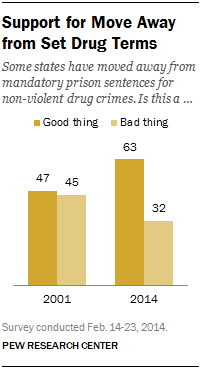
As a growing number of states ease penalties for drug possession, the public expresses increasingly positive views of the move away from mandatory sentences for non-violent drug crimes. By nearly two-to-one (63% to 32%), more say it is a good thing than a bad thing that some states have moved away from mandatory sentences for non-violent drug offenders. In 2001, Americans were evenly divided over the move by some states to abandon mandatory drug terms.

The survey by the Pew Research Center, conducted Feb. 14-23 among 1,821 adults, finds that support for the legalization of marijuana use continues to increase. And fully 75% of the public –including majorities of those who favor and oppose the legal use of marijuana – think that the sale and use of marijuana will eventually be legal nationwide.
Alcohol Seen as Bigger Danger than Marijuana

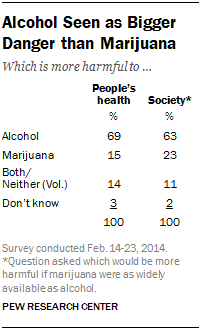
By wide margins, the public views marijuana as less harmful than alcohol, both to personal health and to society more generally. Moreover, just as most Americans prefer a less punitive approach to the use of drugs such as heroin and cocaine, an even larger majority (76% of the public) – including 69% of Republicans and 79% of Democrats – think that people convicted of possessing small amounts of marijuana should not have to serve time in jail.

The Pew Research Center’s report on U.S. drug policy comes at a pivotal moment in the national debate over how best to deal with drug abuse. There is a new bipartisan effort in Congress to give federal judges more discretion in low-level drug cases and reduce mandatory sentences for some drug crimes. Separately, the United States Sentencing Commission is expected to vote soon on a proposal to lessen the federal sentence for drug dealers.
Most Still View Drug Abuse in U.S. as a Crisis or Serious Problem

More and more states are acting to revise drug laws: Between 2009 and 2013, 40 states took some action to ease their drug laws according to a Pew Research Center analysis of data provided by the National Conference on State Legislatures and the Vera Institute.

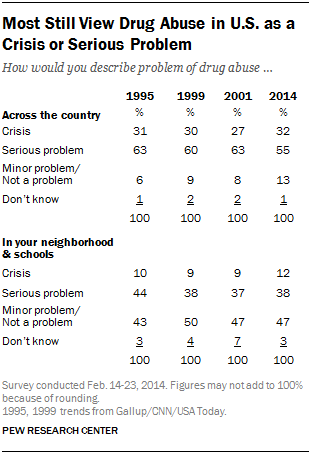
The public remains concerned over the problem of drug abuse – both nationally and locally. In fact, a large majority says that drug abuse across the country is either a crisis (32%) or a serious problem (55%). Half regard the problem of drug abuse in their neighborhoods, including its schools, that seriously. These views have not changed much since the mid-1990s.
Growing Support for Marijuana Legalization

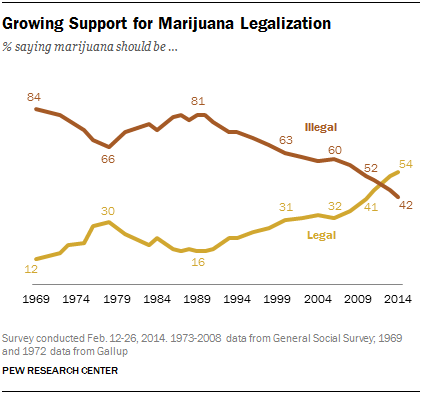
At the same time, there has been a major shift in attitudes on whether or not the use of marijuana should be legal. As recently as four years ago, about half (52%) said they thought the use of marijuana should not be legal; 41% said marijuana use should be legal. Today those numbers are roughly reversed – 54% favor marijuana legalization while 42% are opposed. (These findings, based on a separate survey conducted Feb. 12-26, were included in the “Millennials in Adulthood” report released March 7.)

When asked a more detailed question about marijuana use, 44% say it should be legal only for medicinal use, 39% say it should be legal for personal use and just 16% say it should not be legal at all. Majorities across nearly all demographic and partisan groups say the use of marijuana should be legal, at least for medicinal use.
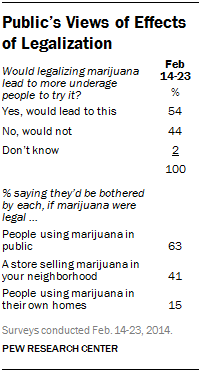
Public’s Views of Effects of Legalization

Despite the growing support for marijuana legalization, however, many Americans express concerns over possible consequences from legalization. More than half (54%) say that legalizing marijuana would lead to more underage people trying it. While people are 65 and older are most likely to say that legalization would lead to more underage people trying marijuana (69%), roughly half of those in younger age groups – including 51% of those under 30 — agree.

On a personal level, most Americans say that, if marijuana were legal, they would be bothered by people using the drug in public (63%), though fewer (41%) would be bothered if a store or business selling marijuana opened in their neighborhood. Just 15% would be bothered if people used marijuana in their own homes.

Section 1: Perceptions of Drug Abuse, Views of Drug Policies

The federal government’s annual survey on drug use in the United States finds that the use of illicit drugs has increased over the past decade, in part because of a rise in marijuana use. The government treats marijuana as an illicit drug; marijuana is now legal for medicinal use in 18 states and for recreational use in two others (Colorado and Washington).

Federal Government Estimates of Illicit Drug Use in the Past Month

According to the 2012 drug use survey by the Substance Abuse and Mental Health Services Administration, approximately 24 million Americans (9.2% of the general public aged 12 or older) reported using an illicit drug in the past month. This is up from 8.3% 10 years earlier.

The number of Americans who had used marijuana in the last month increased from 14.5 million in 2007 (5.8%) to 18.9 million in 2012 (7.3%). Among the so-called “hard drugs,” heroin use more than doubled from 166,000 to 335,000 individuals per month between 2002 and 2012. Cocaine use declined slightly over this same period. In 2012, 6.8 million Americans used prescription-type medications that have legitimate medical uses, such as pain relievers including Oxycontin and Vicodin, but for non-medical purposes (referred to as psychotherapeutic drugs). These figures are statistically equivalent to usage levels going back to 2002 (2.7%).

Young People Less Likely to View Drug Abuse as a Crisis Nationally, as a Serious Problem Locally

About a third of all Americans (32%) say that the problem of drug abuse is a crisis across the country and another 55% see it as a serious problem. When asked to think about their own neighborhoods, including the local schools, about one-in-ten (12%) see drug abuse as a crisis in their community and another 38% call it a serious problem.

Opinions about the problem of drug abuse differ little across most demographic and political groups. But young people are less likely than older Americans to say that drug abuse is a crisis nationally. Just 20% of those under 30 think drug abuse is a crisis compared with at least a third in older age groups. And 60% of young people say the problem of drug abuse in their neighborhoods is either a minor problem or not a problem, the lowest percentage of any age group.

Hispanics and those without college experience are more likely to view drug abuse as a serious problem in their neighborhood. A majority of Hispanics (63%) say that drug abuse is either a crisis or serious problem in their neighborhood, compared with about half of both non-Hispanic blacks (51%) and non-Hispanic whites (47%).

Among those with a high school degree or less education, 58% say drug abuse is a neighborhood crisis (14%) or serious problem (43%). College graduates see drug abuse as less of a problem in the neighborhoods where they live: 10% see a crisis, 35% a serious problem.

Race and Perceptions of Local Drug Abuse

Compared with ‘01, More Non-College Whites View Drug Abuse as a Crisis

Two decades ago, blacks were far more likely than whites to say that the problem of drug abuse was a crisis in their neighborhoods and schools; in 1995, 28% of blacks and just 9% of whites saw drug abuse as a crisis locally.

The share of blacks saying drug abuse in their communities is a crisis declined later in the 1990s. By 2001, 16% of blacks regarded the problem of local drug abuse as a crisis; that is little different from the current measure (15%).

Compared with 2001, a greater share of whites – particularly less educated whites – say the problem of drug abuse in their communities is a crisis. Currently, 12% of non-college whites say drug abuse is a crisis in their neighborhood, double the percentage that said this 13 years ago.

Views of Drug Policies: States Dropping Mandatory Drug Sentences

More than six-in-ten (63%) say that state governments moving away from mandatory prison terms for non-violent drug crimes is a good thing, while just 32% say these policy changes are a bad thing. This is a substantial shift from 2001 when the public was evenly divided (47% good thing vs. 45% bad thing).

Across nearly all demographic groups majorities say that the move away from mandatory prison terms is a good thing, and in most cases these percentages have increased by double digits since 2001. Majorities of both men (64%) and women (62%) view these policy changes as a good thing – up 13 points among men and 20 points among women. In 2001, women were less supportive than men of sentencing revisions. Half of women said it was a bad thing compared with 40% of men.

Most See Shift Away from Mandatory Drug Sentences as a Good Thing

As is the case with opinions on other issues related to illegal drug use, older Americans and Republicans are most likely to have reservations about state governments moving away from mandatory drug sentences.

About half of those 65 and older (49%) say that the move away from mandatory drug sentences is a good thing, up only modestly from 2001 (43%). By contrast, majorities among younger age groups have a positive view of the elimination of mandatory drug sentences, and this view has increased by double digits among those under 65 since 2001.

About half of Republicans (49%) have a positive view of the move away from mandatory drug sentences; in 2001, 41% viewed this change positively. Nearly seven-in-ten independents (69%) and 66% of Democrats say this is a good thing, up from 48% each in 2001.

The pattern is similar in opinions about how the government should deal with people who use illegal drugs such as heroin and cocaine. Two-thirds (67%) say the government should focus more on providing treatment for people who use these type of drugs. Just 26% think the focus should be more on prosecuting illegal drug users.

Public Wants Government Drug Policy to Focus More on Providing Treatment

Half or more in virtually every demographic and partisan group says the priority should be treatment, not prosecution. But there are differences across racial and ethnic lines: 81% of blacks say the government should focus more on treatment for drug users, compared with 66% of whites and 61% of Hispanics.

In addition, while large majorities of Democrats (77%) and independents (69%) want the government’s focus more on treatment, a smaller share of Republicans (51%) favor this approach. Those 65 and older are less likely than those in younger age groups to say that the government should focus on providing treatment for drug users rather than prosecuting them.

Those who view drug abuse across the country as a crisis are about as likely as those who do not to favor treatment rather than prosecution for those using illegal drugs like heroin and cocaine. Among those who say drug abuse is a crisis in their neighborhood, 64% favor the treatment option, about the same percentage as those who view the problem less seriously (68%).


Section 2: Views of Marijuana – Legalization, Decriminalization, Concerns

Public support for legalizing marijuana use is at an all-time high of 54%, though it is virtually unchanged from last year (52%). There is even more agreement that people convicted of possessing small amounts of marijuana should not serve time in jail.

About three-quarters of Americans (76%) say that if marijuana use is not legalized, those who are convicted of possessing small amounts of marijuana should not serve jail time. Just 22% favor jail time for those convicted of minor marijuana possession.

Views of the legalization of marijuana remain divided along partisan, age and ethnic lines. While support for legalization has increased by 15 points among both parties since 2010, Republicans continue to be far less likely than Democrats to favor legalization (39% vs. 63%). Opposition to legalization also is much higher among those 65 and older than younger people and among Hispanics than non-Hispanic whites or blacks.

However, majorities across nearly all partisan and demographic groups say possession of small amounts of marijuana should not result in jail time. The partisan differences in these opinions are relatively modest – 79% of Democrats, 78% of independents and 69% of Republicans do not think people convicted of having small amounts of marijuana should serve time in jail.

People who have tried marijuana are more likely than those who have not to oppose jail time for minor possession. Still, a majority of those who have never tried marijuana (63%) say people convicted of small amounts of marijuana should not spend time in jail. Among those who have tried marijuana, but not in the past year, 88% oppose jail time for possession of small amounts of marijuana, as do 97% of those who have used it in the past year.

Relative Dangers Posed by Alcohol and Marijuana

When asked which is more harmful to a person’s health, 69% of Americans say alcohol, while just 15% consider marijuana to be more harmful. Similarly, 63% say that if marijuana were as widely available as alcohol, the latter would be more harmful to society; 23% say marijuana would do the most harm.

Alcohol Viewed as More Harmful than Marijuana to Health and Society

Majorities across most demographic groups say alcohol is more harmful than marijuana to a person’s health and to society. But roughly a third of Hispanics (32%), people 65 and older (31%) and Republicans (36%) say marijuana would be more harmful to society than alcohol, if it were as widely available.

Even among those who say the use of marijuana by adults should not be legal, many consider alcohol to be more harmful to a person’s health; 45% say this is the case, compared with 29% who think marijuana is more harmful. But those who say marijuana use should not be legal see it as more harmful to society: 51% marijuana say that if marijuana were as widely available as alcohol, it would be more harmful, while 32% say alcohol would be more harmful.

Concerns about Marijuana Use

Would Legalization of Marijuana Lead to More Underage Use?

While many support the legalization – or at least the decriminalization – of marijuana use, most (54%) say legalizing marijuana would lead to more underage people trying it.

Those ages 65 or older are particularly likely to say the legalization of marijuana would lead to more underage use; 69% in this group say this is the case, compared with about half of those in younger age groups.

Majorities of those who say marijuana use should be illegal and those who say it should only be legal for medicinal purposes are also more likely to say the legalization of marijuana would lead to more underage people trying it (80% and 66%, respectively). In contrast, just 29% of those who say marijuana should be legal for personal use say the same.

The view that legalizing marijuana would lead to more underage people trying it is also more prevalent among Republicans. About two-thirds of Republicans (66%) say this would happen, while about half of Democrats (48%) and independents (51%) agree.

Six-in-Ten Would Be Bothered by Public Use of Marijuana

Most Would Be Bothered by Public, Not Private, Marijuana Use

Americans overwhelmingly say that if marijuana were legal, it would not bother them if people used marijuana in their own homes; 83% say this, including 60% of those who do not think marijuana use should be legal for personal or medicinal purposes.

But 63% would be bothered if people used marijuana in public, including a sizable minority (39%) of those who say marijuana use by adults should be legal for personal use.

Older Americans are particularly likely to say that if marijuana were legal, they would be bothered by people using it in public, but majorities across all age groups share this view. About three-quarters (76%) of those 65 or older would be bothered by marijuana use in public, as would 56% of those under 30, 60% of those 30-49 and 64% of 50- to 64-year-olds.

When asked if it would bother them if a store or business selling marijuana legally opened up in their neighborhood, about six-in-ten (57%) say they would not be bothered, but majorities of those who say marijuana use should not be legal (76%) and those who say it should only be legal for medicinal use (57%) would be bothered by this.

Hispanics are more likely than non-Hispanic whites and blacks to say it would bother them if a store of business selling marijuana opened up in their neighborhood; 51% of Hispanics say they would be bothered and 47% would not. In contrast, about six-in-ten whites (58%) and blacks (62%) would not be bothered by this.

About the Surveys

Most of the analysis in this report is based on telephone interviews conducted Feb. 14-23, 2014 among a national sample of 1,821 adults, 18 years of age or older, living in all 50 U.S. states and the District of Columbia, including an oversample of young adults ages 18 to 33 (481 respondents were interviewed on a landline telephone, and 1,340 were interviewed on a cell phone, including 786 who had no landline telephone). The survey was conducted by interviewers at Princeton Data Source under the direction of Princeton Survey Research Associates International. A combination of landline and cell phone random digit dial samples were used. In order to increase the number of 18 to 33 year-old respondents in the sample additional interviews were conducted with that cohort by screening separate random digit dial cell sample. The landline and both cell phone samples were provided by Survey Sampling International. Interviews were conducted in English and Spanish. Respondents in the landline sample were selected by randomly asking for the youngest adult male or female who is now at home. Interviews in both cell samples were conducted with the person who answered the phone if that person was an adult 18 years of age or older (main cell sample) or 18-33 (cell phone youth oversample). For detailed information about our survey methodology, see http://pewresearch.org/pewresearch-org/politics/methodology/

The combined landline and cell phone sample are weighted using an iterative technique that matches gender, age, education, race, Hispanic origin and nativity and region to parameters from the 2012 Census Bureau’s American Community Survey and population density to parameters from the Decennial Census. The weights account for the oversample by bringing the proportion of 18-33 year olds in the survey into line with that cohort’s share of the US population. The sample also is weighted to match current patterns of telephone status and relative usage of landline and cell phones (for those with both), based on extrapolations from the 2013 National Health Interview Survey. The weighting procedure also accounts for the fact that respondents with both landline and cell phones have a greater probability of being included in the combined sample and adjusts for household size among respondents with a landline phone. Sampling errors and statistical tests of significance take into account the effect of weighting.

The following table shows the unweighted sample sizes and the error attributable to sampling that would be expected at the 95% level of confidence for different groups in the survey:

About the Survey

Some of the analysis in this report is based on telephone interviews conducted Feb. 12-26, 2014 among a national sample of 3,338 adults, 18 years of age or older, living in all 50 U.S. states and the District of Columbia (1,671 respondents were interviewed on a landline telephone, and 1,667 were interviewed on a cell phone, including 905 who had no landline telephone). The survey was conducted under the direction of Abt SRBI. A combination of landline and cell phone random digit dial samples were used; both samples were provided by Survey Sampling International. Interviews were conducted in English and Spanish. Respondents in the landline sample were selected by randomly asking for the youngest adult male or female who is now at home. Interviews in the cell sample were conducted with the person who answered the phone, if that person was an adult 18 years of age or older. For detailed information about our survey methodology, see http://pewresearch.org/pewresearch-org/politics/methodology/

The combined landline and cell phone sample are weighted using an iterative technique that matches gender, age, education, race, Hispanic origin and nativity and region to parameters from the 2012 Census Bureau’s American Community Survey and population density to parameters from the Decennial Census. The sample also is weighted to match current patterns of telephone status and relative usage of landline and cell phones (for those with both), based on extrapolations from the 2013 National Health Interview Survey. The weighting procedure also accounts for the fact that respondents with both landline and cell phones have a greater probability of being included in the combined sample and adjusts for household size among respondents with a landline phone. Sampling errors and statistical tests of significance take into account the effect of weighting.

The following table shows the unweighted sample sizes and the error attributable to sampling that would be expected at the 95% level of confidence for different groups in the survey:

About the survey

Sample sizes and sampling errors for other subgroups are available upon request. In addition to sampling error, one should bear in mind that question wording and practical difficulties in conducting surveys can introduce error or bias into the findings of opinion polls.