
Pew Research Center

FOR RELEASE MARCH 19, 2014

Keystone XL Pipeline Divides Democrats

Proposal Retains 2-to-1 Support among Public

FOR MEDIA OR OTHER INQUIRIES:

Communications Department
202.419.4372
www.pewresearch.org

RECOMMENDED CITATION

Pew Research Center, March 2014, "Keystone XL Pipeline Divides Democrats"

About Pew Research Center

Pew Research Center is a nonpartisan, nonadvocacy fact tank that informs the public about the issues, attitudes and trends shaping the world. It does not take policy positions. The Center conducts public opinion polling, demographic research, computational social science research and other data-driven research. It studies politics and policy; news habits and media; the internet and technology; religion; race and ethnicity; international affairs; social, demographic and economic trends; science; research methodology and data science; and immigration and migration. Pew Research Center is a subsidiary of The Pew Charitable Trusts, its primary funder.

© Pew Research Center 2026

Table of contents

  • About Pew Research Center
  • Keystone XL Pipeline Divides Democrats
  • About the Survey

Keystone XL Pipeline Divides Democrats

Proposal Retains 2-to-1 Support among Public

Survey Report
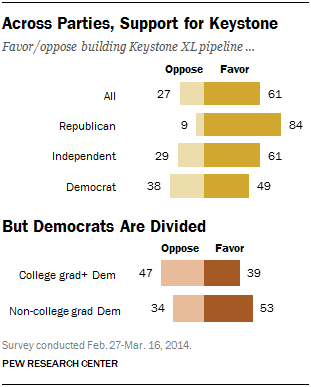
Across Parties, Support for Keystone, But Democrats Are Divided

As the Obama administration deliberates over whether to allow the Keystone XL pipeline to be built, the proposed pipeline continues to draw broad support from the public. Currently, 61% favor building the pipeline while 27% are opposed. These views have changed little over the past year.

As previous surveys on the pipeline proposal have found, there is far more support for constructing the pipeline among Republicans (84% favor) and independents (61%) than among Democrats. About half of Democrats (49%) favor building the pipeline while 38% are opposed.

The new national survey by the Pew Research Center, conducted Feb. 27-Mar. 16 among 3,335 adults, provides an opportunity for a detailed look at differences among Democrats on this issue. Opposition to building the pipeline is most widespread among highly educated Democrats, liberals and those with high family incomes.
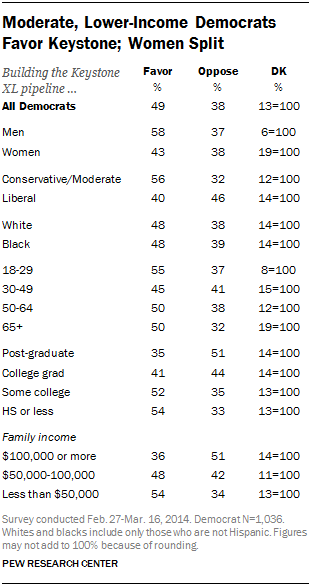
Moderate, Lower-Income Democrats Favor Keystone; Women Split

While Democrats without college degrees support construction by a wide margin (53% to 34%), only about four-in-ten college-graduate Democrats (39%) favor the project and nearly half (47%) oppose it. (Among Democrats in the survey, 28% had a bachelor’s degree or higher.)

There are comparable differences among Democrats across income categories. Democrats with annual family incomes of at least $100,000 are the least likely group to support the pipeline: about half (51%) oppose Keystone and 36% support it. Those with incomes between $50,000 and $100,000 are divided, while there is more support than opposition among those with family incomes of less than $50,000.

As Pew Research polls last year found, moderate and conservative Democrats continue to be far more likely than liberals to favor building the pipeline (56% vs. 40%).

In addition, there is less support for Keystone among Democratic women than men. About as many women oppose (38%) as favor (43%) the pipeline, with 19% offering no opinion. By comparison, a 58% majority of Democratic men favor Keystone and just 37% oppose it.

Republicans also differ over the pipeline, but large majorities across all GOP groups favor its construction, including 94% of Tea Party Republicans and 78% of non-Tea Party Republicans. Greater shares of Republican men than women support Keystone (90% vs. 78%). Unlike Democrats, there are no significant differences by education or income level among Republicans.

About the Survey

The analysis in this report is based on telephone interviews conducted Feb.27-Mar. 16, 2014 among a national sample of 3,335 adults, 18 years of age or older, living in all 50 U.S. states and the District of Columbia (1,668 respondents were interviewed on a landline telephone, and 1,667 were interviewed on a cell phone, including 870 who had no landline telephone). The surveys were conducted under the direction of Abt SRBI. A combination of landline and cell phone random digit dial samples were used; both samples were provided by Survey Sampling International. Interviews were conducted in English and Spanish. Respondents in the landline sample were selected by randomly asking for the youngest adult male or female who is now at home. Interviews in the cell sample were conducted with the person who answered the phone, if that person was an adult 18 years of age or older. For detailed information about our survey methodology, see http://pewresearch.org/pewresearch-org/politics/methodology/

The combined landline and cell phone sample are weighted using an iterative technique that matches gender, age, education, race, Hispanic origin and nativity and region to parameters from the 2012 Census Bureau’s American Community Survey and population density to parameters from the Decennial Census. The sample also is weighted to match current patterns of telephone status and relative usage of landline and cell phones (for those with both), based on extrapolations from the 2013 National Health Interview Survey. The weighting procedure also accounts for the fact that respondents with both landline and cell phones have a greater probability of being included in the combined sample and adjusts for household size among respondents with a landline phone. Sampling errors and statistical tests of significance take into account the effect of weighting.

The following table shows the unweighted sample sizes and the error attributable to sampling that would be expected at the 95% level of confidence for different groups in the survey:

About the Survey

Sample sizes and sampling errors for other subgroups are available upon request. In addition to sampling error, one should bear in mind that question wording and practical difficulties in conducting surveys can introduce error or bias into the findings of opinion polls.