
Pew Research Center

FOR RELEASE JUNE 23, 2013

‘Borders First’ a Dividing Line in Immigration Debate

More Say Legalization Would Benefit Economy than Cost Jobs

FOR MEDIA OR OTHER INQUIRIES:

Communications Department
202.419.4372
www.pewresearch.org

RECOMMENDED CITATION

Pew Research Center, June 2013, "‘Borders First’ a Dividing Line in Immigration Debate"

About Pew Research Center

Pew Research Center is a nonpartisan, nonadvocacy fact tank that informs the public about the issues, attitudes and trends shaping the world. It does not take policy positions. The Center conducts public opinion polling, demographic research, computational social science research and other data-driven research. It studies politics and policy; news habits and media; the internet and technology; religion; race and ethnicity; international affairs; social, demographic and economic trends; science; research methodology and data science; and immigration and migration. Pew Research Center is a subsidiary of The Pew Charitable Trusts, its primary funder.

© Pew Research Center 2026

Table of contents

  • About Pew Research Center
  • ‘Borders First’ a Dividing Line in Immigration Debate
  • Section 1: The Immigration Policy Debate
  • Section 2: View of Undocumented Immigrants, Impact of Legalization
  • About the Survey

‘Borders First’ a Dividing Line in Immigration Debate

More Say Legalization Would Benefit Economy than Cost Jobs

Overview

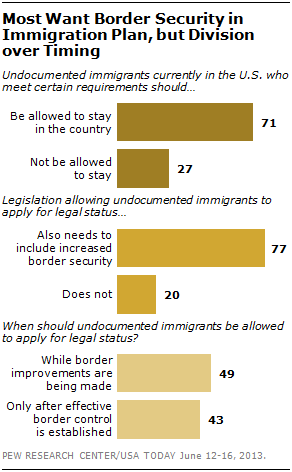
As the Senate works toward a compromise on immigration reform, the emerging proposal addresses two widely-held public goals. Broad majorities – across party lines – continue to support a path to legalization for undocumented immigrants. And large majorities also say this legislation must include increased border security.
6-21-2013. 1

But the public is divided on an issue that has been among the most contentious in Congress – whether border security must be achieved before the process of legalization can go forward. The national survey by the Pew Research Center and USA TODAY, conducted June 12-16 among 1,512 adults, finds that 43% say that people in the U.S. illegally should be allowed to seek legal status only after effective border control is established, while 49% say this can occur while border security improvements are being made.

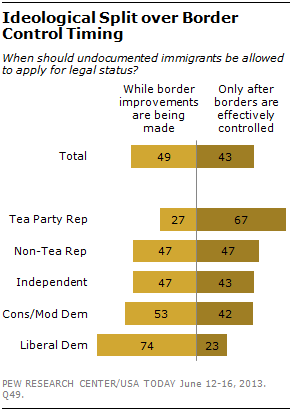
Republicans and Democrats are on opposite sides of this issue: 60% of Democrats say border improvements and applications for legal status can happen at the same time, while a majority of Republicans (56%) say the borders must effectively be controlled first.

Yet there also are substantial differences
6-21-2013. 2

within both partisan bases. Republicans who agree with the Tea Party favor a “border security first” approach by more than two-to-one (67% to 27%). Non-Tea Party Republicans are divided (47%-47%).

And while much of the focus in the congressional immigration debate has been on the GOP’s divisions, internal differences among Democrats are just as wide. Liberal Democrats, by 74% to 23%, say the process of applying for legal status should go forward while border security is being increased. But only about half (53%) of the party’s conservatives and moderates agree.

Perceptions of the nature of the border problem factor into public views on this debate. The
6-21-2013. 3

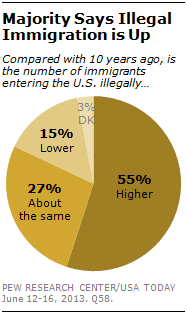
survey finds that a majority of the public (55%) believes that the number of immigrants entering the United States illegally is higher now than it was 10 years ago while about four-in-ten believe it is the same (27%) or lower (15%) today. Those who believe the illegal immigration rate has risen are more likely than others to say legal status should come only after improvements are made to border security.

There is no definitive measure of illegal immigration into the U.S., but recent studies by the Pew Hispanic Center have found that there has been a decline in the number of undocumented immigrants in the U.S. in recent years and net migration from Mexico (inflow minus outflow) has fallen to zero, and possibly lower. And while an imperfect measure, U.S. Border Patrol records also show sharply fewer illegal alien apprehensions than a decade ago.

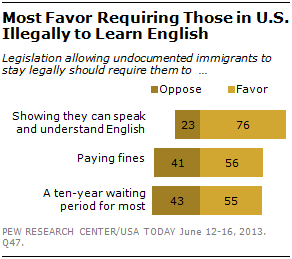
Most Americans believe undocumented immigrants should meet certain requirements before they are allowed to stay in the U.S. legally: 56% say undocumented immigrants should have to pay fines before gaining
6-21-2013. 4

legal status. A similar percentage (55%) backs a 10-year waiting period for most immigrants before permanent residency.

There is much broader support for another requirement – fully 76% of the public, including majorities of nearly every demographic group, say that undocumented immigrants should have to show they can speak and understand English before being allowed to stay in the U.S. legally.

The Pros and Cons of Legalization

The survey finds that large majorities of the public agree with a number of statements – pro and con – about the possible impact of granting legal status to people in the U.S. illegally.

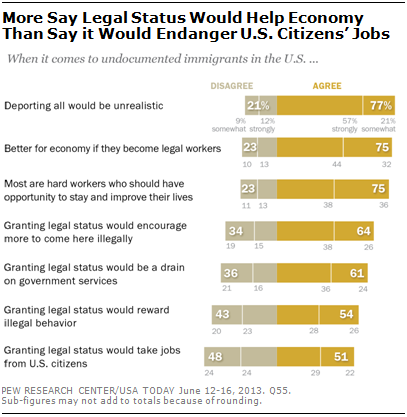
Fully 77% agree – including 57% who strongly agree – that deporting all undocumented immigrants would be unrealistic.

And 75% agree it would be “better for the
6-21-2013. 5

economy for undocumented immigrants to gain legal status and become legal workers.” Far fewer Americans say that legalization would have a negative impact on jobs. About half (51%) say that “granting undocumented immigrants legal status would take jobs from U.S. citizens.”

By comparison, larger shares of the public agree with other concerns about creating a path to legal status, such as that it would encourage more people come to the U.S. illegally (64%) and would be a drain on government services (61%)
6-21-2013. 6

.

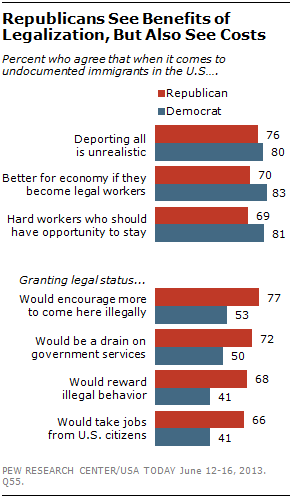
Broad majorities of Republicans agree with some of the arguments made by proponents of a legalization path: 76% say deportation is unrealistic, and 70% say it would be better for the economy if undocumented immigrants had legal status and were legal workers.

But Republicans are far more likely than Democrats to see potential downsides from granting legal status to undocumented immigrants. In particular, 77% say this would encourage more illegal immigration, and 72% say it would be a drain on government services – concerns about half of Democrats share. Roughly two-thirds of Republicans believe a legalization program would reward illegal behavior and would take jobs from U.S. citizens, views that only about four-in-ten Democrats share.

The issue of immigration reform
6-21-2013. 7

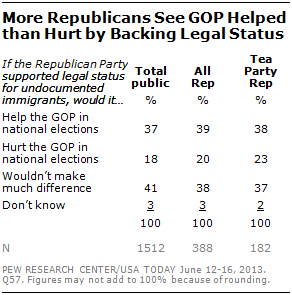
has set off intense debate among GOP leaders over whether the party would be better served politically if it supported legal status for people in the U.S. illegally.

Among Republicans, 39% say that supporting legal status would help the party in national elections while 20% say it would hurt the party politically and 40% say it would not make much difference. Notably, while Republicans who agree with the Tea Party express greater concern about undocumented immigrants, they have about the same view as all Republicans regarding the implications for the GOP if it supports legal status.

Section 1: The Immigration Policy Debate

Public support for creating a way for undocumented immigrants to gain legal status remains high. Currently, 71% say there should be a way for undocumented immigrants living in the U.S. to stay legally, if certain requirements are met. There has been no change in opinion on this question since March.

6-21-2013. 9

Support for legal status for undocumented immigrants varies widely, but majorities across nearly all groups say there should be a way for them to stay in the U.S. legally. For the most part, there has been little change in these views since May, but opposition to legal status has increased among conservative Republicans over the last month (from 34% to 44%).

Public’s Top Requirement for Legal Status: Learn English

When it comes to specific requirements for legal status, 76% of Americans favor requiring undocumented immigrants to show they can speak and understand English before gaining legal status.

Large percentages of whites (79%) and blacks (77%), as well as smaller majority (60%) of Hispanics, support an English requirement

6-21-2013. 10

.

Hispanics are as likely as whites and blacks to say undocumented immigrants should pay fines before obtaining legal status. About six-in-ten Hispanics favor this proposal, compared with 56% of blacks and 54% of whites.

However, there is more opposition than support among Hispanics for requiring a 10-year waiting period for most undocumented immigrants before they can gain permanent residency (59% oppose, 40% favor), while majorities of both whites (56%) and blacks (60%) favor this.

6-21-2013. 11

There are sizable partisan differences in opinions about proposed pre-requisites for legal status. But large majorities of Republicans (86%), Democrats (69%) and independents (77%) say that undocumented immigrants should be required to show they can speak and understand English before gaining legal status.

There also are divides among Democrats over this proposal: 80% of moderate and conservative Democrats favor an English language requirement – little different than the opinions of Republicans and independents; in contrast, 50% of liberal Democrats support this proposal, while about as many (49%) oppose it.

Roughly half of Democrats support requiring undocumented immigrants to wait 10 years before they could become permanent residents (51%) and to pay fines (49%). Majorities of Republicans favor each of these proposals (60% 10-year wait, 67% pay fines).

Should the Border be Secure First?

On a question central to the current debate – whether applications for legal status need to wait until there is effective control of the border – the public is largely split. About half (49%) say undocumented immigrants should be allowed to apply for legal status while improvements are being made, 43% say effective control over the border should be established before undocumented immigrants can apply.

6-21-2013. 12

Liberal Democrats, those with college degrees, those younger than 50 and Hispanics are the most likely to say undocumented immigrants should be allowed to apply while border improvements are being made. Three-quarters of liberal Democrats (74%) say this, compared to 30% of conservative Republicans; other political and ideological groups are about evenly split.

Those with graduate degrees (68%) and bachelor’s degrees (62%) are more likely than those with some college (48%) or no college (42%) education to say that improvements to border security can be concurrent with applications for legal status.

While whites and blacks are split on this question, Hispanics say – by nearly two-to-one (59% to 32%) –that undocumented immigrants should be allowed to apply for legal status while border improvements are being made. Younger people (those younger than 50) are more likely than those 50 and older to say the same.

About Half Say Immigration Bill is Likely to Pass

Roughly half of Americans (53%) say passing significant new immigration legislation this year is very or somewhat likely. Half (50%) also say it is extremely or very important to do so.

6-21-2013. 13

Democrats are more confident than Republicans or independents that significant new immigration legislation will pass this year: 59% of Democrats, compared with 51% of independents and 47% of Republicans say passage is at least somewhat likely this year. Hispanics (71%) and blacks (67%) are much more likely than whites (47%) to say this.

Roughly equal shares of Republicans, Democrats and independents believe that passing significant new legislation is extremely or very important. Hispanics are the most likely to say it is extremely or very important (70%), compared to blacks (53%) and whites (45%).

Most Say Illegal Immigration is Up

A majority of Americans (55%) say that the number of immigrants entering the U.S. illegally is higher today than it was 10 years ago. Just 15% say the number is lower, while 27% say it is about the same. While immigration flows are difficult to measure, research from the Pew Hispanic Center has shown that the numbers of undocumented immigrants in the U.S. had declined by 2011 (the last year for which data is analyzed), from a high point in 2007; they have also shown that migration from Mexico has declined substantially in recent years.

Among partisan groups, there are few differences on this question, with the exception of liberal Democrats, who are much less likely than all other partisan groups

6-21-2013. 14

to say the number of immigrants entering the U.S. illegally is greater today than it was 10 years ago. Just 38% of liberal Democrats say the rate of illegal immigration has increased, compared with majorities in other partisan groups.

Hispanics are substantially less likely than whites and blacks to say the number of undocumented immigrants is higher than in 2003; 41% say this, compared with 57% of whites and 65% of blacks. A third of Hispanics (33%) say the number is lower; just 12% of whites and blacks say this.

Those living in states that border Mexico are also somewhat less likely to say the rate has increased (and more likely to say it’s gone down) compared with those in other states.

College educated people – and particularly those with post-graduate degrees – are less likely than others to say more undocumented immigrants are currently entering the country. Just 34% of post-graduates say this, compared with 48% of those with a bachelor’s degree, and six-in-ten of those without a bachelor’s degree.

Perceptions about the number of immigrants coming into the country are associated with opinions about whether border

6-21-2013. 15

security needs to be addressed before applications for legal status can begin. Among the 55% of Americans who say the number of immigrants entering the country illegally is now greater than it was 10 years ago, half (50%) say applications for legal status should only be allowed after effective border control has been established; 42% say these can happen concurrently. The balance of opinion is reversed among those who say the illegal immigration rate has held steady or dropped: More say undocumented immigrants should be allowed to apply for legal status while improvements are being made to border security (58%) than say border improvements must come first (36%).

Section 2: View of Undocumented Immigrants, Impact of Legalization

There is broad partisan agreement that it would be unrealistic to deport all undocumented immigrants. Fully 80% of Democrats express this view, as do 78% of independents and 76% of Republicans.

And majorities across partisan lines also agree that it would better for the economy if undocumented immigrants became legal workers. In addition, 81% of Democrats, along with 73% of independents and 69% of Republicans, say “most undocumented immigrants are hard workers who should have the opportunity to stay in this country and improve their lives.”

6-21-2013. 16

But there are sharper divisions over possible negative effects from legalization – on jobs and government services – and whether granting legal status would be a reward for illegal behavior and encourage others to enter the country illegally.

About seven-in-ten Republicans (72%) and 63% of independents say providing legal status to undocumented immigrants would be a drain on government services. Just 50% of Democrats agree. The divide between Republicans and Democrats is about as wide (25 points) over whether legalization would take jobs from U.S. citizens.

Nonetheless, about as many Republicans say that providing legal status to undocumented immigrants would be better for the economy (70%) as say it would cost jobs (66%). And among Democrats and independents, much larger shares say granting legal status would help the economy than take jobs from citizens.

Notably, large majorities of both Republicans (77%) and independents (68%) say that granting undocumented immigrants legal status would encourage more people to come to the United States illegally. Only about half of Democrats (53%) agree.

Intra-Party Divides over Undocumented Immigrants

In addition to the clear divisions between the parties on these issues, there are also differences within both parties in views about undocumented immigrants.

6-21-2013. 17

For example, Republicans who agree with the Tea Party overwhelmingly say that granting undocumented immigrants legal status rewards illegal behavior (82% agree, 16% disagree); that compares with a narrower majority of  Republicans who do not agree with the Tea Party (60% agree, 37% disagree).

And, a smaller majority of Tea Party Republicans (57%) than non-Tea Party Republicans (77%) say that most undocumented immigrants are hard workers who should have the opportunity to stay in this country and improve their lives.

There also are substantial differences between liberal Democrats and conservative and moderate Democrats in views of undocumented immigrants.

While on balance all Democrats are somewhat more likely to disagree than to agree that legal status would take

6-21-2013. 18

jobs from U.S. citizens (41% agree, 59% disagree), conservative and moderate Democrats are divided on this question (48% agree, 51% disagree). By contrast, just 26% of liberal Democrats agree with the statement and nearly three quarters disagree (74%) – including 45% who express strong disagreement.

Similarly, most conservative and moderate Democrats (56%) agree that providing legal status would be a drain on government services, while most liberal Democrats (60%) disagree.

There are also differences along racial and ethnic lines in opinions about the impact of granting legal status to undocumented immigrants. About seven-in-ten whites (69%) say legalization would encourage more people to come to the U.S. illegally, compared with about half of both Hispanics (50%) and blacks (49%).

In addition, a solid majority of whites say that granting this population legal status would reward illegal behavior (57%). Hispanics are more evenly divided on this question (45% agree, 49% disagree) as are blacks (46% agree, 52% disagree).

6-21-2013. 19

On the economic arguments, one for and one against granting legal status, there is broad agreement among whites (71%), blacks (79%) and Hispanics (91%) that it would be better for the economy if undocumented immigrants could become legal workers. Yet, there is division over whether granting legal status to undocumented immigrants would take jobs from U.S. citizens: 56% of whites and 52% of blacks agree, compared with just 30% of Hispanics.

Across many questions, those with college degrees are more likely to express positive views of undocumented immigrants, compared with those without at least a bachelor’s degree. For example, just 40% of those with college degrees say that granting legal status to undocumented immigrants would take jobs from U.S. citizens, while most (60%) disagree. Those without a college degree are considerably more likely to agree with this statement (55% agree, 43% disagree).

About the Survey

The analysis in this report is based on telephone interviews conducted June 12-16, 2013 among a national sample of 1,512 adults, 18 years of age or older, living in all 50 U.S. states and the District of Columbia (758 respondents were interviewed on a landline telephone, and 754 were interviewed on a cell phone, including 394 who had no landline telephone). The survey was conducted by interviewers at Princeton Data Source under the direction of Princeton Survey Research Associates International. A combination of landline and cell phone random digit dial samples were used; both samples were provided by Survey Sampling International. Interviews were conducted in English and Spanish. Respondents in the landline sample were selected by randomly asking for the youngest adult male or female who is now at home. Interviews in the cell sample were conducted with the person who answered the phone, if that person was an adult 18 years of age or older. For detailed information about our survey methodology, see http://pewresearch.org/pewresearch-org/politics/methodology/

The combined landline and cell phone sample are weighted using an iterative technique that matches gender, age, education, race, Hispanic origin and nativity and region to parameters from the 2011 Census Bureau’s American Community Survey and population density to parameters from the Decennial Census. The sample also is weighted to match current patterns of telephone status and relative usage of landline and cell phones (for those with both), based on extrapolations from the 2012 National Health Interview Survey. The weighting procedure also accounts for the fact that respondents with both landline and cell phones have a greater probability of being included in the combined sample and adjusts for household size among respondents with a landline phone. Sampling errors and statistical tests of significance take into account the effect of weighting. The following table shows the unweighted sample sizes and the error attributable to sampling that would be expected at the 95% level of confidence for different groups in the survey:

6-21-2013. 20

Sample sizes and sampling errors for other subgroups are available upon request.

In addition to sampling error, one should bear in mind that question wording and practical difficulties in conducting surveys can introduce error or bias into the findings of opinion polls.