Pew Research Center

FOR RELEASE JUNE 6, 2013

In Gay Marriage Debate, Both Supporters and Opponents See Legal Recognition as ’Inevitable’

Overview As support for gay marriage continues to increase, nearly three-quarters of Americans – 72% – say that legal recognition of same-sex marriage is “inevitable.” This includes 85% of gay marriage supporters, as well as 59% of its opponents. The national survey by the Pew Research Center, conducted May 1-5 among 1,504 adults, finds that […]

FOR MEDIA OR OTHER INQUIRIES:

Communications Department
202.419.4372
www.pewresearch.org

RECOMMENDED CITATION

Pew Research Center, June 2013, "In Gay Marriage Debate, Both Supporters and Opponents See Legal Recognition as ’Inevitable’"

About Pew Research Center

Pew Research Center is a nonpartisan, nonadvocacy fact tank that informs the public about the issues, attitudes and trends shaping the world. It does not take policy positions. The Center conducts public opinion polling, demographic research, computational social science research and other data-driven research. It studies politics and policy; news habits and media; the internet and technology; religion; race and ethnicity; international affairs; social, demographic and economic trends; science; research methodology and data science; and immigration and migration. Pew Research Center is a subsidiary of The Pew Charitable Trusts, its primary funder.

© Pew Research Center 2026

Table of contents

  • About Pew Research Center
  • In Gay Marriage Debate, Both Supporters and Opponents See Legal Recognition as ’Inevitable’
  • Section 1: Same-Sex Marriage, Civil Unions and Inevitability
  • Section 2: Views of Gay Men and Lesbians, Roots of Homosexuality, Personal Contact with Gays
  • Section 3: Religious Belief and Views of Homosexuality
  • About the Survey

In Gay Marriage Debate, Both Supporters and Opponents See Legal Recognition as ’Inevitable’

Overview As support for gay marriage continues to increase, nearly three-quarters of Americans – 72% – say that legal recognition of same-sex marriage is “inevitable.” This includes 85% of gay marriage supporters, as well as 59% of its opponents. The national survey by the Pew Research Center, conducted May 1-5 among 1,504 adults, finds that […]

Overview

6-6-13 #1

As support for gay marriage continues to increase, nearly three-quarters of Americans – 72% – say that legal recognition of same-sex marriage is “inevitable.” This includes 85% of gay marriage supporters, as well as 59% of its opponents.

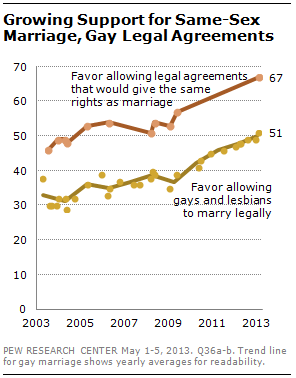
The national survey by the Pew Research Center, conducted May 1-5 among 1,504 adults, finds that support for same-sex marriage continues to grow: For the first time in Pew Research Center polling, just over half (51%) of Americans favor allowing gays and lesbians to marry legally. Yet the issue remains divisive, with 42% saying they oppose legalizing gay marriage. Opposition to gay marriage – and to societal acceptance of homosexuality more generally – is rooted in religious attitudes, such as the belief that engaging in homosexual behavior is a sin.
6-6-13 #2

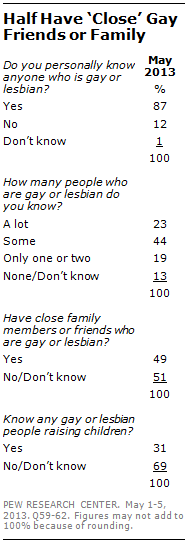
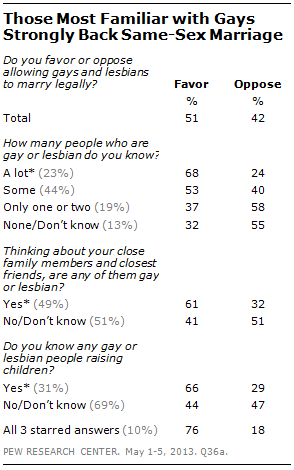
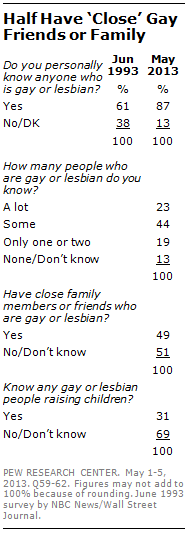
At the same time, more people today have gay or lesbian acquaintances, which is associated with acceptance of homosexuality and support for gay marriage. Nearly nine-in-ten Americans (87%) personally know someone who is gay or lesbian (up from 61% in 1993). About half (49%) say a close family member or one of their closest friends is gay or lesbian. About a quarter (23%) say they know a lot of people who are gay or lesbian, and 31% know a gay or lesbian person who is raising children. The link between these experiences and attitudes about homosexuality is strong. For example, roughly two-thirds (68%) of those who know a lot of people who are gay or lesbian favor gay marriage, compared with just 32% of those who don’t know anyone.

Part of this is a matter of who is more likely to have many gay acquaintances: the young, city dwellers, women, and the less religious, for example. But even taking these factors into account, the relationship between personal experiences and acceptance of homosexuality is a strong one.

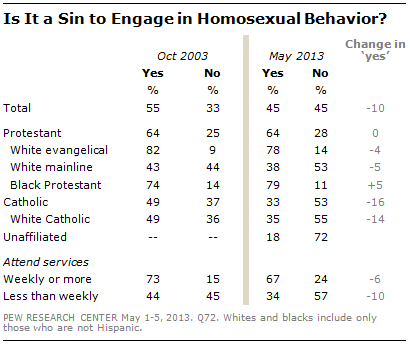
Yet opposition to gay marriage remains substantial, and religious beliefs are a major factor in opposition. Just under half of Americans (45%) say they think engaging in homosexual behavior is a sin, while an equal number says it is not. Those who believe homosexual behavior is a sin overwhelmingly oppose gay marriage. Similarly, those who say they personally feel there is a lot of conflict between their religious beliefs and homosexuality (35% of the public) are staunchly opposed to same-sex marriage.

6-6-13 #3

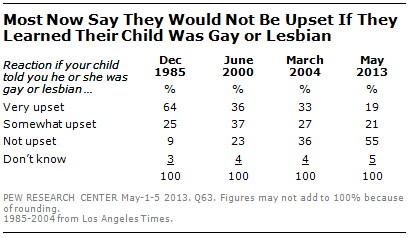
The survey finds that as support for same-sex marriage has risen, other attitudes about homosexuality have changed as well. In a 2004 Los Angeles Times poll, most Americans (60%) said they would be upset if they had a child who told them that they were gay or lesbian; 33% said they would be very upset over this. Today, 40% say they would be upset if they learned they had a gay or lesbian child, and just 19% would be very upset.

Favorable opinions of both gay men and lesbians have risen since 2003. Moreover, by nearly two-to-one (60% to 31%), more Americans say that homosexuality should be accepted rather than discouraged by society. A decade ago, opinions about societal acceptance of homosexuality were evenly divided (47% accepted, 45% discouraged).

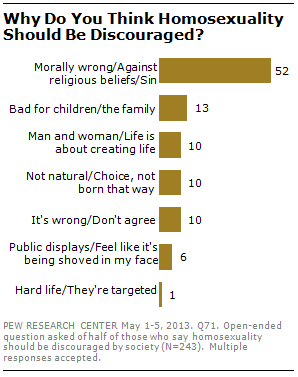
The religious basis for opposition to homosexuality is seen clearly in the reasons people give for saying it should be discouraged by society. By far the most frequently cited factors –mentioned by roughly half (52%) of those who say homosexuality should be discouraged – are moral objections to homosexuality, that it conflicts with religious beliefs, or that it goes against the Bible. No more than about one-in-ten cite any other reasons as to why homosexuality should be discouraged by society.

Widespread Belief that Legal Recognition Is ‘Inevitable’

6-6-13 #4

Despite the increasing support for legal same-sex marriage in recent years, opinions about the issue remain deeply divided by age, partisanship and religious affiliation.

By contrast, large majorities across most demographic groups think that legal recognition of same-sex marriage is inevitable.

Republicans (73%) are as likely as Democrats (72%) or independents (74%) to view legal recognition for gay marriage as inevitable. Just 31% of Republicans favor allowing gays and lesbians to marry legally, compared with majorities of Democrats (59%) and independents (58%).

Similarly, people 65 and older are 30 points more likely to view legal recognition of same-sex marriage as inevitable than to favor it (69% vs. 39%). Among those younger than 30, about as many see legal same-sex marriage as inevitable as support gay marriage (69%, 65%).

Just 22% of white evangelical Protestants favor same-sex marriage, but about three times that percentage (70%) thinks legal recognition for gay marriage is inevitable. Among other religious groups, there are smaller differences in underlying opinions about gay marriage and views of whether it is inevitable.

Section 1: Same-Sex Marriage, Civil Unions and Inevitability

A PEW RESEARCH SERIES

More on Same-Sex Marriage Growing Support for Gay Marriage: Changed Minds and Changing Demographics

Behind Gay Marriage Momentum: Regional Gaps Persist

Support for same-sex marriage has edged above 50% for the first time in a Pew Research Center survey. Currently, 51% favor gays and lesbians marrying legally, while 42% are opposed. In March, 49% favored same-sex marriage and 44% were opposed.

The long-term trend toward support for gay marriage exists across most segments of the American population, though significant divides persist. People younger than 30 support gay marriage by about two-to-one, while those age 50 and older are divided. There is far more support for gay marriage among college graduates than among those who never attended college. And there continues to be a substantial difference of opinion regionally, with more support in the Northeast than in other regions.

6-6-13 #6

As support for same-sex marriage has increased, so too has the percentage favoring legal agreements for gays and lesbians that would give them many of the same rights as married couples. Currently, 67% favor gays and lesbians being allowed to enter legal agreements that would give them many of the rights of married couples, while just 28% are opposed. Support for legal agreements crossed the 50% threshold in 2005, but a decade ago, opinion was evenly divided (46% favor, 47% oppose).

6-6-13 #7

Like the rise in support for same-sex marriage, growing support for providing the same legal rights to gay and lesbian couples has occurred among most demographic and partisan groups. But some of the most dramatic increases have occurred among groups in which there continues to be broad opposition to gay marriage, including Republicans, older Americans and white evangelical Protestants.

Currently, 63% of Republicans favor legal agreements for gays and lesbians that would give them many of the rights of married couples, up from just 34% a decade ago. In the current survey, Republicans are nearly as likely as Democrats (68%) to favor legal agreements for gays and lesbians that give them similar rights to married couples. In 2003, there was a 21-point gap in these opinions.

Over the past decade, support for legal agreements for gays and lesbians has about doubled among people 65 and older (from 26% to 57%) and white evangelical Protestants (from 23% to 49%).

And while support for legal agreements continues to be virtually unanimous among all who support same-sex marriage, it has increased by 16 points – from 20% to 36% among those who oppose same-sex marriage.

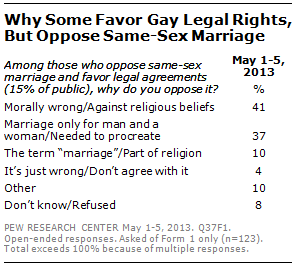
Overall, 15% of Americans say they support legal agreements that would give gay and lesbian couples the same rights as married couples, but oppose same-sex marriage. When

6-6-13 #8

asked to explain in their own words why they oppose gay marriage, 41% cite moral concerns and religious beliefs as the reason. As one 34-year-old woman put it: “For me, I think it’s a religious and moral issue. They shouldn’t be discriminated against but it’s important to preserve what marriage is morally.”

In addition, 37% holding these views say that marriage is only for a man and a woman, or that the main purpose of marriage is procreation. “I am old-fashioned. I believe marriage is between a man and a woman,” said a 79-year-old woman. Another 10% emphasize the term “marriage” itself, such as this 64-year-old man: “Marriage is a religious institution that belongs to religion, not the government.”

Is Gay Marriage ‘Inevitable’?

6-6-13 #9

Along with rising support for gay marriage is the increasing sense that the legal recognition of gay marriage is inevitable: 72% of Americans now say this, up from 59% in a 2004 Los Angeles Times survey.

The rising sense of inevitability is most notable among some of the groups that tend to be the least supportive of gay marriage itself. The share of Republicans who see gay marriage as inevitable rose from 47% to 73% over the past nine years. While there was a steep partisan divide in 2004, now there is none: Republicans are just as likely as Democrats (72%) and independents (74%) to see legal recognition of same-sex marriage as inevitable.

Similarly, in 2004 71% of 18-29 year-olds felt that gay marriage was inevitable, compared with 45% of those age 65 and older. Today there is no such divide: 69% of both the youngest and oldest hold this view.

The same pattern holds along religious lines: the share of white evangelical Protestants who see gay marriage as inevitable rose from 49% to 70%, and there is less of a difference across religious lines today than in 2004.

One divide that exists on this opinion is by education. Eight-in-ten adults with at least some college believe same-sex marriage is inevitable, compared to about six-in-ten (62%) of those with no college experience. This gap did not exist in 2004, when about six-in-ten people of all educational levels believed this.

Section 2: Views of Gay Men and Lesbians, Roots of Homosexuality, Personal Contact with Gays

Most Americans say they are not personally bothered being around gays and lesbians. Currently, 82% say “it doesn’t bother them to be around homosexuals,” while 14% say it does. This is only modestly changed from a decade ago, when there was far less acceptance of homosexuality generally. In October 2003, 76% said it did not bother them to be around homosexuals.

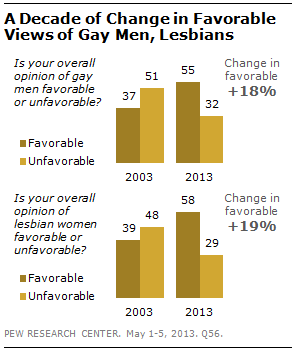
The new survey finds larger changes over the past decade in favorable opinions of gay men and lesbians. Ten years ago, the balance of opinion toward both gay men and lesbians was

6-6-13 #10

unfavorable: 37% viewed gay men favorably, while 51% viewed them unfavorably; 39% had a favorable impression of lesbian women while 48% had an unfavorable opinion.

Today, by a 55% to 32% margin, more have a favorable than unfavorable opinion of gay men. And about twice as many view lesbian women favorably (58%) than unfavorably (29%).

As with many attitudes about homosexuality, opinions about gay men and lesbians have become more positive across nearly all demographic and partisan categories over the past decade. Yet there continue to be wide differences among these groups in opinions about both gay men and lesbians.

6-6-13 #11

More than eight-in-ten liberal Democrats view gay men (85%) and lesbian women (84%) favorably. Opinions are nearly as favorable among white women college graduates (81% favorable view of gay men, 80% favorable view of lesbians).

By contrast, just 36% of white evangelical Protestants have a favorable opinion of gay men, while 50% have an unfavorable view. White evangelicals express mixed views of lesbian women (39% favorable, 46% unfavorable).

Among African Americans, about as many have favorable views as unfavorable opinions of both gay men (42% favorable, 50% unfavorable) and lesbians (50% favorable, 45% unfavorable).

And while white women college graduates stand out for their positive views of both groups, white men who have not completed college have mixed impressions of gay men (41% favorable, 43% unfavorable) and lesbian women (47% favorable, 37% unfavorable).

Reactions to Learning Your Child Is Gay or Lesbian

6-6-13 #12

In 1985, a Los Angeles Times survey found that 64% of the public said they would be “very upset” if their child told them he or she was gay or lesbian. By 2004, that number had fallen by almost half (33%). Since then, it has declined another 14 points, to 19%.

6-6-13 #13

Instead, a majority (55%) now says they would not be upset if they learned their child was gay or lesbian, a 19-point increase since 2004 and a 46-point increase since the mid-1980s.

Again, this has been an across-the-board shift in attitudes. Yet the change has been more dramatic among some groups than others. In 2004, fully 82% of those 65 and older said they would be upset if their child told them they were gay, and 50% said they’d be very upset. Today, only about half (47%) say they’d be upset and just 24% say they’d be very upset.

Among Republicans, the percentage saying they’d be very upset if they learned their child was gay or lesbian also has fallen by half – from 44% to 22% – since 2004.

Views of Gays, Lesbians Raising Children

6-6-13 #14

In recent years, there has been a decline in the percentage of Americans who think that more gays and lesbians raising children is a bad thing for American society. Currently, 35% view this as a negative trend for society. While that is unchanged from 2011, it represents a 15-point decline since 2007 (from 50%), according to a separate survey, conducted March 21-April 8 among 4,006 adults.

Over this period, the percentage saying more gays and lesbians raising children is a good thing has nearly doubled, from 11% to 21%. About four-in-ten (41%) say more gays and lesbians raising children does not make much difference.

The public also takes a more positive view of another social trend – more people of different races marrying each other. Currently, 37% say this is a good thing for American society, up from 25% in 2011 and 24% in 2010. About half (51%) say more interracial marriage does not make much difference, compared with 64% in 2011 and 61% in 2010. About one-in-ten (10%) continue to view this as a negative trend for American society.

Divided Opinions over Why People Are Gay, Lesbian

6-6-13 #15

The public has divided views about why people are gay or lesbian: 42% say being gay or lesbian is “just the way some people choose to live,” while nearly as many say “people are born gay or lesbian.” Just 8% say being gay or lesbian “is a result of a person’s upbringing.”

A decade ago, in a slightly different version of the question, 30% said that “homosexuality is something that people are born with.”

Opinions about why people are gay or lesbian vary widely by race, educational attainment, partisanship and religious affiliation. Fully 66% of African Americans think that being gay or lesbian is just the way some people choose to live, while just 20% say people are born gay or lesbian. Among whites and Hispanics, opinion is more closely divided: 44% of whites say people are born lesbian or gay while 39% say it is a choice; Hispanics’ views are similar (48% born, 36% choice).

6-6-13 #16

Overall, most (58%) who say that homosexuality should be accepted think that people are born gay or lesbian. A majority (63%) of those who say homosexuality should be discouraged think it is just a way some people choose to live.

However, while people under 30 are more likely than those 50 and older to favor societal acceptance of homosexuality, young people are actually more likely than older people to say being gay or lesbian is just the way some people choose to live.

6-6-13 #17

Personal Contacts with Gays and Lesbians

An overwhelming percentage of Americans (87%) say they know someone who is gay or lesbian. Twenty years ago, far fewer (61%) say they had a gay or lesbian acquaintance, according to an NBC News/Wall Street Journal survey.

Nearly a quarter (23%) say they personally know “a lot” of gay or lesbian people, while 44% say they know some, and 19% have only one or two gay or lesbian acquaintances. Overall, nearly a third of Americans (31%) say they know no one who is gay or lesbian (12%) or have only one or two gay acquaintances (19%).

About half of Americans (49%) say that a close family member or one of their closest friends is gay or lesbian. And nearly a third (31%) say they know gays or lesbians who are raising children.

While large majorities across virtually all demographic and partisan groups say they know at least someone who is gay or lesbian, there are differences in the number of gay acquaintances that people have.

Adults ages 65 and older are half as likely as those under 30 to know a lot of gays and lesbians (15% vs. 30%). Roughly one-in-five of those 65 and older (21%) say they do not know any at

6-6-13 #18

all.

Familiarity with gays and lesbians also differs by religious affiliation. Three-in-ten (30%) of those unaffiliated with a religion say they know a lot of gays and lesbians and just 8% say they know none. Among Catholics, 22% know a lot of gays and lesbians, while 14% of white evangelical Protestants say this.

Democrats (24%) and independents (27%) are about equally likely to know a lot of gays and lesbians, compared to 13% of Republicans. There is also a divide based on community type: People who live in urban areas (29%) are much more likely to know a lot of gays and lesbians than suburbanites (20%) or people in rural areas (17%).

Gay Friends and Support for Same-Sex Marriage

6-6-13 #19

Fully 68% of those who know a lot of gays and lesbians – and 61% who have close friends or family members who are gay – say they support same-sex marriage.

There is far less support for gay marriage among those with few or no gay contacts and those who do not have close gay friends or family members. Just 37% of those who know only one or two gay people favor gay marriage, as do 32% of those with no gay acquaintances.

People who have more gay contacts and close gay friends are more likely to be women, young, and religiously unaffiliated, groups that tend to be more supportive of same-sex marriage. But even holding demographic factors constant, those who have many gay acquaintances, or close gay friends and family members, are more likely to favor same-sex marriage than those who do not.

Most Visible Gay, Lesbian Public Figure: Ellen DeGeneres

6-6-13 #20

Comedian and talk show host Ellen DeGeneres is by far the most visible gay or lesbian public figure. When asked which public or entertainment figures who are gay or lesbian first come to mind, 32% cite DeGeneres. Jason Collins, the professional basketball player who revealed he was gay shortly before the survey was conducted, was named by 7%, while 6% named Elton John.

Overall, 38% of the public could not name any gay or lesbian public figure. This includes 61% of those age 65 and older and 57% those with no more than a high school education.

Section 3: Religious Belief and Views of Homosexuality

Religious belief continues to be an important factor in opposition to societal acceptance of homosexuality and same-sex marriage.

Overall, the share of Americans who say that homosexuality should be accepted by society has increased from 47% to 60% over the past decade, while the percentage saying it should be discouraged has fallen from 45% to 31%.

Yet among those who attend religious services weekly or more, there continues to be slightly more opposition than support for societal acceptance of homosexuality. And when the nearly one-third of Americans who say homosexuality should be discouraged are asked in

6-6-13 #22

an open-ended question why they feel this way, by far the most common reason –given by 52% – is that homosexuality conflicts with their religious or moral beliefs.

A 62-year-old man said: “My religious background taught me that this was something that was taboo and not accepted.” A 32-year-old woman described her reasons for why homosexuality should be discouraged this way: “It clearly states in the Bible that it goes against God’s teachings.”

Much smaller percentages cite other reasons, such as concerns that homosexuality is bad for the family or bad for children (mentioned by 13%), that a man and woman are needed to create life, that it’s not natural, or “just wrong” (10% each).

Across most demographic subgroups, including most religious groups, the percentage saying homosexuality should be accepted has increased over the past decade. Nonetheless, about half (48%) of those who attend religious services weekly or more

6-6-13 #23

often say homosexuality should be discouraged. Among less frequent attenders, 71% favor societal acceptance of homosexuality.

White evangelical Protestants, by about two-to-one (59% to 30%), think that homosexuality should be discouraged. Among black Protestants, as well, more say homosexuality should be discouraged (51%) than accepted (39%).

By contrast, wide majorities of Catholics (71%) and white mainline Protestants (65%) say homosexuality should be accepted by society. And those without religious affiliation favor societal acceptance of homosexuality by roughly five-to-one (79% to 16%).

Conflict Between Religious Beliefs and Homosexuality

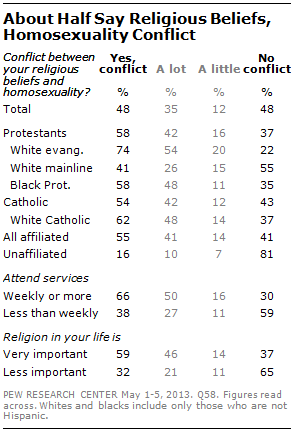
About half of Americans (48%) say there is a conflict between their religious beliefs and homosexuality, with 35% saying there is a lot of conflict. Another 48% see no conflict between

6-6-13 #24

their religious beliefs and homosexuality.

Among those who attend religious services weekly or more, 66% say homosexuality conflicts with their religious beliefs, with 50% saying there is a great deal of conflict. Most people (59%) who attend religious services less than once a week see no conflict between their beliefs and homosexuality.

Fully 74% of white evangelical Protestants say there is a conflict between homosexuality and their religious beliefs, as do majorities of white Catholics (62%) and black Protestants (58%).

Among white mainline Protestants, however, 41% say there is a conflict between their religious beliefs and homosexuality, while 55% see

Replacement box 25 Accept Discourage

no conflict.

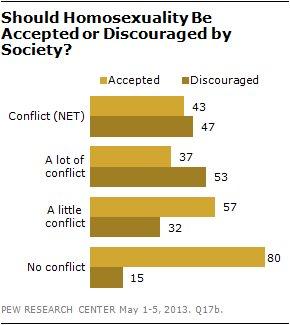
The tension between religious beliefs and homosexuality is closely associated with views about societal acceptance of homosexuality. Among those who see a lot of conflict between their own religious beliefs and homosexuality, a majority (53%) opposes societal acceptance. Those who see a little conflict between religion and homosexuality favor societal acceptance by 57% to 32%. And 80% of those who say there is no conflict between their religious beliefs and homosexuality support societal acceptance.

Fewer See Homosexual Behavior as a Sin

The public is divided over whether engaging in homosexual behavior is a sin: 45% say it

6-6-13 #26

is a sin while an identical percentage says it is not. In 2003, a majority (55%) viewed homosexual behavior as was sinful, while 33% disagreed.

Among several religious groups, there has been relatively little change in these opinions over the past decade. Fully 78% of white evangelical Protestants view homosexual behavior as a sin; 82% said this in 2003. About as many black Protestants view homosexuality as a sin today (79%) as did so ten years ago (74%).

However, opinions among Catholics have changed substantially. In 2003, more Catholics said homosexual behavior was a sin than said it was not (49% vs. 37%). Today, a third of Catholics (33%) say it is sin, while 53% disagree.

People who attend religious services weekly or more continue to view homosexual behavior as a sin by a wide margin (67% to 24%). Nearly six-in-ten (57%) of those who attend less often think such behavior is not a sin, while 34% say it is; 10 years ago, opinion was divided (44% sin, 45% not a sin).

6-6-13 #27

Opinions about whether homosexuality is sinful – as well as views about the conflict between religious beliefs and homosexuality – are highly associated with attitudes toward gay marriage.

Nearly three-quarters (74%) of those who say engaging in homosexual behavior is a sin oppose same-sex marriage. An even larger percentage (84%) of those who say it is not sinful favor gay marriage.

The gap in opinions about gay marriage is nearly as wide between those who say there is a lot of conflict between homosexuality and their religious beliefs (67% oppose gay marriage) and those who see no conflict (71% favor gay marriage).

Similarly, those who say religion is very important in their lives are only half as likely to support gay marriage as those who place less importance on religion (36% favor vs. 72% favor).

About the Survey

The analysis in this report is based on telephone interviews conducted May 1-5, 2013 among a national sample of 1,504 adults, 18 years of age or older, living in all 50 U.S. states and the District of Columbia (751 respondents were interviewed on a landline telephone, and 753 were interviewed on a cell phone, including 401 who had no landline telephone). The survey was conducted by interviewers at Princeton Data Source under the direction of Princeton Survey Research Associates International. A combination of landline and cell phone random digit dial samples were used; both samples were provided by Survey Sampling International. Interviews were conducted in English and Spanish. Respondents in the landline sample were selected by randomly asking for the youngest adult male or female who is now at home. Interviews in the cell sample were conducted with the person who answered the phone, if that person was an adult 18 years of age or older. For detailed information about our survey methodology, see https://alpha.pewresearch.org/pewresearch-org/politics/methodology/

The combined landline and cell phone sample are weighted using an iterative technique that matches gender, age, education, race, Hispanic origin and nativity and region to parameters from the 2011 Census Bureau’s American Community Survey and population density to parameters from the Decennial Census. The sample also is weighted to match current patterns of telephone status and relative usage of landline and cell phones (for those with both), based on extrapolations from the 2012 National Health Interview Survey. The weighting procedure also accounts for the fact that respondents with both landline and cell phones have a greater probability of being included in the combined sample and adjusts for household size among respondents with a landline phone. Sampling errors and statistical tests of significance take into account the effect of weighting. The following table shows the unweighted sample sizes and the error attributable to sampling that would be expected at the 95% level of confidence for different groups in the survey:

6-6-13 #28

Sample sizes and sampling errors for other subgroups are available upon request.

In addition to sampling error, one should bear in mind that question wording and practical difficulties in conducting surveys can introduce error or bias into the findings of opinion polls.