Pew Research Center

FOR RELEASE MARCH 12, 2013

Why Own a Gun? Protection Is Now Top Reason

Perspectives of Gun Owners, Non-Owners

FOR MEDIA OR OTHER INQUIRIES:

Communications Department
202.419.4372
www.pewresearch.org

RECOMMENDED CITATION

Pew Research Center, March 2013, "Why Own a Gun? Protection Is Now Top Reason"

About Pew Research Center

Pew Research Center is a nonpartisan, nonadvocacy fact tank that informs the public about the issues, attitudes and trends shaping the world. It does not take policy positions. The Center conducts public opinion polling, demographic research, computational social science research and other data-driven research. It studies politics and policy; news habits and media; the internet and technology; religion; race and ethnicity; international affairs; social, demographic and economic trends; science; research methodology and data science; and immigration and migration. Pew Research Center is a subsidiary of The Pew Charitable Trusts, its primary funder.

© Pew Research Center 2026

Table of contents

  • About Pew Research Center
  • Why Own a Gun? Protection Is Now Top Reason
  • Section 1: Views of Stricter Gun Laws
  • Section 2: Opinions of Gun Owners, Non-Gun Owners
  • Section 3: Gun Ownership Trends and Demographics
  • About the Survey

Why Own a Gun? Protection Is Now Top Reason

Perspectives of Gun Owners, Non-Owners

Overview

The vast majority of gun owners say that having a gun makes them feel safer. And far more today than in 1999 cite protection – rather than hunting or other activities – as the mai
3-12-13 #1

reason they own guns.

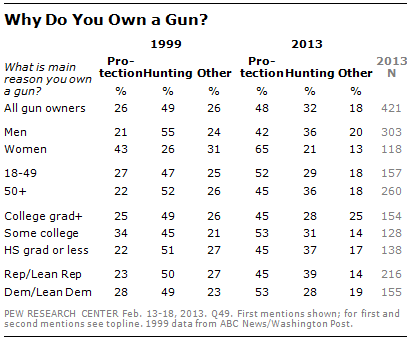
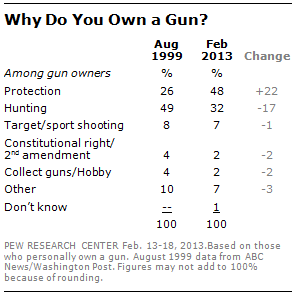
A national survey finds that nearly half of gun owners (48%) volunteer that the main reason they own a gun is for protection; just 32% say they have a gun primarily for hunting and even fewer cite other reasons, such as target shooting. In 1999, 49% said they owned a gun mostly for hunting, while just 26% cited protection as the biggest factor.

The survey by the Pew Research Center, conducted Feb. 13-18 among 1,504 adults, finds that safety also is a major concern among the majority of Americans who do not have guns. Nearly six-in-ten (58%) of those in households without guns say they would be uncomfortable having a gun in their homes. When asked why they would be uncomfortable, more cite concerns over gun accidents and safety than any other factor.

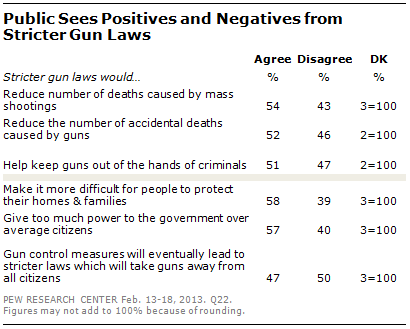
When it comes to enacting stricter gun control laws, Americans see both pros and cons. Most (58%) worry that new laws would make it more difficult for people to protect their homes and families. Roughly the same number (54%) say stricter laws would reduce the number of deaths caused by mass shootings.

Gun owners and non-gun owners have fundamental disagreements over the effectiveness of new gun laws. Two-thirds (66%) of those who live in households that do not have guns say stricter gun laws would reduce the number of deaths in mass shootings, compared with just 35% of gun owners.

Yet the partisan divide over many of these issues is at least as great as the differences between gun owners and non-gun owners. Fully 79% of Democrats say tougher gun laws would cut down on the number of deaths from mass shootings; just 29% of Republicans agree.

Public Opposes Letting States Ignore Federal Gun Laws
3-12-13 #2

As previously reported, most Americans support new gun control legislation such as broader background checks or bans on assault-style weapons and high-capacity ammunition clips. Yet as such legislation is being debated in Washington, D.C., some state legislatures are considering laws that would attempt to nullify any new federal controls.

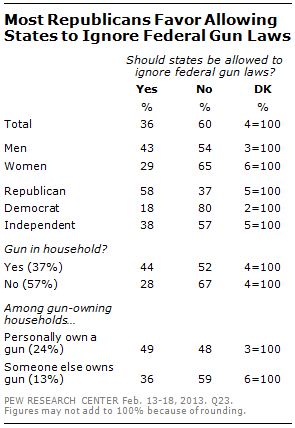
The survey finds that 60% of the public says that states should not be allowed to ignore federal gun laws, while 36% say that states should be able to ignore federal gun laws, if they choose to do so.

Gun owners are divided over whether states should be allowed to ignore federal gun laws: 49% say they should, while 48% disagree. Among those in gun-owning households who do not themselves own guns, 59% oppose states ignoring federal gun laws; among those in households without guns, 67% are opposed.

Republicans, by a 58% to 37% margin, say that states should be allowed to ignore federal gun laws if they so choose. About four-in-ten (38%) independents and just 18% of Democrats favor giving states the option to ignore federal gun laws.

Republicans are far more likely than Democrats to own guns. Nearly a third of Republicans (31%) say they personally own a gun, rifle or pistol; that compares with just 16% of Democrats. But even among Republicans who do not own guns, there is far less support for gun control generally – and more support for states being permitted to ignore federal gun laws – than among independents or Democrats.

Far fewer Republicans say that stricter gun laws would reduce the number of accidental deaths caused by guns than did so 20 years ago. Just 32% of Republicans say that stricter gun laws would reduce the number of accidental gun deaths; in 1993, 61% said tougher laws would cut down on gun-related deaths from accidents and suicides. Among Democrats, there has been virtually no change in opinions about this over the past 20 years; 74% say stricter gun laws would reduce the number of accidental deaths caused by guns, little changed from 76% in 1993.

This is consistent with a widening partisan divide in overall attitudes about whether it is more important to control gun ownership or protect the rights of Americans to own guns. Twenty years ago, there was a partisan gap of 20 points in the percentages of Republicans (45%) and Democrats (25%) prioritizing gun rights. Today, the gap has grown to 52 points; 74% of Republicans say it is more important to protect gun rights than to control gun ownership, compared with 22% of Democrats.

How Gun Owners and Non-Gun Owners Feel about Guns

About a quarter of Americans (24%) say they personally own a gun, rifle or pistol; another 13% say another person in their household has a gun. Most Americans (57%) say they do not have a gun in their household. Gun ownership rates differ by gender, region, age, race, ethnicity and other demographics (See Section 3 of this report).

3-12-13 #3

Gun owners increasingly cite protection as the main reason they own a gun. And a large percentage (79%) say having a gun makes them feel safer. At the same time, nearly as many (78%) say that owning a gun is something they enjoy.

Those in gun-owning households who do not personally own guns derive far less enjoyment from having a gun; just 43% say this is something that they enjoy. But more than six-in-ten (64%) say that having a gun in their home makes them feel safer.

Relatively few people in gun-owning households – either gun owners or non-gun-owners– say having a gun in the home makes them feel uncomfortable. Just 7% of gun owners and 9% of non-gun owners living in gun households say having a gun in the home makes them feel uncomfortable.

Among the majority of Americans who live in households without guns, most (58%) say that they would be uncomfortable having a gun in

3-12-13 #3

their homes; 40% say they would be comfortable having a gun.

There are sizable partisan and gender differences in these opinions: 58% of Republicans in households without guns say they would be comfortable having a gun in their home, compared with 30% of Democrats. Nearly half (49%) of men in households without guns say they would be comfortable with a gun in their home; just a third (33%) of women in non-gun households say this.

While protection is a major reason that gun owners give for having a weapon, safety also is a top concern among those in non-gun households who express discomfort with having a gun in their home. Among those in non-gun households who would be uncomfortable having a gun, 39% say the reason they would be uncomfortable is the risk of an accident, including 29% who specifically mention concerns about children. Another 22% have more general concerns about the dangers posed by guns or gun safety.
Section 1: Views of Stricter Gun Laws

Overall, the public sees both positive and negative consequences from stricter gun laws.

3-12-13 #5

By 54% to 43%, more agree that stricter gun laws would reduce the number of deaths caused by mass shootings. However, by comparable margins, the public also says that stricter gun laws would make it more difficult for people to protect their homes and families (by 58% to 39%) and give too much power to the government (57% to 40%).

On several of these issues, the public’s views have changed since the early 1990s. For example, the percentage saying stricter gun laws would cut down on the number of accidental deaths caused by guns is 15 points lower today than in a December 1993 Gallup survey (52% now, 67% then).

3-12-13 #6

And reflecting the focus on protection in other questions, 58% now say stricter gun laws would make it more difficult for people to protect their homes and families; in 1993, 48% expressed this view. There has been less change over the past two decades in opinions about whether stricter gun laws would give too much power to the government (57% now, 52% in 1993) and whether gun control will lead to laws that will take away guns from all citizens (47% now, 50% then).

There are wide partisan differences over possible consequences of stricter gun laws, and in most cases the gaps are much wider than they were 20 years ago. No more than about a third of Republicans agree that stricter laws would reduce the number of deaths from mass shootings (29%) or accidental gun deaths (32%), or would keep guns out of the hands of criminals (31%). More than seven-in-ten Democrats agree with each of these assertions.

Republicans’ views about whether stricter gun laws would reduce the number of accidental gun deaths have changed markedly over the past two decades. In the 1993 Gallup survey, 61% of Republicans agreed that stricter gun laws would reduce the number of gun deaths caused by accidents and suicides; in the current survey, which asks only about accidental gun deaths, just 32% of Republicans agree. Among independents, fewer also now agree that stricter gun laws would cut down on the number of accidental gun deaths than did so in 1993 (47% now, 64% then). Democrats’ views are little changed (74% now, 76% then).

A larger percentage of Republicans also agrees that stricter gun laws will make it more difficult for people to protect their homes and families than did so in 1993 (77% now, 55% then). And 76% of Republicans agree that stricter gun laws would give the government too much power over average citizens; in 1993, 61% expressed this view.

Republicans’ views about whether stricter gun laws would lead to seizure of all guns have shown less change since 1993: 63% agree with that assertion today, while 54% agreed 20 years ago. Half of independents (50%) and just 34% of Democrats say that stricter gun laws would eventually result in laws taking guns away from all citizens, which are about the same as opinions 20 years ago.

Men and Women Differ Little over Effects of Gun Laws

3-12-13 #7

The gender differences in opinions about the impact of stricter gun laws are modest, and in some cases much narrower than they were two decades ago.

Nearly six-in-ten women (58%) and 50% of men say stricter gun laws would reduce the number of deaths from mass shootings. The differences are comparable over whether stricter gun laws would reduce accidental gun deaths (56% of women, 47% of men).

In 1993, 76% of women said stricter laws would reduce the number of accidental gun deaths and suicides caused by guns. Men’s opinions have shown less change since then (56% in 1993, 47% today).

More women say that stricter gun laws would give the government too much power over average citizens than did so 20 years ago: Currently, 55% of women say stricter gun laws would give the government too much power; 45% expressed this view in 1993. Men’s opinions are unchanged (59 % agree).

Majorities of both men (61%) and women (56%) say stricter gun laws would make it more difficult for people to protect their homes and families. In 1993, 50% of men and 47% of women said tougher gun laws would make protection more difficult. Nearly half of men (49%) and 45% of women say stricter gun laws will eventually lead to all guns being taken away, which is little changed from the 1993 survey.

Section 2: Opinions of Gun Owners, Non-Gun Owners

People in non-gun-owning households have more positive views about the possible impact of stricter gun laws than those who live in a household with a gun.

Majorities of those in non-gun households say that stricter gun laws would reduce deaths from mass shootings (66%) and accidents (65%), and would keep guns away from criminals (63%).

However, many people who do not have guns at home are also sympathetic to the potential downsides of gun control legislation. Nearly half (49%) of those in households without guns say that stricter gun laws would give the government too much power over average citizens. A majority (55%) say that stricter gun laws would make it more difficult for people to protect their homes and families.

Few gun owners believe that gun control efforts would be effective. They largely reject the assertions that stricter gun laws would reduce deaths from mass shootings and accidents or would prevent criminals from obtaining guns.

And a large percentage of gun owners (68%) say that stricter laws would give the government too much power over average citizens, while nearly as many (64%) say they would make it more difficult for people to protect their homes and families. However, gun owners are somewhat more skeptical that stricter laws would ultimately lead to guns being taken away from all citizens (51% agree).

Those who do not own guns, but live in a household with someone who does, mostly agree that stricter gun laws will make protection more difficult (58% agree) and give the government too much power over citizens (59% agree). Yet about half say that stricter laws would reduce deaths from accidents (50%) and mass shootings (48%).

Views of Gun Policies

3-12-13 #9

An earlier report on this survey, released in collaboration with USA TODAY, detailed public attitudes about gun control and specific gun policies. (For more, see “If No Deal Is Struck, Four-in-Ten say Let the Sequester Happen,” Feb. 21, 2013.)

Gun owners overwhelmingly say it is more important to protect gun rights than control gun ownership (70% vs. 27%). People who do not own guns, but live in a household with a gun owner, are more evenly divided: 53% say it is more important to protect gun rights while 42% say it is more important to control gun ownership. By more than two-to-one (66% to 30%), those in households with no guns prioritize controlling gun ownership over protecting gun rights.

Among specific gun policy proposals, there is broad support in each of these groups for making private gun sales and sales at gun shows subject to background checks. Nearly eight-in-ten (79%) gun owners favor background checks on private gun sales, as do 86% of others in gun households and 85% of people in non-gun-owning households.

Other policy proposals are more divisive. Most gun owners (55%) oppose a ban on assault-style weapons while 43% favor such a ban. Similarly, 57% of gun owners oppose a ban on high-capacity ammunition clips that hold more than 10 bullets; 41% favor this proposal.

Majorities of those in gun households who do not personally own guns favor both of these proposals (55% favor a ban on assault-style weapons, 58% favor a ban on high-capacity ammunition clips). Among those in households that have no guns, 65% favor a ban on assault-style weapons while 59% favor a ban on high-capacity ammunition clips.

NRA Households: Staunch Opponents of Gun Control

3-12-13 #10

About one-in-ten Americans (9%) say that they or someone in their household is a member of the NRA. Among households that own guns, 21% say they personally (11%) or someone else (10%) belong to the NRA.

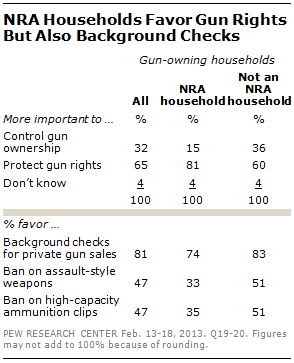
Those in NRA households are even less supportive of gun control than are people in other gun-owning households. Just 15% of those in NRA households say it is more important to control ownership while 81% prioritize protecting gun rights. Among gun-owning households in which there are no NRA members, 36% say it is more important to control gun ownership, compared with 60% who say protecting gun rights is more important.

Only about a third of those in NRA households favor bans on assault-style weapons (33%) and high-capacity ammunition clips (35%). Roughly half of those in other gun-owning households favor these proposals (51% each).

Yet people in NRA households overwhelmingly favor making private gun sales and sales at gun shows subject to background checks: 74% favor this proposal while just 26% are opposed.

Why Own a Gun? The Reasons Have Changed

3-12-13 #11

Those who say they personally own a gun, rifle or pistol are overwhelmingly white (82% white non-Hispanic) and male (74% are men while 26% are women).

Among gun owners, the reasons for owning a gun have changed. Currently, 48% say the main reason they own a gun is for protection while 32% cite hunting and 18% give another reason. In a 1999 ABC News/Washington Post survey, 49% of gun owners cited hunting as the main reason for owning a gun while just 26% said they primarily owned a gun for protection.

The share of gun owners citing protection as the main reason they own guns has increased among all sub-groups of gun owners – men and women, older and younger gun owners and those with different levels of education. As was the case in 1999, women are more likely than men to say they own a gun for protection. In the current survey, 65% of women gun owners cite protection as the main reason they own a gun, compared with 42% of men gun owners.

An overwhelming percentage of women gun owners (80%) say that having a gun makes them feel safer; about the same percentage of men gun owners (79%) express this view. However, women are less likely than men to say than owning a gun is something they enjoy (63% of women vs.83% of men).

Most in Non-Gun Households Would be Uncomfortable Having a Gun

3-12-13 #12

Most people who do not have a gun in their household say that having a gun is something that would make them feel uncomfortable. Nearly six-in-ten (58%) in non-gun households say they would be uncomfortable having a gun while 40% would be comfortable.

Some of the same partisan and demographic differences in gun ownership are mirrored in the views of people in non-gun-owning households about having a gun. Just a third of women (33%) without a gun in the home say they would be comfortable having a gun; that compares with nearly half of men (49%) in non-gun-owning households.

Nearly twice as many Republicans as Democrats in non-gun-owning households say they would be comfortable if there were a gun in their home (58% vs. 30%).

People under 30 are somewhat less likely than older Americans to own a gun: 16% say they personally own a gun, rifle or pistol compared with 30% of those 50 and older.

But among those in non-gun-owning households, 55% of those younger than 30 say they would be comfortable having a gun their home. Far fewer people in older age groups express comfort with having a gun in the home.

Section 3: Gun Ownership Trends and Demographics

There is no definitive data source from the government or elsewhere on how many Americans own guns or how gun ownership rates have changed over time. Also, public opinion surveys provide conflicting results: Some show a decline in the number of households with guns, but another does not.

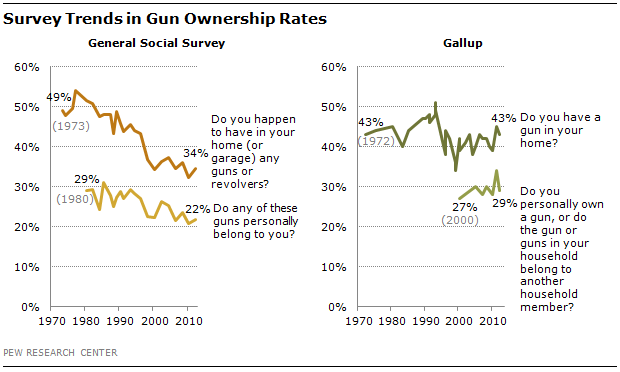
The General Social Survey (GSS), conducted roughly every two years by the independent research organization NORC at the University of Chicago, with principal funding from the National Science Foundation, provides a widely-used look at the rate of gun ownership over time. The GSS data show a substantial decline in the shares of both households and individuals with guns. When the GSS first asked about gun ownership in 1973, 49% reported having a gun or revolver in their home or garage. In 2012, 34% said they had a gun in their home or garage. When the survey first asked about personal gun ownership in 1980, 29% said a gun in their home personally belonged to them. This stands at 22% in the 2012 GSS survey.

3-12-13 #13

The Pew Research Center has tracked gun ownership since 1993, and our surveys largely confirm the General Social Survey trend. In our December 1993 survey, 45% reported having a gun in their household; in early 1994, the GSS found 44% saying they had a gun in their home. A January 2013 Pew Research Center survey found 33% saying they had a gun, rifle or pistol in their home, as did 34% in the 2012 wave of the General Social Survey.

The Gallup Organization has been tracking gun ownership in their surveys over this time period as well, but their trend suggests no consistent decline. A Gallup survey in May 1972 found 43% reporting having a gun in their home. The percentage subsequently fluctuated a great deal, reaching a high of 51% in 1993 and a low of 34% in 1999 – but the percentage saying they had a gun in their home last year was the same as it was 40 years earlier (43%).

Who Has Guns?

3-12-13 #14

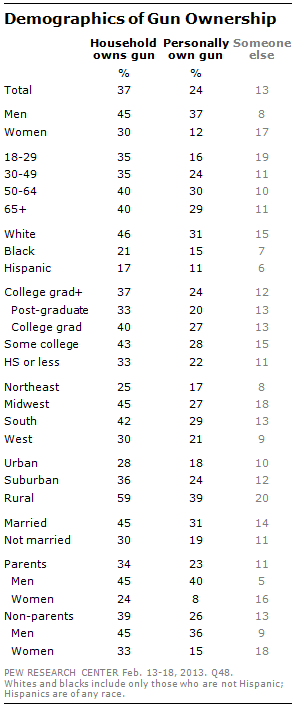
In the Pew Research Center survey conducted Feb. 13-18, 37% of adults reported having a gun in their household: 24% say they personally own a gun, and 13% say the gun or guns in their home are owned by someone else. These figures are not significantly different from the 2012 General Social Survey estimates that 34% of households have guns, and 22% of individuals own a gun.

There is a substantial gender gap when it comes to gun ownership: men are three times as likely as women (37% vs. 12%) to personally own a gun. However, women are more likely than men to live with someone else who owns a gun. Overall, 45% of men live in a gun-owning household compared with 30% of women. (Just 8% of people say that both they and someone else in their household own guns – these people are counted as personal gun owners in this analysis.)

There is also a sharp difference in personal gun ownership by age – 16% of adults under age 30 own a gun, compared with 27% of all adults age 30 and older. However, many young people live in households in which someone else owns a gun.

Roughly three-in-ten (31%) whites own a gun, which is much greater than the rates of gun ownership among blacks (15%) and Hispanics (11%).

Gun ownership also differs substantially by region and type of community. In the Northeast, 17% say they personally own a gun as do 21% in the West. Higher percentages in the Midwest (27%) and South (29%) say they own a gun. Across all regions, people living in rural areas are twice as likely as those in urban areas to own a gun (39% vs. 18%).

3-12-13 #15

A Profile of Gun Owners

The general profile of gun owners in America differs substantially from the general public. Roughly three-quarters (74%) of gun owners are men, and 82% are white. Taken together, 61% of adults who own guns are white men. Nationwide, white men make up only 32% of the U.S. adult population.

Gun owners and those who do not own guns differ politically. While 37% of all adults identify with or lean toward the Republican Party, that proportion jumps to 51% among gun owners. Among those in households without guns, just 27% identify with the Republican Party or lean Republican, while a majority (61%) are Democrats or lean Democratic.

About the Survey

The analysis in this report is based on telephone interviews conducted February 13-18, 2013 among a national sample of 1,504 adults, 18 years of age or older, living in all 50 U.S. states and the District of Columbia (752 respondents were interviewed on a landline telephone, and 752 were interviewed on a cell phone, including 364 who had no landline telephone). The survey was conducted by interviewers at Princeton Data Source under the direction of Princeton Survey Research Associates International. A combination of landline and cell phone random digit dial samples were used; both samples were provided by Survey Sampling International. Interviews were conducted in English and Spanish. Respondents in the landline sample were selected by randomly asking for the youngest adult male or female who is now at home. Interviews in the cell sample were conducted with the person who answered the phone, if that person was an adult 18 years of age or older. For detailed information about our survey methodology, see https://alpha.pewresearch.org/pewresearch-org/politics/methodology/

The combined landline and cell phone sample are weighted using an iterative technique that matches gender, age, education, race, Hispanic origin and nativity and region to parameters from the 2011 Census Bureau’s American Community Survey and population density to parameters from the Decennial Census. The sample also is weighted to match current patterns of telephone status and relative usage of landline and cell phones (for those with both), based on extrapolations from the 2012 National Health Interview Survey. The weighting procedure also accounts for the fact that respondents with both landline and cell phones have a greater probability of being included in the combined sample and adjusts for household size among respondents with a landline phone. Sampling errors and statistical tests of significance take into account the effect of weighting. The following table shows the unweighted sample sizes and the error attributable to sampling that would be expected at the 95% level of confidence for different groups in the survey:

3-12-13 #16

Sample sizes and sampling errors for other subgroups are available upon request.

In addition to sampling error, one should bear in mind that question wording and practical difficulties in conducting surveys can introduce error or bias into the findings of opinion polls.