
Views of Economic News Remain Mixed
Perceptions of Gas Prices Continue to Worsen
Overview
As federal spending cuts take effect and the stock market has reached record highs, the public continues to say they are hearing a mix of good and bad news about the economy. Overall, 58% say they have been hearing mixed economic news; a third (33%) have been hearing mostly bad news about the economy, while just 7% say they have been hearing mostly good

news. Views of economic news are little changed in recent months.
While the overall economic news picture remains mixed, a national survey by the Pew Research Center, conducted March 7-10 among 1,006 adults, finds modest improvement in views of news about the financial markets. About a quarter (23%) say they are hearing mostly good news about markets, up from 18% in February. Nonetheless, more (29%) say they are hearing mostly bad news about financial markets; 43% report hearing mixed news.
Meanwhile, impressions of news about gas prices have turned sharply negative. Nearly three-quarters (74%) say they have been hearing mostly bad news about gas prices, just 4% have been hearing mostly good news and 20% have heard mixed news. About a month ago, 53% said they had been hearing mostly bad news about gas prices. Negative impressions of news about gas prices have risen across nearly all demographic groups.
News about Economic Sectors
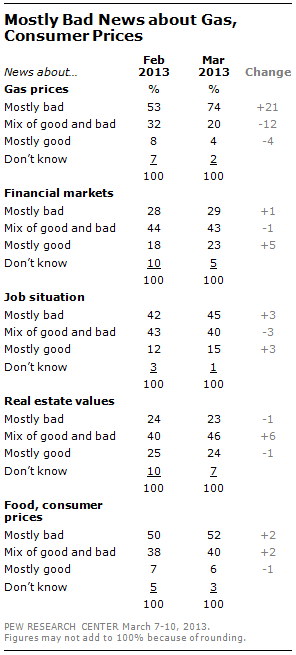
Aside from news about financial markets and gas prices, the public’s perceptions of news about other economic sectors, including the job situation, have shown little change.
Far more continue to say they are hearing mostly bad news about the job situation (45%) than mostly good news (15%); four-in-ten (40%) say they have been hearing mixed news. Opinion is almost identical to that measured one month ago.
Views of news about consumer prices also remain gloomy. About half (52%) say the news they have been hearing about prices for food and consumer goods has been mostly bad, 40% say they have been hearing mixed news; very few (6%) say they have been hearing mostly good news about prices. Opinions are little changed from February.
Impressions of real estate news are more positive when compared with views of news about jobs and prices. Overall, about as many have been hearing mostly good news about real estate values (24%) as mostly bad (23%); 46% have been hearing mixed news. Views of news about real estate values are about the same as they were in February, but are improved from late last year.
Modest Improvement in Financial News
Views of news about financial markets are modestly better than last month, but have shown more marked improvement since December. At that time, just 10% said they were hearing mostly good news about markets; in February, 18% reported hearing mostly good news and that figure has risen to 23% in the current survey.

Since December, there has been a 19-point jump in positive views of news about financial markets among those with family incomes of $75,000 or more (from 13% to 32%). The rise has been comparable among college graduates (from 13% to 33%). There has been less change in opinions among those with family incomes of less than $30,000 (seven-point increase in share hearing mostly good news) and those without a college degree (10 points).
Positive impressions of financial market news are especially high among the small share of Americans (14% of the public) who say they were following news about the stock market very closely last week. Nearly half (47%) of those following the stock market very closely say they have been hearing mostly good news about financial markets, compared with just 19% of those who have been following the stock market less closely.
The Week’s News
News about the condition of the U.S. economy and the government spending cuts that began taking effect March 1 were the public’s two top stories last week. Overall, 35% said they

followed economic news very closely; 31% followed news about the spending cuts very closely. Republicans and Democrats were about equally likely to follow news about the automatic federal spending cuts.
The public paid far less attention to Catholic cardinals meeting in Rome to select a new pope (14% very closely) and reports about the U.S. stock market (14% very closely). And just 10% paid very close attention to the death of Venezuelan President Hugo Chavez.
