Pew Research Center

FOR RELEASE FEBRUARY 21, 2013

If No Deal is Struck, Four-in-Ten Say Let the Sequester Happen

Deficit Reduction: Focus Mostly on Spending But Keep Taxes in Mix

FOR MEDIA OR OTHER INQUIRIES:

Communications Department
202.419.4372
www.pewresearch.org

RECOMMENDED CITATION

Pew Research Center, February 2013, "If No Deal is Struck, Four-in-Ten Say Let the Sequester Happen"

About Pew Research Center

Pew Research Center is a nonpartisan, nonadvocacy fact tank that informs the public about the issues, attitudes and trends shaping the world. It does not take policy positions. The Center conducts public opinion polling, demographic research, computational social science research and other data-driven research. It studies politics and policy; news habits and media; the internet and technology; religion; race and ethnicity; international affairs; social, demographic and economic trends; science; research methodology and data science; and immigration and migration. Pew Research Center is a subsidiary of The Pew Charitable Trusts, its primary funder.

© Pew Research Center 2026

Table of contents

  • About Pew Research Center
  • If No Deal is Struck, Four-in-Ten Say Let the Sequester Happen
  • Section 1: Opinions About Major Issues
  • Section 2: Views of Obama, Congress
  • About the Survey

If No Deal is Struck, Four-in-Ten Say Let the Sequester Happen

Deficit Reduction: Focus Mostly on Spending But Keep Taxes in Mix

Overview

After a series of fiscal crises over the past few years, the public is not expressing a particular sense of urgency over the
2-27-13 #1 update

pending March 1 sequester deadline. With little more than a week to go, barely a quarter have heard a lot about the scheduled cuts, while about as many have heard nothing at all.

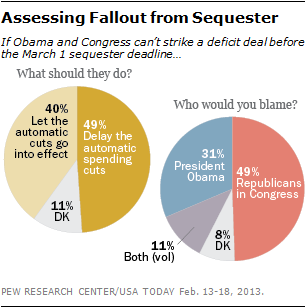
And if the president and Congress cannot reach a deficit reduction agreement before the deadline, 40% of Americans say it would be better to let the automatic spending cuts go into effect, while 49% say it would be better to delay the cuts. Both Republicans and independents are divided evenly over which approach is better, and even among Democrats, roughly a third favor letting the sequester take effect over any delays.

Related

The public’s policy priorities for 2013

Views of Obama and Congress during the fiscal cliff and debt ceiling negotiations

See analysis and charts on this same survey at USATODAY.com

The new survey, conducted Feb. 13-18, 2013 with 1,504 adults nationwide, is the first in a collaboration between the Pew Research Center and USA TODAY. It finds that, as with previous conflicts over the debt ceiling and fiscal cliff, Obama holds the upper hand politically over congressional Republicans. If there is no deficit deal by March 1, 49% say congressional Republicans would be more to blame while just 31% would mostly blame President Obama.

Moreover, 76% say that the president and Congress should focus on a combination of spending cuts and tax increases to reduce the budget deficit. Just 19% agree with the current Republican position that tax increases should be off the table.

And while Obama’s 51% job approval rating is down slightly from a post-election high of 55%, it remains well above the 25% approval rating for GOP congressional leaders. The job rating for Democratic leaders is higher (37%), though more disapprove (55%) than approve of their performance.

The poll finds new evidence of the public’s concern over the federal budget deficit. Fully 70% say it is essential for the president and Congress to pass major legislation to reduce the federal budget deficit, including wide majorities across party lines. Last month, the Pew Research Center’s annual policy priorities survey found a sharp rise in the percentage rating deficit reduction as a top priority since 2009.

2-21-13 #2

Far fewer say it is essential to act on three other issues that Obama mentioned prominently in his State of the Union address: 51% say it is essential for the president and Congress to act on major immigration legislation; 46% view major gun legislation as essential; just 34% say it is essential to set new federal policies dealing with climate change.

There are wide partisan differences in attitudes about all four issues. This also is the case in views about whether to raise the minimum wage, another proposal Obama raised in his State of the Union.
2-21-13 #3

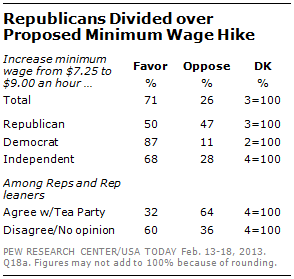
By a wide margin (71% to 26%), the public favors increasing the minimum wage from its current level of $7.25 per hour to $9.00 an hour. But while large majorities of Democrats (87%) and independents (68%) favor raising the minimum wage, Republicans are evenly divided (50% favor, 47% oppose).

Among all Republicans and Republican-leaning independents, those who agree with the Tea Party oppose the proposed minimum wage hike by two-to-one (64% to 32%). Those who have no opinion of the Tea Party, or disagree with it, favor increasing the minimum wage by 60% to 36%.

Most Want Deficit Efforts Focused Largely on Spending Cuts

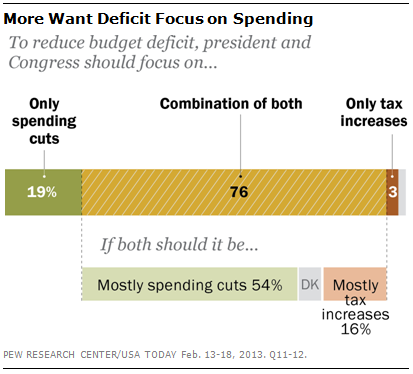
A substantial majority of Americans (76%) feel that both spending cuts and tax increases should be a part of the next step in tackling the federal budget deficit. But an equally large proportion believes that the greater share should come from spending cuts, even if tax hikes
2-21-13 #4

are also considered.

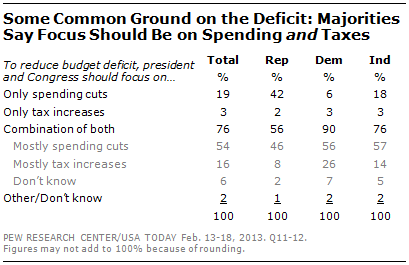
Overall, 19% say the focus of deficit reduction efforts should be only on spending cuts; just 3% want to concentrate only on tax increases. About four-in-ten Republicans (42%) favor reducing the deficit with spending cuts alone; that compares with 18% of independents and just 6% of Democrats. Even among Republicans, more favor a combination of spending cuts and tax increases to just spending cuts (56% vs. 42%).

When those who favor a balanced approach to reducing the deficit are asked if the focus should mostly be on spending cuts or tax increases, they overwhelmingly say spending cuts. Overall, 73% say efforts by the president and Congress to reduce the deficit should be only or mostly focused on spending cuts while just 19% say the focus should be only or mostly on tax increases.

Immigration: Plurality Favors Border Security and Path to Citizenship

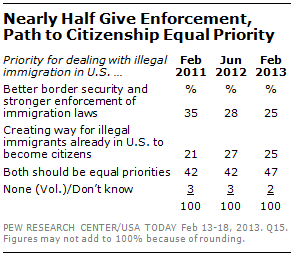
Nearly half (47%) say the priority for illegal immigration is better border security, stronger law enforcement and creating a way for people here illegally to become citizens if they meet certain requirements. Just a quarter (25%) favors an enforcement-only approach while an identical percentage says the focus should only be on a so-called path to citizenship. The percentage favoring a dual approach to immigration policy has risen modestly since June, from 42% to 47%.
2-21-13 #5

Republicans are more likely than Democrats to say that better border security and stronger enforcement of immigration laws should be the bigger priority, while Democrats are more likely to want the focus to be on creating a way for illegal immigrants already here to become citizens if they meet certain requirements.

Obama holds a sizable advantage over congressional Republicans on immigration. Half (50%) say that Obama has a better approach to dealing with immigration, compared with 33% who say congressional Republicans have a better approach. Obama’s job approval in handling the nation’s immigration policy, in negative territory for most of his presidency, also has improved.

Currently, about as many approve (44%) as disapprove (43%) of Obama’s handling of immigration policy; in seven surveys since 2009, far more disapproved than approved. Hispanics, in particular, are much more positive about Obama’s job performance on immigration: 63% approve currently, up from just 28% in November 2011.

Views on Gun Control Unchanged Since Shortly After Newtown

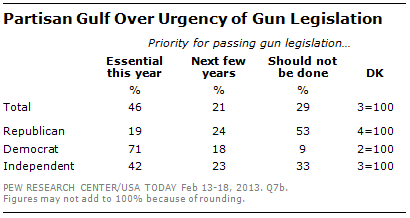
Gun control and climate change are potentially even more divisive political issues. For Democrats, 71% say it is essential that the president and Congress pass major gun legislation this year – that is slightly higher than the number saying major deficit reduction legislation is essential (65%). But just 19% of Republicans place the same emphasis on gun legislation. Nearly half of Democrats (47%) view action on climate change as essential this year, compared with 15% of Republicans.

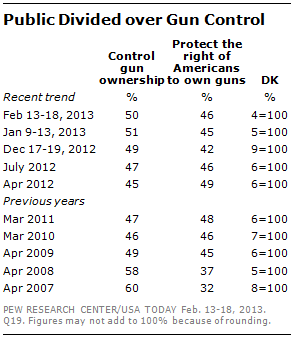
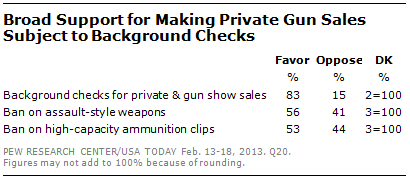
Americans remain divided over whether it is more important to control gun ownership (50%) or protect the right of Americans to own guns (46%), with no significant change in attitudes in the two months since shortly after the Newtown shootings. Similarly, there has been no change in public views about banning high capacity clips (53% favor), banning assault weapons (56% favor), or broader background checks (83% favor).
Section 1: Opinions About Major Issues

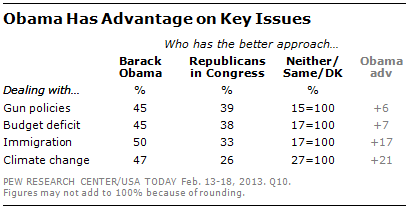
The public prefers President Obama’s approaches to those of congressional Republicans on several of this year’s major policy issues. However, Obama’s advantages are narrower on gun policies and the budget deficit than on immigration and climate change.

Overall, 45% say Obama has the better approach in dealing with gun policies, compared with 39% who favor Republicans in Congress on this issue. While Republicans overwhelmingly

2-21-13 #6

favor GOP members in Congress (76%) and Democrats support Obama (79%), independents are divided: 42% say congressional Republicans have a better approach, while 39% think Obama has a better approach.

Opinions are comparable about whether Obama (45%) or congressional Republicans (38%) have a better approach to the deficit. Again, independents are split: 39% favor Obama while 38% prefer congressional Republicans.

Obama holds wider leads among the public for having a better approach to immigration (50% to 33%) and climate change (47% to 26%). Independents prefer Obama’s approach to congressional Republicans’ on both issues (46% to 33% on immigration; 42% to 26% on climate change).

Obama’s approach on immigration is widely favored by Hispanics: 73% say Obama has a better approach on immigration, compared with just 15% who prefer congressional Republicans. Blacks support Obama by about the same margin (77% to 13%). But opinions are divided among whites – 39% say Obama has a better approach, compared with 42% who favor congressional Republicans.

Most Say Action on Deficit Is Essential This Year

There is broad agreement that major legislation to reduce the federal budget deficit is essential this year. Seven-in-ten (70%) express this view, including 81% of Republicans, 70% of independents and 65% of Democrats. And when it comes to the focus for the next steps in deficit reduction, about three-quarters of the public (76%) say that the president and Congress

2-21-13 #7

should focus on a combination of both spending cuts and tax increases; just 19% say the focus should only be on cuts and 3% say it should only be on taxes.

Across all three partisan groups majorities advocate an approach that includes both spending cuts and tax increases, although Republicans (56%) are less likely than independents (76%) or Democrats (90%) to say this; 42% of Republicans favor an approach that would only include spending cuts.

Those who favor a combination of spending cuts and tax increases were asked which should receive greater focus. Most of those who favor a mixed approach say the focus should be primarily on spending cuts (54% of the public overall). Just 16% of the public say the focus should mostly be on tax increases.

Nearly nine-in-ten Republicans (88%) say deficit reduction should be achieved either only with spending cuts (42%) or mostly through cuts (46%). Just 6% of Democrats say deficit-reduction efforts should concentrate solely on spending cuts. But an additional 56% of Democrats say the focus should be mostly on spending cuts.

Little Awareness of Budget Sequester

While the public views deficit reduction as an urgent matter, the approaching deadline for major cuts in government spending – the so-called budget sequester – has not registered widely.

2-21-13 #8

With a little more than a week to go before the March 1 deadline, there is only modest public awareness about the major cuts in defense and domestic government spending automatically scheduled to go into effect.

Only about a quarter (27%) of Americans have heard a lot about these cuts; 43% say they have heard a little, while 29% have heard nothing at all. By comparison, public attentiveness to the debate over raising the debt ceiling was far greater in July 2011. In a survey conducted July 20-24, 2011, about two weeks before the Aug. 2 debt ceiling deadline, 50% had heard a lot about the possibility of a government default.

There is also a partisan gap in attentiveness to the March 1 deadline; 36% of Republicans say they have heard a lot about the automatic spending cuts scheduled to take effect, compared with just 23% of Democrats and 25% of independents. And awareness is particularly high among Republicans and Republican-leaning independents who agree with the Tea Party movement, nearly half of whom (48%) say they have heard a lot about the possible sequester.

2-21-13 #9

If the sequester deadline is reached without a deficit agreement between the president and Congress, there is somewhat more support for delaying the cuts than for letting them go into effect (49% vs. 40%). The majority of Democrats (57%) say the cuts should be delayed in this case, while both Republicans and independents are more evenly divided.

Those who say they have heard a lot about the potential spending cuts are more supportive of letting them take effect (47%) than those who have heard little or nothing about the issue (37%). About half (54%) of Republicans who have heard a lot about the possible sequester say the cuts should go into effect in the absence of a deficit agreement; that compares with 38% of less attentive Republicans. There are no

2-21-13 #10

significant differences by attention among either Democrats or independents.

Overall, 49% would mostly blame GOP leaders if no deficit reduction agreement is reached by the March 1 deadline. Just 31% would mostly blame Obama, while 11% volunteer that both would be equally to blame.

Immigration: Less Support for Enforcement as Policy Priority

A quarter of the public says the priority for dealing with illegal immigration should be better border security and stronger enforcement of immigration laws. The same percentage (25%)

2-21-13 #11

says the priority should be creating a way for illegal immigrants already here to become citizens if they meet certain requirements.

Far more (47%) say both should be given equal priority. That has increased from 42% two years ago, while the percentage saying stronger border security should be the priority has declined from 35% to 25% today.

Fewer say it is essential for the president and Congress to act on immigration this year than say that about the budget

2-21-13 #12

deficit. Yet 51% say passing major immigration legislation is essential to do this year and another 37% say it should be done in the next few years.

The plurality view, even among groups with different views about illegal immigration, is that major immigration legislation should be enacted this year. About half (51%) of those who say better border security should be the priority think it is essential to pass major immigration legislation this year, as do 55% who prioritize creating a path to citizenship. Similarly, 50% of those who say both should be given equal priority think passing legislation is essential this year.

A plurality of whites (45%) and 58% of African Americans say that increased border security and enforcement of immigration laws and

2-21-13 #13

creating a path to citizenship should be the priority for dealing with illegal immigration.

Among Hispanics, 41% say creating a path to citizenship should be the priority. About half (49%) say a path to citizenship, along with better border security and stronger enforcement, should be the focus for dealing with illegal immigration.

A majority of Democrats (52%) and 47% of independents think that both enforcement and creating a path to citizenship should be given equal priority. Republicans, by contrast, are divided between prioritizing better border security and enforcement (43%) and both improved enforcement and creating a path to citizenship (43%).

Gun Control: Little Change in Opinions

2-21-13 #14

Public opinion shifted modestly toward support for gun control in the immediate aftermath of the school shooting in Newtown, Conn. on Dec. 14. Since then, there has been very little change in public attitudes toward gun control. Currently, 50% say controlling gun ownership is more important, while 46% prioritize protecting the right of Americans to own guns.

Significant partisan and demographic differences remain over this issue. About three-quarters of Republicans (74%) say protecting gun rights is more important, while 73% of Democrats say gun control is more important. Independents are about evenly divided (50% protect rights, 47% control ownership).

2-21-13 #15

Republicans and Democrats are also divided over the importance of passing major legislation about gun policies. Fully 71% of Democrats say it is essential for Congress and the president to act on gun legislation this year, while an additional 18% say it can be done in the next few years; just 9% of Democrats say it should not be done. By contrast, a narrow majority of Republicans (53%) say no action should be taken at all on gun legislation.

Three policy options currently at the forefront of the debate over gun policy – background checks, banning assault-style weapons, and banning high-capacity ammunition clips – all receive more public support than opposition. Background checks for private sales and gun shows are particularly popular: 83% of Americans favor this, including large majorities across all major demographic and partisan groups.

2-21-13 #16

Smaller majorities of Americans say they favor a ban on assault-style weapons (56%) and a ban on high-capacity ammunition clips that hold more than 10 bullets (53%). There are substantial partisan divisions over both proposals: 71% of Democrats favor a ban on assault-style weapons, compared with 52% of independents and 43% of Republicans. The partisan pattern is similar in opinions about a high-capacity ammunition ban.

Climate Change: Public Favors Stricter Emission Standards

2-21-13 #17

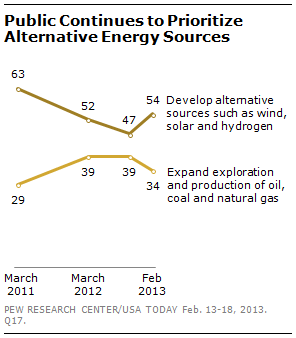
By a 54% to 34% margin, more Americans say the priority for addressing the nation’s energy supply should be developing alternative energy sources, such as wind, solar and hydrogen, over increased production of oil, coal and natural gas. Since 2011, the public has prioritized alternative sources over expanding production. Last October, the gap had narrowed: 47% said the priority should be developing alternative sources while 39% said the focus should be on expanding oil, coal and natural gas.

Further, fully 62% favor setting stricter emission limits on power plants in order to address climate change while 28% oppose this. Those who favor stricter emission standards are far more likely to want new climate change policies this year. Nearly half (46%) of those who favor stricter emission standards say new climate policies are essential this year. That compares with just 15% of those who oppose stricter emission standards; 41% of whom say new climate policies should not be done at all.

There are strong partisan divides over the country’s energy priorities and setting stricter emission standards. Only a third of Republicans (33%) say the priority should be developing alternative sources, while 54% say expanding production of oil, coal and

2-21-13 #18

gas should be the focus. The pattern is reversed among Democrats and independents, with far more saying developing alternative sources should be the priority.

By large margins, Democrats and independents also favor stricter emission limits on power plants in order to address climate change (72% and 64%, respectively). By contrast, Republicans are divided; 42% favor stricter emission standards while 48% are opposed.

There are stark age differences over energy policy priorities. Fully 71% of those younger than 30 give greater priority

2-21-13 #19

to developing alternative sources, while just 24% prioritize increased production of oil, coal and gas.

Opinion among older age groups is more divided. Just 39% of those 65 and older prioritize developing alternative sources while 44% say expanding production of oil, coal and gas should be the priority. Age differences are more modest in views of stricter emission limits on power plants to address climate change. Majorities across all age groups, including 70% of those under 30, favor this proposal.

Section 2: Views of Obama, Congress

For three consecutive months, Barack Obama’s overall job approval rating has held above 50%. But he receives mixed ratings when it comes to specific issues such as his handling of Afghanistan and gun control and more disapprove than approve of his handling of the budget deficit and economy. Obama’s rating on the issue of immigration has improved markedly from 2011, particularly among Democrats, independents, and most notably among Hispanics.

Overall, 51% approve of the way Obama is handling his job as president, while 41% disapprove. Opinion is little changed from one month ago, but down slightly from a recent high of 55% approval in December, shortly after Obama’s reelection.

Independents offer a mixed rating of Obama’s job performance: 47% say they approve while nearly as many (43%) disapprove. Democrats are nearly unanimous in their approval of Obama’s job performance (88% approve, 9% disapprove), while Republican express nearly the exact opposite views (87% disapprove, 10% approve).

2-21-13 #21

While Obama’s job ratings are up at least slightly among many demographic groups, one of the most striking turnarounds over the past year is in the views of Hispanics. In the last quarter of 2011 (approval data is merged on a quarterly basis to increase the sample size of Hispanics), just 48% of Hispanics nationwide approved, and 39% disapproved, of Obama’s job in office. This coincided with a period in which awareness and concern about the Obama administration’s record on deportations ran high among Hispanics, according to research by the Pew Hispanic Center. Since then, approval among Hispanics has risen steadily. By the end of 2012, Hispanic approval had risen to 75%, and has held at 73% so far in the first quarter of 2013. Among blacks, Obama’s approval rating has remained steady (currently 88% approve). Among whites, Obama’s job rating has improved slightly since 2011, from 36% to 41%.

Obama on the Issues

2-21-13 #22

One of the sharpest improvements in Obama’s job ratings come on the issue of immigration. For the first time in his presidency as many approve as disapprove of the job he is doing on the issue, a change driven in large part by improved ratings from Hispanics.

Overall, 44% approve of how Obama is handling the nation’s immigration policy compared with 43% who disapprove.

2-21-13 #23

Approval is up 12 points from November 2011 and marks the first time in Obama’s presidency that disapproval has not outweighed approval.

There has been a complete turnaround in how Hispanics view Obama’s handling of immigration. Today, more approve than disapprove by a 63% to 27% margin. In November, 2011 that margin was reversed: 28% of Hispanics approved of the job Obama was doing on immigration policy while 59% disapproved. Democrats and independents also have become more likely to approve of Obama’s job handling immigration policy since 2011, while opinion among Republicans is little changed.

Yet even with this improvement on the issue of immigration, Obama’s job ratings on a wide range of specific issues are lower than the

2-21-13 #24

rating he receives for his overall performance. Out of the seven issues tested in the survey, there is no issue for which Obama receives an approval rating of 50% or better.

Obama receives the lowest marks for his handling of the budget deficit. Overall, just 34% approve of how Obama is handling the federal budget deficit, while 58% majority disapproves. Opinion on this question is little changed from last spring. Obama has received consistently low marks for his handling of the budget deficit throughout most of his presidency.

Views of Obama’s job handling the economy also are negative. Four-in-ten (40%) approve, while 56% disapprove. Obama has not received an approval rating of 50% or better for his handling of the economy since June 2009, when 52% approved.

2-21-13 #25

Following his decision to remove 34,000 troops from Afghanistan in the next year, 46% approve of how Obama is handling the situation in Afghanistan, while 42% disapprove. Opinion is little changed from last March, but Obama’s approval rating on Afghanistan has fallen from 56% in January 2012.

Obama receives mixed ratings for his handling of gun policies and foreign policy. On both issues, 44% approve of his performance, while about as many disapprove. Overall, 44% also approve of his handling of climate change, fewer disapprove (34%) and 22% do not offer a job rating on the issue.

Views of Congressional Leaders

2-21-13 #26

Views of Republican leaders in Congress remain at near-historic lows. Democratic leaders in Congress are viewed somewhat more positively, though more still disapprove than approve of their job performance.

Only 25% say they approve of the job Republican leaders in Congress are doing, while 67% disapprove, little changed from December 2012. Republican leaders receive only a mixed rating from their own party members: 47% of Republicans approve of the job their Congressional leaders are doing and 47% disapprove. Independents disapprove of the job Republican leaders are doing by a 68% to 22% margin.

Roughly four-in-ten (37%) approve of the job Democratic leaders are doing, including 69% of Democrats. Independents view Democratic leaders only slightly better than they do Republican leaders: 29% approve, while 61% disapprove.

About the Survey

The analysis in this report is based on telephone interviews conducted February 13-18, 2013 among a national sample of 1,504 adults, 18 years of age or older, living in all 50 U.S. states and the District of Columbia (752 respondents were interviewed on a landline telephone, and 752 were interviewed on a cell phone, including 364 who had no landline telephone). The survey was conducted by interviewers at Princeton Data Source under the direction of Princeton Survey Research Associates International. A combination of landline and cell phone random digit dial samples were used; both samples were provided by Survey Sampling International. Interviews were conducted in English and Spanish. Respondents in the landline sample were selected by randomly asking for the youngest adult male or female who is now at home. Interviews in the cell sample were conducted with the person who answered the phone, if that person was an adult 18 years of age or older. For detailed information about our survey methodology, see https://alpha.pewresearch.org/pewresearch-org/politics/methodology/

The combined landline and cell phone sample are weighted using an iterative technique that matches gender, age, education, race, Hispanic origin and nativity and region to parameters from the 2011 Census Bureau’s American Community Survey and population density to parameters from the Decennial Census. The sample also is weighted to match current patterns of telephone status and relative usage of landline and cell phones (for those with both), based on extrapolations from the 2012 National Health Interview Survey. The weighting procedure also accounts for the fact that respondents with both landline and cell phones have a greater probability of being included in the combined sample and adjusts for household size among respondents with a landline phone. Sampling errors and statistical tests of significance take into account the effect of weighting. The following table shows the unweighted sample sizes and the error attributable to sampling that would be expected at the 95% level of confidence for different groups in the survey:

2-21-13 #27

Sample sizes and sampling errors for other subgroups are available upon request.

In addition to sampling error, one should bear in mind that question wording and practical difficulties in conducting surveys can introduce error or bias into the findings of opinion polls.