
Obama Viewed as Fiscal Cliff Victor; Legislation Gets Lukewarm Reception
Overview Barack Obama is viewed as the clear political winner in the fiscal cliff negotiations, but the legislation itself gets only a lukewarm reception from the public: As many disapprove as approve of the new tax legislation, and more say it will have a negative than positive impact on the federal budget deficit, the national […]
Overview

Barack Obama is viewed as the clear political winner in the fiscal cliff negotiations, but the legislation itself gets only a lukewarm reception from the public: As many disapprove as approve of the new tax legislation, and more say it will have a negative than positive impact on the federal budget deficit, the national economy and people like themselves.
The latest national survey by the Pew Research Center for the People & the Press, conducted Jan. 3-6 among 1,003 adults, finds that 57% say that Obama got more of what he wanted from the tax legislation while just 20% say Republican leaders got more of what they wanted. And while 48% approve of the way Obama handled the fiscal cliff negotiations only 19% approve of the way GOP leaders handled the negotiations.
Republicans take a particularly sour view of the outcome: just 16% approve of the final legislation, and by a 74% to 11% margin they think Obama got more of what he wanted. Only 40% of Republicans approve of how their party’s leaders handled the negotiations; by comparison, fully 81% of Democrats approve of how Obama handled the negotiations.
Relatively few Americans expect that the tax legislation that resulted from those talks will help people like themselves, the budget deficit, or the national economy. Just three-in-ten Americans say the tax measure will mostly help people like them; 52% say it will mostly hurt. And even when it comes to the budget deficit, 44% say the deal will mostly hurt, while 33% say it will mostly help.
Political Winners and Losers

There are wide partisan differences in opinions about the tax legislation and the negotiations that produced it. Notably, Republicans are far more likely than Democrats to say that Obama got more of what he wanted from the deal than did Republican leaders in Congress. Fully 74% of Republicans say Obama got more of what he wanted from the talks compared with just 11% who say GOP leaders prevailed.
Democrats and independents also say Obama fulfilled more of his goals in the legislation, but by smaller margins – 53% to 26% among Democrats and 55% to 19% among independents.
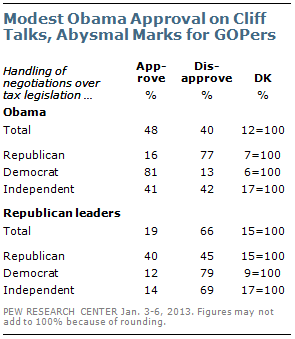
Overall, 48% approve of how Obama handled the negotiations over the tax legislation, while just 19% approve of the job GOP leaders did hammering out the legislation. While Republicans broadly disapprove of how Obama handled the tax measure (77% disapprove), they give GOP leaders only mixed approval ratings – 40% approve while 45% disapprove.
Just 14% of independents approve of the way Republican leaders handled the fiscal cliff talks while 69% disapprove. Independents are divided over how Obama handled the negotiations (41% approve, 42% disapprove). Democrats overwhelmingly approve of Obama’s handling of the negotiations (81% approve) and disapprove of GOP leaders (79% disapprove).
Views of Tax Legislation and Its Impact

There also are substantial partisan differences over the tax legislation itself: 58% of Democrats approve of the measure compared with 36% of independents and 18% of Republicans.
These opinions carry over to the impact the legislation will have on average people, the economy and the budget deficit. Republicans take a decidedly
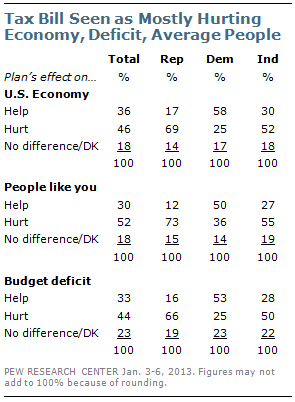
negative view of the effects of the legislation in all three areas: 73% say it will mostly hurt people like them, 69% say it will hurt the U.S. economy and 66% say it will hurt the budget deficit.
Democrats offer much more positive views of the legislation, with majorities saying it will mostly help the economy (58%) and the budget deficit (53%). Half of Democrats (50%) say it will mostly help people like them, while more than a third (36%) say it will mostly hurt.
There are educational differences in opinions about the personal impact of the tax legislation. A majority of those with no more than a high school education (60%) say it will mostly hurt people like them, as do half (50%) of those of those with only some college experience. Among college graduates, 40% say the bill will have a mostly negative impact on them personally while as many (40%) see a mostly positive impact.
Attentive Public More Supportive of Bill

Nearly four-in-ten Americans (38%) say they followed passage of the fiscal cliff legislation very closely. That is comparable to interest in the fiscal cliff talks over previous weeks. Similar percentages of Democrats (44%) and Republicans (41%) followed the legislative end-game very closely; somewhat fewer independents (31%) did so.
Those who tracked the news about passage of the tax legislation very closely are more likely than those who followed it less closely to approve of the measure (49% vs. 32%). In addition, 57% of those who followed the bill’s passage approve of Obama’s handling of the legislation, compared with 42% of those who tracked it less closely.
Public Still Hearing Mixed Economic News
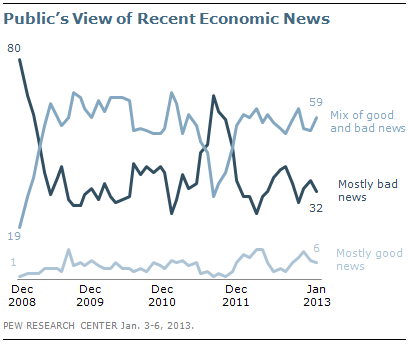
The public continues to say they are hearing mixed news about the nation’s economy: 59% say they are hearing a mix of both good and bad news about the economy these days, while 32% say they are hearing mostly bad news and only 6% say they are hearing mostly good economic news.
Wide partisan gaps persist in views of economic news. Nearly half of Republicans (48%) say they have been hearing mostly bad news compared with 36% of independents and just 18% of Democrats.
