
Pew Research Center

FOR RELEASE SEPTEMBER 17, 2012

Middle East Turmoil Closely Followed; Romney’s Comments Viewed Negatively

Overview About four-in-ten Americans (43%) have followed news about the attacks on U.S. embassies in the Middle East and the killing of an American ambassador very closely, making it by far the most closely followed foreign news story of the year. Those who have followed this story have much more positive opinions about Barack Obama’s […]

FOR MEDIA OR OTHER INQUIRIES:

Communications Department
202.419.4372
www.pewresearch.org

RECOMMENDED CITATION

Pew Research Center, September 2012, "Middle East Turmoil Closely Followed; Romney’s Comments Viewed Negatively"

About Pew Research Center

Pew Research Center is a nonpartisan, nonadvocacy fact tank that informs the public about the issues, attitudes and trends shaping the world. It does not take policy positions. The Center conducts public opinion polling, demographic research, computational social science research and other data-driven research. It studies politics and policy; news habits and media; the internet and technology; religion; race and ethnicity; international affairs; social, demographic and economic trends; science; research methodology and data science; and immigration and migration. Pew Research Center is a subsidiary of The Pew Charitable Trusts, its primary funder.

© Pew Research Center 2026

Table of contents

  • About Pew Research Center
  • Middle East Turmoil Closely Followed; Romney’s Comments Viewed Negatively
  • About the Survey

Middle East Turmoil Closely Followed; Romney’s Comments Viewed Negatively

Overview About four-in-ten Americans (43%) have followed news about the attacks on U.S. embassies in the Middle East and the killing of an American ambassador very closely, making it by far the most closely followed foreign news story of the year. Those who have followed this story have much more positive opinions about Barack Obama’s […]

Overview
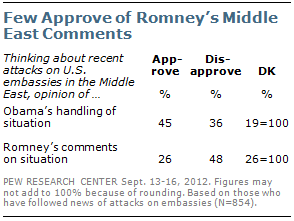
About four-in-ten Americans (43%) have followed news about the attacks on U.S. embassies in the Middle East and the killing of an American ambassador very closely, making it by far the most closely followed foreign news story of the year.

Those who have followed this story have much more positive opinions about Barack Obama’s handling of the situation than Mitt Romney’s comments on the crisis. Nearly half (45%) approve of Obama’s handling of the recent attacks on U.S. embassies and the killing of the U.S. ambassador in Libya; 36% disapprove of Obama’s handling of this situation.

In contrast, only about a quarter (26%) of those who have tracked news on turmoil in the Middle East approve of Romney’s comments on the situation; nearly half (48%) disapprove.

The latest national survey by the Pew Research Center for the People & the Press, conducted Sept. 13-16 among 1,001 adults, finds that public interest in the presidential campaign has increased sharply in the past week. Currently, 42% say they are following news about the

presidential candidates very closely, up from 31% a week earlier, immediately after the party conventions.

As many followed the recent spate of attacks on U.S. embassies in the Middle East and the killing of U.S. Ambassador Christopher Stevens very closely (43%) as tracked campaign news very closely (42%). News interest in events in the Middle East is as high today as it was in the early days of the “Arab spring” last year, or when the U.S. and its allies launched air strikes on Libya in April 2011. (For more, see “Interest in Foreign News Declines,” June 6, 2012.)

Across most demographic groups, far more of those who followed news about the embassy attacks approve of Obama’s handling of the situation than approve of Romney’s statements on the crisis. And while 75% of Democrats approve of Obama’s handling of Middle East turmoil, fewer Republicans (58%) approve of Romney’s comments on the situation.

Nearly identical percentages of those who have followed the situation very closely and those have followed it less closely approve of Obama’s handling of the situation (46% and 44%, respectively). However, disapproval of Obama’s performance is much higher among those who have followed Mideast turmoil very closely (43%) than those who have followed it less closely (29%).

Romney gets higher marks among those who have followed Middle East events very closely than among those who followed them less closely. Even among this group, however, more disapprove (49%) than approve (34%) of his comments on the situation.

There are only modest partisan differences in attentiveness to the recent attacks on the embassies and the killing of the U.S. ambassador: 48% of Republicans, 41% of Democrats and 45% of independents have followed this story very closely.
About the Survey

The analysis in this report is based on telephone interviews conducted September 13-16, 2012 among a national sample of 1,001 adults 18 years of age or older living in the continental United States (600respondents were interviewed on a landline telephone, and 401were interviewed on a cell phone, including 188 who had no landline telephone). The survey was conducted by interviewers at Princeton Data Source under the direction of Princeton Survey Research Associates International. A combination of landline and cell phone random digit dial samples were used; both samples were provided by Survey Sampling International. Interviews were conducted in English. Respondents in the landline sample were selected by randomly asking for the youngest adult male or female who is now at home. Interviews in the cell sample were conducted with the person who answered the phone, if that person was an adult 18 years of age or older. For detailed information about our survey methodology, see: https://alpha.pewresearch.org/pewresearch-org/politics/methodology/.

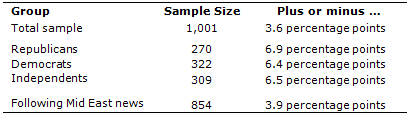
The combined landline and cell phone sample are weighted using an iterative technique that matches gender, age, education, race, Hispanic origin and region to parameters from the March 2011 Census Bureau’s Current Population Survey and population density to parameters from the Decennial Census. The sample also is weighted to match current patterns of telephone status, based on extrapolations from the 2011 National Health Interview Survey. The weighting procedure also accounts for the fact that respondents with both landline and cell phones have a greater probability of being included in the combined sample and adjusts for household size among respondents with a landline phone. Sampling errors and statistical tests of significance take into account the effect of weighting. The following table shows the sample sizes and the error attributable to sampling that would be expected at the 95% level of confidence for different groups in the survey:


Sample sizes and sampling errors for other subgroups are available upon request.

In addition to sampling error, one should bear in mind that question wording and practical difficulties in conducting surveys can introduce error or bias into the findings of opinion polls.