
Pew Research Center

FOR RELEASE JULY 26, 2011

Public Wants a Debt Ceiling Compromise, Expects a Deal Before Deadline

GOP Widely Viewed as 'More Extreme in Its Positions'

FOR MEDIA OR OTHER INQUIRIES:

Communications Department
202.419.4372
www.pewresearch.org

RECOMMENDED CITATION

Pew Research Center, July 2011, "Public Wants a Debt Ceiling Compromise, Expects a Deal Before Deadline"

About Pew Research Center

Pew Research Center is a nonpartisan, nonadvocacy fact tank that informs the public about the issues, attitudes and trends shaping the world. It does not take policy positions. The Center conducts public opinion polling, demographic research, computational social science research and other data-driven research. It studies politics and policy; news habits and media; the internet and technology; religion; race and ethnicity; international affairs; social, demographic and economic trends; science; research methodology and data science; and immigration and migration. Pew Research Center is a subsidiary of The Pew Charitable Trusts, its primary funder.

© Pew Research Center 2026

Table of contents

  • About Pew Research Center
  • Public Wants a Debt Ceiling Compromise, Expects a Deal Before Deadline
  • Section 1: Views of Obama, Congress and the Political Parties
  • Section 2: The Debt and Deficit Debate
  • About the Survey

Public Wants a Debt Ceiling Compromise, Expects a Deal Before Deadline

GOP Widely Viewed as 'More Extreme in Its Positions'

Overview

The public overwhelmingly favors a compromise in the debt ceiling standoff. And even as negotiations aimed at resolving the issue show little progress, a majority thinks that Barack
Obama and congressional Republicans will reach a deal before the Aug. 2 deadline on a possible government default.

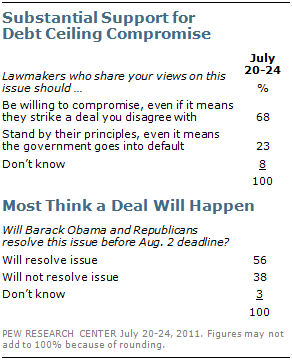
Fully 68% say that lawmakers who share their views on this issue should compromise, even it means striking a deal they disagree with. Just 23% say lawmakers who share their views should stand by their principles, even if that leads to default.

There is broader support for compromise today than on the eve of a possible government shutdown earlier this year. In early April, 55% favored a compromise even if that resulted in a budget deal they disagreed with, while 36% wanted their leaders to stand by their principles even if it led to a shutdown.

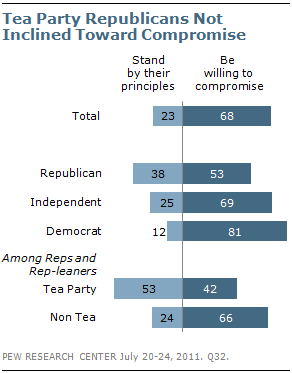
Large majorities of Democrats (81%) and independents (69%) favor a compromise to avoid default, but Republicans are more divided: 53% favor a compromise, while 38% say lawmakers who share their views should stand by their principles even if it leads to a default.

Among all Republicans and Republican-leaning independents, 53% of those who agree with the Tea Party favor lawmakers standing by their principles even if it means the government goes into default. Just 24% of Republicans and GOP leaners who do not agree with the Tea Party express this view.

The latest national survey by the Pew Research Center for the People & the Press, conducted July 20-24 among 1,501 adults, finds continued public optimism about prospects of a last-minute debt-ceiling deal. More than half (56%) say they think Obama and the Republicans will resolve the issue before Aug. 2. This is little changed from a Washington Post/ABC News survey conducted July 14-17 (54% will resolve issue).

Most Americans feel a personal stake in the efforts to resolve the debt ceiling impasse. Nearly two-thirds (65%) say their own personal finances would be affected by a failure to increase
the government’s ability to borrow; 32% say their finances would not be affected. More specifically, 45% are worried that a failure to meet the Aug. 2 deadline would harm their investments and retirement savings, and 46% are worried that they might lose government services
and benefits that affect them personally.

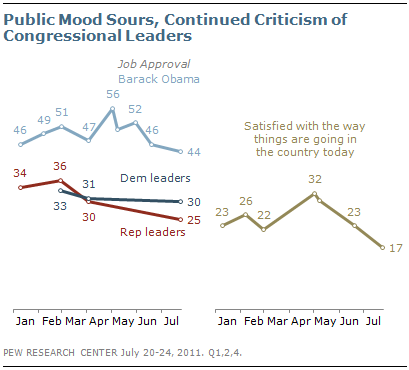
The survey finds that the ongoing stalemate over raising the debt ceiling may be taking a toll on views of national conditions. Just 17% say they are satisfied with the way things are going in the country, down from 23% last month and the lowest measure since late 2008, during the financial crisis.

Barack Obama’s job approval ratings remain mixed – 44% approve of his job performance while 48% disapprove. But Obama’s ratings are far less positive than they were in May, immediately after the death of Osama bin Laden (56% approve).

Just a quarter (25%) approve of the job that Republican leaders in Congress are doing, down 11 points since February. Ratings for Democratic congressional leaders (30% approve) are little changed from earlier this year.

Republicans hold a 10-point lead over the Democrats as the party better able to reduce the federal budget deficit (43% to 33%), while running about even with Democrats on taxes, jobs and Social Security. The GOP’s advantage on the deficit is larger than it was in May (three points), but about the same as in April (12 points).
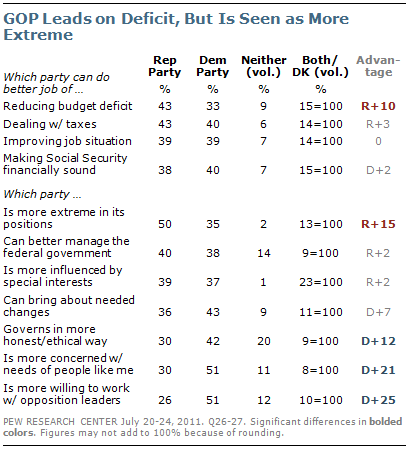
However, Republicans are viewed much more negatively than the Democrats on several important traits and characteristics. Notably, 50% view the Republican Party as “more extreme in its positions.” Far fewer (35%) say this phrase better describes the Democratic Party. Majorities of Democrats (64%) and independents (51%) view the GOP as more extreme, as do about a third of Republicans (35%).

As was the case in April, the Democrats also lead by wide margins as the party more willing to work with political leaders from the other party (by 25 points) and more concerned with the needs of typical Americans (by 21 points). Democrats continue to hold a smaller lead on honest governance (12 points).

Despite the intense focus in Washington on the debt and deficit, more Americans continue to view the job situation as their biggest economic concern. Nearly four-in-ten (39%) cite the job situation as the national economic issue that most worries them; 29% cite the federal budget deficit, while smaller percentages say rising prices (15%) and problems in the financial and housing markets (11%) are their biggest economic worries. Even among Republicans, as many cite the job situation (34%) as the deficit (37%) as the biggest economic problem.
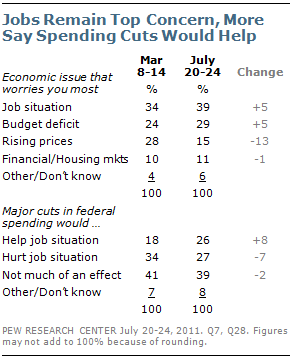
The public’s views of the impact of large cuts in federal spending on the job situation have changed in recent months. Currently, as many say such cuts would help the job situation as hurt it (26% vs. 27%). In March, more saw cuts in spending as harmful rather than helpful (34% vs. 18%); the shift since March has come across partisan lines.

Yet the plurality view, held by 39%, is that cutting federal spending won’t affect the job situation one way or the other.

In keeping with their desire to see compromise, there is no change in the public’s view that the best way to reduce the federal budget deficit is through a combination of both cutting major programs and increasing taxes. Six-in-ten (60%) say that both are in order; just 19% say that the focus should be mostly on cutting major programs while even fewer (8%) say the focus should be mostly on raising taxes. The proportion supporting a mixed approach of funding cuts and tax increases is about the same as it was last December (65%).

Section 1: Views of Obama, Congress and the Political Parties

As views of national conditions worsen, Barack Obama’s job ratings remain mixed: 48% disapprove of the way Obama is handling his job as president, while 44% approve. This is little changed from June (46% approve, 45% disapprove). In early May, immediately following the announcement of Osama bin Laden’s death, 56% approved of Obama’s job performance.

A large majority of Democrats (77%) continue to approve of Obama’s job performance while a comparable majority of Republicans disapprove (79%). For the first time in Pew Research Center polling, a majority of independents (54%) disapprove of Obama’s performance. Obama’s approval among independents has slipped to just 36% from 42% last month and a recent high of 52% following the killing of bin Laden.

National satisfaction has also declined in recent months. In the current survey, just 17% say they are satisfied with the way things are going in this country today while 79% say they are dissatisfied. In May, somewhat more (30%) said they were satisfied with national conditions. That figure fell seven points to 23% in June and has fallen another six points in July. The current ratings are now at the lowest point since the financial crisis of 2008. In October of that year, just 11% expressed a positive view of national conditions.

Only about a quarter of Democrats (27%), 14% of independents and just 8% of Republicans say they are satisfied with the way things are going in the country. In May, 40% of Democrats, 32% of independents and 19% of Republicans were satisfied with national conditions.

Poor Ratings for Congressional Leaders

Just a quarter (25%) of the public approves of the job Republican leaders in Congress are doing, while far more (66%) disapprove. Ratings of Republican leaders have declined in recent months and now stand near long-term lows. Shortly after the midterm elections in November 2010, about as many approved (41%) as disapproved (37%) of Republican congressional leaders’ policies and plans for the future. Republican leaders’ ratings turned negative in January and have declined further since then.

Democrats give Republican leaders overwhelmingly negative job ratings (83% disapprove), as do independents (70% disapprove). A narrow majority of Republicans approve of the way GOP leaders are doing their job (54%), but nearly four-in-ten (38%) disapprove.

Republican and Republican-leaning independents who agree with the Tea Party give GOP leaders mixed job ratings: 51% approve, but about as many disapprove (45%). Among Republicans and leaners who disagree with the Tea Party or have no opinion of the movement, there is less support for party leaders: 42% approve of their performance and 49% approve.

Job ratings for Democratic leaders in Congress are not much better than those of GOP leaders. Just 30% of the public approves of their job performance while twice as many (60%) disapprove. Ratings for Democratic Congressional leaders have shown little change in recent months. Nonetheless, approval ratings for the Democratic Party’s leadership remain near all-time lows.

Democrats approve of their party’s leaders by a 58%-35% margin. Majorities of both liberal Democrats (63%) and conservative and moderate Democrats (55%) approve of their leaders. Independents’ views of Democratic leaders’ job performance are about as negative as their views of Republican leaders – just 23% approve of the way Democratic leaders are doing their jobs while 65% disapprove.

Wide Partisan Divide in Confidence in Government

Most Americans (59%) say they have not too much (37%) or no confidence at all (22%) that the government in Washington will make progress on important problems over the next year. Only about four-in-ten (39%) say they have a lot of confidence (6%) or some confidence (33%). These views have declined slightly since last September, when 44% said they had at least some confidence in the government’s abilities to make progress on major issues.

Democrats stand out for being far more optimistic than other groups about the government’s ability to address important problems over the next year. Fully 62% have at least some confidence in the government’s ability to address major problems over the next year while just 37% say they have not much or no confidence at all. By comparison, just 32% of independents and 24% of Republicans are confident the government in Washington will make progress on important issues. Among Republican and Republican-leaning independents, optimism is somewhat higher among those who do not agree with the Tea Party (29%) than it is among those who agree with the movement (17%).

Parties at Parity on Most Issues

The public’s views about which party can better handle several major issues have changed little since April. The GOP currently holds a 10-point advantage as the party better able to reduce the federal budget deficit (43% to 33%). The Republican advantage had been 12 points in April, but had narrowed to three points in May.

On three other issues – improving the job situation, making the Social Security system financially sound and dealing with taxes – neither party holds a significant advantage.

As in April, independents are much more likely to say Republicans could do a better job than Democrats at reducing the deficit (by 45% to 27%). The GOP also holds a 12-point lead among independents as the party better able to improve the job situation (42% to 30%).This represents a change from April, when independents were divided over which party could better improve the job situation (38% Republican Party, 35% Democratic Party). Independents are split over which party can do a better job of making the Social Security system financially sound and dealing with taxes.

Democrats Seen as More Willing to Work with Opponents

Democrats continue to hold substantial leads over Republicans on several traits, including willingness to cooperate with opponents, empathy and honest governance. And far more people view the GOP as more extreme in its positions than say that about the Democratic Party.

About twice as many say the Democrats are more willing to work with political leaders from the other party than say that about the GOP (51% to 26%). In April, the Democrats held a 17-point lead on this trait (49% to 32%).

The Democrats also continue to hold double-digit leads on concern for “people like me” (21 points) and governing in a more honest and ethical way (12 points).

For almost two years, Democrats and Republicans have run about even as the party better able to manage the federal government. In the new survey, 40% say the Republican Party could better manage the government while about as many (38%) say the Democratic Party. Roughly equal percentages also say each party is more influenced by lobbyists and special interests (39% Republican Party, 37% Democratic Party).

Young, Well Educated See GOP as More Extreme

When asked which political party is more extreme in its positions, 50% say the Republican Party while 35% say the Democratic Party. While there are wide partisan differences in these opinions there also are age and educational differences.

Majorities of those younger than 30 (60%) and those 30 to 49 (54%) say the Republican Party is more extreme in its positions. That compares with only about four-in-ten of those older than 50 (42%). College graduates (59%) and those with some college experience (55%) are more likely than those with less education to view the Republican Party as more extreme.

This question divides Republicans and Republican-leaning independents who support the Tea Party from those who disagree or have no opinion of the movement. Nearly two-thirds (66%) of Republican Tea Party supporters say the Democratic Party is more extreme in its positions, while just 21% say that about the GOP. Those who disagree with the Tea Party or have no opinion about it are about evenly divided: 43% say the Republican Party is more extreme, while 40% name the Democratic Party.

Section 2: The Debt and Deficit Debate

A week ahead of the Aug. 2 debt-ceiling deadline, the public overwhelmingly wants political leaders in Washington to compromise on the issue. About two-thirds (68%) say that lawmakers who share their views should be willing to compromise, even if it means striking a deal they disagree with. Only 23% say lawmakers who share their views should stand by their

principles, even if that leads to a government default.

And even though negotiations about raising the debt limit have continued to stall, a majority (56%) thinks that Barack Obama and congressional Republicans will reach a deal before Aug. 2, while 38% think the issue will not be resolved in time. This is little changed from a Washington Post/ABC News survey conducted a week ago, in which 54% expected a deal and 43% did not.

Half of Americans (50%) say they have heard a lot about the Aug. 2 debt limit deadline, and attention levels are similar across party lines. But there are sizable partisan and ideological divisions when it comes to how lawmakers should approach the final deliberations. Fully 81% of Democrats say the lawmakers they agree with should compromise in the debt ceiling debate, even if it means an imperfect outcome. Roughly two-thirds (69%) of independents say the same. About half (53%) of Republicans want to see their leaders show a willingness to compromise, while 38% say the leaders they agree with should stand by their principles, even if it means a government default.

Nearly half of conservative Republicans (47%) say lawmakers who share their views should stick to principles despite the threat of a default; only 21% of moderate and liberal Republicans agree. There is no comparable ideological divide among Democrats. Liberal Democrats are about as likely as conservative and moderate Democrats to say lawmakers should compromise on the debt ceiling even if it means striking a deal they disagree with.

More than half (53%) of Republicans and Republican-leaning independents who agree with the Tea Party want lawmakers to stand by their principles, even it means the government goes into default. Only 24% of Republicans and Republican leaners who do not agree with the Tea Party express this view.

Attentive Democrats are almost unanimous in their support for compromise to avoid a government default. Fully 90% of Democrats and Democratic-leaning independents who have heard a lot about the possibility of a default if an agreement is not reached say lawmakers should compromise on this issue. By contrast, barely half (54%) of Republicans and Republican leaners who have heard a lot about the debt limit deadline support compromise. Instead, 39% say their leaders should stand by their principles.

Despite the continued deadlock in Washington, attentive Americans are more optimistic that some kind of deal will be reached before Aug. 2. Two-thirds (67%) of people who have heard a lot about the issue say Obama and the Republicans will come to some kind of resolution, compared with 46% of those who have heard little or nothing about it.

Most Say Government Default Will Affect Their Finances

Roughly two-thirds of Americans (65%) believe that their own personal finances would be affected if a deal is not struck by Aug. 2. There is little difference across party lines in this view.

More specifically, 46% of Americans are very or somewhat worried that if the government cannot borrow more money to fund its operations and pay its debts it would lead to the suspension of services and benefits that affect them personally. This concern is higher among women, minorities, low-income Americans, and people over age 50. Most who are worried cite the possible loss of Social Security and Medicare benefits as their greatest fear.

About the same number (45%) are very or somewhat worried that missing the Aug. 2 deadline would harm their investments and retirement savings.

Jobs Still Trump Deficit as Top Economic Worry

Even as the debt has taken center stage in Washington over the last few weeks, more Americans continue to say the job situation is the national economic issue they are most worried about. About four-in-ten (39%) say the job situation is their top worry, while 29% cite the budget deficit. Just 15% say they are primarily concerned about rising prices and 11% say problems in the housing and financial markets. The relative importance of each of these concerns among the public is little changed since May, when the deficit overtook prices as the second highest-ranked concern.

Jobs remain the top economic concern for both Democrats (43%) and independents (39%), while Republicans are about as likely to cite the deficit (37%) as to say jobs (34%). But concern about the deficit is rising among Democrats and independents. In December, just 10% of Democrats cited the deficit as their top worry; today, 24% do so. Similarly, 29% of independents now say they are most worried about the budget deficit, up from 20% in December.

Most Support Combination of Spending Cuts, Tax Increases

The public remains skeptical that lawmakers will make headway in reducing the budget deficit over the next several years: Just 39% say the country will have made significant progress in reducing the deficit five years from now. At the same time, a majority (60%) say that the best way to reduce the federal budget deficit involves both cutting major programs and increasing taxes. Just 19% say the best approach is to focus mostly on cutting major programs; 8% say the focus mostly should be on increasing taxes.

Clear majorities of Democrats (67%) and independents (63%) say the best way to reducing the deficit includes both major program cuts and tax increases. By contrast, Republicans are more divided: 46% favor an approach that includes both tax increases and program cuts, while 39% say the best approach mostly focuses on program cuts.

Within the Republican coalition there is a substantial division of opinion. A majority of Republicans and Republican-leaning independents who agree with the Tea Party movement (52%) say deficit reduction should come mostly through major program cuts; just 24% of those who do not agree or have no opinion of the Tea Party say the same.

Will Federal Spending Cuts Help or Hurt the Job Situation?

A plurality (39%) of Americans say that if the federal government makes major cuts in federal spending in order to reduce the budget deficit, there would not be much of an effect on the job situation. The remainder of the public is divided: About as many say these spending cuts would hurt (27%) as help (26%) the job situation. In March, more said cuts would hurt the job situation than said they would help (34% hurt, 18% help).

Although pluralities of Democrats and independents say potential spending cuts would have little effect on the job situation, both groups are about equally likely to say these cuts would help the job situation as to say they would hurt. In March, Democrats were more likely to say cuts would hurt the employment situation.

Republicans remain more likely than either Democrats or independents to say cuts would help the job situation (34% say this, compared with 24% of Democrats and 23% of independents). And more Republicans now say this than did so in March (up nine points).

About the Survey

The analysis in this report is based on telephone interviews conducted July 20-24, 2011 among a national sample of 1,501 adults 18 years of age or older living in the continental United States (916 respondents were interviewed on a landline telephone, and 585 were interviewed on a cell phone, including 254 who had no landline telephone). The survey was conducted by interviewers at Princeton Data Source under the direction of Princeton Survey Research Associates International. A combination of landline and cell phone random digit dial samples were used; both samples were provided by Survey Sampling International. Interviews were conducted in English and Spanish. Respondents in the landline sample were selected by randomly asking for the youngest adult male or female who is now at home. Interviews in the cell sample were conducted with the person who answered the phone, if that person was an adult 18 years of age or older. For detailed information about our survey methodology, see https://alpha.pewresearch.org/pewresearch-org/politics/methodology/

The combined landline and cell phone sample are weighted using an iterative technique that matches gender, age, education, race, Hispanic origin, region, and population density to parameters from the March 2010 Census Bureau’s Current Population Survey. The sample also is weighted to match current patterns of telephone status and relative usage of landline and cell phones (for those with both), based on extrapolations from the 2010 National Health Interview Survey. The weighting procedure also accounts for the fact that respondents with both landline and cell phones have a greater probability of being included in the combined sample and adjusts for household size within the landline sample. Sampling errors and statistical tests of significance take into account the effect of weighting. The following table shows the sample sizes and the error attributable to sampling that would be expected at the 95% level of confidence for different groups in the survey:

Sample sizes and sampling errors for other subgroups are available upon request.

In addition to sampling error, one should bear in mind that question wording and practical difficulties in conducting surveys can introduce error or bias into the findings of opinion polls.