
Public Favors Tougher Border Controls and Path to Citizenship
Little Change in Immigration Views
Overview

The public continues to favor tough measures to crack down on illegal immigration. Yet Americans see no contradiction in supporting both stepped-up border security and a way for people already in the United States illegally to gain citizenship.
The idea of changing the constitution to bar the children of illegal immigrants from becoming citizens also remains unpopular. Nearly six-in-ten (57%) oppose changing the constitution for this purpose, a figure that has changed little since 2006.
The latest national survey by the Pew Research Center for the People & the Press, conducted Feb. 2-7 among 1,385 adults, finds that in dealing with illegal immigration 42% say the priority should be to tighten border security and more strictly enforce immigration laws but at the same time create a way for people here illegally to become citizens if they meet certain conditions. Somewhat fewer (35%) prioritize better border security and stronger enforcement, while 21% say the priority should be to find a way for illegal immigrants to become citizens.
At the same time, the public remains supportive of Arizona’s controversial immigration law. Roughly six-in-ten (61%) approve of the law, which would require police to verify the legal status of someone stopped or arrested, if the police suspect that person is in the country illegally. These opinions, like other attitudes about illegal immigration, are little changed from last summer.

While the job situation remains the public’s biggest economic worry, jobs are not people’s top concern when it comes to illegal immigration. Four-in-ten (40%) say their biggest concern is that illegal immigration places a burden on government services; 27% say their biggest concern is that it hurts American jobs. Far fewer say their biggest concerns are that illegal immigration contributes to crime (9%) or hurts America’s customs and its way of life.
Pew Research’s annual policy priorities survey in January found that dealing with illegal immigration remains a middle-tier public concern. About half (46%) said it was a top policy priority, placing it far behind the economy (87%), jobs (84%) and a number of other issues.
Opinions about the importance of dealing with illegal immigration – and attitudes toward immigration policies – reflect deep partisan divisions. Fully 61% of Republicans cited dealing with illegal immigration as a top policy priority, compared with 47% of independents and just 33% of Democrats.
Divided Over Immigration Priorities

In the new poll, 55% of Republicans say the priority in dealing with illegal immigration should be on better border security and stricter enforcement of laws against illegal immigration, compared with 34% of independents and just 22% of Democrats.
By contrast, 49% of Democrats and 42% of independents say the priority should be both tougher border security and creating a way for illegal immigrants already in the U.S. to become citizens if they meet certain requirements. Fewer Republicans (33%) favor this approach.
There also are educational differences in these opinions. A plurality of college graduates (43%) say the priority should be both better border security and finding a way for illegal immigrants to become citizens. Among those with less education, about as many say the priority should be primarily on better border security as on both objectives.
Opinions about “Birthright Citizenship”
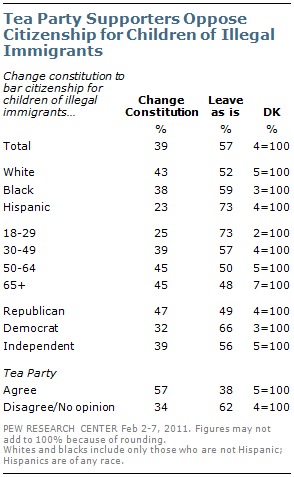
Conservatives in Congress and several state legislatures have proposed legislation to stop granting U.S. citizenship to children born to illegal immigrants, though many legal scholars say this will require a constitutional amendment. The poll finds that a 57% majority of the public opposes such a constitutional amendment, while 39% favor it. This balance of opinion is essentially unchanged from last year or 2006, when 42% favored changing the constitution and 54% opposed doing so.
Opposition to a constitutional amendment is particularly strong among Hispanics (73%) and people younger than 30 (also 73%). About half of whites (52%) oppose such a change (vs. 43% who favor it), and seniors are divided (45% in favor, 48% opposed).
There also is a sizeable partisan split on the question, with Republicans about evenly split (47% in favor, 49% opposed) and Democrats mostly opposed (66%, vs. 32% in favor). Independents divide in about the same way as the public overall (56% oppose changing the constitution, 39% are in favor).
The strongest level of support for amending the constitution is among Tea Party supporters, 57% of whom favor changing the constitution to eliminate birthright citizenship (38% oppose such a change).
AZ Law Still Broadly Supported

A solid majority of Americans (61%) continues to approve of the immigration law passed last year in Arizona that requires police to verify the legal status of anyone they detain if they suspect that the person is in the country illegally; 34% disapprove of this law. Approval of the Arizona law is essentially unchanged from June of last year.
The Arizona law is supported by 72% of whites, but only 42% of blacks and just 27% of Hispanics. A majority of Democrats (54%) disapprove of the law, while an overwhelming proportion of Republicans (88%) approve of it. Among independents, 62% approve and 34% disapprove.
Top Concerns about Illegal Immigration

Asked to choose among four options, 40% of the public say their biggest concern about illegal immigration is the burden it places on government services. About a quarter (27%) say their biggest concern is the impact on jobs, while fewer cite the impact of illegal immigration on crime (9%) and America’s customs and its way of life (6%).
While there is broad concern about the burden that illegal immigration places on government services African Americans, young people and people with less education are particularly concerned about the impact on jobs. In each of these groups at least as many cite jobs as the burden on government services as their biggest concern about illegal immigration.
