Pew Research Center

FOR RELEASE APRIL 28, 2010

Pessimistic Public Doubts Effectiveness of Stimulus, TARP

Republicans Draw Even With Democrats on Most Issues

FOR MEDIA OR OTHER INQUIRIES:

Communications Department
202.419.4372
www.pewresearch.org

RECOMMENDED CITATION

Pew Research Center, April 2010, "Pessimistic Public Doubts Effectiveness of Stimulus, TARP"

About Pew Research Center

Pew Research Center is a nonpartisan, nonadvocacy fact tank that informs the public about the issues, attitudes and trends shaping the world. It does not take policy positions. The Center conducts public opinion polling, demographic research, computational social science research and other data-driven research. It studies politics and policy; news habits and media; the internet and technology; religion; race and ethnicity; international affairs; social, demographic and economic trends; science; research methodology and data science; and immigration and migration. Pew Research Center is a subsidiary of The Pew Charitable Trusts, its primary funder.

© Pew Research Center 2026

Table of contents

  • About Pew Research Center
  • Pessimistic Public Doubts Effectiveness of Stimulus, TARP
  • Section 1: The Parties and Obama
  • Section 2: The National Economy and Economic Policies
  • Section 3: The Supreme Court
  • Section 4: Foreign Policy
  • About the Survey

Pessimistic Public Doubts Effectiveness of Stimulus, TARP

Republicans Draw Even With Democrats on Most Issues

Overview

The public remains doggedly downbeat about the condition of the national economy, even as many experts and economists see signs of recovery. As has been the case for most of the past two years, about nine-in-ten (88%) rate national economic conditions as only fair or poor, and over the past year there has been no decline in the percentage saying the economy will stay the same (36%) or get worse (19%) a year from now.

In this light, it is not surprising that many Americans are dubious about the effectiveness of the government’s principal economic programs. Just 33% say the economic stimulus passed by Congress last year has helped the job situation and only somewhat more (42%) say the loans the federal government provided to troubled financial institutions prevented a more severe financial crisis. Less

than a third (31%) says that the government has made progress in fixing the problems that caused the 2008 financial crisis.

More generally, perceptions of the job situation may well be the critical factor in the public’s economic gloom and doubts about the effectiveness of government economic policies. In a News Interest Index survey in early April, 66% said they were hearing a mix of good and bad news about the economy overall, while a majority (56%) said they were hearing mostly bad news about the job situation. (See “Public Remains Focused on Health Care Reform, April 7, 2010.)

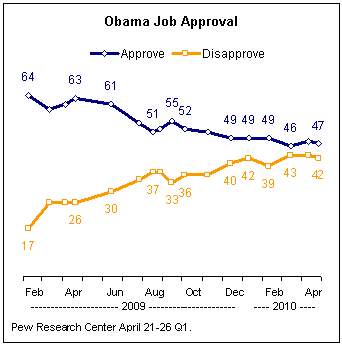
The political consequences of the public’s unabated economic pessimism are evident in the new polling. Barack Obama’s overall job approval rating is 47%, the fifth month in a row he has polled below 50%; just 38% say they approve of his handling of the economy. His party’s capabilities are now also under a cloud. The Democratic Party has lost ground to the Republican Party on a wide range of issues, including the job situation.

The latest national survey by the Pew Research Center for the Press, conducted April 21-26 among 1,546 adults, finds that as many say the Republican Party (36%) as the Democratic Party (37%) could do better in improving the job situation. Four years ago, the Democrats enjoyed a 47% to 29% advantage on this issue. Similarly, the public is evenly split over which party could do a better job of dealing with banks and financial institutions (36% each). Nor is there a consensus on who can reduce the federal budget deficit (38% Republican vs. 35% Democratic Party).

The Democratic Party holds a significant edge on only one of six issues tested – dealing with the nation’s energy problems. Even there however, its 40% to 32% advantage over the GOP is far narrower than its 22-point lead last August (47% to 25%).

Nuclear Arms Treaty Lauded

While Obama’s principal economic policies do not get good reviews, the public on balance has a positive view of his approach to the situation in the Middle East: far more say he is striking the right balance (47%) than say he favors the Palestinians (21%) or the Israelis (7%) too much.

Moreover, Obama gets broad bipartisan support for the treaty he recently signed with Russia to cut the number of nuclear weapons in both countries. Overall, 71% approve of Obama’s decision to sign the treaty, while 64% approve of Obama’s decision to declare that the United States will not use nuclear weapons against non-nuclear countries.

However, the poll finds the public split over Obama’s decision to stop developing new nuclear weapons. While most Democrats (61%) approve of this decision, about as many Republicans (66%) disapprove while independents are divided (48% approve, 47% disapprove).

More broadly, a plurality of Americans (47%) continue to say that Obama is not tough enough in his approach to foreign policy and national security issues. Most Republicans (70%) say Obama is not tough enough in dealing with national security issues, while nearly as many Democrats (66%) say his approach is about right. About half of independents (52%) say Obama is not tough enough, while 37% say he handles foreign affairs about right.

As Obama prepares to make his second Supreme Court nomination, public perceptions of the court have shifted. Today, as many Americans think the current court is liberal as say it is conservative (24% each). Three years ago, 36% said the court was conservative and just 14% saw it as liberal. This shift in views spans partisan lines, as Republicans, Democrats and independents alike see the court as less conservative than three years ago. Four-in-ten Americans say the president’s choice of the next Supreme Court justice is very important to them personally, and there is equal interest in the next nomination on the political left and right.
Section 1: The Parties and Obama

As the debate in Washington heats up over new regulations on financial markets, the public is divided evenly over whether the Republican Party or Democratic Party (36% each) can do a better job of dealing with banks and financial institutions. Another 28% offer no preference between the two. The parties are also even when it comes to dealing with the job situation – 36% see the GOP as stronger, 37% the Democratic Party. The last time this issue was tested in 2006, the Democrats held a wide 47% to 29% advantage on jobs.

Similarly, neither party has an advantage on two other key issues that may be addressed in Congress this year, immigration and energy. Currently, 36% say the GOP can do the better job on immigration, while 35% pick the Democratic Party.

The Democratic Party holds a slim edge (40% vs. 32%) when it comes to dealing with the nation’s energy problems, but its lead has narrowed substantially over the past two years. As recently as last August, 47% favored the Democrats and just 25% the Republicans on this issue.

Since last summer, there has been a sharp turnaround in the balance of public opinion with respect to foreign policy. In August 2009, 44% favored the Democratic Party on foreign policy and 31% the GOP. But today, the Republican Party holds a slim 39% to 34% edge in this issue area.

On each of these issues, the balance of opinion among independents generally mirrors the balance of opinion among the public at large, as Republican and Democratic views offset each other.

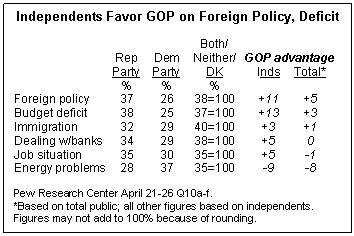
But the GOP’s edge among independents on both foreign policy and the budget deficit is significant because they are less likely to favor Democrats on these issues. The GOP holds a very small 38% to 35% edge overall on the deficit, but the margin is 38% to 25% among independents. Similarly, the GOP’s slim 39% to 34% overall lead on foreign policy becomes a 37% to 26% advantage when independents are analyzed separately. On both issues, independents are roughly twice as likely as partisans to volunteer that neither party will do a better job.

A Leaderless GOP

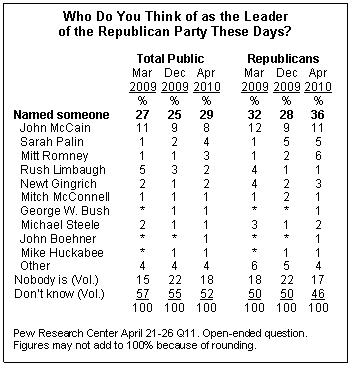
To most Americans, there continues to be no clear leader of the Republican Party. Only about three-in-ten (29%) can name someone who they think of as the leader of the GOP these days. Just over half (52%) say they don’t know, and 18% volunteer that “nobody” leads the party.

Among those offering a name, John McCain continues to be mentioned more frequently than any other Republican as the party’s leader, though only 8% of Americans cite him. Sarah Palin is named by 4%, Mitt Romney by 3%, and 2% of Americans name Rush Limbaugh and Newt Gingrich as the Republican Party’s leader.

More than a third (36%) of Republicans name someone as the party’s leader, up from 28% in December. But even among Republicans, 46% say they don’t know and 17% say nobody leads the party. As with the public at large, McCain’s name comes up more frequently than any other (11%), followed by Mitt Romney (6%) and Sarah Palin (5%). Among conservative Republicans, Romney’s name comes up about as often as McCain’s (8% vs. 9%), with Palin (6%) and Gingrich (5%) not far behind. Just 2% of the public names Rush Limbaugh as the leader of the GOP; however, 8% of liberal Democrats say Limbaugh leads the party.

Obama’s Job Approval

Barack Obama’s overall job approval ratings have remained steady in recent months, with a slim plurality approving of his job performance (currently 47%), and nearly as many disapproving (42%). About eight-in-ten Democrats (79%) approve of Obama’s job performance, up slightly from a low of 74% shortly before the passage of health care reform legislation in March. Just 18% of Republicans approve of Obama – largely unchanged over the course of 2010. Independents are divided over Obama’s job performance: 46% disapprove while 41% approve.

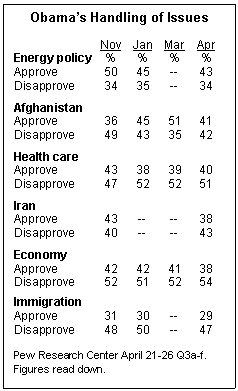
Public reactions to Obama’s handling of major domestic policies have also remained fairly steady. On the key issues of the economy and health care, slim majorities disapprove (54% and 51%, respectively) with little change over the course of the year. Health care remains the single most polarizing issue – with 70% of Democrats approving of Obama’s job compared with 11% of Republicans.

Nearly half of Americans (47%) say they disapprove of Obama’s handling of the nation’s immigration policy, while just 29% approve. This is largely unchanged from January, when 50% disapproved and 30% approved. Obama’s low ratings on immigration reflect the fact that fewer than half of Democrats (45%) say they approve of his performance on the issue. Nearly a quarter of Americans (24%) offer no opinion on Obama’s handling of immigration.

Obama receives more positive (43%) than negative (34%) ratings on the issue of energy policy, with little change in the balance of opinion since January. As with immigration, many Americans (23%) have no opinion one way or the other.

There has been more fluctuation in public ratings of Obama’s handling of Afghanistan. Currently, about as many Americans approve (41%) as disapprove (42%) of how Obama is dealing with the situation in Afghanistan. The balance of opinion was much more positive (51% approve, 35% disapprove) a month ago. In November, prior to Obama’s announcement of his Afghanistan strategy, more Americans disapproved (49%) than approved (36%). As in previous months, Obama receives better marks from Republicans for his handling of Afghanistan (31% approve) than any other issue. The partisan gap on this issue is smaller than any other, as barely half (54%) of Democrats offer a positive assessment.

Section 2: The National Economy and Economic Policies

Though many experts say the nation’s troubled economy is showing signs of recovery, much of the public does not see it. Close to nine-in-ten rate economic conditions today as either poor (49%) or only fair (39%), numbers that have changed little since last June. A majority does not expect an imminent turnaround: more than a third (36%) say they think economic conditions will be about the same a year from now, while 19% say they expect conditions to worsen.

Public perceptions of two of the federal government’s most sweeping efforts to right the economy could be contributing to the pessimism. More than six-in-ten (62%) say the economic stimulus package enacted by Congress last year has not helped the job situation, while about half (49%) say the government’s loans to banks and other financial institutions did not help prevent a more severe economic crisis. Meanwhile, the public sees little government progress toward fixing the causes of the financial crisis. About four-in-ten (42%) say they see just a little progress; 25% say they see no progress at all.

Stimulus Not Seen as Helping

Substantial majorities of Republicans (79%) and independents (69%) say that last year’s economic stimulus has not helped the job situation. Even among Democrats, opinions about the effectiveness of the stimulus are not overwhelmingly positive: 51% say it has helped the job situation while 42% say it has not.

While a clear majority of liberal Democrats (61%) say the stimulus has helped, conservative and moderate Democrats are divided. About as many say the stimulus helped the job situation (46%) as say it has not (47%).

About six-in-ten African Americans (58%) say the nearly $800 billion stimulus package has helped, more than double the percentage of whites (28%). College graduates are more likely to say the stimulus has helped the job situation (39%) than those with some college education (29%) or those with a high school diploma or less education (31%). Still, even among college graduates close to six-in-ten (57%) say the legislation has not helped the job situation.

Mixed Views of TARP’s Effectiveness

Opinions are more mixed about the effectiveness of the federal government’s program to loan billions of dollars to troubled banks and financial institutions. About four-in-ten (42%) say the loans helped prevent a more severe economic crisis, while 49% say they did not.

Again, the partisan differences are stark. More than half of Democrats (54%) say the loans did help prevent a more severe crisis, while 37% say they did not. The balance of opinion among Republicans is nearly reversed: 35% say the loans did help prevent a more severe crisis, while 56% say they did not. Notably, opinions among independents about the loans’ effectiveness are nearly identical to those of Republicans (37% helped, 58% did not).

Better educated and more affluent people are more likely to say the loan program did help prevent a more severe economic crisis. For example, 56% of those with a college degree say the loans helped prevent a greater crisis, compared with 34% of those with a high school diploma or less education. Half (50%) of those with family incomes of $75,000 or more say the loans helped, compared with 40% among those with incomes of between $30,000 and $74,999 and 39% of those with incomes of less than $30,000.

Few See Progress in Fixing Causes of Crisis

With lawmakers on Capitol Hill negotiating specifics of a financial regulatory overhaul, most Americans say the government has made little progress in fixing the problems that caused the crisis in the financial markets in the fall of 2008. Four-in-ten (42%) say it has made just a little progress, while 25% say it has made no progress at all.

About three-in-ten say the government has made a great deal (3%) or some progress (28%) in fixing these problems. These numbers are little changed from October 2009.

As they did last fall, partisans have markedly different perspectives on this question. More than four-in-ten Democrats (45%) now say the government has made at least some progress on this front, compared with 21% of Republicans and 25% of independents. About three-in-ten Republicans (32%) and independents (31%) say the government has made no progress at all, compared with 13% of Democrats.

Democrats More Upbeat About Economy’s Prospects

Most Americans see an economy that continues to struggle. About half (49%) rate economic conditions as poor, while 39% say they are only fair. Just 11% say conditions are excellent or good. In March, 53% rated economic conditions as poor, 39% said they were only fair, and 7% said they were excellent or good. These numbers have fluctuated only slightly for much of the past year.

As has been the case for several months, Democrats express less negative views of the national economy than do Republicans or independents. Majorities of Republicans (56%) and independents (55%) say the economy is poor, compared with 38% of Democrats.

About four-in-ten Americans (42%) say they think economic conditions will be better one year from now, while 36% say they expect conditions to be about the same and 19% expect conditions to be worse. Those numbers also have changed little in recent months. As with views of current economic conditions, opinions about the future economy are divided along partisan lines. Fully 61% of Democrats see the economy improving over the next year, compared with 36% of independents and just 27% of Republicans.

“Haves and “Have-Nots”

About four-in-ten Americans (42%) say they think of the nation as divided between “haves” and “have-nots.” That is up from 35% in April 2009, but comparable to the percentages measured in 2008 (43% in January and 44% in October).

Democrats (51%) are more likely than Republicans (32%) or independents (43%) to say they see a society divided between haves and have-nots. African Americans are much more likely than whites to see American society this way (66% vs. 37%).

Those with lower incomes and less education are also more likely to see a society divided in this way. Close to half (48%) of those with a high school diploma or less education say the nation is divided between haves and have-nots, more than those with some college education (40%) or college graduates (35%).

About half of those with family incomes of less than $30,000 (52%) say there is such a divide, compared with 40% of those with incomes of between $30,000 and $74,999 and 35% of those with incomes of $75,000 or more.

Just under half (45%) of the public says they see themselves as haves, while 36% see themselves as have-nots. That is little changed from surveys going back to March 2005. Not surprisingly, those with higher family incomes and the better educated are more likely to count themselves among the haves.

More than six-in-ten (63%) of those with household income of at least $75,000 say they see themselves as haves. By comparison, 31% of those with incomes of less than $30,000 and 45% of those with incomes between $30,000 and $74,999 say this. About six-in-ten college graduates (58%) say they see themselves as haves, compared with 45% of those with some college experience and 36% of those with a high school diploma or less education.

Section 3: The Supreme Court

As Barack Obama considers potential nominees to replace retiring Justice John Paul Stevens, opinion about the ideological makeup of the court is divided with 24% describing the court as “liberal”, and an equal number saying it is “conservative.” A plurality (36%) considers the current Supreme Court to be “middle of the road.” Far fewer see the court as conservative today than was the case three years ago. In July 2007, 36% said the court was conservative and just 14% said the court was liberal.

Views of the Supreme Court’s ideological leanings have shifted across party lines. Today, more Republicans see the court as liberal rather than conservative by a three-to-one margin (33% to 11%). In 2007, just 18% described the court as liberal while 26% saw it as conservative. In both years, Democrats have been more likely to see the court as conservative rather than liberal, but by a much narrower margin today (34% conservative, 20% liberal) than in 2007 (48%, 11%). As many independents now say the Supreme Court is liberal (24%) as conservative (23%), but in 2007 far more viewed the court as conservative (37%) than liberal (13%).

Conservative Republicans are the most likely to see the court as liberal (39%), while liberal Democrats are the most likely to describe it as conservative (41%). Again, these views have shifted over the past three years. In 2007, just 22% of conservative Republicans said the court was liberal, and 66% of liberal Democrats saw it as conservative.

Has the Court Shifted?

When asked to assess whether the court’s position has changed over the past few decades, 43% say that the court is about the same now as it has been. But among those who see shifts in the court’s ideology, more say the court has become more liberal (28%) than say it has moved in a more conservative direction (19%).

There are sizable partisan differences. While 44% of Republicans say they court has become more liberal over the last 20 years, 35% say it has stayed about the same and just 10% think the court has become more conservative. By comparison, about half of Democrats (51%) say the court has not changed much, while 25% say the court has become more conservative and 16% say the court has become more liberal. Among independents, slightly more see a liberal (28%) than conservative (22%) change in the court, while 41% say the court has stayed about the same.

Both conservative Republicans and liberal Democrats are more likely than others in their party to say the court has undergone a shift away from their own ideological leanings over the past 20 years. About half of conservative Republicans (49%) now say the court has become more liberal, while 35% of moderate and liberal Republicans say this. Among Democrats 36% of liberals say the court has become more conservative over the past two decades, compared with 20% of conservative and moderate Democrats.

College graduates are twice as likely as others to say the Supreme Court has become more conservative over this period. About a third of college graduates (33%) say this, compared with just 16% of those with some college experience and 11% of those who have not attended college. Men are also slightly more likely than women to say the court has become more conservative (22% vs. 16%) over the past 20 years.

Who Should Obama Nominate?

When it comes to replacing Justice Stevens, as many want to see Obama nominate someone who would make the court more liberal (27%), as more conservative (28%), while 35% say he should choose someone who will keep the court about the same as it is now. This is similar to the public’s preferences before the nominations of Ruth Bader Ginsburg in 1993 and John Roberts in 2005.

About half of Republicans (49%), including 59% of conservative Republicans, say Obama should nominate people who will make the court more conservative. By contrast, 45% of Democrats, including two-thirds of liberal Democrats (67%), say Obama should nominate people who will make the court more liberal. Among independents, 39% want to see no change in the ideology of the court, with an equal number preferring a nominee who moves the court in a conservative or liberal direction (26% ea ch).

Importance of Supreme Court Nominee

Four-in-ten Americans (40%) now say the choice of the next Supreme Court justice is very important to them personally. This is somewhat lower than the percentage saying this in July 2005, shortly after Justice Sandra Day O’Connor announced her retirement (47%).

As in 2005, Republicans and Democrats are about equally likely to say the choice of the next justice is very important to them (46% and 43%, respectively). In particular, those on the opposite ends of the ideological and partisan spectrum are the most likely to say this; 56% of both conservative Republicans and liberal Democrats say the choice is very important to them. Independents are less inclined than partisans to view the choice of the next justice as personally important (36%).

African Americans are now significantly more likely than whites to say the choice of the next justice is of personal importance. A majority of blacks (56%) now say this, compared with just 37% of whites. Older Americans are also more likely than others to say the choice of the next member of the court is very important to them. A majority (53%) of those age 65 and older say this, compared with just 43% of those ages 50-64 and only 35% of those younger than 50.

Section 4: Foreign Policy

By roughly three-to-one (71%-23%), most Americans approve of Obama’s decision to sign an arms control treaty with Russia, reducing the number of nuclear weapons in both countries. A somewhat smaller majority (64%) also approves of Obama’s recent declaration that the U.S. will not use nuclear weapons against countries that do not possess them; 30% disapprove of this policy. Support is far lower for Obama’s decision to stop the development of any new nuclear weapons by the United States; on this decision as many approve (47%) as disapprove (47%).

While Democrats are the most supportive of Obama’s nuclear policy decisions, majorities of Republicans and independents also approve of both the arms treaty with

Russia and the decision to not use nuclear weapons on non-nuclear countries. However, a there is sharp partisan disagreement over Obama’s decision to stop the development of any new nuclear weapons; Republicans disapprove of this decision by more than two-to-one (66% to 28%), while Democrats approve of it by only a slightly narrower margin (61% vs. 34%). Independents are divided with 48% saying they approve and 47% saying they disapprove.

College graduates are somewhat more supportive of all three nuclear policy decisions than are those with lower levels of education. And women (70% approve) are more likely than men (57% approve) to say they approve of Obama’s decision to not use nuclear weapons against non-nuclear countries. Notably, those who have heard a lot about Obama’s recent nuclear policy decisions express about the same views on the three decisions tested as do those who have heard a little or nothing at all about them.

Is Obama Tough Enough?

Just under half (47%) of Americans say that Barack Obama is not tough enough in his approach to foreign policy and national security issues – unchanged from last November. Nearly as many (41%) say Obama’s approach to foreign issues is about right, while just 2% say he is too tough. There is an overwhelming partisan divide on this issue – 70% of Republicans say Obama is not tough enough, while 66% of Democrats believe Obama handles foreign policy and security issues about right. Just over half (52%) of independents say Obama isn’t tough enough, while 37% say he strikes the right balance.

Opinion of U.S. Mideast Policy

In the dispute between Israel and the Palestinians a plurality of Americans continue to sympathize more with Israel (49%) than with the Palestinians (16%); 12% say they sympathize with neither side, 4% with both. The public has long expressed more sympathy for Israel than for the Palestinians and the findings from the current survey are little changed from recent years.

As has consistently been the case, more Republicans (64%) than Democrats (44%) or independents (45%) say they sympathize with Israel. Republicans have been at least 10 points more sympathetic toward Israel than Democrats or independents in each Pew Research Center survey fielded over the past decade. And support for Israel is especially strong among conservative Republicans: by an overwhelming 70%-7% margin, conservative Republicans say they sympathize more with Israel than with the Palestinians.

About two-thirds (65%) of white evangelicals say they sympathize more with Israel, while just 9% sympathize more with the Palestinians. Nearly half of Catholics (48%) and black Protestants (47%) sympathize more with Israel, as do 39% of white mainline Protestants; comparable percentages of all three groups sympathize with the Palestinians (16% of Catholics, 18% of black Protestants and 16% of white mainline Protestants). The religiously unaffiliated are more divided in their views: 37% sympathize more with Israel, 26% with the Palestinians.

A 47% plurality says Obama is striking the right balance in dealing with the situation in the Middle East, while 21% say he is favoring the Palestinians too much and 7% say he is favoring Israel too much. These figures are largely unchanged from last November, though the percent saying Obama favors the Palestinians has increased from 16% to 21%.

Republicans are critical of Obama’s handling of the situation in the Middle East. Just 28% of Republicans say Obama is striking the right balance while 38% say he favors the Palestinians too much, and 6% say he favors Israel too much. Democrats are far more supportive, with 66% saying Obama strikes the right balance. Fewer than one-in-ten Democrats say he favors either the Palestinians (7%) or Israel (8%) too much. A plurality of independents (47%) say Obama is striking the right balance; among independents who think his approach is unbalanced more say he favors the Palestinians too much (21%) than say he favors Israel too much (7%).

About the Survey

Results for this survey are based on telephone interviews conducted under the direction of Princeton Survey Research Associates International among a national sample of 1,546 adults living in the continental United States, 18 years of age or older, from April 21-26, 2010 (1,006 respondents were interviewed on a landline telephone, and 540 were interviewed on a cell phone, including 203 who had no landline telephone). Both the landline and cell phone samples were provided by Survey Sampling International. Interviews were conducted in English. For detailed information about our survey methodology, see https://alpha.pewresearch.org/pewresearch-org/politics/methodology/.

The combined landline and cell phone sample are weighted using an iterative technique that matches gender, age, education, race/ethnicity, region, and population density to parameters from the March 2009 Census Bureau’s Current Population Survey. The sample is also weighted to match current patterns of telephone status and relative usage of landline and cell phones (for those with both), based on extrapolations from the 2009 National Health Interview Survey. The weighting procedure also accounts for the fact that respondents with both landline and cell phones have a greater probability of being included in the combined sample and adjusts for household size within the landline sample. Sampling errors and statistical tests of significance take into account the effect of weighting.

The following table shows the error attributable to sampling that would be expected at the 95% level of confidence for different groups in the survey:

In addition to sampling error, one should bear in mind that question wording and practical difficulties in conducting surveys can introduce error or bias into the findings of opinion polls.