
Pew Research Center

FOR RELEASE MARCH 2, 2010

Support for Alternative Energy and Offshore Drilling

Overview The public continues to favor a wide range of government policies to address the nation’s energy supply. More than three-quarters of the public (78%) favors increasing federal funding for research on wind, solar and hydrogen technology. A large majority (70%) also favors spending more on subway, rail and bus systems. Both measures are little […]

FOR MEDIA OR OTHER INQUIRIES:

Communications Department
202.419.4372
www.pewresearch.org

RECOMMENDED CITATION

Pew Research Center, March 2010, "Support for Alternative Energy and Offshore Drilling"

About Pew Research Center

Pew Research Center is a nonpartisan, nonadvocacy fact tank that informs the public about the issues, attitudes and trends shaping the world. It does not take policy positions. The Center conducts public opinion polling, demographic research, computational social science research and other data-driven research. It studies politics and policy; news habits and media; the internet and technology; religion; race and ethnicity; international affairs; social, demographic and economic trends; science; research methodology and data science; and immigration and migration. Pew Research Center is a subsidiary of The Pew Charitable Trusts, its primary funder.

© Pew Research Center 2026

Table of contents

  • About Pew Research Center
  • Support for Alternative Energy and Offshore Drilling
  • About the Survey

Support for Alternative Energy and Offshore Drilling

Overview The public continues to favor a wide range of government policies to address the nation’s energy supply. More than three-quarters of the public (78%) favors increasing federal funding for research on wind, solar and hydrogen technology. A large majority (70%) also favors spending more on subway, rail and bus systems. Both measures are little […]

Overview

The public continues to favor a wide range of government policies to address the nation’s energy supply. More than three-quarters of the public (78%) favors increasing federal funding for research on wind, solar and
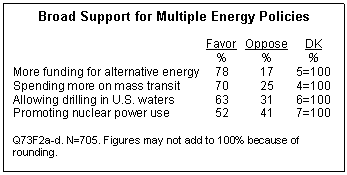
hydrogen technology. A large majority (70%) also favors spending more on subway, rail and bus systems. Both measures are little changed from recent years.

At the same time, the public continues to broadly support expanded offshore oil drilling: 63% say they favor allowing more offshore oil and gas drilling in U.S. waters while 31% are opposed. These opinions also have changed little since 2008.

And by a 52% to 41% margin, Americans favor the government promoting the increased use of nuclear power. In April 2009, the public was more divided about nuclear power (45% favor, 48% oppose), but views are similar to September 2008 (50% favor, 43% oppose). In his State of the Union address last month, President Obama pledged to build new nuclear power plants and raised the possibility of opening up offshore areas for oil and gas development.
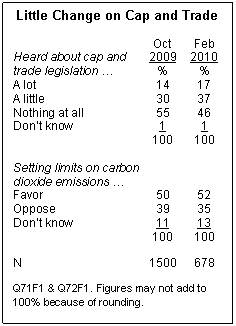
The latest national survey conducted by the Pew Research Center for the People & the Press, conducted Feb. 3-9 among 1,383 adults reached on cell phones and landlines, finds that public awareness about a policy to set limits on carbon emissions – known as “cap and trade” – is still quite low. Nearly half of Americans (46%) have heard nothing at all about the legislation being considered by the president and Congress that would set limits on carbon dioxide, down slightly from last October (55%).

Opinions about the policy also are quite stable. A majority (52%) of Americans favor setting limits on carbon dioxide emissions and making companies pay for their emissions, even if it may mean higher energy prices; about a third (35%) oppose the proposal. As was the case in October, those who have heard a lot about the legislation are more likely to oppose it (54%) than those who have heard a little (27%) or nothing at all (36%).

About the Survey

Results for this survey are based on telephone interviews conducted under the direction of Princeton Survey Research Associates International among a national sample of 1,383 adults living in the continental United States, 18 years of age or older, from February 3-9, 2010 (1,024 respondents were interviewed on a landline telephone, and 359 were interviewed on a cell phone, including 132 who had no landline telephone). Both the landline and cell phone samples were provided by Survey Sampling International. Interviews were conducted in English. For detailed information about our survey methodology, see https://alpha.pewresearch.org/pewresearch-org/politics/methodology/.

The combined landline and cell phone sample are weighted using an iterative technique that matches gender, age, education, race/ethnicity, region, and population density to parameters from the March 2009 Census Bureau’s Current Population Survey. The sample is also weighted to match current patterns of telephone status and relative usage of landline and cell phones (for those with both), based on extrapolations from the 2009 National Health Interview Survey. The weighting procedure also accounts for the fact that respondents with both landline and cell phones have a greater probability of being included in the combined sample and adjusts for household size within the landline sample. Sampling errors and statistical tests of significance take into account the effect of weighting.

The following table shows the error attributable to sampling that would be expected at the 95% level of confidence for different groups in the survey:

In addition to sampling error, one should bear in mind that question wording and practical difficulties in conducting surveys can introduce error or bias into the findings of opinion polls.