Obama’s Ratings Slide Across the Board
The Economy, Health Care Reform and Gates Grease the Skids
Overview

Barack Obama’s approval ratings have suffered major declines. The president’s overall job approval number fell from 61% in mid-June to 54% currently. His approval ratings for handling the economy and the federal budget deficit have also fallen sharply, tumbling to 38% and 32%, respectively. Majorities now say they disapprove of the way the president is handling these two issues. The new poll also finds significant declines over the last few months in the percentage of Americans giving Obama high marks for dealing with health care, foreign policy and tax policy.
Three factors have likely contributed to more negative views of Obama. First, criticisms of the government’s economic policies are mounting. For the first time since Obama took office, as many say the government is on the wrong track (48%) as on the right track (46%) in handling the nation’s economic problems. In May, 53% said the government was on the right track on the economy, while 39% said it was on the wrong track.

Secondly, the latest national survey by the Pew Research Center for the People & the Press, conducted July 22-26 among 1,506 adults reached on landlines and cell phones, finds that many of the health care proposals being debated in Congress are sparking negative reactions, especially from those following the debate most closely. By a 44% to 38% margin, more Americans generally oppose than favor the health care proposals now before Congress. Opposition rises to 56% among people who say they have heard a lot about legislation to overhaul the health care system. Concerns about the costs and increased government involvement in the health care system are volunteered most often by Americans critical of the health care proposals.
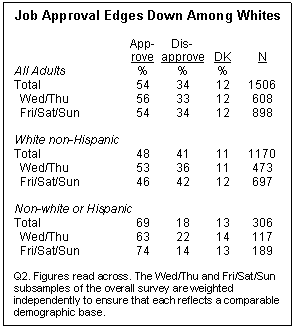
Thirdly, Obama’s comments on the arrest of Henry Louis Gates Jr. appear to have played some role in his ratings decline. News about the arrest of the prominent African American Harvard professor at his Cambridge home was widely followed by the public and 79% are aware of Obama’s comments on the incident. Analysis of the poll data found that the president’s approval ratings fell among non-Hispanic whites over the course of the interviewing period as the focus of the Gates story shifted from details about the incident to Obama’s remarks about the incident.1 Interviews Wednesday and Thursday of last week found 53% of whites approving of Obama’s job performance. This slipped to 46% among whites interviewed Friday through Sunday as the Gates story played out across the nation.

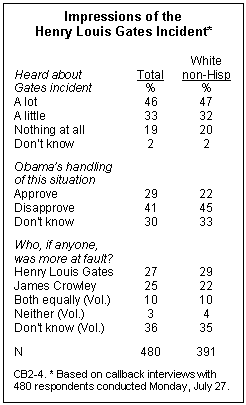
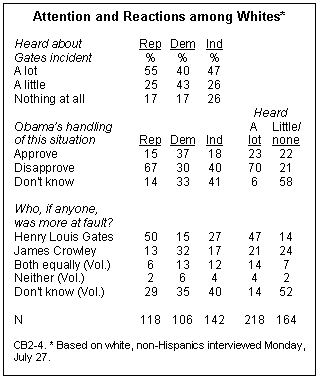
Consistent with this trend, a small re-contact survey conducted Monday night finds a mostly negative reaction, particularly among whites, to Obama’s comments on the controversy, even though the public is closely divided over who was at fault in the original dispute. Based on what people have heard about the incident in Cambridge, 27% of blame Gates, 25% fault the police officer, 13% volunteer both or neither, and 36% offer no opinion. However, more people disapprove (41%) than approve (29%) of the president’s handling of the situation. And by a margin of about two-to-one, more whites disapprove (45%) than approve (22%).
More generally, the new survey shows that since June, Obama’s overall job approval ratings dropped among most political and demographic groups. The greatest declines are apparent among Republicans and independents, poorer people, especially poorer whites, and 30 to 49 year olds. When looking at Obama’s approval ratings on specific issues, the president has lost ground, in most cases, among Republicans, Democrats and independents. Some of the larger declines are among members of his own party.
Yet Obama is widely liked by the public on a more personal level, with close to three-quarters (74%) saying they like the kind of person he is and the way he leads his life. Asked why, among the most frequent responses offered are impressions that he is honest, has integrity, is a good father and is intelligent.
A Reserve of Confidence in Obama

While the American public has grown more critical of Obama’s handling of the economy and budget deficit over the last few months, majorities continue to express optimism about his ability to fix the economy and deal with the budget deficit in the long term. As in June and April, more than six-in-ten (63%) say they are optimistic that Obama’s policies will improve the economy, and more than half (55%) say they are optimistic that he can reduce the budget deficit over time. The views of political independents account in part for the disparity between Obama’s sinking approval ratings and the continued optimism that he will succeed. Independents remain largely optimistic, but critical of the way the president is currently dealing with the economy and budget deficit. In contrast, partisans tend to see it just one way – Democrats mostly approve of Obama’s performance and are overwhelmingly optimistic about his policies. Republicans mostly disapprove and are pessimistic.
In addition, relatively few Americans (21%) believe that Obama’s policies have made the economy worse. About as many, 24% say his policies have made things better. As in previous polls, the largest share (49%) say administration policies have not yet had an effect or that it is too soon to tell. Similarly, although there has been a small uptick in the share saying Obama is trying to address too many issues at once (from 34% in April to 41% today), a plurality (48%) believes he is neither taking on too many nor too few issues.
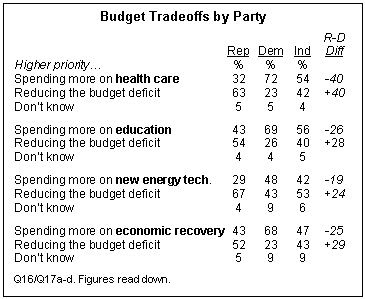
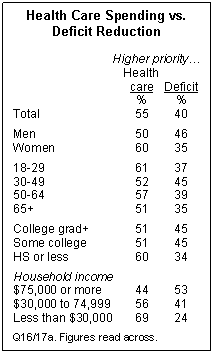
The poll also finds that while the public is expressing broader disapproval of how Obama is dealing with the budget deficit, majorities continue to give a higher priority to spending more to make health care accessible and affordable, to help the economy recover and to improve education, rather than to reducing the budget deficit. Partisan divisions on these issues remain strong – with most Republicans putting deficit reduction first and most Democrats giving priority to additional spending. Most independents continue to see spending on health care and on education as higher priorities than deficit reduction. They are split as to whether economic stimulus spending or deficit reduction is more important right now.
Reactions to Health Care Proposals
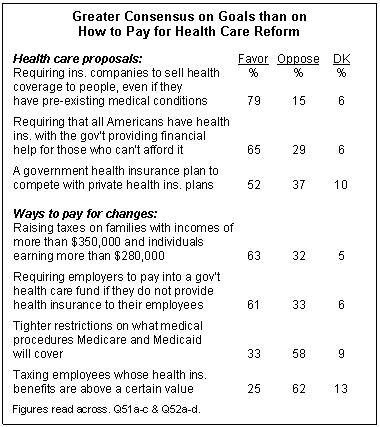
Although the public has a more negative than positive general reaction to the health care proposals being debated on Capitol Hill, there is broad support for many of the core elements of the legislation currently before Congress. Nearly two-in-three (65%) favor requiring that all Americans have health insurance, with the government aiding those who cannot afford it. Nearly as many (61%) favor requiring employers who do not provide insurance to pay into a government health care fund. And there is broad support (79%) for prohibiting insurance companies from denying insurance to people with pre-existing conditions.
But reactions to the methods proposed to make sure more people have access to health care coverage are mixed. A thin 52% majority favor a government health insurance plan to compete with private plans. There is broad support (63%), however, for raising the taxes on affluent people to help pay for changes to the health care system. On the other hand, there is equally strong opposition (62%) to new taxes on employees with health insurance benefits above a certain value. Most (58%) also oppose putting tighter restrictions on what medical procedures Medicare and Medicaid will cover.
The poll found that groups that oppose the general legislative proposals – such as Republicans, the elderly and more affluent people – do so by wider margins than backers – such as Democrats, the young and less affluent people – support the proposals.
By a margin of 50% to 23% Americans say that Supreme Court nominee Sonia Sotomayor should be confirmed. Her level of public support is much greater than was the case for Samuel Alito (33%) and about the same as support for Chief Justice John G. Roberts (46%) at roughly the same point in their confirmation processes.
 Obama’s overall job approval among the public has declined substantially since last month. While a majority (54%) continues to approve of the job he is doing, his rating is down seven points from June (61%).
 Obama’s job rating among independents and Republicans is now significantly lower than at any other point in his presidency. While Democrats are less supportive of Obama on a number of specific issues, overall job approval among Democrats is little changed from earlier in the year.
 While the balance of opinion about Obama’s overall job performance remains positive (54% approve, 34% disapprove), opinion of how the president is handling most specific issues tested is significantly more negative.
 The drops in Obama’s ratings for specific issues are greater than his overall rating decline in large part because they cross party lines. Since April, Obama’s approval on most of the issues tested has declined more among fellow Democrats than among Republicans.
 On two specific foreign policy issues – Obama’s handling of Iraq and Afghanistan – public approval stands at 47% on each. There is no direct comparison with the April survey. About six-in-ten (62%) Democrats approve of Obama’s handling of Iraq, compared with 38% each of Republicans and independents. A comparable share of Democrats (59%) approves of Obama’s handling of the situation in Afghanistan, compared with 46% of independents and 40% of Republicans.
 ten (20%) mention honesty, integrity or forthrightness. About as many (16%) volunteer Obama’s relationship with his family and 13% say they see Obama as “down-to-earth.” Mentions of Obama’s intellect, communication skills and the notion that he is “trying” were each offered by 10% of those making favorable assessments of Obama personally.
 Despite the drop in Obama’s overall public approval rating, and, more specifically, approval for his handling of the economy, more than six-in-ten (63%) say they are optimistic that his policies will improve economic conditions in the country. That’s about the same as the 65% that said they were optimistic about his economic policies in June and the 66% that said the same in April.
 About half (49%) of the public continues to say that Obama’s policies so far have not made economic conditions better or worse. The share saying his policies have had no effect so far – including those who said it was too soon to tell – stood at 53% in June.
 With Obama pushing forward on a wide range of initiatives, the number of Americans that says he is trying to address too many issues at once has increased since the spring. Four-in-ten (41%) say he is trying to do too much; 34% said the same in mid-April. Still, a plurality (48%) says he is doing about right, though that share declined from 56% in April. Small shares in each survey (4% in April, 3% in July) say he is focusing on too few issues.
 A plurality of the public says that Obama is listening more to liberals in his party than Democratic moderates (41% vs. 31%). Last month, 39% said he was listening more to his party’s liberals, while 35% said he was listening more to its moderates.
 The Senate Judiciary Committee confirmation hearings in July for Sonia Sotomayor do not appear to have changed many minds about President Obama’s Supreme Court nominee. Half of the public says Sotomayor, a veteran appeals court judge of Puerto Rican descent, should be confirmed by the Senate. That matches the share that said she should be confirmed just before the hearings.