Pew Research Center

FOR RELEASE JUNE 18, 2009

Obama’s Ratings Remain High Despite Some Policy Concerns

Health Care Views Similar to '93, But Fewer Favor Rebuilding System

FOR MEDIA OR OTHER INQUIRIES:

Communications Department
202.419.4372
www.pewresearch.org

RECOMMENDED CITATION

Pew Research Center, June 2009, "Obama’s Ratings Remain High Despite Some Policy Concerns"

About Pew Research Center

Pew Research Center is a nonpartisan, nonadvocacy fact tank that informs the public about the issues, attitudes and trends shaping the world. It does not take policy positions. The Center conducts public opinion polling, demographic research, computational social science research and other data-driven research. It studies politics and policy; news habits and media; the internet and technology; religion; race and ethnicity; international affairs; social, demographic and economic trends; science; research methodology and data science; and immigration and migration. Pew Research Center is a subsidiary of The Pew Charitable Trusts, its primary funder.

© Pew Research Center 2026

Table of contents

  • About Pew Research Center
  • Obama’s Ratings Remain High Despite Some Policy Concerns
  • Section 1: Obama and the Economy
  • Section 2: Opinions About Health Care
  • Section 3: Foreign Policy and National Security
  • Section 4: The Court and the Congress
  • About the Survey

Obama’s Ratings Remain High Despite Some Policy Concerns

Health Care Views Similar to '93, But Fewer Favor Rebuilding System

Overview

A solid majority of Americans (61%) continue to approve of Barack Obama’s job performance, although they express mixed views of several of his policies. An important positive sign for Obama is the public’s continued optimism that his policies will improve the economy – fully 65% express this view. A smaller majority (55%) is optimistic Obama will reduce the budget deficit over the long-term. Nonetheless, Obama’s job approval on the economy has declined from 60% in April to 52% currently.

The slippage in the president’s economic ratings appears unrelated to the public’s assessments of his administration’s impact on current economic conditions – most (53%) say his policies have “not had an effect so far” or that it is too early to tell. Instead, it may have more to do with his relatively poor ratings for handling the problems of troubled automakers General Motors and Chrysler.

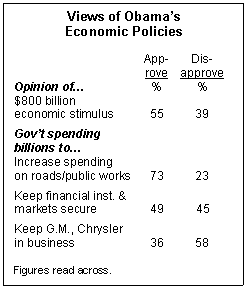
Nearly as many disapprove (44%) as approve (47%) of Obama’s performance in handling the automakers’ problems. There is even less s
upport for government efforts to keep G.M. and Chrysler in business: 58% disapprove of the government spending billions to keep the troubled automakers in business, while just 36% approve.

On other economic policies, 55% approve of the $800 billion economic stimulus passed in February and an even larger majority (73%) approves of substantially increasing spending on roads, bridges and other public works projects. But only about half (49%) approves of spending billions to keep financial markets secure and Obama draws mixed ratings for his handling of this issue (50% approve, 40% disapprove). Overall opinions about Obama’s economic policies have changed little since March.

The latest national survey by the Pew Research Center for the People & the Press, conducted among 1,502 adults June 10-14, shortly after Obama’s major overseas trip, finds the public rendering l
argely positive judgments about his approach to foreign policy. Currently, 57% approve of Obama’s handling of foreign policy, which is largely unchanged from April (61%).

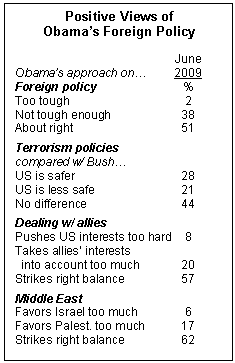
About half of Americans (51%) believe that Obama is about right in his approach to foreign policy and national security issues, while 38% say he is not tough enough. This represents a modest decline from last September, during the presidential campaign, when 45% of registered voters said he would not be tough enough on foreign policy.

Moreover, only about one-in-five Americans (21%) say that the United States is less safe from terrorism under the Obama administration than it was under the Bush administration. More than four-in-ten (44%) say Obama’s policies have not made a difference, while 28% believe they have made the nation safer from
terrorism.

And in the aftermath of his trip, Obama’s approaches to U.S. allies and the Middle East are viewed positively. Nearly three times as many say Obama is striking the right balance in dealing with U.S. allies than say he is taking the allies’ interests into account too much (57% vs. 20%). And while 62% say he strikes the right balance in dealing with the Middle East, just 17% say he favors the Palestinians too much.

However, while Obama receives solid approval ratings on North Korea (51% approve) – which a larger share of Americans see as a major threat to the United States – there is increasing disapproval of his decision to close the U.S. military prison in Guantanamo Bay, Cuba. In mid-April, the public approved of his decision by 51% to 38%: now, opinion is evenly divided (45% approve, 46% disapprove).

The survey finds that as Congress opens a major debate over reforming the nation’s health care system, public opinion about the issue has changed somewhat since President Clinton launched his unsuccessful effort to pass an overhaul of health care in 1993.
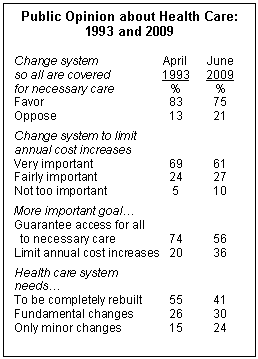
There continues to be widespread support for changing the health care system so that all Americans have insurance that covers all medically necessary care: 75% favor this currently, while 21% are opposed. However, the percentage favoring this proposal is down from 83% in April 1993. Similarly, while a large majority (61%) believes it is very important to limit annual increases in health care costs, fewer say that now than did so 16 years ago (69%).

When asked which is more important – to control annual cost increases or guarantee all Americans access to needed care – a majority (56%) says that it is more important to provide access to necessary medical care for all Americans while 36% say it is more important to control health care costs. In 1993, the public also opted for guaranteed access to care for all, but by a greater margin (74% to 20%).

Perhaps the most important change since 1993 is in the public’s assessment of how much change the current health care system needs. In April 1993, a majority (55%) said the system needed to be completely rebuilt, 26% said it needed fundamental changes, while 15% said it needed only minor changes. Today, fewer than half (41%) say the system needs to be completely rebuilt, while 30% say it requires fundamental change and 24% say the system works pretty well and needs only minor changes.

Sotmayor’s Confirmation Favored

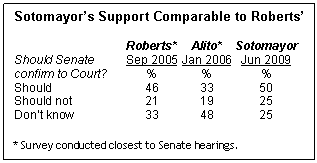
Half of Americans (50%) favor the confirmation of Judge Sotomayor to the Supreme Court while a quarter oppose her confirmation and another quarter offer no opinion. Sotomayor’s current support is comparable to s
upport for Chief Justice John Roberts just prior to his confirmation hearings in 2005.

Shortly before Samuel Alito’s hearings in 2006, a third (33%) said the Senate should confirm Alito while 19% were opposed; but nearly twice as many expressed no opinion than do so about Sotomayor’s confirmation (48% vs. 25%).

When asked about Sotomayor’s ideology, about as many people say she is moderate (34%) as say she is liberal (31%). There is a similar division of opinion about whether Obama is listening more to liberals in his party
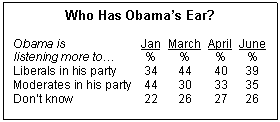
than to moderates: 39% believe that Obama listens more to liberal members of his party while 35% say that he listens more to moderate Democrats.

There has been little change in these opinions since April, when 40% said Obama listened more to liberals in his party and 33% said he listened more to moderates in the Democratic Party. However, somewhat more liberal Democrats now believe that Obama is listening more to them than did so in April; 41% of liberal Democrats say Obama listens more to liberals in his party, up from 28% in April.
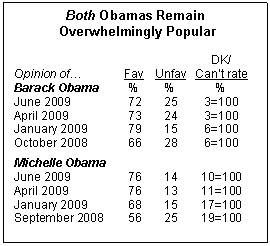
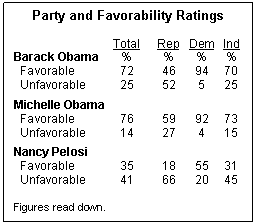
The survey finds that Obama continues to draw higher personal ratings than job approval ratings. And if anything, Michelle Obama is even more popular than her husband. More than seven-in-ten Americans (72%) say they have a favorable impression of Barack Obama, while 25% have an unfavorable opinion, virtually unchanged from April.

Michelle Obama’s personal image also changed little: 76% have a favorable view of the first lady, while 14% have an unfavorable impression. As was the case in April, a majority of Republicans (59%) say they have a favorable opinion of Michelle Obama as do even larger shares of independents (73%) and Democrats (92%).

Section 1: Obama and the Economy

While the public’s overall approval of the president has shifted little over the last few months, assessments of Barack Obama’s handling of the economy are now less positive than they were in mid-April. A slim majority (52%) continues to give Obama high marks for his handling of the economy (compared with 60% in April); four-in-ten (40%) now say they disapprove of the job he is doing on the economy.

Substantial party differences remain in views of Obama’s handling of the economy, although the decline in approval is seen across the board. Fully 80% of Democrats approve of Obama’s handling of the economy, compared with 50% of independents and just 20% of Republicans.

Views of Obama’s handling of the economy differ little by education or income. However, Americans with annual family incomes of less than $30,000 now hold considerably less favorable opinions of Obama’s handling of the economy than they did in April. Today, a slim majority (53%) of those in this group approve of the president’s handling of the economy, down from 77% approval a few months ago.

Most Expect Obama to Improve Economy

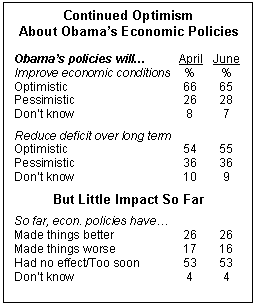
Americans’ optimism about Barack Obama’s economic policies remains high, despite the decline in his ratings on the economy. As was the case in April, about two-thirds (65%) say they are optimistic that Obama’s policies will improve economic conditions in the country; a slimmer majority (55%) say they think his policies will reduce the budget deficit over the long term.

Partisan differences persist in these views, as Democrats are nearly twice as likely as Republicans to say they are optimistic Obama’s policies will improve economic conditions (85% vs. 43%), while 63% of independents hold this view. Similarly, while 78% of Democrats expect Obama’s policies will ultimately reduce the budget deficit, only 31% of Republicans and 52% of independents say the same.

Older Americans are less optimistic on both of these measures than are younger people: While 68% of those younger than 65 are optimistic about the impact of Obama’s policies on the economy, only 54% of older Americans are similarly optimistic. A similar gap (58% to 43%) exists on the question of the budget deficit.

While public optimism about Obama’s policies remains high, there has been little shift in the perceived impact of Obama’s economic policies to date. As was the case in April, about a quarter (26%) say these policies have made economic conditions better, while 16% say they have made conditions worse. However, a majority of the public (53%) say these policies have not yet had an effect or that it is too soon to tell.

Top Concern: Too Much Spending

When asked if they had specific concerns about Obama’s economic policies, the cost of these policies is mentioned most frequently. Nearly a quarter (24%) of the public cites concerns about spending, the debt or the deficit; 13% mention a policy of Obama’s, with 5% specifically citing economic bailouts.

Republicans are more than twice as likely as Democrats (36% vs. 14%) to express concerns about the cost of Obama’s policies or their impact on the debt or deficit. About a quarter of independents (26%) raise concerns about spending or debt.

Concern that Obama’s policies will expand the scope of government or lead to socialism is cited by just 4% overall. Among Republicans, 10% cite concerns relating to the scope of government, which is less than a third of the proportion of Republicans citing excessive spending or debt (36%).

When asked about what, if anything, makes them hopeful about Obama’s economic policies, 21% mention aspects of the process or Obama’s efforts, while 16% point to specific policies or plans. A majority of Republicans (53%) say nothing about Obama’s plans makes them hopeful, compared with 30% of independents and just 14% of Democrats.

Obama’s Job on Banks, Automakers

While slightly more approve than disapprove of his handling of the problems of major banks and financial institutions (50% vs. 40%), the public is nearly evenly divided on the administration’s handling of General Motors and Chrysler (47% approve, 44% disapprove).

While about a third of Republicans (34%) approve of the way Obama had handled problems with banks and financial institutions, an even smaller percentage (26%) approves of his handling of automakers’ problems. Large majorities of Democrats approve of Obama’s handling of both issues (67% banks, 65% automakers), while fewer than half of independents approve of Obama’s job performance on problems with banks (49%) and automakers (45%).

Divisions over Stimulus and Spending

A majority (55%) of Americans approve of Obama’s $800 billion stimulus package, which was enacted in February.

Substantial majorities of both liberal (86%) and conservative and moderate (75%) Democrats approve of the stimulus package, while four-in-ten (40%) moderate and liberal Republicans and just 20% of conservative Republicans do so. As with other economic policies, independents are divided; a slim majority (52%) approves of the stimulus package.

There is broad support across the political spectrum for the government to provide billions to substantially increase spending on roads, bridges and other public works projects. But other major programs – efforts to keep financial institutions secure and Chrysler and G.M afloat – are far more contentious.

Sizable majorities of liberal Democrats (68%) and moderate and conservative Democrats (61%) approve of the government spending billions to keep banks and financial institutions secure. About half of independents (48%) and moderate and liberal Republicans (50%) agree. Only about a quarter of conservative Republicans (28%) approve of spending billions to prop up financial institutions.

Just 36% of Americans approve of spending billions to keep U.S. automakers in business. Only about half of liberal and conservative and moderate Democrats (47%) – and far fewer independents (35%) and Republicans (22%) – favor spending billions to keep the automakers in business.

Those without college experience and those with yearly incomes of less than $30,000 are somewhat more supportive of this policy than those with greater education and higher annual incomes. Regional differences are also evident, with slightly higher support among those in the Northeast than among those in the South and West.

Section 2: Opinions About Health Care

As health care reform legislation moves forward in Washington, the political environment is somewhat different than the last time a major overhaul of the health care system was attempted sixteen years ago. In early 1993 the sense of a health care crisis was far more widespread than it is today – a 55% majority in 1993 said they felt the health care system needed to be “completely rebuilt” compared with 41% today. Health care costs were also a broader problem in 1993 – 63% of Americans said paying for the cost of a major illness was a “major problem” for them, compared with 48% currently.

The issue of limiting overall health care spending is also more prominent in 2009 than it was in 1993. Somewhat fewer today say the country spends “too little” on health care, and a larger share believe that limiting the overall growth in health care costs is a higher priority than expanding coverage. But overall, public support for guaranteed access to medical care for all Americans remains widespread.

Health Care Spending

Relatively few Americans believe the country as a whole is spending the right amount on health care at this point, but there is no consensus on what the problem is. Just as many Americans say we are spending too much on health care (38%) as too little (40%).

This represents a sharp turnaround in the balance of opinion from three years ago. In early 2006, a 57% majority said that the country as a whole was spending too little on health care, while about half as many (26%) said we were spending too much. And this shift in opinion crosses party lines – more Democrats, Republicans and independents today say the country spends too much on health care than said this in 2006.

In April 1993 – as Bill Clinton was initiating his health care reform effort – 49% of Americans felt the country was spending too little on health care, while 36% said the country was spending too much. Just a year later – in June of 1994 – the public was divided, much as it is today, with 38% saying too much and 40% saying too little.

Most Democrats (51%) believe we are spending too little on health care in this country, while about a third (34%) say too much. By comparison, a plurality of Republicans (43%) say we are currently spending too much on health care, with 30% saying too little. Overall, the share of Americans saying we spend too much on health care rose from 26% to 38% since 2006, and this rise occurred among Republicans (up eight points), Democrats (up 14 points) and independents (up 11 points) alike.

While a minority viewpoint, Republicans are roughly twice as likely as Democrats (19% vs. 10%) to say the country is spending the right amount on health care. This viewpoint is particularly prevalent among conservative Republicans, 23% of whom express satisfaction about current levels of health care spending.

By a 50% to 30% margin college graduates are more likely to say the country spends too much, not too little, on health care. By contrast, adults with no more than a high school diploma tend to think we spend too little (46%) not too much (32%) on health care in this country. There is a similar, though less prominent, pattern when it comes to income levels.

Most Back Overhaul; Fewer Than in 1993 See Crisis

Most Americans believe that the nation’s health care system is in need of substantial changes. Four-in-ten (41%) say the health care system needs to be completely rebuilt, while 30% think it needs fundamental changes. About one-in-four (24%) believe that the health care system works pretty well and needs only minor changes.

But there is less support for completely rebuilding the health care system than there was during the early stage of the Clinton administration’s unsuccessful effort to revamp health care. In April 1993, a majority of Americans (55%) said the health care system needed to be completely rebuilt. As discussion of Clinton’s proposals progressed, support for completely rebuilding the health care system declined. By June 1994, just 37% said the health care

system needed to be completely rebuilt.

Support for a complete rebuilding of the health care system is lower than in early 1993 among all partisan groups. Today, 53% of Democrats, 38% of independents and 28% of Republicans support completely rebuilding the health care system. In April of 1993, 70% of Democrats, 55% of independents, and 41% of Republicans supported completely rebuilding the system.

People with no more than a high school education (47%) or some college (42%) are far more likely than are college graduates (31%) to favor a complete rebuilding of the health care system. The education gap was even wider in 1993, when 63% of those with no-college and 56% of those with some college education said the system needed to be completely rebuilt, compared with 36% of college graduates. Income is also a factor, with those living in low income households backing the most dramatic overhaul of the health care system.

Health Reform Priorities

Most Americans favor ensuring health coverage to all Americans, and most also say it is very important to limit the overall annual increase in health care costs. Neither of these objectives, however, receives as overwhelming support as they did in early 1993. When Americans are asked to prioritize between these two goals, most continue to say that expanding health insurance to all is the more important goal. But the share who rate costs as the more important concern is nearly double what it was in 1993.

The public’s overall support for expanding health insurance to cover all Americans remains widespread, though more sharply partisan than in 1993. In the spring of that year, 83% of Americans favored changing the health care system so that all Americans would have health insurance that covers all medically necessary care. Today, 75% support such a reform .

The difference is that support for universal health insurance was more bipartisan in early 1993 than it is today. While there has always been a partisan gap, two-thirds (67%) of Republicans said they favored health coverage for all Americans in 1993, compared with barely half (52%) today. By contrast, the share of Democrats backing this kind of change remained a solid 92% in both years.

There has also been a 15-point drop in the share of independents backing universal health insurance – from 89% in 1993 to 74% today.

The share of Americans who say it is very important to change the health care system in this country in order to limit the overall annual increase in the nation’s health care costs is also slightly lower today (61%) than in 1993 (69%). Today fewer than half of Republicans (47%) rate this as very important, compared with 72% of Democrats and 60% of independents.

When asked whether reining in health care costs or expanding health care coverage is the more important goal for the nation, 56% prioritize guaranteeing access to all while 36% side with limiting growing health care costs. Opinion was more one-sided in early 1993, when 74% prioritized expanded health care coverage and just 20% saw reining in costs as the bigger concern.

The balance of opinion among Republicans is the reverse of what it was in 1993. Then, 55% prioritized expanded care while 37% emphasized reining in costs. Today, 37% prioritize expanded care while 54% emphasize reining in costs. While most Democrats and independents continue to see expanding access to health care coverage as the higher priority, it is by slimmer margins than was the case sixteen years ago.

Fewer See Cost of Care as Major Problem

In the current survey, far fewer say health care expenses are a major problem for themselves and their families than was the case in 1993. Just under half of Americans (48%) say that paying for the cost of a major illness is a major problem, substantially lower than the 63% who said this in early 1993. Similarly, about a third of Americans (34%) say paying for the cost of routine medical care is a major problem for them. In 1993, 40% said this was the case.

But for the most part, it is those who are relatively well off who are feeling more at ease. Just 27% of high income Americans say the cost of a major illness is a major problem for them today, down from 48% in 1993. By comparison, 67% of low income Americans say this is a major problem, little changed from 73% sixteen years ago.

Similarly, the share of high income Americans who say paying for routine medical care is a major problem fell from 25% in 1993 to 13% today. Meanwhile, just over half of low income Americans – at both points in time – say this is a major problem for them.

There is far less concern about the quality and availability of medical care in people’s communities. Just 24% say the quality of medical care in their community is a major problem for them and their families, and 21% say the availability of medical care is a major problem. These figures are virtually unchanged from 1993. Income is an overwhelming factor in these assessments, as lower income people are far more likely than higher income people to say health care quality and availability are major problems for them.

Nationwide, 43% of Americans say paying for the cost of health insurance poses a major problem for them and their family. Fully 59% of Americans with family incomes under $30,000 say health insurance is a major problem for them. Not surprisingly among the low income who currently have no health insurance 73% rate insurance costs as a major problem.

The share of Americans who say paying for the cost of prescription drugs is a major problem dropped from 44% in 2006 to 34% today. This decline has occurred across both age and income categories at about equal rates.

Section 3: Foreign Policy and National Security

In the aftermath of North Korea’s nuclear test in late May, an increasing proportion of Americans view North Korea’s nuclear program as a “major threat.” Currently, 72% say North Korea’s nuclear program is a major threat to the well-being of the United States, up from just 53% in January.

Somewhat more Americans (78%) view Islamic groups like al Qaeda as a major threat to the United States than say that about North Korea. However, concern over North Korea’s nuclear program is now on par with concern over Iran’s nuclear program (69% view this as a major threat). The current survey was largely completed before the outbreak of widespread public protests in Iran over the country’s June 12 presidential election.

As in the past, there are sizable gaps in how Republicans and Democrats view possible international threats to the United States. Republicans are more

likely than Democrats to see most issues as major threats, with the biggest gaps over Iran’s nuclear program (15 points), the Israeli-Palestinian conflict (14 points) and Islamic extremist groups (13 points).

Notably, the partisan differences are not as wide in views of North Korea’s nuclear program: 79% of Republicans, 73% of Democrats and 69% of independents say this poses a major threat to the United States. In January, 60% of Republicans and about half of Democrats (51%) and independents (53%) viewed North Korea’s nuclear program as a major threat.

Obama and Foreign Policy

A majority of the public approves of the way Obama is handling the nation’s foreign policy (57%); however, the percent who disapprove has grown from 22% in April to 31% in the current poll. There continue to be wide partisan differences in these assessments: 78% of Democrats approve of Obama’s handling of foreign policy compared with only 37% of Republicans. More than half (53%) of independents approve, but this is down 10 points since April.

The public also generally approves of Obama’s handling of the situation with North Korea; 51% approve and 23% disapprove, while a relatively large share (26%) offers no opinion. Notably, about as many Republicans approve (36%) as disapprove (38%) of Obama’s handling of the North Korean situation.

Obama’s ratings are fairly similar to those George W. Bush received in January and February of 2003 and the public’s ratings of Bill Clinton in June of 1994. As with Obama’s overall rating on foreign policy, far fewer Republicans (36%) approve of his handling of North Korea than do independents (50%) and Democrats (64%).

Fewer Approve of Closing Guantanamo

The public is now evenly split over Obama’s plan to close the military prison at Guantanamo Bay; 45% approve of closing Guantanamo within a year, while 46% disapprove. As recently as April, 51% approved and 38% disapproved of Obama’s decision to close Guantanamo.

While most Democrats (64%) approve of Obama’s decision to close the prison, support has fallen by 12 points since April. A majority of independents (51%) disapprove of Obama’s plan to close Guantanamo while just 40% approve. There has been little change in views of Republicans; in the current poll 29% approve and 63% disapprove.

Nonetheless, more than half (52%) of the pu blic approves of transferring some of the prisoners to “federal maximum-security prisons in the U.S.” if the military prison at Guantanamo is closed, while 43% disapprove.

Other polls that asked whether prisoners should be transferred to prisons “in your community,” “in your state,” or to “prison facilities in the United States” – without explicitly mentioning that they would be placed in maximum security prisons – have found less support for this policy.

Fewer See Obama as “Not Tough Enough”

Most Americans (51%) say Obama is about right in his approach to foreign policy and national security issues, while 38% say he is not tough enough. Opinion has shifted somewhat since September 2008, when 44% of registered voters said he would be about right and 45% said he would not be tough enough. Throughout last year’s presidential campaign, voters were divided over whether they believed Obama would be not tough enough or about right in his approach to foreign policy.

As was the case last fall, the view that Obama is not tough enough on foreign policy is widely shared among Republicans. In fact, substantially more Republicans believe Obama is not tough enough in his approach to foreign policy and national security (67%) than disapprove of his handling of foreign policy (53%). By contrast, 39% of independents and just 19% of Democrats say Obama is not tough enough on foreign policy. As might be expected, an overwhelming majority (81%) of those who disapprove of Obama’s handling of foreign policy says he is not tough enough, while most of those who approve say he is about right (76%).

Obama’s Handling of Terrorism, Allies

While Obama’s terrorism policies have come under criticism from former vice president Dick Cheney and other leading Republicans, the public generally disagrees with Cheney’s contention that the country is less safe from terrorism under Obama’s administration than it was under the Bush administration.

Only about one-in-five (21%) believe Obama’s policies have made the country less safe from terrorism compared with the Bush administration; somewhat more (28%) say the country is safer now, while 44% say there has been no difference.

A plurality of Republicans (45%) say that Obama’s terrorism policies have made the country less safe, although nearly as many (37%) say there has been no change. More than four-in-ten Democrats (44%) say his administration’s policies have made the country safer when compared with Bush’s, though 45% say they have made no difference. And nearly half of independents (47%) say Obama’s policies have not made a difference, with the remainder split between those who say they have made the country safer (24%) and less safe (21%) from terrorism.

Following Obama’s first visit to Europe as president, a majority of Americans (57%) believe he is “striking the right balance” when it comes to dealings with U.S. allies. Just one-in-five (20%) say he is taking the interests of U.S. allies into account too much while 8% say he is pushing America’s interests too hard.

Republicans are evenly divided in opinions about Obama’s handling of relations with allies: 38% say he takes allies’ interests into account too much and 37% say he is striking the right balance. Nearly eight-in-ten Democrats (77%) and 56% of independents believe that Obama is striking the right balance when it comes to dealings with U.S. allies.

Obama and Israel

The public also positively views Obama’s approach to the Middle East: 62% say he is striking the right balance, while 17% say he favors the Palestinians too much and 6% believe he favors Israel too much.

While there are clear partisan differences in these opinions, Republicans are about as likely to say Obama is striking the right balance in the Middle East (43%) as say he favors the Palestinians too much (36%). Majorities of Democrats (78%) and independents (64%) say Obama is striking the right balance when it comes to the Middle East.

More white non-Hispanic evangelical Protestants (37%) than members of other religious groups say that Obama favors the Palestinians too much. However, nearly half of white evangelical Protestants (47%) believe that Obama strikes the right balance on the Middle East.

Section 4: The Court and the Congress

Half of the public (50%) says that the Senate should confirm Sonia Sotomayor to replace retiring U.S. Supreme Court Justice David H. Souter. By contrast, only a quarter (25%) says the Senate should not confirm the federal appeals court judge from New York, while another quarter (25%) did not express an opinion.

Sotomayor has strong support among Democrats, especially liberals, as well as among non-Hispanic blacks, Hispanics and college graduates. Meanwhile, Republicans are internally divided over whether President Obama’s first Supreme Court pick should be confirmed.

The opinions of moderate and liberal Republicans are much like the nation as a whole (46% support confirmation, 28% are opposed). Conservative Republicans stand staunchly in opposition; by a greater than two-to-one margin (53% to 24%), conservative Republicans say Sotomayor should not be confirmed.

Impressions of Sotomayor

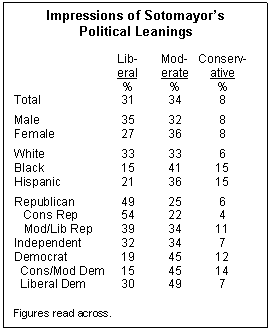
About as many Americans say Sotomayor is a moderate (34%) as describe her as a liberal (31%). Fewer than one-in-ten (8%) say she is conservative, while 26% offer no opinion.

While Republicans and Democrats differ in their impressions of Sotomayor’s ideology, there also are divisions within both parties. A majority of conservative Republicans (54%) say Sotomayor is liberal while 22% say she is moderate. Moderate and liberal Republicans are more evenly divided – 39% say she is liberal and 34% moderate.

Democrats generally view Sotomayor as moderate – more than twice as many say she is moderate (45%) than liberal (19%). However, liberal Democrats are more likely than than conservative and moderate Democrats to describe Sotomayor as liberal (30% vs. 15%). Like the public, independents are evenly divided, with 32% saying she is liberal and 34% saying she is moderate.

By greater than two-to-one (41% to 15%), more African Americans say that Sotomayor is moderate rather than liberal. More Hispanics also view her as moderate (36%) than liberal (21%). Non-Hispanic whites are evenly divided (33% liberal, 33% moderate).

Importance of Court Issues

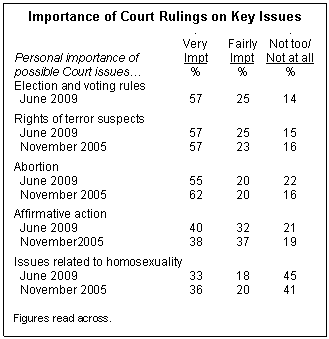
Among the issues that may face the Supreme Court in coming years, comparable majorities say that election and voting issues (57%), the rights of terrorist suspects (57%) and abortion (55%) are very important to them personally. Smaller percentages view affirmative action (40%) and issues related to homosexuality (33%) as very important.

These opinions have shown little change since November 2005, although fewer people now cite abortion as very important (55%) than did so four years ago (62%). Since 2005, there has been an 11-point decline in the percentage of Democrats rating abortion as very important (from 68% to 57%); fewer independents also view abortion as very important personally (58% in 2005, 50% currently). There has been no change in the views of Rep ublicans; as in 2005, 62% regard abortion as very important to them personally.

For the most part, there are only modest partisan differences in opinions about the personal importance of issues that may come before the Supreme Court. About six-in-ten Democrats (62%) say that court decisions about election and voting rights are very important to them personally, compared with 55% each for Republicans and independents. However, this is a particularly important issue for African Americans – 78% say it very important – compared with 53% of whites and 60% of Hispanics.

There are partisan differences over the importance of affirmative action. About half of Democrats (49%) say court decisions on this are very important, compared with 39% of Republicans and 35% of independents. A majority (59%) of African Americans say that affirmative action issues that come before the Supreme Court are very important to them personally, compared with 42% of Hispanics and 36% of whites.

Ratings of Republican Leaders

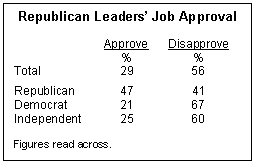
The job approval of Republican leaders in Congress remains at near record lows. Currently, 29% approve of the job Republican leaders in Congress are doing, while a majority (56%) disapproves. Approval ratings are little changed from March when Republican leaders received their lowest approval marks (28%) since Pew Research first began tracking the question in 1994.

In large part, low overall ratings for Republican leaders in Congress reflect ambivalence among those in their own party. Fewer than half of Republicans (47%) approve of the work their congressional leaders are doing; however, about as many (41%) disapprove. In addition, a majority of independents offer critical assessments of Republican leaders in Congress: 60% disapprove of their performance, just 25% approve. Democrats are predictably critical of the performance of Republican leaders (67% disapprove), but no more so than Republicans are of Democratic congressional leaders (75% disapprove).

Democratic Leaders’ Approval Slips

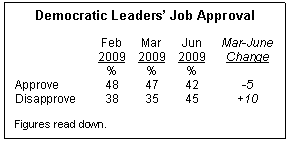
Approval of Democratic congressional leaders has slipped somewhat since earlier in the year. In February, shortly after Barack Obama’s inauguration, a 48% plurality approved of the job Democratic leaders were doing while less than four-in-ten (38%) disapproved. These generally favorable ratings held through March.

Since then, however, approval of Democratic leaders in Congress has slipped five points while disapproval has climbed 10 points. As a result, about as many now disapprove (45%) as approve (42%) of the job Democratic leaders in Congress are doing. The trend in opinion among political independents mirrors that of the general public: Currently, just 33% of independents approve of how Democratic leaders are handling their job while 53% disapprove; this represents an eight-point drop in approval from March.

Working Together?

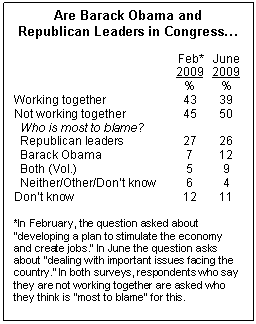
Half of the public (50%) says that Barack Obama and Republican leaders in Congress are not working together in dealing with important issues facing the country, while 39% say they are working together. Opinion was more divided in February over whether the White House and GOP congressional leaders were working together in developing a plan to stimulate the economy (45% not working together; 43% working together).

When asked who is to blame for the two sides not working together, more than twice as many say Republican leaders than say Obama (26% vs. 12%). However, the percent saying Obama is to blame is up from 7% in February, and the share volunteering that both are to blame is also up from 5% to 9%.

A majority (59%) of Republicans now say Obama and Republican congressional leaders are not working together: 28% blame Obama, 11% blame Republican leaders and 12% blame both. Democrats are more divided: 45% think they are working together and the same percentage says they are not. Many more Democrats say Republican leaders are to blame (38%) than fault Obama (2%). A majority (52%) of independents say the two sides are not working together; more than a quarter (27%) blame GOP leaders while 11% blame Obama.

Favorable Ratings: Pelosi and the Obamas

About a third of the public (35%) holds a favorable opinion of Speaker of the House Nancy Pelosi, while 41% express an unfavorable view of her. While the overall balance of opinion is mixed, far more hold a very unfavorable opinion (25%) of Pelosi than say they have a very favorable opinion (8%).

Two-thirds of Republicans (66%) hold an unfavorable impression of Pelosi, while just 18% offer a favorable opinion of the speaker of the house. Among independents, a 45% plurality offers an unfavorable impression, 31% offer a favorable one. More than half of Democrats (55%) view the speaker of the house positively, while 20% offer a negative assessment.

Barack and Michelle Obama receive much more positive ratings from all partisan groups than does Pelosi. A majority of Republicans (59%) rate Michelle Obama favorably. Her ratings are even higher among independents (73% favorable), and more than nine-in-ten (92%) Democrats express a favorable view of Michelle Obama.

Barack Obama continues to register relatively high favorability ratings. An overwhelming 94% of Democrats hold a favorable opinion of Obama, as do 70% of independents. Republican opinions are more mixed: 52% view Barack Obama unfavorably, while 46% take a favorable view of the president.

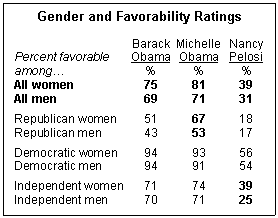
There is a modest gender gap when it comes to evaluations of these three Democratic political figures; women are 10 points more likely than men to rate Michelle Obama favorably, six points more likely to rate Barack Obama favorably, and eight points more likely to rate Nancy Pelosi favorably.

To some extent, these gaps reflect the fact that women are substantially more likely to identify as Democrats overall – 40% of women say they are Democrats compared with 28% of men. But even when party is taken into account, gender is a factor in views of Michelle Obama and Nancy Pelosi. Two-thirds (67%) of Republican women offer a favorable assessment of Michelle Obama, compared with 53% of Republican men. And Pelosi gets better ratings among women independents (39%) than among men independents (25%).

About the Survey

Results for this survey are based on telephone interviews conducted under the direction of Princeton Survey Research Associates among a nationwide sample of 1,502 adults, 18 years of age or older, from June 10-14, 2009 (1,126 respondents were interviewed on a landline telephone, and 376 were interviewed on a cell phone, including 153 who had no landline telephone). Both the landline and cell phone samples were provided by Survey Sampling International. Interviews were conducted in English and Spanish. For detailed information about our survey methodology, see https://alpha.pewresearch.org/pewresearch-org/politics/methodology/.

The combined landline and cell phone sample are weighted using an iterative technique that matches gender, age, education, race/ethnicity, region, and population density to parameters from the March 2008 Census Bureau’s Current Population Survey. The sample is also weighted to match current patterns of telephone status and relative usage of landline and cell phones (for those with both), based on extrapolations from the 2008 National Health Interview Survey. The weighting procedure also accounts for the fact that respondents with both landline and cell phones have a greater probability of being included in the sample.

The following table shows the error attributable to sampling that would be expected at the 95% level of confidence for different groups in the survey:

In addition to sampling error, one should bear in mind that question wording and practical difficulties in conducting surveys can introduce error or bias into the findings of opinion polls.