
Pew Research Center

FOR RELEASE JANUARY 15, 2009

Strong Confidence in Obama – Country Seen As Less Politically Divided

America's Pre-Inauguration Mood

FOR MEDIA OR OTHER INQUIRIES:

Communications Department
202.419.4372
www.pewresearch.org

RECOMMENDED CITATION

Pew Research Center, January 2009, "Strong Confidence in Obama – Country Seen As Less Politically Divided"

About Pew Research Center

Pew Research Center is a nonpartisan, nonadvocacy fact tank that informs the public about the issues, attitudes and trends shaping the world. It does not take policy positions. The Center conducts public opinion polling, demographic research, computational social science research and other data-driven research. It studies politics and policy; news habits and media; the internet and technology; religion; race and ethnicity; international affairs; social, demographic and economic trends; science; research methodology and data science; and immigration and migration. Pew Research Center is a subsidiary of The Pew Charitable Trusts, its primary funder.

© Pew Research Center 2026

Table of contents

  • About Pew Research Center
  • Strong Confidence in Obama – Country Seen As Less Politically Divided
  • Section 1: Obama and His Administration
  • Section 2: A New Era in the Capital
  • Section 3: Opinions About Iraq and Afghanistan
  • Section 4: Favorability of Political Figures and Parties
  • About the Survey

Strong Confidence in Obama – Country Seen As Less Politically Divided

America's Pre-Inauguration Mood

Overview

Public confidence in Barack Obama to deal with the nation’s most pressing problems is quite high, with about seven-in-ten saying they have at least a fair amount of confidence that he will do the right thing when it comes to mending the economy, preventing terrorism, and in dealing with Iraq. Notably, many Americans not only see the president-elect as a problem-solver, but as a “uniter” as well.
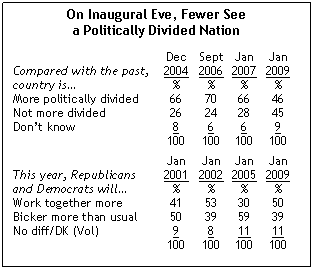
For the first time in several years, there has been a sharp decline in the proportion of Americans who say the country is more politically divided than in the past. Fewer than half (46%) now see the country as more divided, down 20 points from January 2007 (66%).

Moreover, the percentage saying that Republicans and Democrats in Washington will work together more to solve problems, rather than bicker and oppose each other, is markedly higher than it was at the start of either of President Bush’s two terms. Currently, 50% say the two parties will work together more to solve problems, while 39% expect more partisan bickering. Four years ago, just 30% said the two parties would work cooperatively while nearly twice as many (59%) said they anticipated more partisan bickering. Public expectations for partisan cooperation are now as great as in January 2002, amid the mood of national unity that prevailed after the Sept. 11 attacks.

Democrats are particularly optimistic about prospects for partisan cooperation: 59% of Democrats say they expect the two parties to work together more, compared with 49% of independents and 40% of Republicans.

These trends may well reflect strikingly different perceptions of the partisan influences on President-elect Obama and President Bush. A 44% plurality says that when it comes to matters of national policy, Obama listens more to moderate members of his party, while 34% believe he listens more to liberals in his party. This is in sharp contrast to how President Bush has been viewed. Throughout most of his presidency, but particularly in his second term, Bush has been viewed as listening more to conservatives than moderates in his party.

The latest national survey by the Pew Research Center for the People & the Press, conducted Jan. 7-11 among 1,503 adults on cell phones and landlines, finds that Americans are enthusiastic about Obama and broadly approve of his handling of the presidential transition. Fully 79% of Americans – including 59% of Republicans – say they have a favorable impression of Obama. That is far higher than Bush’s personal favorability shortly before he took office in 2001 (60%).
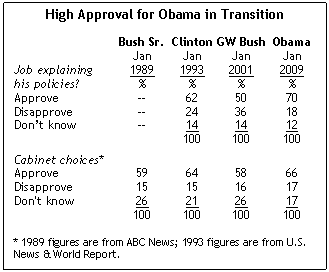
Seven-in-ten (70%) approve of the job Obama has done in explaining his plans and policies for the future. This rating tops those achieved by both George W. Bush and Bill Clinton as they were taking office.

About two-thirds of Americans (66%) approve of Obama’s choices for his cabinet and other high-level posts. While that is slightly lower than the proportion saying this in December (71%), it exceeds positive ratings for the cabinet selections of both George W. Bush (58%) and his father (59%), and is on par with approval of Bill Clinton’s cabinet picks in January 1993 (64%).

As is typically the case at this stage, most Americans think it is too early to tell whether Obama will be a successful or unsuccessful president. Yet optimists far outnumber pessimists (30% successful vs. 4% unsuccessful). At a comparable point in 2001, 26% said they expected Bush to be successful, compared with 15% who said he would be unsuccessful.
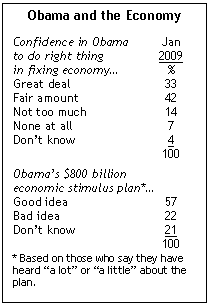
Large majorities say they have at least some confidence in Obama’s judgment on the big issues facing the country – including 75% who say they have a great deal (33%) or a fair amount (42%) of confidence in Obama to do the right thing to fix the economy. His economic stimulus package, which has not been finalized but may total about $800 billion, is viewed as a good idea by 57% of those who have heard something about the plan. However, a small plurality of Republicans who have heard about the plan (43%) view the emerging proposal as a bad idea – perhaps an indication that the anticipated era of partisan cooperation may be short-lived.

Despite the troubled economy, Americans are about as optimistic about the coming year as they were at about this point a year ago. Currently, 52% say they expect that 2009 will be better than 2008, which is about the same as the percentage saying that about a year ago (50% in December 2007). Two years ago, in looking ahead to 2007, 57% expected that year to be an
improvement from 2006.

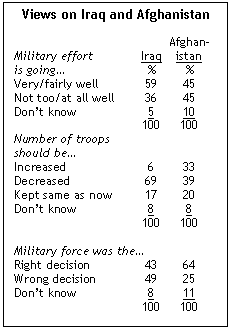
The survey also finds continuing concern about the situation in Afghanistan. Far more people now believe that the military effort in Iraq is going very or fairly well than say the same about the U.S. operation in Afghanistan (59% vs. 45%).

The public’s views on other aspects of the two wars also are in sharp contrast: while a large majority (69%) favors decreasing the number of U.S. troops in Iraq, there is no consensus regarding troop levels in Afghanistan. Nearly four-in-ten (39%) say the number of U.S. troops there should be decreased, while 33% say the number of forces should be increased and 20% favors keeping the number of troops the same as it is now.

Winners and Losers in New Era

The public’s belief that Washington will change dramatically under the new president is seen in the groups that are expected to gain and lose influence during Obama’s presidency. The list of perceived winners and losers is very different than for Bush’s administration in January 2001 and more closely resembles the predicted winners and losers for Clinton’s presidency in 1993.

Fully 73% say that poor people will gain influence, while just 8% say they will lose influence. Prior to both of Bush’s terms, pluralities said that poor people would lose influence (40% in January 2001, 49% in January 2005). Before Clinton took office, 61% said poor people would gain influence.

Other predicted winners under Obama’s presidency are younger people (71% gain influence), blacks (67%), children (64%), environmentalists (60%) and women (58%). Nearly half (47%) say that “people like yourself” will gain influence; that is greater than the percentages saying average people would gain influence under Bush’s presidency in 2001 (35%) and 2005 (22%).

More than four-in-ten say that wealthy people (44%) and business corporations (42%) will lose influence under Obama’s administration, the highest percentages for any group tested. A 38% plurality also says that Washington lobbyists will lose influence under the new president.

Section 1: Obama and His Administration

Public opinion about President-elect Obama’s transition continues to be very positive. Seven-in-ten approve of the job Obama has done so far in explaining his policies and plans for the future, while just 18% disapprove.

These numbers have changed little since December (72% approve) and are significantly higher than opinions about George W. Bush (50%) and Bill Clinton (62%) before they took office.

An overwhelming majority of Democrats approve (92%) of the way Obama has explained his policies and plans. Democrats’ views have not changed since December and are considerably higher than those for Clinton in 1993 (77% of Democrats approved). In contrast, Republicans’ opinions are more evenly divided (44% approve, 41% disapprove), which is similar to Republicans’ views in December. In January 1993, 43% of Republicans approved of Clinton’s performance in explaining his policies. Two-thirds of independents (67%) approve of the job Obama has done explaining his future plans, down slightly from December when 76% approved. This is comparable to independents’ ratings of Clinton in 1993 (63% approve).

As is typically the case at the beginning of a new administration, a majority of Americans (65%) say that it is too early to tell whether Obama will be a successful or unsuccessful president. The balance of opinion among those who offer an opinion is much more positive than negative; 30% of the public says Obama will be a successful president while only 4% say he will be unsuccessful.

A comparable proportion said that Bush would be successful in January 2001 (26%), but slightly more said he would be unsuccessful (15%); 58% said it was too early to tell. In the summer of 1993, after Clinton had been in office six months, 60% said it was too early to tell; 13% said Clinton would be a successful president; and 25% thought he would be unsuccessful.

Nearly half of Democrats (47%) say Obama will be successful compared with only 24% of independents and 13% of Republicans. Large majorities of Republicans (77%) and independents (73%), as well as about half of Democrats (51%), say that it is too early to tell whether Obama will be a successful president.

Confidence in Obama

Substantial majorities of Americans express confidence in Obama to do the right thing when it comes to fixing the economy, preventing terrorist attacks and handling the war in Iraq. Three-quarters of the public (75%) says they have at least a fair amount of confidence in Obama to do the right thing when it comes to fixing the economy. Similarly, 71% say they have at least a fair amount of confidence in Obama to prevent future terrorist attacks and 69% say the same about Iraq.

There are substantial partisan differences in how much confidence people have in Obama to handle these issues. Democrats are overwhelmingly confident in Obama; 91% have at least a fair amount of confidence in Obama to do the right thing when it comes to the economy, 89% in preventing terrorist attacks and 88% in Iraq. Similarly, about seven-in-ten independents have at least a fair amount of confidence in Obama to do the right thing when it comes to terrorism (74%), the economy (73%) and Iraq (69%).

A narrow majority of Republicans (52%) say they have at least a fair amount of confidence in Obama to do the right thing in fixing the economy; 44% of Republicans say they have at least a fair amount of confidence in him to do the right thing in dealing with Iraq, while 39% have confidence in him to prevent terrorist attacks.

Obama’s Economic Stimulus Plan

More than eight-in-ten Americans have heard a lot (33%) or a little (53%) about Obama’s proposed $800 billion economic stimulus package. Only 13% have heard nothing at all about his stimulus plan. Of those who have heard about the plan, a majority (57%) thinks the proposal is a good idea, while 22% think it is a bad idea.

Three-fourths of Democrats (75%) who have heard at least a little about Obama’s proposal say it is a good idea, compared with 53% of independents and only 37% of Republicans. Conservative Republicans are particularly negative: half of conservative Republicans (50%) who have heard at least a little about the the plan say it is a bad idea, compared with 32% of moderate and liberal Republicans. Comparable majorities of liberal Democrats (79%), and moderate and conservative Democrats (73%), who have heard at least a little about the plan view it positively.

Overall, those who have heard more about the stimulus package are somewhat more likely to favor it; 63% who have heard a lot about the proposal think it is a good idea, compared with 53% who have heard a little. Democrats who have heard a lot about the proposal are particularly positive about it. Nearly nine-in-ten Democrats (87%) who have heard a lot about the proposal say it is a good idea, compared with 67% who have heard a little about it. The pattern is reversed for Republicans; those who have heard a lot about the plan are more likely to say it is a bad idea. More than half of Republicans (53%) who have heard a lot about the plan say it is a bad idea compared with only 36% who have heard a little.

Obama’s Influences and Appointments

A plurality of the public (44%) says that when it comes to national policy, Obama is listening more to moderates in his party while about a third (34%) says he listens more to liberals in his party. Shortly before George W. Bush took office in 2001, more people said he was listening to conservatives in his party than to GOP moderates (48% vs. 37%). As Bush began his second term in January 2005, 54% said he listened more to conservatives in his party and only 27% said he listened more to the party’s moderates.

Currently, half of Democrats say Obama is listening more to the party’s moderates while 27% say he is listening more to liberal Democrats. Independents, by a slightly smaller margin (46% to 34%) also say that Obama listens more to his party’s moderates. By comparison, nearly half of Republicans (48%) say Obama listens more to liberals in his party, while 37% say he listens more to moderate Democrats.

In general, Obama’s choices for cabinet positions and other high-level posts get positive marks and most people say it is a good thing that many of his appointees worked in the Clinton administration. Two-thirds (66%) say they approve of Obama’s choices for his cabinet and other high level appointments. That is down slightly from 71% in early December as he started to make his appointments, but is still higher than the percentages giving positive ratings to George W. Bush’s top appointees in January 2001 (58%), and George H.W. Bush’s in January 1989 (59%). It is comparable to the 64% approval mark for Bill Clinton’s choices in January 1993.

Nearly nine-in-ten Democrats (87%) say they approve of Obama’s cabinet choices, as do 63% of independents and 45% of Republicans. In January 2001, George W. Bush’s choices for the cabinet and other senior positions received about the same approval rating from Democrats that Obama’s choices currently receive from Republicans (44%).

Public views of Obama’s advisors’ ties with the Clinton administration are comparable to opinions expressed in 2001 about the ties that George W. Bush’s advisors had to his father’s administration. Currently, 59% say it is a “good thing” that many of Obama’s top advisors served in the previous Democratic administration, down slightly from 63% in early December. In 2001 as Bush took office, 56% said it was a good thing that so many of his top advisors had served in his father’s administration.

Nearly eight-in-ten Democrats (79%) say it is a good thing that many Obama appointees also served under Clinton; just 4% see the ties to the Clinton administration as a bad thing. Independents, by 59% to 22%, also view the associations with the Clinton administration positively. Republicans, on balance, say it is a bad thing rather than a good thing that many of Obama’s advisors served in the Clinton administration (47% to 36%).

Most Plan to Watch the Inauguration

Two-thirds of Americans (67%) say they plan to watch Obama’s inauguration on Jan. 20. Not surprisingly, even higher percentages of Democrats, Obama voters and African Americans say they plan to tune in.

Fully 85% of Democrats say they plan to watch Obama’s inauguration, compared with 62% of independents and 49% of Republicans. Similarly, 89% of Obama voters say they plan to watch, while just 46% of McCain voters say the same. More than nine-in-ten (92%) African Americans plan to watch the historic inauguration, which is significantly more than the 63% of white respondents who expect to tune in.

Slightly more than four-in-ten (43%) say they would attend the inauguration if offered a ticket, while 56% say they would not attend. These results mirror a Fox Opinion Dynamics poll conducted in January 2005 in which 42% said they would attend that year’s Bush inaugural if offered a ticket and 57% said they would not attend.

As expected, far more Democrats (54%) and independents (46%) than Republicans (23%) say they would attend the inauguration if they were offered a ticket. Nearly two-thirds of those younger than 30 (65%) say they would attend the inauguration if they were offered a ticket, the greatest share of any age group. Just 19% of those ages 65 and older say they would attend the ceremony.

Section 2: A New Era in the Capital

Public’s Forecast: Reduced Partisanship

As Barack Obama prepares to take office, half of the public (50%) thinks that Republicans and Democrats in Washington will work together more to solve problems in the coming year, while 39% say they will bicker and oppose each other more than usual.

The public is more optimistic on this measure than it was eight years ago – at the start of George W. Bush’s first term in office – when 41% said the two parties would work together while 50% predicted more partisan bickering. Forecasts were even more downbeat at the start of Bush’s second term. In January 2005, just 30% said they thought party leaders would work together more, while a 59% majority expected increased opposition. Optimism for bipartisan cooperation has not topped 50% since January 2002 – shortly after the Sept. 11 terrorist attacks – when 53% of the country thought Republicans and Democrats would work together more cooperatively in the coming year.

Democrats are much more likely than Republicans to predict increased cooperation between the parties in the coming year. Nearly six-in-ten Democrats (59%) say partisans will work together more, compared with 40% of Republicans. In January 2001, more Republicans (51%) than Democrats (34%) anticipated improve d partisan relations in Washington. In 2005, Republicans, Democrats and independents were all about equally skeptical that the two parties would work together more.

Fewer See Country as Politically Divided

In addition to greater optimism about bipartisan cooperation in Washington, fewer now describe the country as a whole as more politically divided than in the past. In the current survey, 46% say the country is more politically divided these days than in the past; about as many (45%) say the country is not more divided. The share of the public calling the country more politically divided has fallen 20 points since January 2007, when two-thirds (66%) saw greater political divisiveness.

Democrats and independents, in particular, are much less likely to say the country is politically divided than they were in January 2007. Currently, 36% of Democrats see the country as more politically divided than in the past – half the level of two years ago (72%). The proportion of independents who say the country is more politically divided has fallen by 18 points in the same period (from 67% to 49%). But 57% of Republicans say the country is more politically divided, which is little changed from two years ago (62%).

While the public senses less division at the national level, there has been only a modest shift in their own personal interactions. Currently, 47% of Americans say the people they know are more politically divided than in the past, down only slightly from 51% in 2007 and 53% in 2004. More Republicans (56%) than Democrats (42%) say the people they know are more politically divided than they used to be.

Most Are Optimistic About 2009

Not since Ronald Reagan in 1981 has a newly inaugurated president faced a public more dissatisfied with national conditions. Just 20% are satisfied with the way things are going in the country today, while 73% say they are dissatisfied. The measure of national satisfaction, while low historically, is higher than it was in October, when just 11% expressed a positive view of national conditions.

Despite the negative national mood, most Americans say that 2009 will be a better year than 2008. More than half (52%) say they think the current year will be an improvement on the one just passed, while 37% think 2009 will be worse than last year. Nearly two-thirds of Democrats (64%) say things will be better compared with 38% of Republicans. This is a reversal from the outlooks for the past two years, when Republicans were more optimistic than Democrats. More independents say 2009 will be better than say it will be worse (54% to 38%), which is comparable to independents’ expectations for 2008 and 2007.

When asked an open-ended question on why they think 2009 will be better or worse than 2008, respondents focused on two major themes: the economy and the transfer of power to a new administration. Among those who think 2009 will be a better year, fully 56% mentioned political change or the new administration as a reason for their optimism. While politics was by far the most common response, 14% cited optimism about the economy as a reason why 2009 will be better than 2008.

Those who think the coming year will be worse than 2008 mentioned the economy most often to explain why they feel that way. Nearly six-in-ten (59%) said the economy is the reason they think 2009 will be worse than 2008; Obama replacing Bush in the White House was mentioned by 17% of those who have a negative outlook for 2009.

Winners and Losers

The public has clear ideas about which groups will gain and lose influence under Barack Obama’s administration, and its assessment of likely winners and losers is vastly different than the list for the Bush administration eight years ago.

In the public’s mind, poor people, young people and blacks will gain influence under the Obama administration. Nearly three-quarters (73%) say that poor people will gain influence with Obama taking office, and 71% say the same about younger people.

Two-thirds (67%) believe blacks will gain influence; in January 1993, virtually the same percentage (66%) said they expected blacks to gain influence during Bill Clinton’s administration. Women are also seen as big winners with the Obama administration – 58% say they will gain influence in the coming years. Nearly half (46%) say that Hispanics will gain influence under Obama – just 9% say they will lose influence. And by a margin of 40% to 11%, more say gays and lesbians will also gain, rather than lose, influence.

In terms of organized interests, both environmentalists and union leaders are seen as gaining influence with the transition of power. Six-in-ten (60%) say environmentalists will gain influence by Obama taking office, while just 7% say they will lose influence. Somewhat fewer (46%) say that the influence of union leaders will increase; 18% say union leaders will lose influence under the new president.

With poor people topping the list of groups that will gain influence in the coming years, it may be no surprise that wealthy people are seen as the biggest losers. Just 17% of Americans say that wealthy people will gain influence with Obama in office, while a plurality (44%) says they will lose influence. Other groups seen as more likely to lose than gain influence in the coming years are: business corporations (42% lose, 29% gain); Washington lobbyists (38% lose, 21% gain); and conservative Christians (36% lose, 21% gain).

Comparing Administrations

Public perceptions of who would win and lose were starkly different as George W. Bush was taking office in January 2001. The military and business corporations were widely viewed as gaining influence, while a majority (51%) also said that conservative Christians would gain. The public again sees the military gaining, rather than losing, influence under Obama (37% gain vs. 26% lose), but by a much smaller margin than under Bush (72% gain vs. 4% lose).

In many cases, expectations for winners and losers under Obama mirror those expressed in January 1993 on the eve of Bill Clinton’s first inauguration. Blacks are widely expected to gain influence under Obama, but virtually the same percentage said that just before Clinton took office in 1993 (67% Obama, 66% Clinton). By contrast, in January 2001 about as many thought blacks would lose influence (29%) as gain influence (30%) with Bush taking office.

Poor people and younger people also were predicted to be winners as Clinton took office in 1993, and expectations that these groups will gain influence are even more pronounced today. Environmentalists were predicted to gain influence under Clinton, as they are with Obama; a plurality thought environmentalists would lose influence under Bush. More people expected union leaders to gain rather than lose influence under Clinton (35% vs. 24%), but that view is more widely shared today (46% vs. 18%).

In January 1993, 34% predicted business corporations would gain influence under Clinton while a comparable percentage (33%) said they would lose influence. As Bush prepared to take office in 2001, 66% thought business corporations would gain influence and just 9% predicted they would lose influence. Today, a 42% plurality thinks that business corporations will lose influence, while 29% see their influence growing.

Opinions about whether children and older people will gain or lose influence have remained fairly stable across the past three presidential transitions. On balance, these groups have been seen as l ikely to gain influence under Clinton, Bush and Obama.

Obama Benefits ‘People Like Yourself’

Perhaps the most critical question is how people see the new administration affecting people like themselves, and by this measure Obama is viewed quite favorably. Nearly half of Americans (47%) say that people like themselves will gain influence as he takes office, while just 18% say people like themselves will lose influence (29% say they will not be affected).

Public views were more mixed as Bush took office eight years ago – 35% felt people like themselves would gain influence, but 26% thought they would lose influence. During Clinton’s 1993 transition, 43% felt people like themselves would gain influence, and 22% though they would lose influence.

African Americans and young people are among the most upbeat about their influence in the coming years. Nearly eight-in-ten blacks (79%) say that people like themselves will gain influence, more than said this as Clinton (67%) prepared to take office, and far more than said this during Bush’s transition (30%). And 62% of people age 18-29 believe people like themselves will gain influence in the coming years. In 1993, 49% of young people said this, as did just 40% in 2001.

Section 3: Opinions About Iraq and Afghanistan

Positive views of the situation in Iraq have risen dramatically since the beginning of 2007. Currently, 59% say the U.S. military effort in Iraq is going very well (16%) or fairly well (43%); 36% say things in Iraq are going not too well (26%) or not at all well (10%). These opinions have changed little since the fall, but roughly a year ago, in Feburary 2008, only about half (48%) said the military effort was going very or fairly well. In January 2007, just 35% expressed a positive opinion about how things were going in Iraq.

By contrast, opinions about the situation in Afghanistan have changed little over the past year and are much less positive than views of Iraq. Currently, 45% say the U.S. military effort there is going very well (7%) or fairly well (38%), while an equal percentage (45%) says things are going not too well (34%) or not at all well (11%). In February 2008, 48% said things were going well in Afghanistan.

Despite the contrast in perceptions of the situations in Iraq and Afghanistan, nearly identical majorities say the United States will definitely or probably succeed in achieving its goals in each country. Roughly six-in-ten (61%) say they believe United States will succeed in Iraq – the highest percentage in Pew Research surveys since the question was first asked in 2006 – and 62% say that the United States will definitely or probably succeed in Afghanistan.

For all of the positive signs in public attitudes about Iraq, however, a large majority of Americans (69%) say that the number of U.S. troops there should be decreased over the next year; just 6% say the number of troops should be increased while 17% support keeping troop levels as they are now. By contrast, the public is divided over whether troop levels should be increased (33%) or decreased (39%) in Afghanistan.

Another major difference between opinions about Iraq and Afghanistan is in how people view the original decision to use military force. Only about four-in-ten (43%) say the decision to go to war in Iraq was right. By comparison, nearly two-thirds (64%) endorse the decision to use force in Afghanistan. Public opinion about both wars has remained fairly stable over the past three years.

Iraq Troop Withdrawals and Obama

Sizable majorities of Democrats (83%) and independents (69%) say that the number of U.S. troops should be decreased over the next year. A majority of Republicans share this view – 53% say that the number of troops should be decreased, while 28% say troop levels should be kept as they are.

Americans are optimistic that Barack Obama will handle the withdrawal of troops from Iraq about right. Fully two-thirds (67%) share this view, while about one-in-five (19%) say the president-elect will remove troops from Iraq too quickly just 6% think he will wait too long.

Democrats and independents are especially likely to say Obama will handle the removal of troops from Iraq about right (82% and 68%, respectively), while Republicans are more divided. Nearly half of Republicans (47%) are confident that Obama will handle it right, while 39% express concern that he will remove troops from Iraq too quickly.

No Consensus on Afghanistan

The public is more evenly divided when it comes to opinions about U.S. troop levels in Afghanistan. Nearly four-in-ten (39%) would like to see the number of troops decreased over the next year, but fully one-third of Americans think the number of troops in Afghanistan should be increased and one-in-five think troop levels should be kept the same as now.

Obama, who has pledged to send more troops to Afghanistan, has yet to convince most Democrats that a troop increase is a good idea. Nearly half of Democrats (48%) would like to see fewer troops in Afghanistan over the next year, while 29% favor a troop increase and 17% support keeping the current troop level. Notably, more Republicans (38%) and independents (37%) than Democrats (29%) say that the number of troops in Afghanistan should be increased.

There also are large gender, racial and age differences in views about U.S. troops in Afghanistan. Far more men than women favor increasing the number of U.S. troops over the next year (43% vs. 24%); whites also are more likely than African Americans to say the number of troops should be increased (35% vs. 20%). By more than two-to-one, people younger than 30 say that the number of U.S. troops in Afghanistan should be decreased rather than increased, and a plurality of those ages 30 to 49 agree. The balance of opinion among those 50 and older, by contrast, is in favor of increasing, not decreasing, the number of U.S. troops.

Section 4: Favorability of Political Figures and Parties

Barack Obama’s favorability rating is much higher than those of his predecessors just before they were sworn in. While both Bill Clinton and George W. Bush enjoyed robust favorability ratings on the eve of their inaugurations, neither of their measures matches Obama’s current mark.

Nearly eight-in-ten Americans (79%) view the president-elect favorably; that compares with Bush’s 60% favorability rating in January 2001 and Clinton’s 69% rating in January 1993. Moreover, 40% now say they have a “very favorable” opinion of Obama, compared with 24% each for Bush and Clinton shortly before they took office.

Opinion of the president-elect is much less politically divided than were opinions of Bush and Clinton on the eve of their inaugurations. Obama is overwhelmingly popular with members of his own party (95% favorable), as were Bush (91%) and Clinton (91%), yet Obama also is viewed favorably by a majority of Republicans. Nearly six-in-ten Republicans (59%) say they have a favorable opinion of Obama, while 33% express an unfavorable opinion. By contrast, just 36% of Democrats had a favorable impression of Bush in 2001, while 56% held unfavorable views. Similarly, 40% of Republicans felt favorably toward Clinton in early 1993, compared with 50% who expressed a negative view.

Obama enjoyed high favorability ratings throughout the fall, but his popularity with the public has increased 13 points since mid-October, with much of the change coming among Republicans and independents. In October, just 34% of Republicans expressed a favorable opinion of Obama; that has increased 25 points, to 59%. More than three-quarters of independents (78%) now have a favorable impression of Obama, up from 68% in October. Obama remains overwhelmingly popular among Democrats; 95% now view him favorably, which is little changed from October (93%).

While Obama remains popular with people younger than 35, his favorability ratings among older age groups have increased since October. More than eight-in-ten (83%) of those 50 to 64 now view Obama favorably, up from 60% in October. Since October, there also has been a 21-point increase in positive views of Obama among those 65 and older, and an 11-point increase among those 35 to 49. Opinion of Obama those younger than 35 has remained stable, at 76% favorable. As a consequence, the age gap in positive opinions of Obama, which was sizable in October, has narrowed considerably.

Biden Favorability On Par With Incoming VPs

Opinions of Joe Biden also have improved since the election, although the improvement has been more modest than Obama’s. More than six-in-ten (63%) Americans now view the incoming vice president positively, up eight points since October. Overall opinion of Biden today mirrors that of both Dick Cheney and Al Gore just before they first took the oath of office.

However, Biden has much lower favorability among Republicans (36%) than Cheney had among Democrats in 2001 (50%); Gore also was more popular with Republicans (42%) than Biden is today. Biden’s positive ratings among independents (59%) and Democrats (87%) are roughly comparable to the ratings Cheney and Gore received among independents and members of their own parties.

Views of Incoming First Ladies

The balance of opinion about Michelle Obama is about the same as it was for Laura Bush shortly before she became first lady in 2001, but Obama is better known than Bush was then. About two-thirds (68%) say they have a favorable opinion of Michelle Obama; 15% say they have an unfavorable opinion. In January 2001, a majority (56%) held a favorable opinion of Laura Bush, while just 11% held an unfavorable opinion. A third of the public did not rate Laura Bush in January 2001, almost twice the percentage who did offer an opinion Michelle Obama (17%).

Michelle Obama’s rating now is a little higher than Hillary Clinton’s in the days just before Bill Clinton’s inauguration (63% favorable in January 1993). And, like her husband, Michelle Obama is now more popular than she was during the presidential campaign. In September, 56% expressed a favorable opinion of Michelle Obama while 25% held an unfavorable opinion.

Laura Bush’s Popularity Rebounds

Laura Bush’s image also has improved. Nearly two-thirds (66%) of the public now holds a positive opinion of the first lady, reflecting a considerable rebound in public opinion of Laura Bush since December 2007, when a much smaller majority viewed her positively (54%).

Laura Bush’s ratings have improved across the board, but the greatest shift is seen among younger people and Democrats. In December 2007, the balance of opinion about the first lady was negative among those younger than 30 (39% favorable, 46% unfavorable); today, more than six-in-ten (62%) of those younger than 30 hold a positive opinion of the first lady. In addition, a majority of Democrats (55%) now say they have a favorable impression of the first lady, up from 39% in December 2007.

Final Impressions of Bush and Cheney

As George W. Bush prepares to leave office, 37% say they have a favorable opinion of him, up from 31% last April. However, Bush will leave office with a job approval rating of 24%, up just two points from his all-time low of 22% measured in late October.

Positive ratings of Dick Cheney continue to trail those of Bush, as they have throughout the administration. Slightly more than three-in-ten (31%) give Dick Cheney a favorable rating. Views of Cheney among Democrats and independents have not changed significantly since December 2006. Over this period, positive ratings of Cheney among Republicans have slipped from 65% to 56%.

Democrats’ Growing Favorability Advantage

The Democratic Party has held a substantial favorability advantage over the GOP for more than two years, but the gap has never been as large as it is currently. More than six-in-ten (62%) say they have a positive opinion of the Democratic Party, while just 40% say they have a favorable opinion of the Republican Party.

The current favorability rating for the Democratic Party matches the highest measured in a Pew Research survey (62% in July 1994). Positive views of the Republican Party have stayed at around 40% for most of the past three years – with the exception of the period just after last year’s GOP convention, when 47% said they had a favorable opinion of the party.

Democrats overwhelmingly express favorable opinions of their own party (90%), while fewer Republicans hold a positive opinion of the GOP (74%). Nearly six-in-ten independents (58%) express positive opinions of the Democratic Party, compared with 38% who say they have a favorable impression of the Republican Party.

Congress Viewed Unfavorably

While the Democratic Party enjoys high favorability, the public continues to express negative opinions of the Democratic-led Congress. Just 40% say they have a favorable opinion of Congress, while 52% have an unfavorable opinion. Views of Congress have changed little since last May (41% favorable), but the current favorability measure is the lowest recorded in a Pew Research survey.

Opinions of Congress have become increasingly polarized. Six-in-ten Democrats (60%) express a favorable opinion of Congress, up from 54% last May. Positive views of Congress among Republicans have declined by 11 points over this period (from 34% to 23%). About a third of independents view Congress favorably (32%), which is little changed from last May (35%).

About the Survey

Results for this survey are based on telephone interviews conducted under the direction of Princeton Survey Research Associates among a nationwide sample of 1,503 adults, 18 years of age or older, from January 7-11, 2009 (1,128 respondents were interviewed on a landline telephone, and 375 were interviewed on a cell phone, including 112 who had no landline telephone). Both the landline and cell phone samples were provided by Survey Sampling International.

The combined landline and cell phone sample are weighted using an iterative technique that matches gender, age, education, race/ethnicity, region, and population density to parameters from the March 2007 Census Bureau’s Current Population Survey. The sample is also weighted to match current patterns of telephone status and relative usage of landline and cell phones (for those with both), based on extrapolations from the 2007 National Health Interview Survey. The weighting procedure also accounts for the fact that respondents with both landline and cell phones have a greater probability of being included in the sample.

The following table shows the error attributable to sampling that would be expected at the 95% level of confidence for different gr oups in the survey:

Group Sample Size Plus or minus…
Total sample 1,503 3.0 percentage points
Form 1 sample 769 4.0 percentage points
Form 2 sample 734 4.0 percentage points

In addition to sampling error, one should bear in mind that question wording and practical difficulties in conducting surveys can introduce error or bias into the findings of opinion polls.

ABOUT THE CENTER

The Pew Research Center for the People & the Press is an independent opinion research group that studies attitudes toward the press, politics and public policy issues. We are sponsored by The Pew Charitable Trusts and are one of seven projects that make up the Pew Research Center, a nonpartisan “fact tank” that provides information on the issues, attitudes and trends shaping America and the world.

The Center’s purpose is to serve as a forum for ideas on the media and public policy through public opinion research. In this role it serves as an important information resource for political leaders, journalists, scholars, and public interest organizations. All of our current survey results are made available free of charge.

All of the Center’s research and reports are collaborative products based on the input and analysis of the entire Center staff consisting of:

Andrew Kohut, Director Scott Keeter, Director of Survey Research Carroll Doherty and Michael Dimock, Associate Directors Michael Remez, Senior Writer Juliana Menasce Horowitz, Robert Suls, Shawn Neidorf, Leah Christian, Jocelyn Kiley and Neha Sahgal, Research Associates Kathleen Holzwart and Alec Tyson, Research Analysts