Pew Research Center

FOR RELEASE OCTOBER 15, 2008

Public Not Desperate About Economy or Personal Finances

Obama Clearer than McCain in Addressing Crisis

FOR MEDIA OR OTHER INQUIRIES:

Communications Department
202.419.4372
www.pewresearch.org

RECOMMENDED CITATION

Pew Research Center, October 2008, "Public Not Desperate About Economy or Personal Finances"

About Pew Research Center

Pew Research Center is a nonpartisan, nonadvocacy fact tank that informs the public about the issues, attitudes and trends shaping the world. It does not take policy positions. The Center conducts public opinion polling, demographic research, computational social science research and other data-driven research. It studies politics and policy; news habits and media; the internet and technology; religion; race and ethnicity; international affairs; social, demographic and economic trends; science; research methodology and data science; and immigration and migration. Pew Research Center is a subsidiary of The Pew Charitable Trusts, its primary funder.

© Pew Research Center 2026

Table of contents

  • About Pew Research Center
  • Public Not Desperate About Economy or Personal Finances
  • Section 1: The National Economy and Personal Finances
  • Section 2: Causes and Consequences of the Financial Crisis
  • Section 3: Public Attitudes Toward Government and Business
  • Section 4: The Candidates and the Crisis
  • About the Survey

Public Not Desperate About Economy or Personal Finances

Obama Clearer than McCain in Addressing Crisis

Overview
Americans are concerned about the nation’s economic problems almost to the exclusion of every other issue, and they register the lowest level of national satisfaction ever measured in a Pew Research Center survey. Just 11% say they are satisfied with the way things are going in the country – down 14 points in the past month alone.

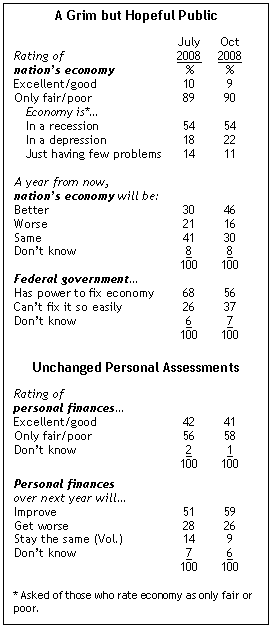
However, there is little indication that the nation’s financial crisis has triggered public panic or despair. Most Americans express confidence that the government still possesses the power to fix the economy, though that belief has lost adherents since July. There has been no decline in people’s perceptions of their own financial situations. Looking ahead to next year, Americans are more confident than they were in July about an improvement in the national economy and in their own personal finances.

This is not to say that the public has been spared the effects of the financial crisis: over the past three weeks, there have been sharp increases in the percentages saying they plan to rein in spending in a number of areas. Moreover, for the first time in a Pew survey, more Americans say that “people should learn to live with less,” rather than that “there are no limits to growth in this country.”

The latest national survey by the Pew Research Center for the People & the Press, conducted Oct. 9-12 among 1,485 adults reached on landlines and cell phones, finds that an increasing number say that jobs are difficult to find locally, and views of local real estate values remain negative. In addition, fewer people than in February say that their employer is in excellent financial shape. But these perceptions notwithstanding, there are no signs that the crisis has eroded people’s fundamental confidence in either their own personal financial outlook or the nation’s. As in July, a solid majority of Americans (54%) says the economy is in a recession, and the percentage saying the nation is in depression has not grown significantly (22%). Compared with this summer, more Americans think that economic conditions will improve next year (46% vs. 30%).

Continued optimism about the economy may well reflect the fact that while polls have shown that the president and Congress receive low grades for dealing with the financial crisis, most Americans continue to say that the federal government still has the power to fix the economy. A 56% majority of the public expresses this view, though that is considerably less than the percentage saying this in July (68%).

Perhaps more important, the public’s personal financial ratings are no lower than they were in mid-summer; 41% rate their finances as excellent or good, which is virtually unchanged since July (42%). Notably, 59% say they expect their financial situation to improve over the next year, up from 51% in July. Declining energy prices may be playing some part in the public’s resilience in the face of the financial crisis. The proportion citing fuel or gas prices as the top economic problem facing the country has fallen steeply, from 38% in July to 10% currently.
Overall, fewer people now say that their incomes are falling behind the cost of living (57% vs. 64% in July). However, while inflation concerns have eased somewhat, nearly four-in-ten (38%) say that rising prices is the economic issue that worries them most; by comparison, 31% cite problems in the financial markets. Among those who describe themselves as working class or struggling financially, far more say their biggest economic worry is rising prices rather than problems in the financial markets. By contrast, those who describe themselves as professional or business class are far more likely to cite problems in financial markets than rising prices.

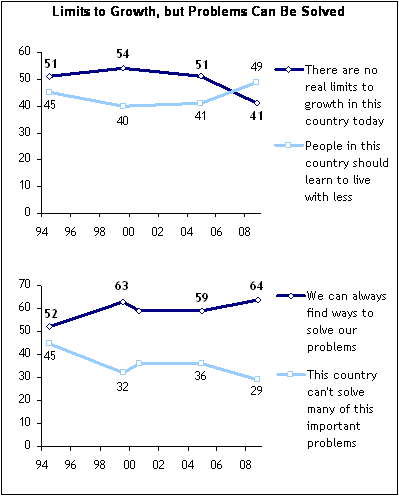
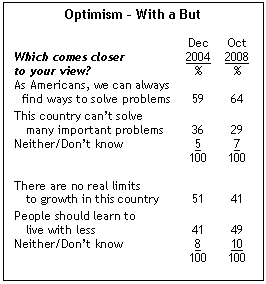
The new poll finds no evidence that fundamental American optimism has eroded in the face of the financial crisis. Even after a week of some of the largest stock market declines since the Great Depression, 64% of the public say that “As Americans, we can always find ways to solve our problems and get what we want.” That is up from 59% since December 2004, shortly after the last presidential election.

Yet the survey does show a shift in basic public values regarding the limits of growth. A 49% plurality now says that “people in this country should learn to live with less” – the highest percentage expressing this sentiment since the question was first asked in 1994.
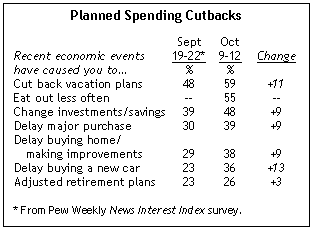
In this regard, Americans clearly signal they intend to scale back their own spending. Nearly six-in-ten (59%) say they have delayed or cancelled vacation spending while 55% say they have been eating out at restaurants less often. Roughly half (48%) say they are changing the way their money is saved or invested, while substantial minorities are either delaying or shelving plans to make major household purchases (39%) or to buy a new car (36%). The percentages saying they are reining in spending have risen sharply in the past three weeks.

Views on Regulation of Business Unchanged

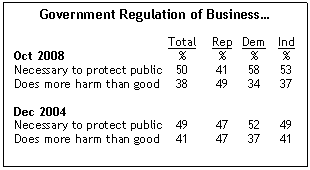
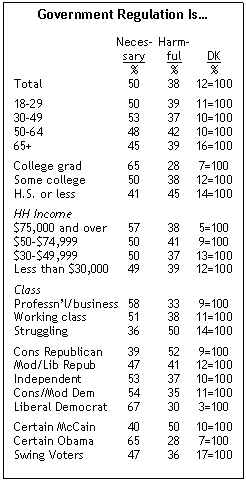
As Americans’ fundamental optimism remains unabated by the financial crisis, basic views about the role of government have shown only modest changes. The public continues to be divided about the efficacy of government regulation of business. Currently, 50% believe such regulation is necessary to protect the public interest, while 38% think government regulation of business does more harm than good. The balance of opinion is largely unchanged since December 2004 (49% vs. 41%).

Overall views of government are more negative they have been since the late 1990s. Nearly six-in-ten (57%) say that “government is almost always inefficient and wasteful” – up 10 points since December 2004. And somewhat fewer Americans say “the government should do more to help needy Americans even if it means going deeper into debt” than did so in 2004 (51% now, 57% then).

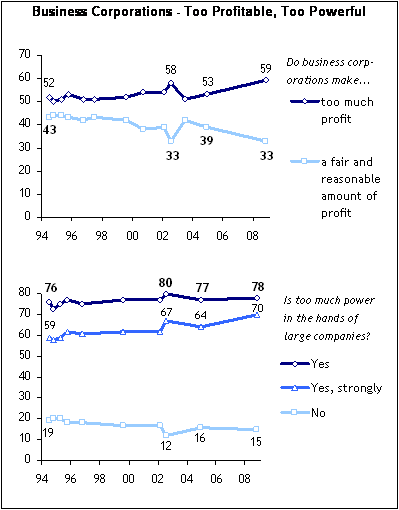
Views of business also have become more negative. Roughly eight-in-ten (78%) believe that “too much power is concentrated in the hands of a few large companies,” which is largely unchanged from past years; but a greater percentage strongly express this sentiment (70%) than at any point since the question was first asked in 1994. In addition, there has been a modest increase in the percentage saying “business corporations make too much profit” – from 53% in December 2004 to 59% currently.

Debtors and Banks Blamed for Crisis

There is a broad public consensus regarding the causes of the current problems with financial institutions and markets: 79% say people taking on too much debt has contributed a lot to the crisis, while 72% say the same about banks making risky loans. Far fewer say weak governmental regulation of financial institutions (46%) or other factors have contributed a lot to the recent problems.

There are substantial partisan differences in opinions about the causes of the crisis. Far more Democrats than Republicans say weak government regulation is a major contributing factor (56% vs. 38%); 45% of independents express this sentiment. By contrast, fully 91% of Republicans place a lot of blame on people taking on too much debt, compared with 80% of independents and 74% of Democrats.

Crisis Favors Obama
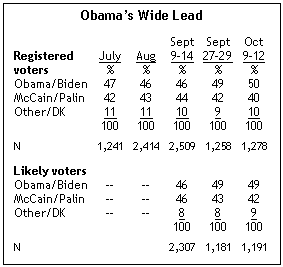
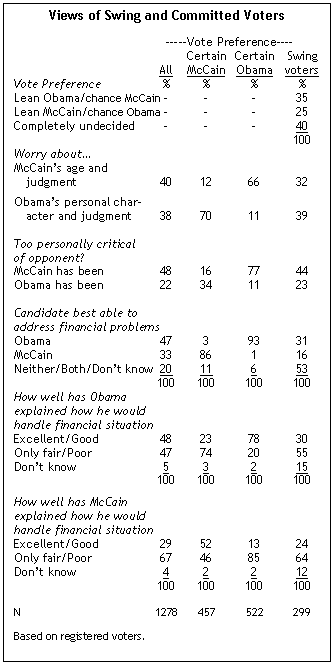
With few Americans expressing a positive view of national conditions and President Bush’s approval rating reaching a new low (25%) in a Pew survey, the political environment favors the Democrats. Barack Obama holds a sizable 50% to 40% lead over John McCain, and a greater share of his supporters back him strongly. Moreover, the percentage of voters saying they have definitely decided not to vote for McCain has risen steadily, from 37% in early August to 45% in the current survey.

Voters continue to express more confidence in Obama than in McCain to handle the financial crisis; 47% say Obama could best address the current problems while 33% choose McCain. Voters are especially critical of McCain’s performance in explaining how he would handle the crisis. Just 29% say he has done an excellent or good job in explaining

his approach to the crisis while 67% say he has done only a fair or poor job.

Obama’s ratings for explaining how he would handle the crisis are much better than McCain’s. Still, fewer than half (48%) say Obama has done an excellent or good job in this regard, while about as many (47%) say he has done only fair or poor.

Section 1: The National Economy and Personal Finances

The economy dominates the list of the most important problems facing the country; three-quarters of the public now cites an economic concern as the most important national problem. This is the highest percentage mentioning an economic problem as the biggest issue confronting the nation since January 1992 (76%).

While the overall economy is a greater concern than it was in July, the economic issues mentioned are far different. Currently, 26% point to an aspect of the financial crisis – including the banking situation, drops in the stock market and retirement accounts, and home foreclosures – as the most important problem facing the nation; the crisis only emerged in recent weeks and was not cited in polls earlier this year. Far fewer people cite energy or gas prices than in July. Just 5% now say energy or gas prices are the biggest national problem, down from 19% in July.

Since the beginning of the year, there has been a sharp decline in the percentage citing the war in Iraq as the most important national problem; 11% volunteer the war, compared with 17% in July and 27% in January. And health care, which was mentioned by 10% of respondents in January, dropped to 3% in July and 4% in the current poll.

Personal and National Economic Ratings

Americans continue to offer starkly negative views of national economic conditions. Nine-in-ten say the economy is in only fair (32%) or poor (58%) shape, largely unchanged from earlier in the year and near historic lows for the question’s 16-year trend.

People give far more positive ratings to their own financial situation than to national economic conditions. Just more than four-in-ten (41%) rate their personal financial situation as excellent or good, compared with just 9% who say that about the nation’s economy. Currently, about as many people rate their personal finances positively as did so in July (42% excellent/good).

Historically, personal financial ratings have been more stable than ratings of the national economy. During the economic boom years of the late 1990s, the share rating the nation’s economy positively soared, but personal financial ratings remained largely unaffected. Today, with national economic ratings near historic lows, personal financial ratings have been more resilient.

It is worth noting, however, that the erosion in personal financial ratings over the course of the year has been notable. In January, an equal number of Americans rated their personal finances positively as negatively (49% excellent/good, 49% only fair/poor). The percentage rating their finances positively fell to 42% in July and remains low currently (41%).

Personal financial ratings vary widely across demographic and political subgroups. Most of those in households earning $50,000 or more offer a positive assessment of their financial situations, while most in lower income households offer a negative one. Race also is a factor, with African Americans substantially less satisfied than whites with their finances.

By comparison, there is far less variation in ratings of the national economy. Overall, 58% say it is in poor shape, and while this is somewhat higher among lower- income and African American respondents, the gaps are far smaller than on personal financial ratings.

However, there are substantial political differences in ratings of both personal finances and the nation’s economy. Large majorities of both Democrats (64%) and independents (61%) rate their personal finances as only fair or poor; comparable percentages rate the national economy as “poor” (68% of Democrats and 62% of independents). By contrast, most Republicans offer a positive personal financial assessment, and while few say the nation’s economy is in “good” shape, only 44% offer a rating of “poor.”

A majority of Americans say that the country is currently in a recession (54%); an additional 22% says the country is in a depression. Among those with annual family incomes of less than $30,000, about three-in-ten (31%) think the country is in a depression and another 42% describe current conditions as a recession. The view that the country is in a recession, and not a depression, prevails among higher income groups. Roughly six-in-ten (62%) respondents with household incomes of $75,000 or more say the country is in a recession, while just 15% see it as a depression.

Majorities of Republicans (54%), Democrats (56%) and independents (56%) agree that the country is in a recession, but Democrats are more than twice as likely as Republicans to say the country is in a depression (28% vs. 12%); 23% of independents say the country is in a depression.

Americans Remain Optimistic

While, on balance, most Americans offer a negative assessment of their personal financial situation today, most remain optimistic about their future finances. About six-in-ten (59%) expect their financial situation to improve over the next year, while just 26% expect it to get worse (15% volunteer that it will not change or are uncertain.) The percentage expressing personal financial optimism has rebounded from a low point over the summer; in July, 51% said they expected their financial situation to improve over the next year – the lowest proportion in 16 years of surveys.

Personal financial optimism has recovered among several demographic groups. More than four-in-ten (43%) of those ages 65 or older expect their personal finances to improve over the next year, compared with 29% in July. Optimism also has increased among those 30 to 49

(65% now vs. 55% in July). Young people, who offer somewhat more negative ratings of their current finances than do older Americans, continue to be optimistic that their situation will improve over the next year; nearly three-quarters of those younger than 30 expect that to be the case (74%).

Comparable percentages of Republicans (at 65%) and Democrats (at 62%) say they expect their financial situation to improve over the next year; fewer expressed optimism in July (56% of Republicans, 50% of Democrats). A more modest majority of independents (55%) express optimism about their future finances, virtually unchanged from July (52%).

The public’s outlook for the national economy over the coming year also is broadly optimistic. Currently, 46% say they expect that economic conditions in the country a year from now will be better than they are at present – just 16% think they will be worse. In July, 30% predicted the economy would get better and 21% worse.

Americans Cut Back on Luxuries and Necessities

Americans are increasingly optimistic that the economy, and their own finances, will improve over the course of the next year. But in the short-term, many are delaying or cancelling spending on big-ticket, and smaller-ticket, items.

Most (59%) say that as a result of what has been happening with the economy lately, they have cut back on vacation spending. Three weeks ago, 48% reported doing so. Cutting back on dining out also is a common reaction to the current economic situation, with 55% eating out less often.

The public’s belt tightening extends to other major purchases as well. Nearly four-in-ten say they have delayed or canceled plans to buy a new home or make major home improvements because of the recent economic downturn (38%) and a nearly identical percentage say they have delayed or canceled plans to buy a major home appliance such as a computer (39%). Some 36% now say they have delayed or cancelled plans to buy a new car, up 13 points over the past few weeks alone.

In addition to reduced spending, about half of the public (48%) has changed the way their money is saved or invested because of what’s been happening with the economy lately. However, most do not see the current economic crunch as affecting their retirement as of yet: Just more than a quarter (26%) say they have adjusted their plans for retirement, up only three points from Sept. 19-22.

Confidence in Banks

In the midst of the current financial crisis, just 36% of Americans say they are very confident that money they have in banks is safe; an additional 38% say they are somewhat confident that their bank savings are safe. About one-in-five (21%) say they are not too or not at all confident that their bank deposits are safe.

Nearly half of college graduates (48%) say they are very confident in the security of their bank deposits compared with just 26% of those with a high school education or less. Those with relatively high annual incomes also express greater confidence in the safety of their deposits.

Republicans (47%) are much more likely than either independents (35%) or Democrats (29%) to express a great deal of confidence in the security of their bank savings. About as many Democrats say they are very confident in the safety of their deposits as say they are not too or not at all confident in the safety of those deposits (29% vs. 25%).

Jobs Getting Scarce

The proportion of Americans who say jobs are difficult to find where they live has risen sharply from about a year ago, and is at its highest level since October 2003. In November 2007, fewer than half of Americans (48%) said it was tough to find work where the lived; that has grown to 64% in the current survey.

The sense that jobs have become scarce is shared across income groups and education levels. Last year, about a third (34%) of those in households with family incomes of $100,000 or more said that jobs were difficult to find. Currently, a majority of those in this income category (54%) say that jobs are difficult to find. Substantial majorities of people at all education levels say jobs are difficult to find, but that reflects a more dramatic increase among college graduates (22 points) than among those with less education.

The perception that jobs are difficult to find has increased among people across the political spectrum. However, Democrats (70%) and independents (67%) are more likely than are Republicans (53%) to say that jobs are scarce.

Most working Americans say their employer is in excellent or good financial shape, but the proportion saying excellent has dropped eight points since early February (30% to 22%). Three-in-ten employed people say their company is in fair or poor shape, which has changed little since early February.

Inflation Concerns

Most Americans (57%) now say that their household income is falling behind the cost of living. That is down from a high of 64% in July, but notably higher than September 2007, when just 44% said they were falling behind financially.

The sense that prices are outpacing incomes has eased somewhat since July across all income groups. However, two-thirds of those with household incomes of less than $50,000 say they are not keeping up with the cost of living. More than half (57%) of those in households with incomes of $50,000 to less than $75,000 agree, as do 37% of those with incomes of $100,000 or more.

More than six-in-ten of those 30 and older now say their incomes are falling behind the cost of living, a view shared by 42% of those younger than 30. Concern about inflation has declined somewhat since July among Americans younger than 50, though they remain more worried than they were a year ago. Among Americans ages 50 and older, there has been no decline since July in concern about rising prices.

While inflation concerns remain high, nearly half of Americans (49%) say it is easy to afford the things they want in life; about the same percentage says it is difficult (48%). This opinion has changed little since February (52% easy to afford). In January 1992, fewer Americans (39%) said it was easy to afford the things they want in life.

Section 2: Causes and Consequences of the Financial Crisis

Americans place the blame for the current problems with financial institutions and markets squarely on people who took on too much debt and banks that made risky loans. Nearly eight-in-ten (79%) say that people taking on more debt than they can afford contributed “a lot” to the current situation, and 72% say the same about banks making risky loans. By comparison, fewer than half (46%) see weak government regulation as having a lot to do with it, and even fewer blame the complexity or the growing globalization of the financial system.

Republicans are most likely to point to banks offering risky loans and people taking on excessive debt as the leading contributors to the current financial problems. About nine-in-ten (91%) say people taking on too much debt contributed a lot, while 80% say the same about banks making risk loans.

Nearly three-quarters of Democrats (74%) also cite people taking on too much debt, while about seven-in-ten (69%) cite banks making risky loans as a major factor. But Democrats are more likely than Republicans to see weak government regulation playing a significant role in current financial problems. More than half of Democrats (56%) say weak regulation contributed a lot to these problems, compared with 45% of independents and 38% of Republicans.

People in all income levels cite people taking on too much debt and banks making risky loans as significant factors in the financial problems. Yet wealthier people take a different view of causes of the crisis than do people with low annual incomes. For instance, 86% of those with an annual family income of $75,000 or more cite risky loans made by banks as having a lot to do with the recent financial problems; that compares with 60% of those making less than $30,000 annually. More than half (52%) of those in the high income category say weak regulation contributed a lot to current problems, compared with 40% for those earning less than $30,000.

Those with lower incomes are more likely to point to the complexity of the financial system and growing global financial ties as major causes for the crisis. More than four-in-ten of those with annual family incomes below $30,000 say each of these factors has had a lot to do with current financial problems (46% financial system too complicated; 45% growing global ties); this compares with only about a quarter of those with annual incomes of at least $75,000 (27% and 26%, respectively).

Greed Is … More Prevalent

With so much attention focused on the risky practices of financial institutions as a factor in the economic crisis, many Americans see the leaders of those businesses as greedier today than they were in the past. Some six-in-ten say those executives are greedier, while 37% say they are about the same as they have always been. There are only slight partisan differences in these opinions, but those who say they are struggling in this economy are significantly more likely to see more greed today.

Solid majorities of Republicans and Democrats (62% each) say they see financial leaders as more greedy today than in the past; 60% of independents share this view. Significant differences, though, are evident among those who describe themselves as professional class, working class or struggling. Slightly more than half of those who define themselves as professionals (54%) say that leaders of financial institutions are greedier today. That increases to 61% of those who describe themselves as working class and nearly three-quarters (74%) of those who see themselves as struggling.

Rising Concern about Troubled Financial Markets

When asked to assess their own financial situations, Americans continue to put rising prices at the top the list. But worries about problems in the financial markets are not far behind, and have increased significantly since March. Close to four-in-ten (38%) cite higher prices as their top economic concern, down from nearly half (49%) in March. On the other hand, 31% now cite problems in the financial markets, more than twice the amount that cited the same concern in March (14%).

Roughly equal percentages of Republicans, Democrats and independents say that rising prices are their top concern about their own financial situations, but significantly more Republicans than Democrats point to problems in the financial markets as the economic issue that concerns them most (38% vs. 28%). Democrats, meanwhile, are more likely than Republicans to cite the job situation (22% vs. 10%).

African Americans are twice as likely as whites (31% vs. 14%) to cite the job situation as their top concern. Meanwhile, whites are twice as likely as African Americans to say they are most concerned about the financial markets (35% vs. 17%).

Of those who identify their households as professional, close to half (49%) point to the financial markets as their top financial worry. Some 24% cite rising prices. Among those who say they are working class, more than four-in-ten (43%) list rising prices as the top concern, while a quarter cite the financial markets. About half (49%) of those who identify their families as struggling say rising prices are the top concern, followed by 28% who list the job situation and just 14% who cite the financial markets.

Biggest Economic Problem

As might be expected, the financial crisis is now viewed as the dominant economic problem facing the nation. More than a quarter (27%) mention some aspect of the crisis – including problems with financial institutions (8%), corporations or corporate greed (6%), or the recent government bailout (6%). None of these issues registered significantly on the public’s list of top economic problems in February and July.

By contrast, far fewer volunteer prices as the most important national economic problem than did so earlier this year. Just 16% mention prices, with energy prices (at 10%) cited most frequently. In July, 45% pointed to prices as the top economic problem facing the country (with 38% specifically citing energy prices), which was far more than the percentage citing any other problem; prices were also the most frequently mentioned problem in February (at 24%).

Government’s Power to Fix the Economy

As the economy continues to struggle and problems with the financial markets prove more global, a smaller majority than in July says the federal government has the power to fix the economy. During the summer, nearly seven-in-ten (68%) said that the government still had that power. Currently, 56% express that view. Meanwhile, those saying the government cannot fix the economy so easily have increased from 26% in July to 37% in the current survey.

The declines come across the political spectrum, with 56% of conservative Republicans now saying the government has the power to fix the economy, compared with 65% in July. Among liberal Democrats, that percentage has dropped even more: from 73% in July to 58%. More also are saying that the government cannot fix the economy “so easily these days.” That is the view of 36% of liberal Democrats, up significantly from 19% in July. Among conservative Republicans, 38% say government cannot fix the problems easily, up slightly from 31% in July.

Meanwhile, voters who say they are certain they will vote for Obama are more optimistic than certain McCain voters or swing voters that the government has the power to fix the economy. Close to six-in-ten certain Obama voters (59%) say the government has that power, compared with 50% each for certain McCain and swing voters.

Section 3: Public Attitudes Toward Government and Business

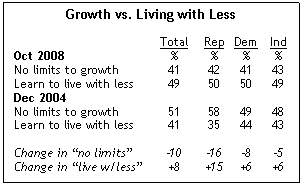
The findings of two long-term values questions exemplify the public’s nuanced, but fundamentally positive, outlook on the country’s ability to weather the financial crisis. When asked whether there are “no real limits to growth in this country” or whether “people should learn to live with less” the public has shifted decidedly toward the latter. The number saying that people need to live with less has risen from 41% in 2004 to 49% today – the highest percentage saying this since the question was first asked in 1994.

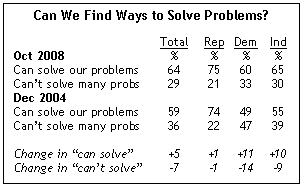
Yet while many see a need for belt-tightening, the number of citizens saying that “as Americans, we can always find ways to solve our problems” has risen from 59% in 2004 to 64% today, which nearly matches the previous high in August 1999 (63%).

There is substantially less partisan division over these questions than was the case in the period immediately following the 2004 election. For example, Republicans, Democrats and independents today are all equally likely to say that people in this country should learn to live with less. In December 2004, Republicans were less likely than the others to hold this view.

While Republicans are still the most optimistic that the country can always find ways to solve its problems, the number of Democrats and independents sharing this view has increased substantially since 2004 . Currently,

60% of Democrats say that Americans can always find a way to solve problems while 33% say the country cannot solve many of its important problems; in 2004, opinion among Democrats was evenly divided, with nearly identical percentages expressing both sentiments (49% can solve problems; 47% country can’t solve many of its problems). The belief that Americans are able to solve national problems also has increased among independents; 65% express that view in the current survey compared with 55% in December 2004.

Less Support for Help to Needy

Currently, 51% say that “the government should do more to help needy Americans, even if it means going deeper into debt;” 37% take the opposing view, saying that “the government today can’t afford to do much more to help the needy.” In 2004, more Americans (57%) expressed the view that the government should do more for the needy, while 33% said the government could not afford increased aid.

Democrats’ opinions about this issue have not changed much since 2004: 69% now say the government should do more for the needy even if it means greater indebtedness; 68% expressed that view in 2004. But fewer Republicans and independents believe that the government should provide more aid for the needy if it means increasing the debt. Only about a third of Republicans (32%) express this sentiment currently (down from 46% in 2004); there has been a comparable decline among independents (from 58% to 45%).

Regulation OK, But Doubts about Government Effectiveness

While 80% of Americans believe weak government regulation of financial institutions played at least some part in causing the current financial crisis, there is no shift in public support for regulation more generally. Overall, 50% of Americans say government regulation of business is necessary to protect the public interest, while 38% say government regulation usually does more harm than good. This is virtually unchanged from four years ago, and represents a slight drop in support for regulation from a peak of 54% in 2002.

Views of government’s effectiveness have become more negative since December 2004. Fully 57% of Americans today say the government is almost always wasteful and inefficient, up from 47% four years ago. Meanwhile, the share saying the government often does a better job that people give it credit for has dropped from 45% to 35%.

The issue of regulation has also become substantially more partisan over the past four years. In 2004, Democrats were only slightly more likely than Republicans (52% vs. 47%) to

say that government regulation is necessary to protect the public interest. But in the current environment, Democratic support for regulation has increased by six points while Republican support has dropped by the same amount, leading to a wider division across party lines (58% of Democrats vs. 41% of Republicans).

The impression that government regulation usually does more harm than good is most widespread among less educated and more economically stressed Americans. College graduates see regulation as necessary, not harmful, by more than two-to-one (65% vs. 28%). But those who have no more than a high school degree are divided, with 45% saying it does more harm than good and 41% saying it benefits the public interest. Similarly, among respondents who describe themselves as in a struggling household, half see regulation as doing more harm than good.

Not surprisingly, conservative Republicans are among the most critical of government regulation, yet even here barely half (52%) see regulation doing more harm than good, while 39% say it is necessary to protect the public interest. Liberal Democrats, by comparison, are far more one-sided in their view of regulation – fully 67% say it is necessary, while 30% say it does more harm than good.

Cynicism about Business Grows

The American public is increasingly skeptical about the power and profits of large companies and business corporations. A 59% majority say that business corporations make too much profit, up from 53% in December of 2004. The percentage saying that business corporations make a fair and reasonable amount of profit fell from 39% to 33%. And while overwhelming majorities throughout the nearly 15 years of values trend measurements have said they think too much power is concentrated in the hands of a few large companies, the number who feel strongly about this has grown to 70%, up from 64% in 2004.

The biggest partisan division is on the question of business profits. Republicans are roughly divided, with 49% saying business corporations make a fair and reasonable amount

of profit, while 45% say they make too much. But Democrats, by a 73% to 21% margin, believe that corporations are making too much profit. There is a similar division along educational and income lines – college graduates and those with household incomes over $75,000 annually are split over whether corporate profits are fair or not. But those with less education, and those with lower incomes see profits as excessive by margins of two-to-one or more.

Section 4: The Candidates and the Crisis

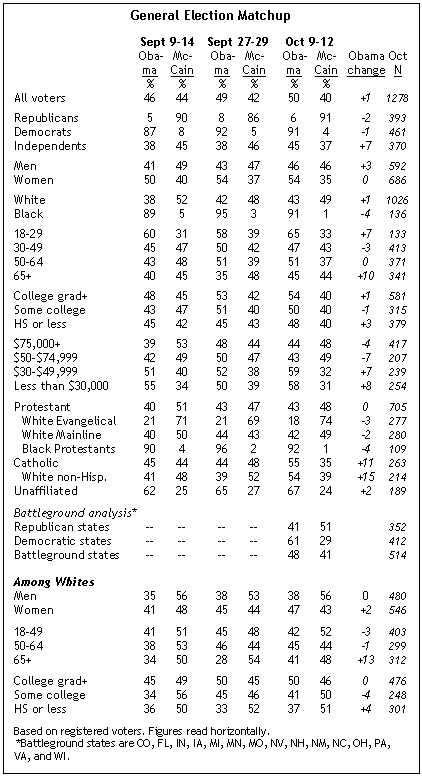
With two well-received debate performances behind him and the public focused on the economy, Barack Obama holds a solid 10-point lead (50% to 40%) over John McCain, one of his largest advantages in Pew polls this year. Among those most likely to vote on Nov. 4, Obama’s lead is seven points (49% to 42%). Just one month ago, following the party conventions, the race was tied among likely voters, 46% each.

Voters continue to express greater confidence in Obama to address the current problems with financial institutions and markets. But neither candidate receives particularly high marks for the specifics of what he has said about the economic crisis. A sizeable plurality (47%) says Obama is the candidate best able to deal with the problems in financial institutions and markets (33% say McCain would be best). Among independent voters, Obama holds a smaller 40%-30% advantage on this question.

But neither candidate is seen by a majority as having

laid out a clear plan for dealing with the situation. Voters are divided on whether Obama has done so: 48% say he has done an excellent or good job explaining what he would do, while 47% rate him as only fair or poor in doing so. But McCain fares worse. Just 29% say he has done an excellent or good job in explaining his ideas, while fully two-thirds (67%) say he has done only a fair or poor job in this respect.

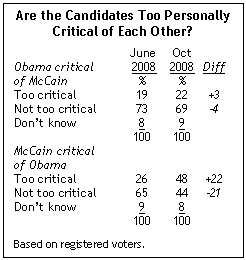
Obama also has an advantage in voter assessments of the tone of the campaign. Nearly half (48%) see McCain as too personally critical of Obama. By comparison, just 22% see Obama as too critical of McCain. Even among McCain’s own voters, nearly one in five (19%) think he has been too critical of Obama. Fewer Obama voters (13%) think their candidate has been too hard on McCain. Perceptions about the campaign McCain is running are starkly different from what they were in June, when just 26% said he had been too personally critical of Obama. In contrast, the percentage bel ieving that Obama has been too negative is nearly unchanged since June.

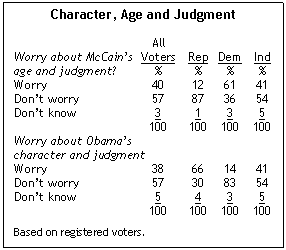
The poll addressed public reaction to two of the negative themes in the campaign – McCain’s character question (“Who is the real Barack Obama?”) and Obama’s charge that McCain has been “erratic,” which some observers have seen as a reference to McCain’s age. Comparable majorities of 57% say they do not worry about Obama’s personal character and judgment, or about McCain’s age and judgment. (Forty percent say they do worry about McCain’s age and judgment, and 38% worry about Obama’s character and judgment.)

Since Pew’s last poll, conducted in late September, Obama has taken the lead among white non-Hispanic Catholics. He continues to dominate John McCain among his core support groups, including a nearly two-to-one lead among young voters (65%-33%), a 19-point advantage among women (54%-35%), and a whopping 91%-1% advantage among African Americans. He has now pulled even among voters ages 65 and older, gaining 10 points among this group since last month.

There is also a somewhat greater correspondence between income and voter preferences than there was two weeks ago. Obama gained support among voters with annual incomes under $50,000 while dropping slightly among those making $50,000 or more.

McCain holds a very large lead among white evangelicals (74%-18%) but does not have a clear lead among any other religious group. Obama has struggled among white Catholics but now holds a significant lead of 54% to 39% among this key swing group.

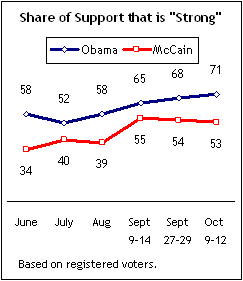
As Obama’s margin has increased so has his advantage in strong support. The percentage of voters overall who say they support him “strongly” now stands at 36%; thus he is receiving strong support from nearly three-fourths of his voters (71%). By contrast, McCain has trailed Obama in strong support throughout the campaign: just 21% of voters overall are supporting McCain strongly. About half of McCain’s own backers (53%) say they support him strongly, which is largely unchanged since the GOP convention.

One-in-Four Still Swinging

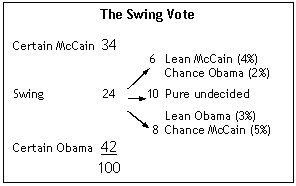
About one-in-four registered voters (24%) remain in the swing vote category, with 10% completely undecided and the remainder either leaning to a candidate or saying they might change their mind before the election. The size of the swing vote is somewhat larger than at a comparable point in the campaign four years ago and about the same size as in mid-October 2000, when – as now – there was no incumbent running.

Meanwhile, Obama has a sizeable advantage among those who express certainty about their choice: 42% of voters are classified as certain to vote for him, compared with 34% certain to vote for McCain.

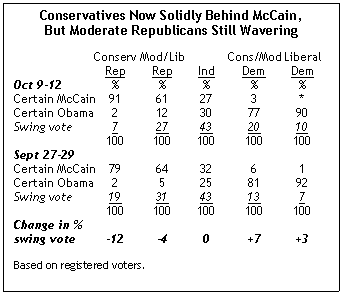
McCain has solidified his support among conservative Republicans, with 91% now saying they are certain to vote for him (up from just 79% last month). But he has made no progress in cementing the votes of more moderate Republicans; only 61% of moderate and liberal Republicans are classified as solidly behind McCain. By contrast, 81% of conservative and moderate Democrats are certain to vote for Obama, as are 92% of liberal Democrats.

Independents remain unsettled, with 43% still classified as swing voters, the same as last month. About one-third (32%) say they are certain to vote for McCain, and one-quarter (25%) are certain to vote for Obama.

Whither the Swing Vote?

There are few clear clues as to how swing voters might break as they reach decisions about how – and whether – to vote. Among swing voters, more are leaning or weakly committed to Obama (35%) than to McCain (25%), but 40% are completely undecided.

Swing voters are unimpressed by the economic plans put forth by both candidates. A 53% majority declines to choose between the candidates when asked which one could best address the current financial problems. Among those willing to express a preference, more pick Obama (31% overall) than McCain (16%). Majorities of swing voters give both candidates low ratings on how well they have explained their plans.

Swing voters do see a difference in how the candidates are campaigning. As with voters overall, far more swing voters see McCain as too personally critical of Obama (44%) than say the same about the Democrat’s criticism of his opponent (23%).

About the Survey

Results for this survey are based on telephone interviews conducted under the direction of Princeton Survey Research Associates among a nationwide sample of 1,485 adults, 18 years of age or older, from October 9-12, 2008 (1,110 respondents were interviewed on a landline telephone, and 375 were interviewed on a cell phone, including 114 who had no landline telephone). Both the landline and cell phone samples were provided by Survey Sampling International.

The combined landline and cell phone sample are weighted using an iterative technique that matches gender, age, education, race/ethnicity, region, and population density to parameters from the March 2007 Census Bureau’s Current Population Survey. The sample is also weighted to match current patterns of telephone status and relative usage of landline and cell phones (for those with both), based on extrapolations from the 2007 National Health Interview Survey. The weighting procedure also accounts for the fact that respondents with both landline and cell phones have a greater probability of being included in the sample.

The following table shows the error attributable to sampling that would be expected at the 95% level of confidence for different groups in the survey:

Group Sample Size Plus or minus…
Total sample 1,485 3.0 percentage points
Republicans 428 5.5 percentage points
Democrats 519 5.0 percentage points
Independents 451 5.5 percentage points
Registered voters 1,278 3.5 percentage points
Republican voters 393 5.5 percentage points
Democratic voters 461 5.5 percentage points
Independent voters 370 6.0 percentage points

In addition to sampling error, one should bear in mind that question wording and practical difficulties in conducting surveys can introduce error or bias into the findings of opinion polls.